
Judge, 1916-01-22 · page 18 of 28
Judge — January 22, 1916 — page 18: what you’re looking at
What you’re looking at
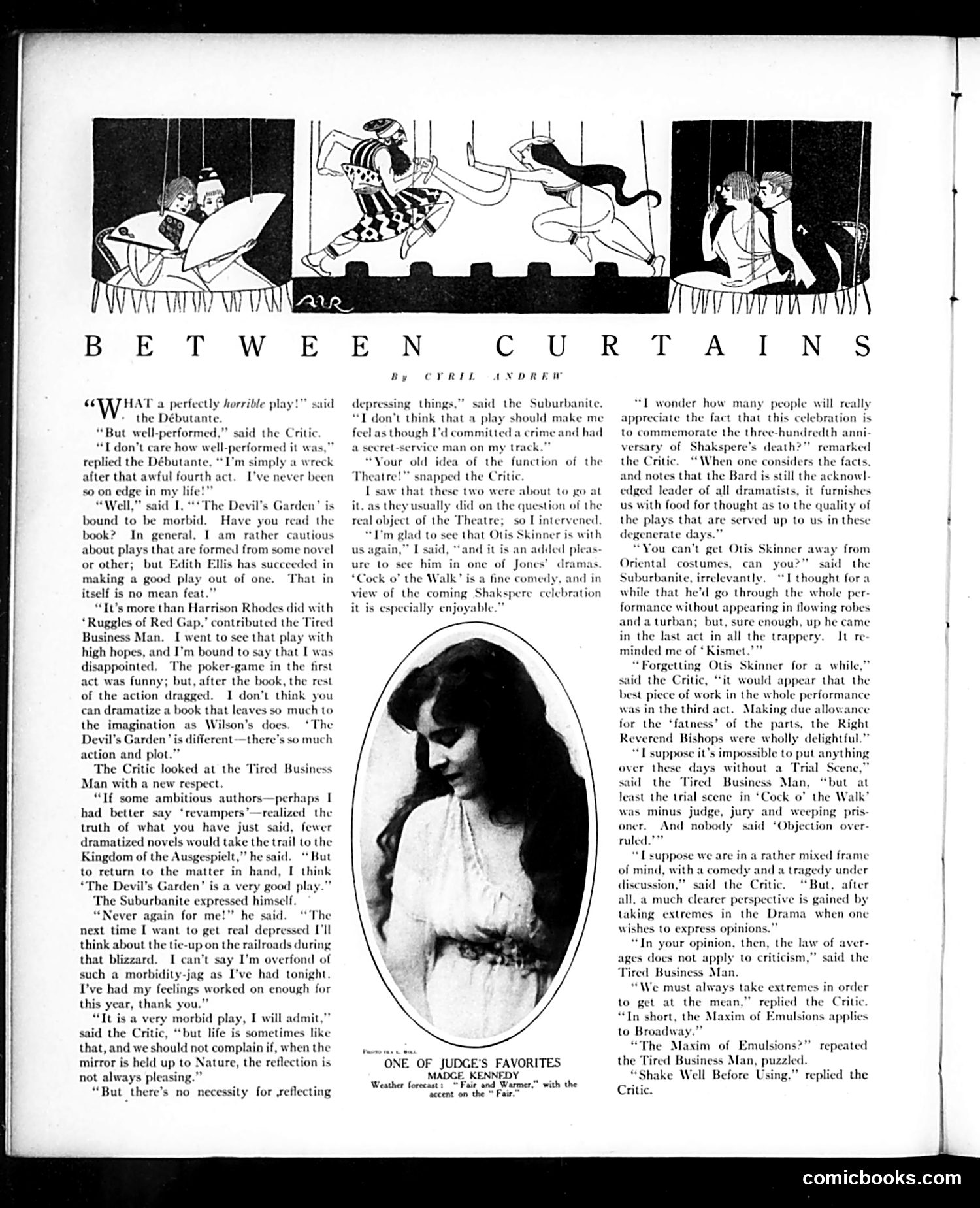
This page presents a theater criticism dialogue featuring stock Judge characters debating recent Broadway productions. The "Débutante," "Tired Business Man," "Suburbanite," and "Critic" discuss plays including "The Devil's Garden" (adapted from a novel) and "Cock o' the Walk" starring actor Otis Skinner. The satire targets differing theatergoer attitudes: the Débutante dislikes emotionally taxing dramas; the Tired Business Man criticizes adaptations that lose literary nuance; the Suburbanite objects to morally dark content; while the Critic defends theater's role in reflecting life's complexities, even unpleasant ones. The photograph shows Madge Kennedy, identified as "one of Judge's favorites," likely a popular actress of the period. The cartoon's joke centers on the tension between entertainment expectations and artistic responsibility—a recurring Judge theme mocking middlebrow taste.
📄 Transcribed text from this page (OCR, searchable)
Machine-transcribed from the original scan — historical spelling and the odd misread are preserved.
BET WE SOUSJHAT a perfectly horrible play!” said the Débutante. “But well-performed,” said the Critic. “T don’t care how well-performed it was,” replied the Débutante, “I'm simply a wreck after that awful fourth act. I’ve never L so on edge in my life!” “Well,” said 1, ** The Devil's Garden’ is bound to be morbid. Have you read the book? In general, 1 am rather cautious about plays that are formed from some novel or other; but Edith Ellis has succeeded in making a good play out of one. That in itself is no mean feat.” “Tt’s more than Harrison Rhodes did with “Ruggles of Red Gap,’ contributed the Tired Business Man. I went to see that play with high hopes, and I’m bound to say that I was disappointed. The poker-game in the first act was funny; but, after the book, the rest of the action dragged. I don’t think you can dramatize a book that leaves so much to the imagination as Wilson’s does. ‘The Devil's Garden’ is different—there’s so much action and plot.” The Critic looked at the Tired Business Man with a new respect. If some ambitious authors—perhaps I had better say ‘revampers’—realized the truth of wha pu have just said, fewer dramatized novels would take the trail to the Kingdom of the Ausgespielt,”’ he said.“ But to return to the matter in hand, [ think rden’ is a very good play.” anite expressed himself. “Never again for me!” he said next time I want to get real depress think about the tie-up on the r, ads during that blizzard. I can’t say I’m overfond of such a morbidity-jag as I’ve had tonight I’ve had my feelings worked on enough for this year, thank you.” “It is a very morbid play, I will admit,” said the Critic, “but life is sometimes like that, and we should not complain if, when the mirror is held up to Nature, the reflection is not always pleasing. “But there’s no necessity for reflecting E N By CYRIL tYDREW depressing things,” said the Suburbanite. “T don’t think that a play should make me feel as though I'd committed a crime and had a secret-service man on my track.” “Your old idea of the function of the Theatre!” snapped the Critic. I saw that these two were about to go at it, as they usually did on the question of the real object of the Theatre; so [intervened “I'm glad to see that Otis Skinner is with us again,” L said, “and it is an added pleas- ure to see him in one of Jones’ dramas “Cock o” the Walk’ is a fine comedy, and in view of the coming Shakspere celebration it is especially enjoyable.” ONE OF JUDGE'S FAVORITES MADGE. KENNEDY ‘Weather forecast: “Fair and Warmer,” with the accent on the * Fair.” C U RTA N S$ “L wonder how many people will really appreciate the fact that this celebration is to commemorate the three-hundredth anni versary of Shakspere’s death?” remarked the Critic. “When one considers the facts, and notes that the Bard is still the acknowl edged leader of all dramatists, it furnishes us with food for thought as to the quality of the plays that are served up to us in these degenerate days. You can’t get Otis Skinner a Oriental costumes, can you?” said the Suburbanite, irrelevantly. “IT thought for a while that he'd through the whole per- formance without appearing in flowing robes and a turban; but, sure enough, up he came in the last act in all the trappery. It re minded me of ‘ Kismet.’” “Forgetting Otis Skinner for a while,” said the Critic, “it would appear that the best piece of work in the whole performance was in the third act. Making due allowance for the ‘fatness’ of the parts, the Right Reverend Bishops were wholly delightful.” “TL suppose it's impossible to put anything over these days without a Trial Scene, stid the Tired Business Man, “but at least the trial scene in ‘Cock 0° the Walk’ was minus judge, jury and weeping pris- oner. And nobody said ‘Objection over- ruled.’ “TL suppose we are in a rather mixed frame of mind, with a comedy and a tragedy under discussion,” said the Critic. ‘But, after all, a much clearer perspective is gained by taking extremes the Drama when one wishes to express opinions. “In your opinion, then, the law of aver- ages does not apply to criticism,” said the Tired Business Man. “We must always take extremes in order to get at the mean,” replied the Critic. “In short, the Maxim of Emulsions applies to Broadway. The Maxim of Emulsions?” repeated ired Business Man, puzzled, hake Well Before Using.” replied the from comicbooks.com