
Judge, 1916-01-22 · page 14 of 28
Judge — January 22, 1916 — page 14: what you’re looking at
What you’re looking at
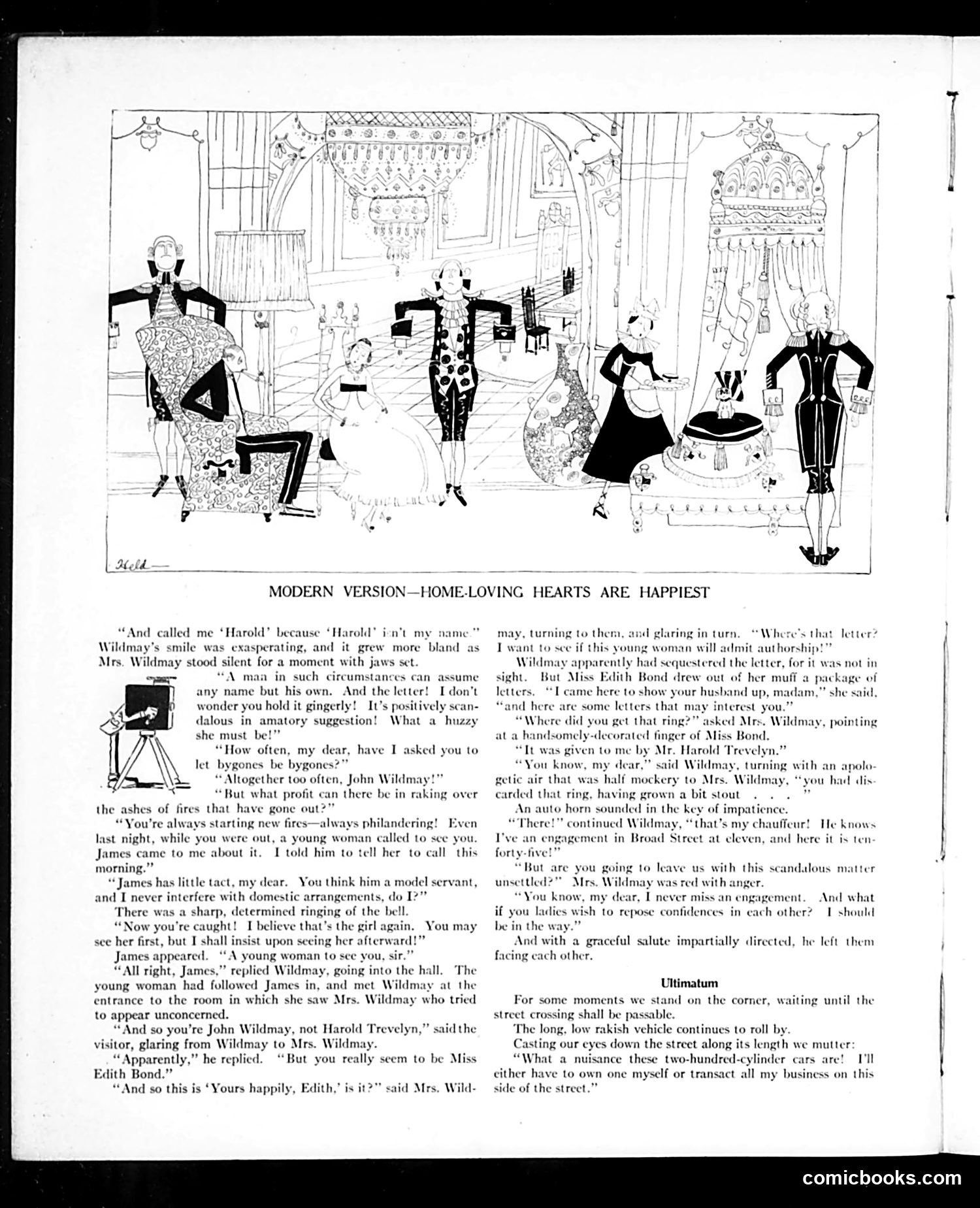
This satirical cartoon critiques modern marriage dynamics and infidelity among the wealthy. The narrative depicts John Wildmay, a philandering husband who receives romantic letters from a young woman named Edith Bond. His suspicious wife confronts him when Miss Bond unexpectedly visits. The satire targets several contemporary (1910s-era) concerns: male infidelity presented as casual and consequence-free, the absurdity of marital conflicts resolved by a husband simply leaving via automobile, and the superficiality of wealthy urban society. Wildmay's repeated evasions—excusing himself with his chauffeur and "urgent business"—mock men who use work obligations to escape domestic accountability. The title's irony is pointed: despite its claim that "home-loving hearts are happiest," the actual story shows a husband abandoning his distressed wife mid-confrontation, suggesting modern life actively prevents domestic happiness. The final section about frustrating automobiles reinforces themes of modern inconvenience disrupting daily life.
📄 Transcribed text from this page (OCR, searchable)
Machine-transcribed from the original scan — historical spelling and the odd misread are preserved.
MODERN VERSION—HOME-LOVING HEARTS ARE HAPPIEST “And called me ‘Harold’ because ‘Harold’ ion't my name” Wildmay’s smile was exasperating, and it grew more bland as Mrs. Wildmay stood silent for a moment with jaws set. “A man in such circumstances can assume any name but his own. And the letter! [don’t wonder you hold it gingerly! It’s positively scan- dalous in amatory suggestion! What a huzzy she must be!” have I asked you to “How often, my des let bygones be bygones? r= “ Altogether too often, John Wildmay! “But what profit can there be in raking over the ashes of fires that have gone out?” “You're always starting new fires—always philandering! Even last night, while you were out, a young woman called to sce you. James came to me about it. I told him to tell her to call this morning.” “James has little tact, my dear. You think him a model servant, and I never interfere with domestic arrangements, do 1?” There was a sharp, determined ringing of the bell. “Now you're caught! I believe that’s the girl again. You may see her first, but I shall insist upon seeing her afterward!” James appeared. “A young woman to see you, sir.’ “All right, James,” replied Wildmay, going into the hall. The young woman had followed James in, and met Wildmay at the entrance to the room in which she saw Mrs. Wildmay who tried to appear unconcerned. “And so you're John Wildm visitor, glaring from Wildmay te “Apparently,” he replied. Edith Bond.” “And so this is ‘Yours happily, Edith,’ is it?” said Mrs, Wild- said the , not Harold Trevelyn, Mrs. Wildmay. But you really seem to be Miss may, turning to then d glaring in turn. “Where's that letter? IT want to see if this young woman will admit authorship!” Wildmay apparently had sequestered the letter, for it was not in sight. But Miss Edith Bond drew out of her muff a letters, “TL came here to show your husl nd here are some letters that may interest you. “Where did you get that ring?” asked Mrs, Wildmay, pointing ata handsomely-decorated finger of Miss Bond. “It was given to me by Mr. Harold Trevelyn. “You know, my dear,” said Wildmay, turning with an apolo getic air that was half mockery to Mrs. Wildmay, “you had dis carded that ring, having grown a bit stout " An auto horn sounded in the key of impatience. “There!” continued Wildmay, “that’s my chauffeur! He knows I've an engagement in Broad Street at eleven, and here it is ten forty-five!” “But are you going to leave us with this scandalous matter unsettled?" Mrs. Wildmay was red with anger. “You know, my dear, [ neve! if you ladies wish to repose confidences in be in the way.” And with a graceful salute impartially directed, he left them facing cach other. kage of nd up, madam,” she said, And what I should miss an en, ement ch other? Ultimatum For some moments we stand on the corner, waiting until the street crossing shall be passable. rhe long, low rakish vehicle continues to roll by. Casting our eyes down the street along its length we mutter “What a nuisance these two-hundred-cylinder cars are! I'll cither have to own one myself or transact all my business on this side of the street.” comicbooks.com