
Judge, 1916-01-22 · page 17 of 28
Judge — January 22, 1916 — page 17: what you’re looking at
What you’re looking at
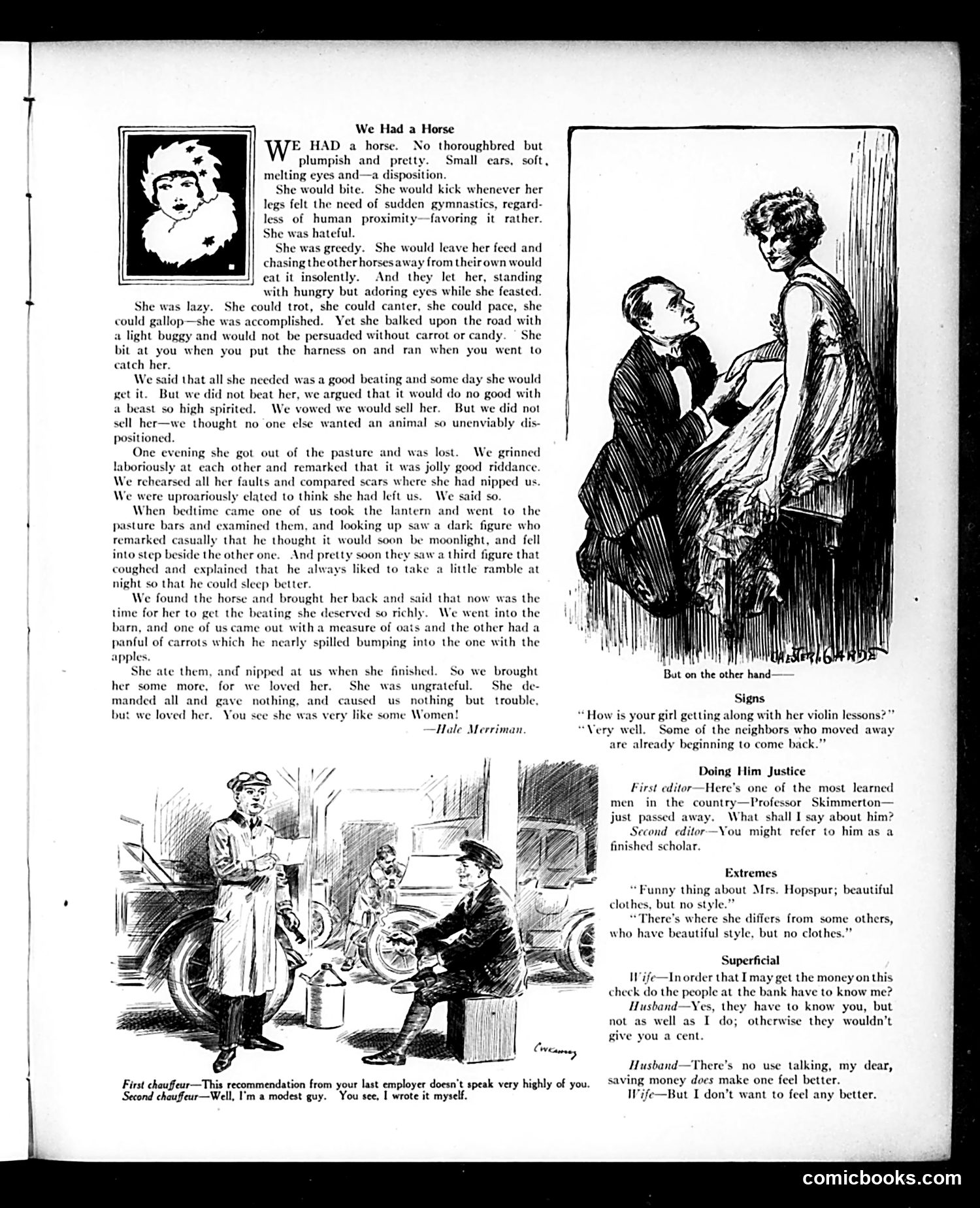
**Main Story ("We Had a Horse"):** A humorous narrative by Hale Merriman comparing an unpleasant horse to a difficult woman. The horse is vicious, greedy, and demanding—yet the owners cannot bring themselves to discipline or sell her. Instead, they secretly search for her when lost, then reward her with food and affection upon her return. The moral: women, like this horse, are illogical, demanding creatures whom men tolerate despite their faults. This reflects early 20th-century attitudes treating women as inherently unreasonable and analogous to animals. **Short Comic Sketches:** Several brief satirical dialogues mock: - **Class pretense**: A chauffeur forging his own recommendation letter - **Marriage dynamics**: A husband noting his wife won't acknowledge his financial sacrifices (she refuses to "feel better" about saving money) - **Fashion hypocrisy**: Contrasting women who have expensive clothes but poor style with those possessing style but lacking clothes The overall tone is misogynistic humor typical of the era, depicting women as vain, illogical, and burdensome to men.
📄 Transcribed text from this page (OCR, searchable)
Machine-transcribed from the original scan — historical spelling and the odd misread are preserved.
We Had a Horse E HAD a horse. No thoroughbred but plumpish and_prett Small cars, soft, melting eyes and: disposition. She would bite. She would kick whenever her legs felt the need of sudden gymnastics, regard- less of human proximity—favoring it rather. She was hateful. She was greedy. She would leave her feed and chasing the other horses away from their own would eat it insolently. And they let her, standing with hungry but adoring eyes while she feasted. She could trot, she could canter, she could pace, she could gallop—she was accomplished. Yet she balked upon the road with a light buggy and would not be persuaded without carrot or candy. ° She bit at you when you put the harness on and ran when you went to catch her. We said that all she needed was a good beating and some day she would get it. But we did not beat her, we argued that it would do no good with a beast so high spirited. We vowed we would sell her. But we did not sell her—we thought no one else wanted an animal so unenviably dis- positioned. One evening she got out of the pasture and was lost. We grinned laboriously at each other and remarked that it was jolly good riddance. all her faults and compared scars where she had nipped us. We were uproariously elated to think she had left us. We said so. When bedtime came one of us took the lantern and went to the pasture bars and examined them, and looking up saw a dark figure who arked casually that he thought it would soon be moonlight, and fell into step beside the other one. And pretty soon they saw a third figure that coughed and explained that he always liked to take a little ramble at night so that he could sleep better. We found the horse and brought her back and said that now was the time for her to get the beating she deserved so richly. We went into the barn, and one of us came out with a measure of oats and the other had a panful of carrots which he nearly spilled bumping into the one with the apples. She ate them She was la. and nipped at us when she finished. So we brought her some more, for we loved her. She was ungrateful. She de- manded all and gave nothing, and caused us nothing but trouble, but we loved her. You see she was very like some Women! —Hale Merriman First chauffeur—This recommendation from your last employer doesn’t speak very highly of you. chauffeur—Well, I'm a modest guy. You see, I wrote it myself. “ How is your girl getting along with her violin lessons?” “Very well, But on the other hand— Signs Some of the neighbors who moved away are already beginning to come back.” Doing Him Justice First editor—Here’s one of the most learned men in the country—Professor Skimmerton— just passed away. What shall I say about him? Second editor—You might refer to him as a finished scholar. Extremes “Funny thing about Mrs. Hopspur; beautiful clothes, but no style.” There’s where she differs from some others, who have beautiful style, but no clothes.” Superficial IW ife—In order that I may get the money on this check do the people at the bank have to know me? Husband—Yes, they have to know you, but not as well as I do; otherwise they wouldn’t € you a cent. Husband—tThere’s no use talking, my dear, saving money does make one feel better. Wife—But I don’t want to feel any better. comicbooks.com