
Judge, 1916-01-22 · page 12 of 28
Judge — January 22, 1916 — page 12: what you’re looking at
What you’re looking at
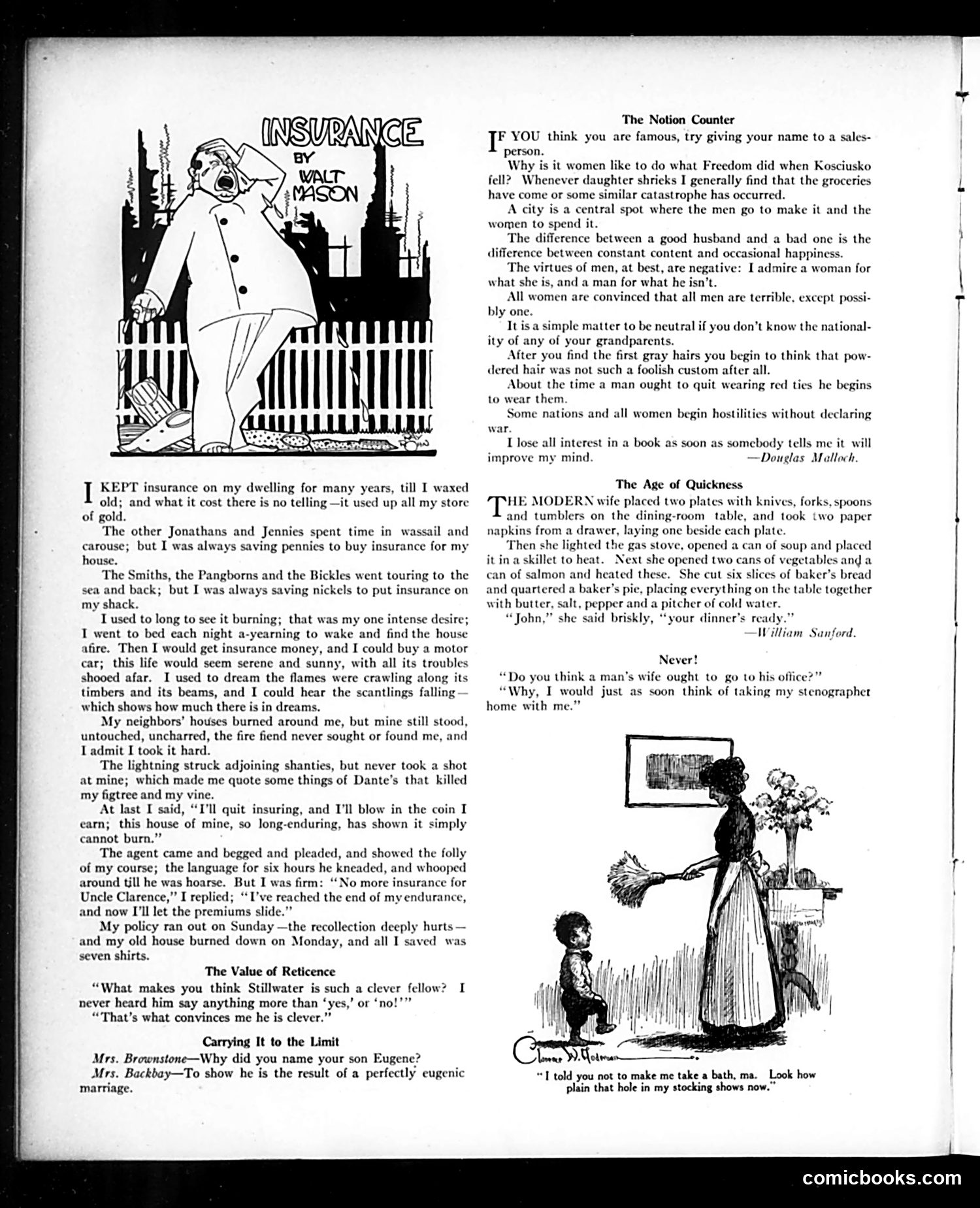
**Main Cartoon (Top Left):** "Insurance" by Walt Mason depicts a man in an overcoat standing amid city buildings. The accompanying story is a cautionary tale about false economy: a homeowner skimps on insurance premiums for years, dreaming his house will burn so he can collect money for a motor car. When he finally cancels his policy on Sunday, his house burns down Monday—leaving him with only seven shirts. **The Satire:** This critiques both human irrationality (wishing for disaster) and the insurance industry's predatory practices. It mocks the everyman's magical thinking while implicitly endorsing insurance as necessary protection, however costly. **Side Content:** The page includes humor columns like "The Notion Counter" (witty observations about gender and society), "The Age of Quickness" (satirizing modern wives' shortcuts), and brief jokes about cleverness and eugenics—typical early-20th-century Judge content mixing social commentary with casual period prejudices.
📄 Transcribed text from this page (OCR, searchable)
Machine-transcribed from the original scan — historical spelling and the odd misread are preserved.
PT insurance on my dwelling for many years, till I waxed old; and what it cost there is no telling —it used up all my store of gold. The other Jonathans and Jennies spent time carouse; but I was always saving pennies to buy house. The Smiths, the Pangborns and the Bickles went touring to the sea and back; but I was always saving nickels to put insurance on my shack. I used to long to see it burning; that was my one intense desire; I went to bed each night a-yearning to wake and find the house afire. Then I would get insurance money, and I could buy a motor car; this life would seem serene and sunny, with all its troubles shooed afar. I used to dream the flames were crawling along its timbers and its beams, and I could hear the scantlings falling which shows how much there is in dreams. My neighbors’ houses burned around me, but mine still stood, untouched, uncharred, the fire fiend never sought or found me, and I admit I took it hard. The lightning struck adjoining shanties, but never took a shot at mine; which made me quote some things of Dante’s that killed my figtree and my vine. At last I said, “I'll quit insuring, and I'll blow in the coin I earn; this house of mine, so long-enduring, has shown it simply cannot burn.” The agent came and begged and pleaded, and showed the folly of my course; the language for six hours he kneaded, and whooped around till he was hoarse. But I was firm: ‘No more insurance for Uncle Clarence,” I replied; “I’ve reached the end of my endurance, and now I'll let the premiums slide.” My policy ran out on Sunday —the recollection deeply hurts — and my old house burned down on Monday, and all I saved was seven shirts. in wassail and surance for my The Value of Reticence “What makes you think Stillwater is such a clever fellow? I never heard him say anything more than ‘y “That's what convinces me he is clever.”” Carrying It to the Limit Mrs. Brownstone—Why did you name your son Eugene? Mrs. Backbay—To show he is the result of a perfectly eugenic marriage. The Notion Counter IF YOU think you are famous, try giving your name to a sal person. Why is it women like to do what Freedom did when Kosciu: fell? Whenever daughter shricks I generally find that the groceries have come or some similar catastrophe has occurred. A city is a central spot where the men go to make it and the women to spend i The difference between a good husband and a bad one is the difference between constant content and occasional happin The virtues of men, at best, are negati' L admire a woman for what she is, and a man for what he isn’t. All women are convinced that all men are terrible, one. It isa simple matter to be neutral if you don’t know the national- ity of any of your grandparents. After you find the first gray hairs you begin to think that pow- dered hair was not such a foolish custom after all. About the time a man ought to quit wearing red ties he begins to wear them. Some nations and all women begin hostilities without declaring war. I lose all interest in a book as soon as somebody tells me it will improve my mind. —Douglas Malloch. except possi- bl. The Age of Quickn Tie MODERN wife placed two plates with knives, forks, spoons. and tumblers on the dining-room table, and took two paper napkins from a drawer, laying one beside each plate Then she lighted the gas stove, opened a can of soup and placed it in a skillet to heat. Next she opened two cans of vegetables and a can of salmon and heated the She cut six slices of baker’s bread and quartered a baker’s pie, placing everything on the table together with butter, salt, pepper and a pitcher of cold water. “John,” she said briskly, “your dinner’s ready.” William Sanford. Never! “Do you think a man’s wife ought to go to his office?” “Why, I would just as soon think of taking my stenographer home with me.” “TT told you not to make me take a bath, ma. Look how plain that hole in my stocking shows now.” comicbooks.com