
Judge, 1916-01-22 · page 13 of 28
Judge — January 22, 1916 — page 13: what you’re looking at
What you’re looking at
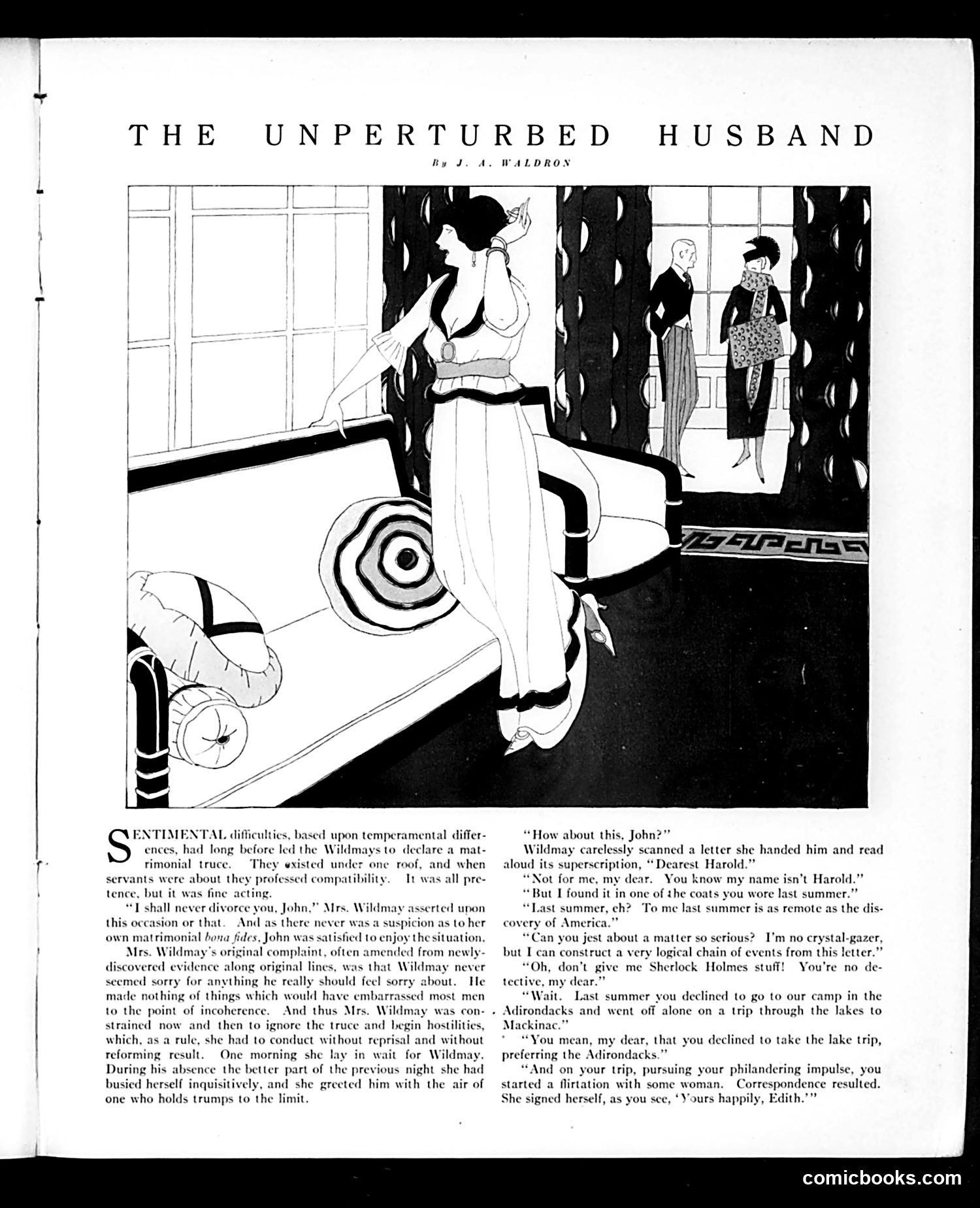
This is a satirical short story with illustration depicting a marital dispute typical of early-20th-century domestic comedy. Mrs. Wildmay discovers a love letter signed "Dearest Harold" in her husband's coat, suggesting an affair during his solo trip to Mackinac the previous summer. The humor centers on Mr. Wildmay's complete indifference to the accusation. Rather than deny, apologize, or show embarrassment, he dismisses the evidence with casual deflection—claiming he doesn't remember last summer, rejecting her "Sherlock Holmes" logic, and trivializing the discovery. The satire mocks both characters: his shameless unconcern about infidelity and her frustration at being unable to provoke genuine contrition. Their "matrimonial truce" involves enduring mutual dissatisfaction while maintaining social appearances—a critique of convenient, emotionless marriages among the wealthy. The title itself is ironic; his imperviousness is treated as comical rather than admirable.
📄 Transcribed text from this page (OCR, searchable)
Machine-transcribed from the original scan — historical spelling and the odd misread are preserved.
THE Ry J. A. ences, had long before led the Wildmays to declare a mat- rimonial truce. They existed under one roof, and when cy professed compatibility. Tr was all pre- S TIMENTAL difficulties, based upon temperamental diffe! servants were about thi tence, but it was fine acting. “1 shall never divorce you, John,” Mrs. Wildmay asserted upon a suspicion as to her this occasion or that. And as there never wa: own matrimonial bona fides, John was satisfied to enjoy the situation. Mrs. Wildmay’s original complaint, often amended from newly- discovered evidence along original lin was that Wildmay never for anything he really should feel sorry about. He made nothing of things which would have embarrassed most men to the point of incoherence. And thus Mrs. Wildmay was con- straincd now and then to ignore the truce and begin hostilities, which, as a rule, she had to conduct without reprisal and without reforming result. One morning she lay in wait for Wildm: During his absence the better part of the previous night she had busied herself inquisitively, and she greeted him with the air of one who holds trumps to the limit. seemed sorr. UNPERTURBED HUSBAND WALDRON “How about this, John?” Wildmay carelessly scanned a letter she handed him and read aloud its superscription, “Dearest Harol “Not for me, my dear. You know my name isn’t Harold.” “But I found it in one of the coats you wore last summer.” “Last summer, ch? To me last summer is as remote as the dis- covery of America.” “Can you jest about a matter so serious? I’m no crystal-gazer, but I can construct a very logical chain of events from this letter.” “Oh, don’t give me Sherlock Holmes stuff! You're no de- tective, my dear.” Wait. Last summer you declined to go to our camp in the Adirondacks and went off alone on a trip through the lakes to Mackinac.” “You mean, my dear, that you declined to take the lake trip, preferring the Adirondacks.” “And on your trip, pursuing your philandering impulse, you started a flirtation with some woman. Correspondence resulted. She signed herself, as you sce, ‘ Yours happily, Edith.’” comicbooks.com