
A complete issue · 28 pages · 1916
Judge — January 15, 1916
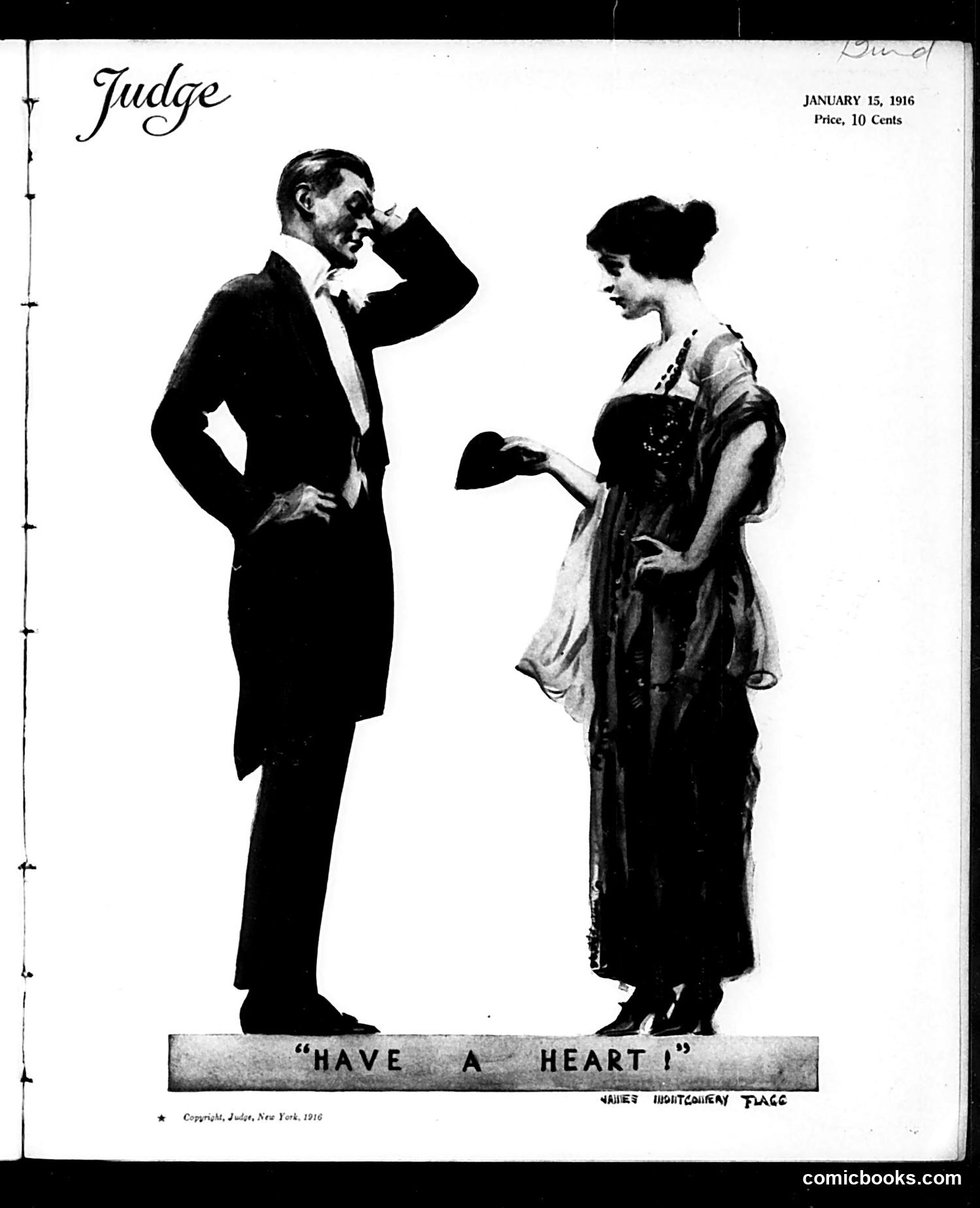
This cartoon depicts a well-dressed man in formal attire pleading with a woman holding what appears to be a hat or small object. The caption "Have a Heart" suggests an appeal for compassion or mercy. Without additional context visible on the page, the specific figures and situation aren't clearly identifiable from the image alone. The cartoon likely satirizes a contemporary social or political scenario from early 1916, possibly involving a romantic or domestic dispute, labor negotiation, or similar interpersonal conflict where one party is requesting the other show mercy or understanding. The art style and composition are typical of Judge's satirical commentary, but the particular reference requires additional historical documentation to identify with certainty.
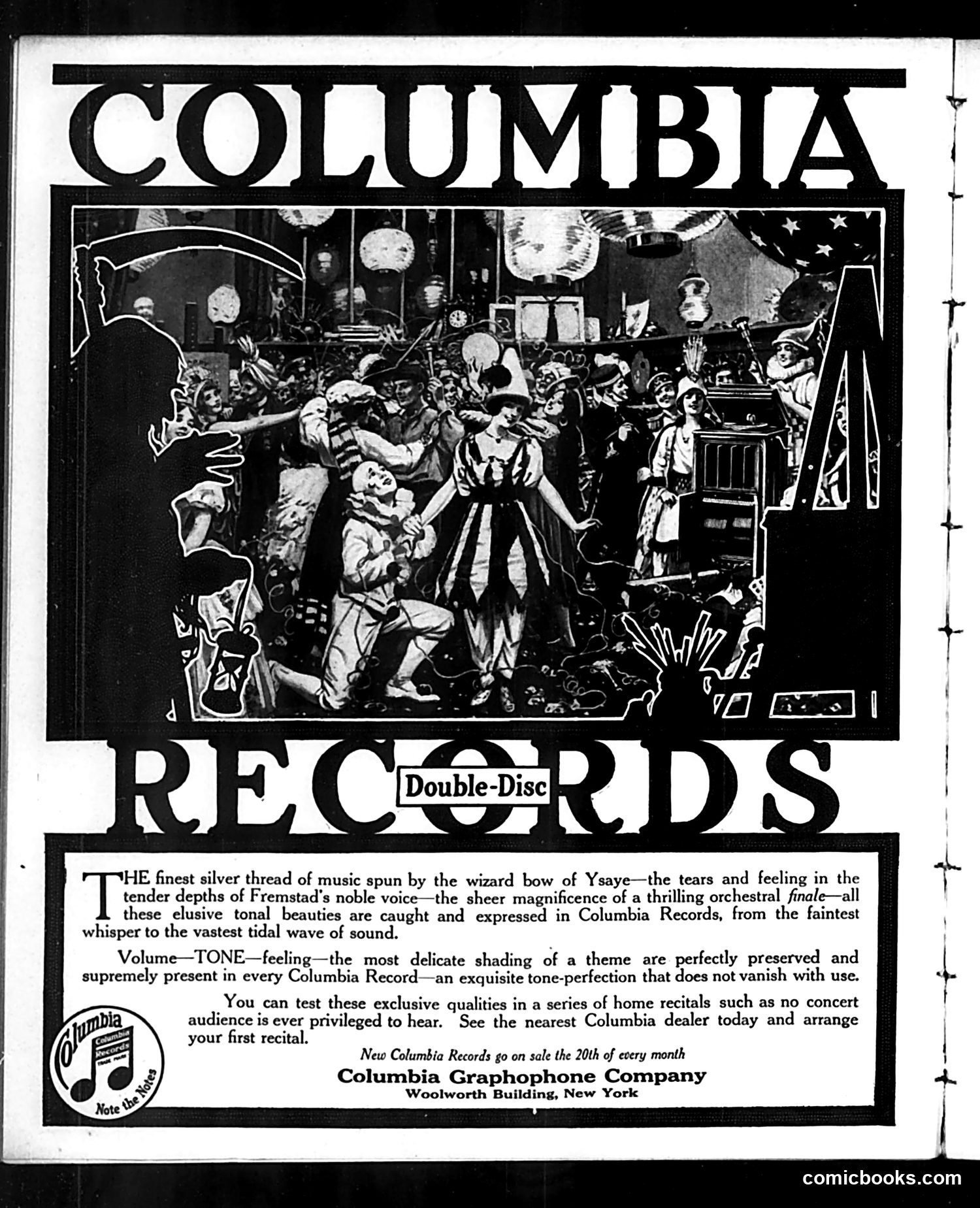
This page is primarily a **product advertisement** for Columbia Records' double-disc format, not political satire. The illustrated scene depicts an orchestra or musical performance in progress, with musicians and audience members in formal dress from what appears to be the early 20th century. The ad promotes Columbia's recording technology, emphasizing superior "tone" and "volume" qualities. It references performers like "Ysaye" (likely violinist Eugène Ysaÿe) and "Fremstad" (likely opera singer Olive Fremstad), marketing their performances as available on Columbia Records. The text claims exclusive "home recitals" are now possible through their technology—positioning recorded music as a luxury consumer product for the affluent home listener.
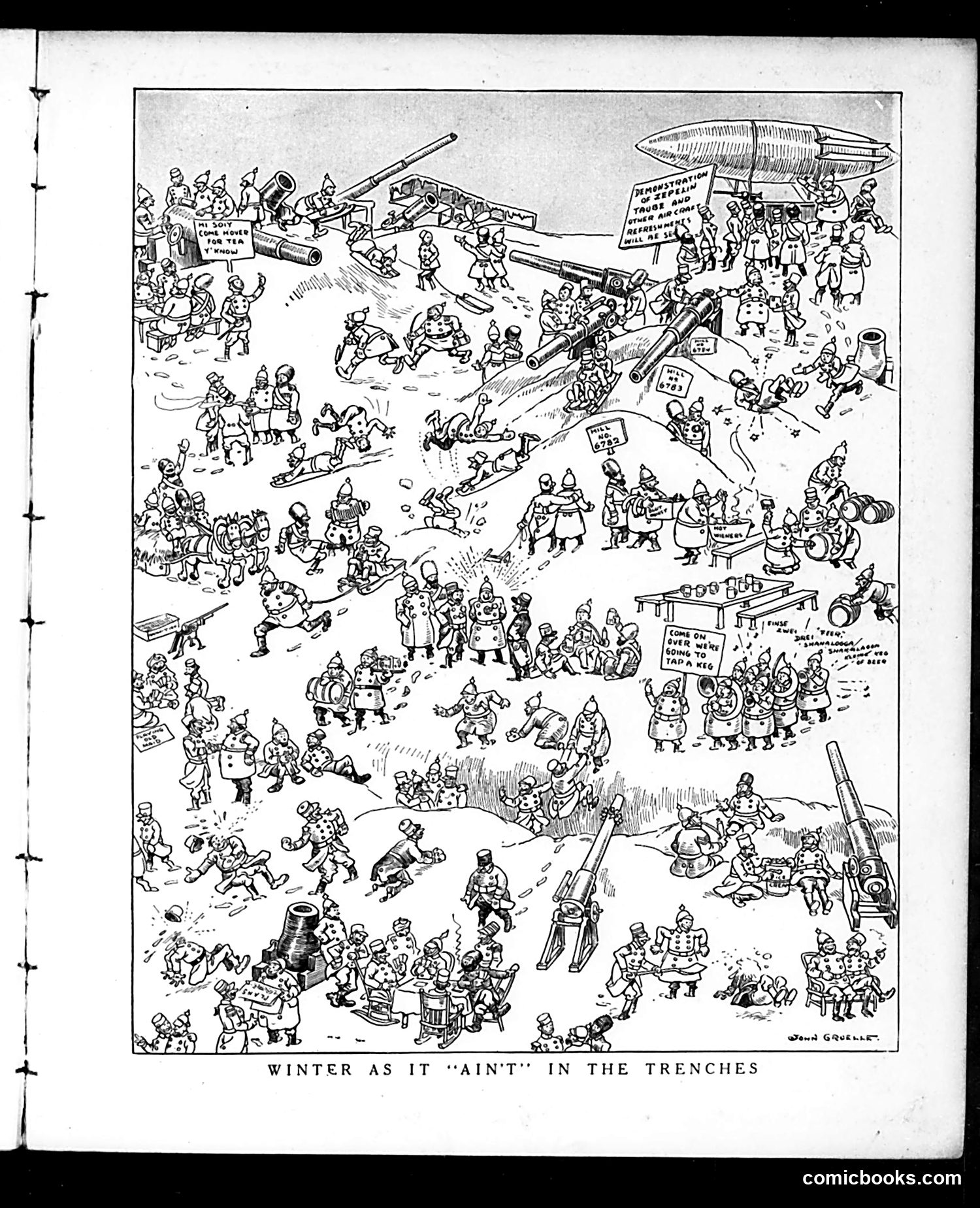
This WWI-era satirical cartoon depicts soldiers in trench warfare enjoying unexpected luxuries and comforts—contradicting the harsh reality of trench conditions. The image shows soldiers playing games, using recreational equipment, relaxing near an airship, and generally enjoying leisure activities impossible in actual trenches. The satire mocks the disconnect between home-front perceptions of soldier life and combat's brutal reality. The title's "ain't" emphasizes the irony: winter in actual trenches was characterized by mud, cold, disease, and death—not the fantasy leisure depicted here. The cartoon likely critiques either propagandistic depictions of military life or civilians' naive assumptions about soldiers' comfort, highlighting how romanticized portrayals masked the war's true horrors.
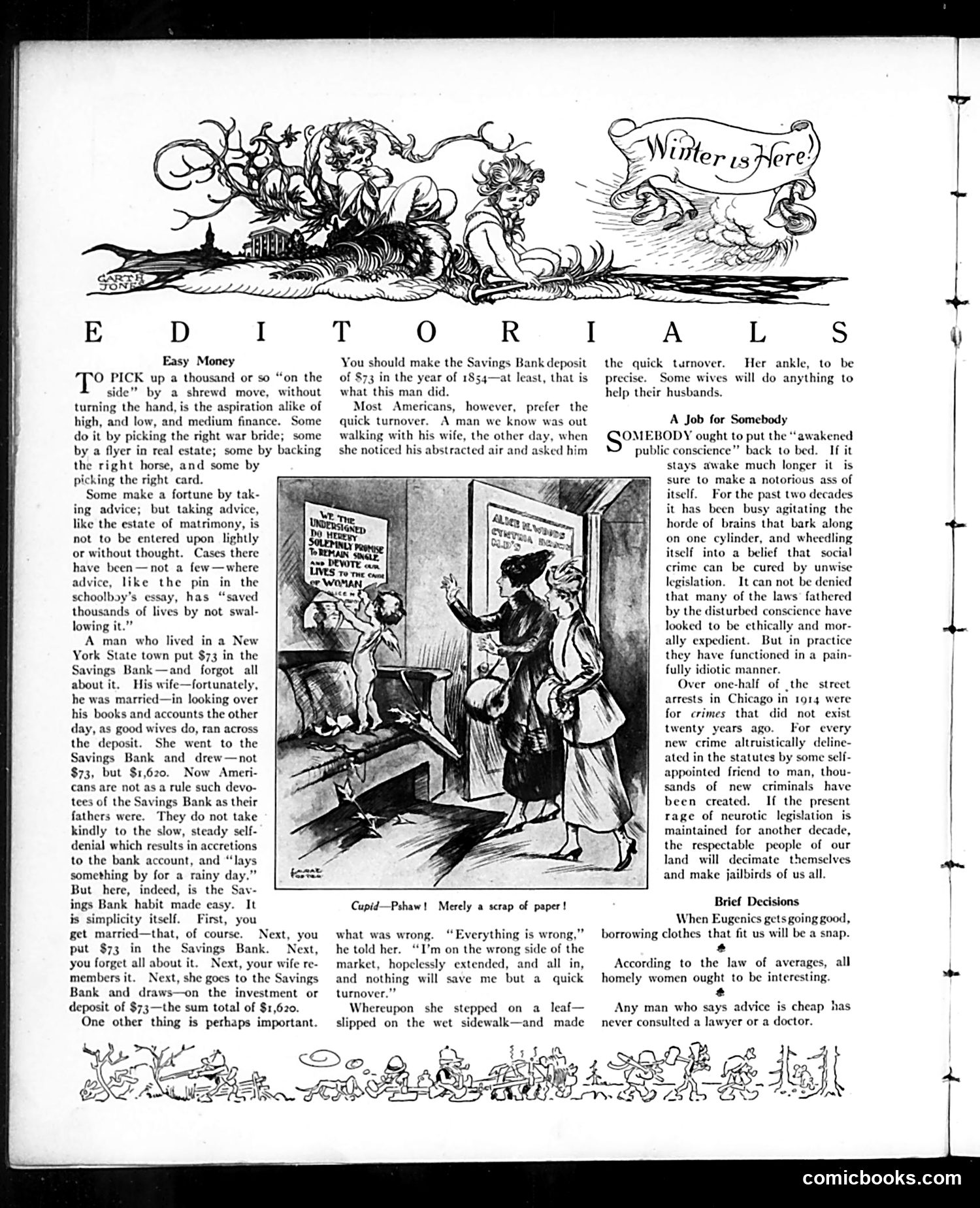
This page mixes financial advice with social criticism. The left column discusses Savings Bank practices, using a New York example where a man deposited $73 but forgot about it—a critique of Americans' casual financial habits. The central cartoon titled "Cupid—Phaw! Merely a scrap of paper!" shows a domestic dispute where a man tells a woman "Everything is wrong" and dismisses their marriage as easily discardable. This satirizes contemporary attitudes toward matrimony and male irresponsibility in relationships. The right column critiques vague laws addressing social problems (crime, neurosis), suggesting legislation is ineffective without clear definition. The brief aphorisms mock contemporary wisdom about eugenics, women, and professional advice—typical Judge satire targeting pretentious social commentary of the era.
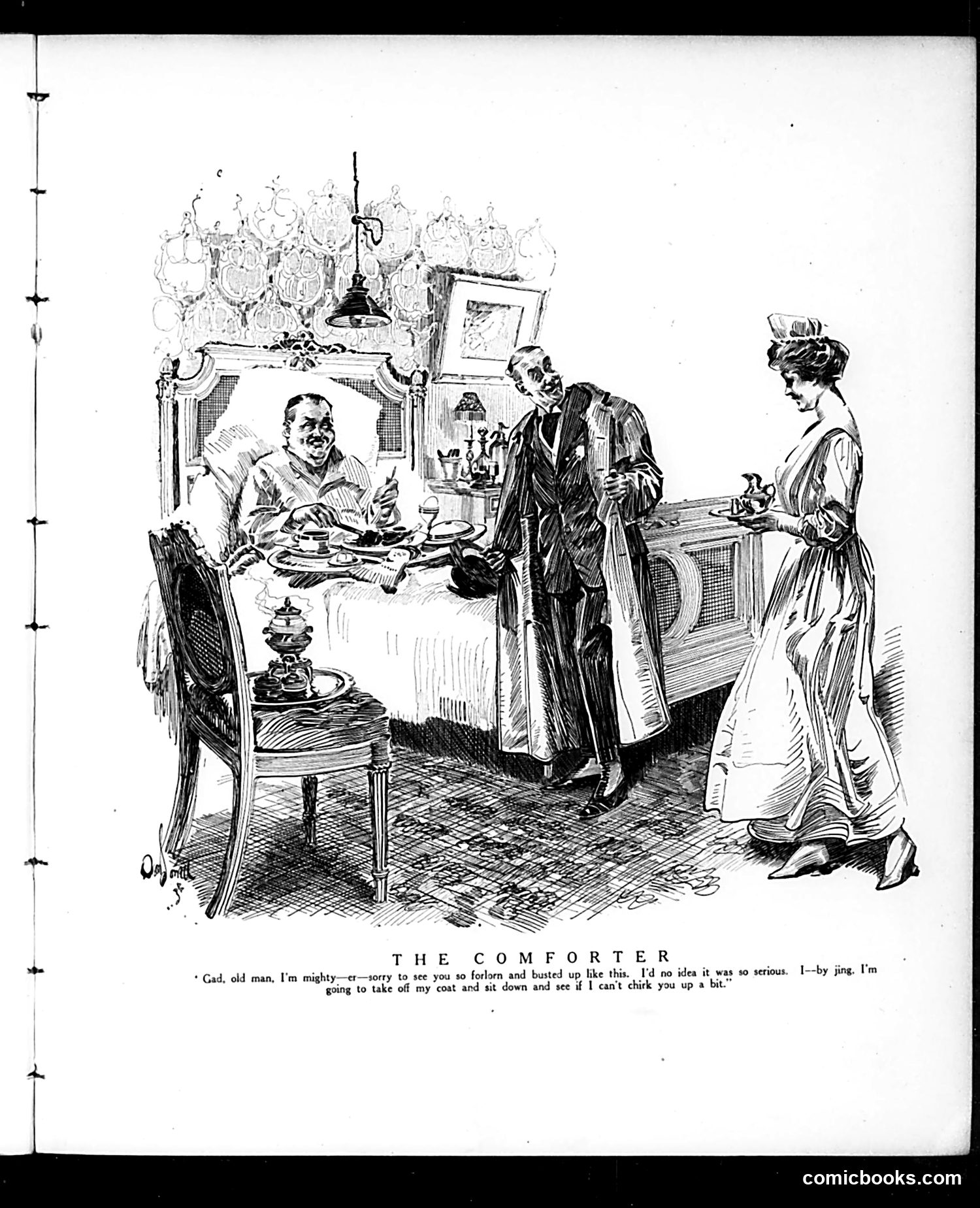
This cartoon satirizes a social visitor attempting to console a distressed man during what appears to be a financial or personal crisis. The title "The Comforter" is ironic—the well-dressed visitor's patronizing advice ("I'd no idea it was so serious. I—by jing, I'm going to take off my coat and sit down and see if I can't cheer you up a bit") suggests he offers platitudes rather than genuine help. The humor lies in the contrast between the visitor's casual, self-important demeanor and the man's evident despair. This critiques the superficial "comfort" offered by society's privileged classes to those in distress—mere sympathy without substantive assistance. The ornate furnishings suggest the setting's genteel pretense, making the hollow consolation more absurd.
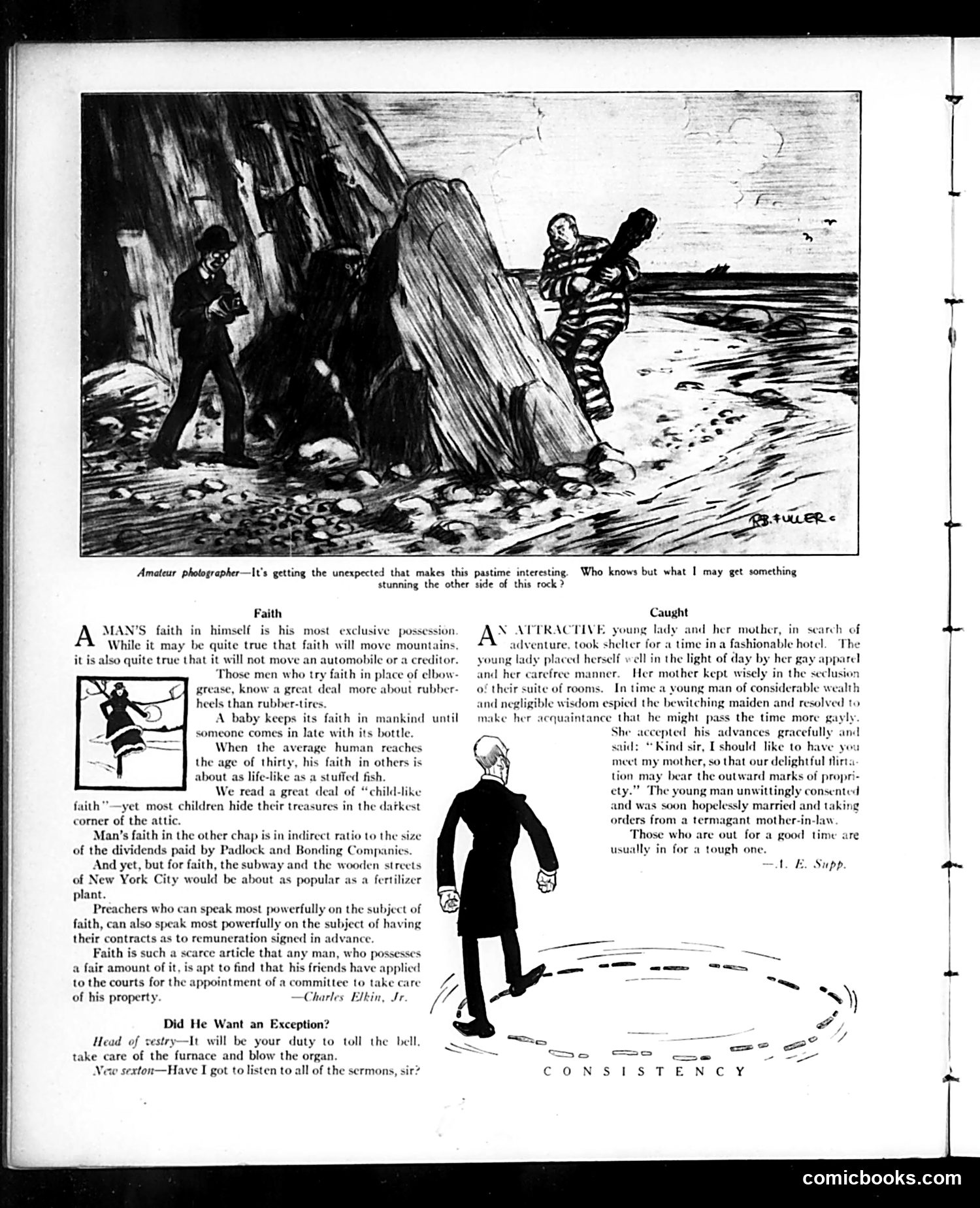
This page contains three satirical pieces typical of early 20th-century American humor: **"Faith"** mocks people who rely on blind faith instead of practical effort. The text cynically observes that while faith supposedly moves mountains, it won't pay debts or fix cars. The satire targets those who trust in providence rather than "elbow-grease," and notes that faith in others decreases proportionally with age and financial self-interest. It criticizes even preachers for demanding contracts before preaching about faith. **"Caught"** is a morality tale about a young woman whose mother strategically displays her in a hotel to attract a wealthy suitor. The man, having "negligible wisdom," accepts her advances. When he meets the mother, he becomes "hopelessly married" to her domineering presence. The moral: those seeking "a good time" end up in difficult situations. **"Did He Want an Exception?"** is a brief clergy joke where a new sexton asks if he must attend all sermons—implying sermons are an unbearable burden even for church employees. The illustrations by C. D. Fuller support these satirical critiques of human nature and social pretense.
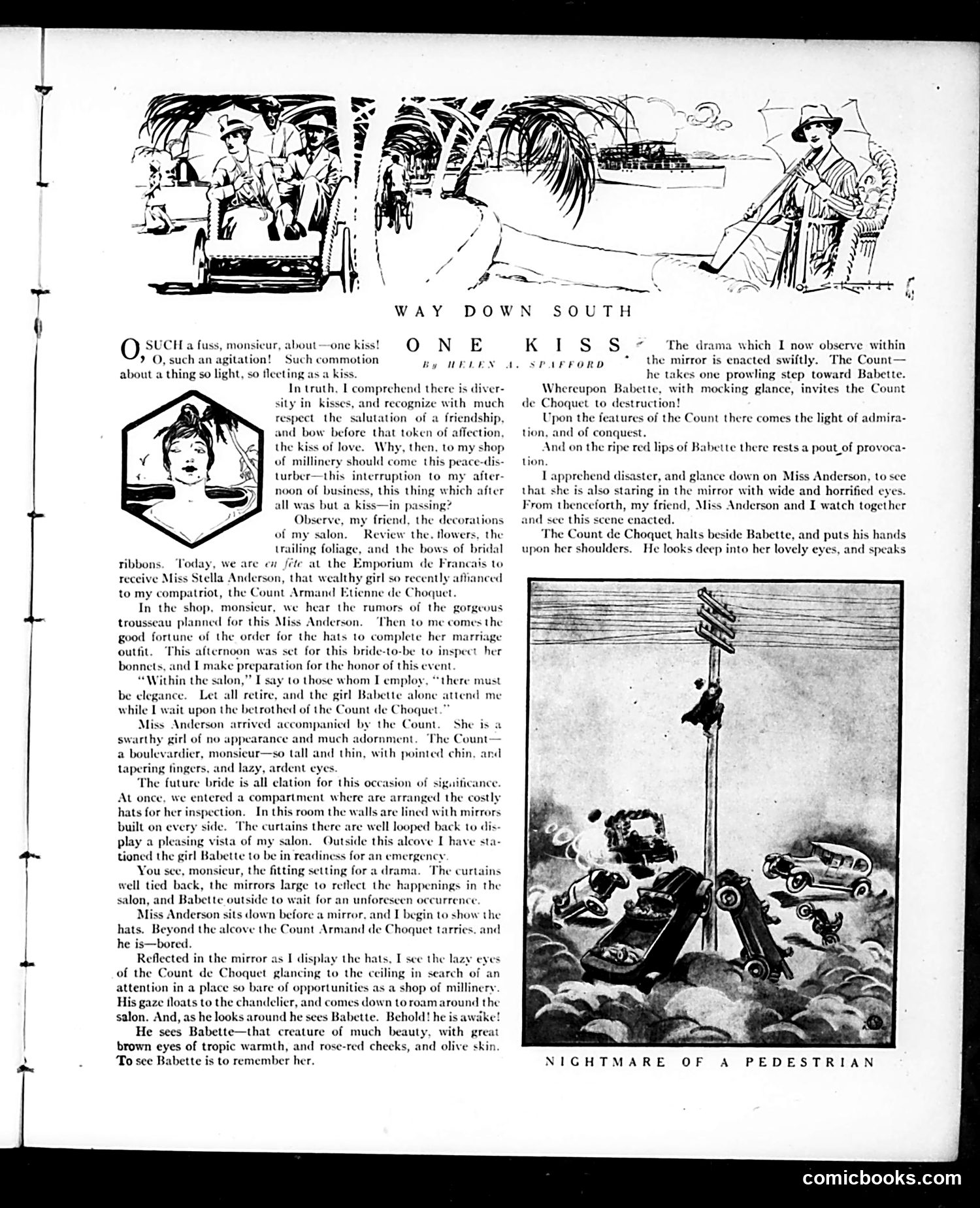
This is a romantic comedy narrative illustrated with sketches, not a political cartoon. The story, "One Kiss" by Helen J. Spafford, depicts a French milliner narrating a dramatic incident at his shop. **The Setup:** A wealthy American woman, Miss Stella Anderson, visits to inspect wedding hats before marrying Count Armand Etienne de Choquet. The Count accompanies her but grows bored. **The Drama:** While the milliner fits hats, the Count notices Babette, a beautiful shop girl, and flirts with her. Miss Anderson observes this betrayal in the mirror and is horrified. **The Satire:** The piece gently mocks French aristocratic rakishness—the Count's wandering attention and the shop girl's flirtation—while playing on American anxieties about European seducers. The "nightmare" image suggests the pedestrian consequences of such romantic entanglement. The humor relies on period-appropriate stereotypes about French romance and Old World decadence versus American earnestness.
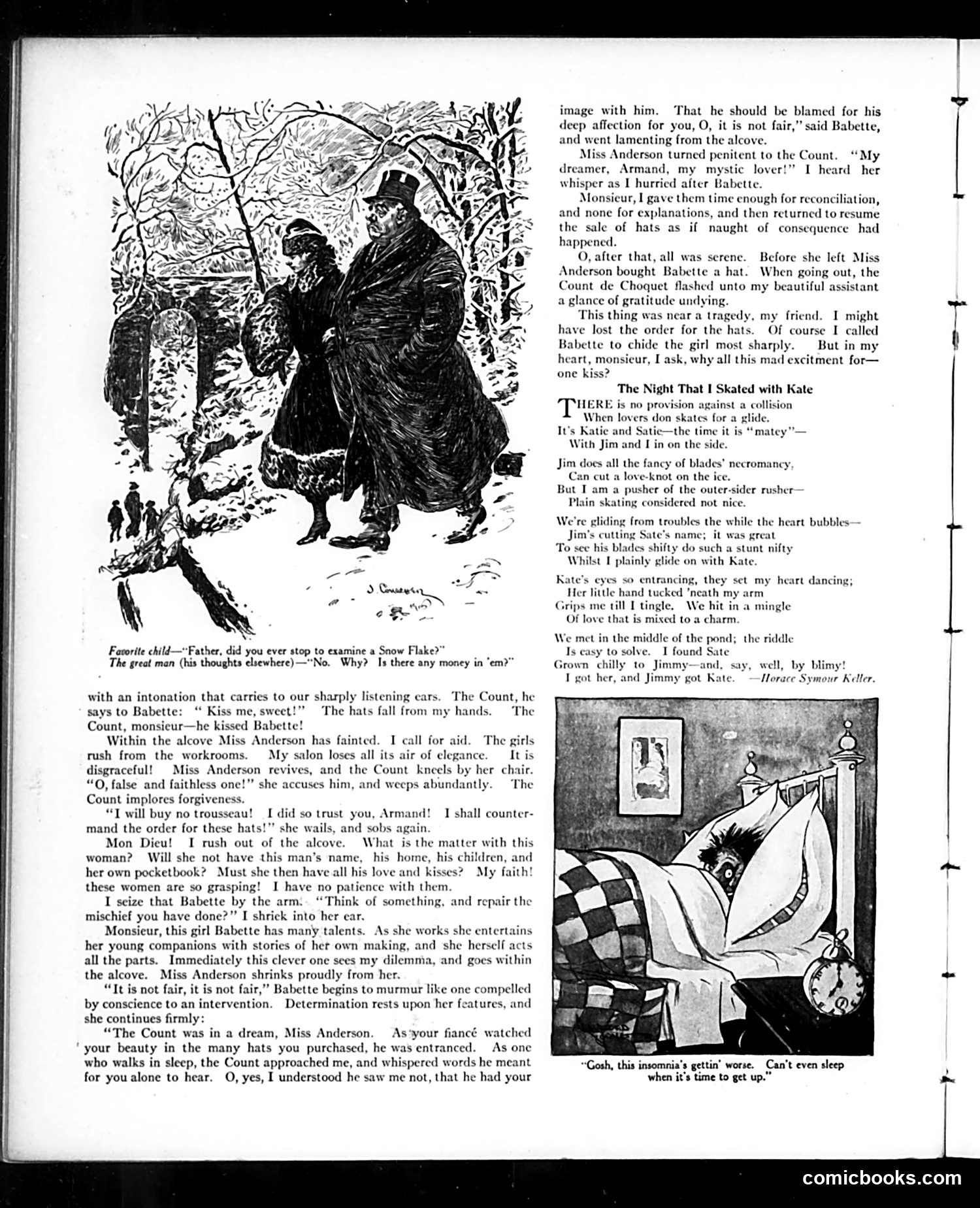
This page contains two distinct pieces: **Upper Section: A Short Story About Hat Sales** A French milliner narrator recounts a romantic crisis resolved through clever intervention. When a Count accidentally compliments his fiancée Miss Anderson while entranced by her beauty, she faints. The narrator's employee Babette salvages the situation by convincing Miss Anderson the Count was sleepwalking—a romantic excuse that restores peace. The joke targets wealthy customers' vanity: the narrator cares less about the couple's feelings than securing "the order for the hats," successfully manipulating both parties through flattery. **Lower Section: "The Night That I Skated with Kate"** A humorous poem about ice skating where the narrator and Jim each pursue romantic interests (Kate and Satie). Jim skillfully cuts Satie's name into the ice while the narrator merely pushes along with Kate. The punchline: by being a mediocre skater, the narrator wins Kate while Jim loses her to the narrator. Both pieces are lighthearted romantic comedy aimed at Judge's middle-class readership, emphasizing commercial self-interest and comedic male rivalry.
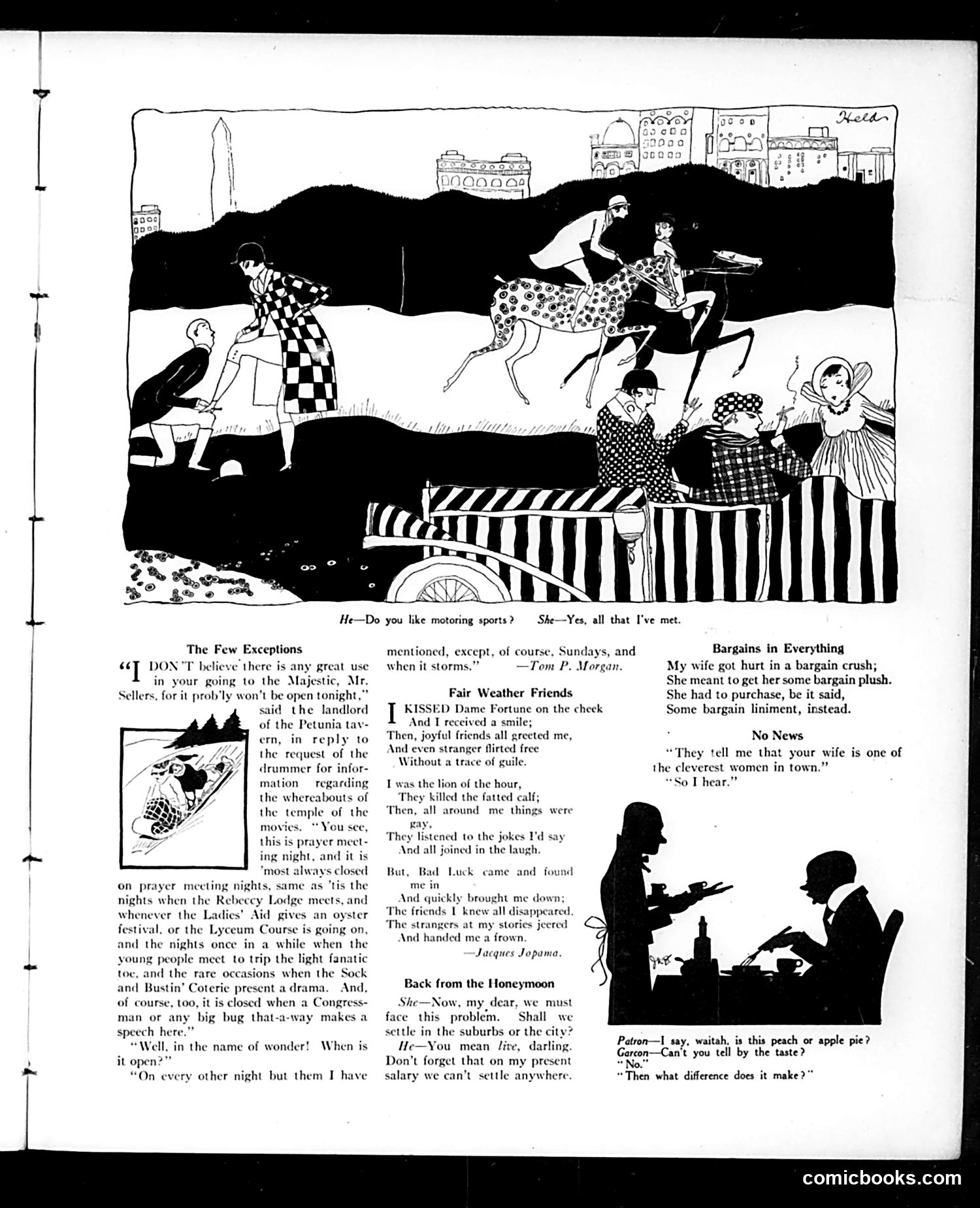
This page from *Judge* magazine contains humor pieces satirizing early 20th-century American social life. **Top cartoon**: Shows people engaging in "motoring sports" (early automobile recreation). The caption joke plays on the era's obsession with cars as a leisure activity. **"The Few Exceptions"**: Satirizes small-town cinema culture, where a movie theater ("the Majestic") is constantly closed due to competing community events—prayer meetings, fraternal lodges (Rebecca Lodge), ladies' aid societies, church activities, dramatic performances, and visiting politicians. The humor lies in the absurdity that there's virtually no night available for moviegoing, mocking the crowded social calendar of rural/small-town America and religious community dominance. **Other pieces** include light verse about fair-weather friends and newlywed humor about settling location disputes. **"Patron/Garcon" dialogue**: A cynical joke where a waiter can't identify a dish by taste alone—implying poor food quality or deceptive restaurant practices. The overall tone reflects *Judge*'s satirical style: gently mocking American middle-class customs, religion's social influence, and domestic life.
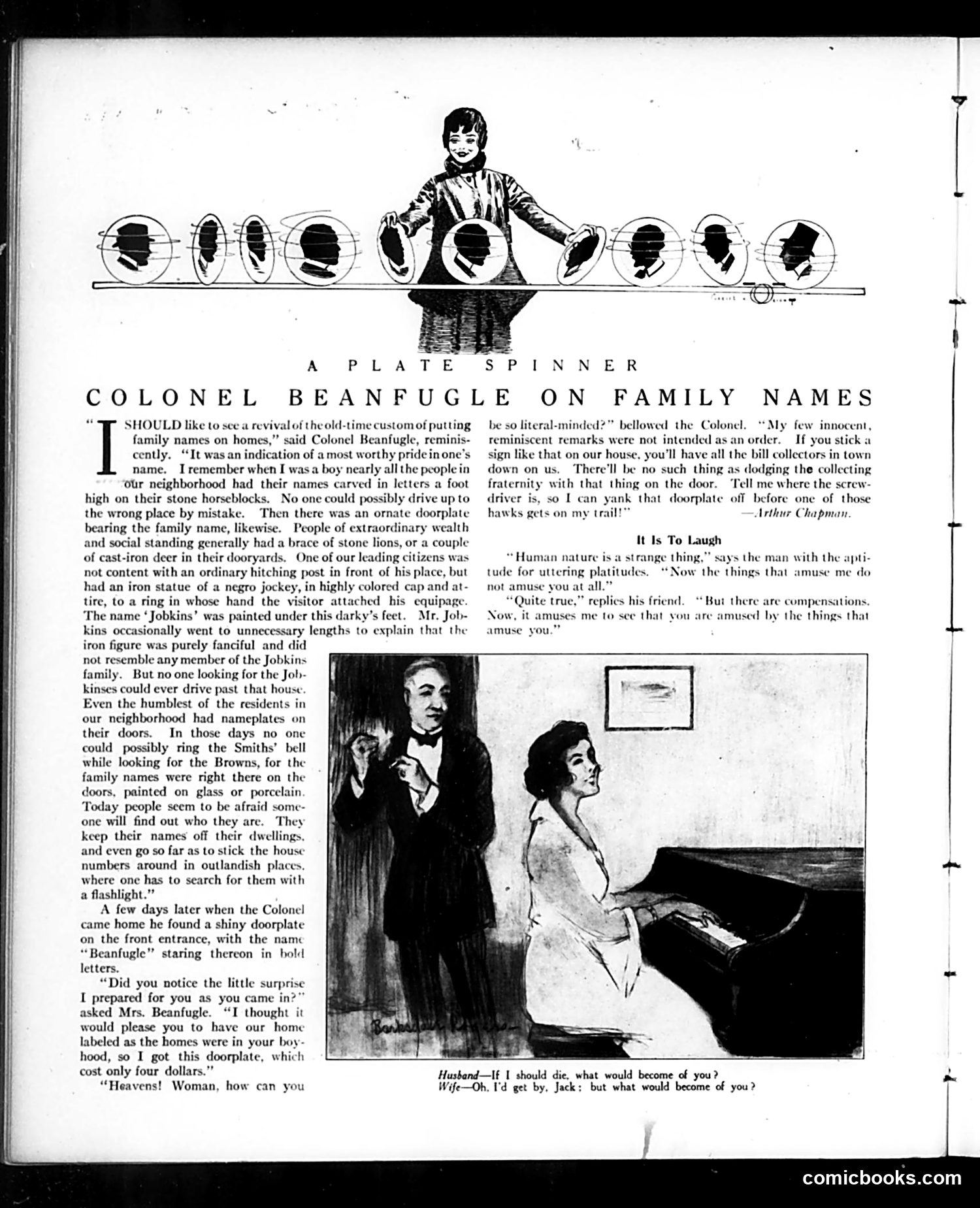
This satirical piece mocks nostalgia for older social conventions. Colonel Beanfugle romanticizes 19th-century practices of displaying family names prominently on homes—carved stones, ornate doorplates, even decorative lawn statuary—as markers of respectability and pride. The humor lies in the gap between sentiment and practical reality. When his wife actually installs a nameplate following his wistful advice, the Colonel immediately panics: such visibility would allow bill collectors and creditors to find him. His cherished emblem of honor becomes a liability in a world of debt and financial obligations. The satire targets not just Beanfugle's hypocrisy, but broader American anxiety about privacy and class in the modern era. People avoided displaying their names precisely *because* identification invited unwanted attention from creditors—revealing that respectability and vulnerability were two sides of the same coin.
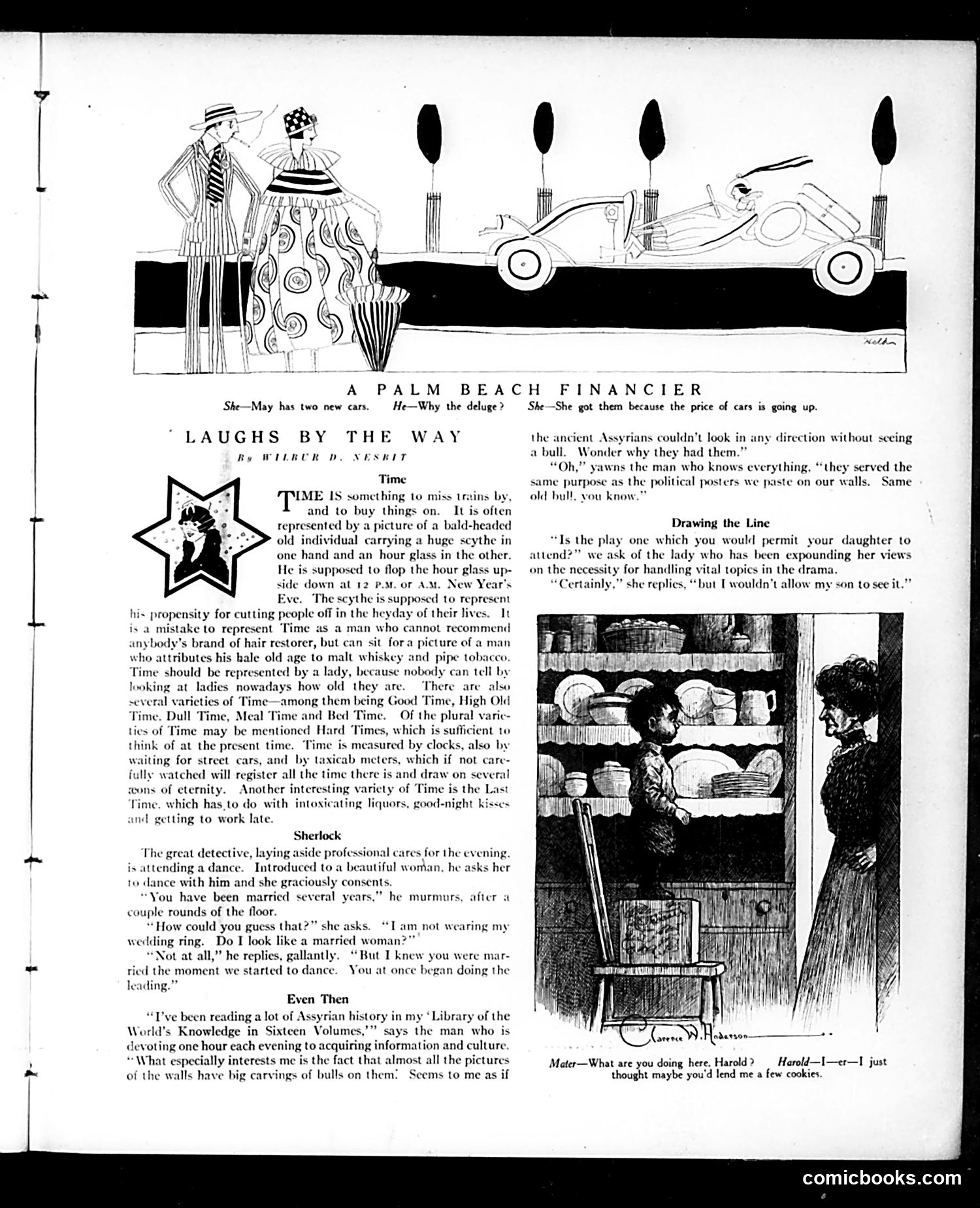
This page collects several brief satirical pieces typical of Judge's humor: **"A Palm Beach Financier"** (top cartoon): A wealthy couple displays two new cars. The joke satirizes wealth during inflation—she bought them because car prices are rising, so she's "investing" in vehicles as a hedge against economic decline. It mocks the illogical spending habits of the rich. **"Time"**: A philosophical essay mocking the traditional personification of Time as an old man with a scythe. The satire suggests Time should be female because women's ages are inscrutable. It catalogs varieties of "Time" (Good Time, Hard Times, etc.), ultimately deflating the concept through absurdist humor. **"Sherlock"**: A detective story parody where a Sherlock Holmes-type deduces a woman is married not from her ring, but because she immediately takes the lead while dancing—satirizing women's assertiveness or marital behavior. **"Even Then"**: Political satire comparing ancient Assyrian bull carvings to modern political propaganda posters, suggesting both served identical propagandistic purposes across millennia.
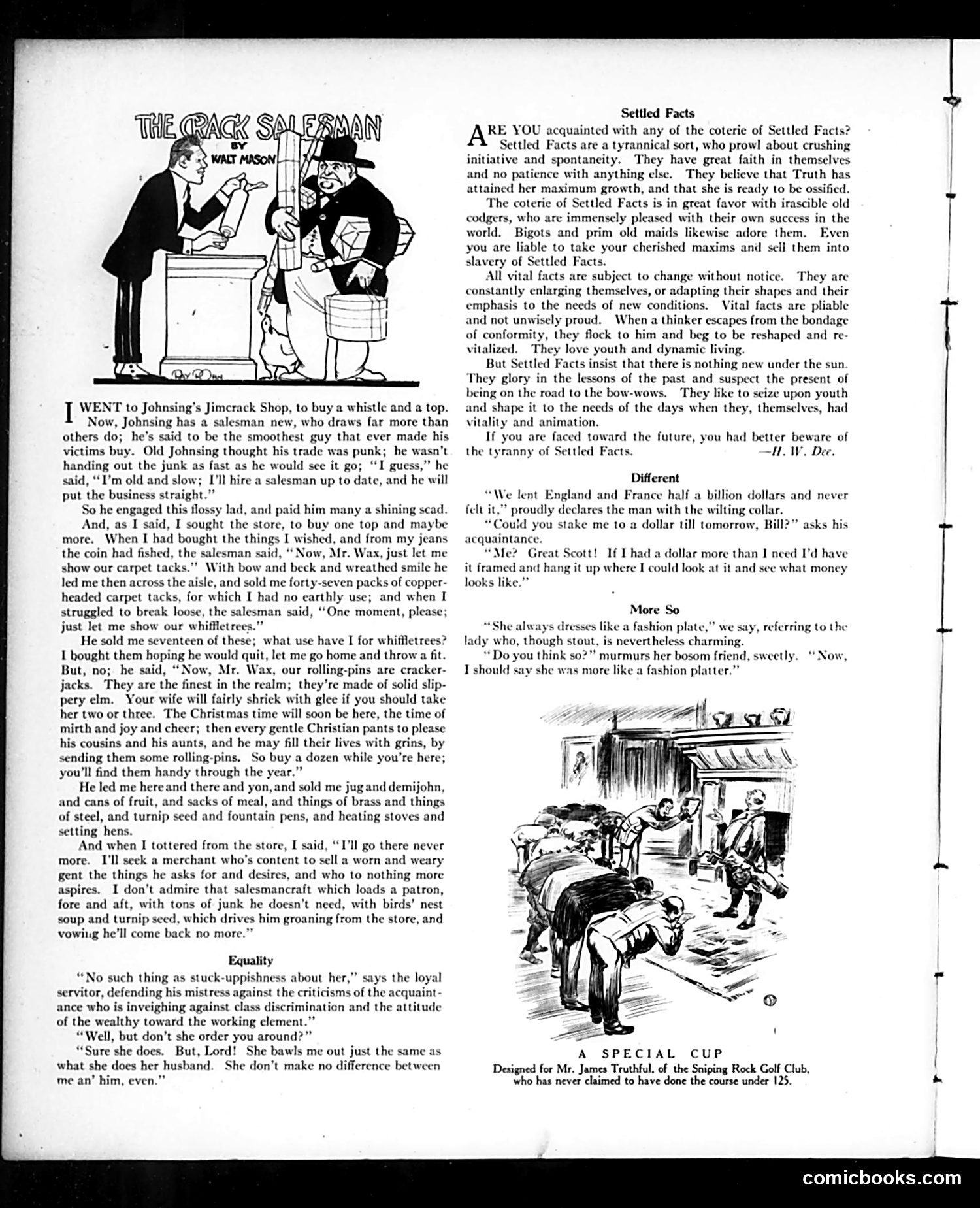
This page contains three satirical pieces targeting early 20th-century social attitudes: **"The Crack Salesman"** (top cartoon and accompanying story) mocks aggressive high-pressure sales tactics. The narrator, Mr. Wax, visits a shop where an overly persuasive new salesman manipulates him into buying completely unnecessary items—whiffletrees, carpet tacks, rolling pins, turnip seed—through flattery and relentless persistence. The satire targets both the unethical sales methods and the customer's weakness in resisting them. **"Equality"** (brief dialogue) ironically critiques class hypocrisy. A servant defends her "egalitarian" mistress by claiming she treats servants and husbands identically—by ordering them around equally. The joke exposes that "equality" between classes merely means workers receive the same harsh treatment as family members. **"Settled Facts"** (essay section) attacks intellectual rigidity and dogmatism, particularly among the wealthy and elderly who resist new ideas, believing "Truth has attained her maximum growth." It advocates for flexible, evolving thinking rather than ossified certainty. All three pieces reflect Progressive Era concerns about salesmanship, class relations, and intellectual stagnation.
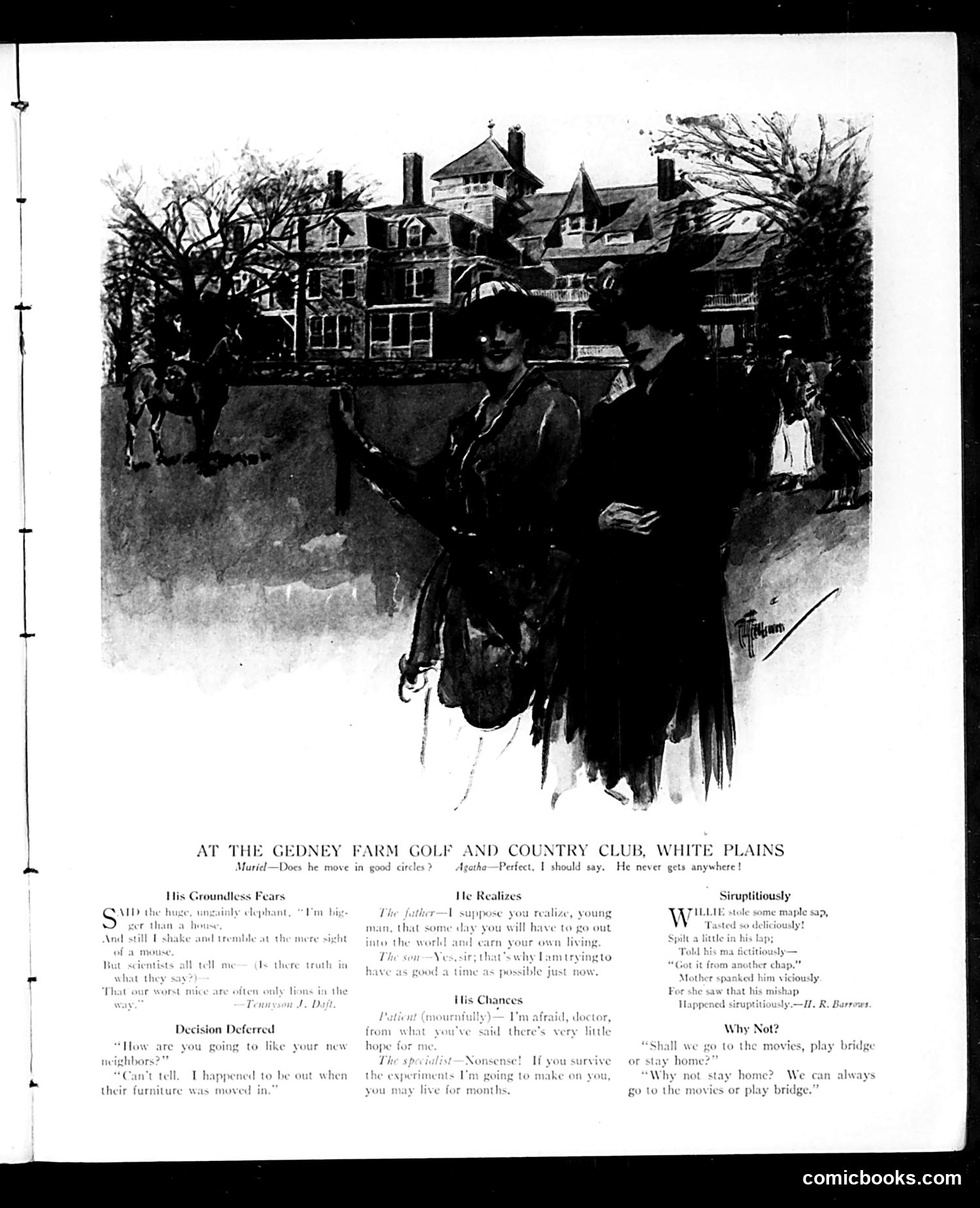
This page contains **social humor** satirizing upper-class anxieties and courtship dynamics, likely from the early 20th century. The main illustration depicts two elegantly-dressed women at the Gedney Farm Golf and Country Club (a White Plains venue). The dialogue sections below present various conversational scenarios between what appear to be **courting couples or marriageable pairs** discussing: - A man's groundless fears about his financial prospects - A father's realistic assessment of his son's future earning potential - A suitor's slim romantic chances - Debate over whether to pursue entertainment (movies, bridge) versus staying home The satire targets the **social pretensions and marriage-market anxieties** of the leisure class—the gap between appearance and economic reality, parental concerns about sons' viability as husbands, and the era's prescribed courtship activities. The humor relies on recognizing these as typical anxious conversations among the wealthy during an era of economic uncertainty, with the cartoon gently mocking both masculine insecurity and feminine materialism in matrimonial negotiations.
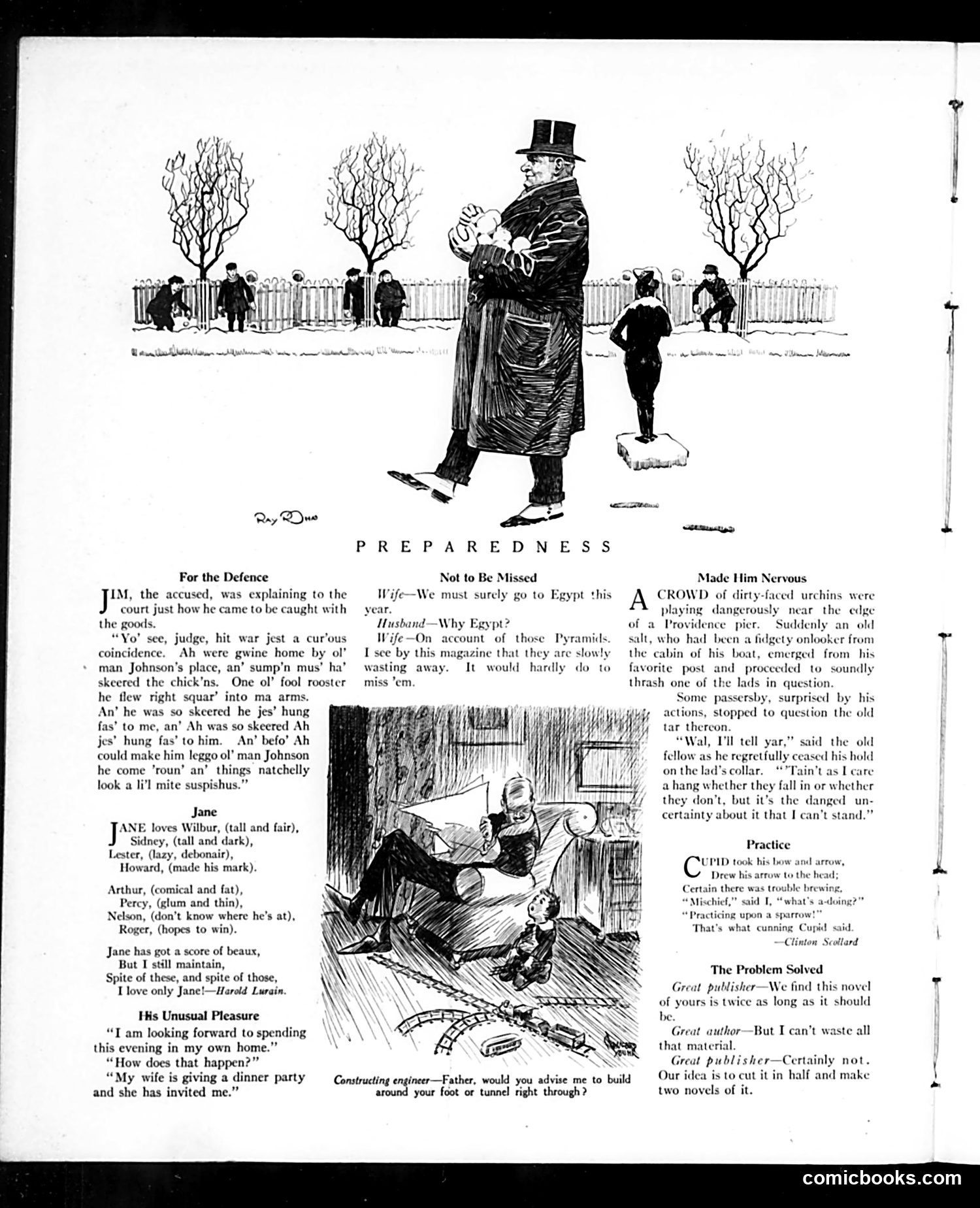
This Judge magazine page contains multiple satirical pieces typical of early 20th-century American humor: **"For the Defence"** mocks racial stereotypes through dialect humor—a Black defendant explains stealing chickens as a comedic accident. This reflects the deeply racist comedy conventions of the era. **"Jane"** is a light romantic poem listing Jane's many suitors, a common magazine feature. **"His Unusual Pleasure"** jokes about a husband grateful to be *invited* to his own wife's dinner party—satirizing domestic dynamics where wives control social events. **"Preparedness"** (top illustration) shows a well-dressed man with a child, likely referencing pre-WWI military readiness debates. The wife's comment about Egyptian pyramids "wasting away" pokes fun at frivolous tourist priorities during serious times. **"Made Him Nervous"** depicts an old sailor beating a child for playing dangerously near water—the joke being his anxiety about *uncertainty* rather than actual danger. **"Practice" and "The Problem Solved"** are brief humorous anecdotes about Cupid and publishing respectively. The overall tone reflects early 1900s satirical magazine conventions: domestic comedy, period anxieties, and casual ethnic stereotyping.
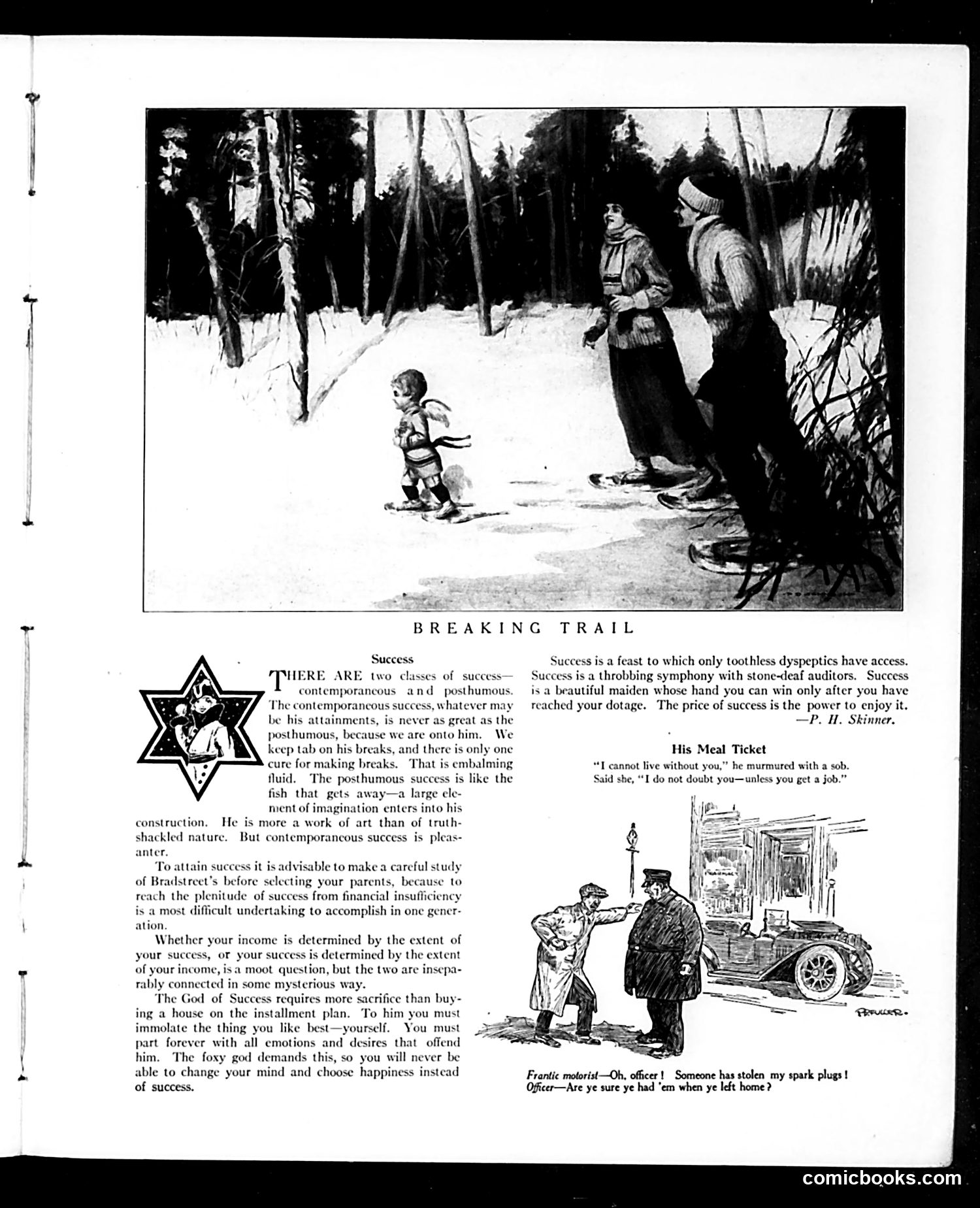
This Judge magazine page contains satirical commentary on American success culture and relationships circa early 20th century. **"Breaking Trail"** (top): A winter scene showing adults watching a child trudge through snow, illustrating the metaphor that success requires pioneering effort and sacrifice. **Main essay**: A cynical philosophical piece distinguishing "contemporaneous" from "posthumous" success—arguing that living success is always compromised because we're "onto" people, while dead people's accomplishments become mythologized. The satire mocks American obsession with financial success, suggesting it requires sacrificing one's authentic self and emotions entirely. **"His Meal Ticket"**: A cartoon about economic dependency in relationships, where a woman declares she can't live without her boyfriend—unless he gets employed (suggesting her affection depends on his financial support, not love). **"Frantic Motorist"**: A joke about an officer questioning a car owner's reliability, playing on early automotive technology's notorious unreliability. Overall, the page satirizes American capitalism's demands, relationship transactionalism, and technological inadequacy.
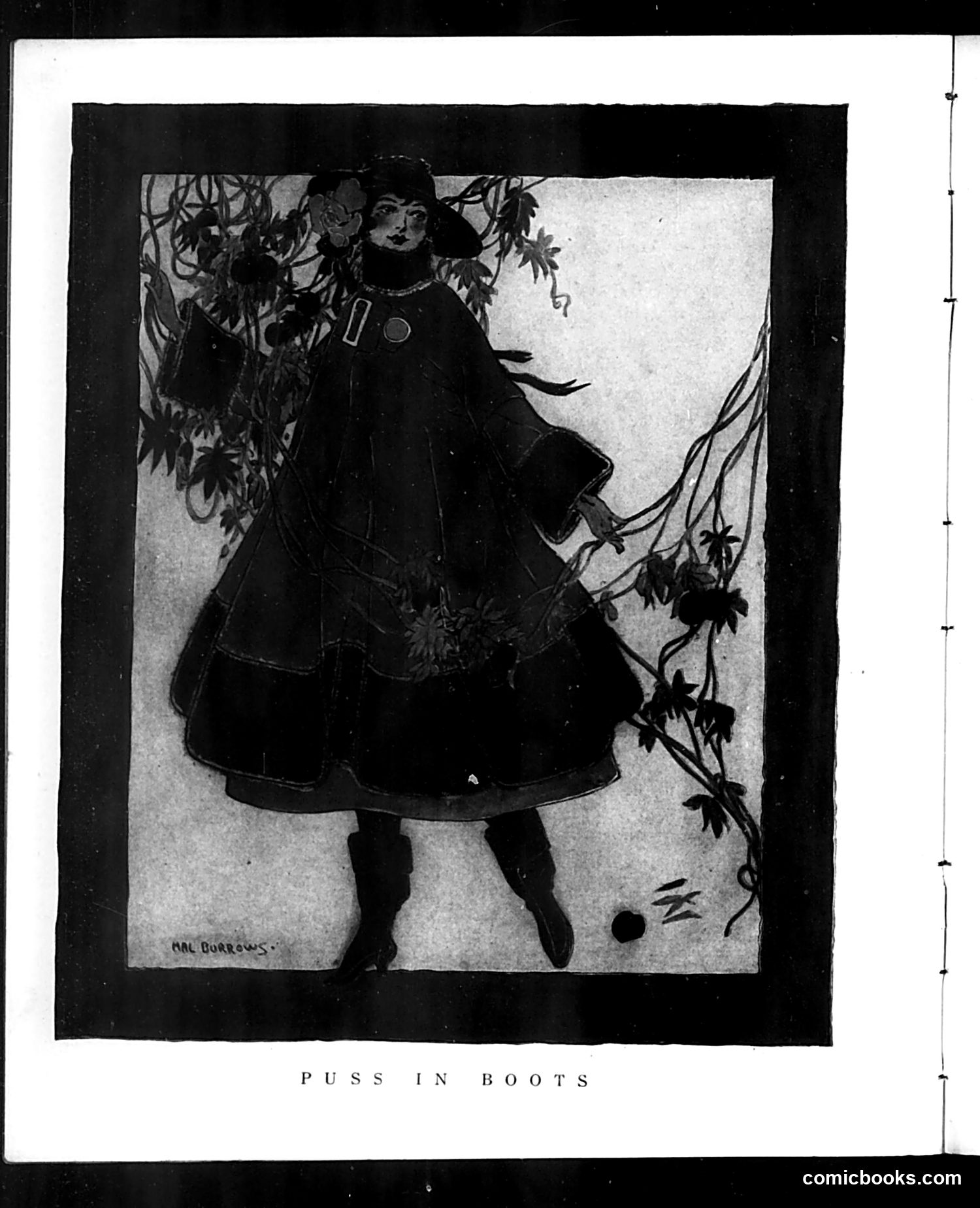
This illustration shows a figure in a dark coat and boots standing among stylized foliage. The title references the classic fairy tale character "Puss in Boots," the clever cat who helps his master gain wealth and status through deception. The artwork appears to be a satirical commentary, likely employing the tale as metaphor for some contemporary figure or situation—using cunning and manipulation (like the fairy tale character) to achieve goals. The art style and the figure's sophisticated appearance suggest this may reference a political or social figure of the early 20th century, though the specific target remains unclear without additional context from the Judge magazine's publication date and surrounding articles. The signature "CARL BARKS" or similar appears on the illustration.
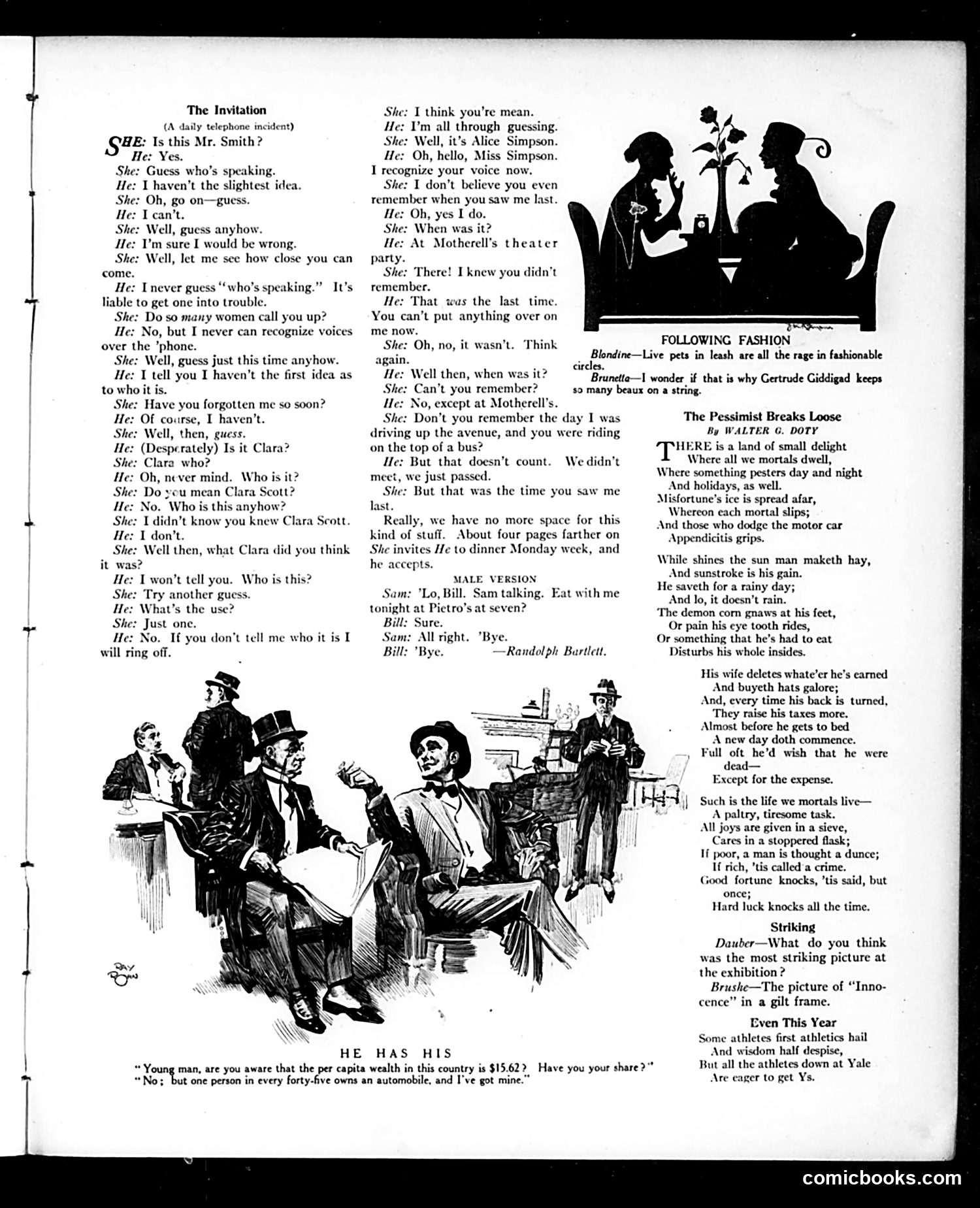
This page satirizes early 20th-century telephone etiquette and gender dynamics. **"The Invitation"** depicts a woman calling a man and asking him to guess her identity—a common social game of the era. The humor lies in the man's predicament: he cannot recognize her voice and awkwardly guesses the wrong woman's name (Clara), revealing he's received calls from multiple women. The woman feigns hurt that he's forgotten her, though they've only met once briefly. The "Male Version" presents the inverse: a man's straightforward phone call without games. **"He Has His"** (bottom cartoon) shows a wealthy man boasting about owning an automobile while a questioner asks if he's aware of the country's per capita wealth. The satire mocks nouveau-riche materialism—he measures his worth by possessing a car rather than understanding actual economic statistics. **"The Pessimist Breaks Loose"** is a humorous poem cataloging life's inevitable complaints: disease, financial burden, taxes, and misfortune—suggesting pessimism as the rational response to modern existence.
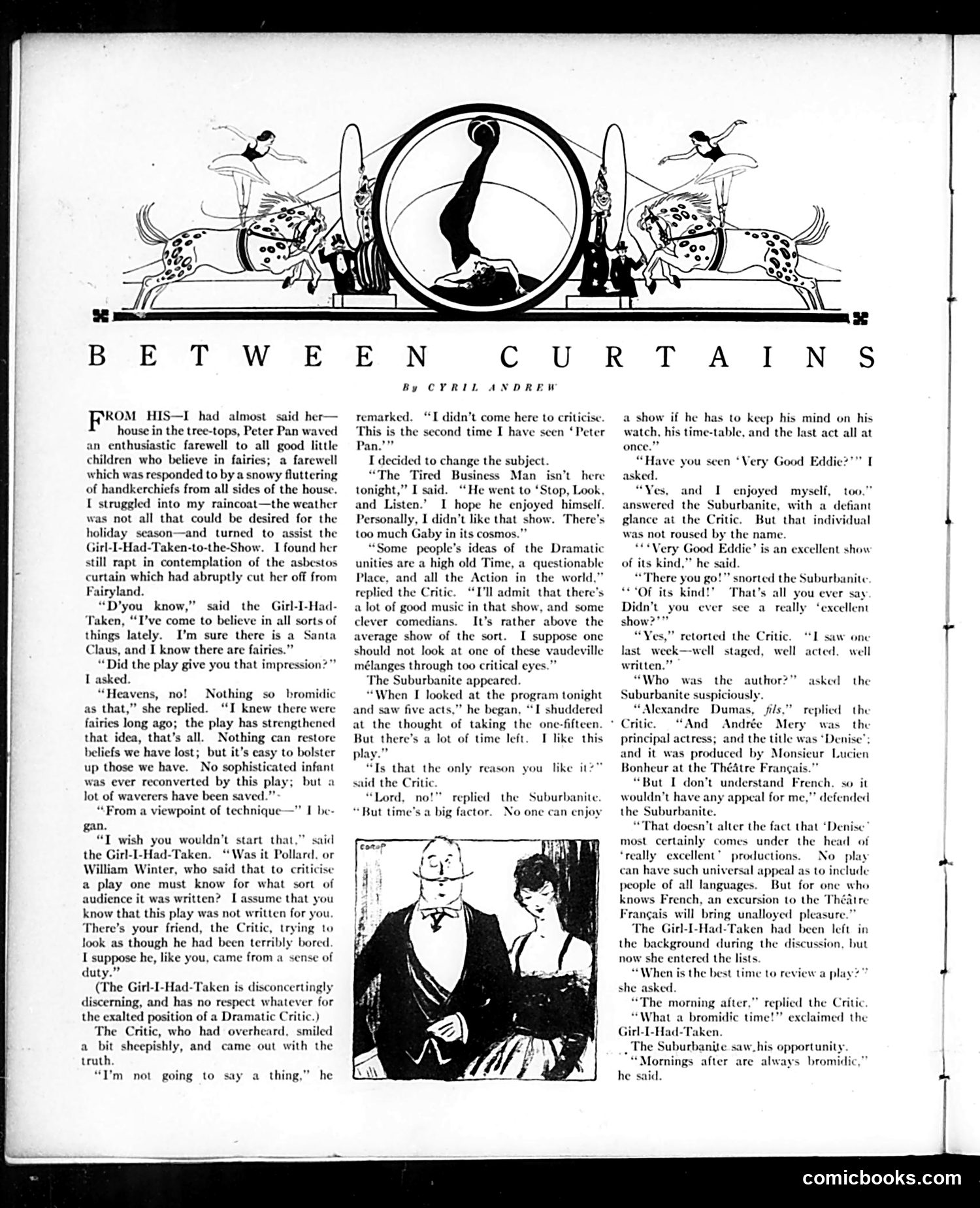
This is a satirical dialogue about theatrical criticism and audience taste. The main characters are a theater critic, a young woman ("Girl-I-Had-Taken"), and a suburban commuter, discussing plays they've seen: *Peter Pan*, *Stop, Look, and Listen*, and *Very Good Eddie*. The satire targets the **pretentious theater critic** who dismisses popular entertainment (*Peter Pan*, vaudeville) while praising obscure foreign works (*Denise* by Alexandre Dumas fils at the Théâtre Français) that ordinary audiences cannot appreciate. The suburbanite and young woman represent sensible viewers—one values entertainment that doesn't interfere with catching his train; the other recognizes that the critic's refined taste is impractical. The joke: sophisticated critics championing inaccessible foreign drama over genuinely entertaining American theatrical productions, disconnected from what actual audiences enjoy or understand.
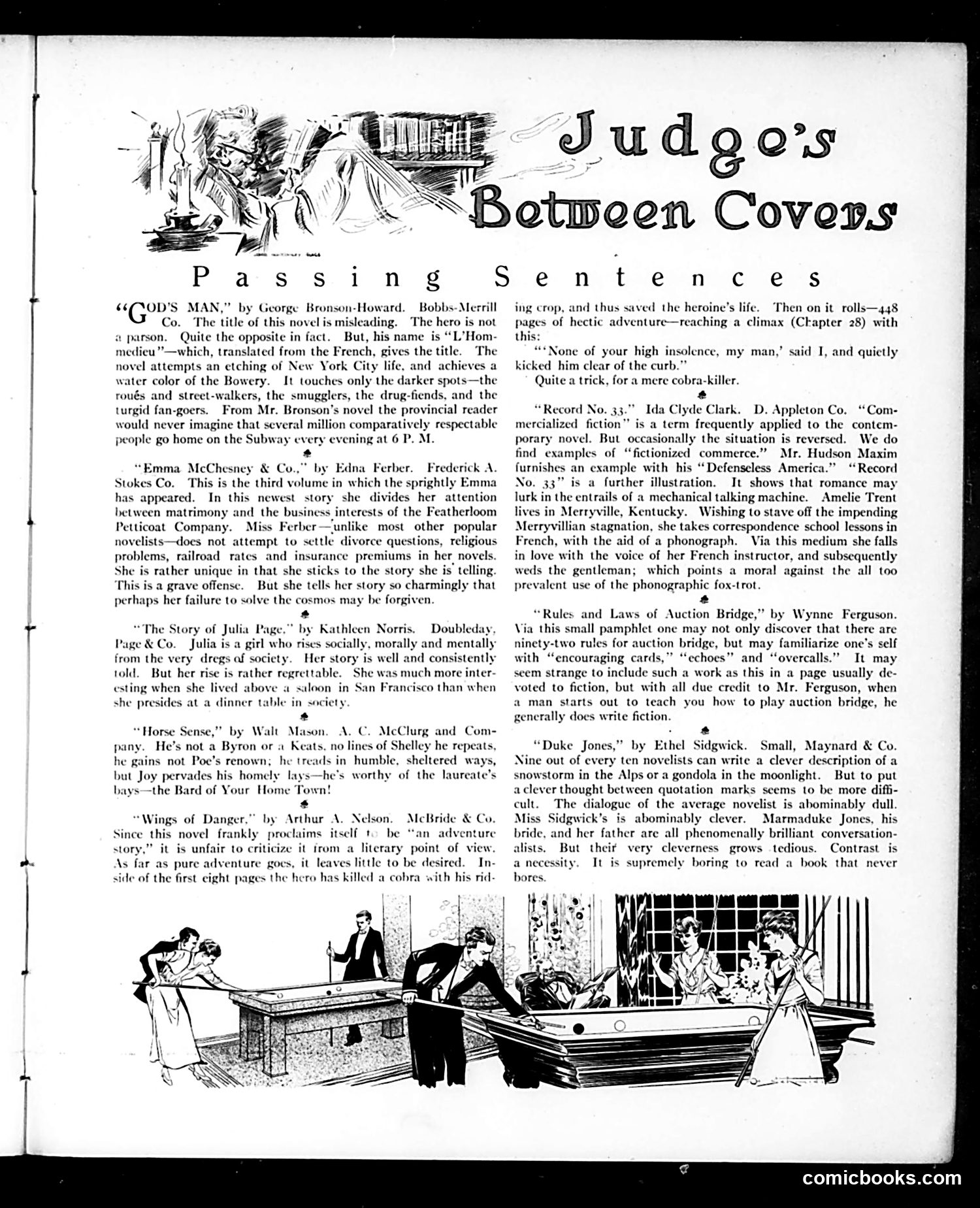
This is a **book review section** from Judge magazine, not primarily satirical content. The page surveys contemporary novels with critical commentary. The reviews mock literary pretension and commercialism: a novel titled "God's Man" disappoints by focusing only on NYC's seedy underworld; another author is praised for simply *telling a story* rather than solving cosmic questions; a adventure tale absurdly has its hero kill a cobra with a riding crop; and "fictionized commerce" (romance wrapped around mechanical talking machines) replaces genuine storytelling. The **illustration at bottom** shows people playing billiards/pool—a social scene typical of the era's leisure activities—accompanying these reviews of popular fiction. The satire targets how contemporary novelists either sensationalize urban life or reduce fiction to commercial formulas, rather than crafting genuine narrative.
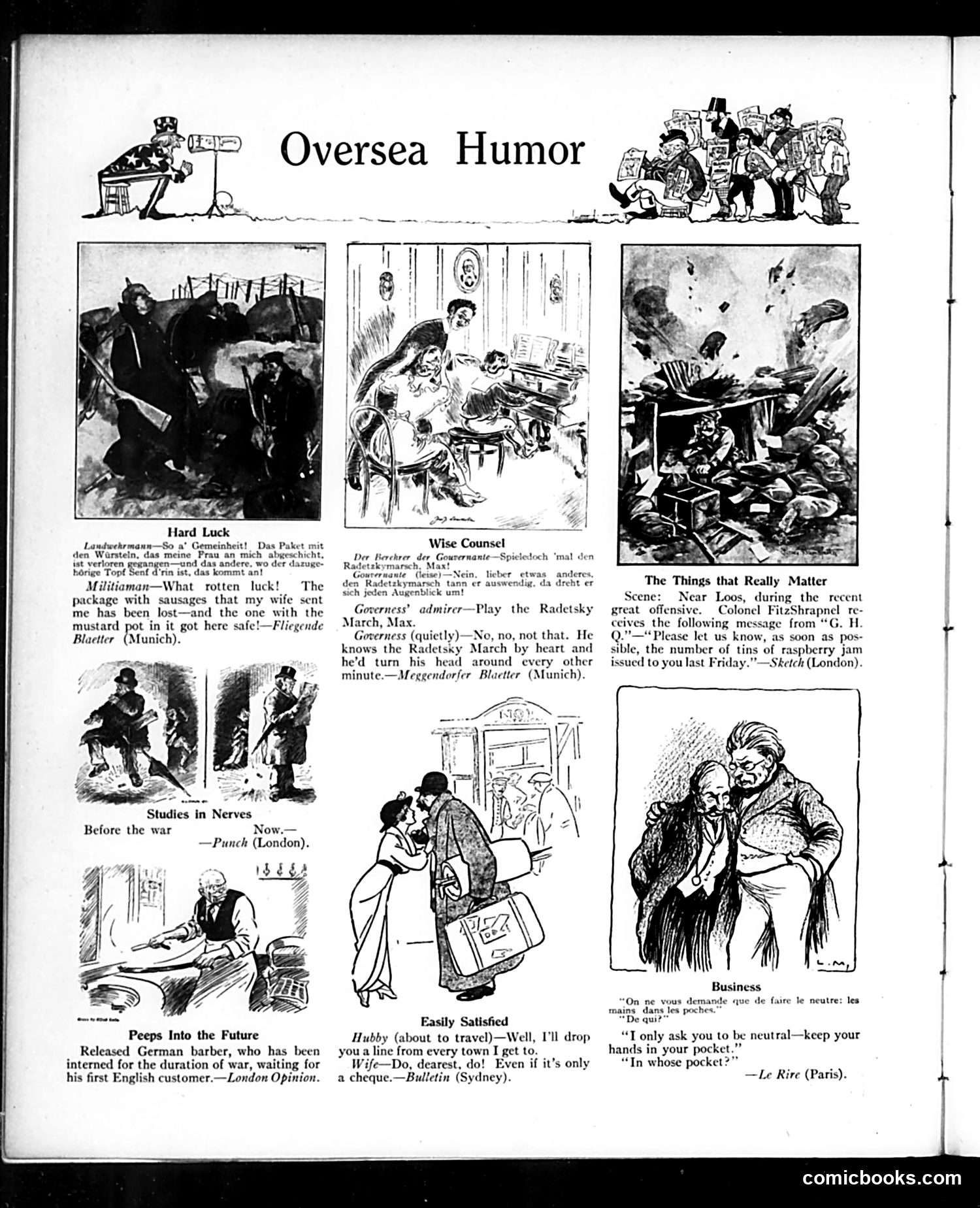
This page collects humorous cartoons from Allied and neutral publications during World War I, showcasing how different countries satirized wartime conditions. **"Hard Luck"** mocks a German soldier's misfortune: his wife's sausage package was lost, but the mustard arrived—inverting normal expectations of what matters. **"Studies in Nerves"** contrasts pre-war and wartime anxiety, suggesting civilians' nervousness increased dramatically during conflict. **"Peeps Into the Future"** darkly jokes about a German barber released from internment, awaiting British customers—implying unclear prospects for German nationals post-war. **"Wise Counsel"** shows a governess rejecting an admirer because he can't play the Austrian military march "Radetsky March" by heart—trivializing romantic compatibility during wartime. **"The Things that Really Matter"** satirizes military bureaucracy: Colonel FitzShrapnel cares only about raspberry jam inventory counts, not actual combat conditions. **"Business"** and **"Easily Satisfied"** offer light domestic humor about neutrality and marital expectations. The page demonstrates how wartime satire functioned across Allied nations, emphasizing absurdity, cultural stereotypes, and bureaucratic folly.
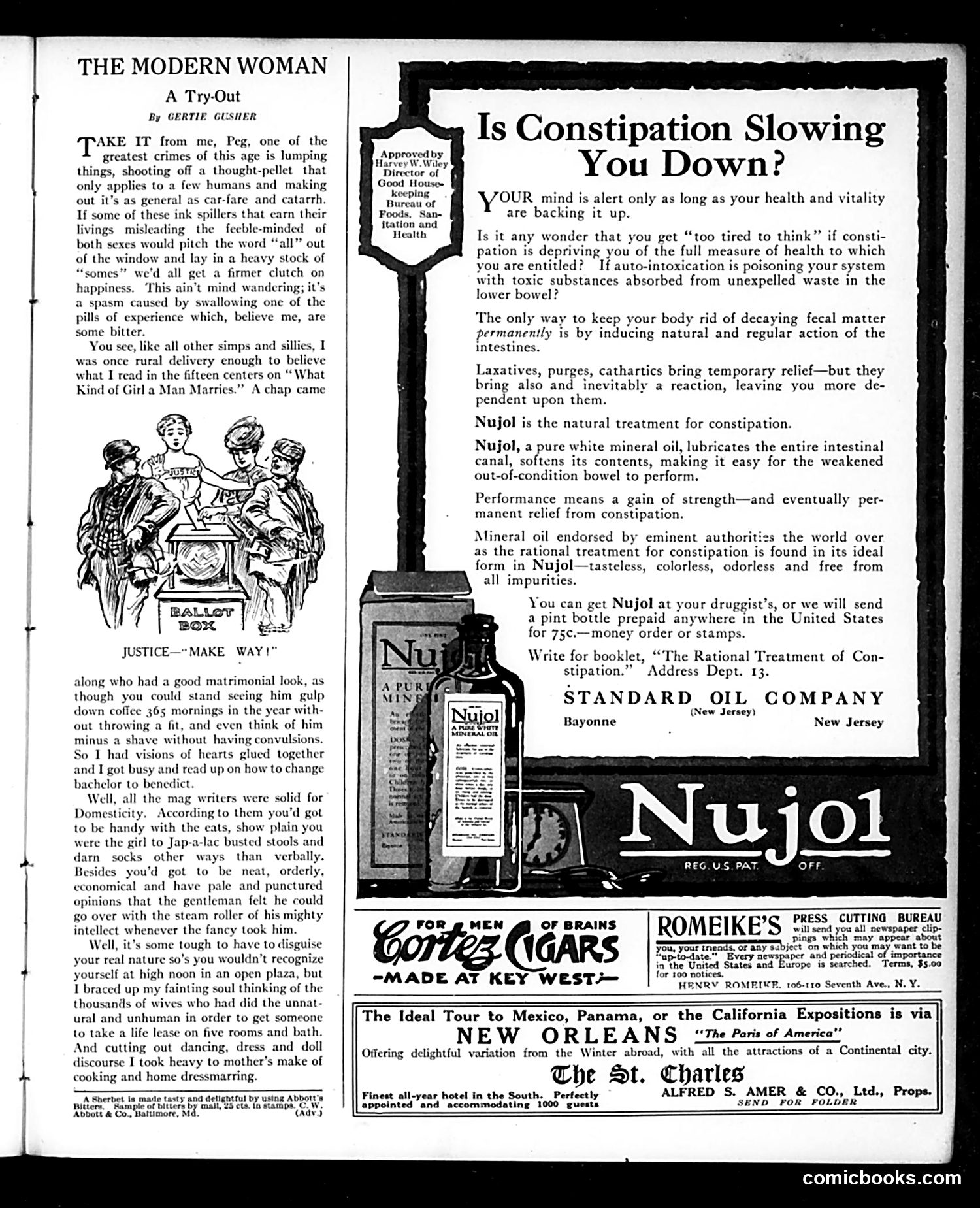
This satirical piece by Gertie Gusher mocks prescriptive magazine advice about how women should behave to catch husbands. The narrator describes reading articles in "fifteen cent" women's magazines that prescribed rigid domesticity—being handy, neat, orderly, economical, and deferring to male intellect through the "steam roller" of masculine reasoning. The cartoon's caption "JUSTICE—'MAKE WAY!'" (showing a woman asserting herself) suggests the satire's real target: the tension between emerging "modern women" seeking independence and traditional expectations. Gusher ridicules the false promise that self-erasure guarantees marital happiness, having painfully adopted these behaviors only to discover their artificiality. The page is primarily advertising (Nujol laxative, Cortez cigars, hotels), typical of Judge magazine's commercial nature, but Gusher's column uses humor to critique outdated gender prescriptions for an early 20th-century female readership navigating changing social roles.
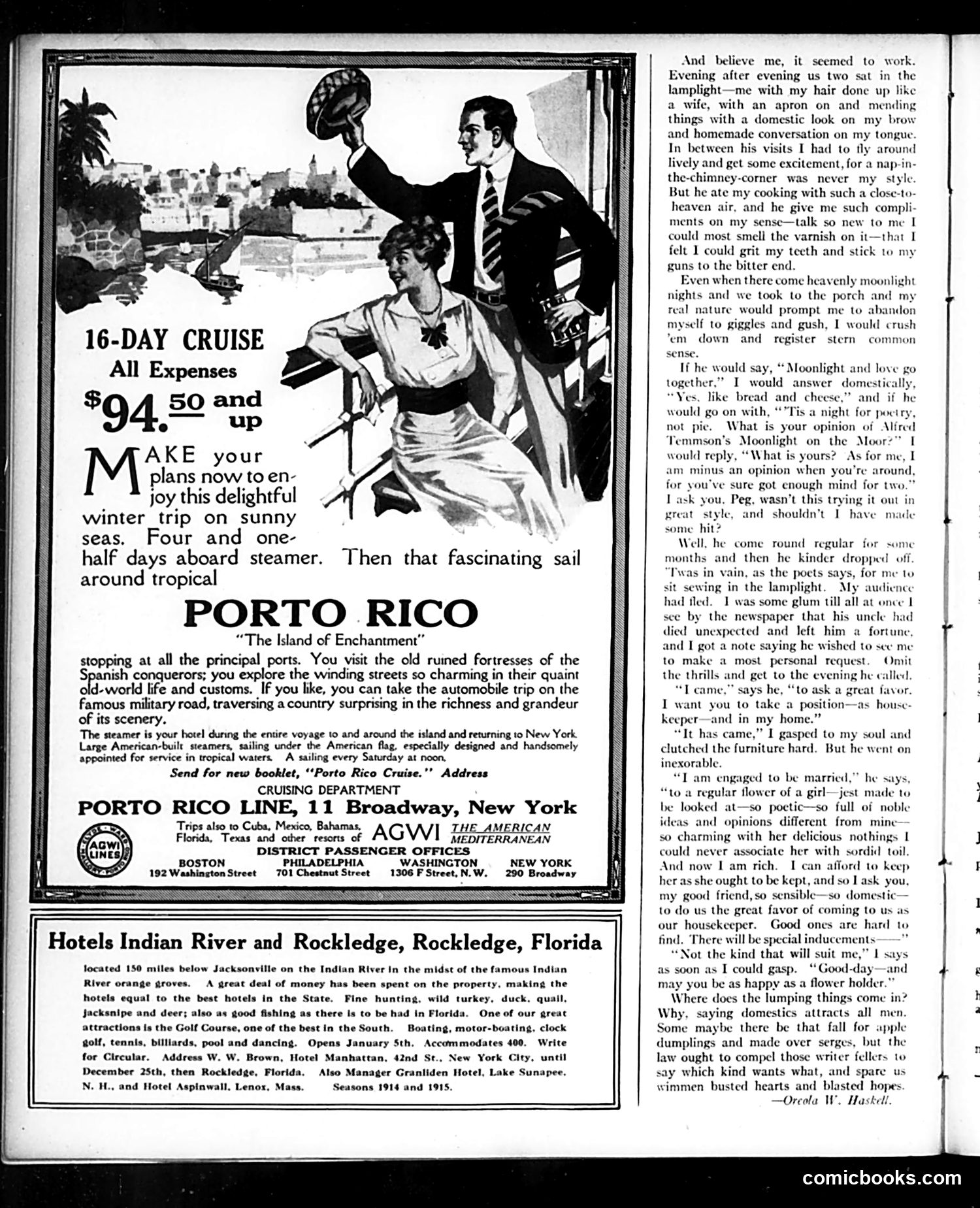
This page is primarily **advertising**, not satirical content. It contains three travel/hotel advertisements: 1. **Porto Rico Cruise** ($94.50, 16 days): Promotes tropical tourism to Puerto Rico, emphasizing exotic scenery, Spanish colonial ruins, and leisure activities. This reflects early 20th-century American tourism marketing to U.S. territories. 2. **Hotels Indian River and Rockledge, Florida**: Advertises luxury winter resort amenities (hunting, fishing, golf, dancing) in Florida, targeting wealthy northeastern visitors seeking warm-weather escapes. 3. **Right-side column**: A serialized domestic fiction story about a woman adopting a "homemade" persona—pretending to be domestic and domestic-minded—to attract a suitor, ultimately failing when he stops visiting. The advertisements reflect **Gilded Age leisure culture**: wealthy Americans traveling to warm climates and resorts. The fiction story satirizes gender performance and courtship rituals of the era. No specific political cartoons or identifiable caricatures appear.
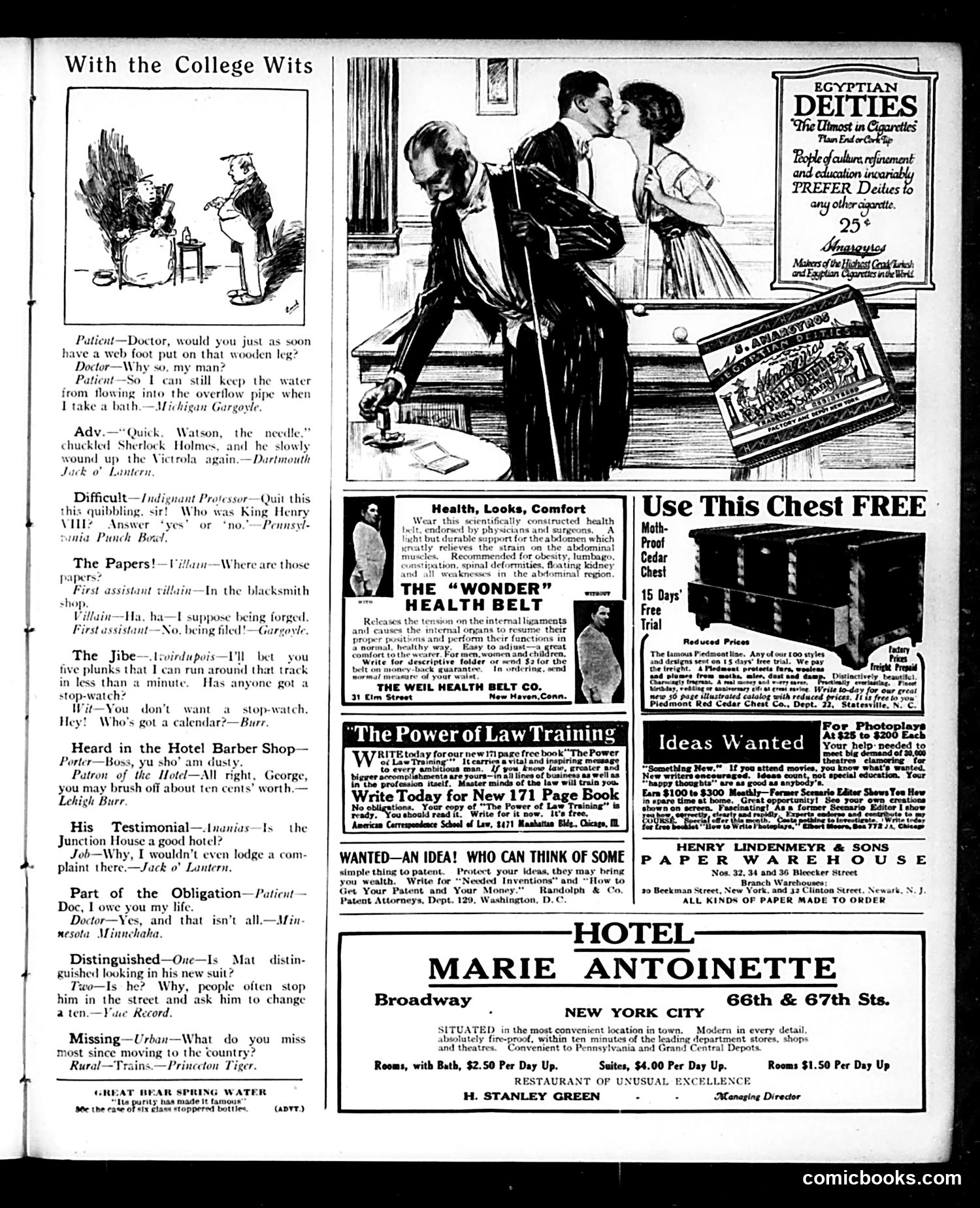
This page from *Judge* magazine consists primarily of **college humor** reprinted from various university publications, plus advertisements. The "With the College Wits" section collects short jokes and quips from sources like the Michigan Gargoyle, Dartmouth Jacko' Lantern, and Pennsylvania Punch Bowl. The jokes rely on wordplay and absurdist logic typical of 1920s college humor—a patient wanting a "web foot" for his wooden leg to manage bathwater overflow, or someone joking that another person doesn't need a stopwatch to run laps because "who's got a calendar?" The main illustration (top center) shows a couple kissing while a man plays what appears to be a Victrola (early phonograph), likely accompanying a joke about Sherlock Holmes and recorded music. The page is otherwise **dominated by period advertisements**: health belts, law training programs, patent services, hotel listings, and paper warehouse services—typical commercial content for this era's magazines. No specific political figures or events are referenced; this is entertainment-focused content aimed at a educated, middlebrow audience.
This is primarily an **advertising and humor page**, not political satire. The main content includes: **"Passing the Mustard"** (center): A moralizing poem about ancestors, asking whether one would be proud *to* meet one's forebears, or whether they'd be proud *of you*—a gentle joke on social pretension and family trees. **Short humor pieces** below the poem: Collection of brief domestic and workplace jokes with familiar early-20th-century themes—wives criticizing husbands' fishing, applicants avoiding working with children, conductors making mistakes, etc. These are gentle, inconsequential gags about everyday life. **Advertisements**: Multiple liquor ads (Club Cocktails, Old Overholt Rye, Evans Ale) and job-training ads dominate the page. The "Avoid This Ad" at bottom is meta-humor, warning readers not to fall for inferior correspondence-school cartooning courses. **Overall**: This reflects Prohibition-era advertising (liquor ads still appearing), American domestic humor conventions, and the magazine's mix of satire, advertising, and mild comedy typical of the period.
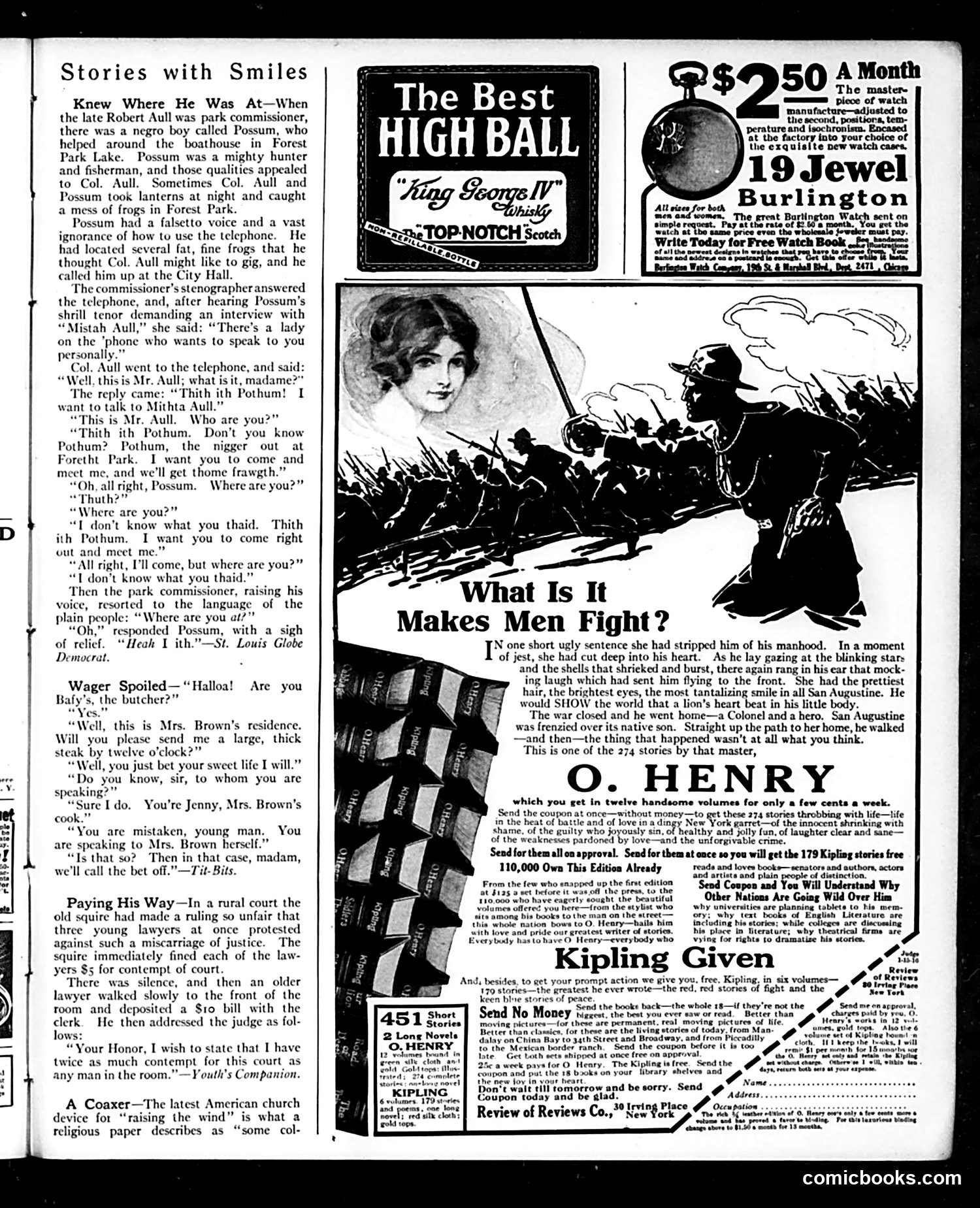
This page from Judge magazine contains primarily **humorous anecdotes** rather than political cartoons. The main content consists of four short stories illustrating verbal misunderstandings and social comedy: 1. **"Knew Where He Was At"**: A dialect humor piece featuring a Black park worker named Possum who cannot understand formal English on the telephone until the commissioner uses plain speech ("Where are you at?"). The humor relies on period stereotypes about dialect and class differences. 2. **"Wager Spoiled"**: A butcher mistakenly thinks he's speaking to the cook but is actually speaking to the homeowner, Mrs. Brown, leading to an awkward revelation. 3. **"Paying His Way"**: A lawyer pays a fine to mock a judge's unfair ruling, doubling down on contempt of court. 4. **"A Coaxer"**: A brief note about church fundraising methods. The page also contains extensive **advertising** for O. Henry story collections, Burlington watches, and Kipling books—typical of early 20th-century magazines. There is no clear political satire visible; the humor is primarily social comedy based on misunderstandings and class/racial stereotypes common to that era.
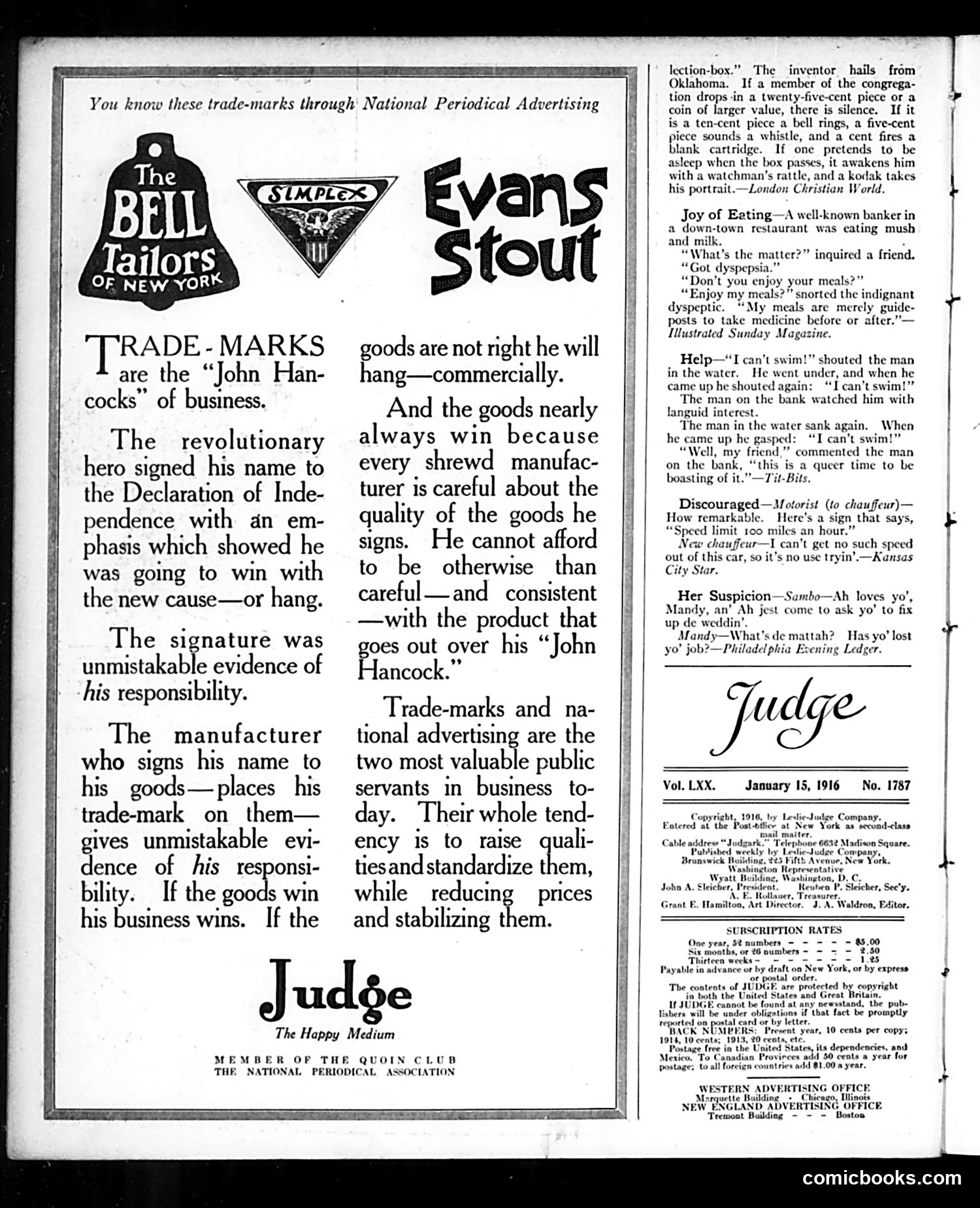
This page is primarily **advertising and editorial content**, not a political cartoon. The left side features a substantial advertisement for Judge magazine itself, promoting the value of trade-marks and national advertising. It uses John Hancock's famous Declaration of Independence signature as a metaphor—just as Hancock's signature showed personal responsibility, manufacturers who put their names on products stake their reputation on quality. The right side contains miscellaneous **humor snippets** from readers: jokes about a church collection box that rewards donations with noise, a dyspeptic banker, a drowning man who can't swim, a motorist's complaint about speed limits, and a suspicious woman questioning her suitor's employment. These are lighthearted fillers typical of the era's humor magazines—no specific political figures or events are referenced. The page reflects early-20th-century American consumer culture and working-class domestic life.
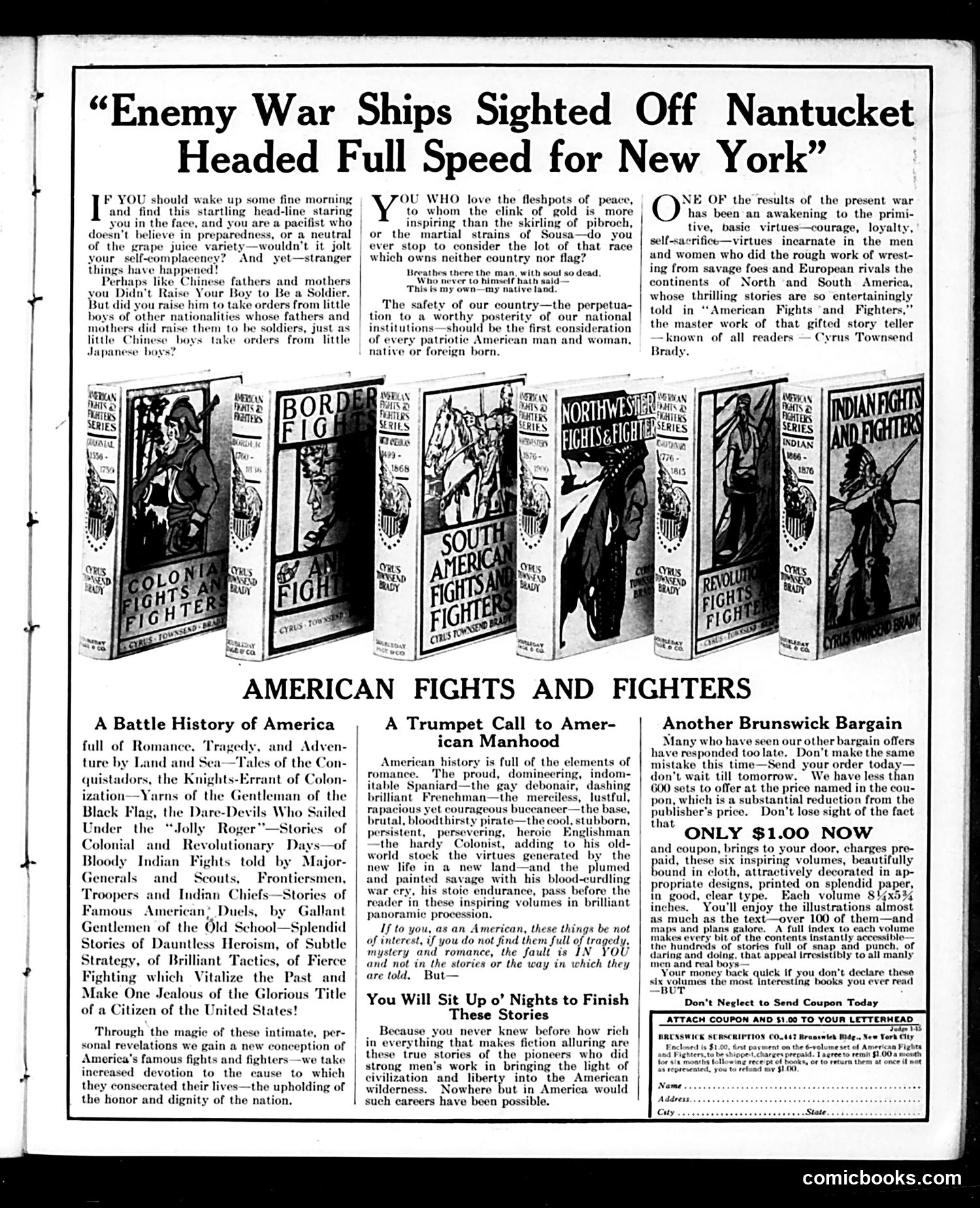
This page is primarily **advertising** for a book series called "American Fights and Fighters" by Cyrus Townsend Brady, positioned as patriotic historical narratives about American military and frontier history. The satirical headline—"Enemy War Ships Sighted Off Nantucket Headed Full Speed for New York"—is a **fear-mongering device** meant to wake pacifists to "preparedness." The opening text mocks anti-war sentiment and those who didn't want to militarize children, sarcastically suggesting Americans should fear invasion. The accompanying editorial text argues that national safety requires patriotic sacrifice, contrasting those who love "peace" and profit over martial virtue. It references recent war ("the present war"—likely WWI era) as having revived "basic virtues." The six book covers shown display classic frontier/military imagery: colonial fighters, border conflicts, South American battles, and Indian fights—all presented as exciting narratives of American expansion. **The satire targets pacifists and isolationists**, using alarmist scenarios to argue for military preparedness and nationalist education through heroic historical tales.
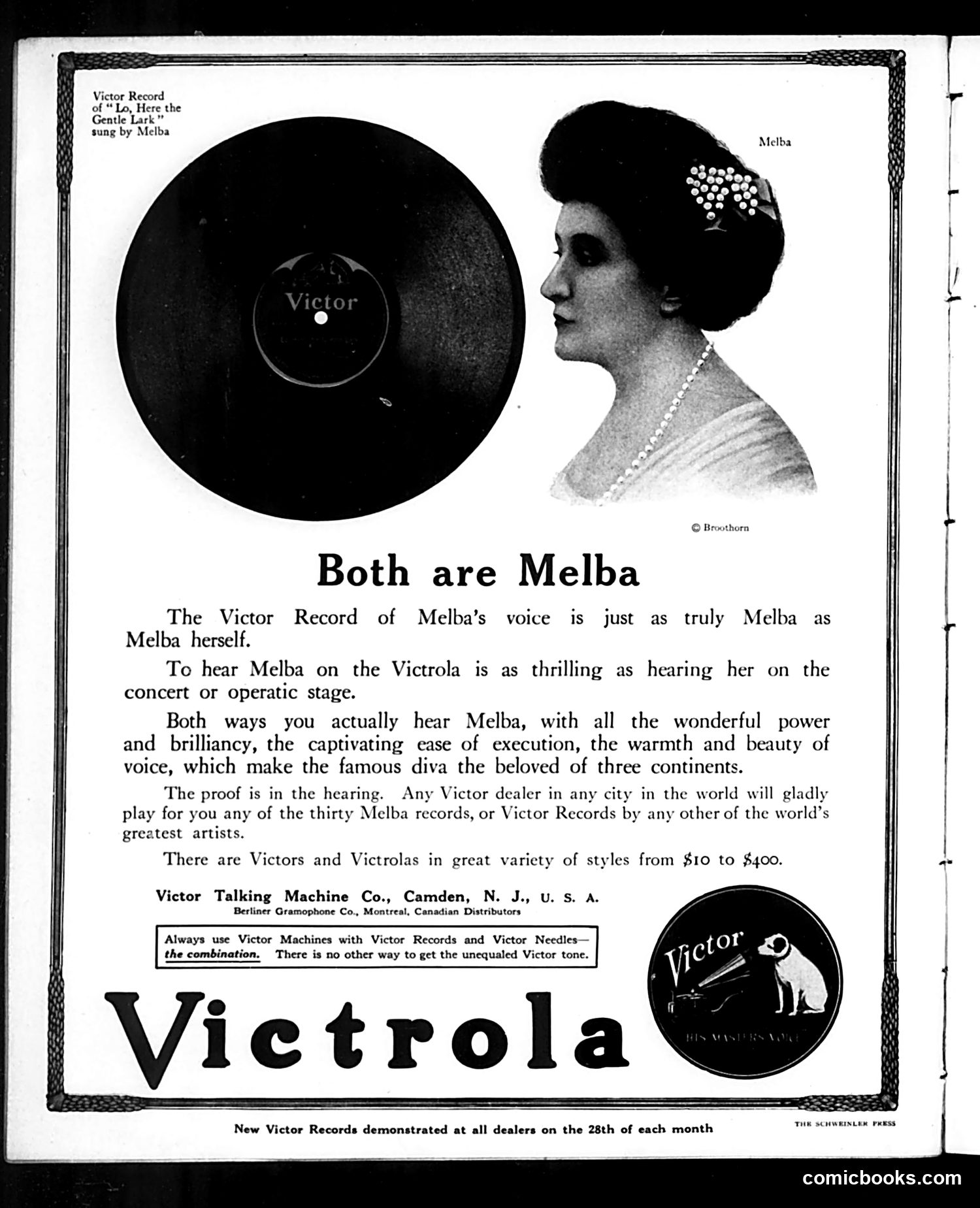
This is not a cartoon or satire, but a **product advertisement** for the Victor Talking Machine Company's Victrola phonograph player. The page features **Melba**, the famous Australian opera singer Nellie Melba, alongside a Victor record. The advertisement's central claim is that hearing Melba's recorded voice on a Victrola is virtually identical to hearing her perform live on stage—"Both are Melba." **Context for modern readers**: This represents early 20th-century marketing for recorded music technology. At that time, phonograph sound quality was still developing, and the ability to hear a celebrated international opera star in one's home was genuinely novel and remarkable. The ad emphasizes that the recording captures "all the wonderful power and brilliancy" of her voice, attempting to overcome skepticism about whether mechanical reproduction could preserve an artist's performance authentically. The advertisement runs in *Judge* magazine because such luxury products appealed to its affluent readership.