
Judge, 1916-01-15 · page 19 of 28
Judge — January 15, 1916 — page 19: what you’re looking at
What you’re looking at
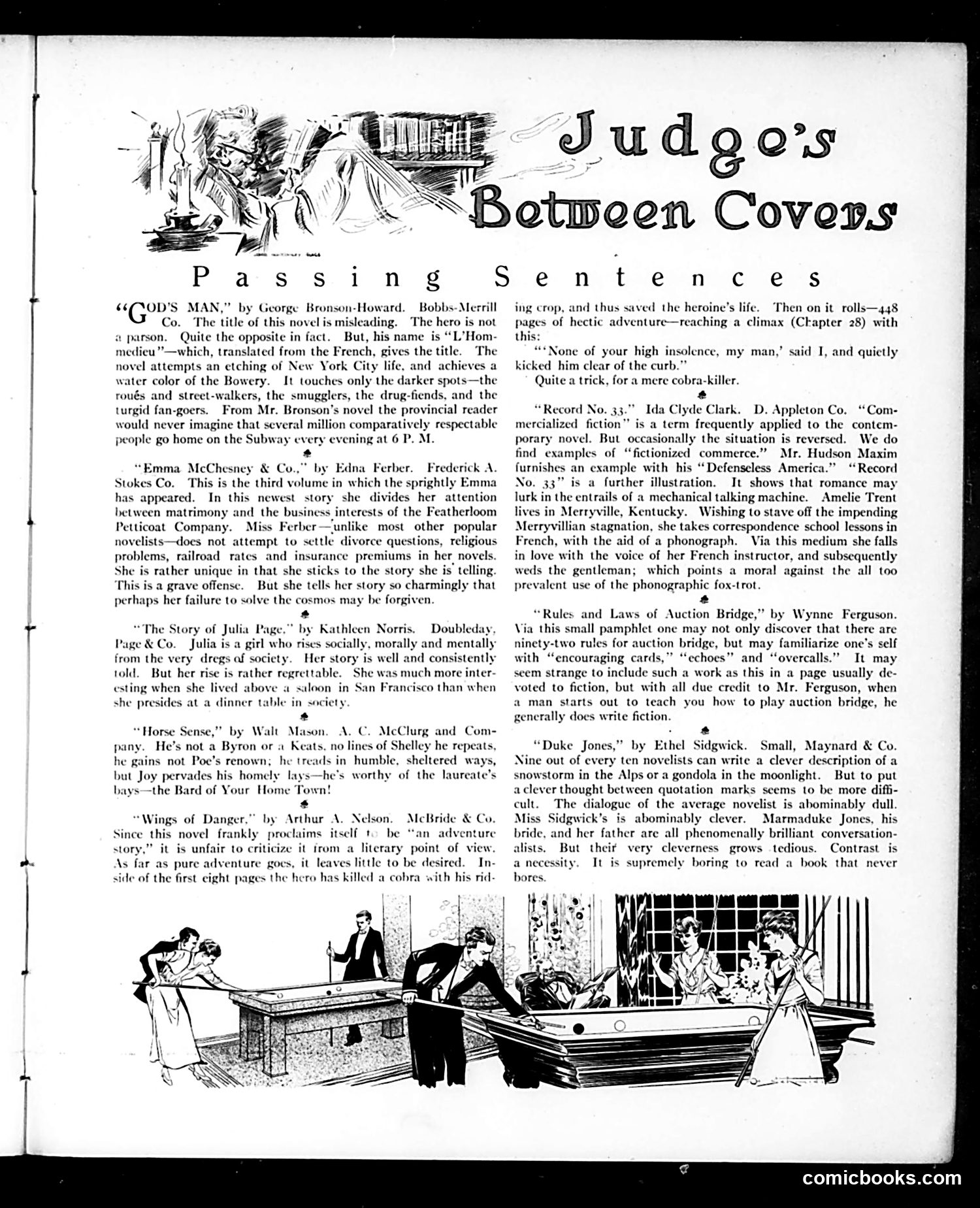
This is a **book review section** from Judge magazine, not primarily satirical content. The page surveys contemporary novels with critical commentary. The reviews mock literary pretension and commercialism: a novel titled "God's Man" disappoints by focusing only on NYC's seedy underworld; another author is praised for simply *telling a story* rather than solving cosmic questions; a adventure tale absurdly has its hero kill a cobra with a riding crop; and "fictionized commerce" (romance wrapped around mechanical talking machines) replaces genuine storytelling. The **illustration at bottom** shows people playing billiards/pool—a social scene typical of the era's leisure activities—accompanying these reviews of popular fiction. The satire targets how contemporary novelists either sensationalize urban life or reduce fiction to commercial formulas, rather than crafting genuine narrative.
📄 Transcribed text from this page (OCR, searchable)
Machine-transcribed from the original scan — historical spelling and the odd misread are preserved.
in g Bobbs-M 66QX0D'S MAN,” by George Bronson-Howard. rill Co. The title of this novel is misleading. The hero is not 2 parson. Quite the opposite in fact. But, his name is “L’Hom- medieu””—which, translated from the French, gives the tit The novel attempts an etching of New York City life, and achieves a water color of the Bowery. It touches only the darker spots—the roués and street-walkers, the smugglers, the drug-fiends, and the turgid fan-goers. From Mr. Bronson’s novel the provincial reader would never imagine that several million comparatively respectable people go home on the Subway every evening at 6 P. M. 2 mma McChesney & Co., na Ferber. Frederick A. Stokes Co. This is the third volume in which the sprightly Emma has appeared. In this newest story she divides her attention between matrimony and the business interests of the Featherloom Petticoat Company. Miss Ferber —unlike most other popular novelists—does not attempt to settle divorce questions, religious problems, railroad rates and insurance premiums in her, novels. She is rather unique in that she sticks to the story she is telling. ‘This is a grave offense. But she tells her story so charmingly that perhaps her failure to solve the cosmos may be forgiven. * “The Story of Julia Page.” by Kathleen Norris. Doubleday, Page & Co. Julia is a girl who rises socially, morally and mentall. from the very dregs af society. Her story is well and consistently told. But her rise is rather regrettable. She was much more inter- esting when she lived above a sitloon in San Francisco than when she presides at a dinner table in society * “Horse Sense,” by Walt) Mason. A. C. McClurg and Com- He’s not a Byron or a Keats, no lines of Shelley he repeats, ins not Poe’s renown; he treads in humble, sheltered ways, but Joy pervades his homely lays—he’s worthy of the laureate’s bays—the Bard of Your Home Town! ¢ “Wings of Danger,” by Arthur A. Nelson. McBride & Co, Since this novel frankly proclaims itself 1 be “an adventure story,” it is unfair to criticize it irom a literary point of view. As far as pure adventure gocs. leaves little to be desired. In- side of the first eight pages the hero has killed a cobra with his rid- Se. mirtena c e § ing crop, and thus sa the heroine's life. Then on it rolls—448 pages of hectic adventure—reaching a climax (Ckapter 28) with this: None of your high insolence, my man,’ kicked him clear of the curb.” Quite a trick, for a mere cobra-killer. # “Record No. 33.” Ida Clyde Clark. D. Appleton Co. “Com- mercialized fiction” is a term frequently applied to the contem- porary novel. But occasionally the situation is reversed. We do find examples of “fictionized commerce.” Mr. Hudson Maxim furnishes an example with his “Defenseless America.” “Record 3” is a further illustration. It shows that romance may the entrails of a mechanical talking machine. Amelie Trent lives in Merryville, Kentucky. Wishing to stave off the impending Merryvillian stagnation, she takes correspondence school lessons in French, with the aid of a phonograph. Via this medium she falls in love with the voice of her French instructor, and subsequently weds the gentleman; which points a moral against the all too prevalent use of the phonographic fox-trot. 2 “Rules and Laws of Auction Bridge,” by Wynne Ferguson. Via this small pamphlet one may not only discover that there are ninety-two rules for auction bridge, but may familiarize one’s self with “encouraging cards,” “echoes” and “overcalls.” It may seem strange to include such a work his in a page usually de- voted to fiction, but with all due credit to Mr. Ferguson, when a man starts out to teach you how to play auction bridge, he generally does write fiction. said I, and quietly : * ” by Ethel Sidgwick. Small, Maynard & Co. Nine out of every ten novelists can write a clever description of a snowstorm in the Alps or a gondola in the moonlight. But to put aclever thought between quotation marks seems to be more diffi- The dialogue of the average novelist is abominably dull. s Sidgwick’s is abominably clever. Marmaduke Jones, his bride, and her father are all phenomenally brilliant. conversation- But their very cleverness grows tedious. Contrast is It is supremely boring to read a book that never “Duke Jones comicbooks.com