
Judge, 1916-01-15 · page 18 of 28
Judge — January 15, 1916 — page 18: what you’re looking at
What you’re looking at
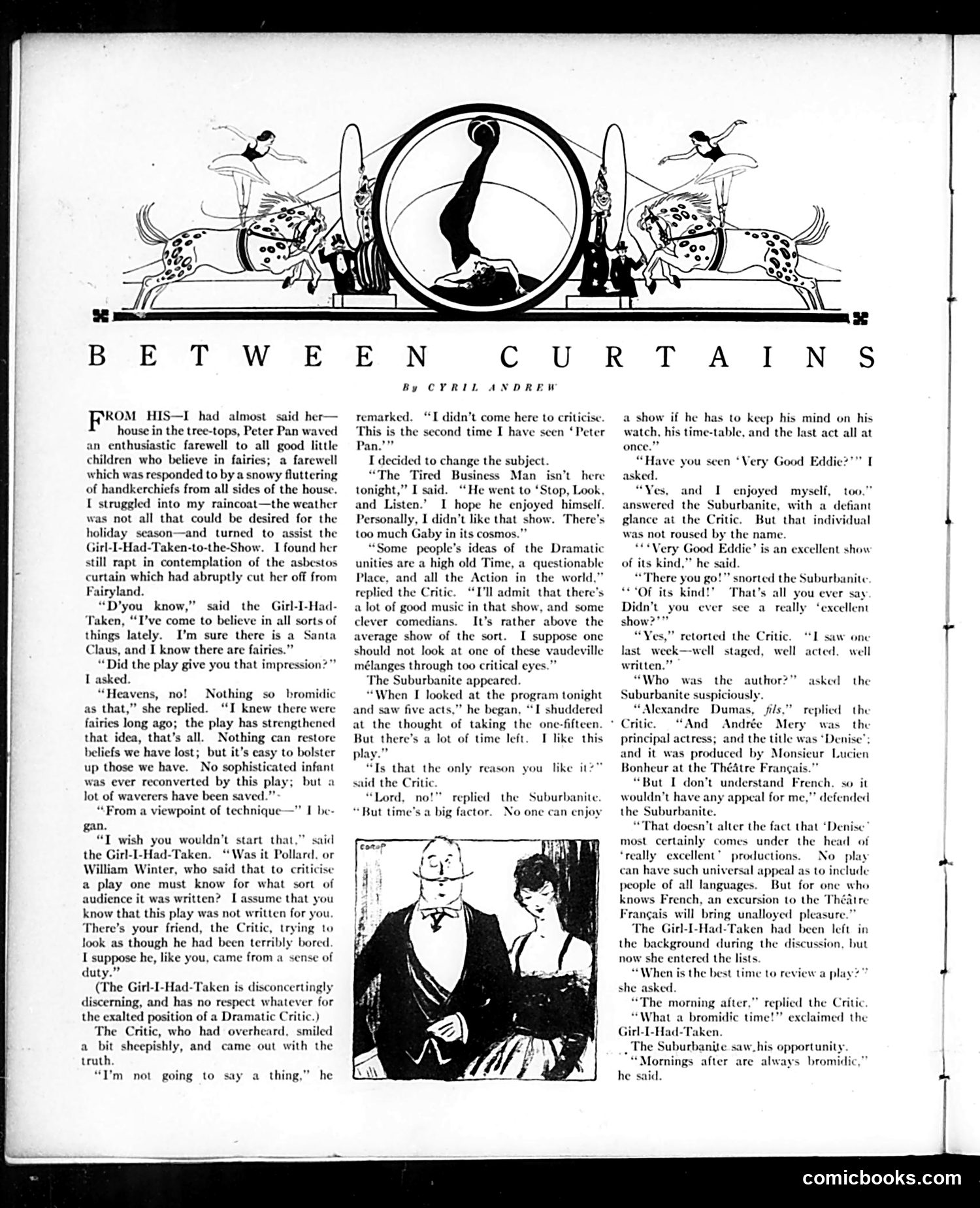
This is a satirical dialogue about theatrical criticism and audience taste. The main characters are a theater critic, a young woman ("Girl-I-Had-Taken"), and a suburban commuter, discussing plays they've seen: *Peter Pan*, *Stop, Look, and Listen*, and *Very Good Eddie*. The satire targets the **pretentious theater critic** who dismisses popular entertainment (*Peter Pan*, vaudeville) while praising obscure foreign works (*Denise* by Alexandre Dumas fils at the Théâtre Français) that ordinary audiences cannot appreciate. The suburbanite and young woman represent sensible viewers—one values entertainment that doesn't interfere with catching his train; the other recognizes that the critic's refined taste is impractical. The joke: sophisticated critics championing inaccessible foreign drama over genuinely entertaining American theatrical productions, disconnected from what actual audiences enjoy or understand.
📄 Transcribed text from this page (OCR, searchable)
Machine-transcribed from the original scan — historical spelling and the odd misread are preserved.
BosE 'T OW °E ROM HIS—I had almost said her— house in the tree-tops, Peter Pan waved an enthusiastic farewell to all good little children who believe in fairies; a farewell which was responded to by a snowy fluttering of handkerchiefs from all sides of the house. I struggled into my raincoat—the weather was not all that could be desired for the holiday season—and turned to assist the Girl-I-Had-Taken-to-the-Show. I found her still rapt in contemplation of the asbestos curtain which had abruptly cut her off from Fairyland. “D’you know,” said the Girl-I-Had- Taken, “I’ve come to believe in all sorts of things lately. I’m sure there is Santa Claus, and I know there are fairies. “Did the play give you that impression?” I asked. “Heavens, no! Nothing so bromidic hat,” she replied. “I knew there were ics long ago; the play has strengthened that idea, that’s all. Nothing can restore beliefs we have lost; but it’s easy to bolster up those we have. No sophisticated infant was ever reconverted by this pl but a lot of waverers have been saved. “From a viewpoint of technique—” I be- gan. “I wish you wouldn't start that,” said the Girl-I-Had-Taken. ‘Was it Pollard. or William Winter, who said that to criticise a play one must know for what sort of audience it was written? I assume that you know that this play was not written for you. There’s your friend, the Critic, trying to look as though he had been terribly bored I suppose he, like you, came from a sense of duty.” (The Girl-I-Had-Taken is disconcertingly discerning, and has no respect whatever for the exalted position of a Dramatic Critic.) The Critic, who had overheard, smiled a bit sheepishly, and came out with the truth. “I'm not going to say a thing,” he E N By CYRIL ANDREW remarked. “TI didn’t come here to criticise. This is the second time I have seen ‘Peter Pan.’” I decided to change the subject. “The Tired Business Man isn’t here tonight,” I said. “He went to ‘Stop, Look, and Listen.’ I hope he enjoyed himself Personally, I didn’t like that show. There's too much Gaby in unities are Place, and all the Action in the world,” replied the Critic. “I'l admit that there's. a lot of good mus that show \d some clever comedians. It’s rather above the average show of the sort. I suppose one should not look at one of these vaudeville mélanges through too critical eyes.” The Suburbanite appeared. “When I looked at the program tonight and saw five acts,” he began, “1 shuddered at the thought of taking the one-fifteen. But there’s a lot of time left. I like this play.” Is that the only reason you like it?” said the Critic “Lord, no!” replied the Suburbani “But time’s a big factor. No one can enjoy C U RTA * Cri a show if he has to keep his mind on his watch, his time-table, and the last act all at once.” “Have you seen ‘Very Good Eddic? asked. “Yes, and I enjoyed myself, too.” red the Suburbanite, with a defiant the Critic. But that individual ot roused by the name. “Very Good Eddi n excellent show of its kind,” he said. “There you go!” snorted the Suburbanit« “OF its kind!’ Th; pu ever say Didn’t you ever sce a really ‘excellent show?"” “Yes,” retorted the Critic. “1 saw one last. week—well staged, well acted, well written. “Who was the author?” asked the Suburbanite suspicious! “Alexandre Dumas, fils,” replied the “And Andrée Mery) was the principal actress; and the title was ‘Denise’; and it was produced by Monsieur Lucien Bonheur at the ThéAtre Frangais.”” “But [ don’t unde id French, so it wouldn’t have any appeal for me,’ defended the Suburbanit “That doesn’t alter the fact that ‘Denise most certainly comes under the head of ‘really excellent’ productions. No play can have such universal appeal as to includ people of all languages. But for one who knows French, an excursion to the Théatre " unalloyed pleasure.” en had been left in the background during the discussion, but now she entered the lists. “When is the best time to review a play?” she asked. “The morning after,” replied the Critic “What a bromidic time!” exclaimed the _ The “Mornings after are always bromidic,” he said. comicbooks.com