
Judge, 1916-01-15 · page 10 of 28
Judge — January 15, 1916 — page 10: what you’re looking at
What you’re looking at
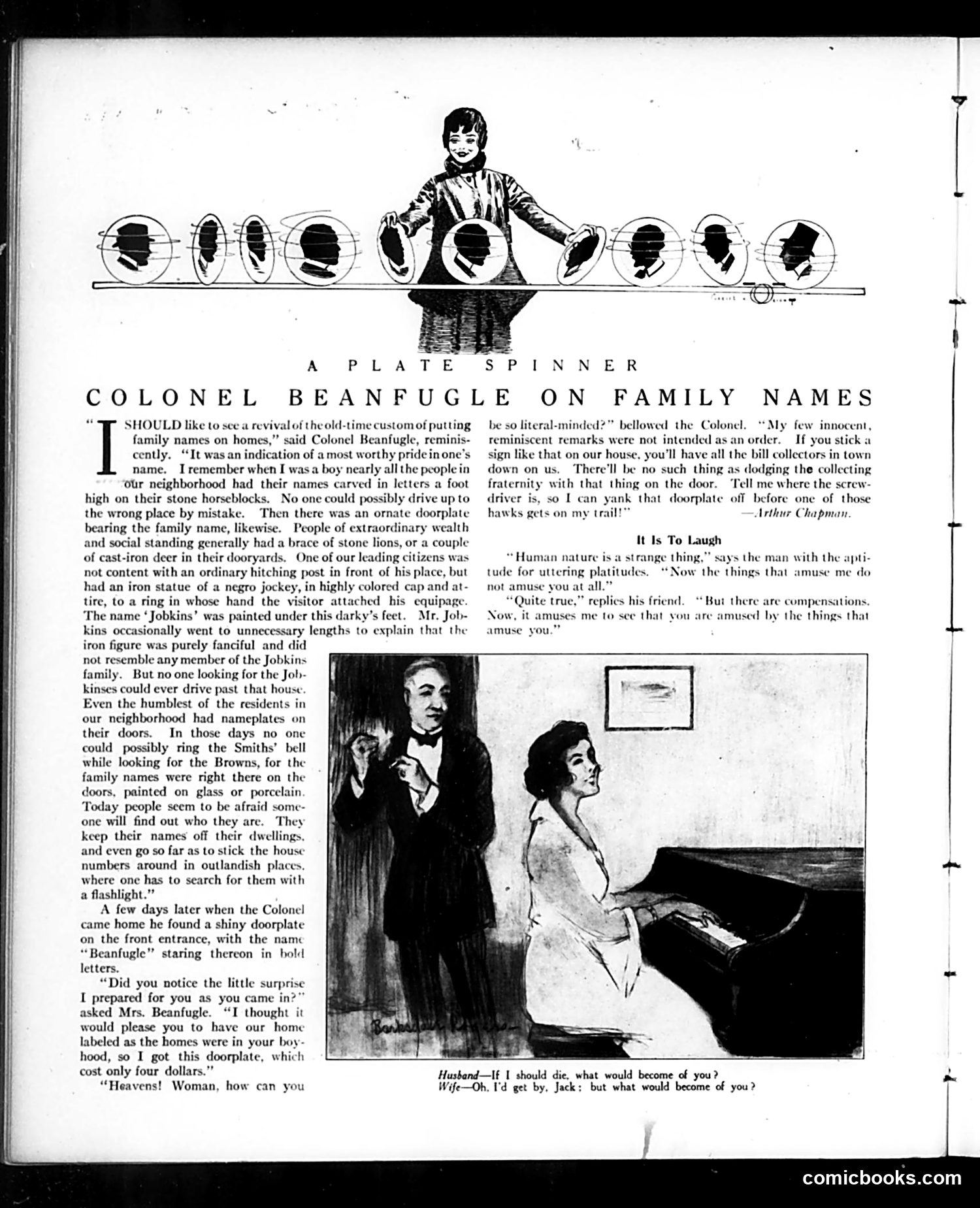
This satirical piece mocks nostalgia for older social conventions. Colonel Beanfugle romanticizes 19th-century practices of displaying family names prominently on homes—carved stones, ornate doorplates, even decorative lawn statuary—as markers of respectability and pride. The humor lies in the gap between sentiment and practical reality. When his wife actually installs a nameplate following his wistful advice, the Colonel immediately panics: such visibility would allow bill collectors and creditors to find him. His cherished emblem of honor becomes a liability in a world of debt and financial obligations. The satire targets not just Beanfugle's hypocrisy, but broader American anxiety about privacy and class in the modern era. People avoided displaying their names precisely *because* identification invited unwanted attention from creditors—revealing that respectability and vulnerability were two sides of the same coin.
📄 Transcribed text from this page (OCR, searchable)
Machine-transcribed from the original scan — historical spelling and the odd misread are preserved.
o=-3 A PLATE SPINNER COLONEL BEANFUGLE ON FAMILY NAMES bet SHOULD like to sce a revival of theold-time custom of putting family names on home: id Colonel Beanfugle, reminis- cently, “It was an indication of a most worthy pridein one’s name. I remember when I was a boy nearly all the people in ‘our neighborhood had their names carved in letters a foot high on their stone horseblocks. No one could possibly drive up to the wrong place by mista! Then there was an ornate doorplate bearing the family name, likewise. People of extraordinary wealth and social standing generally had a brace of stone lions, or a couple of cast-iron deer in their dooryards. One of our leading citizens was not content with an ordinary hitching post in front of his place, but had an iron statue of a negro jockey, in highly colored cap and at- tire, to a ring in whose hand the visitor attached his equipage. The name ‘Jobkins’ was painted under this darky’s feet. Mr. Job- kins occasionally went to unnecessary lengths to explain that the iron figure was purely fanciful and did not resemble any member of the Jobkins family. But no one looking for the Job- kinses could ever drive past that house Even the humblest of the residents in our neighborhood had nameplates on their doors. In those days no one could possibly ring the Smiths’ bell while looking for the Browns, for the family names were right there on the doors, painted on glass or porcelain Today people seem to be afraid some- one will find out who they are. They keep their names off their dwellings. and even go so far as to stick the house numbers around in outlandish places. where one has to search for them with a flashlight.” A few days later when the Colonel came home he found a shiny doorplate on the front entrance, with the namc “Beanfugle” staring thereon in bold letters. “Did you notice the little surprise I prepared for you as you came in?” asked Mrs. Beanfugle. “I thought it would please you to have our home labeled as the homes were in your b be so literal-minded?” bellowed the Colonel. “My few innocent, reminiscent remarks were not intended as an order. If you stick a sign like that on our house, you'll have all the bill collectors in town down on us. There'll be no such thing as dodging the collecting fraternity with that thing on the door. Tell me where the screw- driver is, so I can yank that doorplate off before one of those hawks gets on my t * Arthur Chapman. It Is To Laugh “Human nature is a strange thing,” says the man with the apti- tude for uttering platitudes. ‘Now the things that amuse me do not amuse you at all.” “Quite true,” replies his friend.“ But there are compensations. Now, it amuses me to sce that vou are amused by the things that amuse you.” hood, so I got this doorplate, which cost only four dollars.”’ “Heavens! Woman, how can you Husband—If | should die, what would become of you? Wife—Oh, I'd get by, Jack; but what would become of you? comicbooks.com