
A complete issue · 28 pages · 1915
Judge — December 18, 1915
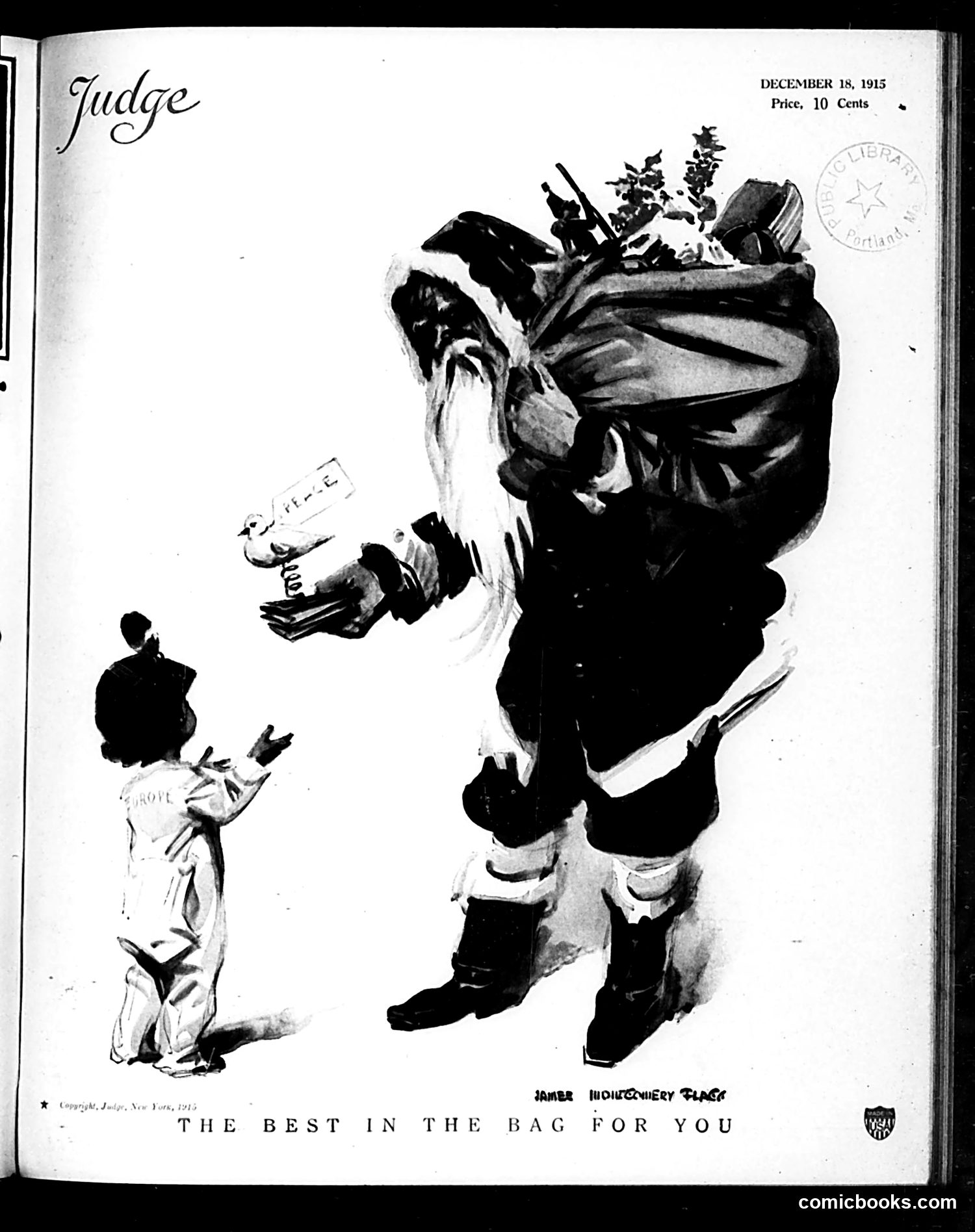
This illustration by James Montgomery Flagg depicts Santa Claus presenting a large sack of gifts to a small child. The caption reads "THE BEST IN THE BAG FOR YOU." The image appears to be a straightforward Christmas advertisement or holiday greeting rather than political satire. It celebrates consumer abundance and gift-giving during the holiday season. The contrast between the jovial, well-fed Santa figure and the modest child emphasizes commercial generosity as a seasonal virtue. Given the 1915 date during World War I, this likely represents American consumer culture and optimism, distinct from the conflict affecting Europe. The illustration promotes holiday shopping and gift-purchasing as patriotic American normalcy.
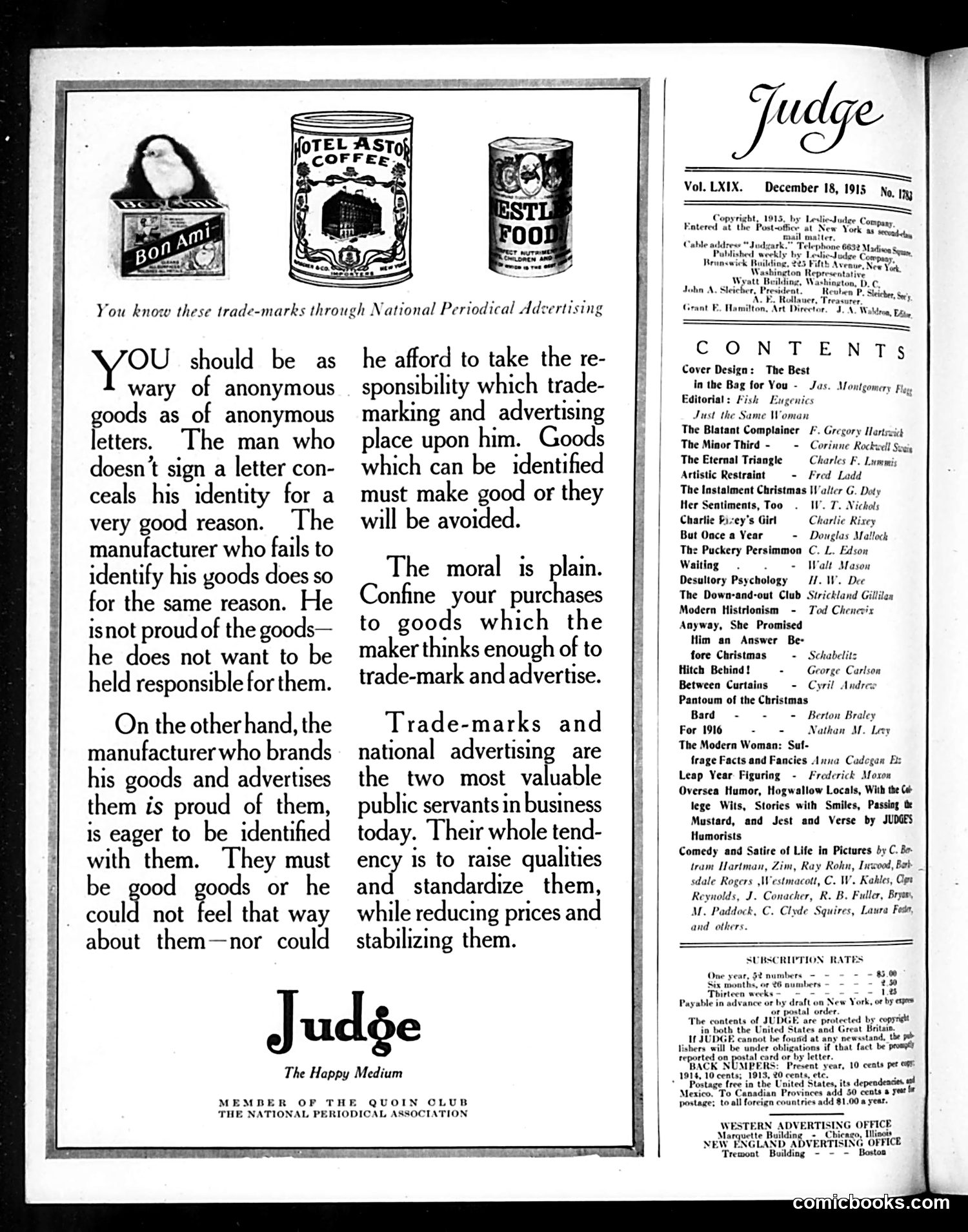
This page is primarily **advertising and editorial content** rather than political cartoon. The left side features an advertisement for Judge magazine itself, using three branded product images (Bon Ami, Hotel Astor Coffee, Nestlé Food) as examples. The accompanying editorial argues that **manufacturers should proudly brand and advertise their goods** rather than hide behind anonymous labels. The logic: reputable makers stand behind quality products, while those concealing identity lack confidence in their wares. This reflects Progressive Era consumer protection concerns about product safety and manufacturer accountability. The right side lists table of contents and subscription rates for this December 1915 issue. The satirical magazine was published by Leslie-Judge Company in New York.
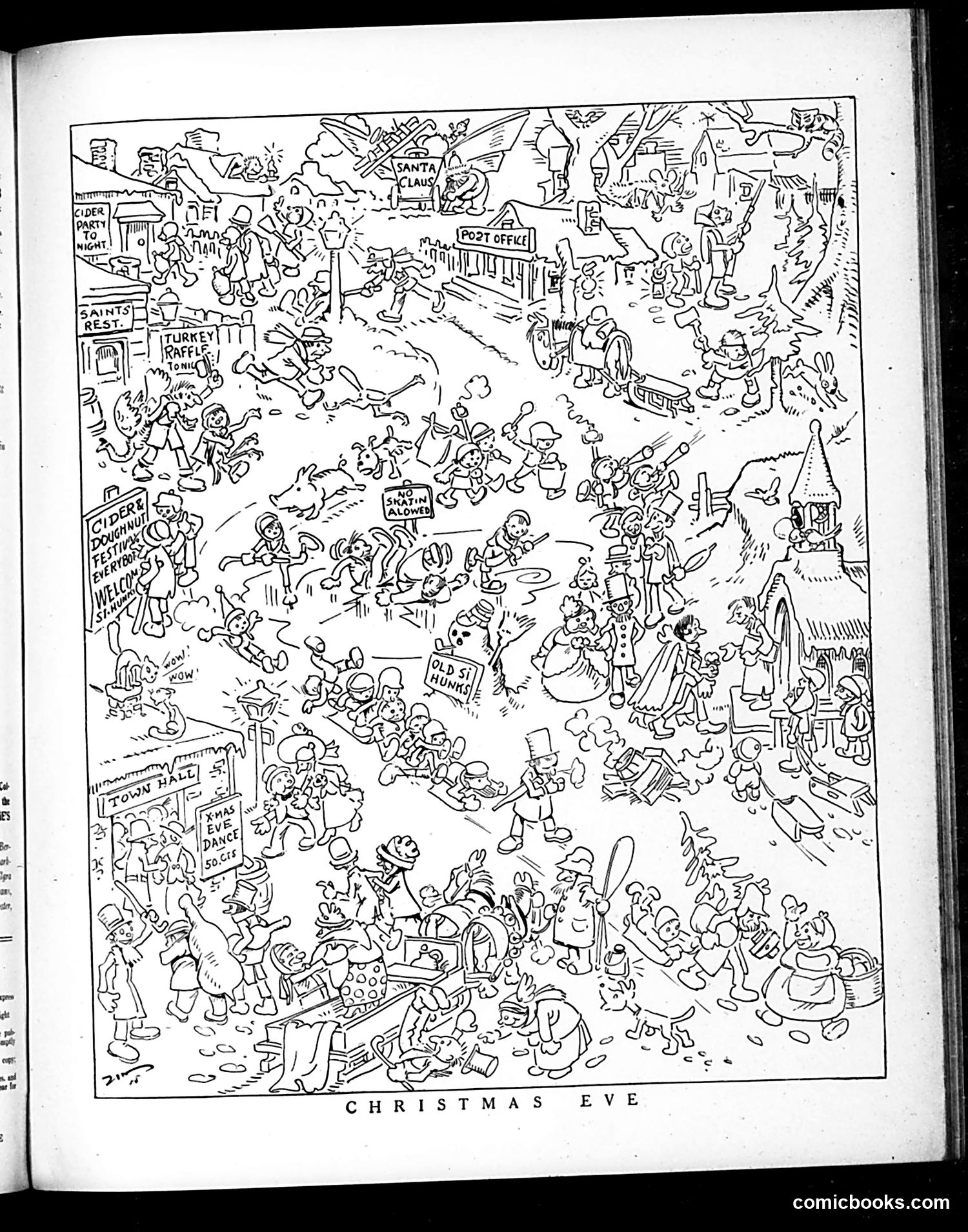
This is a densely-packed "find the hidden elements" style cartoon depicting a chaotic Christmas Eve celebration in what appears to be a town square or village setting. Visible signs reference "Santa Fe," a "Post Office," "Saints," and "Turkey" establishments. The scene shows numerous figures engaged in holiday activities—caroling, shopping, playing, and general merrymaking. There's a "No Sleighs Allowed" sign visible, suggesting some comedic regulation. The satire appears to target the commercialization and chaotic excess of Christmas celebrations in early 20th-century America—the crowding, the shopping frenzy, and the general pandemonium of holiday season. The style mimics popular "spot the difference" or crowded-scene illustrations common in Judge magazine's humorous content of that era.
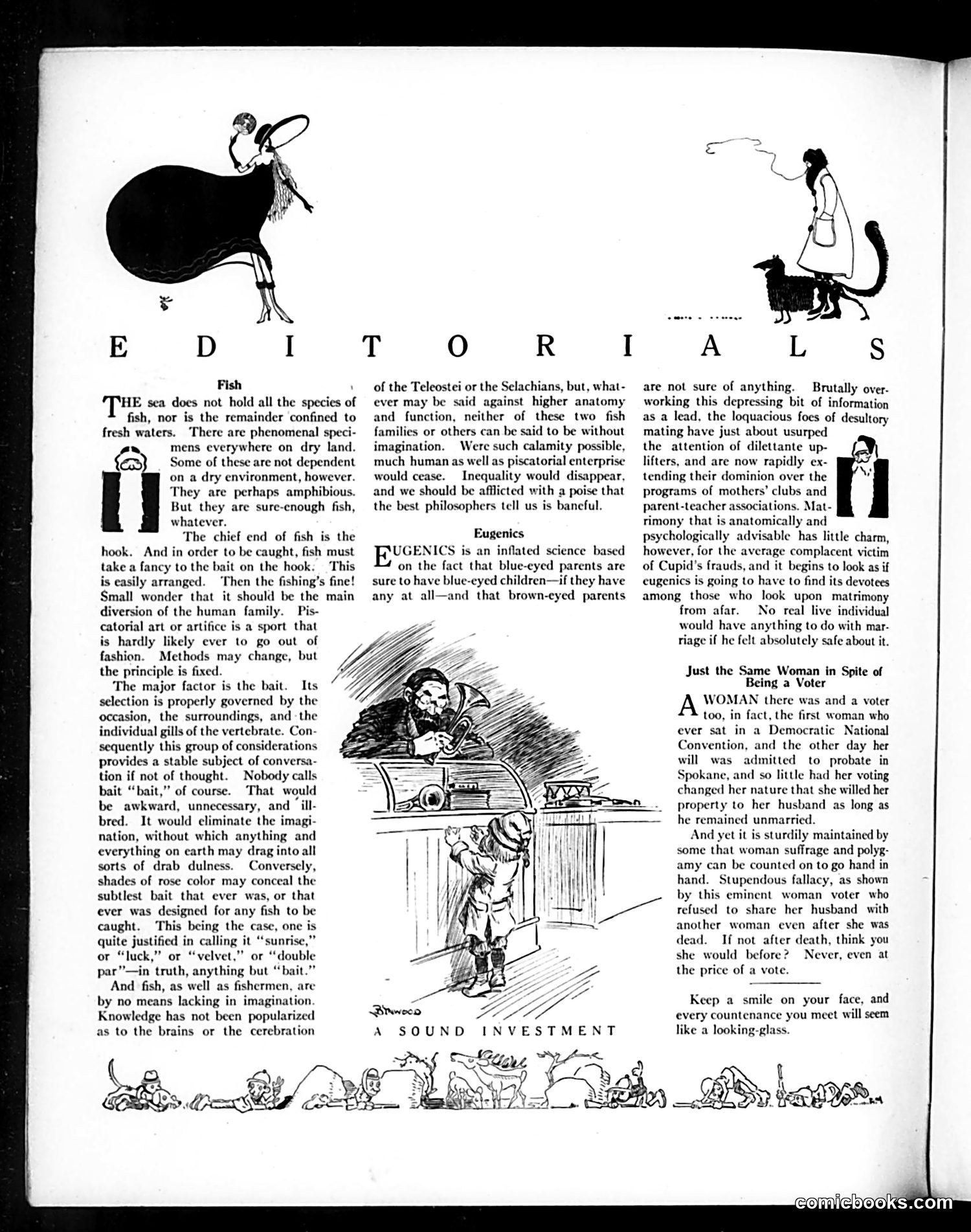
This page contains three distinct editorial pieces: 1. **"Fish" essay** (left column): A satirical discussion of fish species and fishing, critiquing scientific classification methods. The text mocks overly complicated taxonomy while emphasizing practical knowledge. 2. **"Eugenics" section** (center): A direct critique of eugenics pseudoscience, mocking the belief that eye color inheritance determines fitness for parenthood. The author sarcastically dismisses eugenic claims as absurd, calling eugenics a flawed "inflated science." 3. **"Just the Same Woman in Spite of Being a Voter"** (right): Satirizes women's suffrage opponents by describing an absurd scenario where a woman voter remains unchanged—implying anti-suffrage fears of radical social upheaval were unfounded. The cartoon shows a woman at a ballot box with a cat. The page's overall theme critiques pseudoscientific thinking and social anxieties about progress.
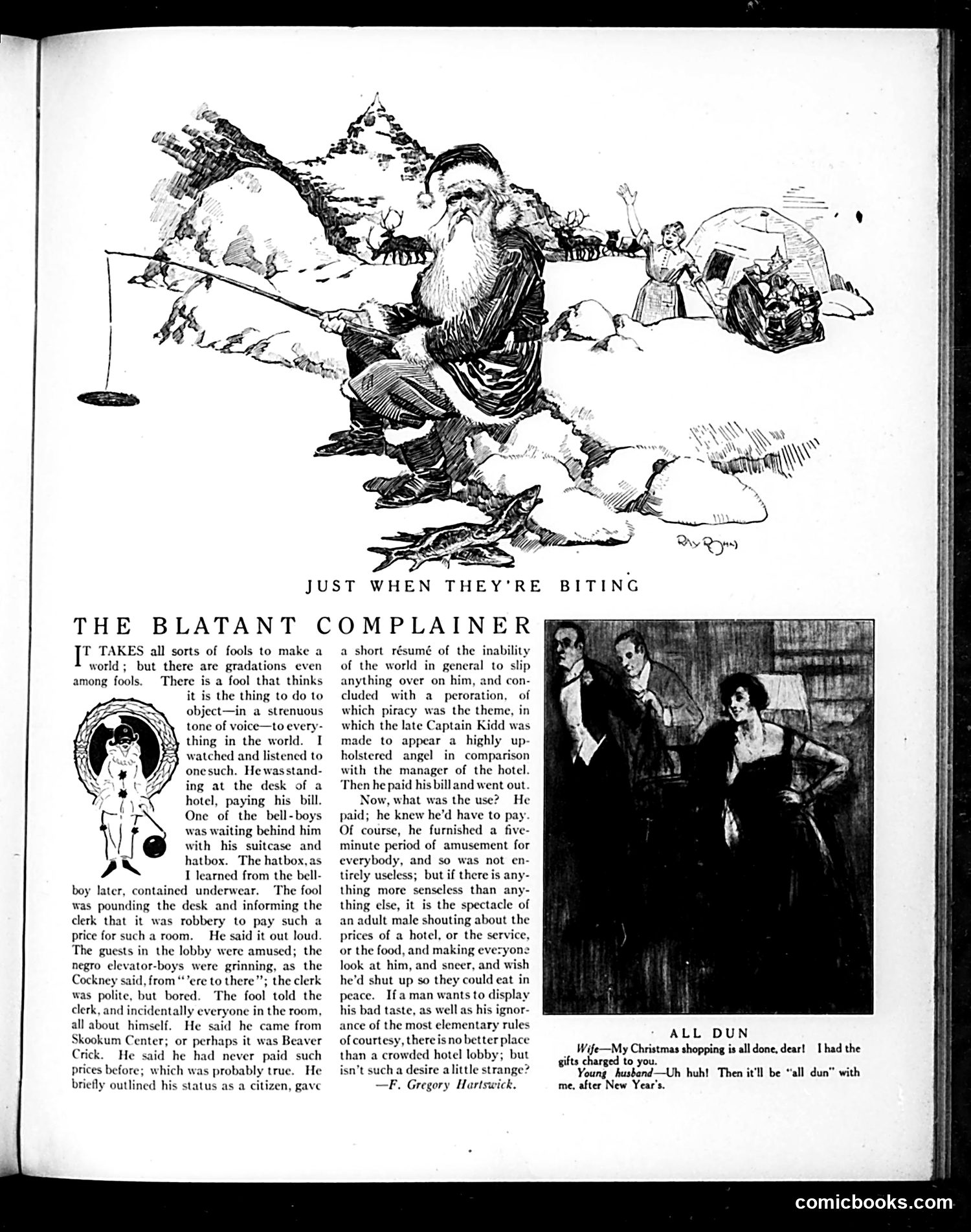
The top cartoon depicts Santa Claus fishing through ice, titled "Just When They're Biting"—likely satirizing someone who complains at inopportune moments, interrupting enjoyment. The main article mocks a hotel guest who loudly complained about paying high prices for a room, loudly announcing it was "robbery." The complainer apparently came from "Skookum Center; or perhaps it was Beaver Creek," suggesting rural origins. The satire targets his lack of hotel etiquette and his public display of bad taste and ignorance of "elementary rules of courtesy." The bottom photograph with caption "All Dun" appears to show a domestic comedy scene about Christmas shopping and gift-giving, playing on the pun "all done/all dun." The page satirizes working-class rudeness and social pretension.
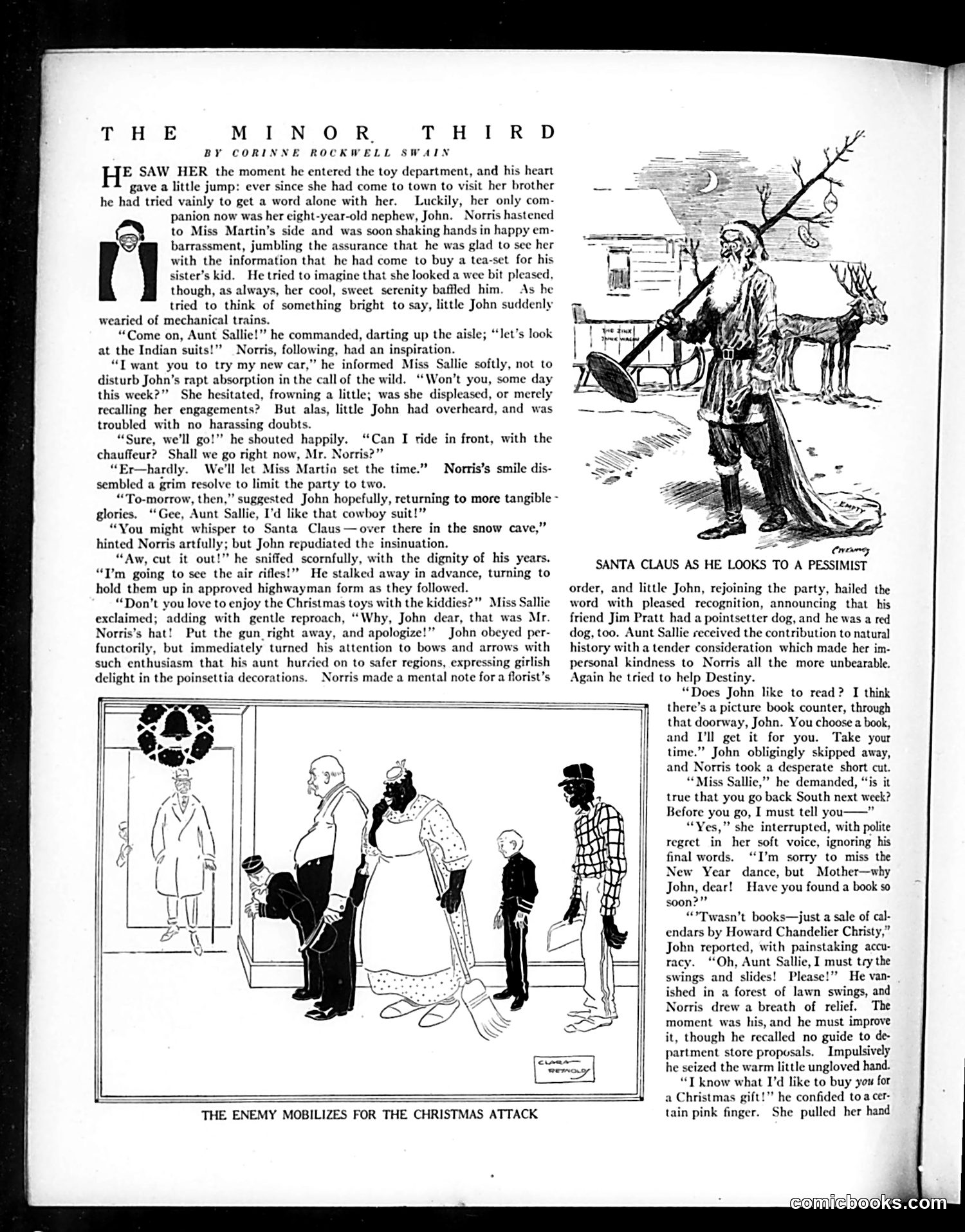
This is a romantic comedy story, not political satire. The narrative follows a man named Norris attempting to court Miss Sallie Martin in a toy department, repeatedly thwarted by her eight-year-old nephew, John, who becomes an unwitting "enemy" to romance. The humor derives from John's innocent interference: he invites himself on Norris's car ride, interrupts romantic moments, and monopolizes Miss Sallie's attention with childish demands (cowboy suits, air rifles, toy guns). The cartoon caption "Santa Claus as He Looks to a Pessimist" depicts a disappointed, cynical Santa—reflecting Norris's gloomy romantic prospects. The bottom illustration, "The Enemy Mobilizes for the Christmas Attack," humorously portrays the child as a military threat to Norris's courtship. The story satirizes not politics but the universal romantic predicament: how children derail adult social plans. The "Howard Chandelier Christy" reference suggests contemporaneous popular illustration culture.
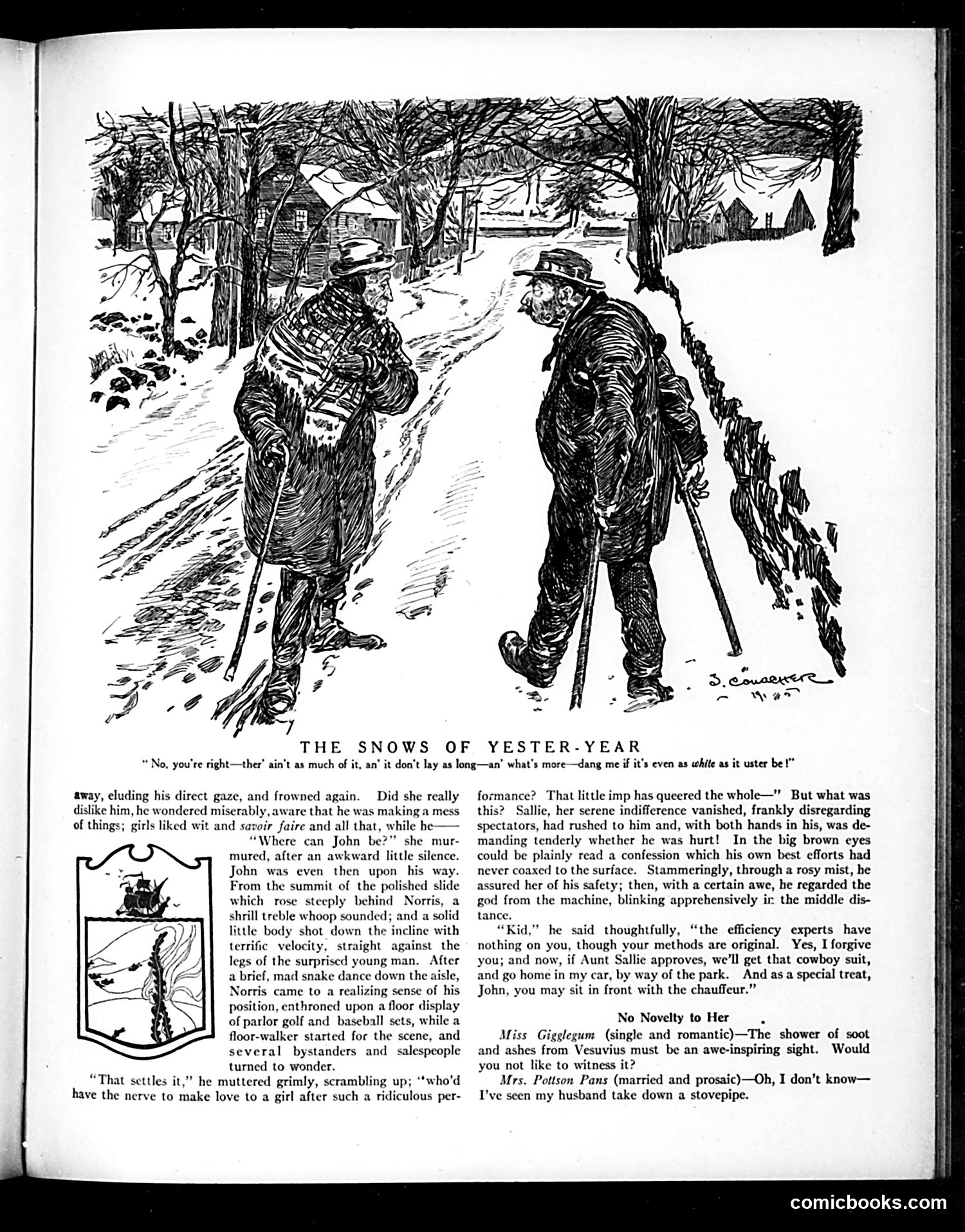
**Main Illustration:** Two men on skis in a snowy landscape discuss winter's decline. One complains that snow "ain't as much of it" and "don't lay as long" and "ain't even as white as it uster be"—a nostalgic lament about environmental or climate change. The title references the medieval poem "Ballade des Dames du Temps Jadis" (Where are the snows of yesteryear?), suggesting wistful reminiscence. **Embedded Story:** A romantic comedy about a young man (John) attempting courtship with a girl (Sallie) at what appears to be a department store. A child sliding down a display interrupts his awkward proposal attempt, causing him to crash into merchandise. The disruption paradoxically helps him—Sallie reveals her affection while caring for his welfare, and they reconcile. **Bottom Jokes:** "Miss Gigglegum" and "Mrs. Pottson Pans" trade witticisms about Vesuvius versus domestic drudgery—marriage presented as less exciting than volcanic catastrophe. **Overall:** Typical Judge humor mixing mild social observation (climate nostalgia) with light romantic and domestic comedy.
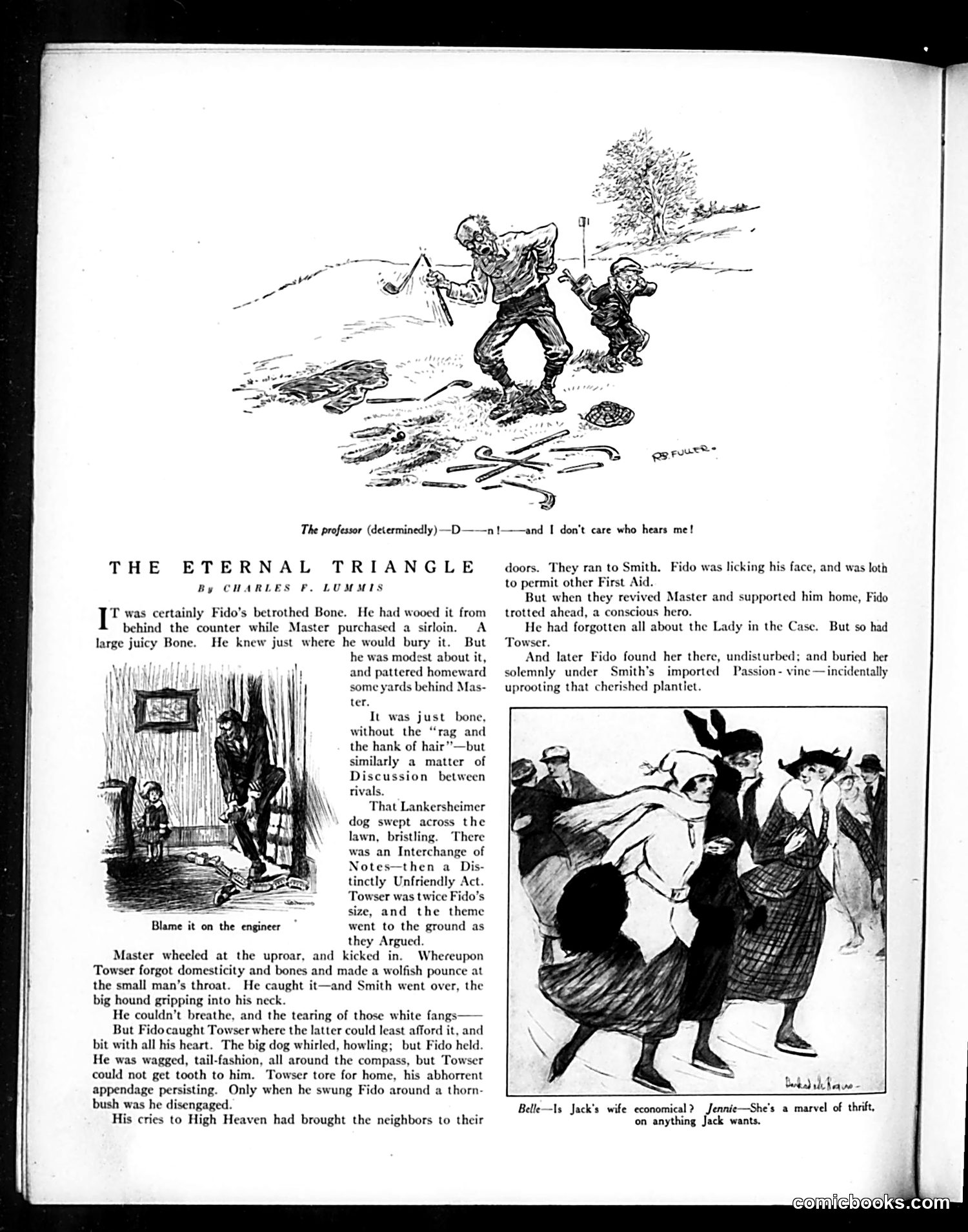
This is a humorous short story about dogs, not political satire. The narrative follows Fido, a small dog who claims a bone from a butcher shop. A larger rival dog, Towser, challenges him for it—the "eternal triangle" being the classic love-triangle plot applied absurdly to canine rivalry over a bone. When Towser attacks Fido's master (Smith), Fido heroically bites Towser to save him. The irony: after his brave act, Fido forgets about the bone entirely and buries Smith's imported passion-vine plant instead—suggesting even heroes have short attention spans. The accompanying cartoon at top shows a professor cursing, and a bottom panel features a joke about a wife's thriftiness. These appear to be separate, unrelated humor pieces typical of *Judge* magazine's mixed-content format.
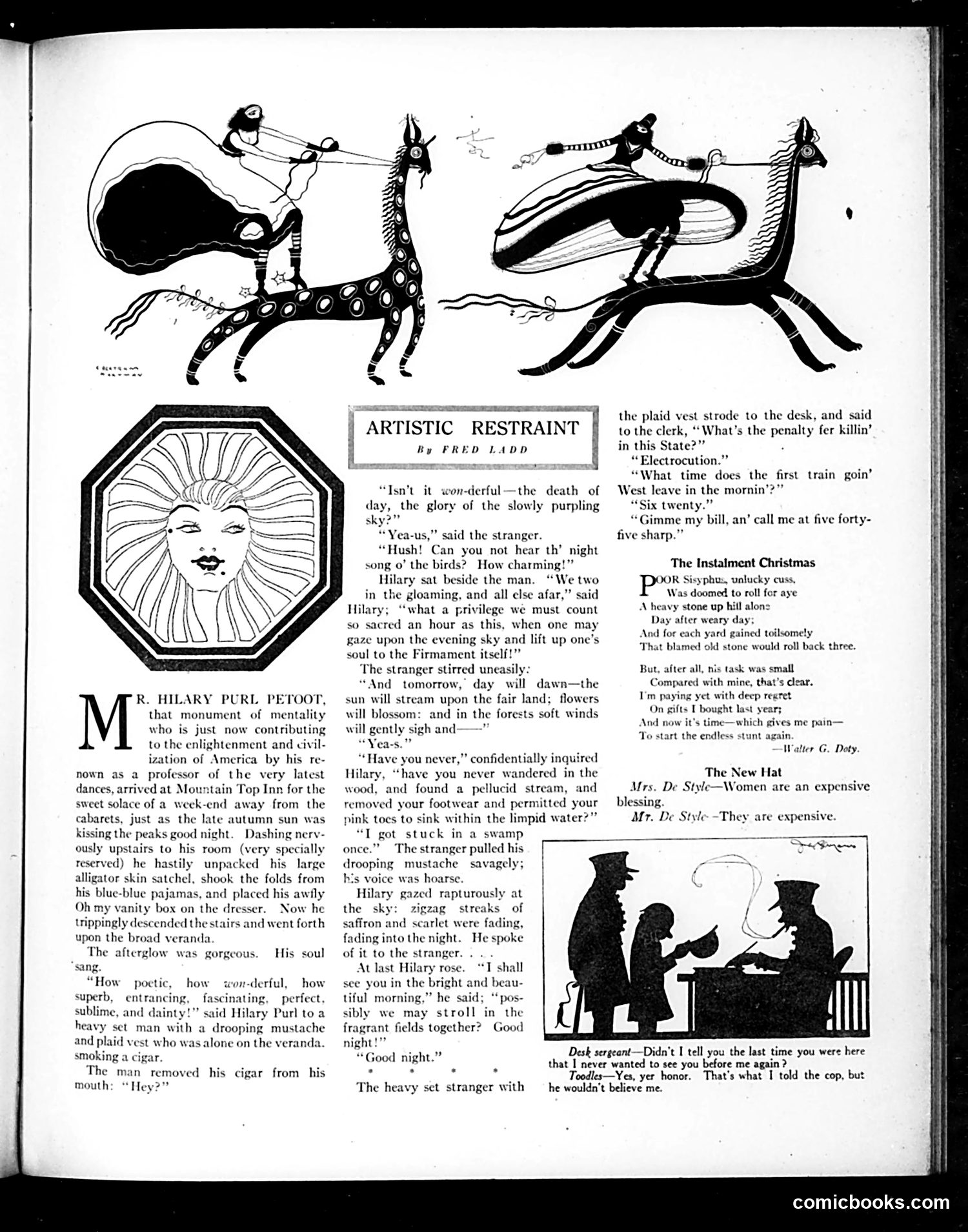
This satirical story mocks the aesthetic pretensions of early 20th-century "modern" dance instructors and affected intellectuals. R. Hilary Purl Petoot, described as a professor of "the very latest dances," arrives at a mountain inn and immediately launches into flowery, overwrought romantic monologues to a stranger on the veranda—gushing about sunsets, birds, streams, and "lifting one's soul to the Firmament." The joke: the other man, a practical fellow smoking a cigar, is utterly unmoved and bewildered by this verbose sentimentality. By story's end, he abruptly flees—asking the hotel clerk about execution penalties and demanding the first westbound train at 5:45 AM. The satire targets the era's fashionable cultural posturing: pretentious pseudo-artistic types who speak in affected language about nature and beauty, oblivious to how ridiculous they appear to ordinary people. Hilary's elaborate rhapsodies about "pellucid streams" and "limpid water" drive away his audience entirely.
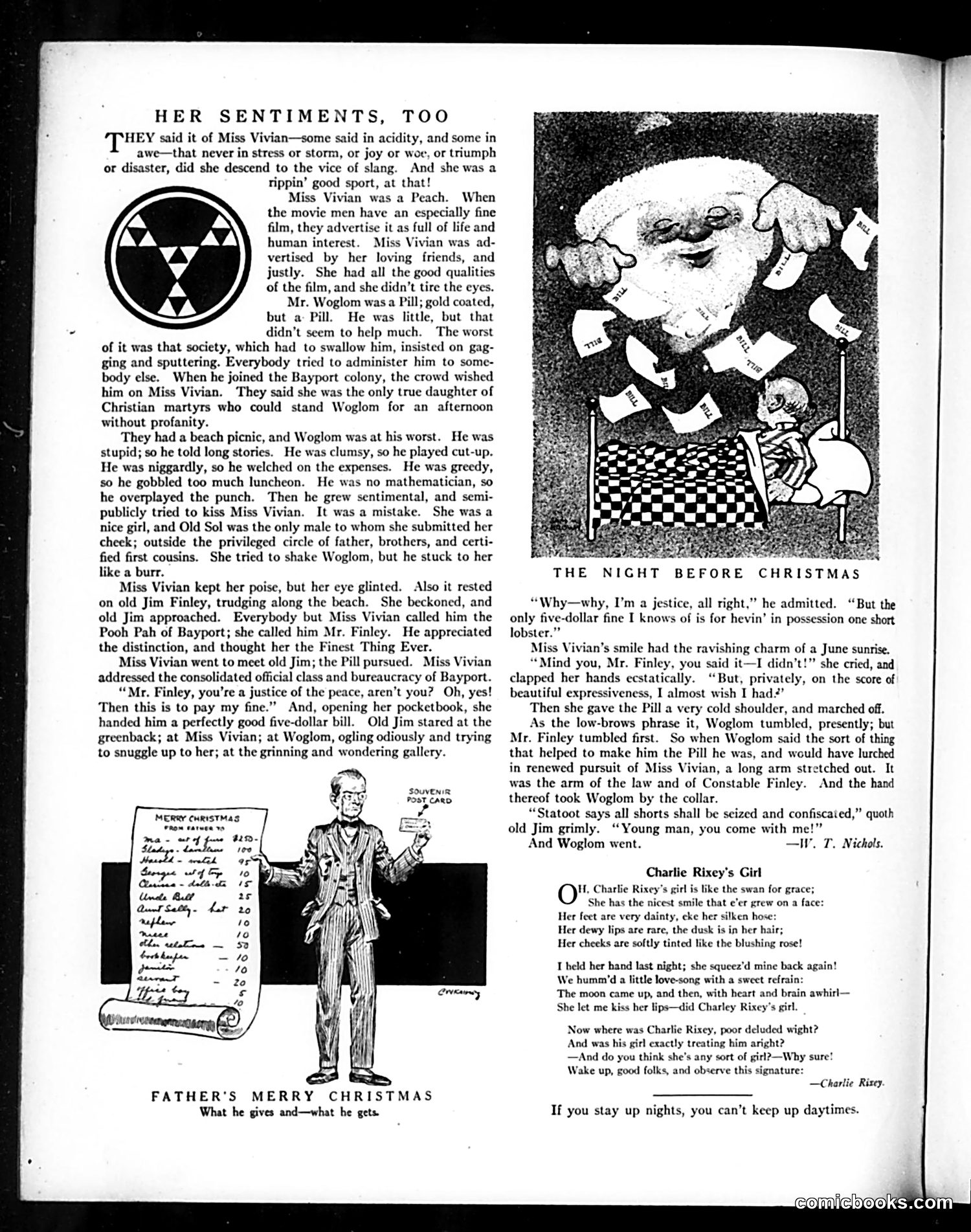
This story satirizes social pretension and comeuppance through a romantic triangle at a seaside resort ("Bayport colony"). Miss Vivian is portrayed as an exceptionally refined young woman who never uses slang. Mr. Woglom—nicknamed "the Pill"—is an obnoxious, wealthy bore whom society tolerates but dislikes. When Woglom attempts an uninvited kiss at a beach picnic, Miss Vivian cleverly orchestrates his arrest by obtaining a "five-dollar fine" from Justice Finley for possessing an undersized lobster—a legal violation she subtly manipulates Woglom into committing through her charm and wit. The humor lies in the protagonist's refined revenge: she uses the law and social hierarchy against a man society already despises, punishing his crude behavior without ever descending to direct confrontation or "slang." The satire mocks both Gilded Age propriety and the entitled behavior of wealthy men like Woglom.
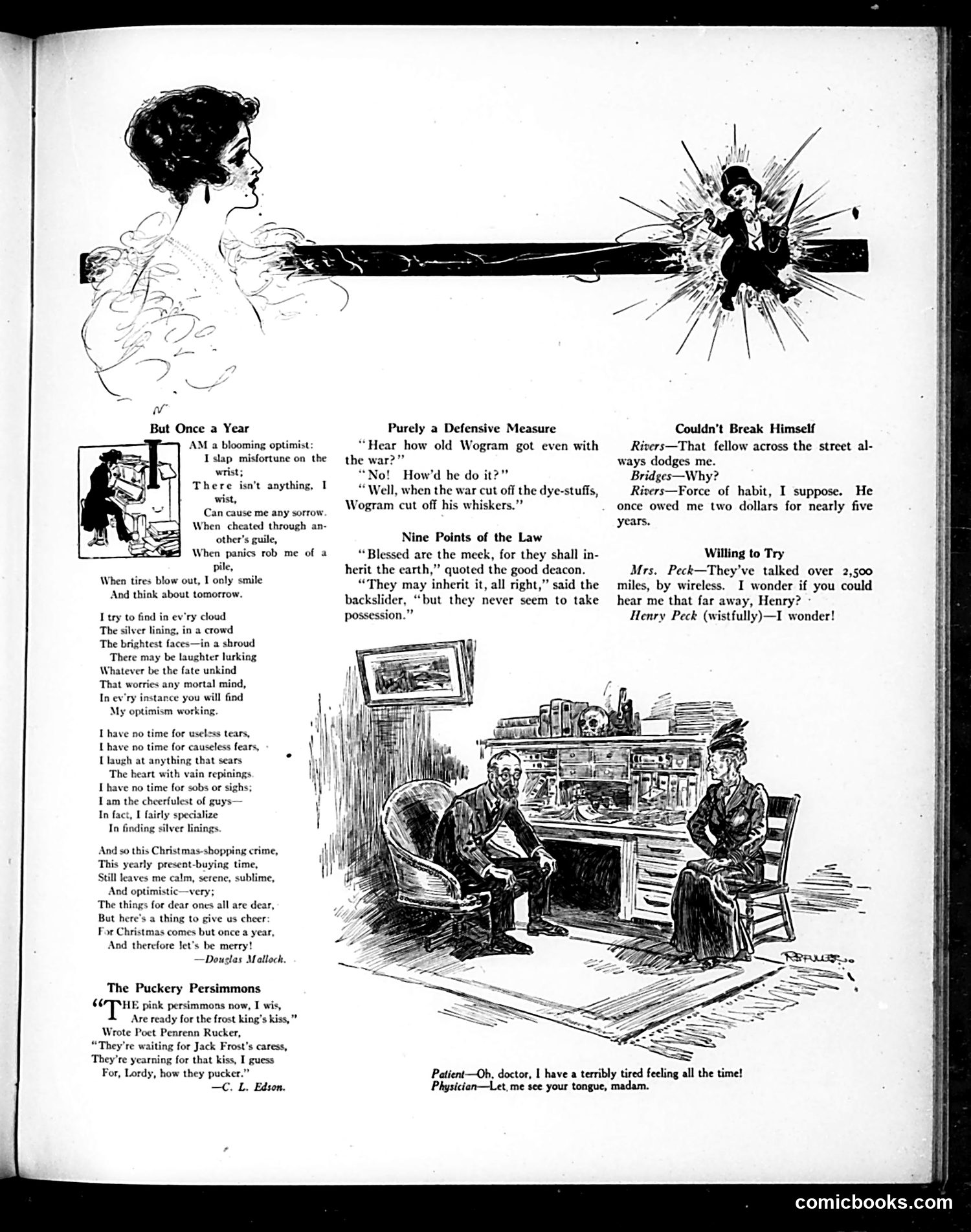
This page contains several brief humorous sketches typical of early 20th-century American satire magazine format. **Top cartoon**: Shows a woman shooting a rifle at a man across a distance, illustrating "Purely a Defensive Measure." The caption references "Wogram" cutting off his whiskers during wartime when dye-stuffs (used in textile manufacturing) were cut off by war restrictions. The humor lies in this absurd "defensive" response to war shortages. **Middle section**: Contains a poem by Douglas Malloch celebrating relentless optimism despite hardship—a popular sentiment of the era. Below it are three brief joke vignettes: one about a neighbor who dodges payment on an old debt; another titled "Nine Points of the Law" about inheriting property; and "Willing to Try" about a couple attempting long-distance wireless communication. **Bottom illustration**: Shows a doctor's office scene where a patient complains of constant fatigue, and the physician requests to examine the patient's tongue—a standard comedic setup playing on medical examination procedures. The page reflects typical Judge magazine humor: mild social observation, wordplay, and gentle mockery of contemporary life and relationships.
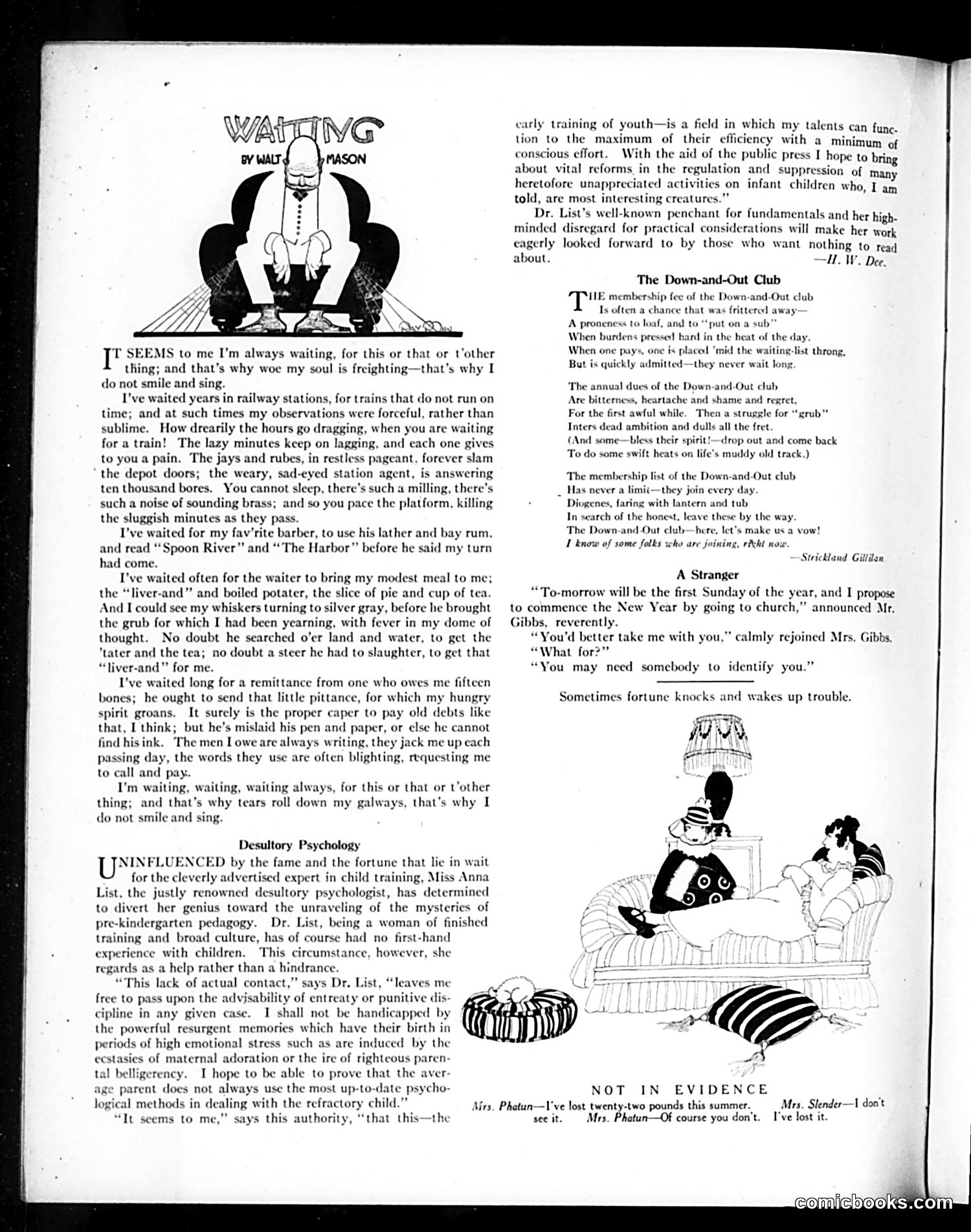
This *Judge* page contains two satirical pieces: **"Waiting"** (left): A humorous poem mocking the universal frustration of waiting—in train stations, for barbers, meals, and debts to be repaid. The complaint that constant waiting prevents happiness ("that's why I do not smile and sing") is exaggerated for comic effect. The satire targets everyday modern inconveniences. **"Desultory Psychology"** (right): This mocks Dr. Anna List, a child-psychology "expert" who, ironically, has never actually spent time with children. The satire ridicules credentialed theorists who lack practical experience yet confidently prescribe methods. Her boast that inexperience is an *advantage*—freeing her from "powerful resurgent memories"—is absurd. This reflects early 20th-century skepticism toward academic psychology and "expert" advice disconnected from reality. Both pieces target ordinary frustrations and professional pretension with deadpan irony.
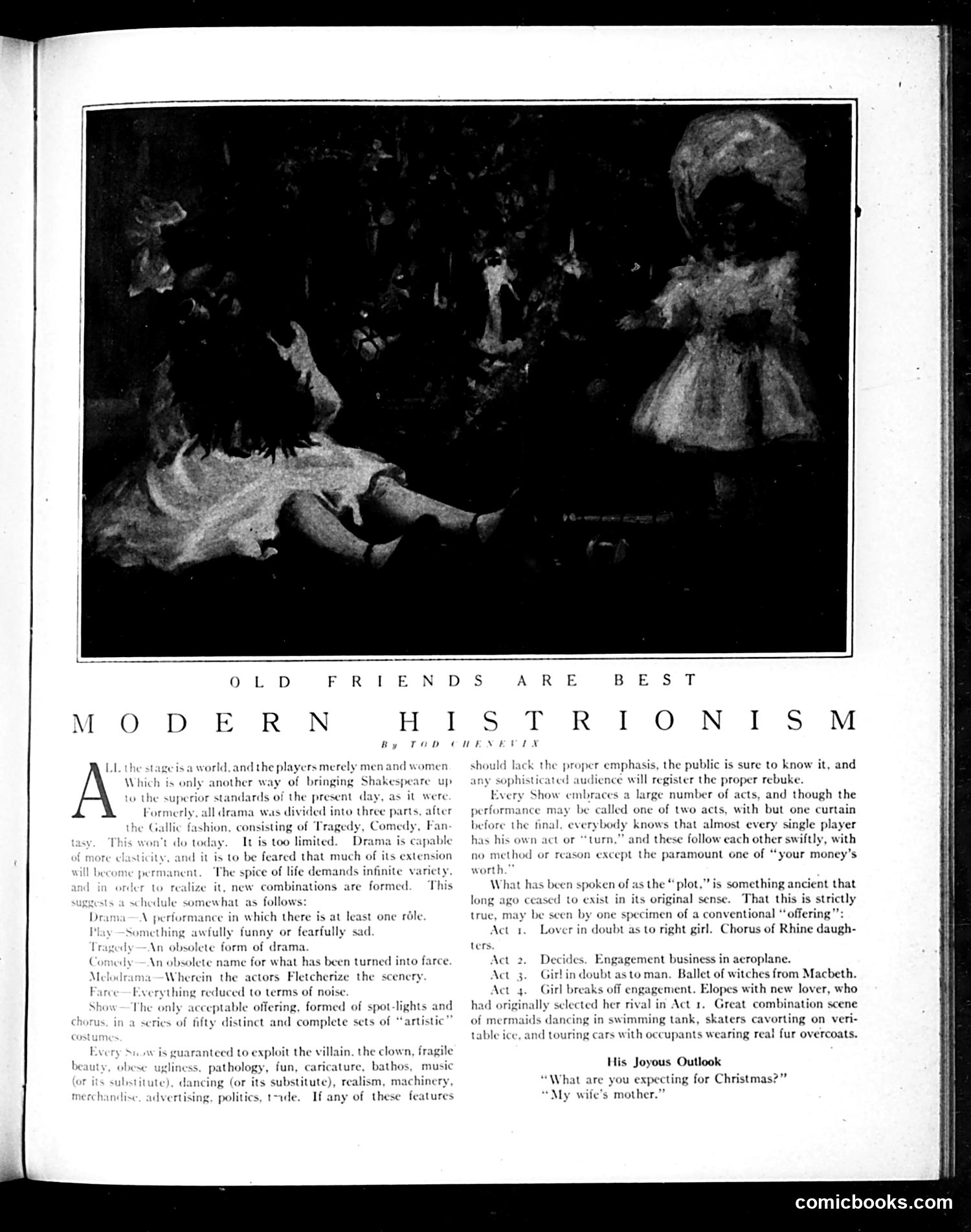
This page satirizes modern theatrical productions that have abandoned classical dramatic structure. The author (Tod Lusvia) argues that contemporary theatre has become a formless spectacle prioritizing entertainment gimmicks over coherent storytelling. The opening image appears to show a theatrical scene with performers in elaborate costumes, illustrating the "modern histrionism" being mocked. The satire's main points: 1. **Plot obsolescence**: Traditional plots have been replaced by disconnected "acts" or specialty performances (acrobatics, music, scenic displays). 2. **Example parody**: The specimen "offering" ridiculously combines unrelated elements—a love triangle with Rhine maidens, aeroplane stunts, witches' ballets, mermaids, ice skaters, and automobiles in one incoherent show. 3. **Spectacle over substance**: Rather than meaningful drama, shows exploit villains, clowns, music, and "artistic" costumes as distractions. The closing joke reinforces the critique: when asked what he expects for Christmas, a man replies "My wife's mother"—suggesting modern theatre is equally unwelcome torture.
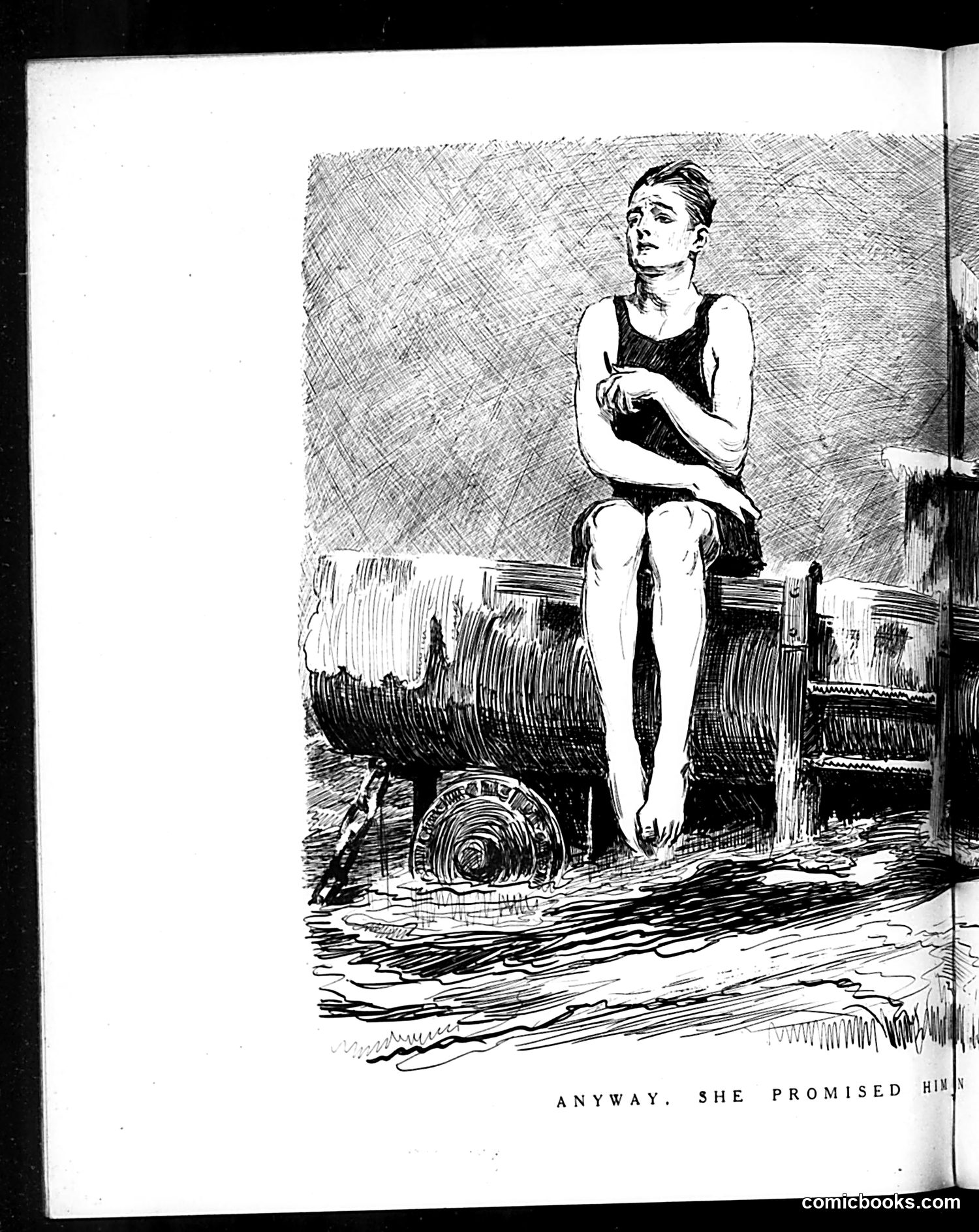
This is a single illustration from *Judge* magazine showing a young woman sitting on a bed in what appears to be a modest room. The incomplete caption reads "ANYWAY, SHE PROMISED HIM—" The drawing uses the suggestive visual language of early 20th-century satirical humor: the woman's state of undress, the bedroom setting, and the trailing caption all imply an illicit or compromising situation. The satire likely concerns broken promises in romantic or sexual contexts—a common theme in period humor that played on anxieties about women's morality and reliability. Without the complete caption or additional context, the specific political or social reference remains unclear, though the subject matter reflects era-typical attitudes toward gender and propriety that *Judge*'s audience would have recognized.
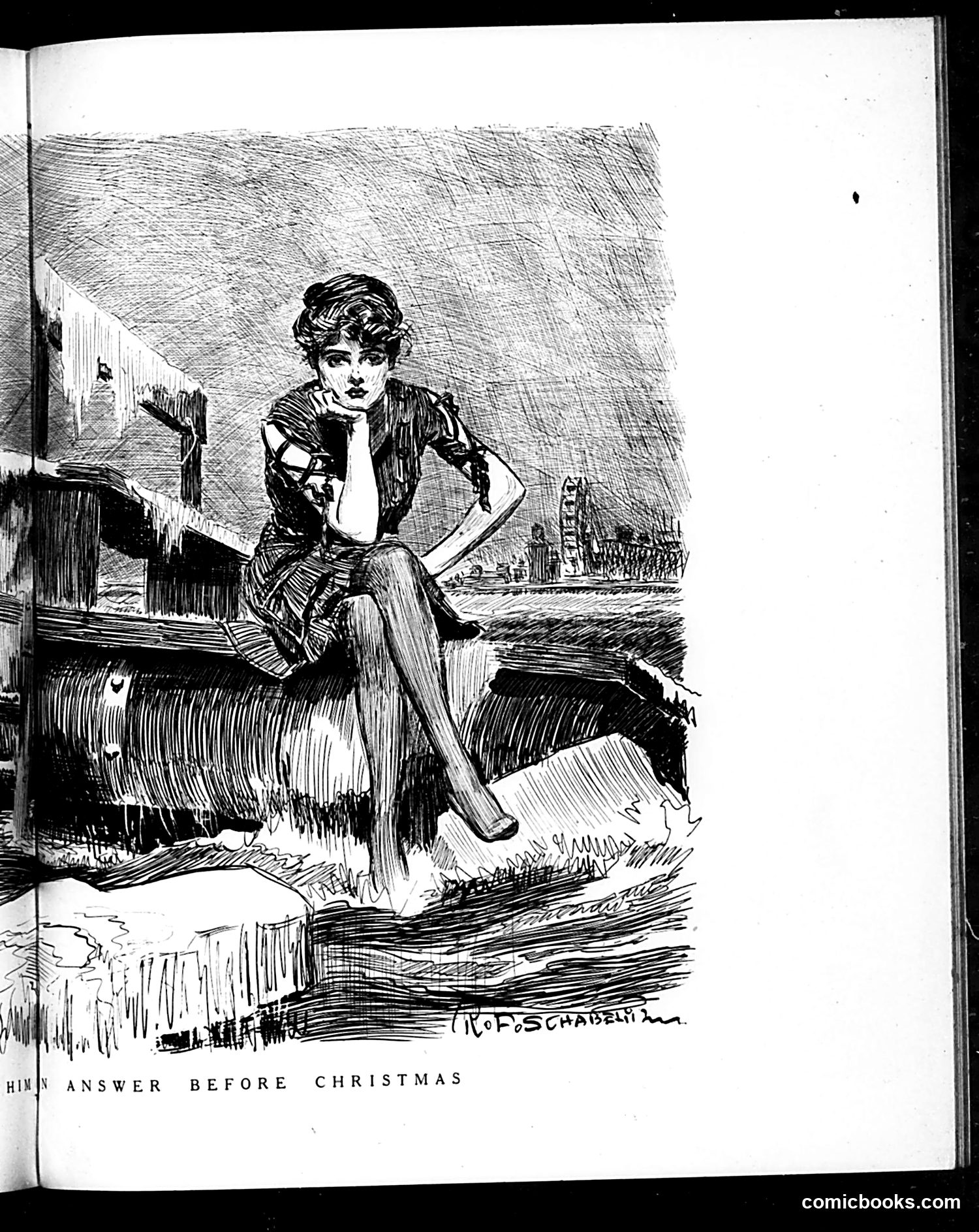
This appears to be an illustration from *Judge* magazine depicting a woman in an elegant dress sitting on what looks like a dock or waterfront setting, with industrial structures visible in the background. The caption reads "HIM, ANSWER BEFORE CHRISTMAS." The cartoon likely satirizes romantic or marital pressure around the Christmas season—a common theme in early 20th-century American humor. The woman's contemplative pose and the caption suggest she's awaiting a marriage proposal or important romantic commitment before the holidays arrive. The artist signature appears to read "Robschabelitz" or similar. Without additional context about the specific issue date, I cannot identify the particular figures or reference any contemporary events this may allude to.
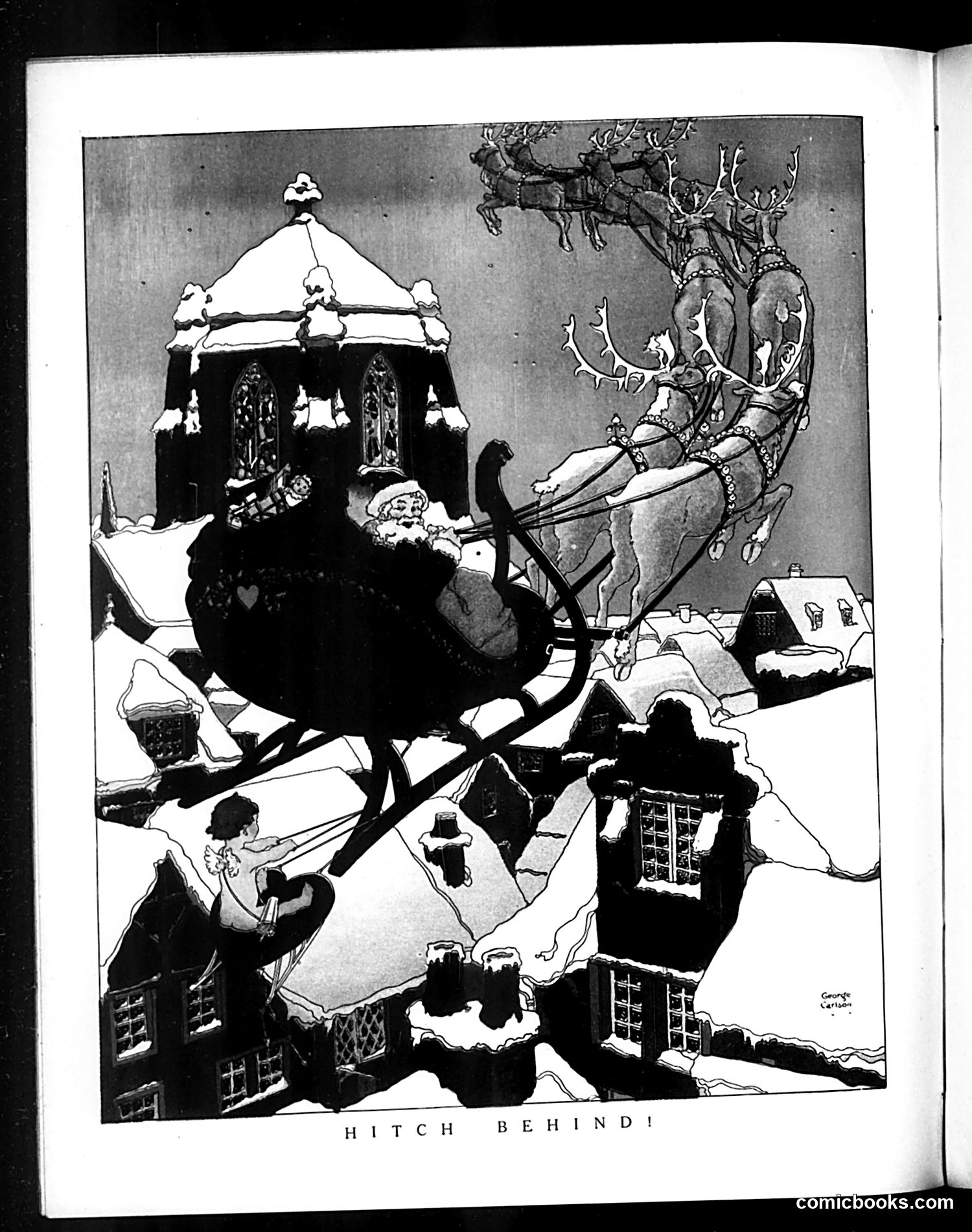
This is a Christmas-themed political cartoon depicting Santa Claus in his sleigh being pulled by reindeer over a snowy village landscape. The caption "HITCH BEHIND!" appears to be a visual pun or double entendre playing on the idea of "hitching" a ride. The satire likely critiques some contemporary political or social figure or policy by showing them attempting to exploit Santa/Christmas imagery or goodwill for their own purposes. The specific target is unclear without additional historical context, but the cartoon uses the beloved Christmas tradition and Santa figure as a vehicle (literally) for commentary on political opportunism or attempted manipulation of popular sentiment during the holiday season. The style and publication in *Judge* magazine suggests this dates to the early 20th century.
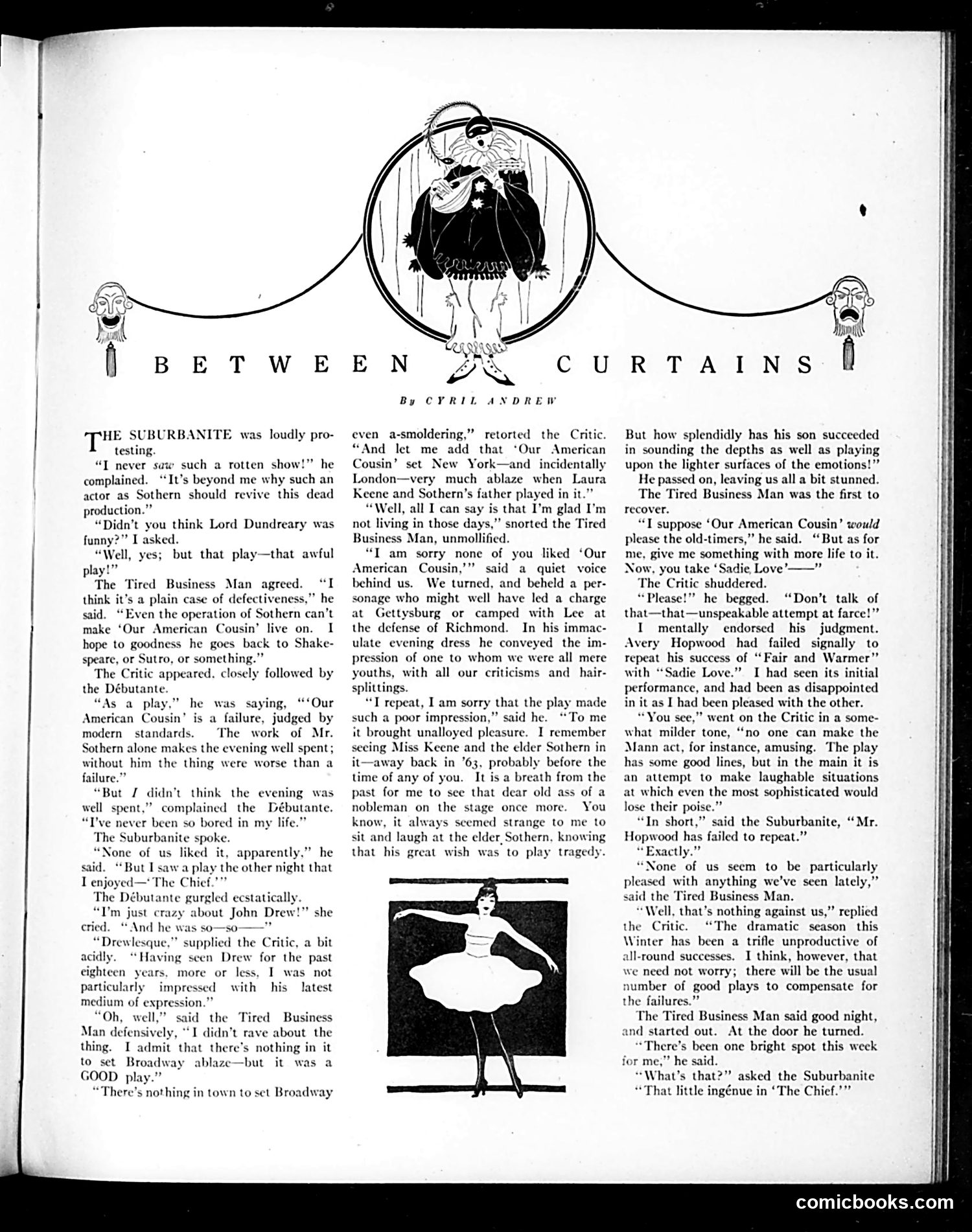
This page from Judge magazine satirizes Broadway theater criticism and generational taste divides circa the early 1900s. The dialogue features archetypal characters—a Suburbanite, Tired Business Man, Critic, and Débutante—debating a revival of "Our American Cousin," the 1858 comedy. An elderly gentleman interrupts their complaints, revealing he saw the original production in 1863 with Laura Keene and the elder Sothern. He appreciates the son's performance with nostalgia for the play's historical moment. The modern critics dismiss it as dated and boring. The satire targets how contemporary audiences and critics undervalue classic theater while the older generation finds genuine pleasure in revivals connected to their past. The "old-timer" represents lost cultural continuity, while the younger characters represent shallow, ever-changing fashions in entertainment taste.
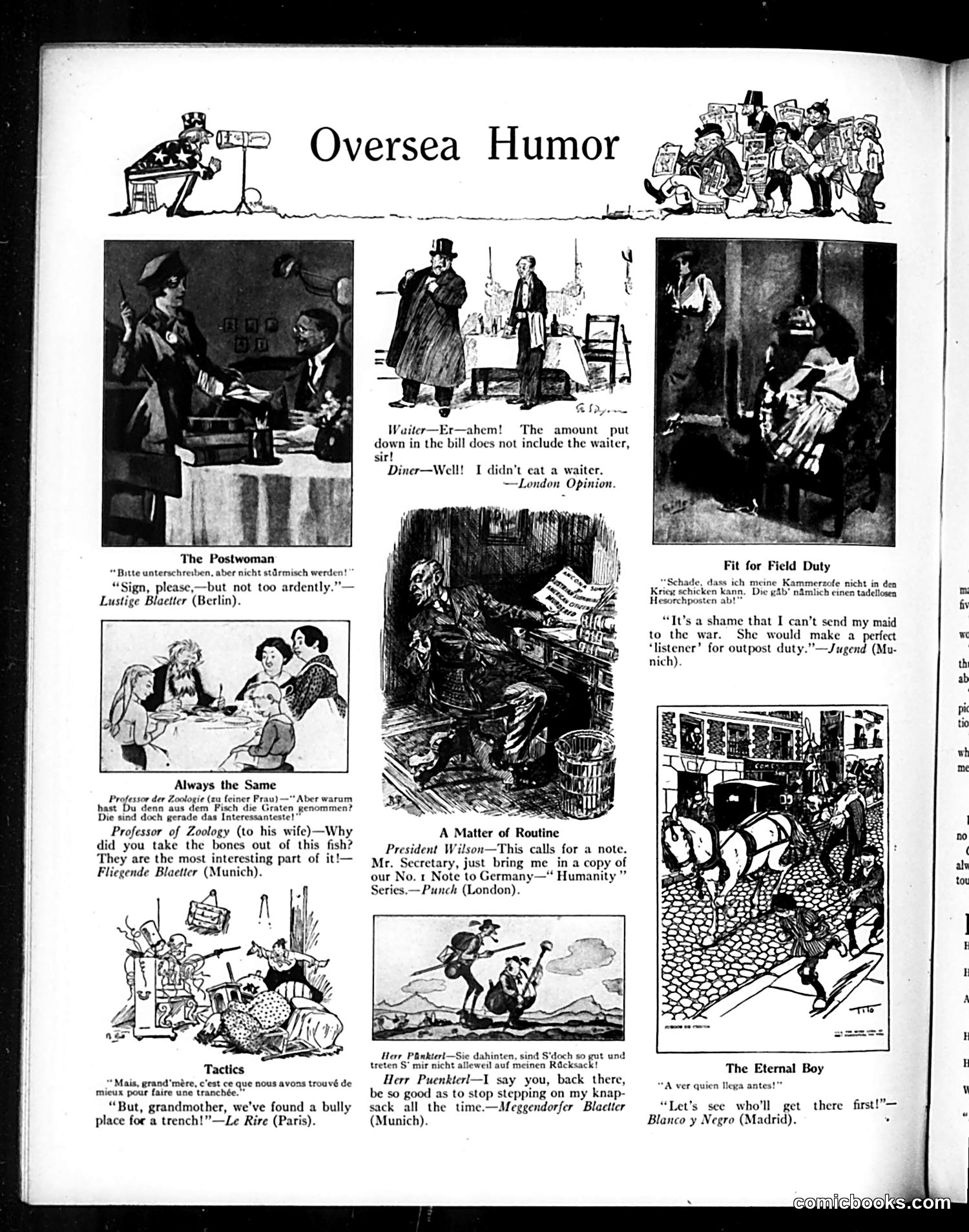
This page collects humorous cartoons from European publications, showcasing how different nations satirized wartime experiences. Key pieces include: **"The Postwoman"** (Berlin): A female postal worker receiving an overly enthusiastic signature—likely satirizing women taking traditionally male jobs during wartime labor shortages. **"A Matter of Routine"** (London): President Wilson requesting a standardized diplomatic note to Germany, mocking bureaucratic repetition of stern warnings that seemingly had little effect. **"Tactics"** (Paris): Using a grandmother's location as a trench—dark humor about civilians displaced by warfare. **"Fit for Field Duty"** (Munich): A woman lamenting she cannot send her maid to war because maids made excellent "listeners" for outpost duty—satirizing absurd wartime labor classifications. The page reflects how Allied and Central European publications used humor to process shared wartime absurdities: labor shortages, diplomatic futility, civilian displacement, and bureaucratic nonsense.
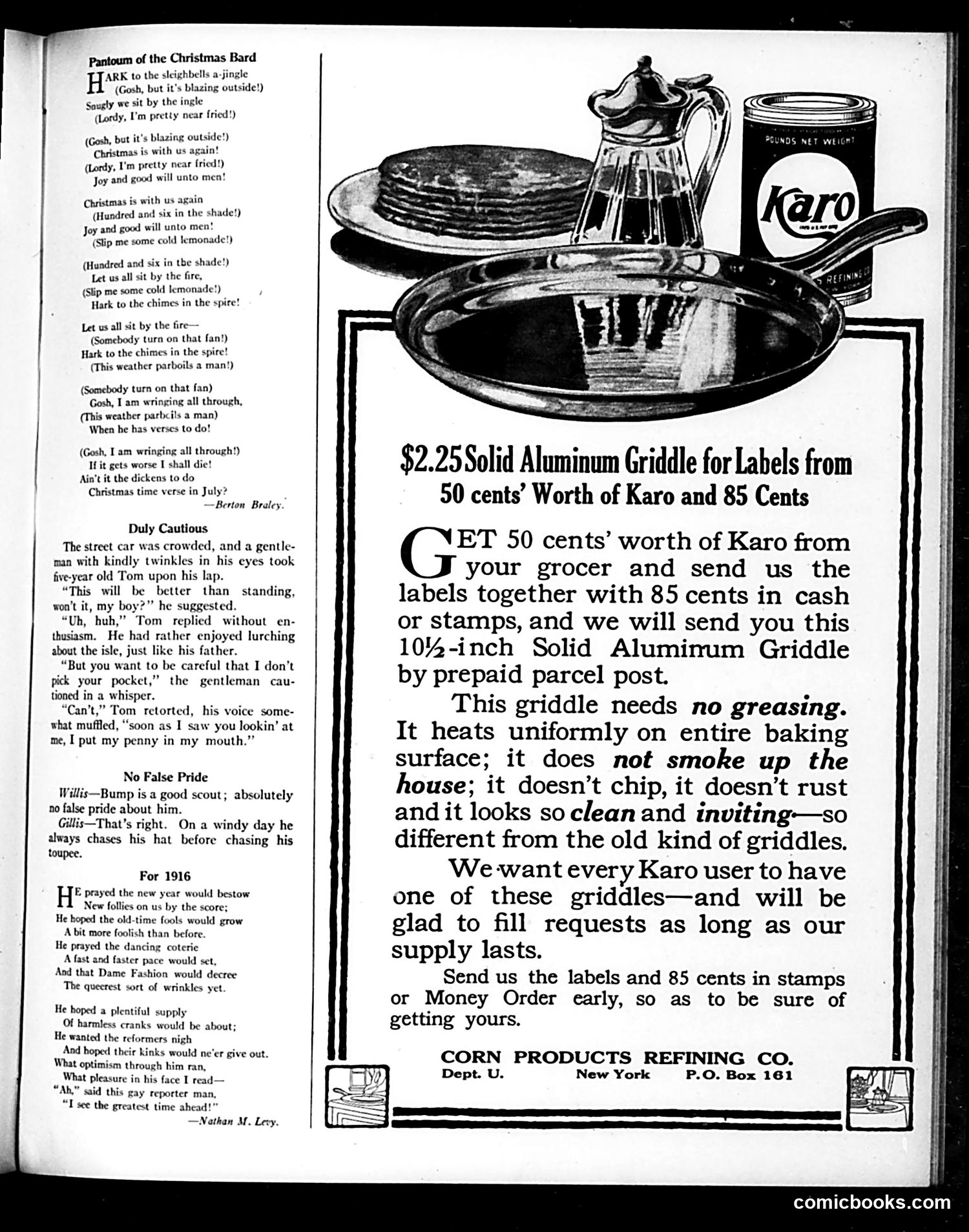
This page contains **satirical poetry and humorous short fiction**, plus a **product advertisement**—not political cartoons. The humor relies on early-20th-century domestic and social observations: **"Pantoum of the Christmas Bard"** (by Berton Braley) jokes about the contradiction of Christmas imagery—sleighs, fireplaces, winter cheer—clashing with summer heat. The speaker is sweltering in July while forced to write Christmas verse, creating absurd juxtapositions ("Hundred and six in the shade" vs. "Hark to the chimes"). **"Duly Cautious"** features a child's precocious self-protection: when a stranger warns he might pick his pocket, the boy reveals he's already hidden his penny in his mouth—suggesting street-car pickpocketing was a real concern. **"No False Pride"** uses the bald-man/toupee joke: a man will chase his hairpiece before his hat, implying vanity. **"For 1916"** sardonically celebrates foolishness, fashionable excess, and cranks—reflecting era anxieties about social change. The **Karo syrup advertisement** dominates the right side, promoting a mail-in premium offer (aluminum griddle).
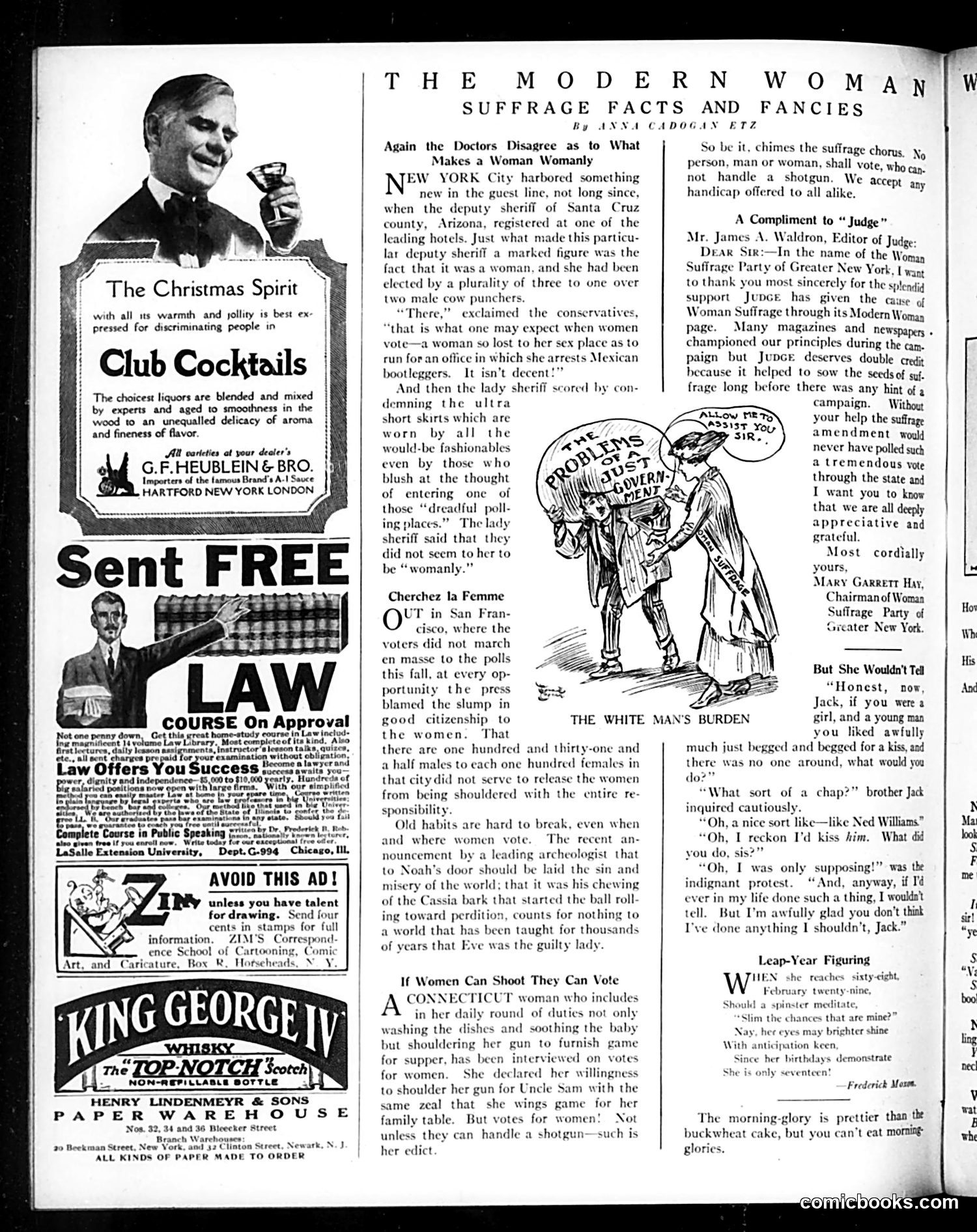
This page satirizes the women's suffrage movement through three scenarios that expose male hypocrisy about what constitutes "womanly" behavior: **The Arizona sheriff story** ridicules conservatives who condemn a woman elected official for being "unwomanly"—even though she herself opposes the short skirts worn by fashionable women, suggesting she shares their values. **The San Francisco voting story** mocks the press for blaming women for low voter turnout, despite men outnumbering women 131-to-100 in the city. It highlights how men historically blamed women (Eve) for society's problems regardless of actual responsibility. **The Connecticut woman anecdote** exposes the ultimate contradiction: a woman who hunts game for her family and proves willing to shoot for the military is deemed unfit to vote—yet "decent" men impose this standard without shame. The cartoon "The White Man's Burden" visualizes this hypocrisy: men load impossible contradictions onto women regarding voting rights. The satire's point: opponents of suffrage use arbitrary, shifting definitions of "womanly" behavior to deny women rights, while ignoring their own illogical standards.
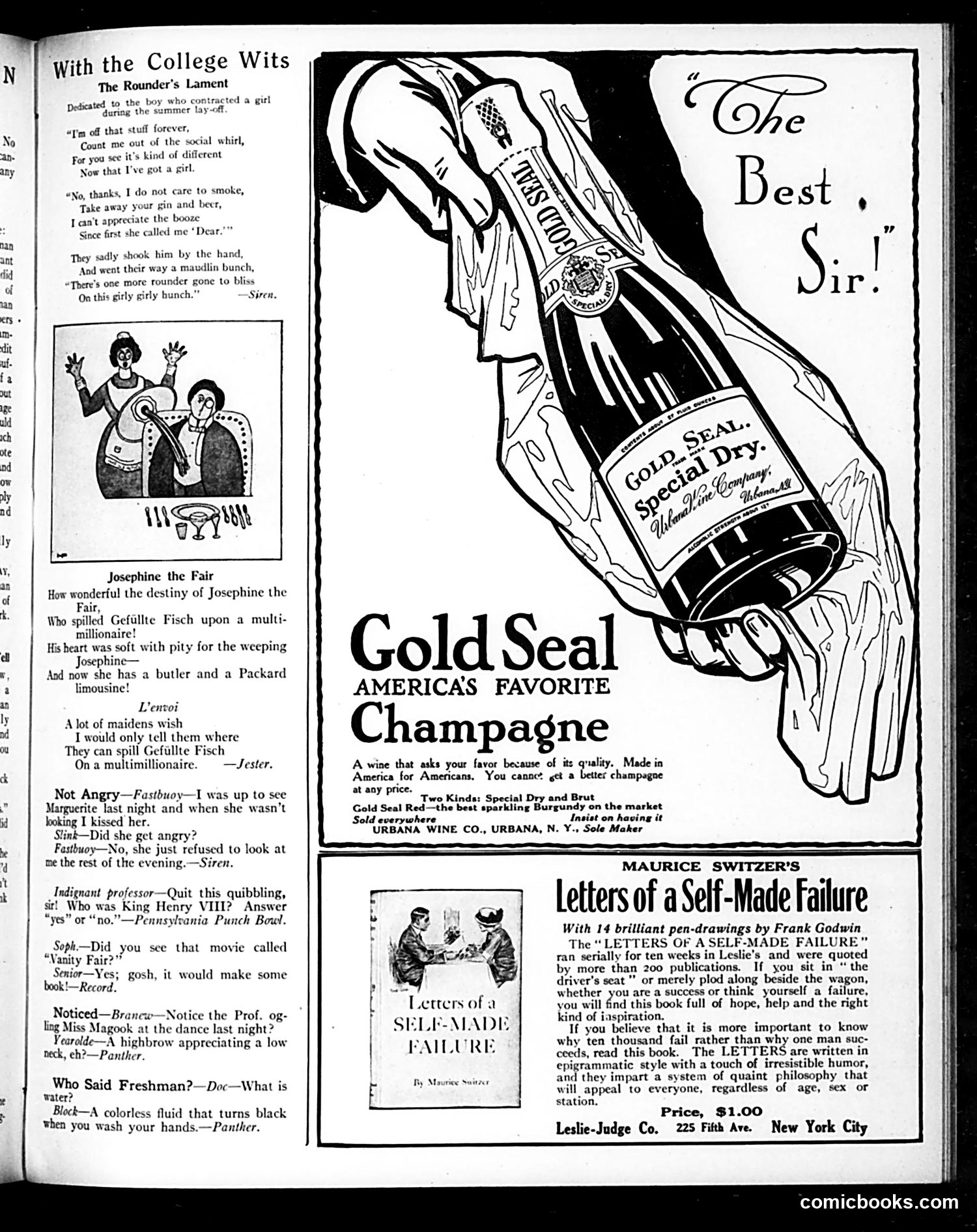
This page from Judge combines satirical humor with period advertisements. The left side features several short comedic pieces mocking college and social life: **"The Rounder's Lament"** jokes about a young man abandoning his carefree bachelor lifestyle after acquiring a girlfriend—he renounces smoking, drinking, and socializing, prompting his friends to mourn him as "gone to bliss." **"Josephine the Fair"** is a humorous poem about a working-class woman (suggested by her Yiddish surname and mention of gefilte fish) who marries wealth by spilling food on a millionaire, gaining servants and luxury cars. The satire targets both social climbing and the wealthy man's sentimentality. Additional brief jokes mock college dating customs and academic pretension. The right side features advertisements for Gold Seal Champagne ("America's Favorite," made domestically) and Maurice Switzer's self-help book *Letters of a Self-Made Failure*, reflecting early-20th-century consumer culture aimed at Judge's educated, middle-to-upper-class readership.
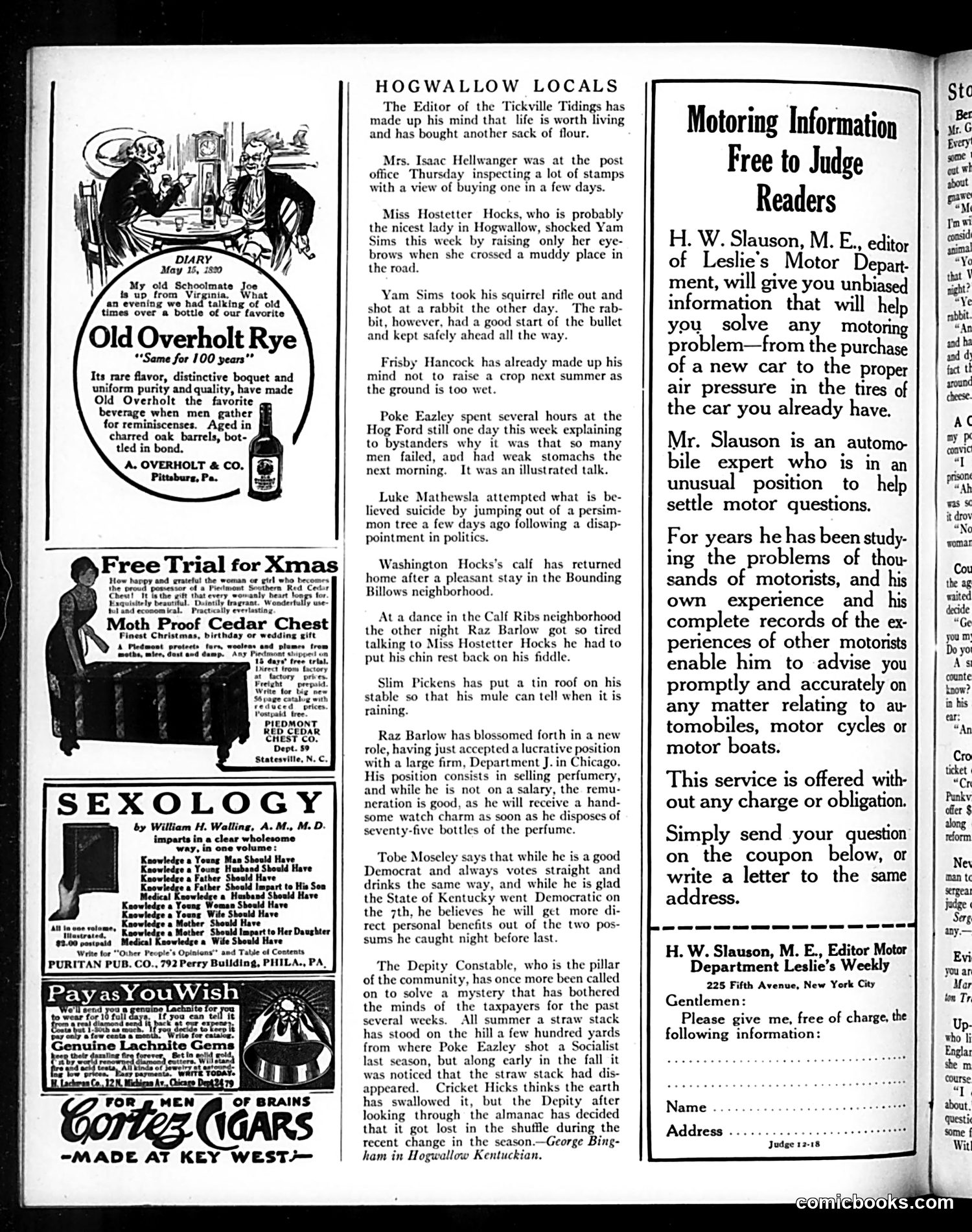
This page is primarily advertising, but includes a satirical humor column titled "Hogwallow Locals" presented as news items from a fictional backwoods Kentucky town. The column mocks rural American life through absurdist accounts: a man shooting at a rabbit that escapes; another explaining weak stomachs at an illegal still ("Hog Ford"); a farmer planning to skip crops because ground is too wet; someone attempting suicide over political disappointment. The humor is intentionally absurd and condescending—presenting rural/small-town people as simple, ineffective, and foolish (a mule with a tin roof, a calf wandering neighborhoods, a deputy "solving" mysteries through an almanac). The column reflects early-20th-century urban attitudes toward rural America as backward and amusing. "Hogwallow" itself signals comic contempt for the setting. The page also advertises whiskey, books on sexuality and etiquette, and cedar chests—seemingly unrelated products typical of period magazines.
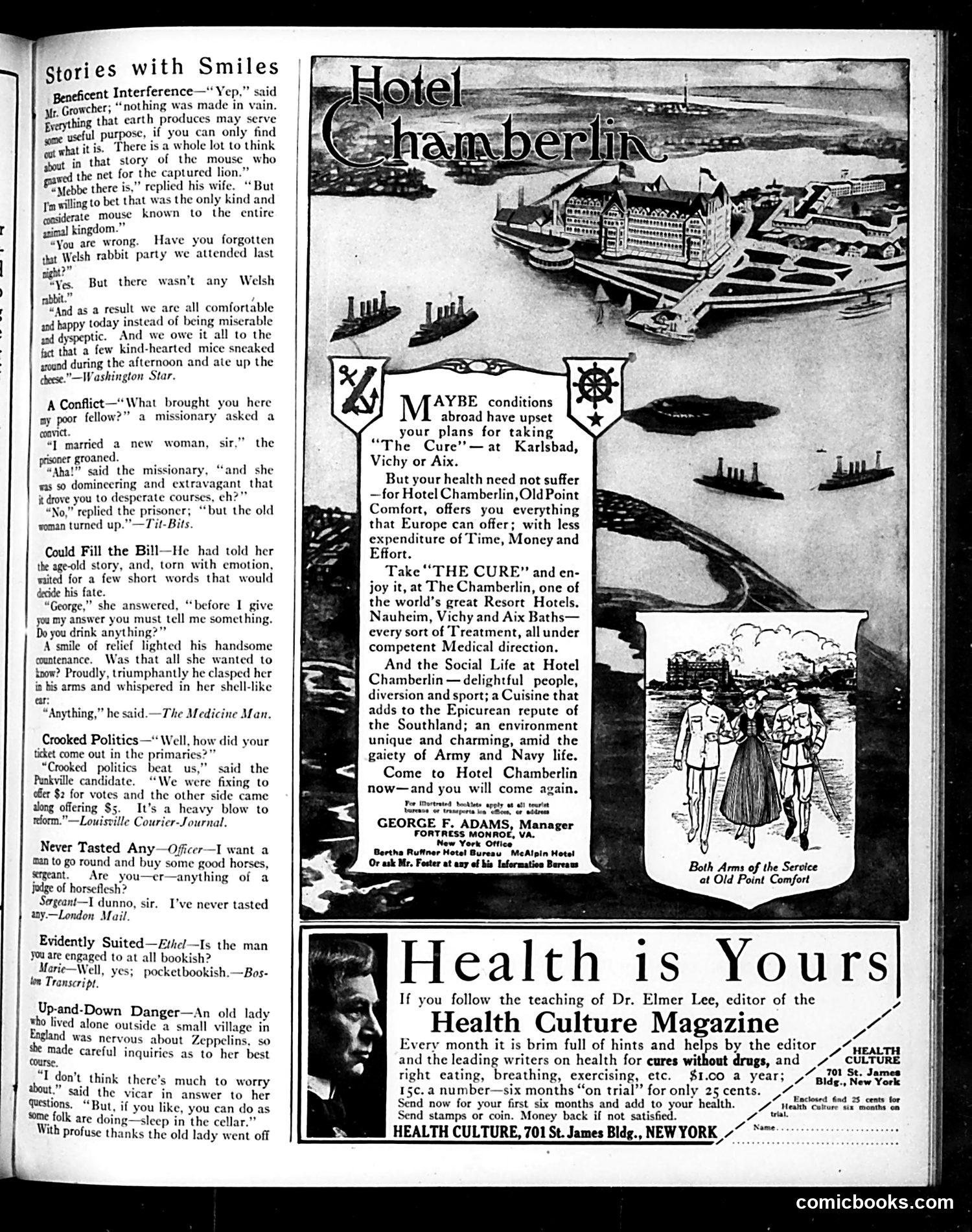
This page contains humorous short stories ("Stories with Smiles") rather than political cartoons. The jokes target early 20th-century social absurdities: **"Crooked Politics"** satirizes election fraud: a candidate laments that his team planned to offer $2 per vote but the opposition outbid them at $5—a direct critique of bribery in American primaries. **"Up-and-Down Danger"** references Zeppelin (German airship) attacks during WWI, when British civilians feared aerial bombardment. An elderly woman asks a vicar for safety advice; his suggestion to sleep in the cellar is darkly funny because cellars offered minimal protection. **Other jokes** mock marriage, drinking, horse-trading, and digestion—common comedic targets of the era. The page is primarily **advertising**: Hotel Chamberlin promotes European-style health treatments at an American resort, while Health Culture Magazine advertises wellness guides below.
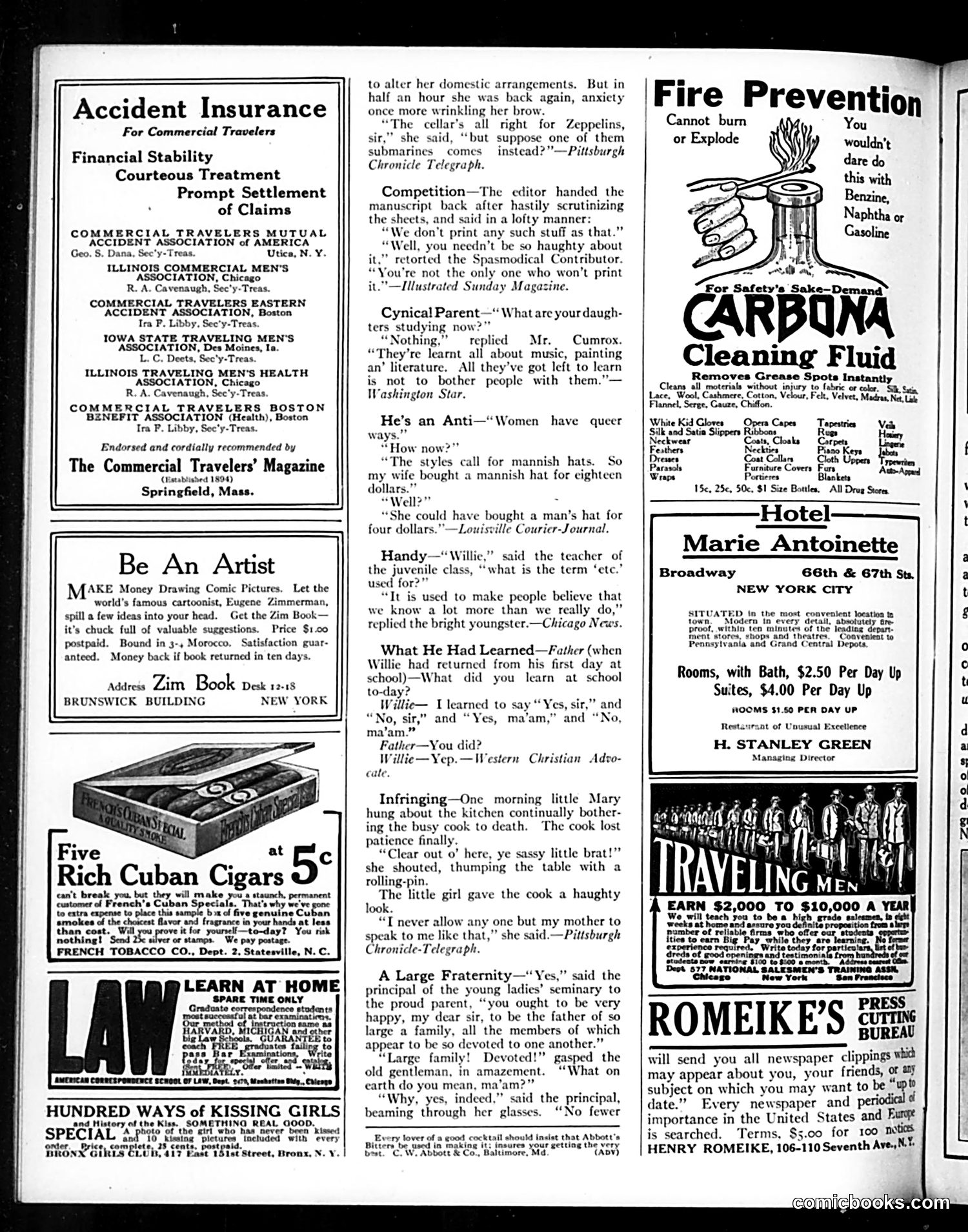
This page is primarily **advertising and humor content**, not political satire. The layout features commercial advertisements (accident insurance, cigars, correspondence courses) alongside a "humor" section with short jokes. The jokes reflect early 20th-century domestic life and social attitudes: - **"Zeppelins" reference**: A woman worries about German airships during WWI, then submarines—topical wartime anxiety. - **Teacher/student jokes**: Mock the gap between formal education and practical knowledge ("etc." used to seem smart; children learn only politeness). - **Gender humor**: Women adopting "mannish" fashion (hats) is presented as absurdly wasteful compared to buying men's clothing. - **Class dynamics**: A cook's exasperation with an intrusive child; employer-employee formality. The satire is gentle, domestic, and reflects period concerns about war, education, gender presentation, and social hierarchy—not political commentary. This appears to be a typical Judge issue blending advertisements with light humor for commercial travelers and middle-class readers.
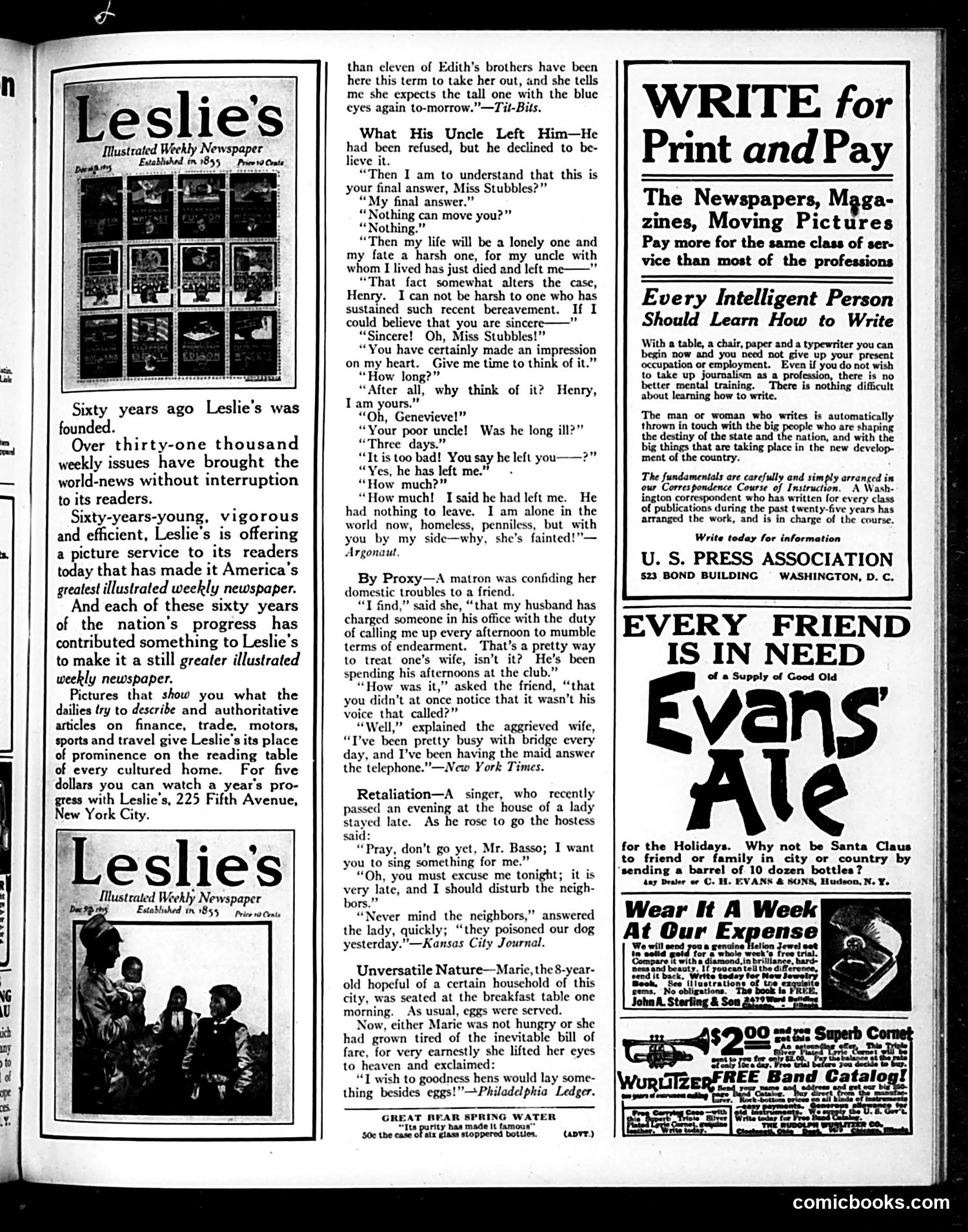
This page is primarily **advertising and promotional content** rather than political satire. The left side features ads for Leslie's Illustrated Weekly Newspaper (a competing publication), celebrating its 60-year history and promoting subscriptions. The center contains three **humorous anecdotes**—brief joke stories typical of period humor magazines: 1. "What His Uncle Left Him"—plays on a marriage proposal twist, where a woman rejects a suitor until he mentions an inheritance, only to discover he inherited nothing. 2. "By Proxy"—satirizes modern marital disconnection: a husband hires an office worker to call his wife with romantic endearments while he's at his club; she doesn't notice the deception because she's distracted with bridge. 3. "Retaliation"—incomplete in this excerpt, but appears to concern a singer exacting revenge after being kept late at a social engagement. The right side advertises writing instruction courses and Evans Ale. **No clear political cartoons appear on this page.** The humor reflects early 20th-century social anxieties about marriage, leisure, and modernity.
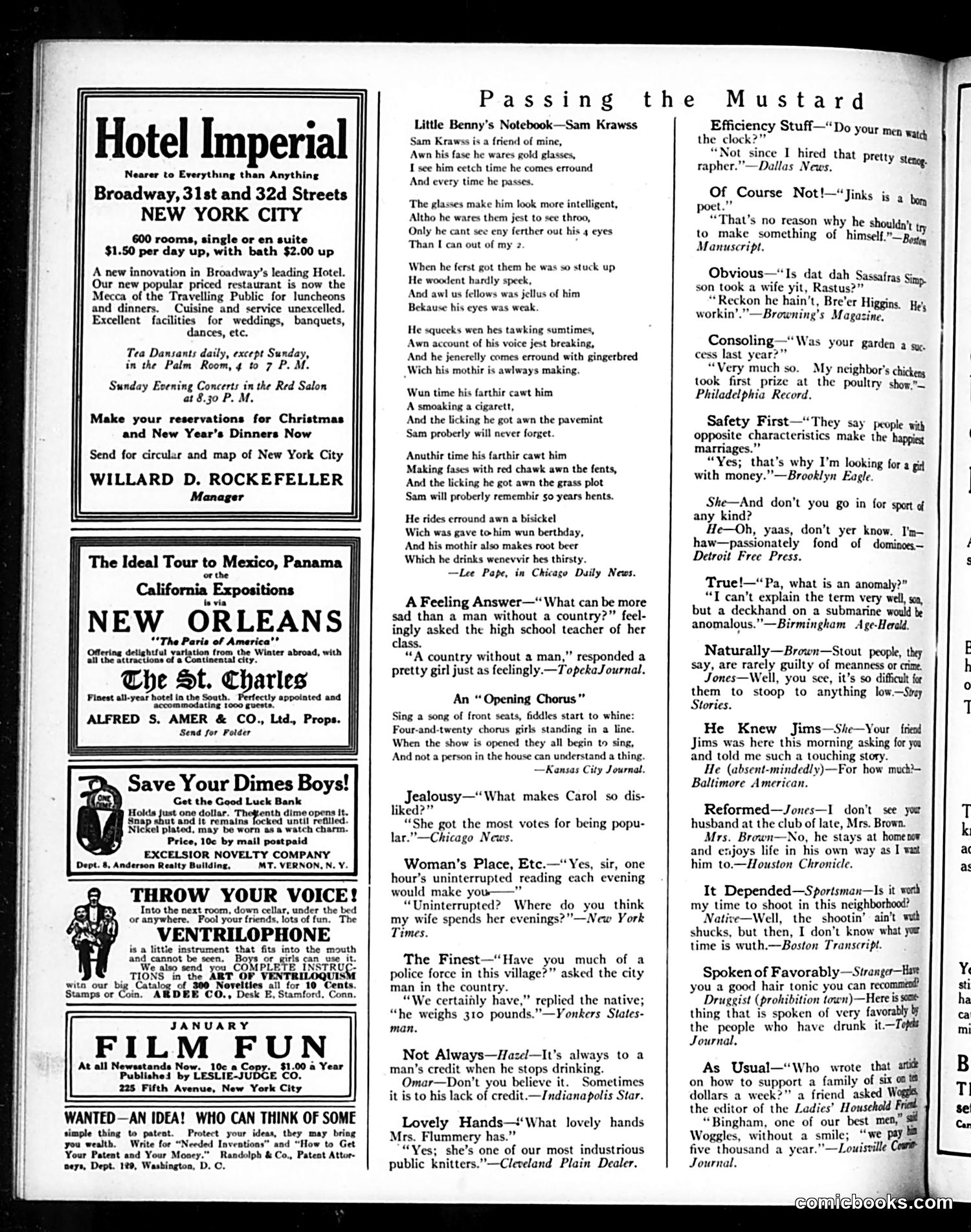
This page is primarily **advertisements and humorous prose**, not political cartoons. The main content includes: **Advertisements:** Hotel Imperial, travel tours to Mexico and New Orleans, novelty items (a "Good Luck Bank," a "Ventrilophone" voice-throwing device), and patent services—typical early 20th-century offerings targeting middle-class readers. **Humorous Content:** "Little Benny's Notebook" is a comedic piece about a boy named Sam Krawss who wears gold-rimmed glasses and gets into typical childhood mishaps (smoking, making faces, bicycle riding). The deliberately misspelled dialect humor was popular in the era. Other brief jokes mock various social situations—efficiency, safety in marriage, gardening, etc.—with punchlines attributed to newspapers and magazines. There are **no visible political cartoons or caricatures** on this page. It represents Judge's mix of advertising revenue and light, domesticated humor rather than its satirical editorial content.
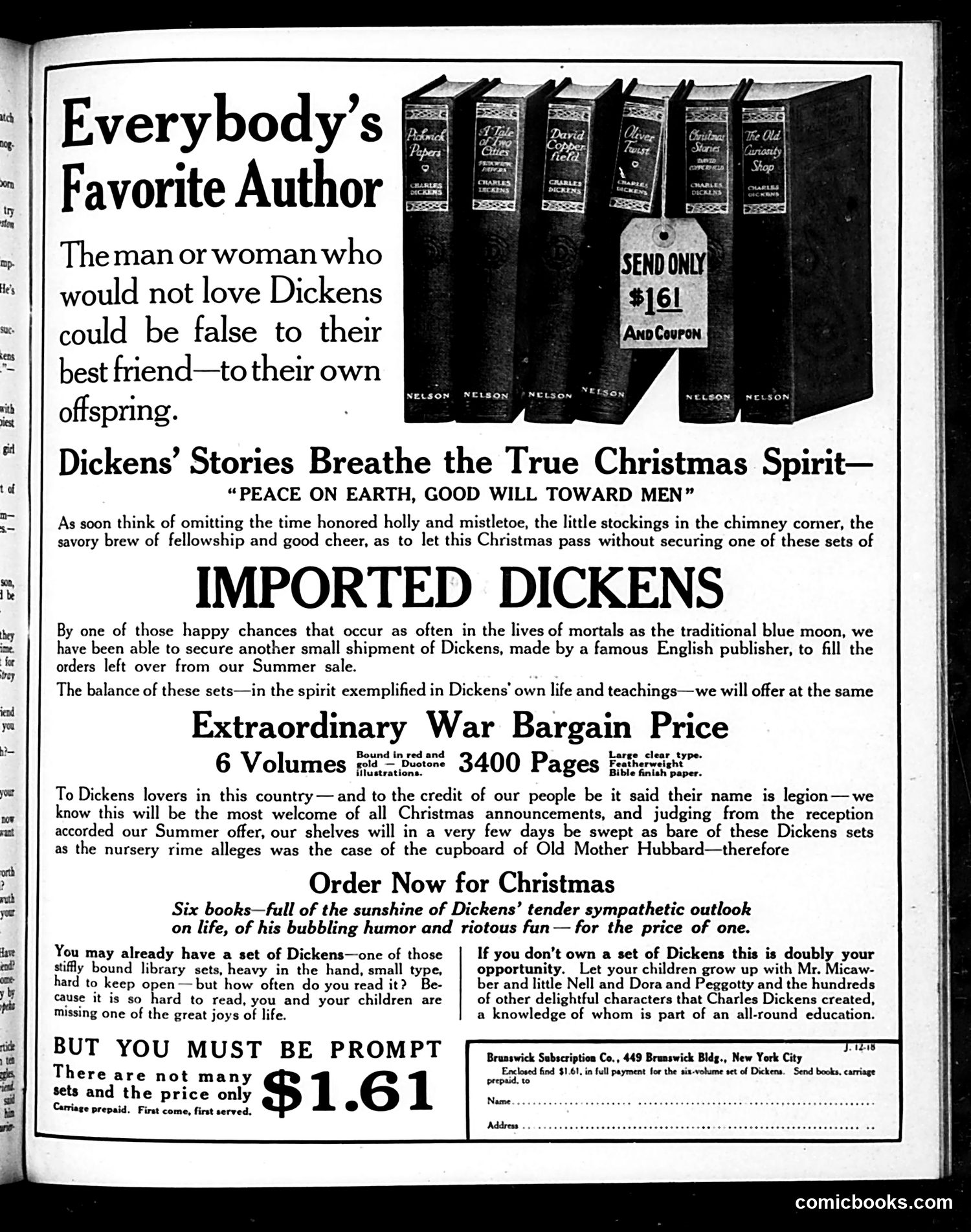
This page is primarily a **mail-order advertisement** for imported Charles Dickens book sets, not political satire or cartoon content. It runs in *Judge* magazine but contains no visible cartoons or caricatures to analyze. The ad markets a six-volume Dickens collection at the "war bargain price" of $1.61 (postpaid), emphasizing that Dickens embodies Christmas spirit and wholesome family values. The pitch targets middle-class readers: owning Dickens signals cultural refinement and proper child-rearing. The urgency ("BUT YOU MUST BE PROMPT") and scarcity claim ("not many sets") employ standard sales tactics. The reference to "war bargain" likely dates this to WWI-era cost-consciousness, when "war prices" marketed goods as patriotic or economical. The appeal to Dickens-lovers as "legion" assumes widespread, aspirational readership among the magazine's audience.
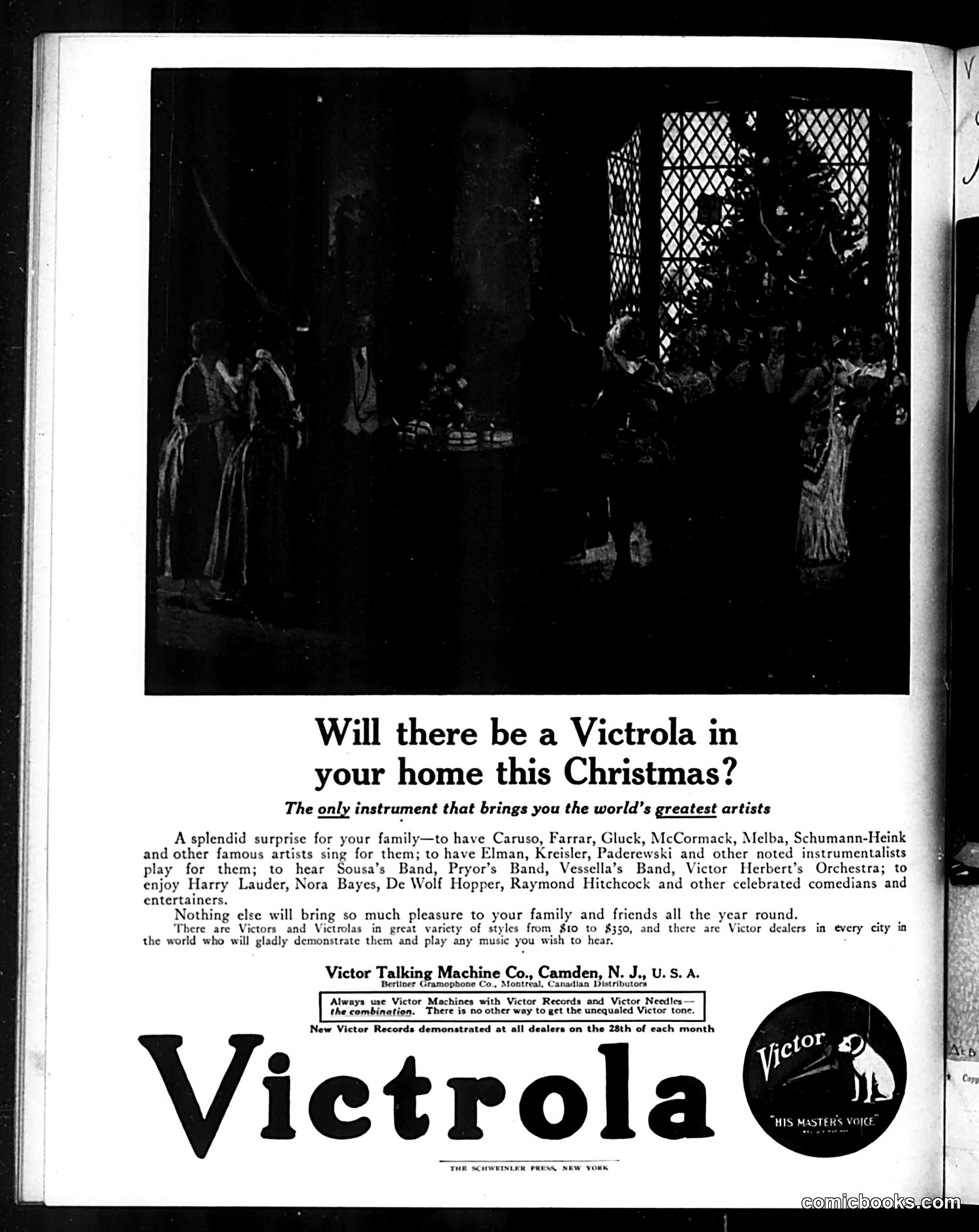
This is **not a political cartoon or satire**—it's a full-page advertisement for the Victrola, Victor Talking Machine Company's phonograph player. The image shows what appears to be an elegant interior scene with figures in formal dress, suggesting the aspirational lifestyle the product promised. The ad targets Christmas gift-givers by emphasizing luxury: owning a Victrola would bring famous opera singers (Caruso, Melba), comedians (De Wolf Hopper), and orchestras into the home. Key selling points: prices ranging $10–$350 (suggesting options for different budgets); availability of "Victor Records"; and the famous "His Master's Voice" logo (the dog listening to the phonograph). This represents early 20th-century consumer marketing—positioning an expensive device as an essential luxury item and status symbol for prosperous households. The prominence in *Judge* magazine reflects how thoroughly advertising had infiltrated even satirical publications by this era.