
Judge, 1915-12-18 · page 17 of 28
Judge — December 18, 1915 — page 17: what you’re looking at
What you’re looking at
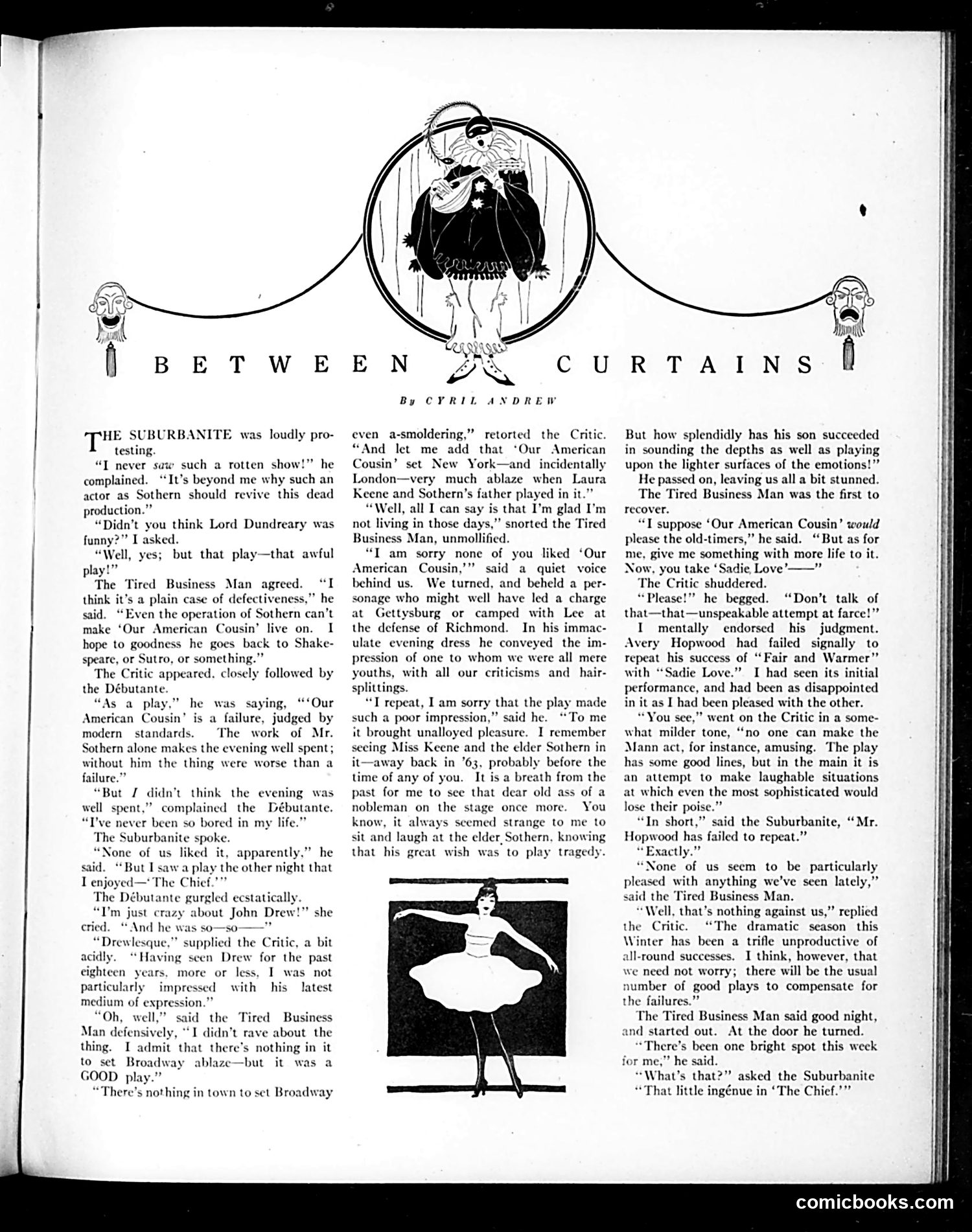
This page from Judge magazine satirizes Broadway theater criticism and generational taste divides circa the early 1900s. The dialogue features archetypal characters—a Suburbanite, Tired Business Man, Critic, and Débutante—debating a revival of "Our American Cousin," the 1858 comedy. An elderly gentleman interrupts their complaints, revealing he saw the original production in 1863 with Laura Keene and the elder Sothern. He appreciates the son's performance with nostalgia for the play's historical moment. The modern critics dismiss it as dated and boring. The satire targets how contemporary audiences and critics undervalue classic theater while the older generation finds genuine pleasure in revivals connected to their past. The "old-timer" represents lost cultural continuity, while the younger characters represent shallow, ever-changing fashions in entertainment taste.
📄 Transcribed text from this page (OCR, searchable)
Machine-transcribed from the original scan — historical spelling and the odd misread are preserved.
1 a SUBURBANITE was loudly pro- testing. “I never saw such a rotten show!” he complained. “It’s beyond me why such an actor as Sothern should revive this dead production.” “Didn’t you think Lord Dundreary was funny?” I asked. Vell, yes; but that play—that awful play!” The Tired Business Man agreed. “I think it’s a plain case of defectiveness,” he said. “Even the operation of Sothern can’t make ‘Our American Cousin’ live on. I hope to goodness he goes back to Shake- speare, or Sutro, or something.” The Critic appeared. closely followed by the Débutante. “As a p he was saying, ‘‘Our American Cousin’ is a failure, judged by modern standards. The work of Mr. Sothern alone makes the evening well spent; without him the thing were worse than a failure.” “But J didn’t think the evening was well spent,” complained the Débutante. “ve never been so bored in my life.” The Suburbanite spoke. “None of us liked it, apparently,” he said. “But I saw a play the other night that I enjoyed— The Chief."” The Débutante gurgled ecstatically. “Dm just crazy about John Drew!” she cried. “And he was so—so——” “Drewlesque,” supplied the Critic, a bit acidly. “Having scen Drew for the past eighteen years, more or less, I was not particularly impressed with his latest medium of expression.” “Oh, well,” said the Tired Business Man defensively, “I didn’t rave about the thing. I admit that there's nothing in it to set Broadway ablaze—but it was a nothing in town to set Broadway C U By CYRIL ANDREW even a-smoldering,” retorted the Critic. “And let me add that ‘Our American Cousin’ set New York—and incidentally London—very much ablaze when Laura Keene and Sothern’s father played in it. “Well, all I can say is that I’m glad I’m not living in those days,” snorted the Tired Business Man, unmollified. “IT am sorry none of you liked ‘Our American Cousin,’” said a quiet voice behind us. We turned, and beheld a per- sonage who might well have led a charge at Gettysburg or camped with Lee at the defense of Richmond. In his immac- ulate evening dress he conveyed the im- pression of one to whom we were all mere youths, with all our criticisms and_hair- splittings. “T repeat, I am sorry that the play made such a poor impression,” said he. ‘To me it brought unalloyed pleasure. I remember secing Miss Keene and the elder Sothern in it—away back in ’63, probably before the time of any of you. It is a breath from the past for me to see that dear old ass of a nobleman on the stage once more. You know, it always scemed strange to me to sit and laugh at the elder, Sothern, knowing that his great wish was to play tragedy. R TAINS But how splendidly has his son succeeded in sounding the depths as well as playing upon the lighter surfaces of the emotions!” He passed on, leaving us all a bit stunned. The Tired Business Man was the first to recover. “T suppose ‘Our American Cousin’ would please the old-timers,” he said. “But as for me, give me something with more life to it. Now, you take ‘Sadie, Love’-——” The Critic shuddered. “Please!” he begged. “Don’t talk of that—that—unspeakable attempt at farce!” I. mentally endorsed his judgment. Avery Hopwood had failed signally to repeat his success of ‘Fair and Warmer” with “Sadie Love.” I had seen its initial performance, and had been as disappointed in it as I had been pleased with the other. “You see,” went on the Critic in a some- what milder tone, “‘no one can make the Mann act, for instance, amusing. The play has some good lines, but in the main it is an attempt to make laughable situations at which even the most sophisticated would lose their poise.” “In short,” said the Suburbanite, “Mr. Hopwood has failed to repeat.” “Exactly.” one of us seem to be particularly eased with anything we've seen lately,” said the Tired Business Man. “Well, that’s nothing against us,” replied the Critic. ‘The dramatic season this Winter has been a trifle unproductive of all-round successes. I think, however, that we need not worry; there will be the usual number of good plays to compensate for the failures.” The Tired Business Man said good night, and started out. At the door he turned. There’s been one bright spot this week for me,” he said. “What's that?” asked the Suburbanite “That little ingénue in ‘The Chief. comicbooks.com