
Judge, 1915-12-18 · page 12 of 28
Judge — December 18, 1915 — page 12: what you’re looking at
What you’re looking at
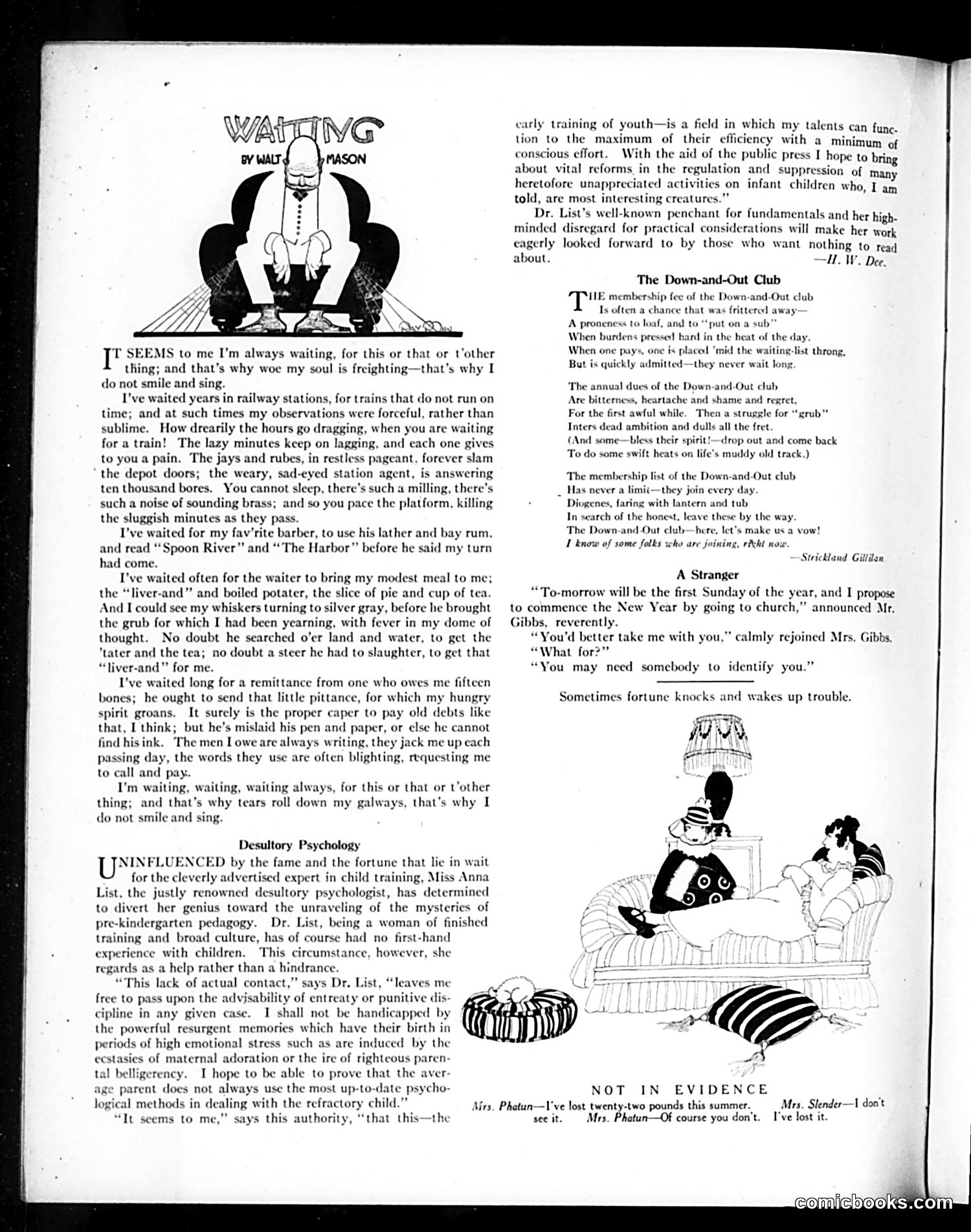
This *Judge* page contains two satirical pieces: **"Waiting"** (left): A humorous poem mocking the universal frustration of waiting—in train stations, for barbers, meals, and debts to be repaid. The complaint that constant waiting prevents happiness ("that's why I do not smile and sing") is exaggerated for comic effect. The satire targets everyday modern inconveniences. **"Desultory Psychology"** (right): This mocks Dr. Anna List, a child-psychology "expert" who, ironically, has never actually spent time with children. The satire ridicules credentialed theorists who lack practical experience yet confidently prescribe methods. Her boast that inexperience is an *advantage*—freeing her from "powerful resurgent memories"—is absurd. This reflects early 20th-century skepticism toward academic psychology and "expert" advice disconnected from reality. Both pieces target ordinary frustrations and professional pretension with deadpan irony.
📄 Transcribed text from this page (OCR, searchable)
Machine-transcribed from the original scan — historical spelling and the odd misread are preserved.
T SEEMS to me I'm always waiting, for this or that or t’other thing; and that’s why woe my soul is freighting—that’s why I do not smile and sing. I've waited years in railway stations, for trains that do not run on time; and at such times my observations were forceful, rather than sublime. How drearily the hours go dragging, when you are waiting for a train! The lazy minutes keep on lagging, and each one gives to youa pain. The jays and rubes, in restless pageant. forever slam the depot doors; the weary, sad-eyed station agent, is answering ten thousand bores. You cannot sleep, there's such @ milling, there’s such a noise of sounding brass; and so you pace the platform, killing the sluggish minutes as they I’ve waited for my fav’rite barber, to use his lather and bay rum, and read “Spoon River” and “The Harbor” before he said my turn had come. I’ve waited often for the waiter to bring my modest meal to me; the “liver-and” and boiled potater, the slice of pie and cup of tea. And I could see my whiskers turning to silver gray, before he brought the grub for which I had been yearning, with fever in my dome of thought. No doubt he searched o’er land and water, to get the ‘tater and the tea; no doubt a steer he had to slaughter, to get that “liver-and” for me. I've waited long for a remittance from one who owes me fifteen he ought to send that little pittance, for which my hungry spirit groans. It surely is the proper caper to pay old debts like that, I think; but he’s mislaid his pen and paper, or else he cannot find his ink. The men L owe are always writing, they jack me up cach passing day, the words they use are often blighting, requesting me to call and pay. I’m waiting, waiting, waiting always, for this or that or t’other thing; and that’s why tears roll down my galways, that’s why I do not smile and sing. Desultory Psychology NINFLUENCED by the fame and the fortune that lie in wait for the cleverly advertised expert in child training, Miss Anna List, the justly renowned desultory psychologist, has determined to divert her genius toward the unraveling of the mysteries of indergarten pedagogy. Dr. List, being a woman of finished training and broad culture, has of course had no first-hand experience with children. This circumstance, however, she as a help rather than a hindrance. “This lack of actual conta says Dr, List, “leaves me free to pass upon the advisability of entreaty or punitive dis- cipline in any given case. I shall not be handicapped by the powerful resurgent memories which have their birth in periods of high emotional stress such as are induced by the ecstasies of maternal adoration or the ire of righteous paren- tal belligerency. I hope to be able to prove that the aver parent does not always use the most up-to-date psycho- logical methods in dealing with the refractory child.” “It seems to me, “that this—the ys this authority wed carly training of youth—is a field in which my talents can func. tion to the maximum of their efficiency with a minimum of conscious effort. With the aid of the public press I hope to bring about vital reforms, in the regulation and suppression of many heretofore unappreciated activities on infant children who, I am told, are most interesting creatures.” Dr. List’s well-known penchant for fundamentals and her high- minded disregard for practical considerations will make her work eagerly looked forward to by those who want nothing to read —H.W. Dee. about. The Down-and-Out Club IIE membership fee of the Down-and-Out club Is often a chance that was fritterod away— and to ut on a sub” A proneness to le: When burdens pressed bard in the heat of the When one pays, But is quickly admitted—they never wait Io one is placed ‘mid the w The annual dues of the Down-and-Out club Are bitterness, heartache and shame and regret, For the first awful while. Then a struggle for “grub” Inters dead ambition and dulls all the fret (And some !—drop out and come back To do some swift heats on life's muddy old track.) The membership list of the Down-and-Out club Has never a limit—they join every day. Diogenes, faring with lantern and tub In search of the honest, leave these by the way ‘The Down-and-Out club—here, let's make us a vow! I know of some folks who arc joining, rkeht now. Strickland Gillilan A Stranger “To-morrow will be the first Sunday of the y to commence the New Year by going to church, Gibbs, reverently. “You'd better take me with you,” calmly rejoined Mrs. Gibbs. “What for?” “You may need somebody to identify you.” r, and I propose announced Mr, Sometimes fortune knocks and wakes up trouble. IN EVIDENCE Mrs. Phatun—I've lost twenty-two pounds this summer. NOT Mrs. Slender—I don't see it. Mrs. Phatun—Of course you don’t. I've lost it.