
A complete issue · 27 pages · 1915
Judge — September 4, 1915
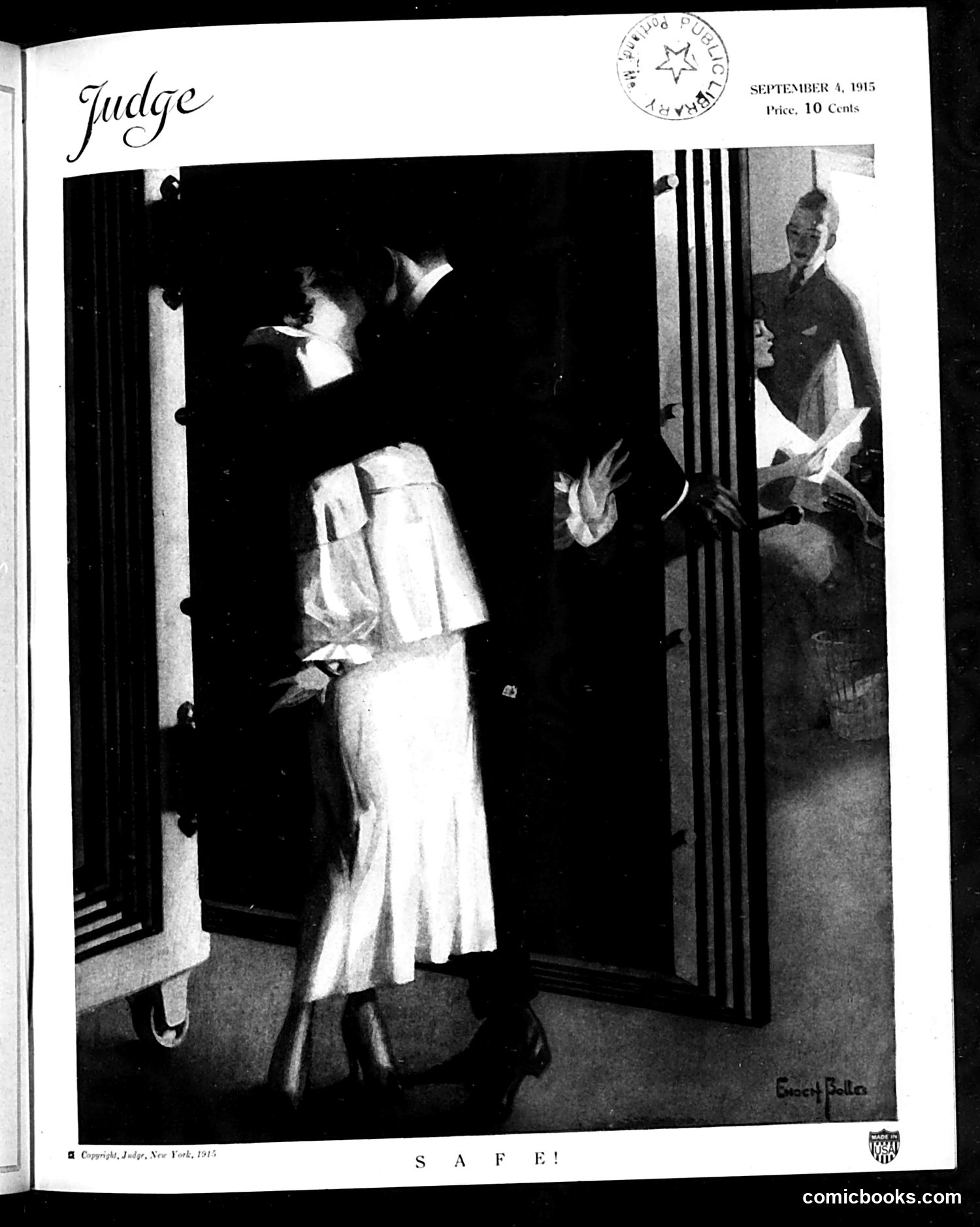
This cartoon depicts a domestic scene where a woman in a light dress stands in a doorway while a man in dark clothing appears to be leaving or entering. Another figure is visible on the right side of the frame. The title "Safe!" suggests the satire concerns safety or security in a household context. Given the 1915 date and the woman's prominent positioning, this likely comments on domestic relations or marital propriety of the era. The composition—with figures framed in doorways and the apparent surveillance or observation occurring—may satirize concerns about monitoring domestic behavior or questions of fidelity that were common subjects in period satirical magazines. The specific social commentary remains somewhat unclear without additional context about contemporary scandals or social debates of September 1915.
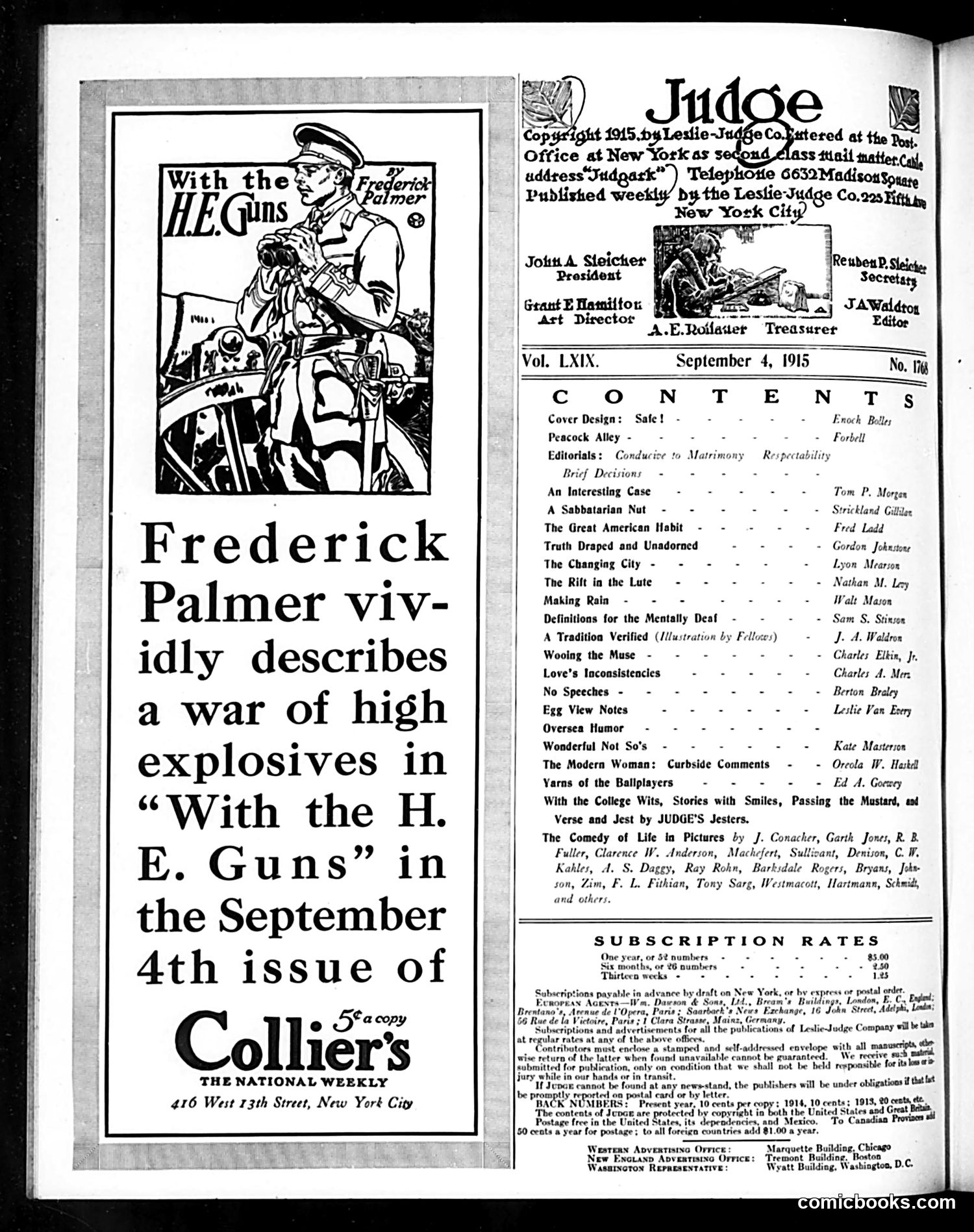
This is primarily an **advertisement for Collier's magazine**, not editorial content. The ad promotes Frederick Palmer's article "With the H.E. Guns," appearing in Collier's September 4th issue. The illustration depicts a military officer in uniform (Palmer, identified in the title) describing WWI artillery warfare. Palmer was a war correspondent who covered the conflict firsthand. The image shows him gesturing authoritatively, suggesting he's recounting dramatic firsthand combat experiences involving heavy explosives. The ad's appeal targets readers interested in serious war reportage—positioning Collier's as a source for vivid, detailed accounts of the ongoing European conflict. For 1915 American readers, this represented exciting access to battlefield details before U.S. entry into the war. The rest of the page shows Judge magazine's masthead and contents listing.
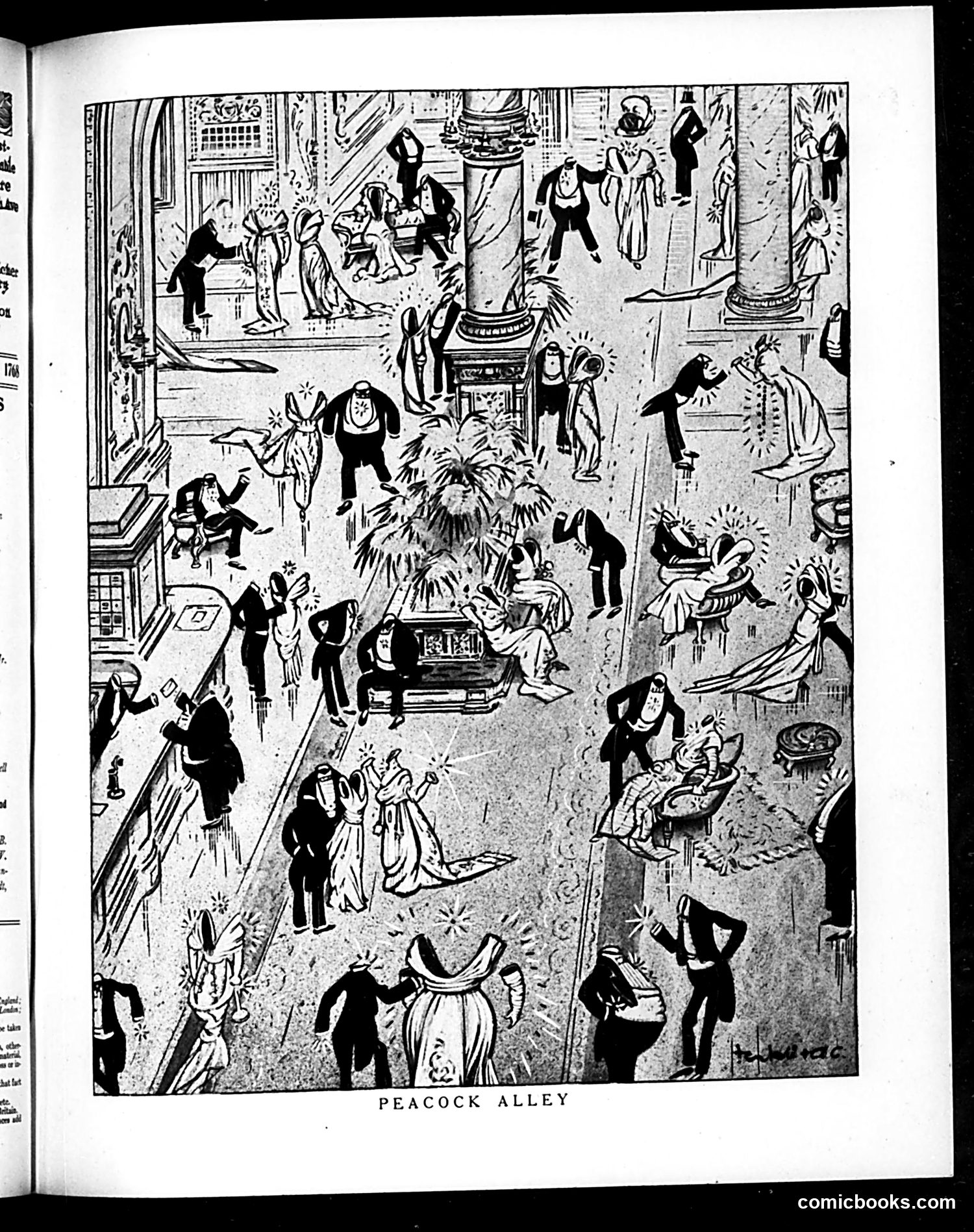
This illustration depicts a crowded, elegant interior space labeled "Peacock Alley"—likely referencing the famous corridor in the Waldorf-Astoria Hotel, a fashionable gathering spot for New York's wealthy elite. The cartoon satirizes high society through chaotic, exaggerated scenes of socialites in formal dress engaged in various social posturing and displays. The composition suggests vanity and pretension, with figures engaged in conversation, flirtation, and conspicuous behavior—mimicking peacocks displaying their plumage. The satire targets the superficiality and self-absorption of the upper class, presenting their social rituals as ridiculous theater. The crowded composition and animated poses emphasize the absurdity of their status-conscious performances, mocking their elaborate social conventions and peacock-like vanity.
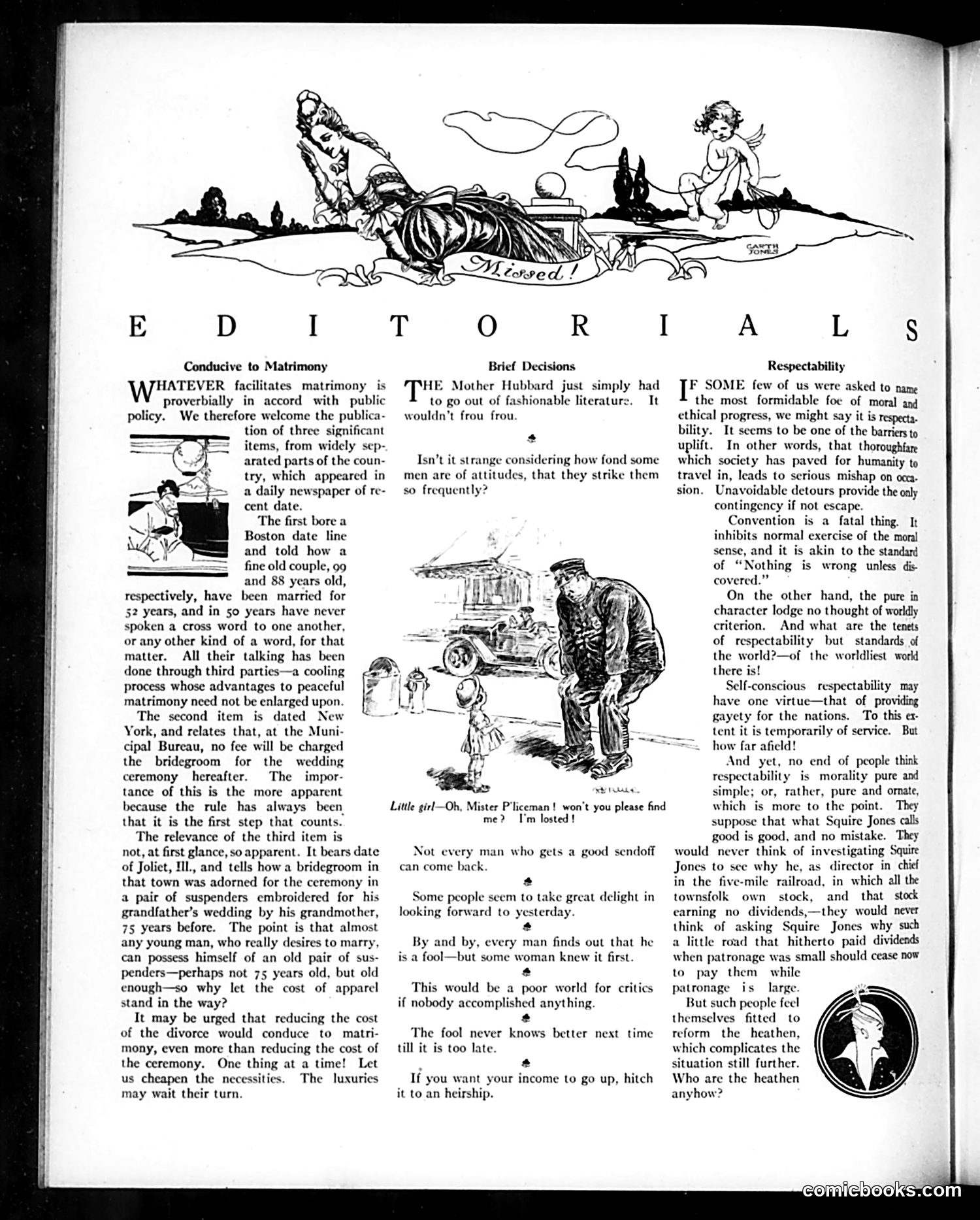
This Judge magazine page contains three opinion columns on marriage and social conduct, accompanied by illustrations and editorial cartoons. The main visual cartoon shows a man in a car speaking to a young girl, with the caption "Little girl—Oh, Mister Policeman! I won't you please find me? I'm lost!" This appears to satirize either predatory behavior or the vulnerability of children in public spaces. The left column discusses reducing marriage costs and wedding expenses to encourage matrimony. The center and right columns debate "respectability" in society—criticizing both excessive moral conventionality and the hypocrisy of people who selectively enforce moral standards. The overall page reflects early 20th-century anxieties about marriage, morality, and social propriety, using humor to critique inconsistent social standards.
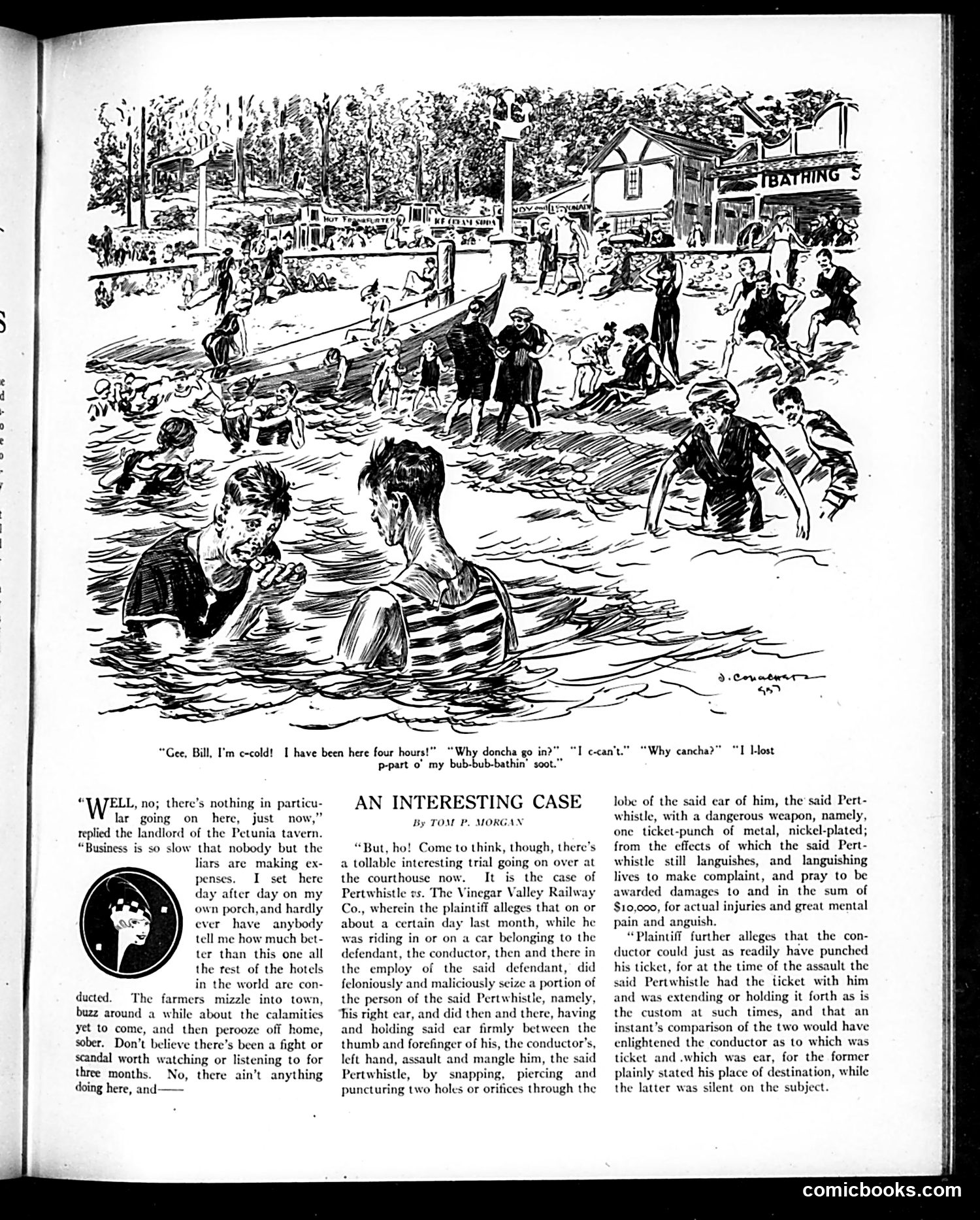
The top illustration depicts a crowded beach resort scene with bathers and vacationers. The cartoon caption captures casual beach conversation, with one person complaining about being cold after four hours of swimming, another asking "Why doncha go in?" — to which comes the reply "I c-can't" and "Why cancha?" followed by "I bloat p-part o' my bub-bub-bathin' suit." This is a simple gag about someone who has lost or damaged their swimming costume and is embarrassed to enter the water. It's humor based on physical embarrassment and the social awkwardness of a modest mishap at a public beach—the kind of mild, family-friendly comic scenario typical of Judge magazine's satirical content. The joke relies on Victorian-era attitudes about propriety and bathing attire.
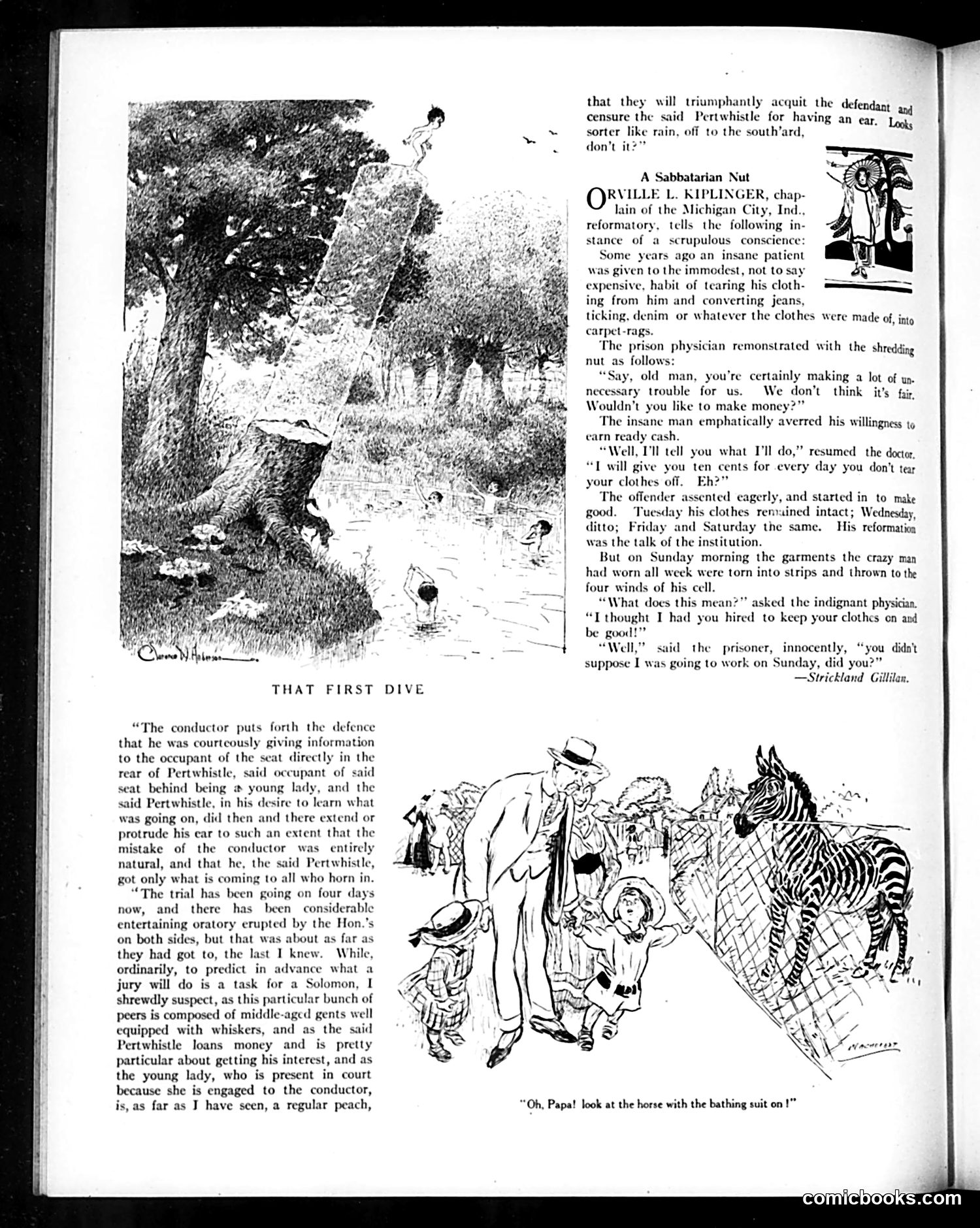
This page contains two separate satirical pieces from *Judge* magazine: **"A Sabbatarian Nut"**: A humorous anecdote mocking religious rigidity. An insane asylum inmate tears his clothes constantly. A doctor offers him ten cents daily to stay clothed—he succeeds Monday through Saturday but tears everything apart on Sunday. When confronted, the prisoner innocently notes the doctor never said he had to work on Sundays. The satire targets strict Sabbatarian observance (religious prohibition on work Sundays) as absurdly literal and counterproductive, even in treating mental illness. **"That First Dive"**: A courtroom satire involving a defendant named Pertwhistle suing a conductor. The conductor allegedly struck Pertwhistle's ear while gesturing to a young lady. The piece mocks legal proceedings' tedium and the predictable jury bias—the jurors are middle-aged, whisker-wearing men; Pertwhistle loans money (implying he's wealthy/credible); the conductor's fiancée sits in court. The setup satirizes how juries favor certain social types over justice. Both pieces exemplify *Judge's* satirical style targeting institutional hypocrisy and human folly.
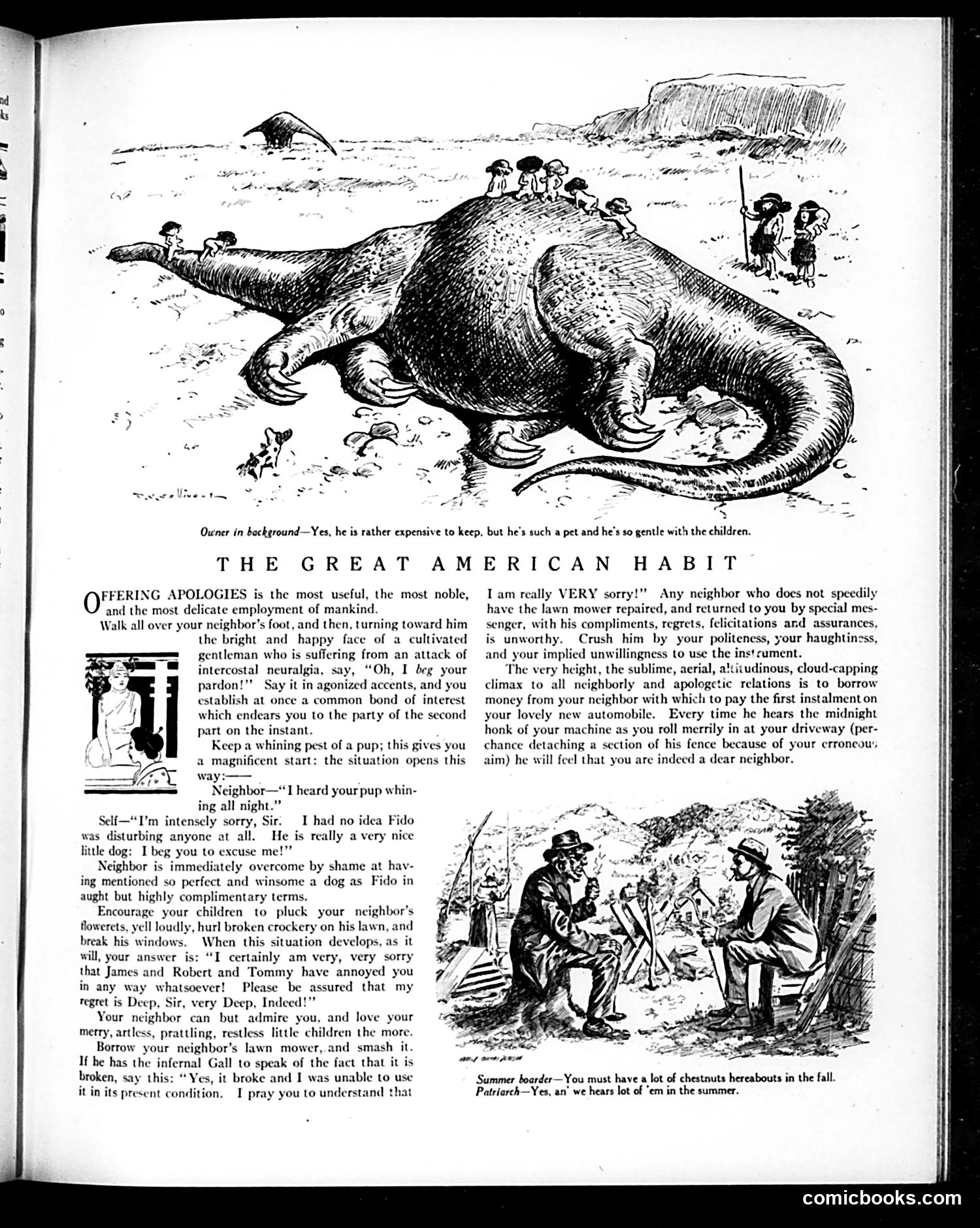
This satirical piece mocks the American custom of excessive apologizing as a social lubricant. The main text portrays apologies as a manipulative tool: one can transgress against neighbors—disturbing them with a noisy dog, allowing children to destroy property, borrowing and breaking items, or even borrowing money for a car—and neutralize their justified anger through sufficiently earnest and elaborate apologies. The joke is that elaborate politeness becomes its own form of aggression, psychologically guilting the neighbor into accepting mistreatment. The accompanying illustrations show a dinosaur (labeled "expensive to keep" but "gentle with children") as a visual metaphor for this absurd dynamic—an obviously dangerous creature excused by charming rhetoric. The lower cartoon's exchange about "chestnuts" and hearing "'em in the summer" appears to be a separate, unrelated pun or joke.
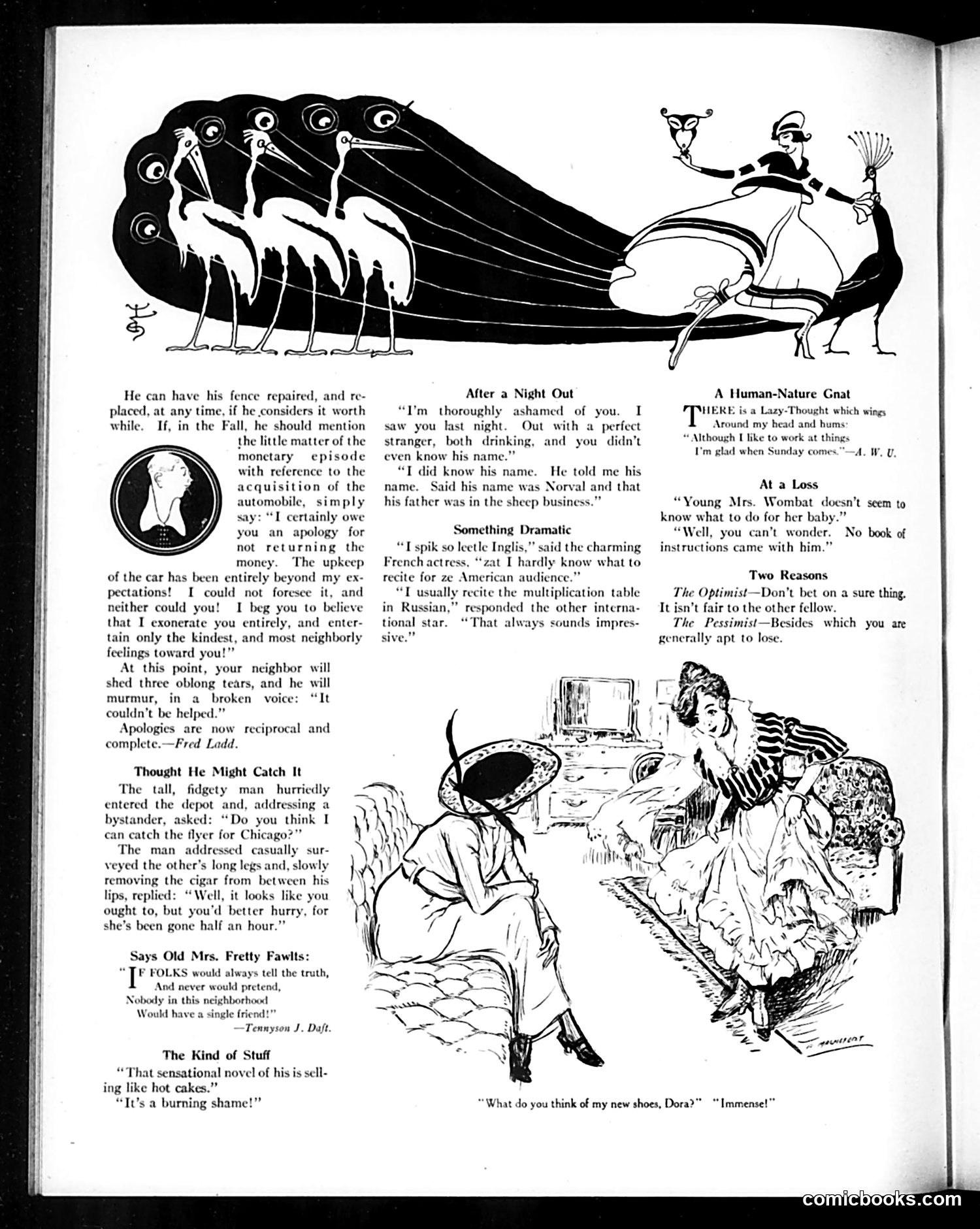
This page contains several short humorous pieces typical of early 20th-century satirical magazines: **Top cartoon**: Shows a woman being pulled by three ostriches—likely satirizing the fashionable use of ostrich feathers in women's clothing and hats, which were expensive status symbols. The absurdity emphasizes how impractical and excessive this trend had become. **Text pieces** include comedic anecdotes about social etiquette and human nature: a man making elaborate apologies for damaging a borrowed car; a woman caught out on a drunken evening; an actress reciting multiplication tables in Russian; and wordplay about catching a train. **Bottom cartoon**: Shows a woman with large, exaggerated shoes, with the caption "Immense!"—likely mocking women's fashion choices or shoe size, playing on the gap between intention and effect. The overall tone reflects Judge's satirical approach to contemporary social customs, fashion absurdities, and middle-class pretension. These pieces assume readers familiar with turn-of-the-century American social conventions and their contradictions.
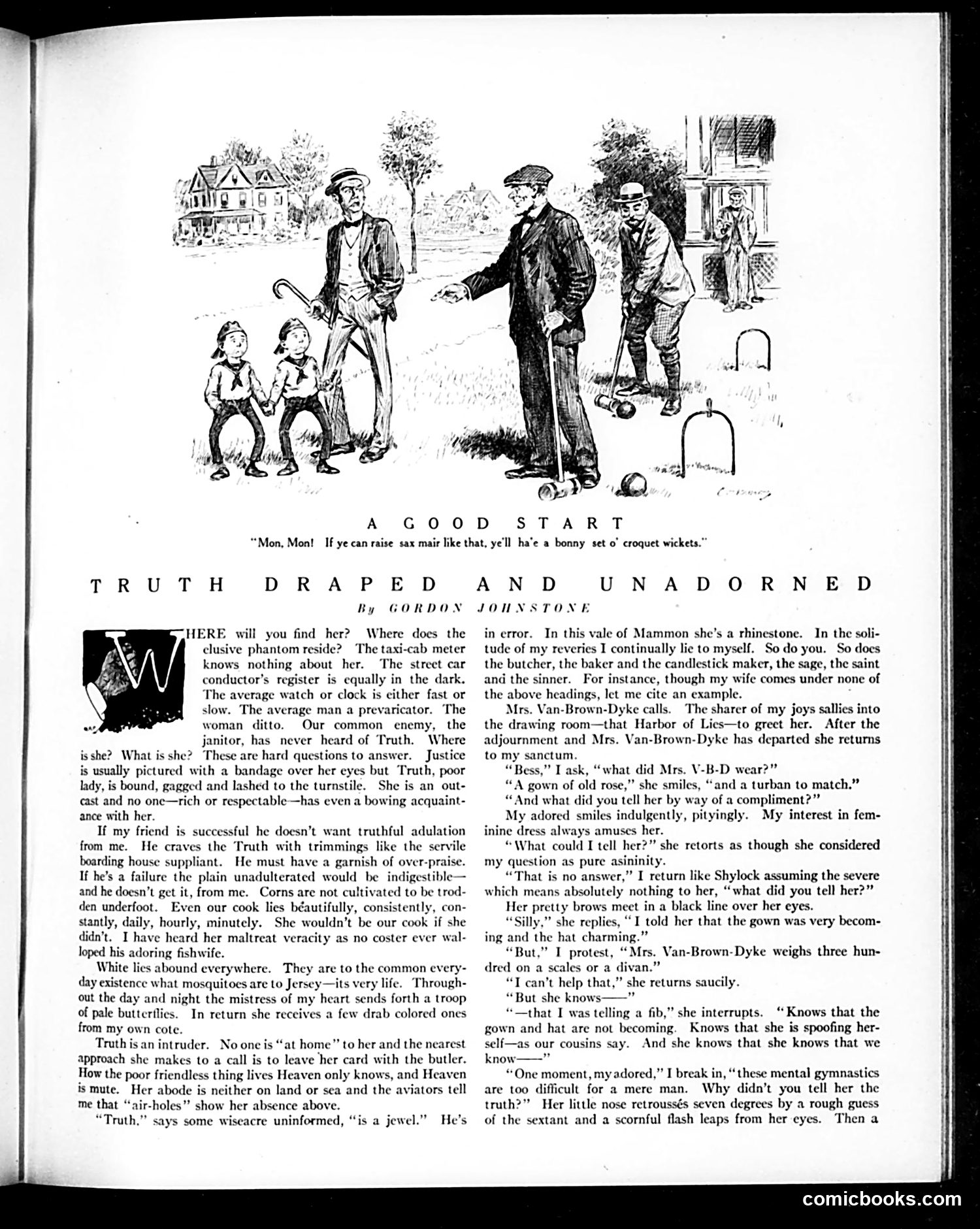
The top cartoon shows men discussing raising "sax mair" (six more) like something to use as croquet wickets—likely a crude joke about children or small people, typical of Judge's often dark humor. The longer piece below is a satirical essay arguing that Truth is socially unwelcome in American life. The author contends that people—servants, friends, society—routinely lie with "trimmings" of flattery rather than honest feedback. He illustrates this with an anecdote: when his wife compliments an obese visitor's unflattering dress, he demands she state the plain truth. She responds that everyone involved *knows* it's a lie, creating "mental gymnastics" too complex to untangle. The satire's target: Victorian-era hypocrisy and the social convention that politeness requires dishonesty. Truth, the essay concludes, is unwelcome except as garnish on flattery—making it practically worthless in society.
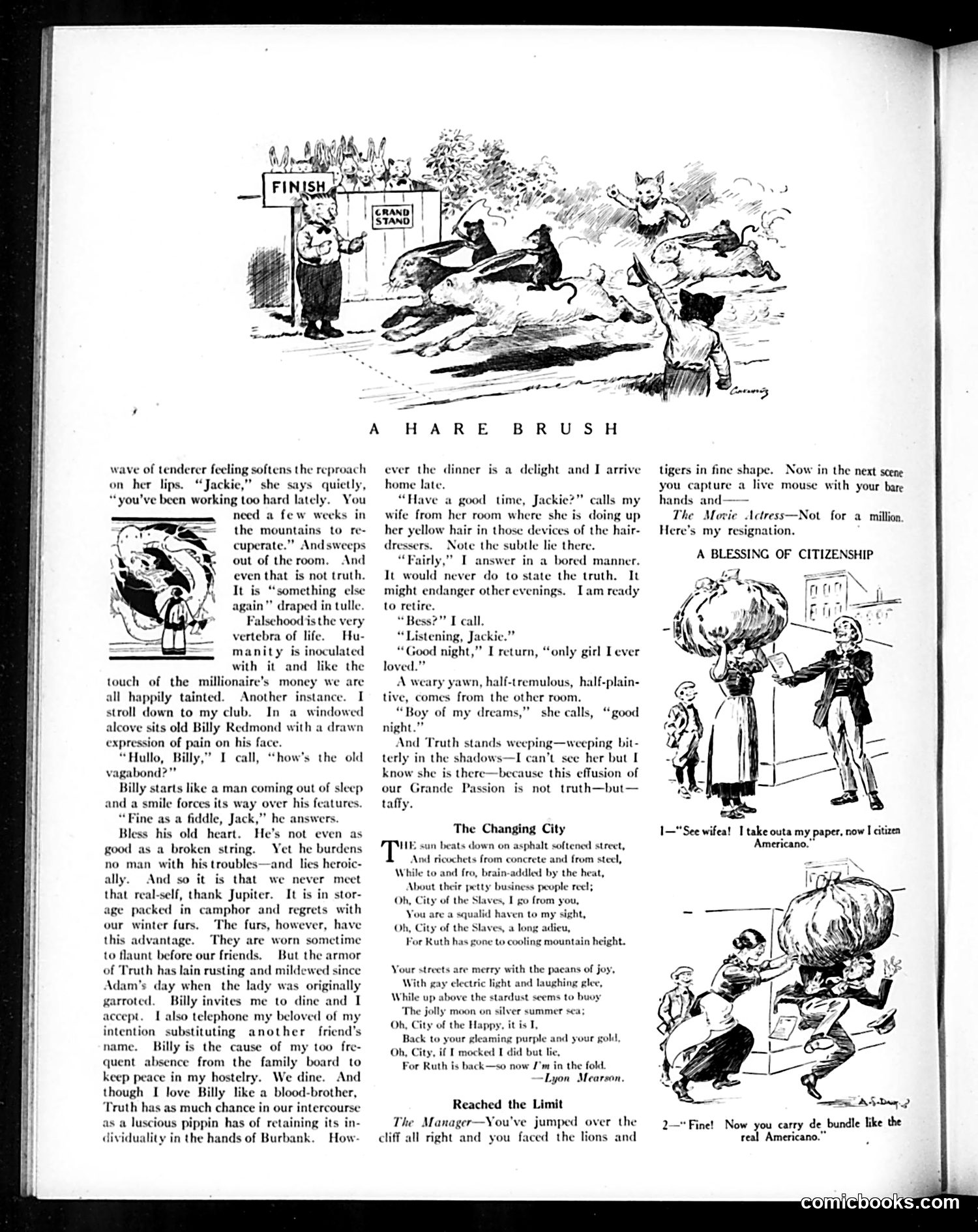
This page contains three satirical pieces: **"A Hare Brush"** (top): A narrative essay mocking everyday dishonesty. The author describes how people routinely lie in social situations—telling a weary friend "Fine as a fiddle" when he's clearly miserable, lying to his wife about dinner plans, and exchanging false endearments with her at bedtime. The satire targets Victorian-era hypocrisy: society demands these "polite" falsehoods to maintain appearances, yet Truth "stands weeping" unheeded. The hare-brush cartoon illustrates a physical comedy scene (unrelated to text). **"The Changing City"** (middle): A poem contrasting the speaker's dislike of the urban heat and crowds with his joy upon returning—likely satirizing fickle city-dwellers who complain yet remain. **"A Blessing of Citizenship"** (bottom): Two cartoon panels showing a newly naturalized immigrant proudly displaying his citizenship papers, then being handed a heavy bundle to carry. The satire mocks both the immigrant's naive pride and American society's cynical expectation that citizenship merely means accepting manual labor and burden.
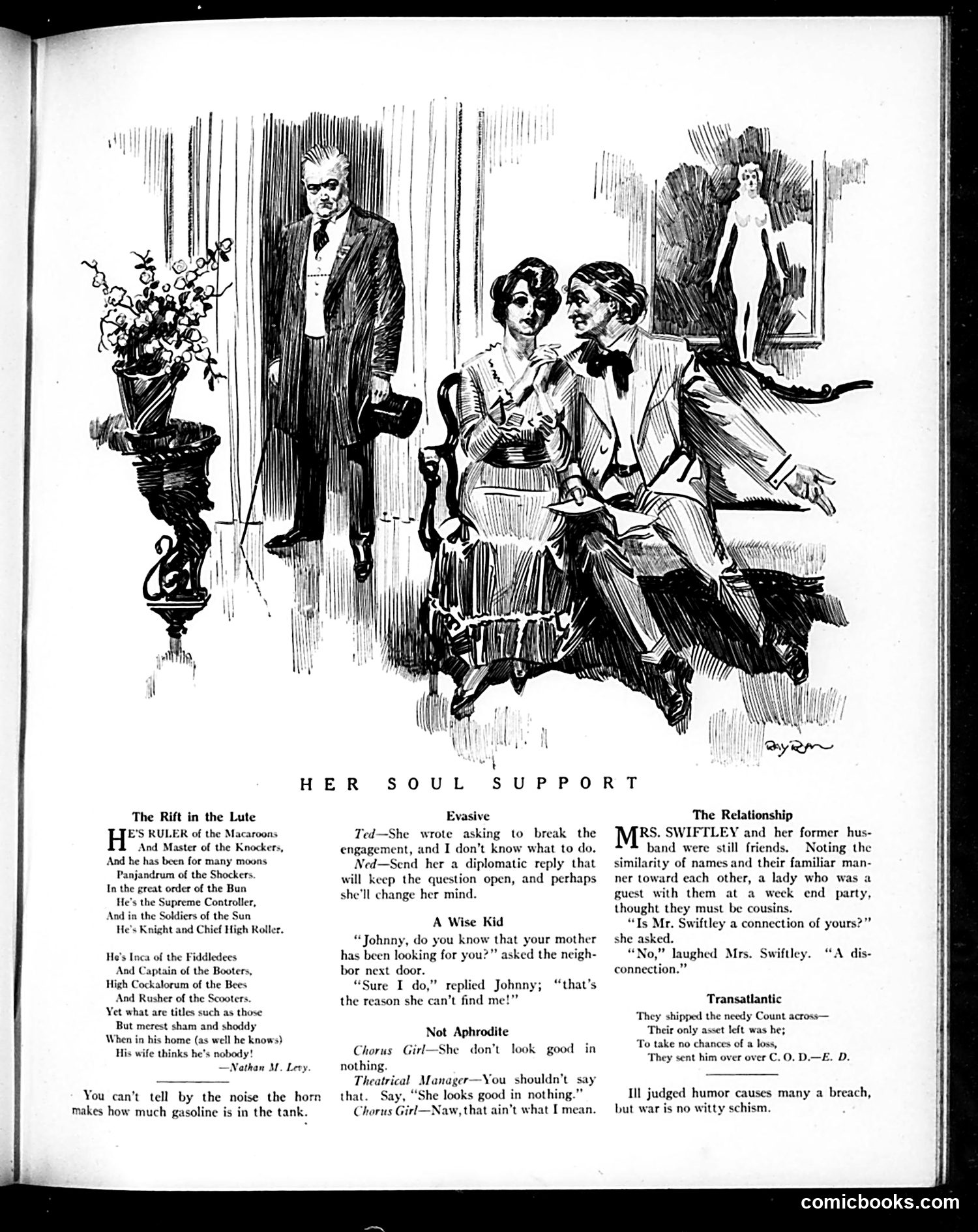
This page collects short humorous pieces satirizing early 20th-century social conventions, particularly gender relations and marriage. The main cartoon depicts a domestic scene where a pompous man holds many grandiose titles ("Supreme Controller," "Knight and Chief High Roller"), yet his wife dismisses him as a nobody—the joke being that domestic authority undermines all public status. The accompanying poem by Nathan M. Levy makes this explicit: a man's home life renders his titles meaningless. The other brief gags mock relationship dynamics: a woman breaking an engagement receives diplomatic evasion; a chorus girl's complaint about her appearance is "corrected" by a manager into sexual innuendo; a divorced couple remaining friendly confuse a guest about their relationship. Together, these pieces satirize the gap between men's public pretensions and their actual domestic powerlessness, while also poking fun at theatrical sleaze and the awkwardness of modern divorce (then still relatively scandalous). The humor assumes readers share skepticism about both male pomposity and changing social conventions around marriage.
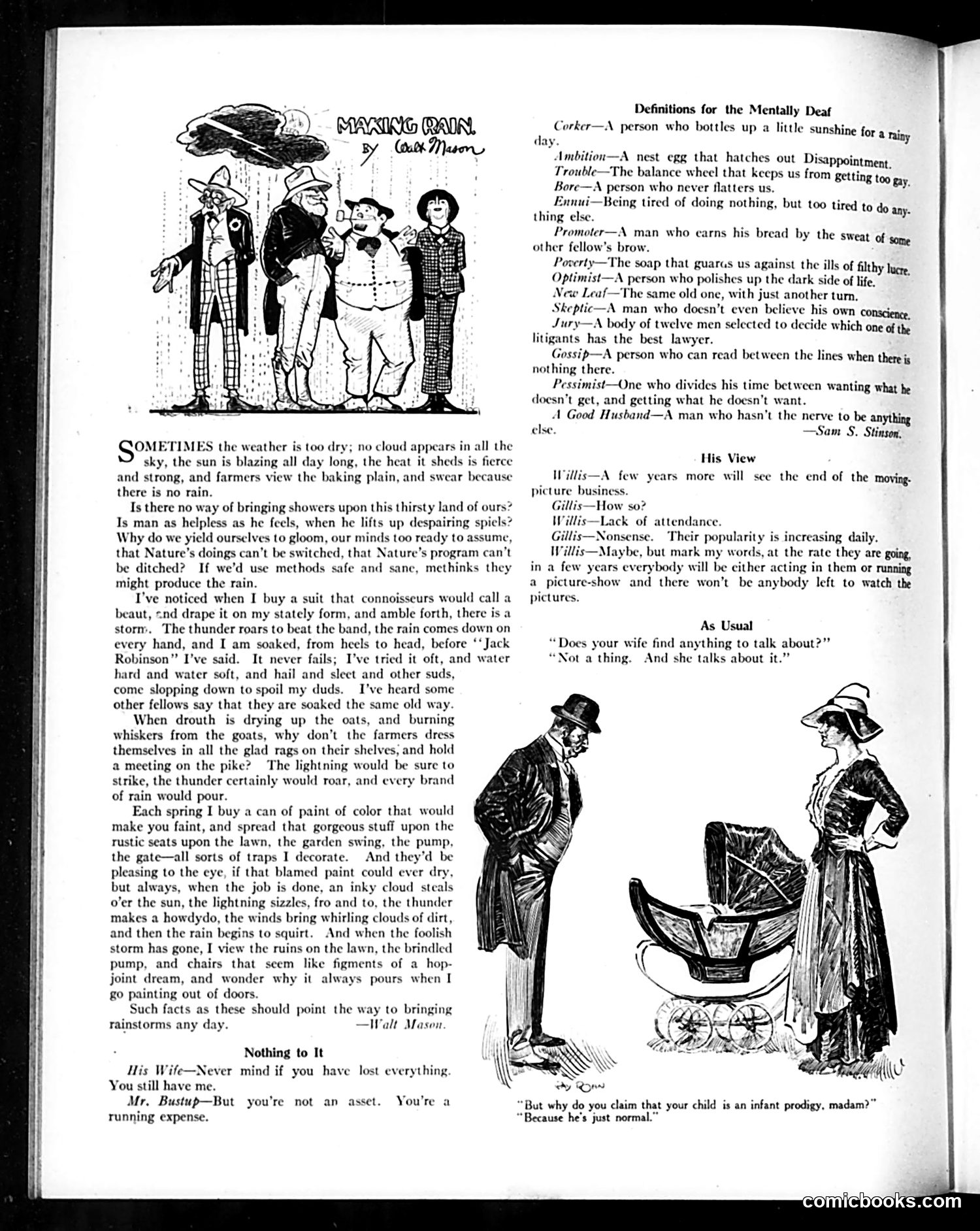
This page from *Judge* magazine contains several satirical pieces mocking contemporary life around the early 20th century. **"Making Rain"** (top cartoon and accompanying essay by Walt Mason) satirizes human helplessness against nature. The humorous observation is that whenever the author buys new clothing or attempts home improvement projects, storms inevitably strike—ruining paint jobs, soaking new suits. Mason uses this to ironically suggest farmers should simply dress in their finest clothes to "manufacture" rain, mocking both human presumption and actual drought conditions. **"Nothing to It"** is a marriage joke: Mr. Bustup tells his wife that though he's lost everything, at least he still has her—but he cruelly corrects himself, saying she's not an asset but rather a financial burden ("running expense"). **"Definitions for the Mentally Deaf"** offers cynical dictionary-style definitions—Ambition hatches Disappointment, Promoters exploit others' labor, Juries are controlled by lawyers—reflecting the magazine's satirical worldview about human nature and social institutions. The remaining dialogues mock predictable marital dynamics and entertainment industry optimism.
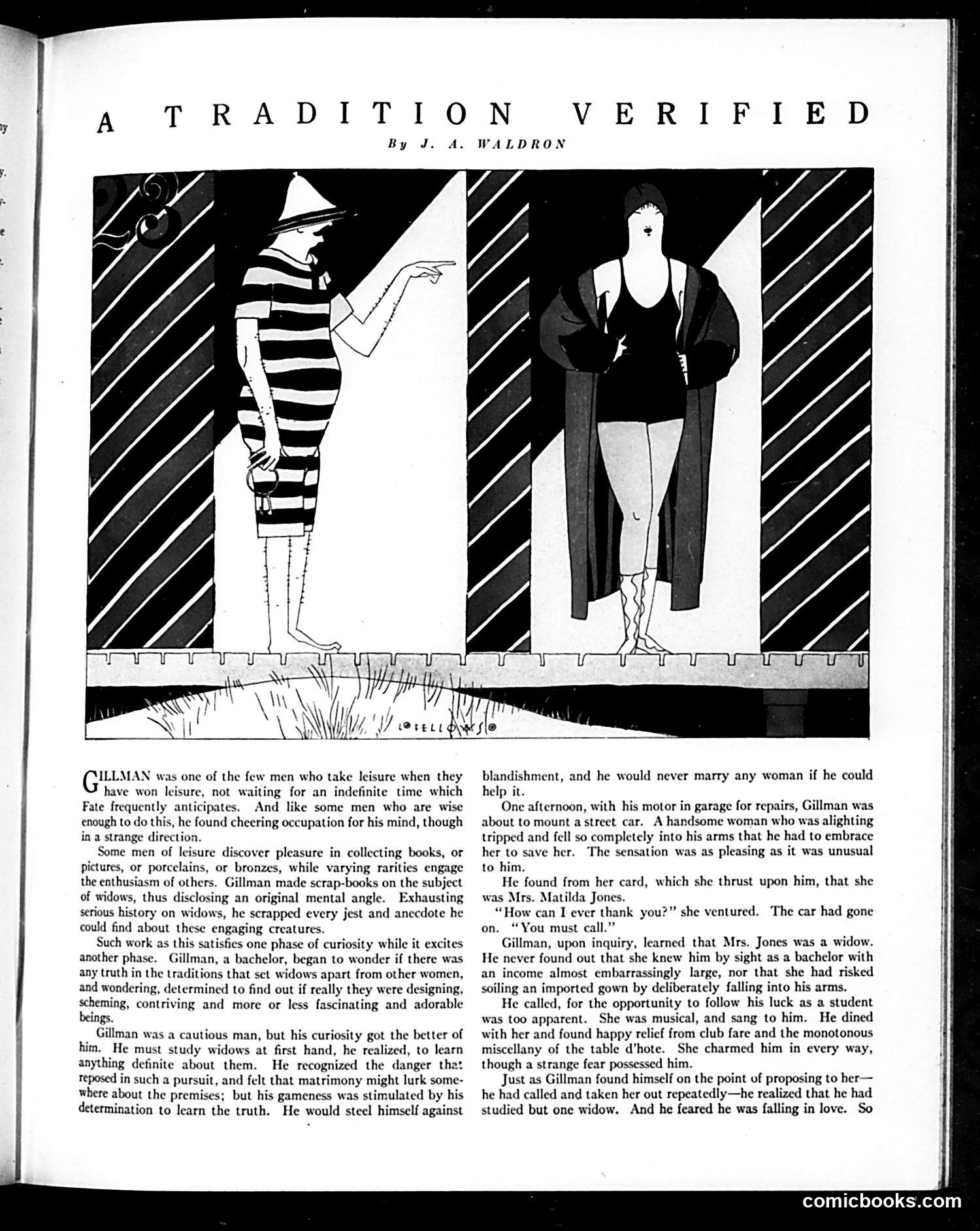
This story illustrates a common early-20th-century satirical trope: the scheming widow. Gillman, a wealthy bachelor, becomes obsessed with studying widows as a hobby—collecting jokes and anecdotes about them—suspecting they possess some dangerous, manipulative quality that sets them apart from other women. The narrative's humor derives from dramatic irony: Mrs. Matilda Jones deliberately engineers their "chance" meeting by staging a fall, exploiting Gillman's chivalry while he remains oblivious to her calculated seduction. She's already researched his wealth and status. The cartoon illustrates the contrasting personas: Gillman in his ridiculous striped bathing costume (suggesting naive leisure), and Mrs. Jones in elegant, seductive attire. The satire targets both his paranoid prejudice against widows and his actual vulnerability to sophisticated feminine manipulation—his "research" proves the very stereotype he feared, though through his own blindness rather than any inherent widow trait. The piece gently mocks masculine presumptions about women's cunning.
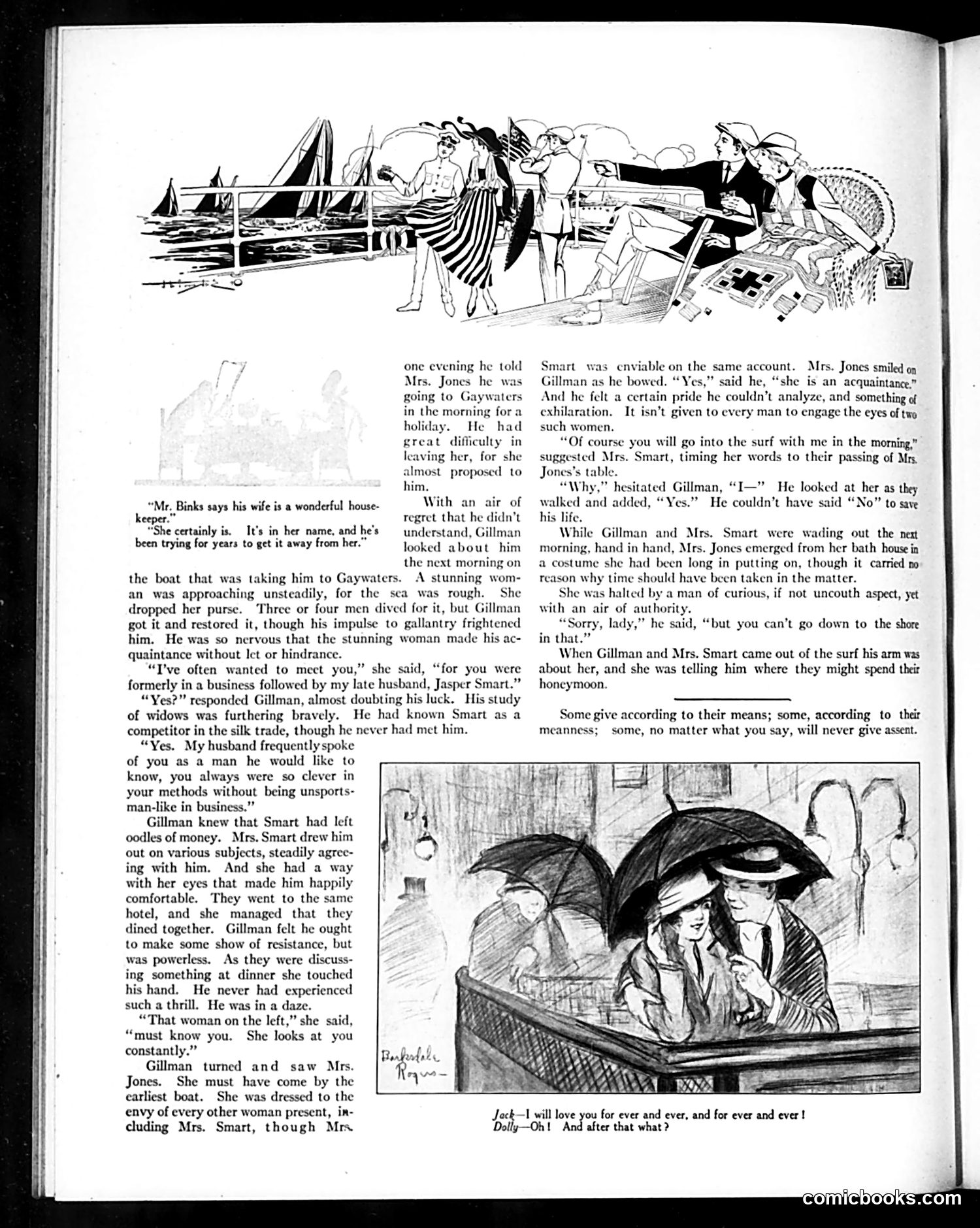
This page from *Judge* presents a romantic comedy about social climbing and marital scheming among the wealthy leisure class. **The Main Story:** Gillman, a businessman, encounters the wealthy widow Mrs. Smart aboard a boat to the resort town "Gaywaters." She flatters him, claiming her late husband admired him. Gillman becomes enchanted, unaware she's manipulating him for his apparent wealth and status. Meanwhile, Mrs. Jones—apparently someone Gillman knows—arrives at the resort and competes for his attention by dressing extravagantly. **The Satire:** The joke targets turn-of-the-century social dynamics where wealthy widows and women strategically pursued men for financial security, while men were easily manipulated by flattery and female attention. The cartoon (showing a couple in a boat) and the closing dialogue joke ("And after that what?") mock romantic naiveté—the assumption that love conquers all practical concerns. **Social Context:** This reflects Gilded Age anxieties about gold-diggers, competitive courtship among the wealthy, and the performative nature of resort society.
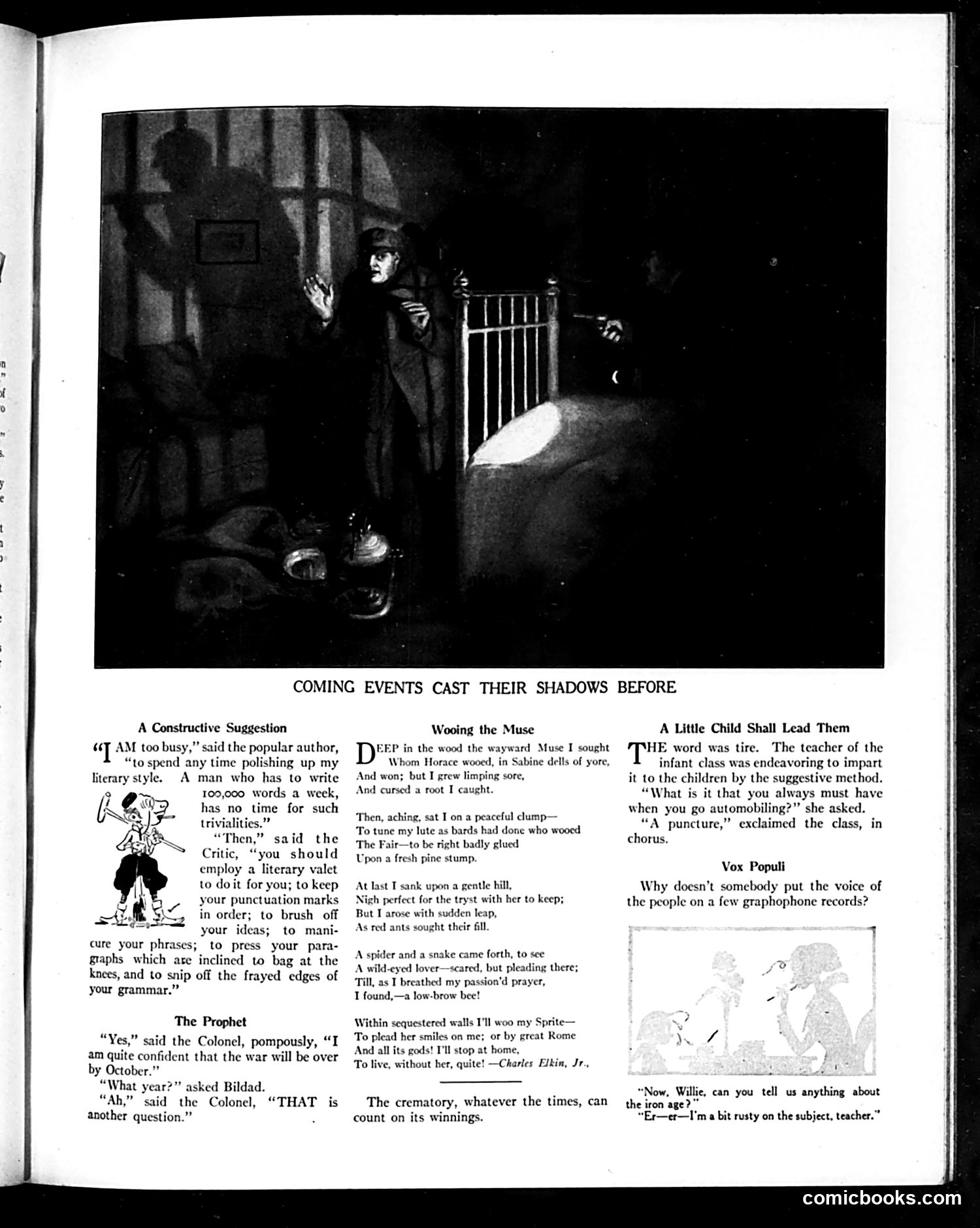
This page contains several satirical pieces targeting early 20th-century subjects: **"A Constructive Suggestion"** mocks prolific but sloppy authors writing 109,000 words weekly, suggesting they hire a "literary valet" to fix punctuation, grammar, and style—satire on mass-produced, low-quality popular literature. **"The Prophet"** jokes about a Colonel's absurdly confident prediction that WWI will end by October, with the punchline that he won't specify *which* year—mocking military optimism about the war's duration. **"Wooing the Muse"** is humorous verse about a poet's failed attempts to romantically commune with his muse in nature, repeatedly interrupted by practical annoyances (roots, ants, snakes, bees)—satirizing Romantic poetry's idealism versus reality. **"A Little Child Shall Lead Them"** is a short joke: when asked what's needed for automobiling, children answer "puncture" instead of the expected serious answer—humor based on the newfangled automobile's unreliability. **"Vox Populi"** briefly jokes about a student being "rusty" on the Iron Age—mild wordplay.
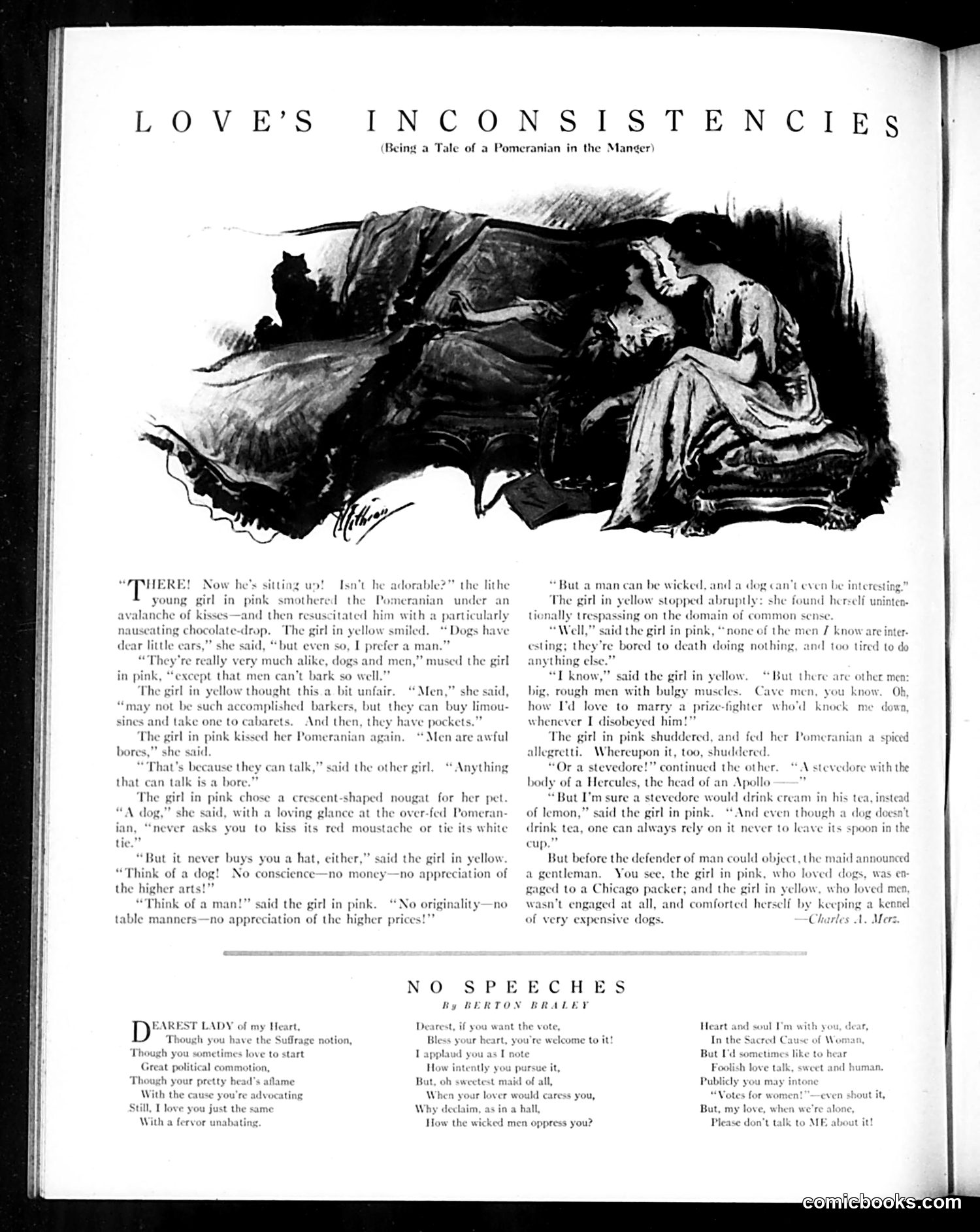
This humorous story contrasts two young women debating the merits of men versus dogs (specifically a Pomeranian). The girl in pink prefers her dog because it's affectionate without demands—it doesn't ask her to kiss its mustache or need expensive gifts. The girl in yellow argues men have advantages: they buy limousines, take you to cabarets, and have money. However, the satire's punch comes in the ending: both women ultimately reject real men. The girl in pink marries a rough prize-fighter she'll obey; the girl in yellow marries a Chicago packer. Neither marriage works out. Both end up alone, consoling themselves with expensive dogs instead. The joke targets female sentimentality and poor judgment in love—a common Judge magazine theme mocking women's logic. The subtitle "A Pomeranian in the Manger" suggests both women selfishly keep what they won't use (romantic partnership), settling instead for pampered pets and failed marriages.
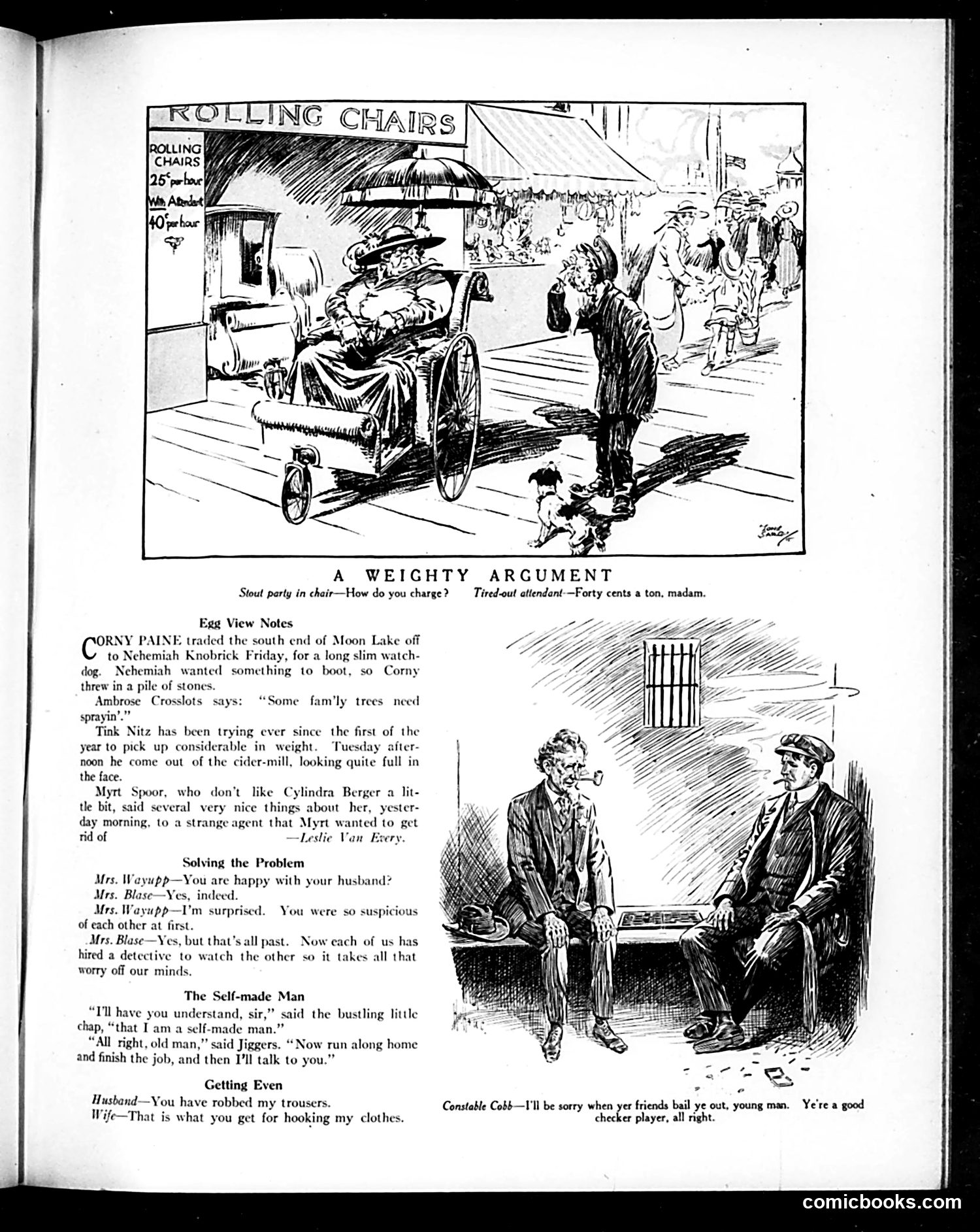
The main cartoon satirizes a common commercial dispute: a stout woman renting a rolling chair at what appears to be a public amusement venue protests the attendant's charge of "forty cents a ton," highlighting her substantial weight. The joke turns on the awkward collision between polite society and blunt economic reality—the attendant's matter-of-fact pricing based on weight versus the woman's indignation at being literally weighed and charged accordingly. The surrounding brief comedic pieces use small-town gossip and domestic humor typical of early 20th-century Judge magazine. "Solving the Problem" jokes about married couples hiring detectives to spy on each other—presented as oddly pragmatic rather than disturbing. "The Self-made Man" mocks a boastful man's claim to self-creation, with the punchline suggesting he's still incomplete. These sketches rely on gentle social satire about American manners, weight consciousness, and marital dynamics.
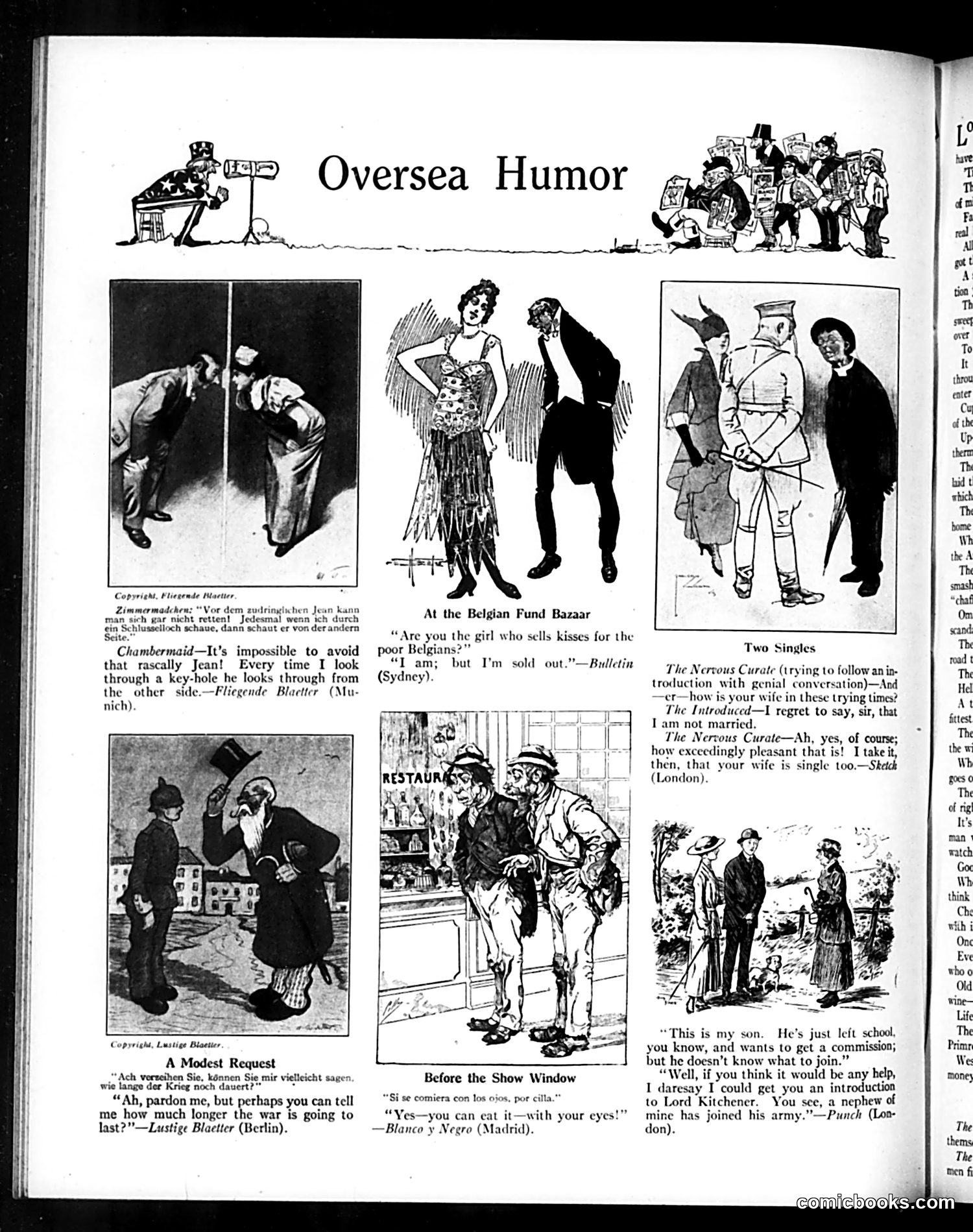
This page collects humorous cartoons from European publications, translated for American readers during World War I. The cartoons satirize wartime absurdities and social awkwardness: 1. **Chambermaid/Keyhole**: A flirtation joke about a persistent suitor—the humor lies in the mutual spying through opposing keyholes. 2. **War Duration**: Someone naively asks a stranger how much longer the war will last, treating it as casual conversation—mocking public anxiety about the conflict's length. 3. **Belgian Fund Bazaar**: References WWI charity fundraising (Belgium was invaded in 1914). The joke: a woman selling kisses for Belgian relief is "sold out"—darkly humorous given wartime suffering. 4. **Nervous Curate/Wife**: An awkward clergyman makes a verbal blunder, assuming an unmarried man has a "single" wife—absurdist humor from social confusion. 5. **Lord Kitchener**: References the famous British recruitment minister, using nepotistic military connections as comedy—satirizing wartime favoritism in commissions. The collection demonstrates how different nations' satirical magazines tackled shared wartime anxieties.
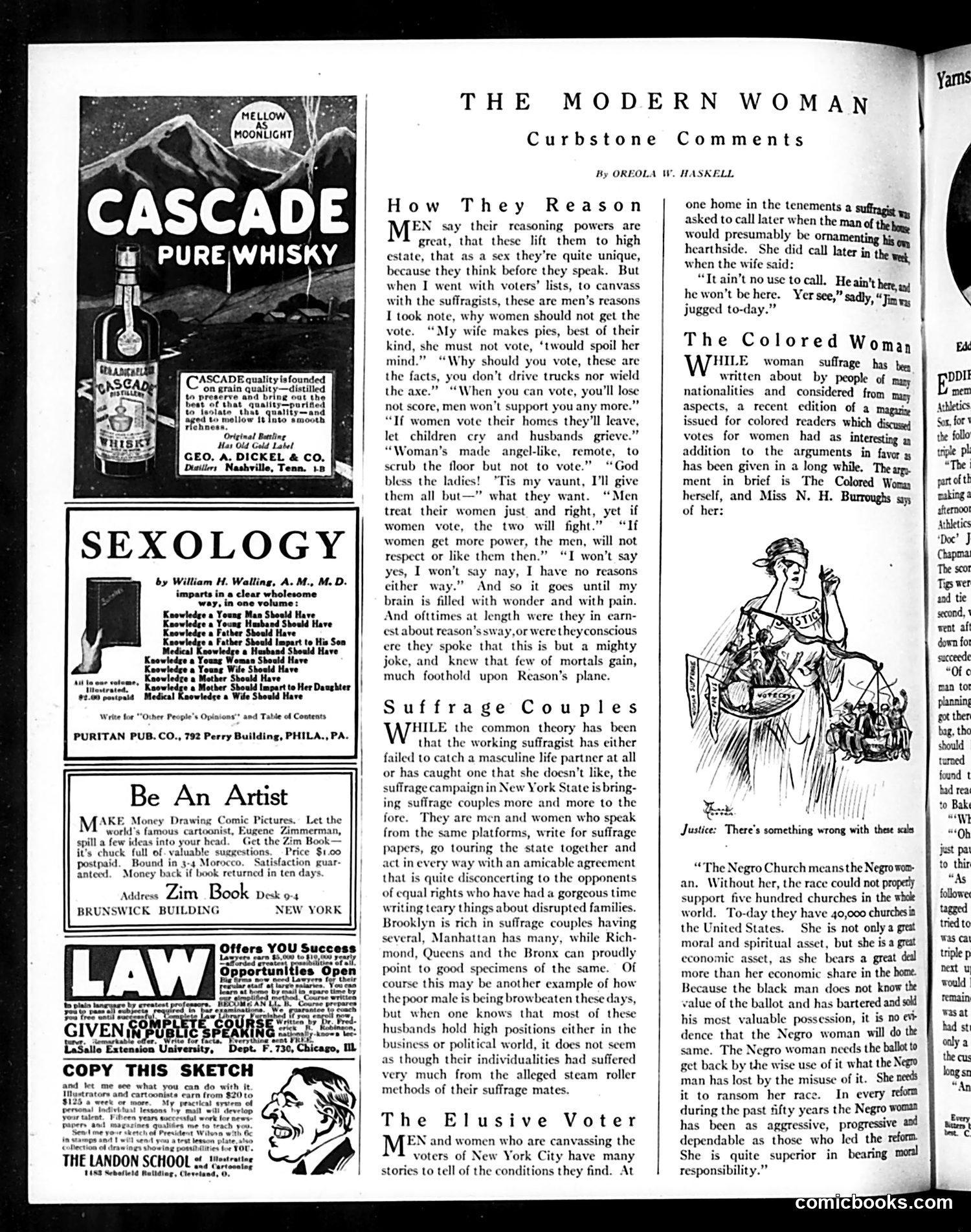
This Judge magazine page satirizes anti-suffrage arguments through columnist Oreola W. Haskell's commentary on women's voting rights. **"How They Reason"** mocks male opponents of female suffrage by cataloging their contradictory objections: women's voting will ruin housekeeping, destroy families, reduce male support, or—paradoxically—give women "too much power." The satire exposes how these arguments lack logical consistency, revealing prejudice masquerading as reason. **"Suffrage Couples"** ridicules anti-suffragists' claims that voting women neglect families and husbands. The piece notes that many suffragists are actually married couples working together on the campaign, holding respectable positions. This undermines opponents' dire predictions about family breakdown, suggesting their fears are exaggerated propaganda ("teary things about disrupted families"). The page's surrounding advertisements—for whisky, "Sexology" books, and art instruction—appear incidental to the satirical content, typical of Judge's mixed editorial/advertising format. **Political context**: This reflects the 1910s women's suffrage debates preceding the 1920 19th Amendment.
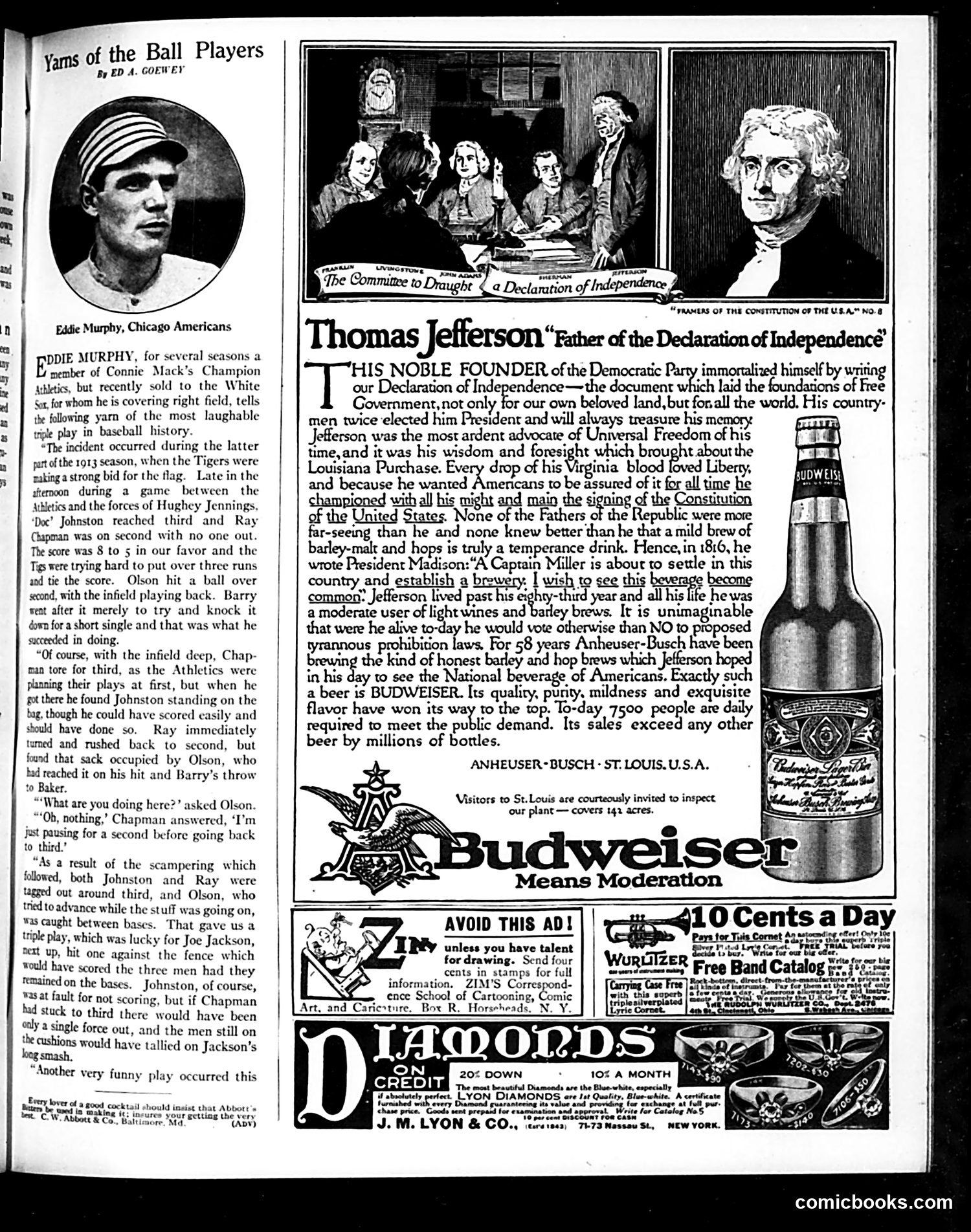
This page contains two distinct elements: **Left side:** A baseball anecdote by Ed A. Goewey featuring Eddie Murphy of the Chicago Americans, recounting a comically confused triple play from 1913. The humor derives from players running the bases in bewildering sequence—Johnston and Chapman both occupying third base, triggering a farcical chain reaction. **Right side:** A propagandistic advertisement masquerading as editorial content. It lionizes Thomas Jefferson as the "Father of the Declaration of Independence" while making an absurd argument: that Jefferson, a "moderate user of light wines and barley brews," would have opposed Prohibition. The piece then pivots to endorsing Budweiser beer as the "National beverage of Americans," claiming the brewery has honorably resisted "tyrannous prohibition laws" for 58 years. This is **clearly sponsored content** blurring advertising and journalism—a pre-Prohibition advocacy piece using founding-father rhetoric to legitimize beer consumption. The juxtaposition with sports humor suggests Judge's editorial approach: mixing entertainment with commercial persuasion.
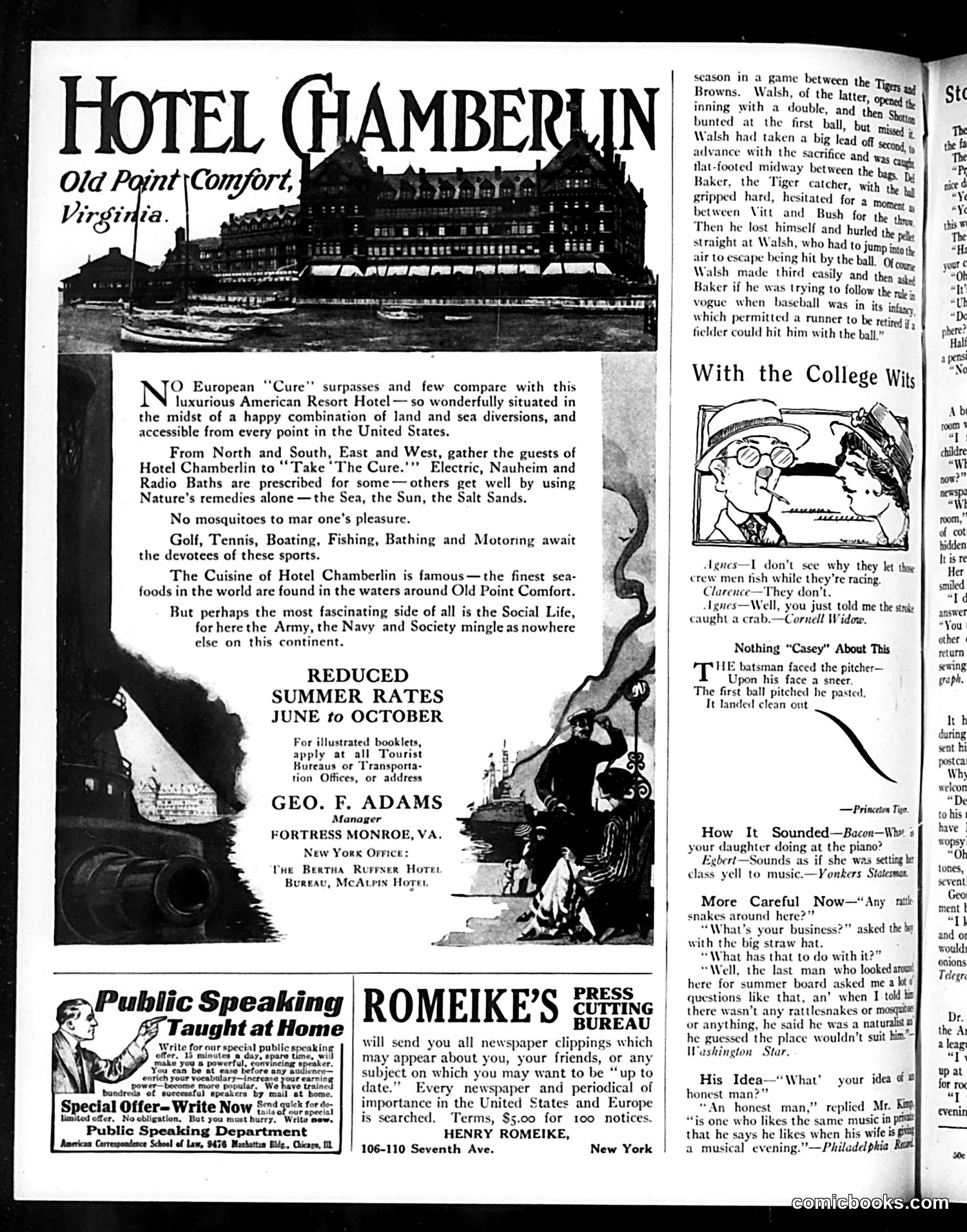
This page is primarily **advertising and light humor**, not political satire. The main content includes: **Hotel Chamberlin Advertisement**: A luxury resort pitch promoting the Virginia hotel as offering European-style spa treatments ("Electric, Nauheim and Radio Baths") alongside American leisure activities. The appeal emphasizes social mixing of "Army, the Navy and Society." **Small Comic Vignettes**: Brief humorous exchanges typical of Judge's style—college students discussing fishing ("crew men"), baseball humor, and social observations. These are gentle jokes about everyday life rather than pointed satire. **Romeike's Press Clipping Bureau**: A service advertisement offering to track newspaper mentions of clients across U.S. and European publications. **Public Speaking Course**: Correspondence school advertising. The page reflects early 20th-century leisure culture and consumer marketing, showing how magazines mixed advertising with light entertainment. No specific political figures or events appear to be targeted.
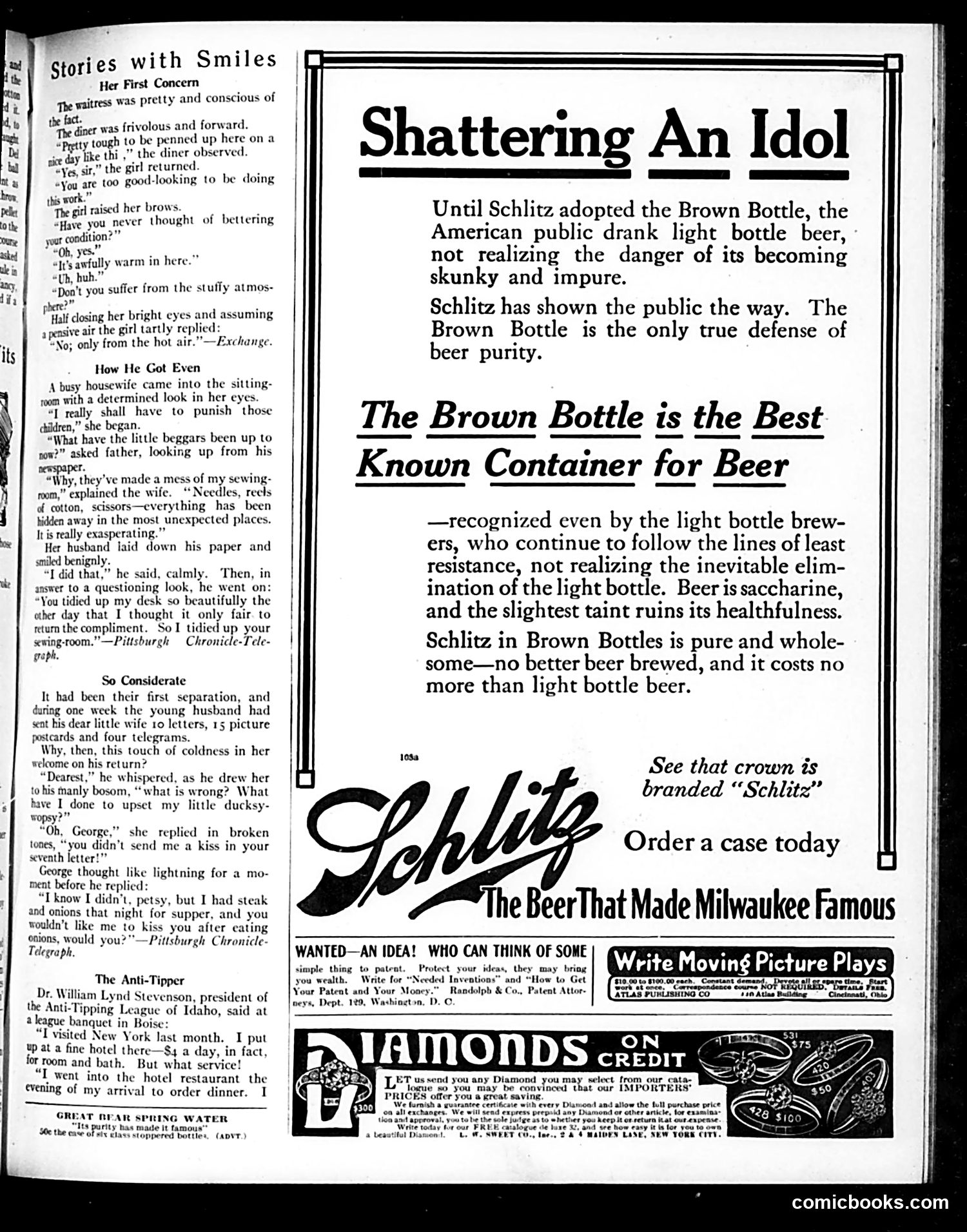
This page is primarily a **Schlitz beer advertisement** disguised as editorial content in Judge magazine. The left column contains humorous short stories ("Stories with Smiles"), but the dominant right side promotes brown bottle beer. **The "Idol" Being Shattered:** The advertisement attacks the American brewing industry's standard practice of selling beer in clear glass "light bottles." Schlitz claims these bottles allow light exposure, causing beer to become "skunky and impure." **The Sales Pitch:** Schlitz positions its brown bottle as the superior alternative—the "only true defense of beer purity." The ad suggests even competing light-bottle brewers recognize brown bottles' superiority but resist change out of inertia. **Historical Context:** This reflects early-20th-century beer marketing competition. The ad's logic—that brown glass protects beer from light degradation—is actually scientifically valid, though presented as revolutionary insight rather than established knowledge. **For Modern Readers:** This exemplifies how vintage magazines blurred advertising and editorial content, and how companies claimed moral/scientific authority to differentiate products in competitive markets.
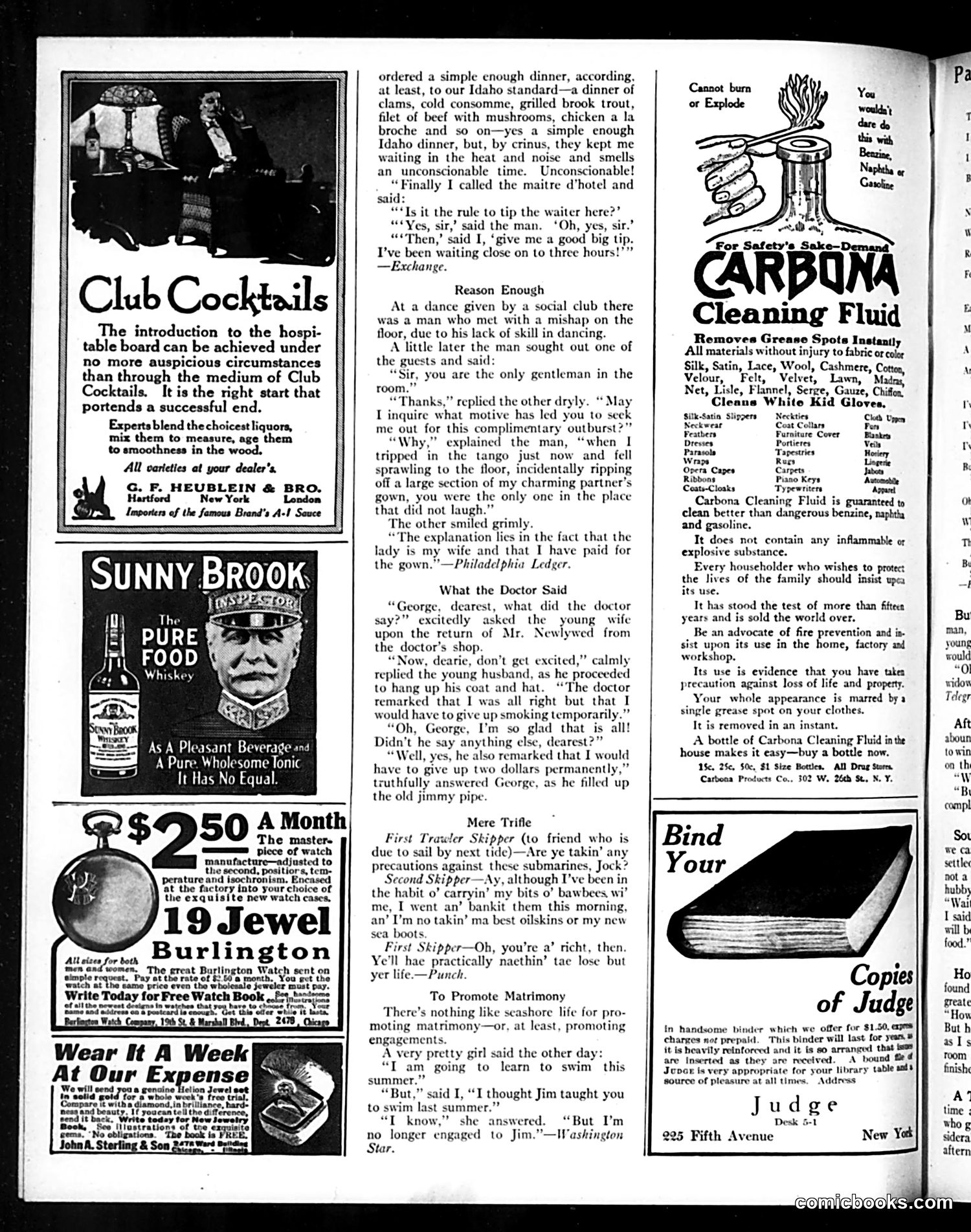
This page is primarily **advertisements and humorous anecdotes** rather than political cartoons. The ads promote consumer products (Heublein cocktails, Carbona cleaning fluid, Burlington watches, Sunny Brook whiskey) typical of early 20th-century marketing. The humor pieces are genteel short stories satirizing **upper-class social etiquette**: - A diner complains about long waits and tips the waiter to compensate for poor service - A dancing mishap at a club becomes awkward when a guest's partner's gown is torn - A young husband downplays the doctor's advice to quit smoking, but admits he's lost two dollars (likely a fine or bet) - Scottish fishermen debate submarine precautions with dark humor about risking only their lives The satire targets **pretension, social awkwardness, and marital dynamics** among the middle and upper classes. These brief comedic vignettes reflect period concerns: dining customs, dancing propriety, marital communication, and wartime worries (submarines suggest WWI era). The page reflects Judge's editorial approach: genteel humor for educated readers rather than sharp political commentary.
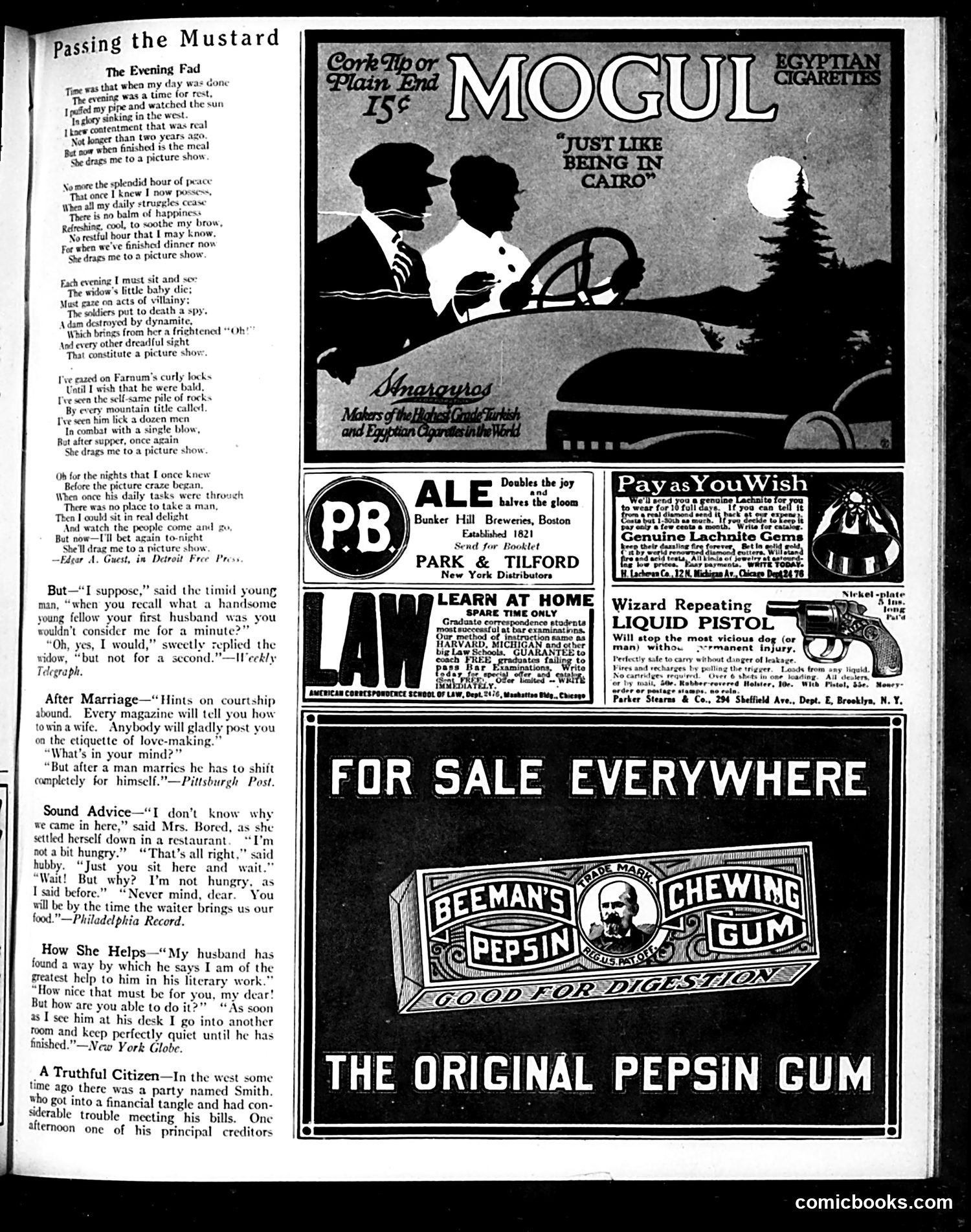
This Judge magazine page mixes humorous commentary on modern life with advertisements. The main feature is a poem by Edgar Guest titled "The Evening Fad," which satirizes the emerging cinema craze of the early 20th century. The speaker laments that his wife constantly drags him to picture shows after dinner, destroying the peaceful evening routine he once enjoyed. He catalogs tedious recurring scenes—William S. Hart films, dynamite explosions, repetitive plots—expressing exhaustion with this newfangled entertainment obsession. The satirical point: cinema was becoming an inescapable social obligation that disrupted domestic tranquility. The accompanying jokes mock marriage ("not for a second"), courtship advice, and marital dynamics, all suggesting anxiety about how modern leisure and commerce were reshaping family life. The advertisements—for Beeman's Pepsin Gum, Lachnite gems, and ale—are period-typical marketing appearing alongside the editorial content.
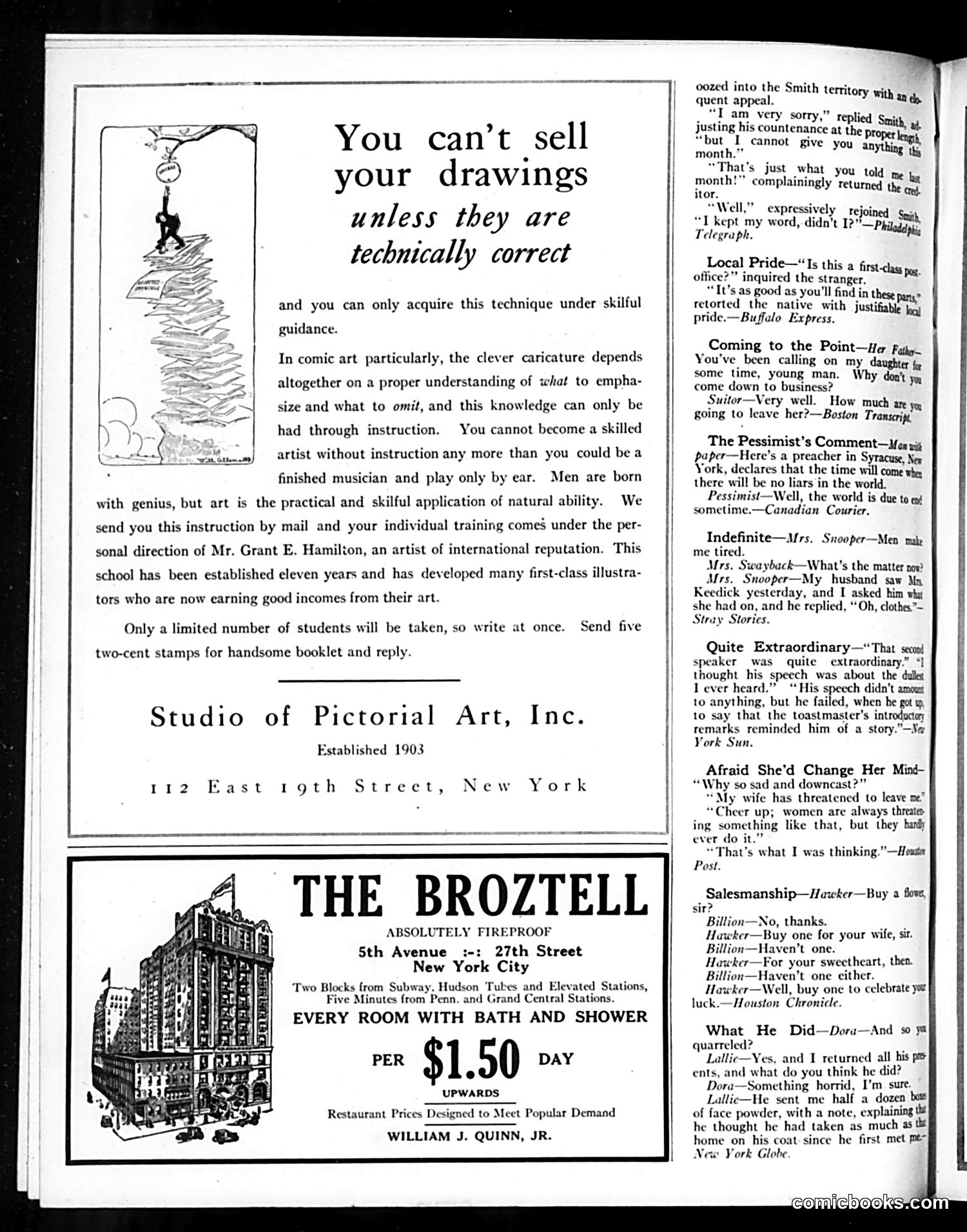
This page combines advertisement with humor content typical of Judge magazine. The main feature is a large ad for the "Studio of Pictorial Art, Inc." (established 1903), promoting correspondence courses in cartooning under instructor Grant E. Hamilton. The pitch emphasizes that skilled comic art requires technical training—you cannot become a successful cartoonist through natural talent alone. Below that is a hotel advertisement for the Broztell on 5th Avenue. The right column contains brief comedic anecdotes and jokes on everyday topics: marital disputes, hotel prices, pessimism about human nature, and romantic misunderstandings. These represent typical Judge humor—short, punchy jokes reflecting early 20th-century social attitudes about marriage, gender relations, and urban life. The page reflects the magazine's dual purpose: entertainment through satire and humor, supplemented by revenue from instructional and commercial advertisements.
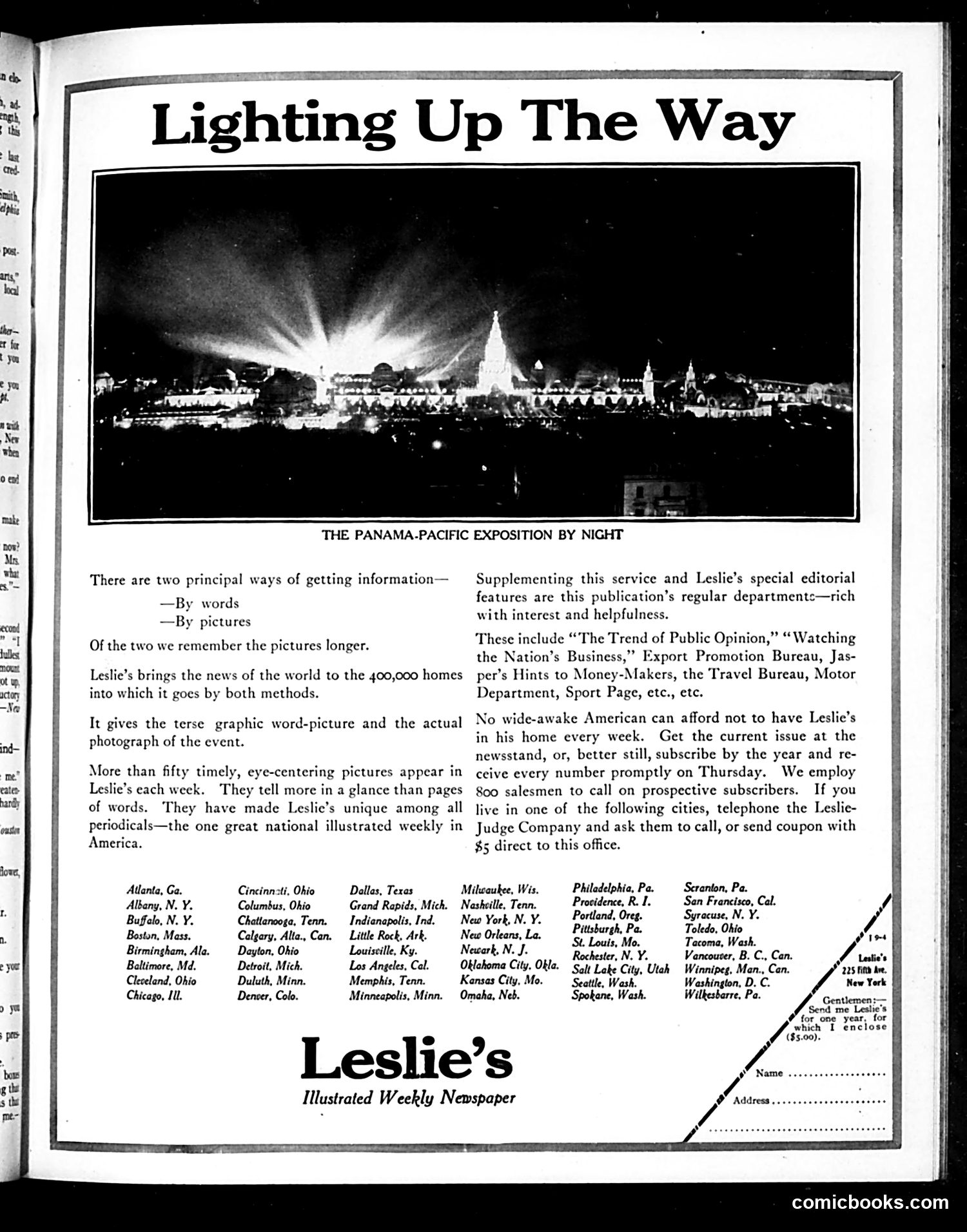
This is not a political cartoon but a **magazine advertisement** for *Leslie's Illustrated Weekly Newspaper*. The page promotes *Leslie's* by featuring a photograph of the **Panama-Pacific Exposition illuminated at night** (likely the 1915 San Francisco fair). The ad argues that pictures communicate more effectively than words—"we remember the pictures longer"—positioning *Leslie's* as superior to competitors because it combines photography with text. The bulk of the page lists subscription offices across America and advertises regular features ("Trend of Public Opinion," "Watching the Nation's Business," travel and motor departments). It encourages subscriptions at $5/year with home delivery by Thursday. This reflects early 20th-century magazine competition and the emerging cultural belief in photojournalism's power. No satire or political commentary is present—it's straightforward commercial promotion emphasizing visual journalism's appeal to middle-class American readers.
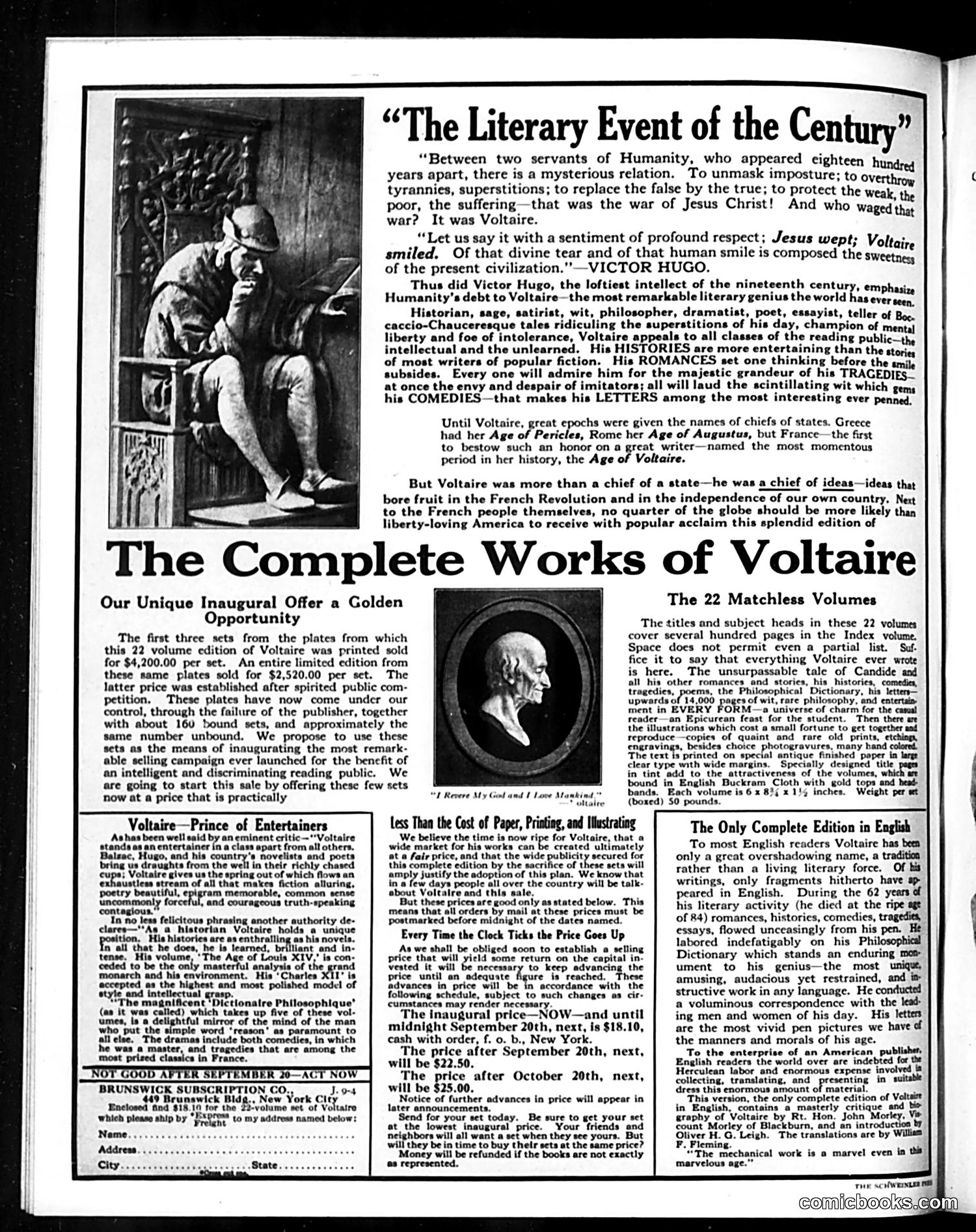
This is primarily **advertising copy**, not a political cartoon. The page promotes a 22-volume complete edition of Voltaire's works. The satirical/editorial content frames Voltaire as a revolutionary intellectual hero. Victor Hugo's quote (top) compares Voltaire to Jesus Christ—both fought tyranny and protected the suffering, though Voltaire "smiled" where Jesus "wept." The text emphasizes Voltaire's role in the French Revolution and American independence, positioning him as a champion of "liberty" and "foe of intolerance." The satire is implicit: American publishers are capitalizing on Voltaire's fame by packaging him as the ultimate Enlightenment hero—a "chief of ideas" rather than a political leader. For a 1920s American audience, this positioned Voltaire as an ancestor of democratic values. The accompanying illustration (left) shows Voltaire at his desk, reinforcing the "great writer" mythology the advertisement constructs.