
Judge, 1915-09-04 · page 7 of 27
Judge — September 4, 1915 — page 7: what you’re looking at
What you’re looking at
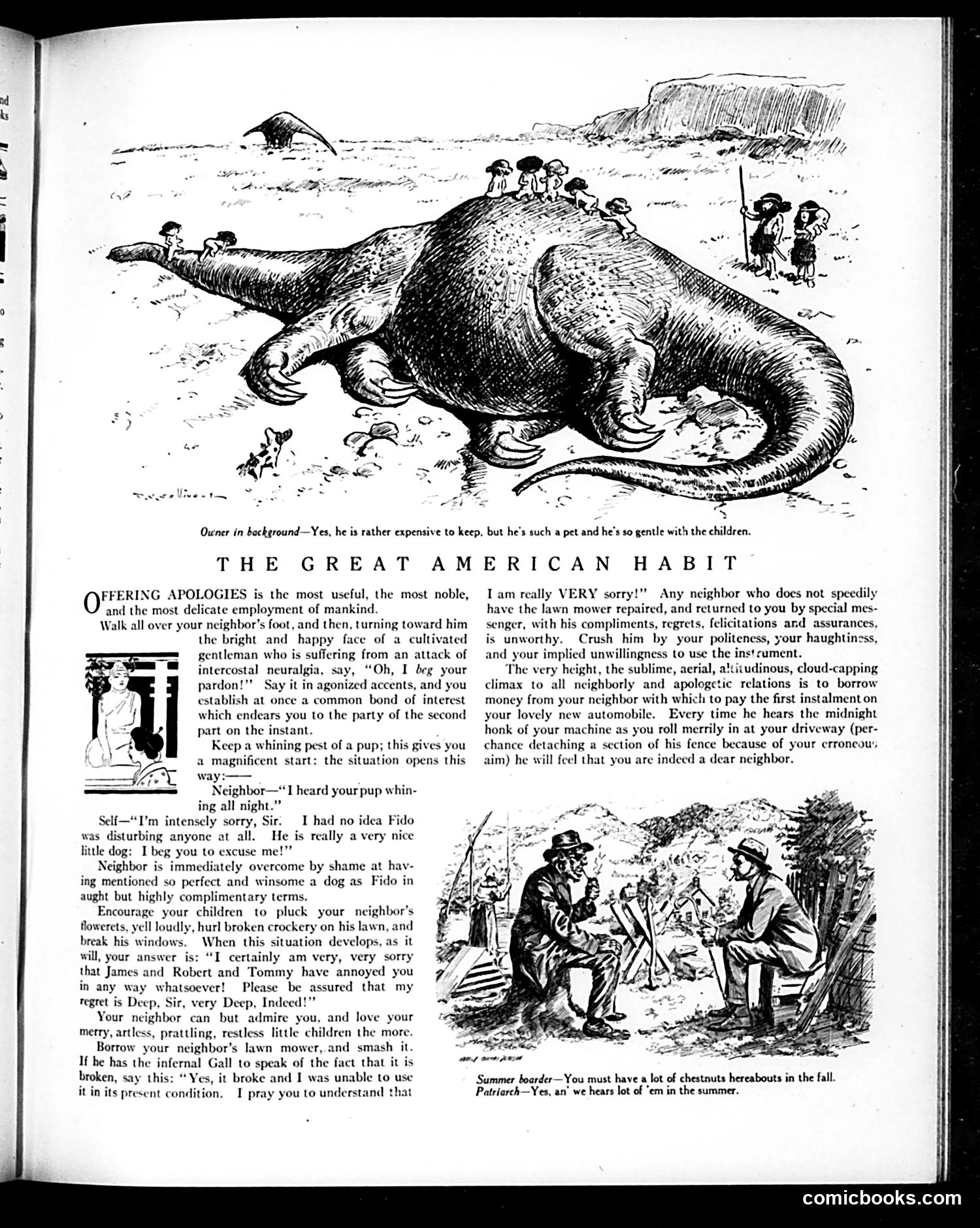
This satirical piece mocks the American custom of excessive apologizing as a social lubricant. The main text portrays apologies as a manipulative tool: one can transgress against neighbors—disturbing them with a noisy dog, allowing children to destroy property, borrowing and breaking items, or even borrowing money for a car—and neutralize their justified anger through sufficiently earnest and elaborate apologies. The joke is that elaborate politeness becomes its own form of aggression, psychologically guilting the neighbor into accepting mistreatment. The accompanying illustrations show a dinosaur (labeled "expensive to keep" but "gentle with children") as a visual metaphor for this absurd dynamic—an obviously dangerous creature excused by charming rhetoric. The lower cartoon's exchange about "chestnuts" and hearing "'em in the summer" appears to be a separate, unrelated pun or joke.
📄 Transcribed text from this page (OCR, searchable)
Machine-transcribed from the original scan — historical spelling and the odd misread are preserved.
Owner in background—Yes, he is rather expensive to keep, but he’s such a pet and he’s so gentle with the children. THE GREAT AMERICAN HABIT FFERING APOLOGIES is the most useful, the most noble, and the most delicate employment of mankind. Walk all over your neighbor's foot, and then, turning toward him the bright and happy face of a cultivated gentleman who is suffering from an attack of intercostal neuralgia, say, “Oh, I beg your pardon!” Say it in agonized accents, and you establish at once a common bond of interest which endears you to the party of the second part on the instant. Keep a whining pest of a pup; this gives you a magnificent start: the situation opens this Neighbor—‘I heard your pup whin- ing all night.” Selfi—“I’m intensely sorry, Sir. I had no idea Fido was disturbing anyone at all. He is really a very nice little dog: I beg you to use me!”” Neighbor is immediately overcome by shame ing mentioned so perfect and winsome a dog as F aught but highly complimentary terms. Encourage your children to pluck your neighbor's flowerets, yell loudly, hurl broken crockery on his lawn, and break his window situation develops, as it will, your answer is: “I certainly am very, very sorry that James and Robert and Tommy have annoyed you whatsoever! Please be assured that my », Sir, very Deep, Indee hbor can but admire you, and love your merry, artless, prattling, restless little children the more. Borrow your neighbor’s If he has the infernal Gall to speak of the fact that it is broken, say this: “Yes, it broke and I was unable to use it in its present condition. I pray you to understand that hav- Jo in Tam really VERY sorry!” Any neighbor who does not speedily have the lawn mower repaired, and returned to you by special mes- senger, with his compliments, regrets, felicitations and assurances, is unworthy. Crush him by your politeness, your haughtiness, and your implied unwillingness to use the inst cument. The very height, the sublime, aerial, a!tiiudinous, cloud-capping climax to all neighborly and apologetic relations is to borrow money from your neighbor with which to pay the first instalment on your lovely new automobile. Every time he hears the midnight honk of your machine as you roll merrily in at your driveway (per- chance detaching a section of his fence because of your erroneous aim) he will feel that you are indeed a dear neighbor. Summer boarder—You must have a lot of chestnuts hereabouts in the fall. Patriarch—Yes, an’ we hears lot of “em in the summer. comicbooks.com