
Judge, 1915-09-04 · page 13 of 27
Judge — September 4, 1915 — page 13: what you’re looking at
What you’re looking at
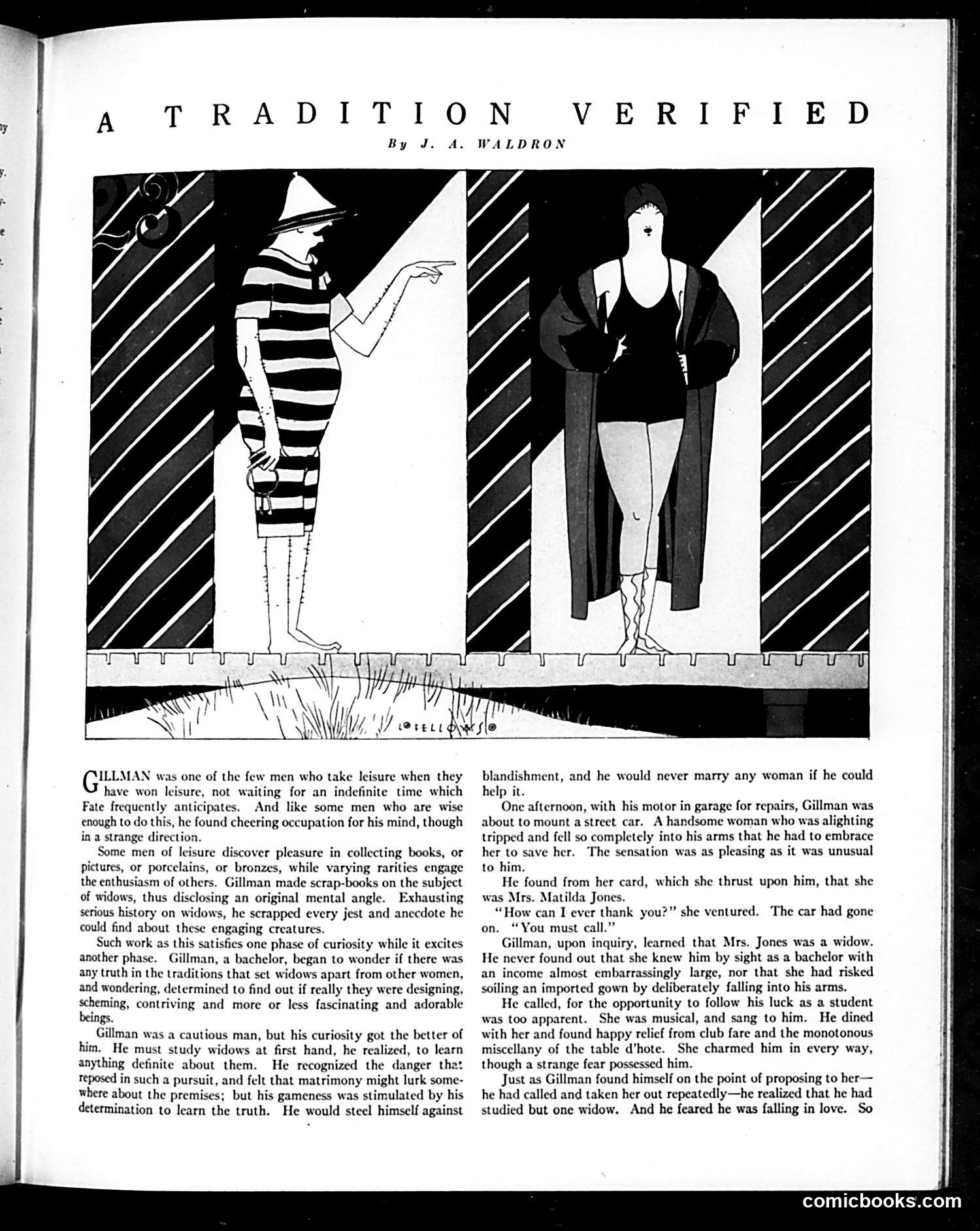
This story illustrates a common early-20th-century satirical trope: the scheming widow. Gillman, a wealthy bachelor, becomes obsessed with studying widows as a hobby—collecting jokes and anecdotes about them—suspecting they possess some dangerous, manipulative quality that sets them apart from other women. The narrative's humor derives from dramatic irony: Mrs. Matilda Jones deliberately engineers their "chance" meeting by staging a fall, exploiting Gillman's chivalry while he remains oblivious to her calculated seduction. She's already researched his wealth and status. The cartoon illustrates the contrasting personas: Gillman in his ridiculous striped bathing costume (suggesting naive leisure), and Mrs. Jones in elegant, seductive attire. The satire targets both his paranoid prejudice against widows and his actual vulnerability to sophisticated feminine manipulation—his "research" proves the very stereotype he feared, though through his own blindness rather than any inherent widow trait. The piece gently mocks masculine presumptions about women's cunning.
📄 Transcribed text from this page (OCR, searchable)
Machine-transcribed from the original scan — historical spelling and the odd misread are preserved.
By J. A. SQ OA Zz WALDRON A@TELL \W\y f 5 Neste = ILLMAN was one of the few men who take leisure when they have won leisure, not waiting for an indefinite time which Fate frequently anticipates. And like some men who are wise enough to do this, he found cheering occupation for his mind, though in a strange direction. Some men of leisure discover pleasure in collecting books, or pictures, or porcelains, or bronzes, while varying rarities engage the enthusiasm of others. Gillman made scrap-books on the subject of widows, thus disclosing an original mental angle. Exhausting serious history on widows, he scrapped every jest and anecdote he could find about these engaging creatures. Such work as this satisfies one phase of curiosity while it excites another phase. man, a bachelor, began to wonder if there was any truth in the traditions that set widows apart from other women, and wondering, determined to find out if really they were designing, scheming, contriving and more or less fascinating and adorable beings. _ Gillman was a cautious man, but his curiosity got the better of him. _He must study widows at first hand, he realized, to learn anything definite about them. He recognized the danger that Teposed in such a pursuit, and felt that matrimony might lurk some- where about the premises; but his gameness was stimulated by his determination to learn the truth. He would steel himself against blandishment, and he would never marry any woman if he could help it. One afternoon, with his motor in garage for repairs, Gillman was about to mount a street car. A handsome woman who was alighting tripped and fell so completely into his arms that he had to embrace her to save her. The sensation was as pleasing as it was unusual to him. He found from her card, which she thrust upon him, that she was Mrs. Matilda Jones. “How can I ever thank you?” she ventured. The car had gone on. “You must call.” Gillman, upon inquiry, learned that Mrs. Jones was a widow. He never found out that she knew him by sight as a bachelor with an income almost embarrassingly large, nor that she had risked soiling an imported gown by deliberately falling into his arms. He called, for the opportunity to follow his luck as a student was too apparent. She was musical, and sang to him. He dined with her and found happy relief from club fare and the monotonous miscellany of the table d’hote. She charmed him in every way, though a strange fear possessed him. Just as Gillman found himself on the point of proposing to her— he had called and taken her out repeatedly—he realized that he had studied but one widow. And he feared he was falling in love. So comicbooks.com