
Judge, 1915-09-04 · page 9 of 27
Judge — September 4, 1915 — page 9: what you’re looking at
What you’re looking at
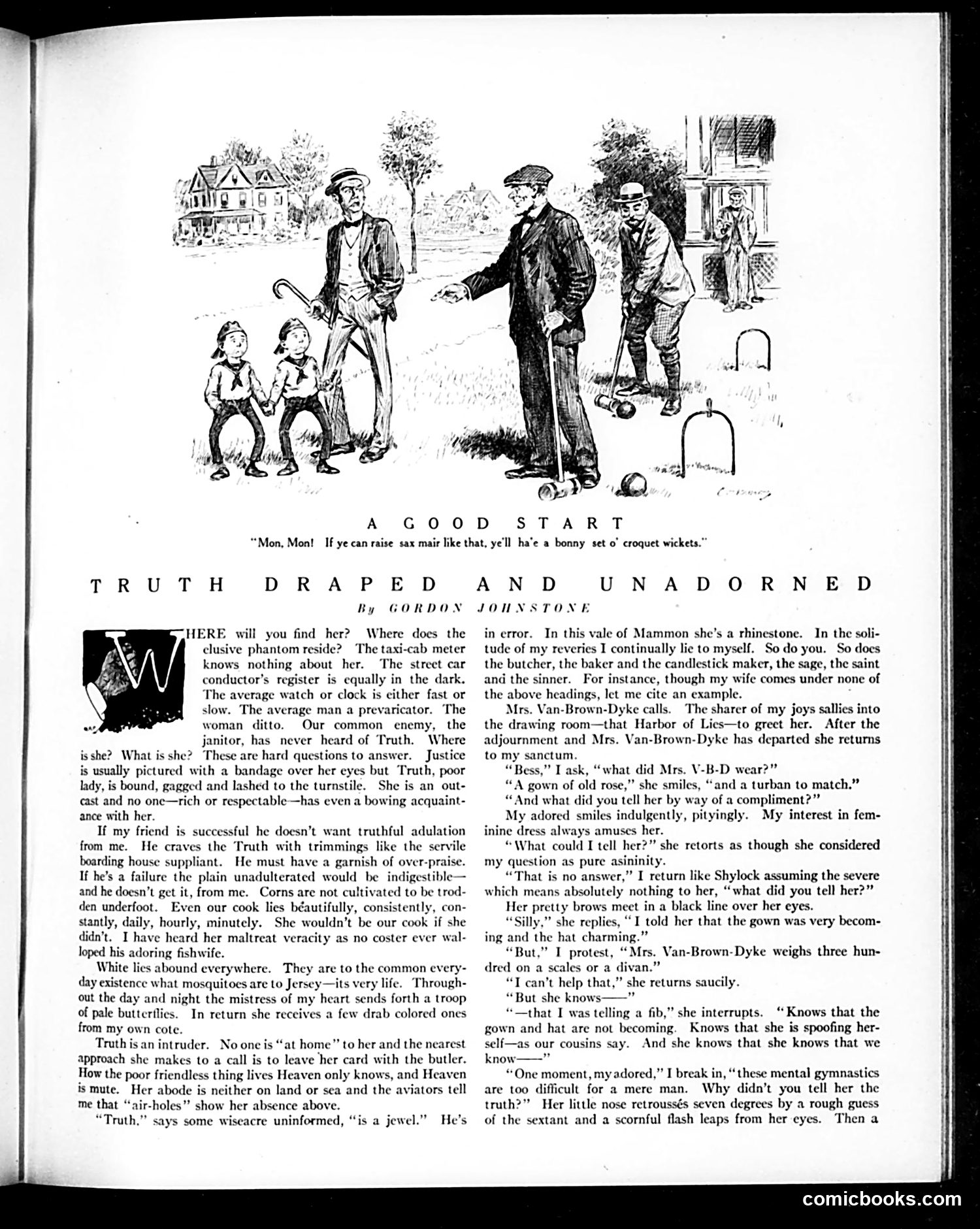
The top cartoon shows men discussing raising "sax mair" (six more) like something to use as croquet wickets—likely a crude joke about children or small people, typical of Judge's often dark humor. The longer piece below is a satirical essay arguing that Truth is socially unwelcome in American life. The author contends that people—servants, friends, society—routinely lie with "trimmings" of flattery rather than honest feedback. He illustrates this with an anecdote: when his wife compliments an obese visitor's unflattering dress, he demands she state the plain truth. She responds that everyone involved *knows* it's a lie, creating "mental gymnastics" too complex to untangle. The satire's target: Victorian-era hypocrisy and the social convention that politeness requires dishonesty. Truth, the essay concludes, is unwelcome except as garnish on flattery—making it practically worthless in society.
📄 Transcribed text from this page (OCR, searchable)
Machine-transcribed from the original scan — historical spelling and the odd misread are preserved.
A GOOD START “Mon, Mon! If ye can raise sax mair like that, ye'll ha’e a bonny set 0’ croquet wickets.” DR AP ED By GORDON A N D JOUNSTON TRUTH UN AODORWN E D HERE will you find her? Where does the elusive phantom reside? The taxi-cab meter knows nothing about her. The street car conductor’s register is equally in the dark. The average watch or clock is either fast or slow. The average man a prevaricator. The w woman ditto. Our common enemy, the janitor, has never heard of Truth. Where isshe? What is she? These are hard questions to answer. Justice is usually pictured with a bandage over her eyes but Truth, poor lady, is bound, gagged and lashed to the turnstile. She is an out- cast and no one—rich or respectable—has even a bowing acquaint- ance with her. If my friend is successful he doesn’t want truthful adulation from me. He craves the Truth with trimmings like the le boarding house suppliant. He must have a garnish of over-praise. If he’s a failure the plain unadulterated would be indigestible— and he doesn’t get it, from me. Corns are not cultivated to be trod- den underfoot. en our cook lies béautifully, consistently, con- stantly, daily, hourly, minutely. She wouldn’t be our cook if she didn’t. I e heard her maltreat veracity as no coster ever wal- loped his adoring fishwife. White lies abound everywhere. They are to the common every- day existence what mosquitoes are to Jersey—its very life. Through- out the day and night the mistress of my heart sends forth a troop of pale butterilies. In return she receives a few drab colored ones from my own cote. Truth isan intruder. No onc is “at home” to her and the nearest approach she makes to a call is to leave her card with the butler. How the poor friendless thing lives Heaven only knows, and Heaven is mute. Her abode is neither on land or sea and the aviators tell -holes” show her absence above. says some wiseacre uninformed, “is a jewel.” He's In this vale of Mammon she’s a rhinestone. In the soli- So do you. So docs cr, the sage, the saint comes under none of in error. tude of my reveries I continually lie to myself. the butcher, the baker and the candlestick m: and the sinner. For instance, though my the above headings, let me cite an example. Mrs. Van-Brown-Dyke calls. The sharer of my joys sallies into the drawing room—that Harbor of to grect her. After the adjournment and Mrs. Van-Brown-Dyke has departed she returns to my sanctum. “Bess,” I ask, “what did Mrs. V-B-D wear?” “A gown of old rose,” she smiles, “and a turban to match.” “And what did you tell her by way of a compliment?” My adored smiles indulgently, pityingly. My interest in fem- inine dress always amuses her. “What could I tell her?” she retorts as though she considered my question as pure asininity. “That is no answer,” I return like Shylock assuming the severe which means absolutely nothing to her, “what did you tell her?” etty brows mect in a black line over her eyes. she replies, “I told her that the gown was very becom- ing and the hat charming.” “But,” I protest, “Mrs. Van-Brown-Dyke weighs three hun- dred on a scales or a divan.” “T can’t help that,” she returns saucily. “But she know 7 “that I was telling a fib,” she interrupts. ‘“ Knows that the gown and hat are not becoming. Knows that she is spoofing her- self—as our cousins say. And she knows that she knows that we know as “One moment, my adored,” I break in, “these mental gymnastics are too difficult for a mere man. Why didn’t you tell her the truth?” Her little nose retroussés seven degrees by a rough guess of the sextant and a scornful flash leaps from her eyes. Then a comicbooks.com