
Judge, 1915-09-04 · page 8 of 27
Judge — September 4, 1915 — page 8: what you’re looking at
What you’re looking at
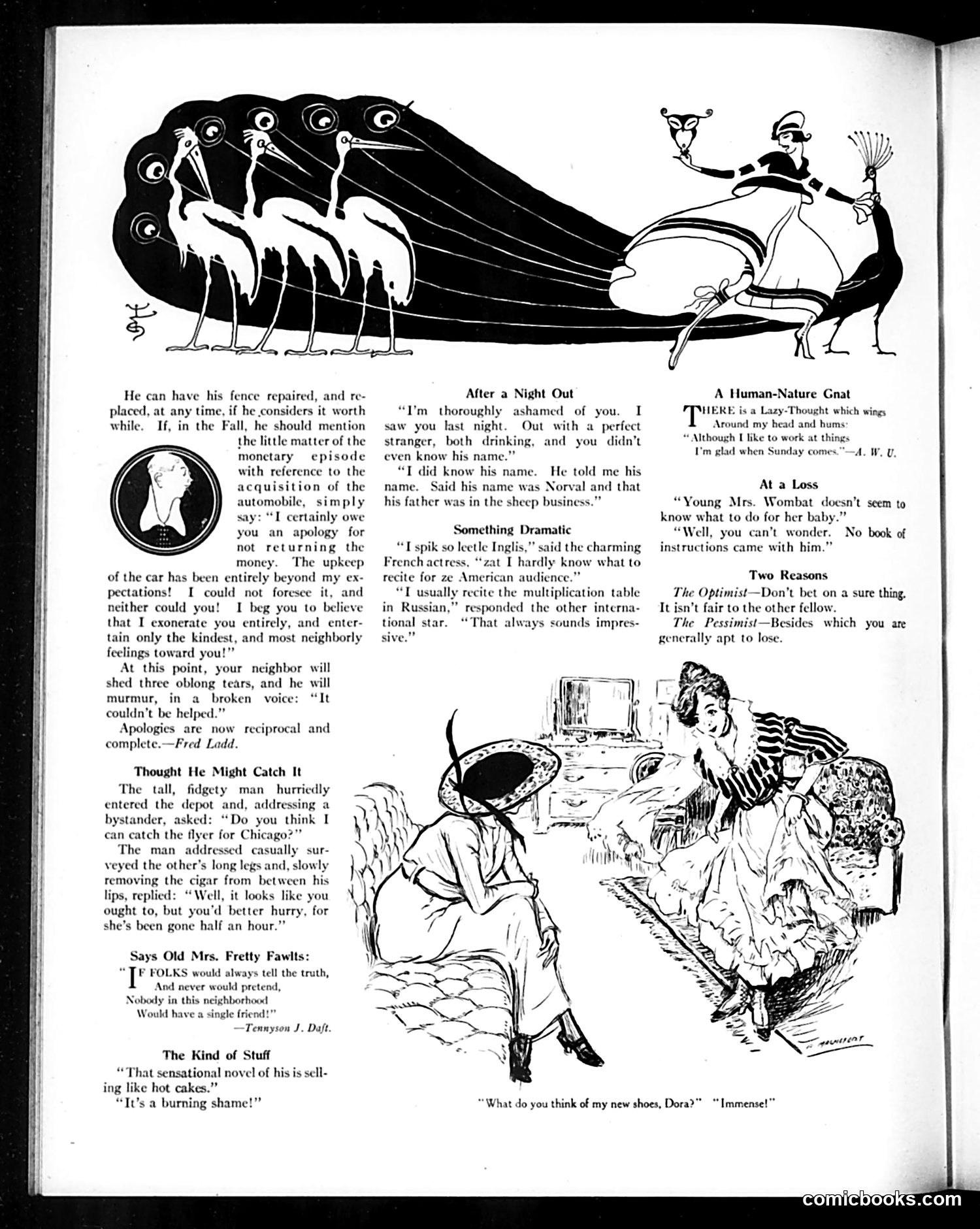
This page contains several short humorous pieces typical of early 20th-century satirical magazines: **Top cartoon**: Shows a woman being pulled by three ostriches—likely satirizing the fashionable use of ostrich feathers in women's clothing and hats, which were expensive status symbols. The absurdity emphasizes how impractical and excessive this trend had become. **Text pieces** include comedic anecdotes about social etiquette and human nature: a man making elaborate apologies for damaging a borrowed car; a woman caught out on a drunken evening; an actress reciting multiplication tables in Russian; and wordplay about catching a train. **Bottom cartoon**: Shows a woman with large, exaggerated shoes, with the caption "Immense!"—likely mocking women's fashion choices or shoe size, playing on the gap between intention and effect. The overall tone reflects Judge's satirical approach to contemporary social customs, fashion absurdities, and middle-class pretension. These pieces assume readers familiar with turn-of-the-century American social conventions and their contradictions.
📄 Transcribed text from this page (OCR, searchable)
Machine-transcribed from the original scan — historical spelling and the odd misread are preserved.
After a Night Out A Human-Nature Gnat HIERE is a Lazy-Thought which wings Around my head and hums: “Although I like to work at thi I'm glad when Sunday con He can have his fence repaired, and re- placed, at any time, if he considers it worth “I’m thoroughly ashamed of you. I while. If, in the Fall, he should mention saw you last night. Out with a perfect the little matter ofthe — stranger, both drinking, and you didn’t monetary episode even know his name.” with reference to the “T did know his name. He told me his acquisition of the name. Said his name was Norval and that At a Loss automobile, simply _ his father was in the sheep business.” “Young Mrs. Wombat doesn’t seem to say: “I certainly owe know what to do for her baby.” you an apology for Something Dramatic “Well, you can’t wonder. No book of not returning the “T spik so Icetle Inglis,” said the charming instructions came with him.” money. The upkeep French actress, “zat I hardly know what to of the car has been entirely beyond my ex- recite for ze American audience.” Two Reasons pectations! I could not foresee it, and “T usually recite the multiplication table The Optimist—Don’t bet on a sure thing, neither could you! I beg you to believe in Russian,” responded the other interna- It isn’t fair to the other fellow. I exonerate you entirely, and enter- I star. “That always sounds impres- The Pessimist—Besides which you are n only the kindest, and most neighborly sive.” generally apt to lose. feelings to’ At this point, your neighbor will shed three oblong tears, and he will murmur, in a broken voice: “It couldn't be helped.” Apologies are now reciprocal and complete.—Fred Ladd. Thought He Might Catch It The tall, fidgety man_ hurriedly entered the depot and, addressing a bystander, ask “Do you think I can catch the flyer for Chicago?” The man addressed casually sur- veyed the other’s long legs and, slowly removing the cigar from between his lips, replied: “Well, it looks like you ought to, but you'd better hurry, for she’s been gone half an hour.” ys Old Mrs. Fretty Fawits: « I > FOLKS would always tell the truth, And never would pretend, Nobody in this neighborhood Would haw ingle friend!” Tennyson J. Daft. r The Kind of Stuff 2 “That sensational novel of his is sell- ing like hot cakes.” “Tvs a burning shame!” "What do you think of my new shoes, Dora?” “Immense!”