
Judge, 1915-09-04 · page 4 of 27
Judge — September 4, 1915 — page 4: what you’re looking at
What you’re looking at
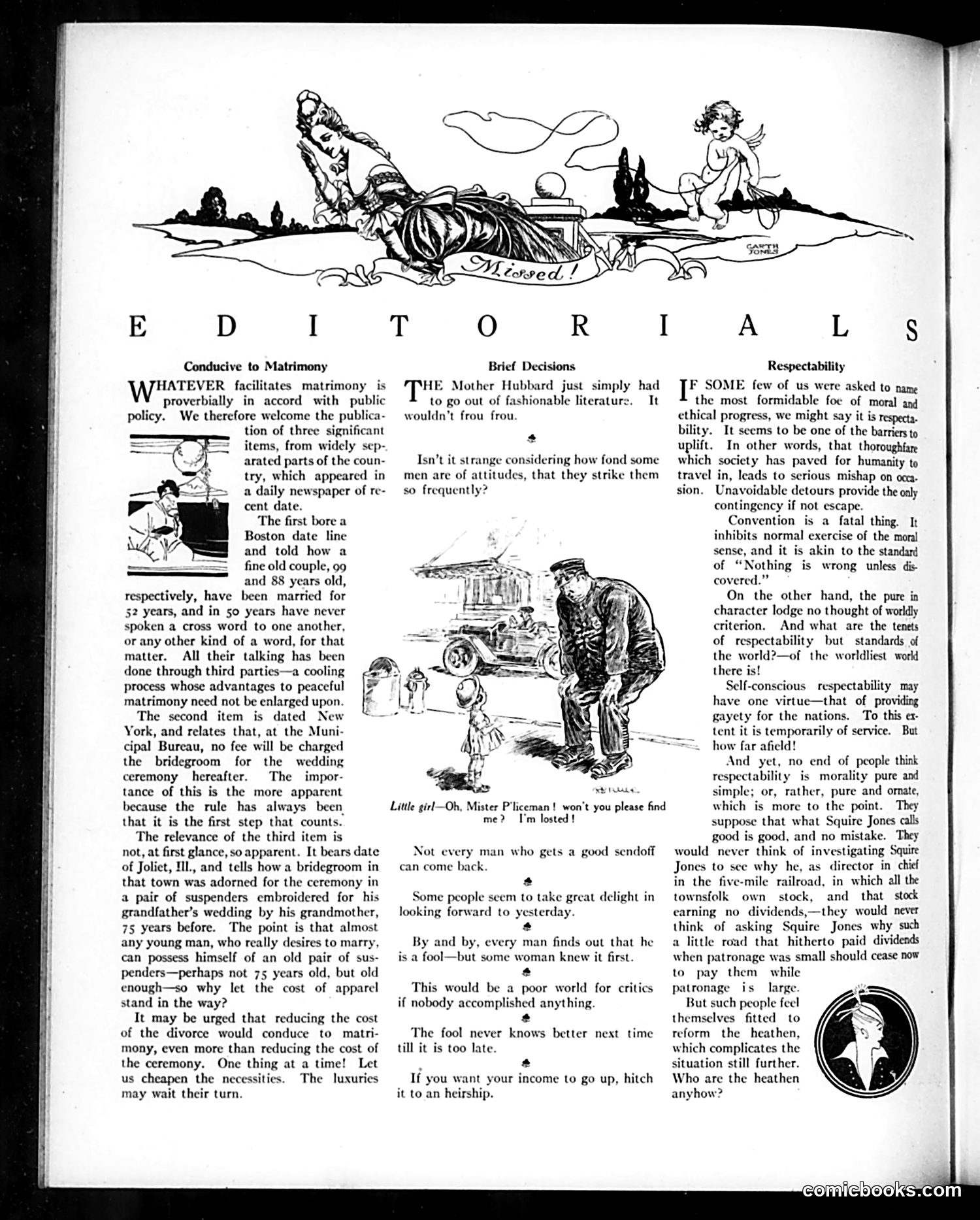
This Judge magazine page contains three opinion columns on marriage and social conduct, accompanied by illustrations and editorial cartoons. The main visual cartoon shows a man in a car speaking to a young girl, with the caption "Little girl—Oh, Mister Policeman! I won't you please find me? I'm lost!" This appears to satirize either predatory behavior or the vulnerability of children in public spaces. The left column discusses reducing marriage costs and wedding expenses to encourage matrimony. The center and right columns debate "respectability" in society—criticizing both excessive moral conventionality and the hypocrisy of people who selectively enforce moral standards. The overall page reflects early 20th-century anxieties about marriage, morality, and social propriety, using humor to critique inconsistent social standards.
📄 Transcribed text from this page (OCR, searchable)
Machine-transcribed from the original scan — historical spelling and the odd misread are preserved.
Conducive to Matrimony WHATEVER facilitates matrimony is proverbially in accord with public We therefore welcome the publica- tion of three significant items, from widely sep- arated parts of the coun- try, which appeared in a daily newspaper of re- cent date. The first bore a Boston date line and told how a fine old couple, 99 and 88 years old, respectively, have been married for 52 years, and in 50 years have never spoken a cross word to one another, or any other kind of a word, for that matter. All their talking has been done through third partics—a cooling process whose advantages to peaceful matrimony need not be enlarged upon. The second item is dated New York, and relates that, at the Muni- cipal Bureau, no fee will be charged the bridegroom for the wedding ceremony hereafter. The impor- tance of this is the more apparent because the rule has always been. that it is the first step that counts. The relevance of the third item not, at first glance, so apparent. It bears date of Joliet, TL., and tells how a bridegroom in that town was adorned for the ceremony in a pair of suspenders embroidered for his grandfather’s wedding by his grandmother, 75 years before. The point is that almost any young man, who really desires to marry, can possess himself of an old pair of sus- penders—perhaps not 75 years old, but old enough—so why let the cost of apparel stand in the way? It may be urged that reducing the cost of the divorce would conduce to matri- mony, even more than reducing the cost of the ceremony. One thing at a time! Let us cheapen the necessities. The luxuries may wait their turn. policy. Brief Decisions HE Mother Hubbard just simply had to go out of fashionable literature. It wouldn't frou frou + Isn’t it strange considering how fond some men are of attitudes, that they strike them so frequently? Little girl—Oh, Mister P'liceman ! won't you please find me? I'm losted ! Not every man who gets a good sendoff can come back. 2 Some people seem to take great delight in looking forward to yesterday. 2 By and by, every man finds out that he is a fool—but some woman knew it first. cd This would be a poor world for critics if nobody accomplished anything. # The fool never knows better next time till it is too late. . s If you want your income to go up, hitch it to an heirship. S Respectability F SOME few of us were asked to name the most formidable foe of moral and ethical progress, we might say it is respecta- bility. It seems to be one of the barriers to uplift. In other words, that thoroughfare which society has paved for humanity to travel in, leads to serious mishap on occa. sion. Unavoidable detours provide the only contingency if not escape. Convention is a fatal thing. It inhibits normal exercise of the moral dit is akin to the standard othing is wrong unless dis covered.” On the other hand, the pure in character lodge no thought of worldly criterion, And what are the tenets of respectability but standards of the world?—of the worldliest world there is! Self-conscious respectability may have one virtue—that of providing gayety for the nations. To this ex- tent it is temporarily of service. But how far afield! And yet, no end of people think respectability is morality pure and i r, rather, pure and ornate, is more to the point. They suppose that what Squire Jones calls good is good, and no mistake. They would never think of investigating Squire Jones to see why he, as director in chief in the five-mile railroad, in which all the townsfolk own stock, and that stock earning no dividends,—they would never think of asking Squire Jones why such a little road that hitherto paid dividends when patronage was small should cease now to pay them while patronage large. But such people feel themselves fitted to reform the heathen, which complicates the situation still further. Who are the heathen anyhow? is