A complete issue · 28 pages · 1915
Judge — August 7, 1915
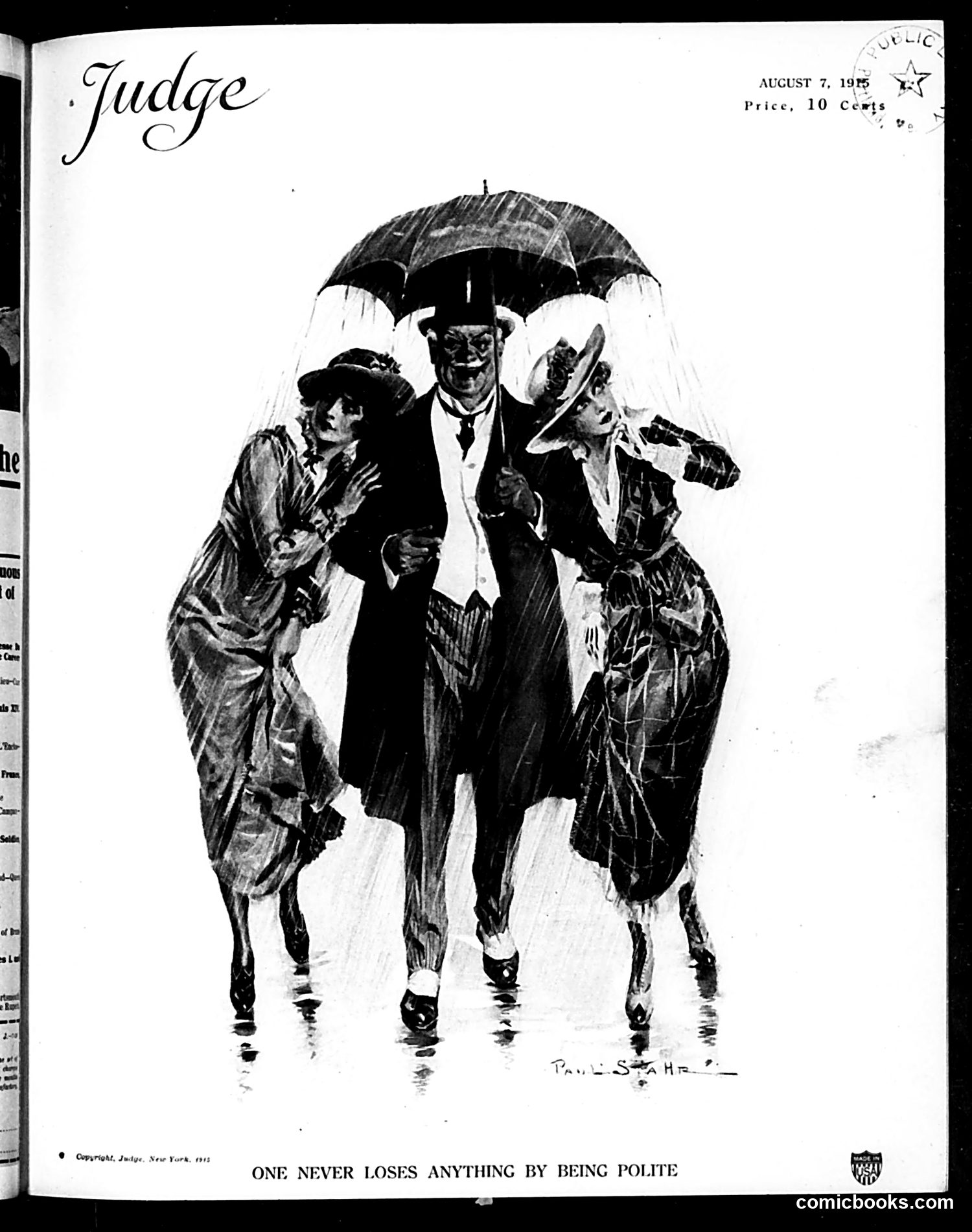
This satirical cartoon depicts three figures sheltering under an umbrella during heavy rain. The caption reads "ONE NEVER LOSES ANYTHING BY BEING POLITE." The image appears to be social commentary on civility and manners during the era. The central figure is a well-dressed man flanked by two women in fashionable attire, all huddled together for shelter. The artist's signature appears to be Paul Stahr. The satire likely suggests that maintaining politeness and proper decorum—even in uncomfortable situations (like being crowded under an umbrella in the rain)—preserves one's dignity and social standing. This reflects early 20th-century middle-class values emphasizing etiquette and courteous behavior as markers of respectability.
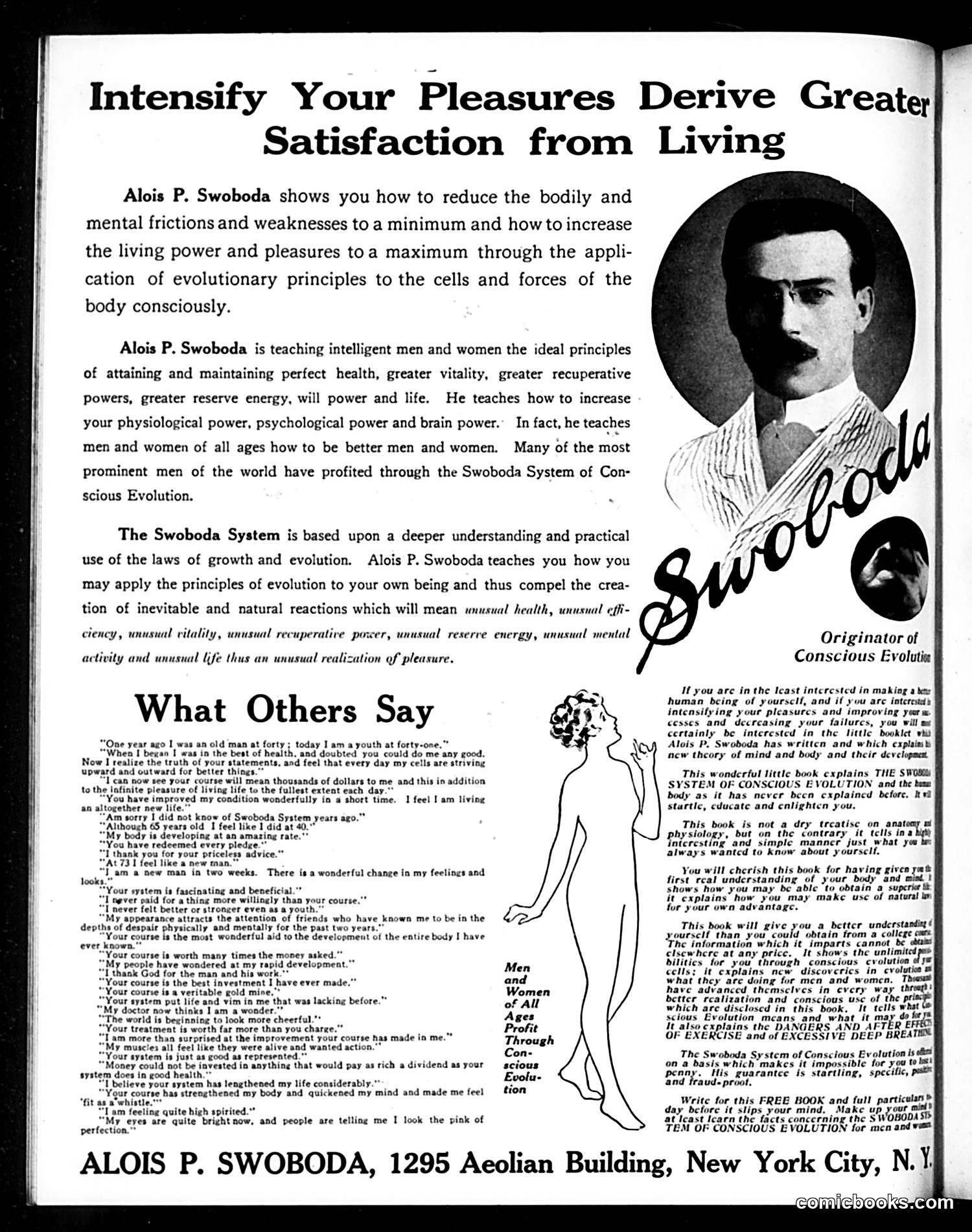
This page is primarily **advertising, not satire or political commentary**. It promotes Alois P. Swoboda's self-help system called "Conscious Evolution," which claims to improve health, vitality, and life satisfaction through evolutionary principles applied to the human body and mind. The content includes: - A portrait of Swoboda himself (identified as "Originator of Conscious Evolution") - Testimonial quotes from satisfied customers praising the system - A simple line drawing of a male figure labeled "Men and Women of All Ages Profit Through Conscious Evolution" - Marketing copy emphasizing health benefits and promising a free book This represents early 20th-century **pseudoscientific self-improvement marketing**—a common Judge advertiser targeting readers seeking health optimization through quasi-evolutionary theories.
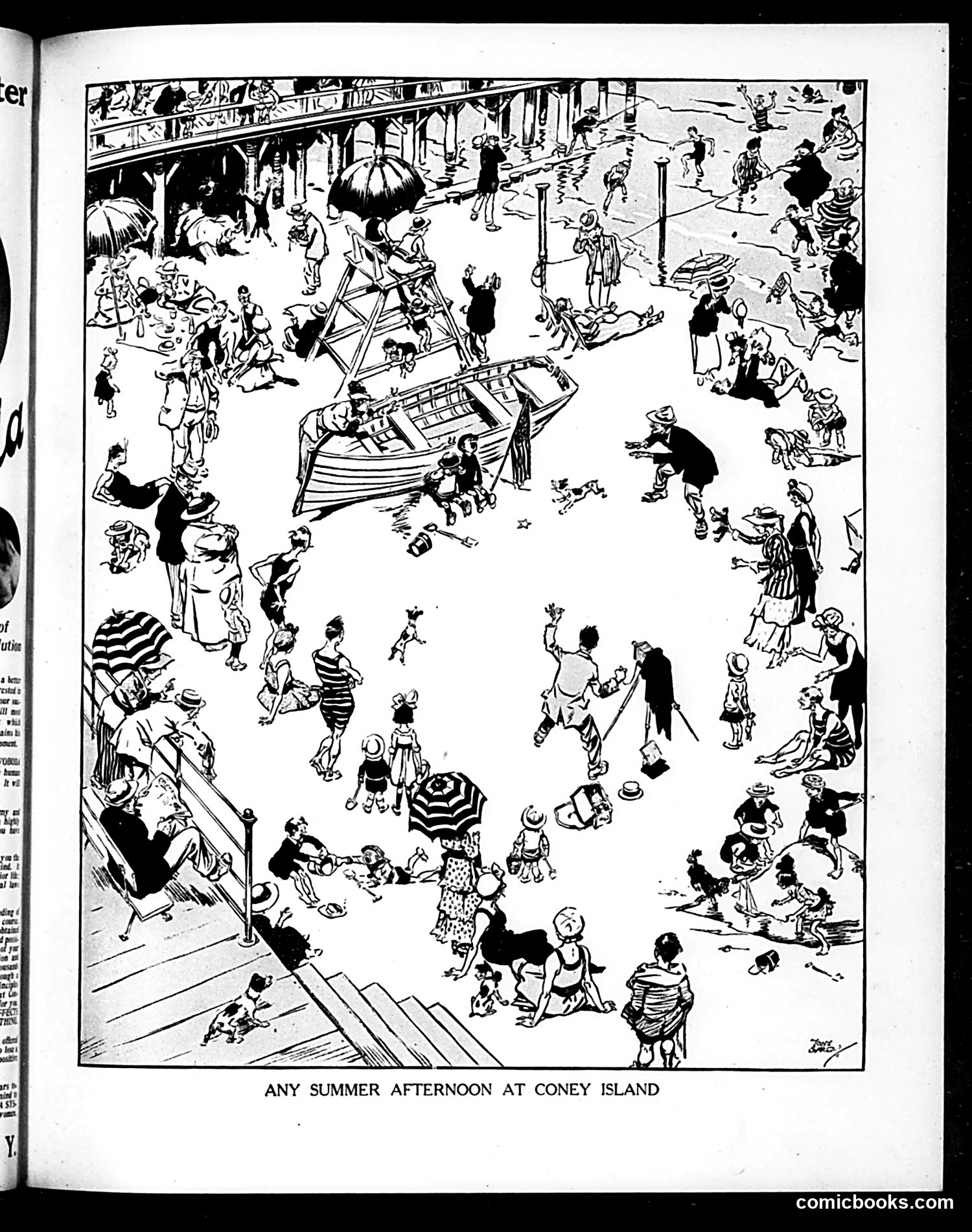
This is a satirical illustration of Coney Island beach during summer, titled to suggest it depicts a typical crowded scene. The cartoon shows dozens of beachgoers in various states of leisure and chaos—swimming, playing, eating, lounging under umbrellas, and interacting in the crowded sand. The satire appears to target the chaotic nature of mass public recreation at the era's most famous amusement beach destination. The dense, energetic composition emphasizes overcrowding and the collision of different social classes and behaviors in a shared public space. This likely reflects early 20th-century anxieties about urbanization and modern leisure culture's unpredictable, sometimes undignified social mixing.
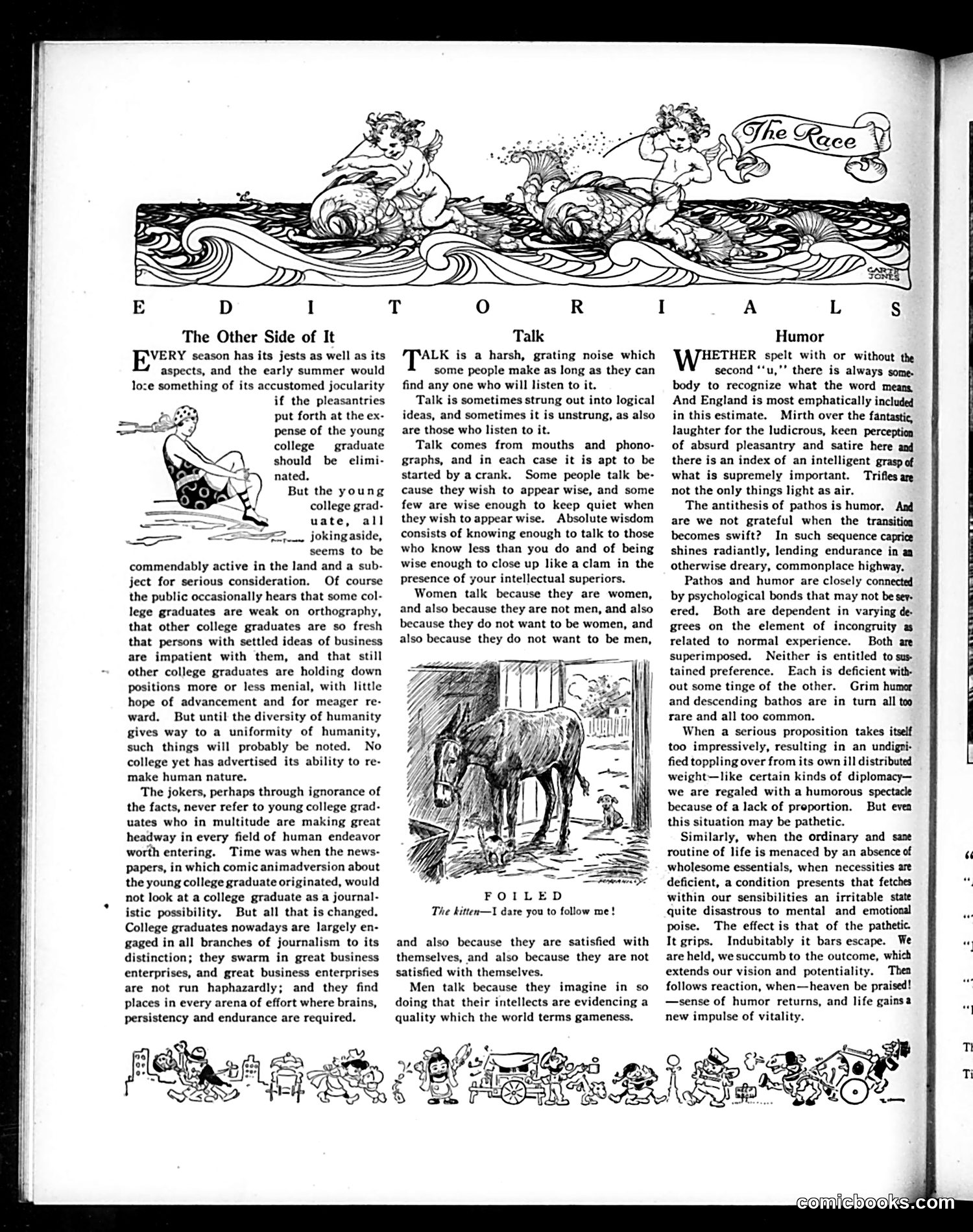
This page contains three humorous essays about social behavior ("The Other Side of It," "Talk," and "Humor"), accompanied by decorative illustrations rather than political cartoons. The main illustration shows a horse that has kicked over a bucket, captioned "Foiled—I can you to follow me!" This appears to be a visual pun supporting the essay on "Talk"—the horse's stubborn refusal to follow illustrates the human tendency to resist persuasion through talk alone. The essays critique college graduates' pretentiousness, excessive talkativeness (particularly women's), and the role of humor in society. The content is social satire rather than political commentary, aimed at early 20th-century American attitudes toward education, gender, and etiquette.
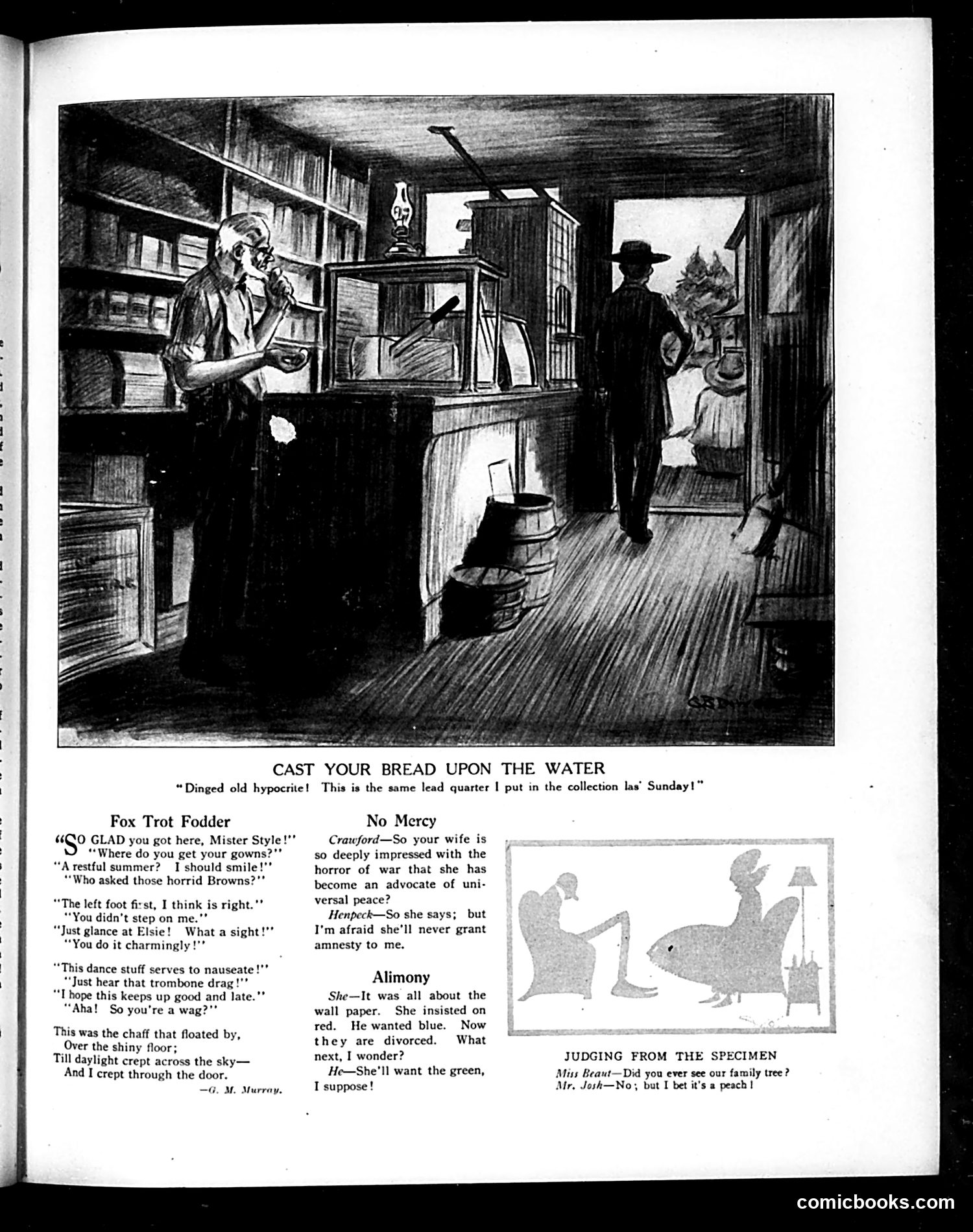
The main cartoon, "Cast Your Bread Upon the Water," depicts a shopkeeper confronting a customer about a counterfeit coin in the collection plate at church—a humorous example of karmic irony. The phrase references the biblical proverb about generosity returning good fortune. Below are three separate joke sections: "Fox Trot Fodder" mocks the popular dance craze through dialogue. "No Mercy" satirizes post-WWI attitudes, with a husband refusing amnesty toward his pacifist wife who opposed the war. "Alimony" uses domestic discord (arguing over wallpaper colors) as a punchline about marriage dissolution. The small cartoon "Judging from the Specimen" makes a visual gag about genealogy and family resemblance. The content reflects 1920s American social anxieties: war attitudes, changing gender relations, and modern dance culture.
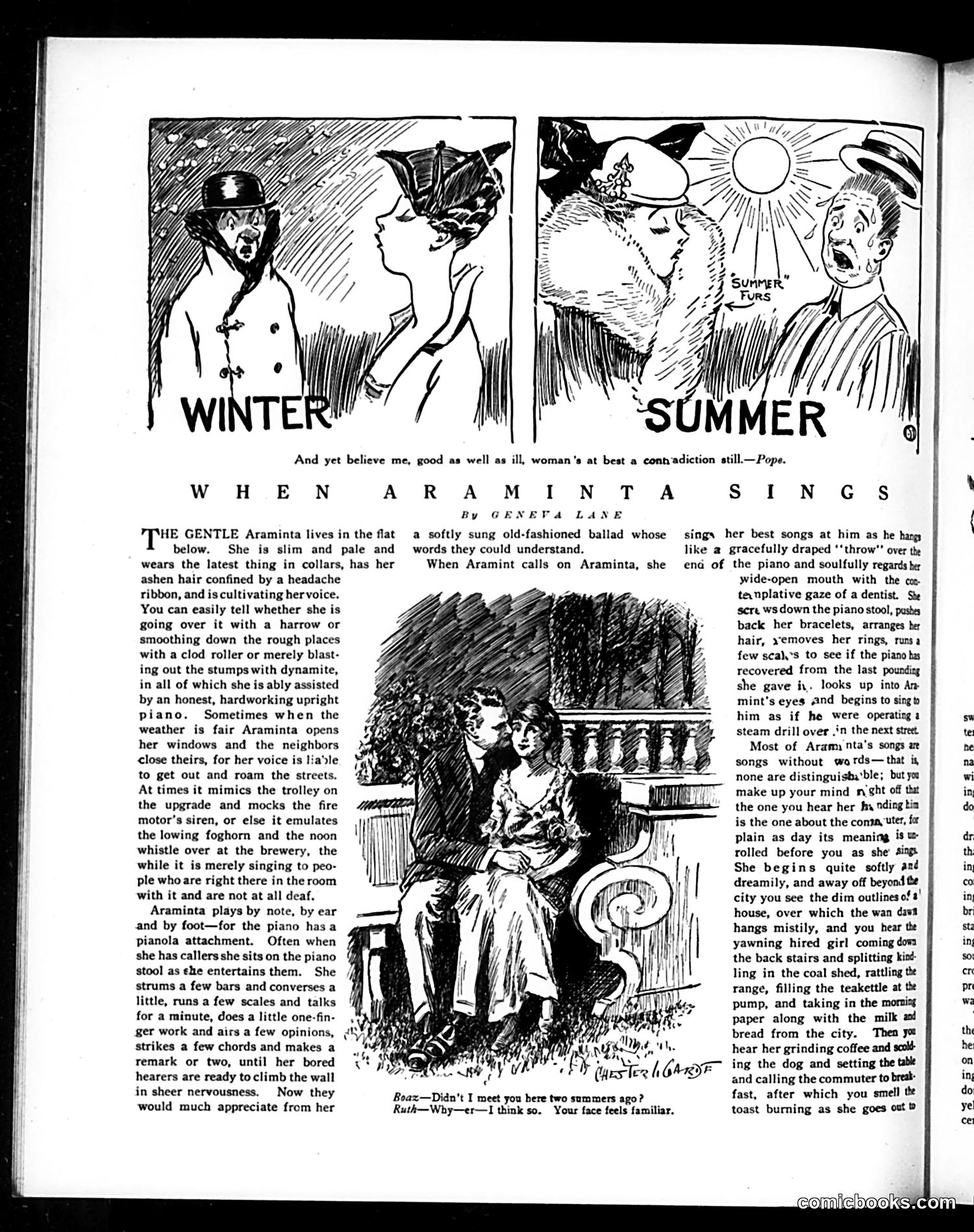
This is a satirical article about Araminta, an upper-class woman who plays piano and sings poorly. The satire targets the pretentious amateur musicianship of wealthy women in the early 20th century. **The joke:** Araminta performs constantly—with piano rolls, multiple playing styles, and elaborate vocal dramatics—yet her singing is unbearable. Neighbors close their windows; visitors are driven to nervous distraction. The article notes her songs are technically "without words" but convey an unintentionally vivid domestic narrative (a hired girl's morning routine, burnt toast) through sheer cacophony rather than artistry. **The social reference:** This mocks the period's expectation that educated, wealthy women cultivate "accomplishments" like music and singing, regardless of talent. The Pope epigraph about women's contradictions frames the entire critique. The cartoons at top contrast Araminta in **Winter** (stylish, proper) with **Summer** (apparently overheated), suggesting seasonal extremes in her behavior or appearance.
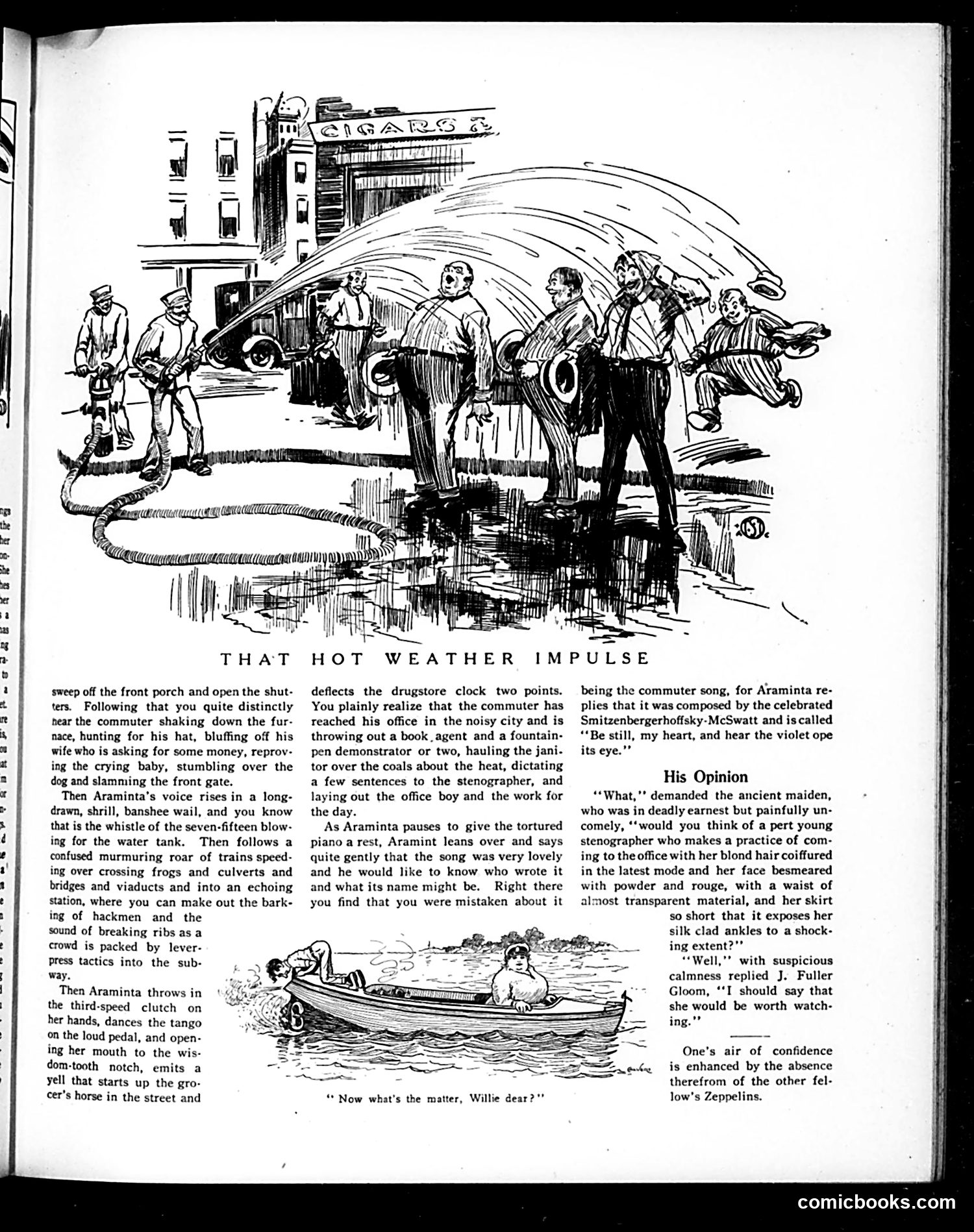
This page satirizes the early 20th-century urban commuter experience during summer heat. The top cartoon depicts a woman named Araminta playing piano so loudly that her performance literally vibrates through the neighborhood—the sound waves physically distort buildings and affect street activity. The joke is that her terrible piano-playing is so powerful it disrupts the entire city: it deflects a drugstore clock, startles horses, and somehow conveys what the commuter is experiencing miles away at his office. The accompanying text humorously catalogs the cacophony of urban summer life—furnaces, arguing spouses, crying babies, trains, subway crowds—all compressed into sensory overload. The lower cartoon and "His Opinion" section offers additional period humor about workplace propriety and gender, with conservative commentary on women's fashion and behavior in offices. Overall, the page mocks modern urban summer chaos and domestic disruption with exaggerated illustration.
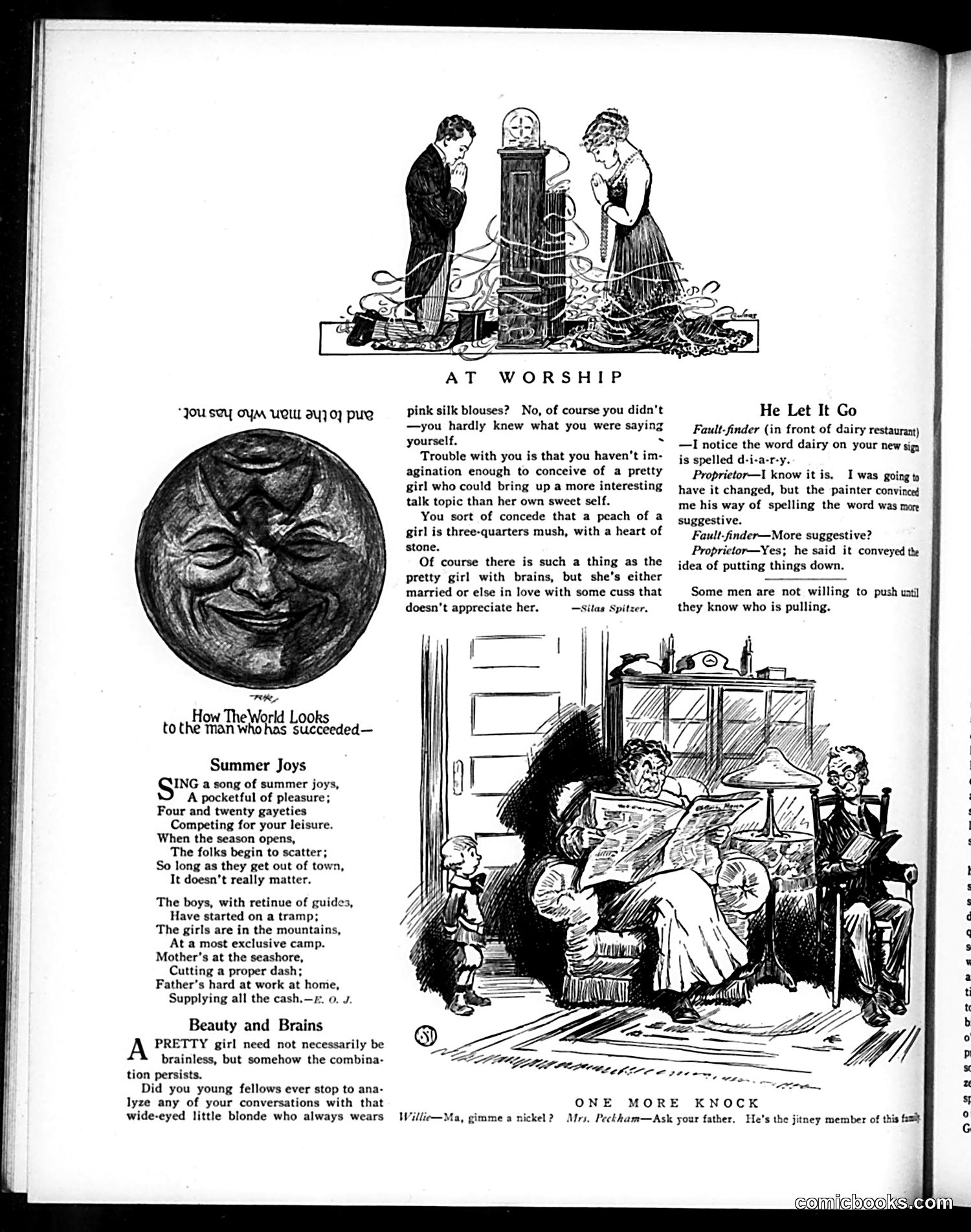
This page from *Judge* magazine contains several satirical pieces mocking early 20th-century social attitudes: **"At Worship"** (top): A couple and clergyman at an altar, satirizing shallow courtship—the text attacks men who pursue pretty girls lacking substance, noting such women are "three-quarters mush, with a heart of stone." **"He Let It Go"**: A restaurateur defends misspelling "dairy" as "d-i-a-r-y," claiming it's "more suggestive" of "putting things down"—sexual innuendo about women's bodily functions. **"Beauty and Brains"**: Criticizes the persistent stereotype that attractive women lack intelligence, urging young men to stop pursuing vapid "wide-eyed little blondes." **"Summer Joys"** and **"One More Knock"**: Lighter domestic humor about family summer scattering and children's allowance requests. The page's overall theme satirizes gender stereotypes and shallow masculinity, while the crude humor reflects period attitudes toward women's bodies.
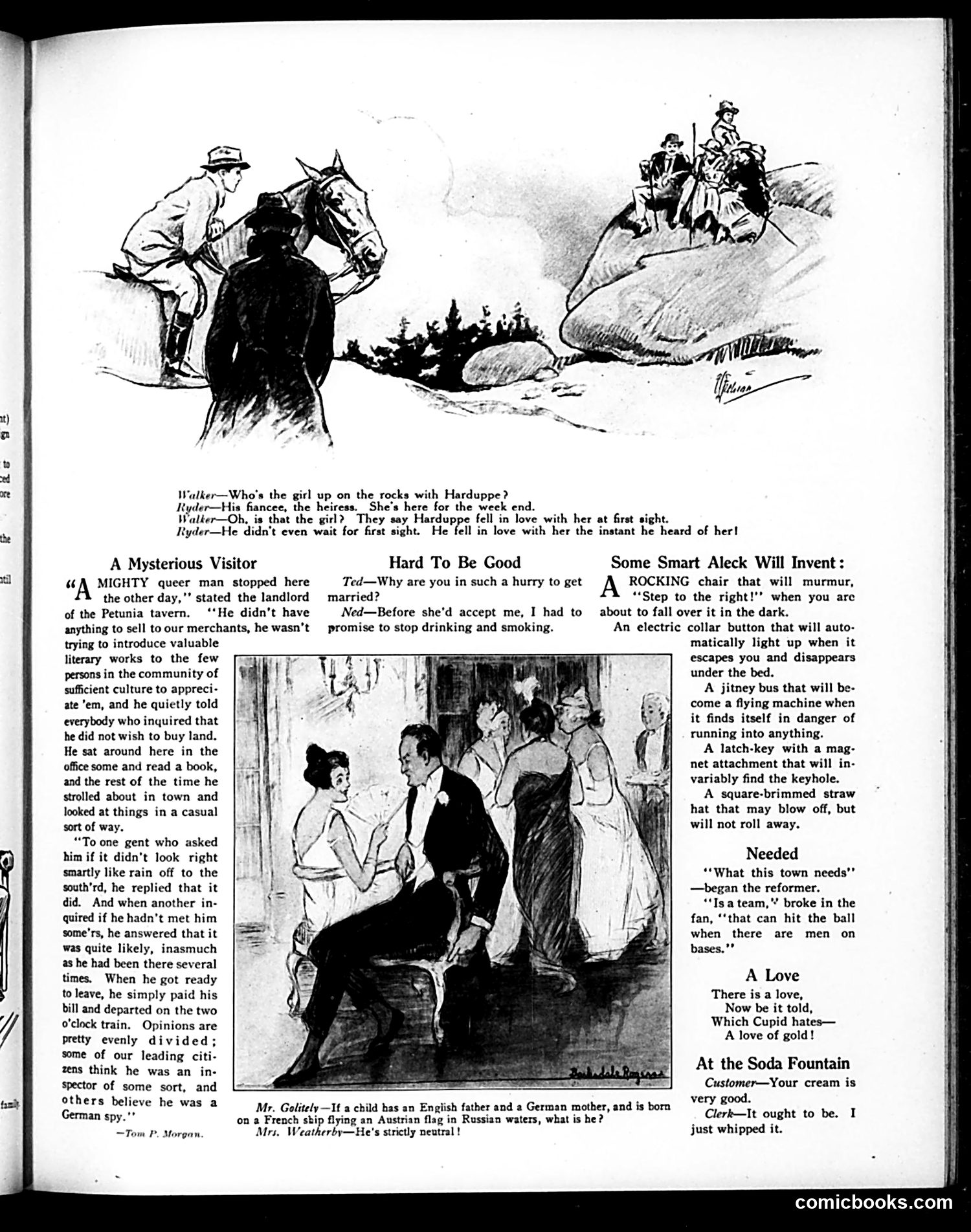
This page contains several satirical pieces typical of Judge magazine's social commentary: **Top cartoon:** Shows a man (Harduppe) who fell in love with his fiancée not upon meeting her, but instantly upon learning she was an *heiress*—satirizing fortune-hunting and mercenary marriages among the wealthy. **"A Mysterious Visitor":** A rural tavern keeper recounts a peculiar stranger who wasn't a salesman, land speculator, or cultural promoter—just a normal visitor. The ambiguity about his identity (inspector? German spy?) likely satirizes post-WWI American paranoia about foreign agents, a common concern in that era. **Other pieces:** Include light humor about marriage conditions, a riddle about international neutrality (likely WWI-related), inventions mocking modern conveniences, and brief quips about romance and materialism. The overall tone mocks American obsessions with wealth, marriage prospects, and contemporary anxieties about foreign threats.
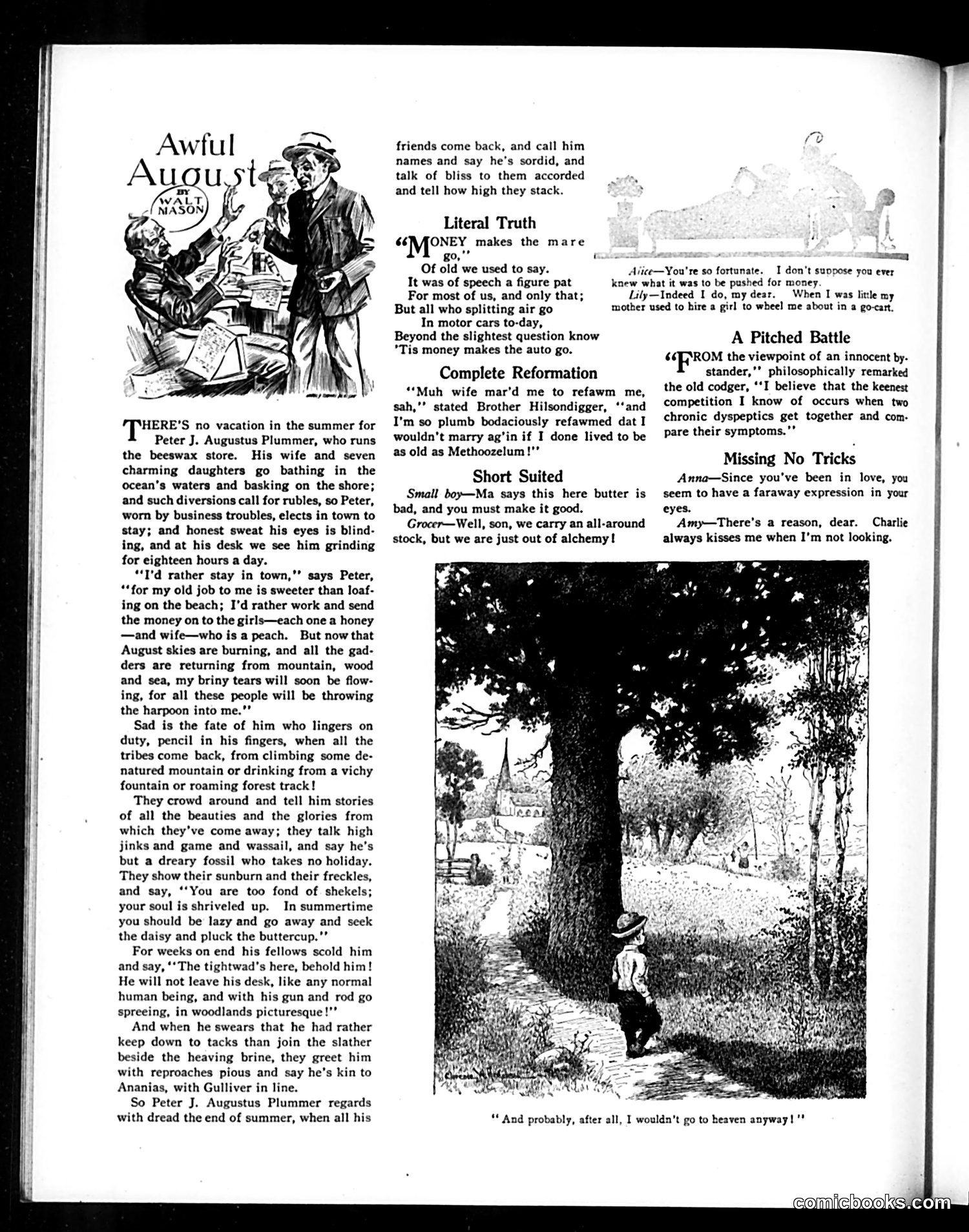
This page satirizes the social pressure of summer vacation culture among the American middle class. The main story concerns **Peter J. Augustus Plummer**, a beeswax store owner forced to remain working while his wife and seven daughters vacation at the beach. The satire targets two contradictory social anxieties: the expectation to spend money on leisure ("shekels"), yet the shame of prioritizing work over vacation. Upon their return, Plummer's friends mock him as stingy and soulless, comparing him to biblical miser Ananias. The joke critiques how summer leisure had become a status marker—those who vacationed displayed sunburns and stories; those who worked were deemed unambitious. The page also contains brief comic vignettes mocking other social pretenses: a grocer's inability to improve bad butter, and romantic clichés about love and attention. The overall tone reflects fin-de-siècle anxieties about American consumerism and the performative nature of leisure.
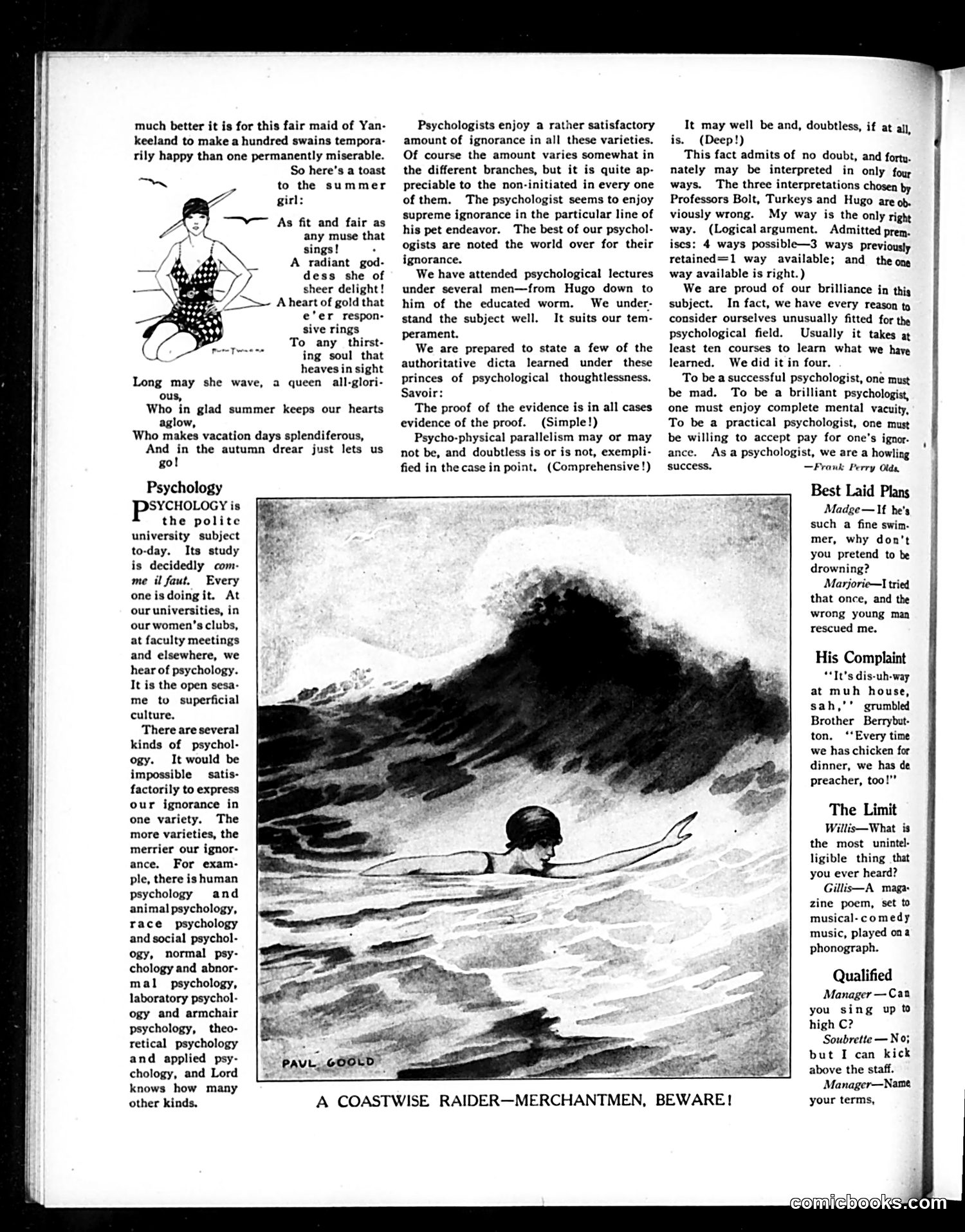
This page satirizes psychology as a fashionable but intellectually empty pursuit among educated Americans. The main article by Frank Perry Olds mocks psychologists for masking profound ignorance behind pseudoscientific jargon. Olds argues that psychology has become "the polite university subject" and that successful psychologists are those willing to accept payment for their ignorance while maintaining an air of brilliance. The satire targets academia's pretentiousness: psychologists are portrayed as people who speak in circular logic ("proof of evidence is evidence of proof"), make unfalsifiable claims about psycho-physical parallelism, and dismiss colleagues' interpretations while claiming their own way is "the only right way." The illustration "A Coastwise Raider—Merchantmen, Beware!" depicts a swimmer crawling up a beach, apparently a clever visual pun on psychology being a form of intellectual "raiding" or theft of credibility. The humor column snippets mock romantic misunderstandings and social pretension—typical Judge fare of the era.
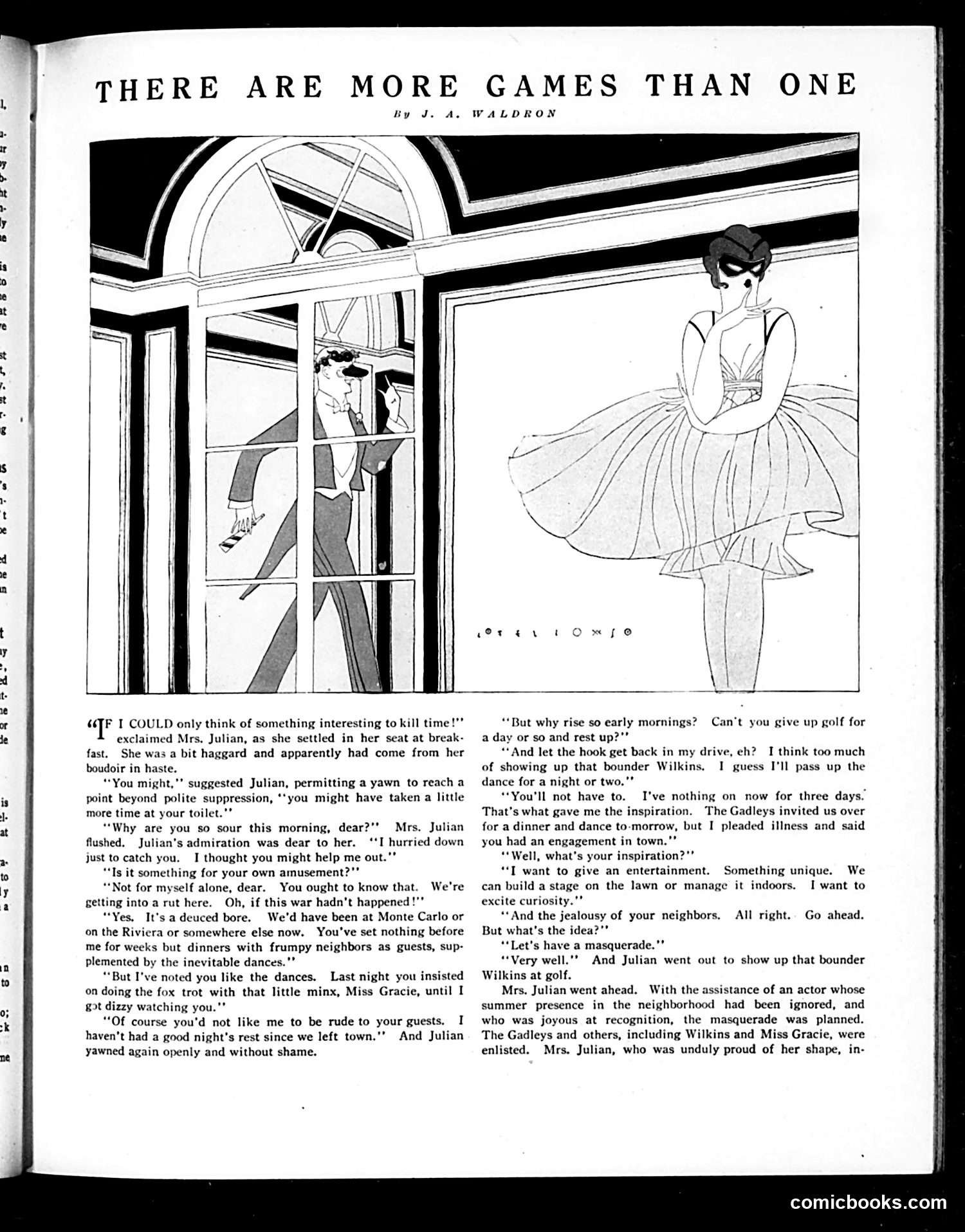
This is a domestic comedy story (not a political cartoon) by J.A. Waldron depicting upper-class boredom and marital gamesmanship during wartime—likely WWI, given the reference to "if this war hadn't happened." **The Setup:** Mrs. Julian, bored and seeking entertainment, proposes a masquerade party to enliven their dull social circle. Her husband Julian is preoccupied with golf and one-upping a rival named Wilkins, plus flirtation with "Miss Gracie." **The Satire:** The piece mocks wealthy society's shallow concerns—they're emotionally distant ("sour"), restless despite privilege, and petty (Julian's competitive golfing). The title suggests life is a series of games: social games, romantic games, competitive games. Mrs. Julian's "entertainment" scheme is itself a game to regain her husband's attention. **Modern relevance:** It satirizes how privilege breeds ennui and how people manufacture drama to escape monotony, a theme still recognizable today.
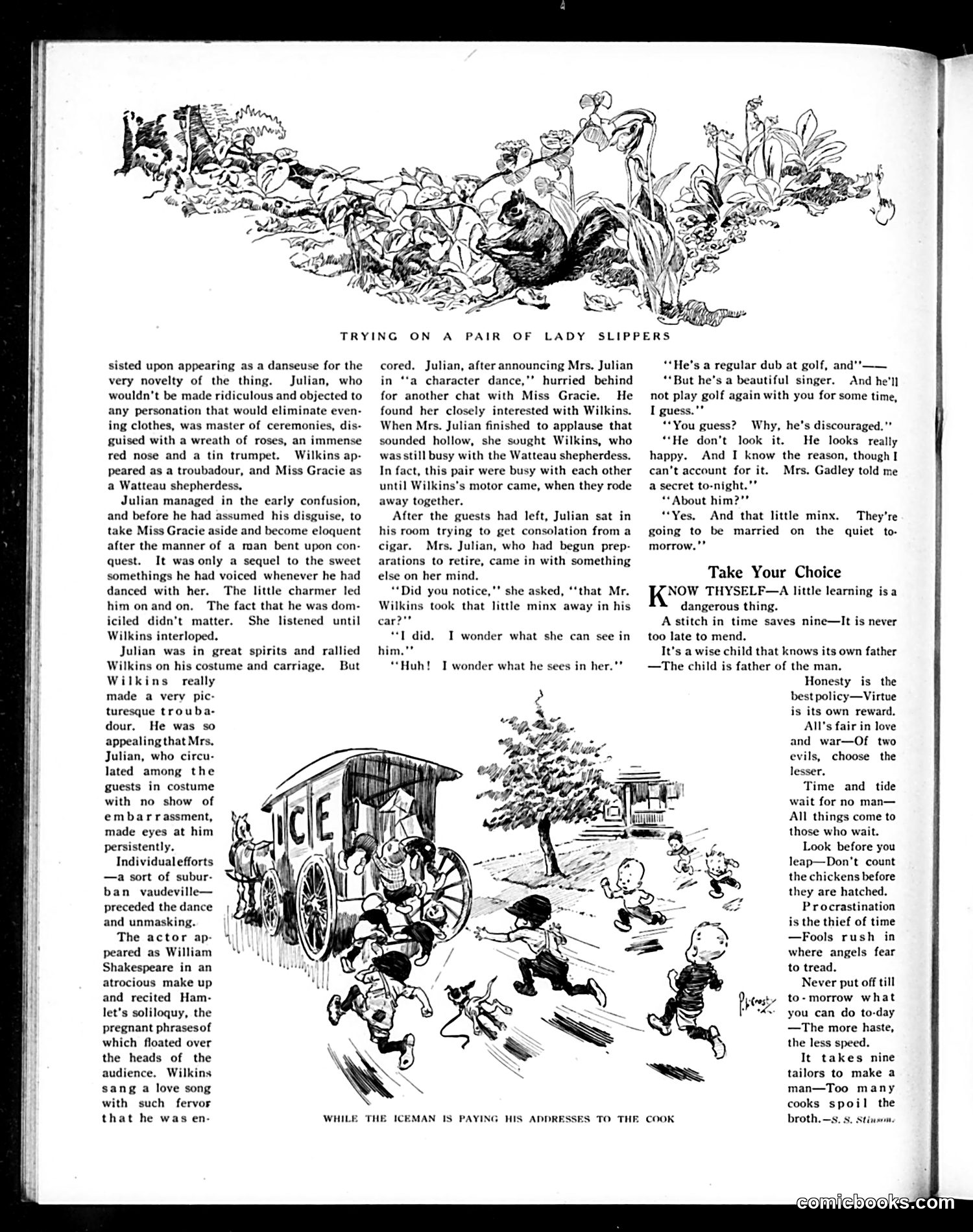
**Top Cartoon: "Trying On a Pair of Lady Slippers"** This is a domestic comedy about marital infidelity at a costume party. Julian, a married man, flirts with "Miss Gracie" (a young woman), while his wife Mrs. Julian makes romantic advances toward a guest named Wilkins dressed as a troubadour. The irony is mutual betrayal: Julian pursues Miss Gracie, but his wife successfully seduces Wilkins instead. They leave together in Wilkins's car. The final twist—revealed through gossip—is that Wilkins and Miss Gracie plan to marry, suggesting Julian's flirtation was ultimately irrelevant. The satire mocks upper-class social hypocrisy: fancy costume parties providing cover for affairs, the performative nature of respectability, and the comeuppance when a philandering husband loses both his paramour and (implicitly) his marriage. **Bottom Section: "Take Your Choice"** A collection of contradictory proverbs presented as equally valid life guidance, satirizing how conventional wisdom often conflicts with itself—a commentary on the unreliability of moral platitudes.
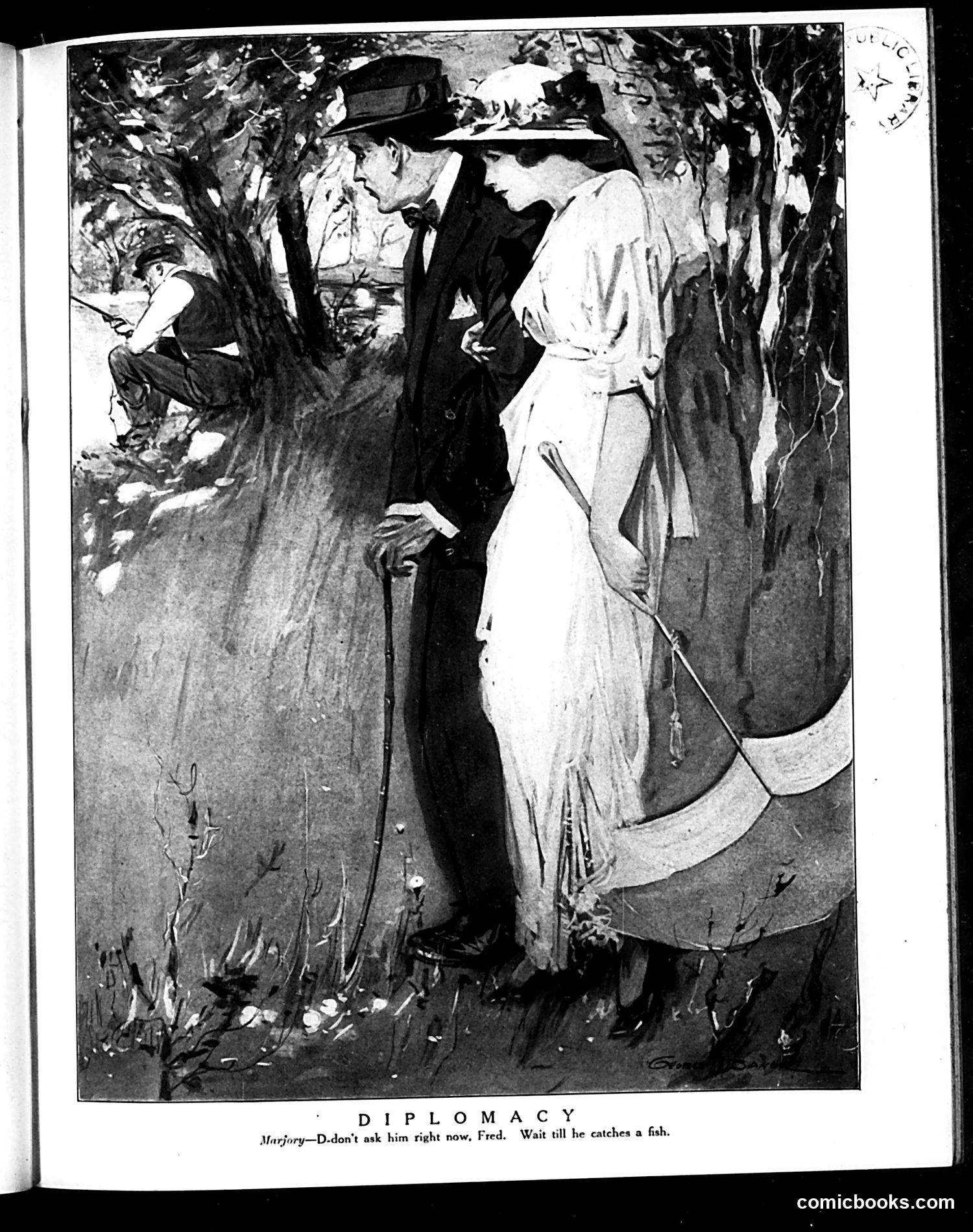
This cartoon satirizes diplomatic negotiation tactics using a fishing scenario as metaphor. A woman (Marjory) advises a man (Fred) to approach another man only after he's caught a fish—implying that success or satisfaction makes someone more amenable to requests or demands. The satire suggests that in matters of diplomacy (international relations), timing is crucial. One should approach negotiations when the other party is in a favorable mood or position of strength. The fishing setting provides a genteel, leisurely backdrop that contrasts with the serious business of diplomatic maneuvering, emphasizing how calculated and strategic such "civilized" dealings actually are beneath their surface courtesy. The cartoon mocks both diplomatic pretense and the psychological calculation underlying seemingly casual social interactions.
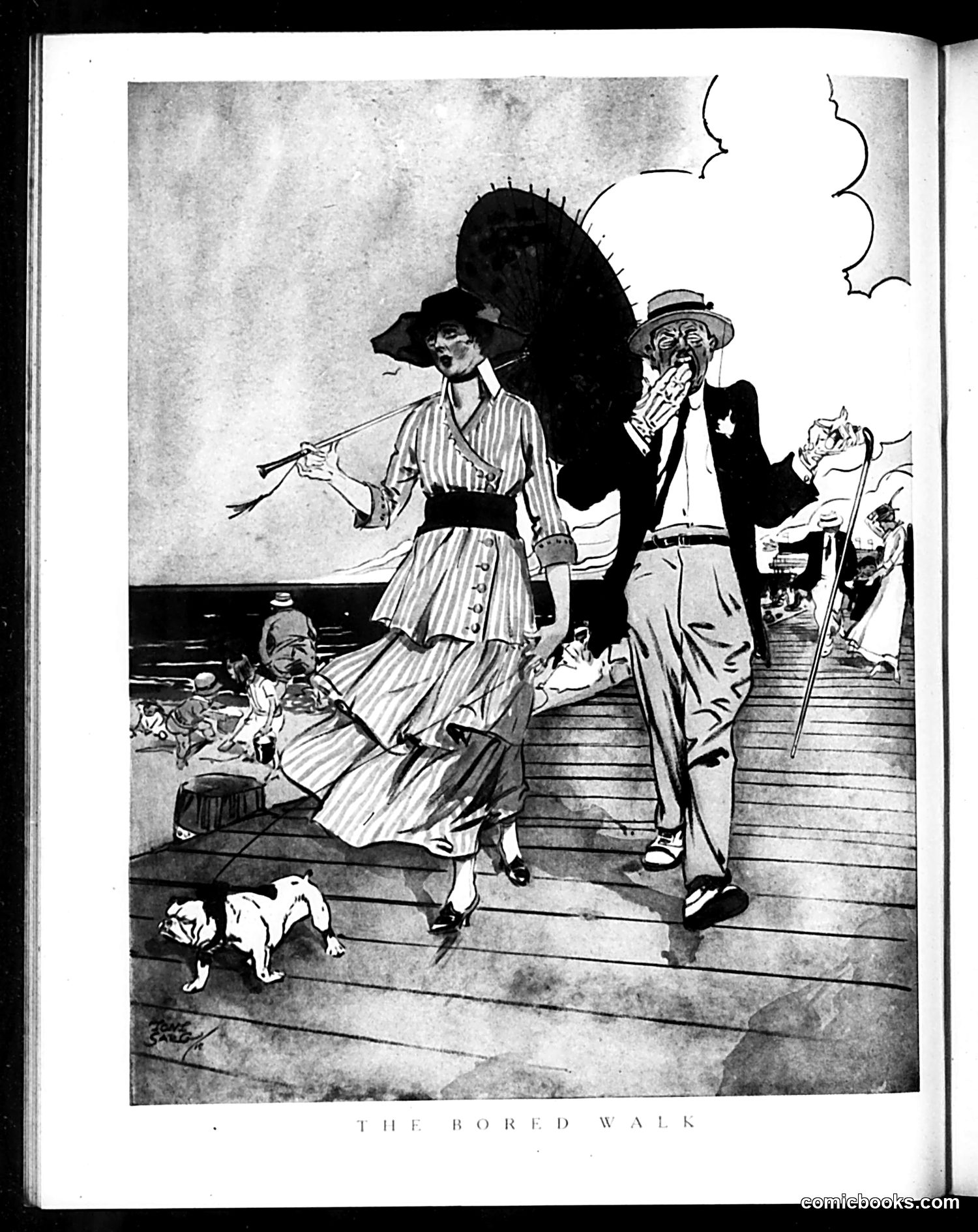
This satirical cartoon depicts a wealthy couple on a seaside promenade, appearing utterly disengaged despite their privileged setting. The woman carries a large parasol and walks ahead with an expression of indifference, while the man beside her looks equally unimpressed, hand to his face in a gesture of ennui. The satire targets the leisure class's inability to enjoy themselves despite having every advantage—servants, fine clothing, and leisure time. Small dogs accompany them, and other beachgoers populate the background, yet neither principal figure shows interest or animation. The title "The Bored Walk" is the joke itself: wealth and idleness have created such superficial, hollow lives that even relaxation brings no genuine pleasure. It's social commentary on fin-de-siècle upper-class aimlessness and moral emptiness.
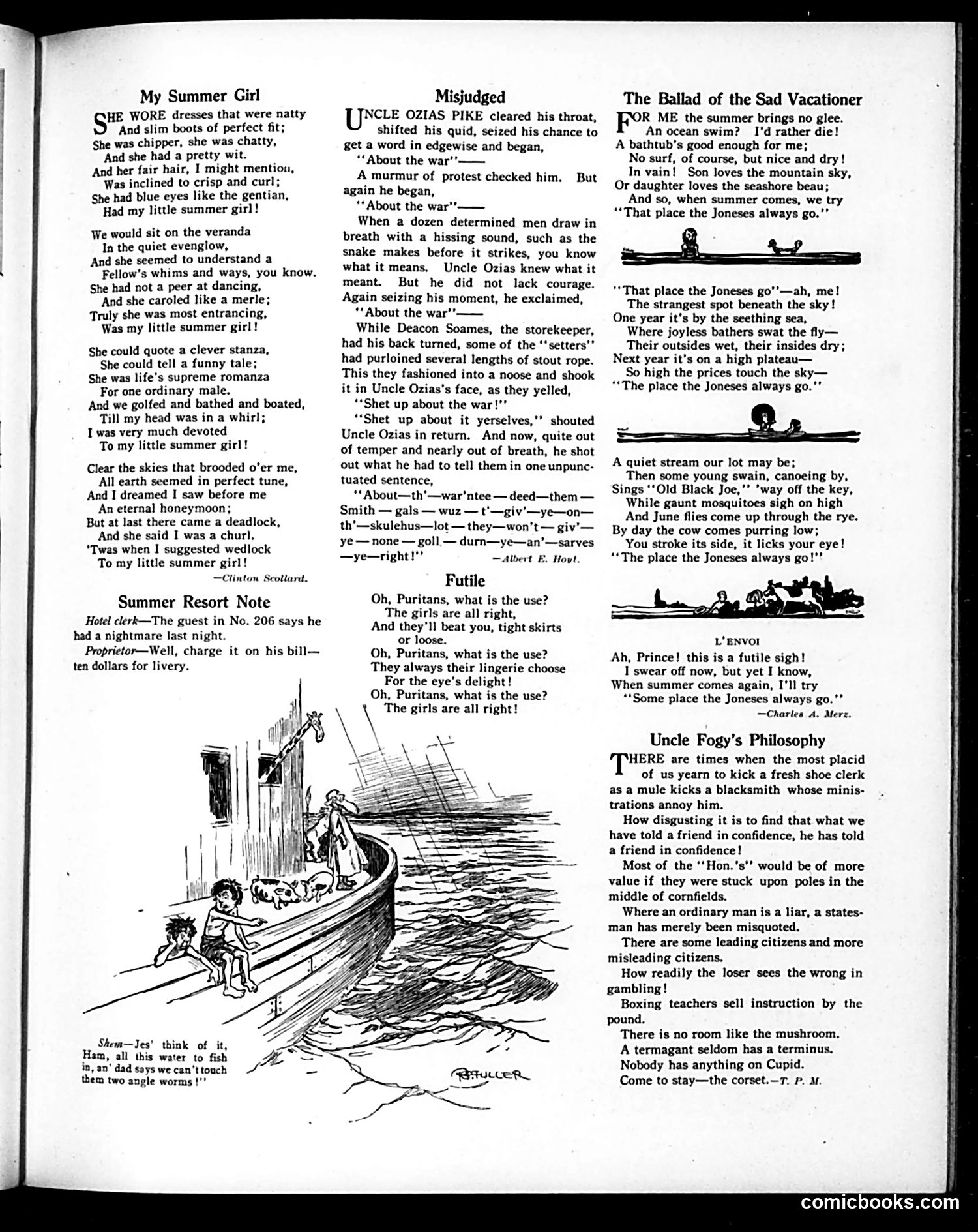
This page contains three satirical pieces reflecting early 20th-century American leisure and social anxieties: **"My Summer Girl"** (poem): A romantic narrative where a suitor falls for a charming woman during summer vacation, only to be rejected when he proposes marriage—satirizing the gap between vacation romance and real commitment. **"Misjudged"** (short story): Uncle Ozias Pike attempts to discuss war but is violently silenced by townsmen who fashion a noose, threatening him. The satire critiques small-town conformity and suppression of dissent, though the specific war referenced is unclear from the image alone. **"Futile"** (poem): Mocks Puritan attempts to restrict women's fashion, suggesting women will always choose attractive undergarments regardless of moral pressure—satirizing futile moral censorship. **"The Ballad of the Sad Vacationer"** (poem): Chronicles a reluctant family repeatedly visiting "where the Joneses go"—satirizing status-conscious vacation culture and keeping up with neighbors' expectations, despite uncomfortable accommodations. The page illustrates Judge's typical satire of American social conventions, romance, conformity, and class anxiety.
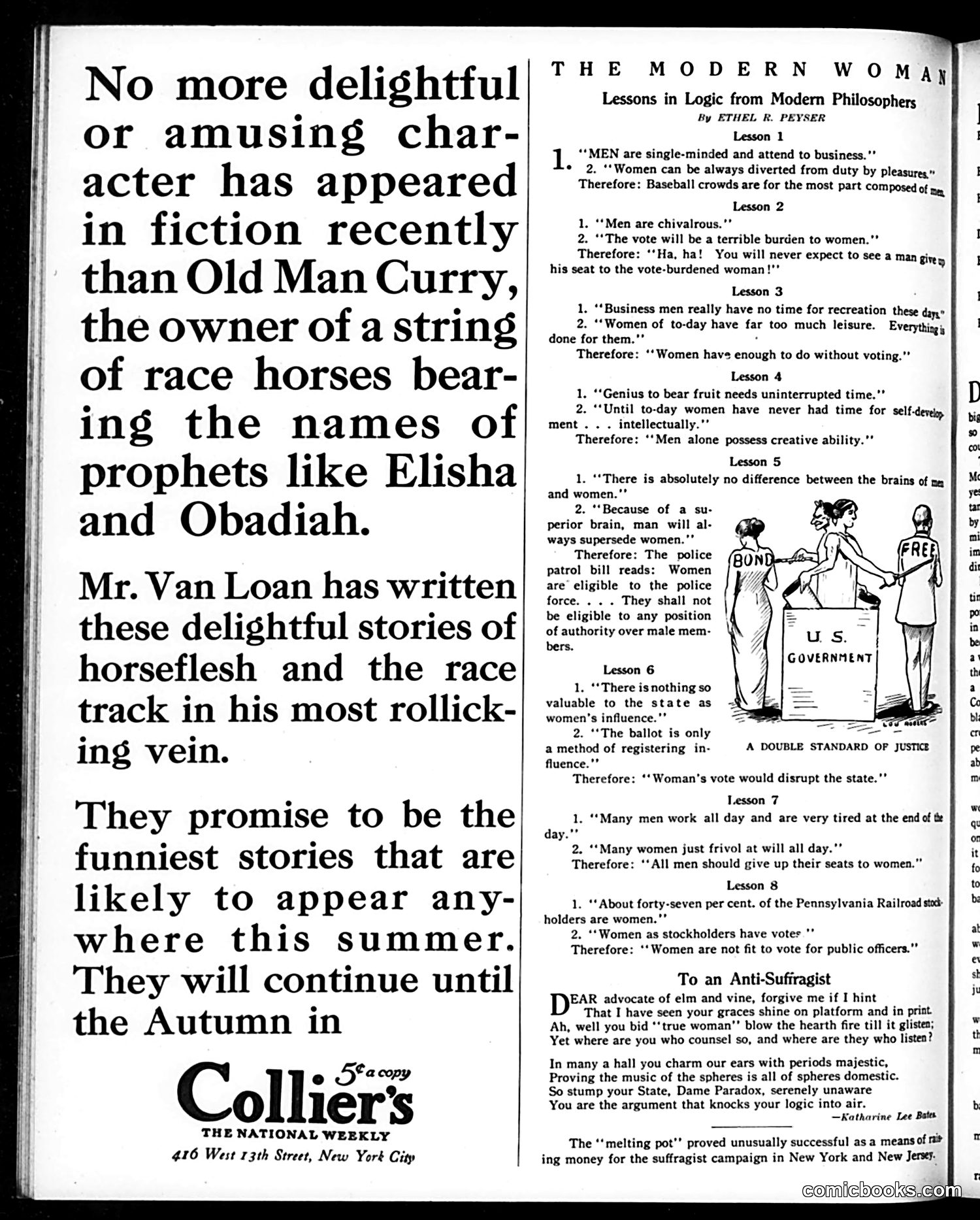
This page satirizes anti-suffrage arguments through deliberate logical fallacies. By Ethel R. Peyser, it deconstructs common claims used to oppose women's voting rights circa the suffrage era. Each "lesson" pairs contradictory premises to expose hypocrisy. For example: men allegedly need uninterrupted time for genius, yet women have never had such time—therefore only men possess creativity. Or: women's influence is invaluable to the state, but voting (merely registering influence) would disrupt it. The cartoon "A Double Standard of Justice" visually reinforces this theme, showing women being denied authority despite eligibility. The poem "To an Anti-Suffragist" by Katharine Lee Bates further mocks the contradiction: anti-suffrage advocates publicly argue women belong only at home, yet these same women appear on platforms advocating against women's rights—proving their own argument absurd. The satire targets the logical inconsistency of denying political participation to women while simultaneously praising women's intelligence and influence.
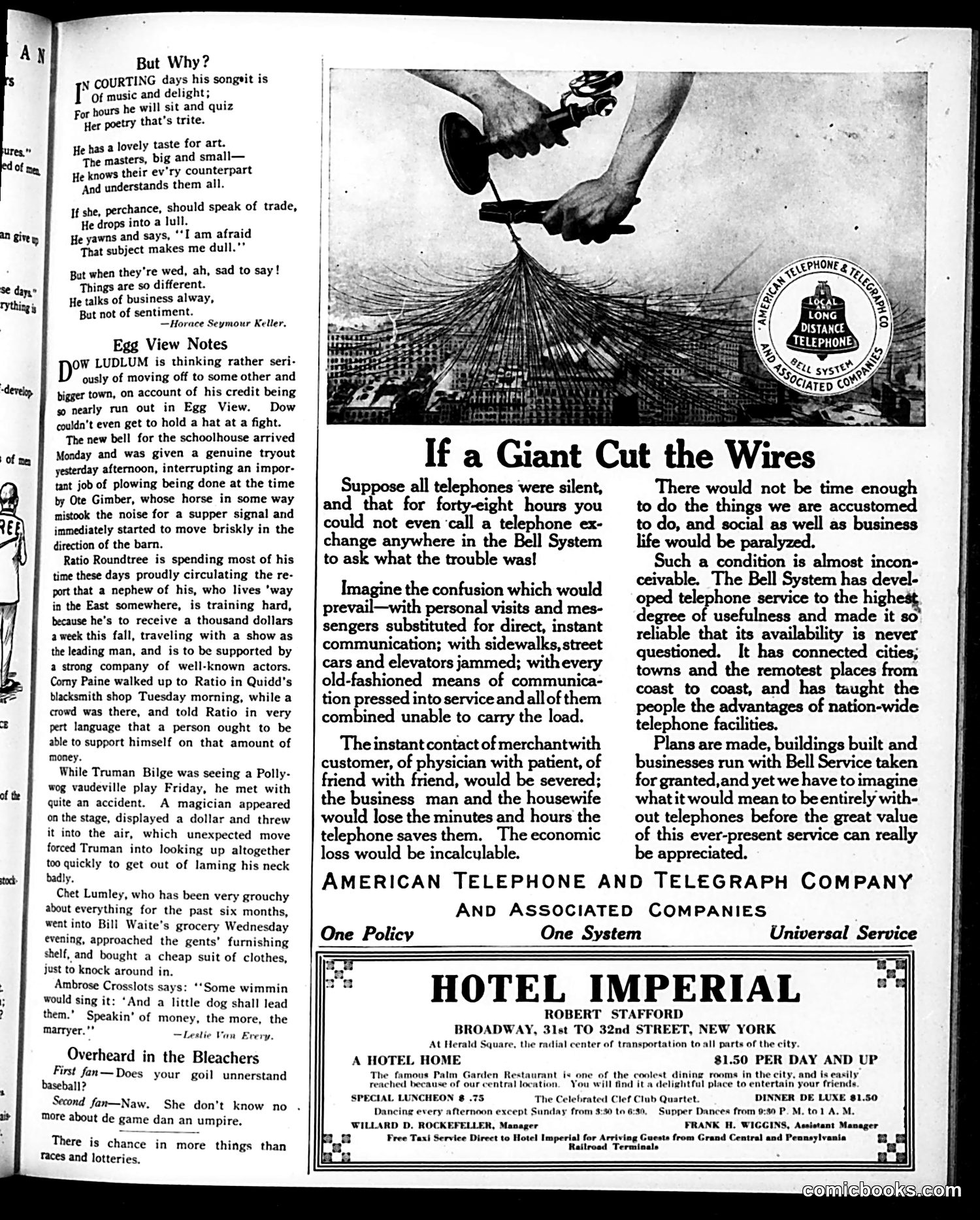
This Judge magazine page contains satirical humor alongside a corporate advertisement. **"But Why?"** is a romantic comedy poem mocking how men's behavior changes after marriage—they court women with artistic appreciation but become obsessed with business talk once wed. The satire targets male inconsistency and shallow romantic performance. **"Egg View Notes"** is small-town gossip humor featuring rural characters (Dow Ludlum, Ratio Roundtree, etc.) in comedic situations—a schoolhouse bell spooking a horse, a man injuring his neck watching a magic trick. This reflects Judge's frequent mockery of unsophisticated small-town life. **"If a Giant Cut the Wires"** is a full-page Bell Telephone advertisement disguised as editorial content. It presents a hypothetical catastrophe—48 hours without telephones—to argue that telephone service is indispensable to modern civilization. This is early corporate propaganda emphasizing infrastructure's importance, followed by a Hotel Imperial advertisement. The "giant" cutting wires likely references a popular idiom about sabotage or disaster.
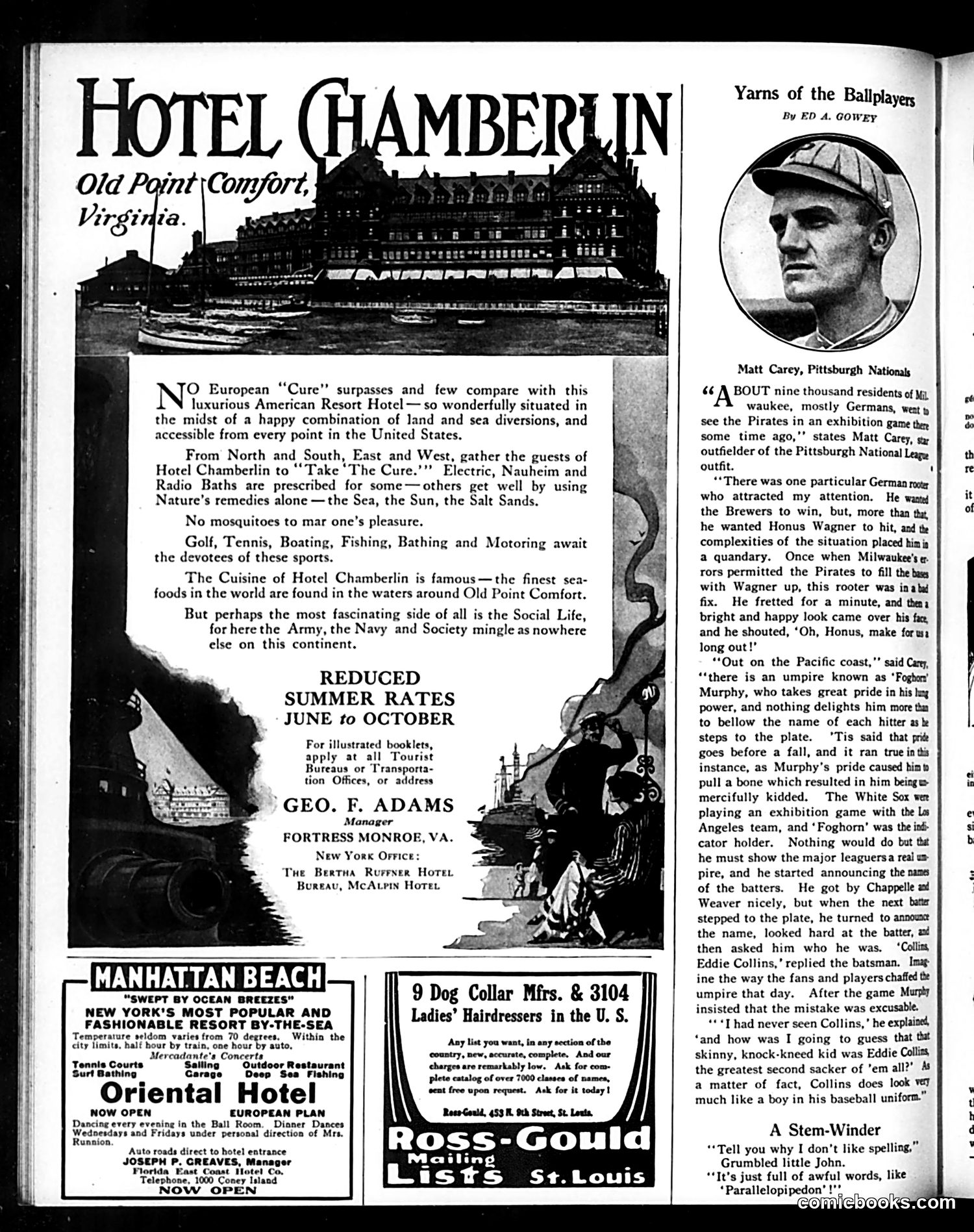
This page features a sports humor column by Ed A. Gowey about Matt Carey, an outfielder for the Pittsburgh Nationals. The column contains anecdotes about baseball personalities and fan behavior. **The Main Story:** A German immigrant in Milwaukee wants the local Brewers to win, but also wants star player Honus Wagner (a real Pirates player) to succeed—creating comic conflict. When Wagner comes to bat with bases loaded, the fan hopes for a "long out" to resolve his dilemma. **The Second Anecdote:** "Foghorn" Murphy, a prideful Pacific Coast umpire, embarrasses himself by not recognizing Eddie Collins (a real White Sox player) and asking his name at the plate. Murphy's overconfidence backfires when he cannot identify this "skinny, knock-kneed kid." **The Humor:** Both stories mock social pretension—the immigrant's divided loyalties and the umpire's inflated self-importance. The page is primarily advertising; the column illustrates early 20th-century baseball culture and immigrant perspectives.
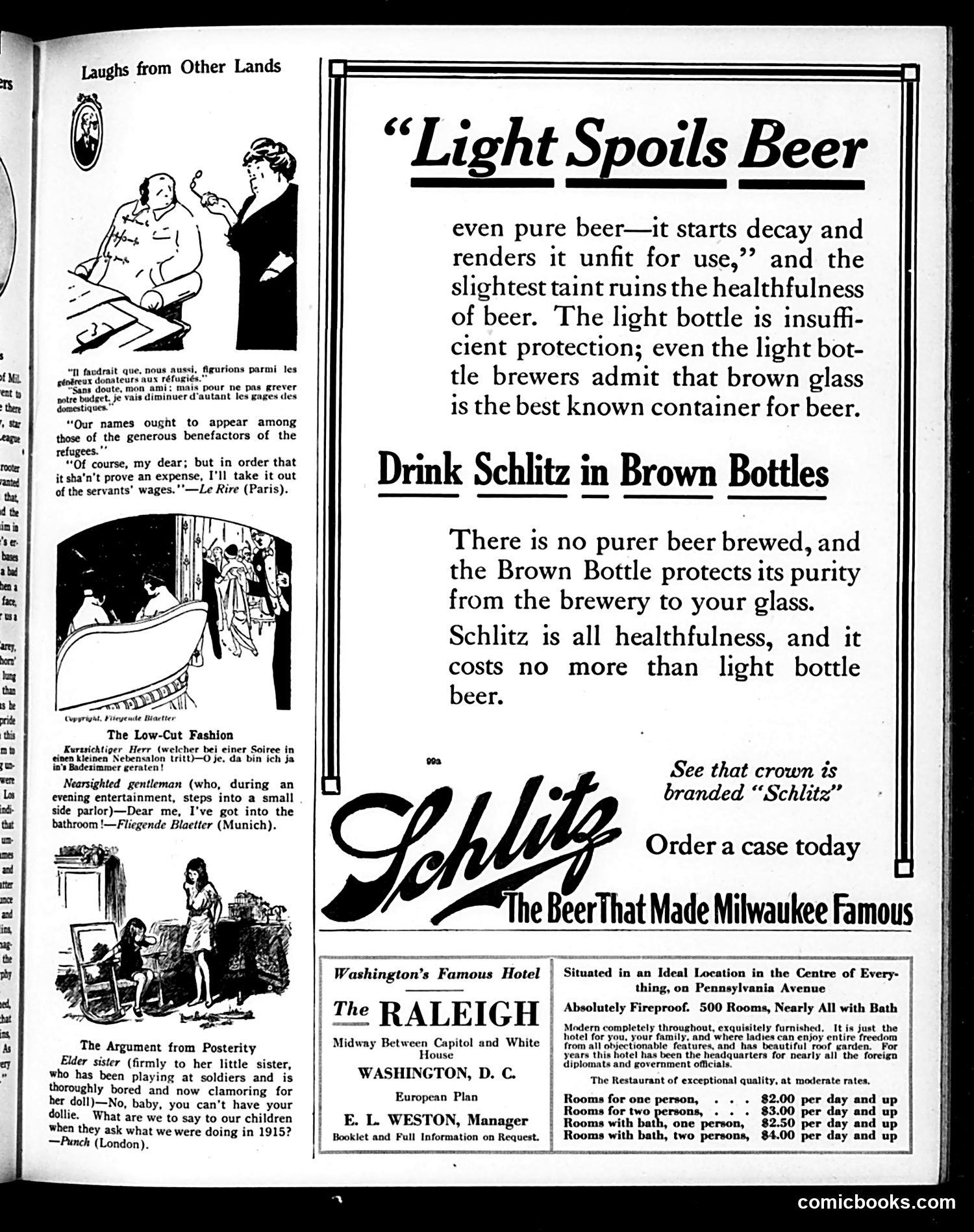
This page mixes international humor with advertising. The "Laughs from Other Lands" section reprints satirical cartoons from European publications: **Top cartoon (French source):** A wealthy man tells his sister they can afford refugee donations by cutting servants' wages—satirizing hypocritical philanthropy. **Middle cartoon (German source):** A nearsighted gentleman mistakes a parlor for a bathroom, likely commenting on women's fashions of the era (the "low-cut" reference suggests exposed décolletage was shocking enough to resemble undressing). **Bottom cartoon (British source):** An elder sister forbids her younger sibling her doll, claiming they must explain to future children what they were doing in 1915—a WWI-era reference, suggesting wartime sacrifice and duty to posterity. The page's dominant content is a full-page **Schlitz beer advertisement** claiming brown bottles preserve beer purity better than light bottles. This appears to be the magazine's primary revenue focus, with international humor serving as filler.
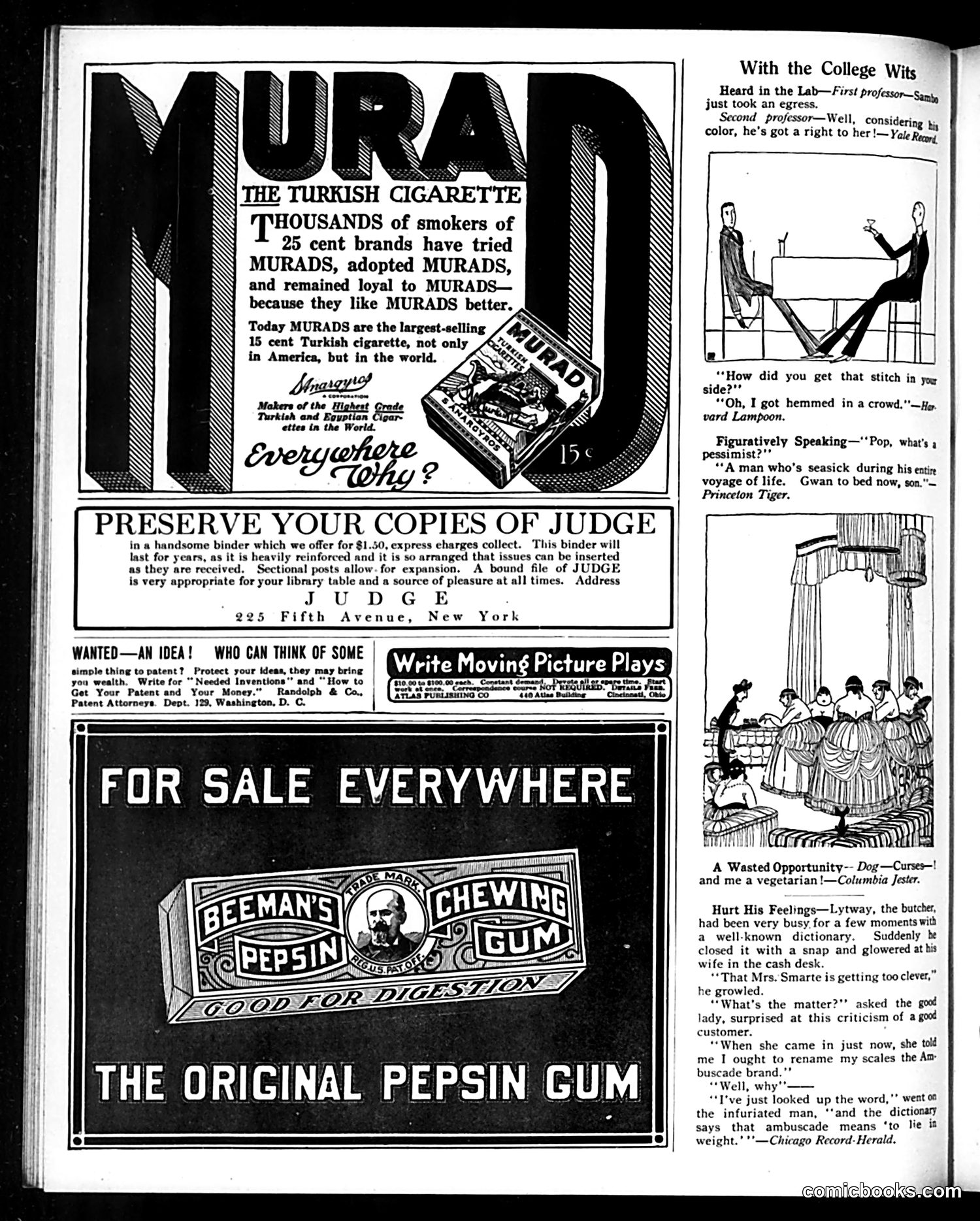
This page is primarily **advertising and humor content**, not political cartoons. The main advertisement promotes **Murads Turkish cigarettes**, claiming they're the best-selling 15-cent Turkish cigarette globally. The copy emphasizes brand loyalty among smokers switching from more expensive 25-cent brands—a marketing pitch targeting budget-conscious consumers. The right side features "**College Wits**"—humorous anecdotes from university humor magazines (Yale, Harvard, Princeton, Columbia). These are light jokes: a professor making a pun on "egress," a student getting hemmed in by crowds, a pessimist's metaphorical seasickness, and a butcher angered when a customer suggests renaming his scales "ambuscade" (which means "to lie in wait"—a pun on "weight"). The remaining ads include a Judge magazine binder offer, patent attorney services, and **Beeman's Pepsin Chewing Gum**. There is **no political satire** on this page—it's typical magazine filler combining advertisements with genteel collegiate humor popular in early 20th-century publications.
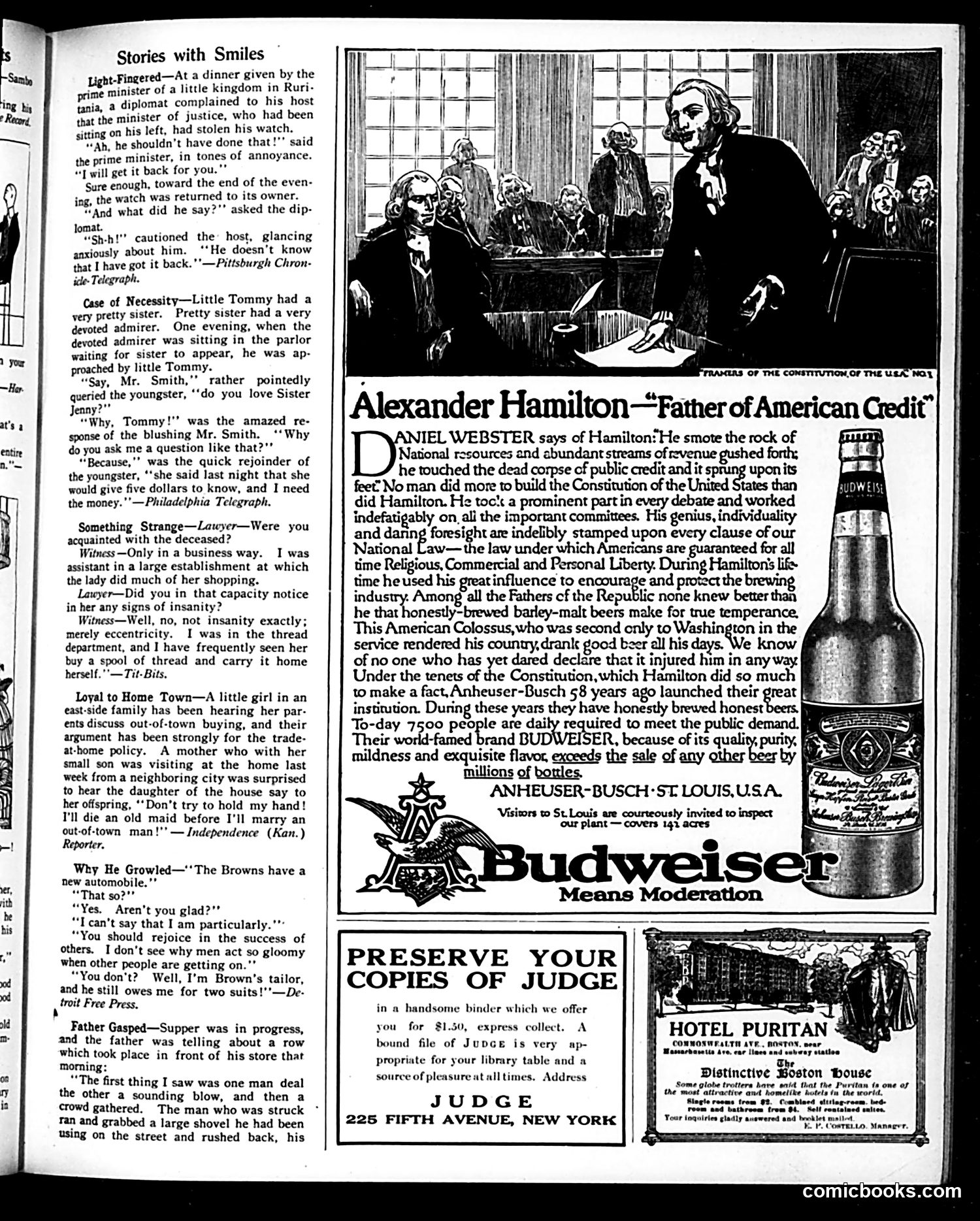
This page from *Judge* magazine contains several humorous short stories in its "Stories with Smiles" section, along with a significant advertisement for Budweiser beer. The main illustrated advertisement features Alexander Hamilton and includes a testimonial from Daniel Webster praising Hamilton's role in establishing American credit and the Constitution. The ad argues that just as Hamilton built the nation's financial foundation, Anheuser-Busch has built a great brewing institution over 58 years, producing quality beer ("Budweiser") that "exceeds the sale of any other beer by millions of bottles." The satire here is subtle: the ad elevates beer-brewing to the level of nation-building by drawing an analogy between Hamilton's constitutional genius and corporate industrial success. For modern readers, this represents early-20th-century American advertising's use of patriotic and historical rhetoric to market consumer products—conflating commerce with civic virtue. The short stories are conventional humor pieces about marital situations, business matters, and domestic life, featuring wordplay typical of the era's comic magazines.
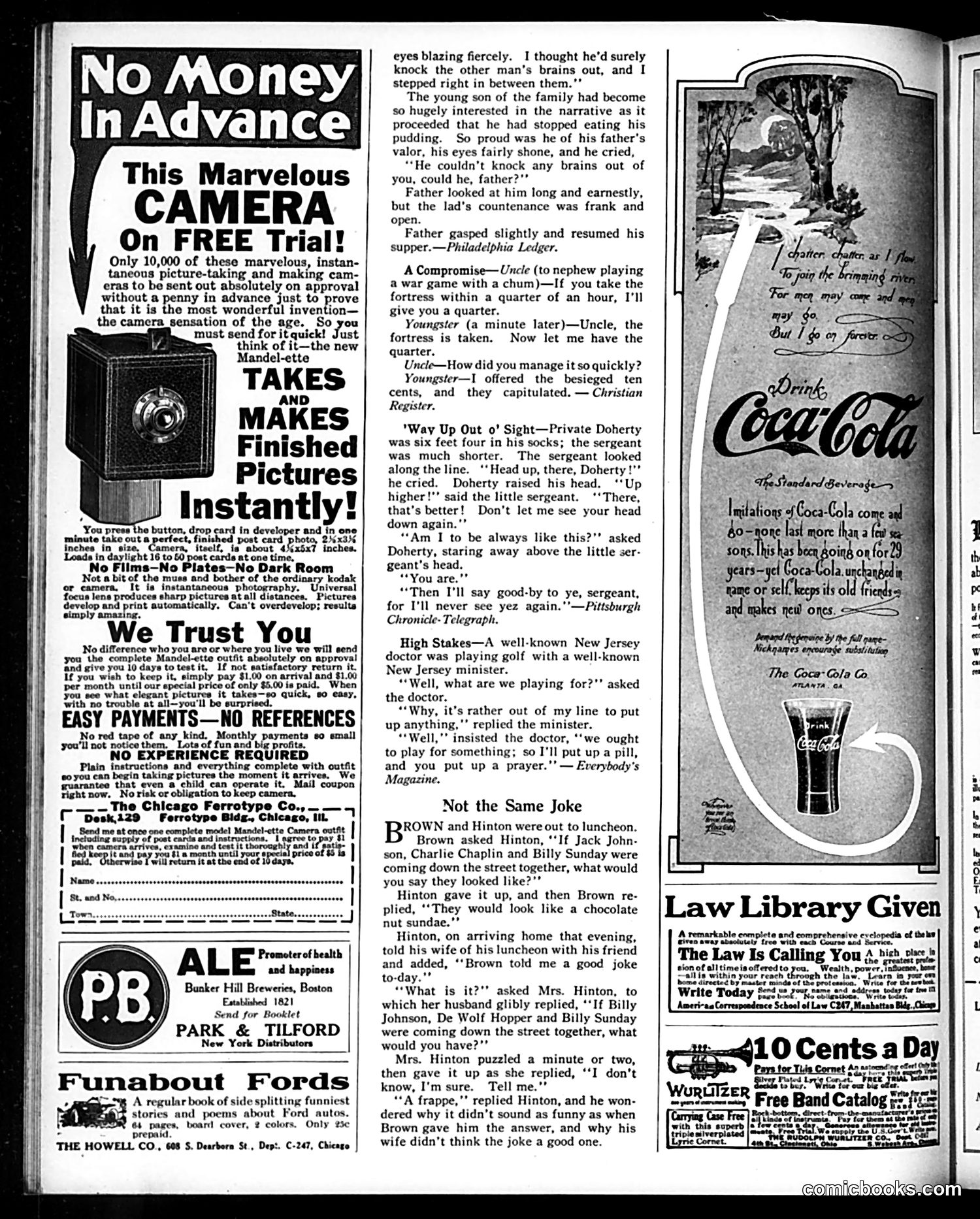
This page is primarily **advertising**, with several small humorous anecdotes in the text columns. The main advertisement promotes the "Mandel-ette" camera, offering it on free trial with easy monthly payments ($1.00 on arrival, then $1.00/month until $5.00 is paid). The pitch emphasizes instant picture-taking without darkroom chemicals—appealing to early 20th-century consumers wanting simplified photography. The brief jokes scattered throughout include: - A father embarrassed when his son innocently suggests he lacks brains - A nephew negotiating with a rival army in a war game, offering payment for surrender - A very tall soldier (Private Doherty) unable to see eye-level with his short sergeant These are generic humor pieces typical of Judge's style—gentle observations about domestic life, military hierarchy, and children's logic—rather than political satire. The other advertisements promote PB ale, Funabout Fords (a humorous book), Coca-Cola, and legal services, reflecting commercial magazine content of the era.
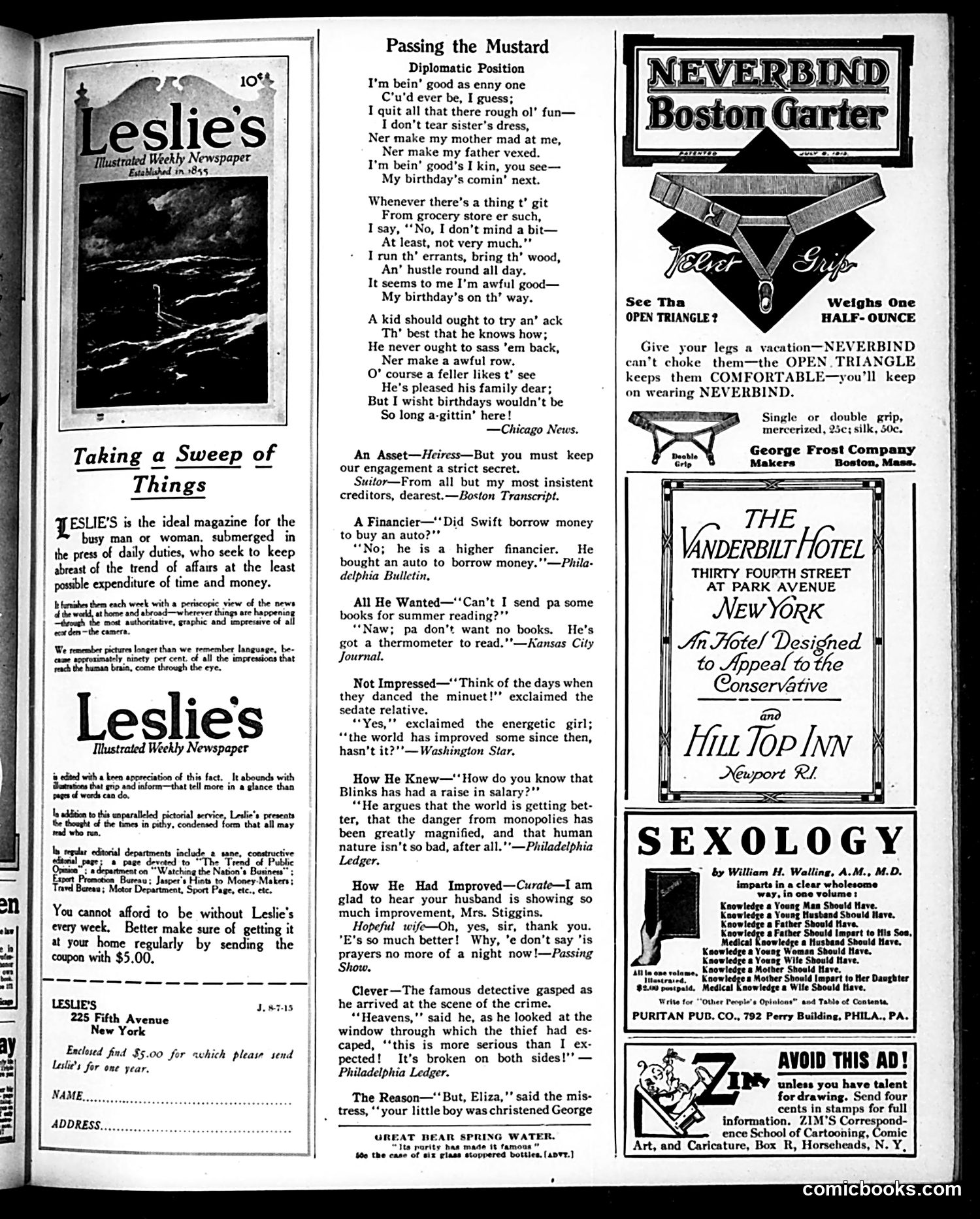
This page from *Judge* contains primarily **light humor and advertisements** rather than political satire. The main content piece, "Passing the Mustard," is a poem about childhood behavior—a child attempting to be well-behaved before his birthday, hoping for rewards. The satire here is domestic and gentle, mocking a child's transparent calculation that good behavior temporarily performed will secure parental gifts. The surrounding content consists of **short humorous anecdotes** addressing everyday situations (romantic engagements, financial dealings, domestic life) and **period advertising** for *Leslie's* magazine, the Neverbind garter, the Vanderbilt Hotel, and a book on sexuality. There's **no identifiable political content or caricature**. The page reflects early-20th-century middle-class concerns and products rather than significant satirical commentary.
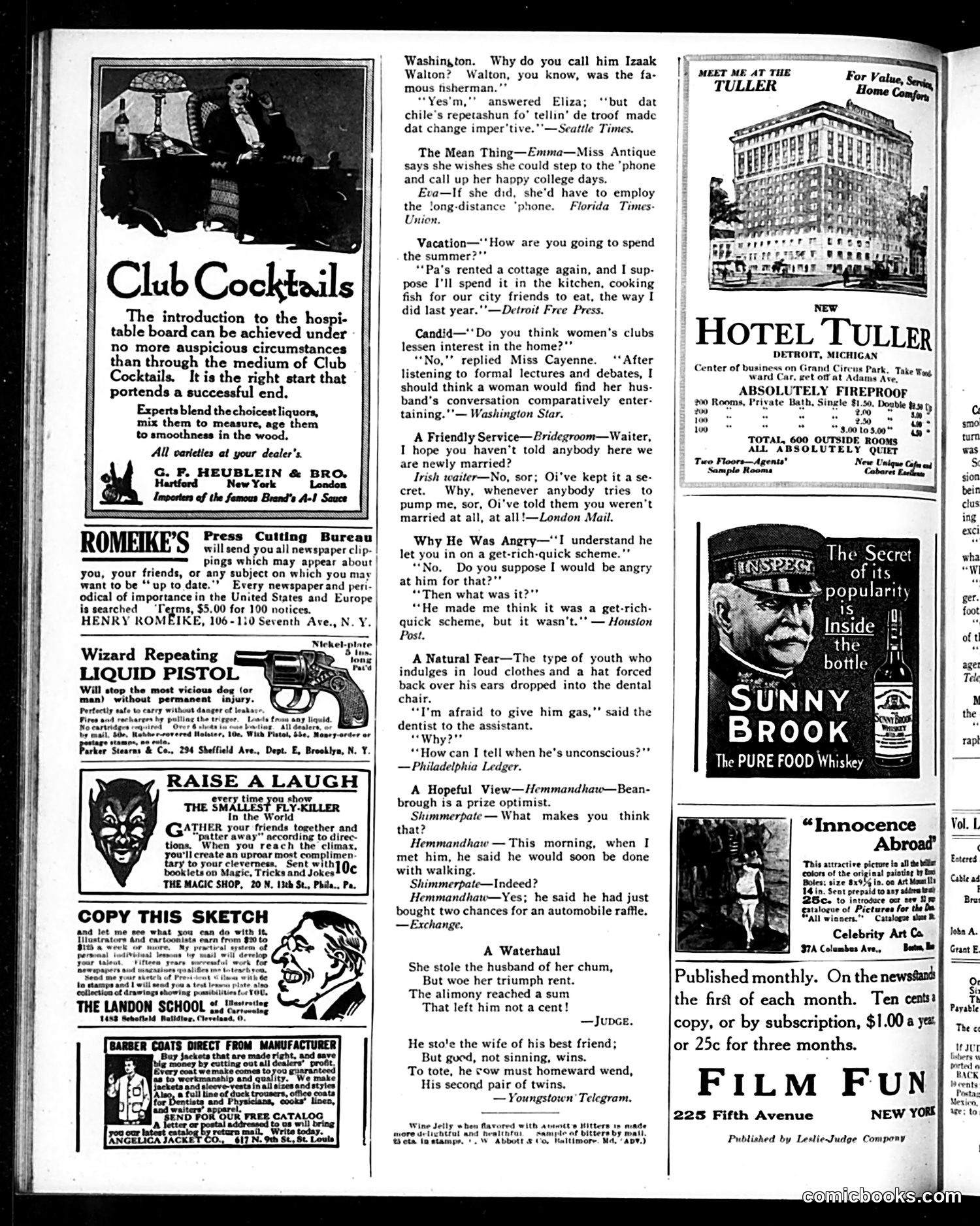
This page is primarily **advertising and humor vignettes** rather than political cartoons. The ads promote products like cocktail mixers, clipping bureaus, and novelty items ("Liquid Pistol" dog repellent, magic tricks). The humor pieces are brief jokes typical of early 20th-century magazines, mostly playing on **domestic and social situations**: women's college clubs versus homemaking, newlyweds, fishing stories, dental anxiety. One vignette uses a **racial dialect** (an African American character named Eliza), reflecting period conventions of offensive humor. The only potentially satirical content targets **women's education and feminism**—the "Candid" joke suggesting women's clubs make them dismissive of husbands' conversation. This reflects contemporary anxieties about women's changing roles. The page shows Judge as a magazine mixing serious satire with genteel social humor and heavy advertising, aimed at middle-class readers. Historical value lies in documenting period attitudes rather than sharp political commentary.
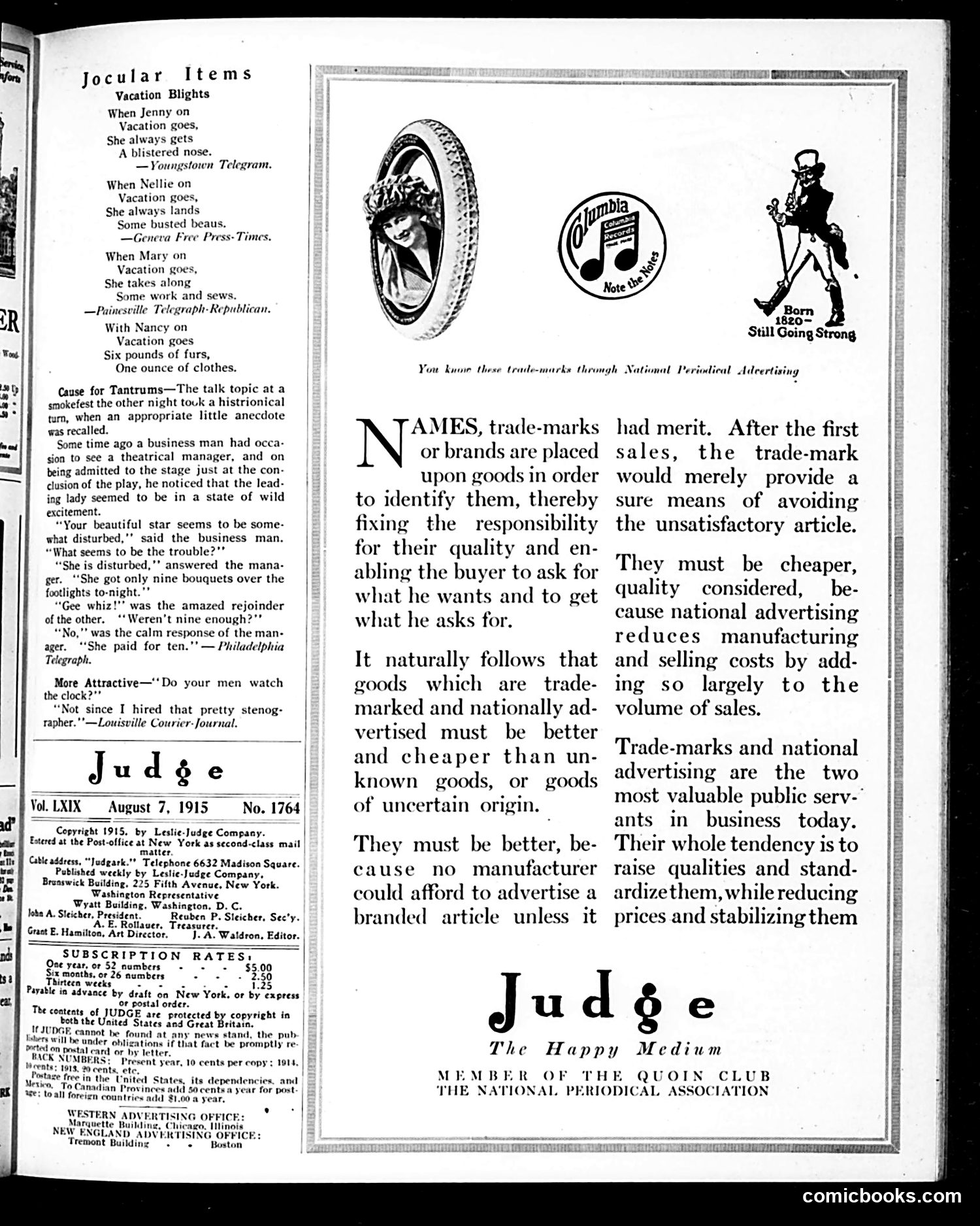
This page combines humor and advertising. The left column contains "Jocular Items"—brief jokes about vacation mishaps (sunburned noses, excessive luggage) and workplace observations (actresses demanding unearned bouquets, male employees distracted by attractive stenographers). These are light social satire reflecting early 20th-century middle-class anxieties. The right side is primarily a full-page advertisement promoting the value of trade-marks and national advertising. It argues that branded, nationally-advertised products must be superior and cheaper than unknown goods because manufacturers wouldn't risk advertising inferior items. The advertisement showcases recognizable brand logos (Columbia Records, 1820—Still Going Strong) as examples. This juxtaposition is itself revealing: *Judge* used humor to attract readers while relying on brand advertising revenue—demonstrating the exact commercial principle the advertisement promotes. The page illustrates how advertising shaped early 20th-century magazines.