
Judge, 1915-08-07 · page 7 of 28
Judge — August 7, 1915 — page 7: what you’re looking at
What you’re looking at
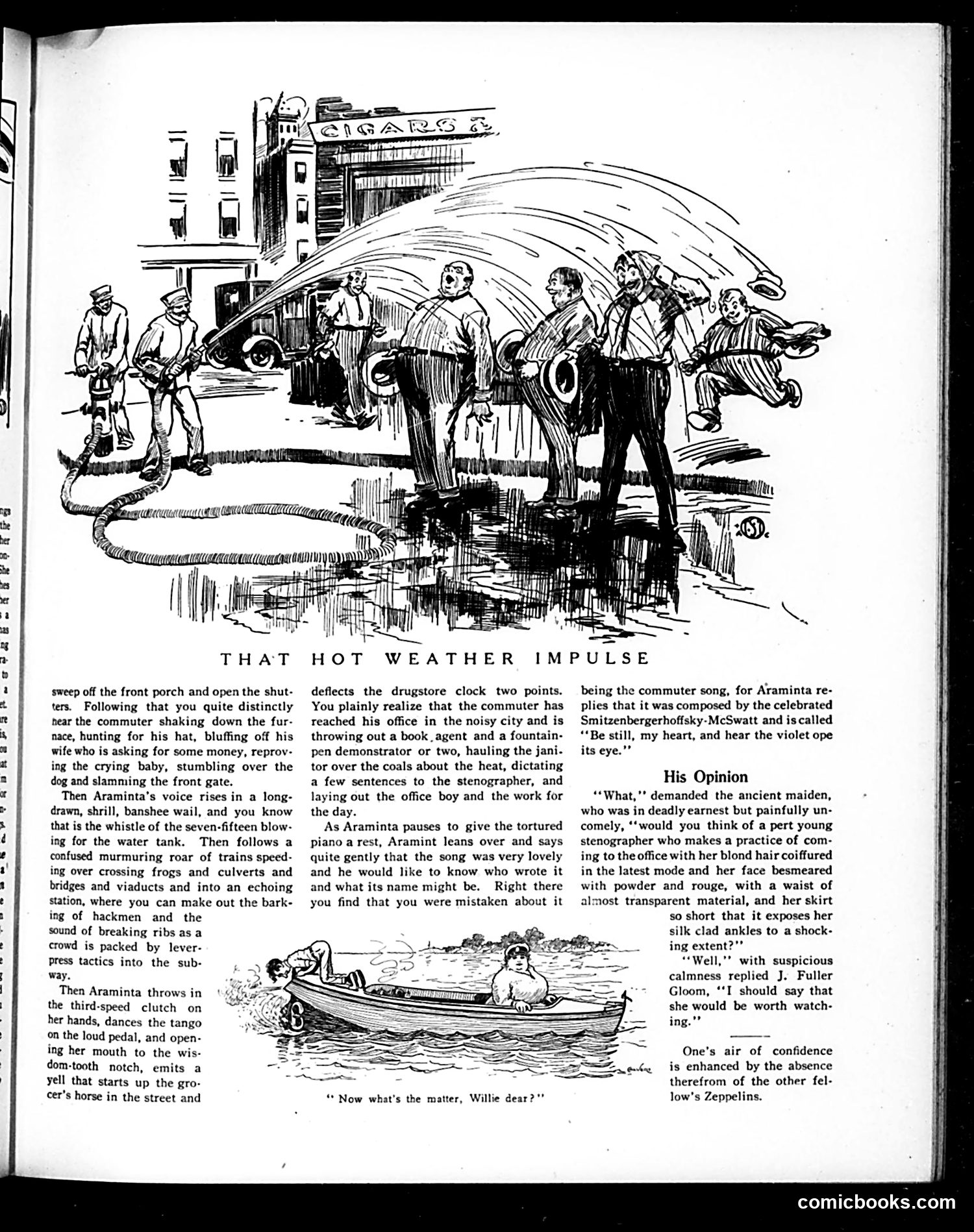
This page satirizes the early 20th-century urban commuter experience during summer heat. The top cartoon depicts a woman named Araminta playing piano so loudly that her performance literally vibrates through the neighborhood—the sound waves physically distort buildings and affect street activity. The joke is that her terrible piano-playing is so powerful it disrupts the entire city: it deflects a drugstore clock, startles horses, and somehow conveys what the commuter is experiencing miles away at his office. The accompanying text humorously catalogs the cacophony of urban summer life—furnaces, arguing spouses, crying babies, trains, subway crowds—all compressed into sensory overload. The lower cartoon and "His Opinion" section offers additional period humor about workplace propriety and gender, with conservative commentary on women's fashion and behavior in offices. Overall, the page mocks modern urban summer chaos and domestic disruption with exaggerated illustration.
📄 Transcribed text from this page (OCR, searchable)
Machine-transcribed from the original scan — historical spelling and the odd misread are preserved.
RGORPR RS Senarare CSTR E St Nt et NBS AT et St : a iI | Fares Al stomata My sweep off the front porch and open the shut- ters. Following that you quite distinctly hear the commuter shaking down the fur- nace, hunting for his hat, bluffing off his wife who is asking for some money, reprov- ing the crying baby, stumbling over the dog and slamming the front gate. Then Araminta’s voice rises in a long- drawn, shrill, banshee wail, and you know that is the whistle of the seven-fifteen blow- ing for the water tank. Then follows a confused murmuring roar of trains speed- ing over crossing frogs and culverts and bridges and viaducts and into an echoing station, where you can make out the bark- ing of hackmen and the sound of breaking ribs as a crowd is packed by lever- Press tactics into the sub- way. Then Araminta throws in the third-speed clutch on her hands, dances the tango on the loud pedal, and open- ing her mouth to the wis- dom-tooth notch, emits a yell that starts up the gro- cer’s horse in the street and ™ ie G deflects the drugstore clock two points. You plainly realize that the commuter has reached his office in the noisy city and is throwing out a book agent and a fountain- pen demonstrator or two, hauling the jani- tor over the coals about the heat, dictating a few sentences to the stenographer, and laying out the office boy and the work for the day. As Araminta pauses to give the tortured piano a rest, Aramint leans over and says quite gently that the song was very lovely and he would like to know who wrote it and what its name might be. Right there you find that you were mistaken about it “* Now what's the matter, Willie dear?"’ being the commuter song, for Araminta re- plies that it was composed by the celebrated Smitzenbergerhoffsky-McSwatt and is called “*Be still, my heart, and hear the violet ope its eye.’” His Opinion “*What,’* demanded the ancient maiden, who was in deadly earnest but painfully un- comely, ‘‘would you think of a pert young stenographer who makes a practice of com- ing to the office with her blond hair coiffured in the latest mode and her face besmeared with powder and rouge, with a waist of almost transparent material, and her skirt so short that it exposes her silk clad ankles to a shock- ing extent?’’ “Well”? with suspicious calmness replied J, Fuller Gloom, ‘‘I should say that she would be worth watch- ing.’” One’s air of confidence is enhanced by the absence therefrom of the other fel- low's Zeppelins. comicbooks.com