
Judge, 1915-08-07 · page 6 of 28
Judge — August 7, 1915 — page 6: what you’re looking at
What you’re looking at
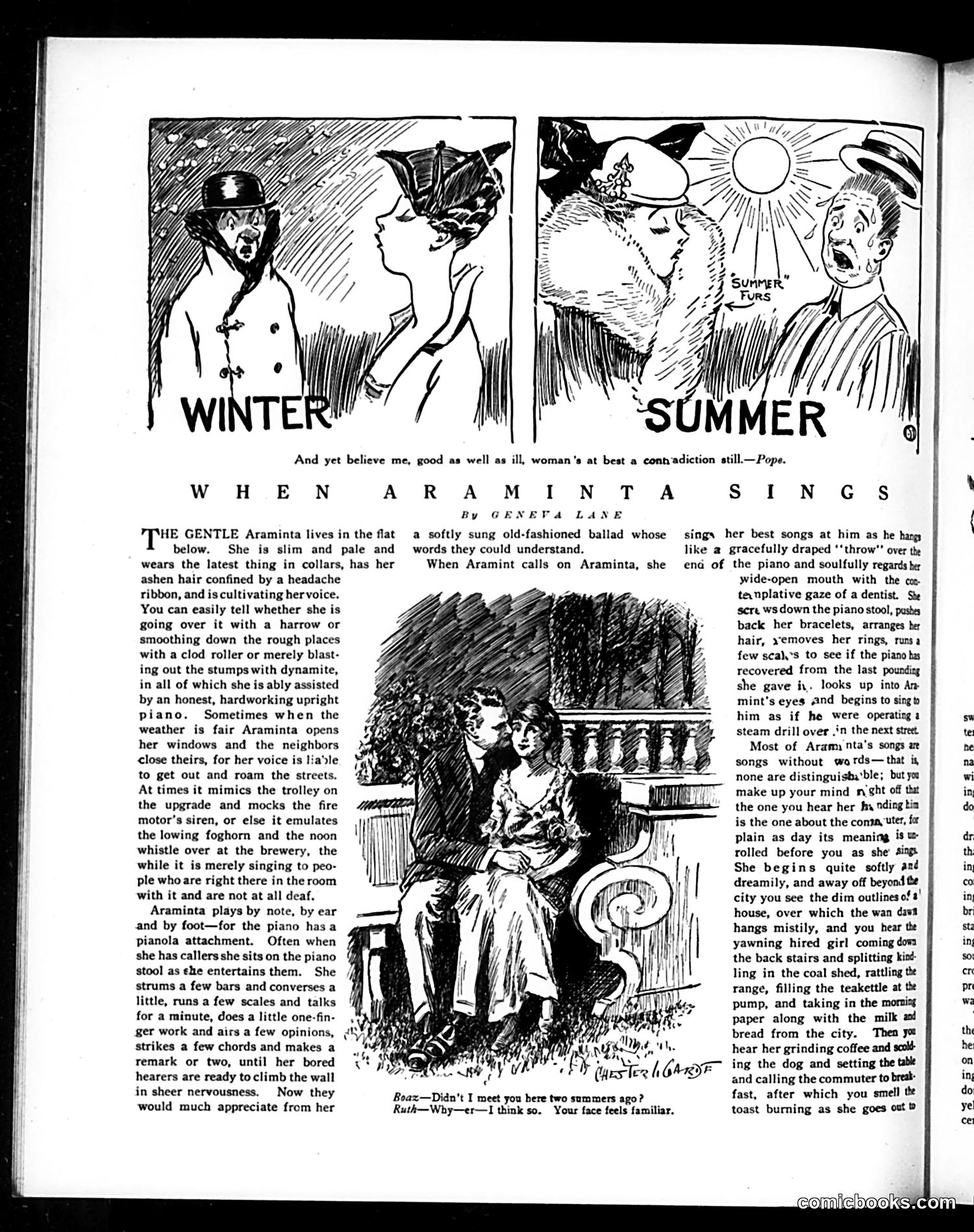
This is a satirical article about Araminta, an upper-class woman who plays piano and sings poorly. The satire targets the pretentious amateur musicianship of wealthy women in the early 20th century. **The joke:** Araminta performs constantly—with piano rolls, multiple playing styles, and elaborate vocal dramatics—yet her singing is unbearable. Neighbors close their windows; visitors are driven to nervous distraction. The article notes her songs are technically "without words" but convey an unintentionally vivid domestic narrative (a hired girl's morning routine, burnt toast) through sheer cacophony rather than artistry. **The social reference:** This mocks the period's expectation that educated, wealthy women cultivate "accomplishments" like music and singing, regardless of talent. The Pope epigraph about women's contradictions frames the entire critique. The cartoons at top contrast Araminta in **Winter** (stylish, proper) with **Summer** (apparently overheated), suggesting seasonal extremes in her behavior or appearance.
📄 Transcribed text from this page (OCR, searchable)
Machine-transcribed from the original scan — historical spelling and the odd misread are preserved.
TY agen), MAS And yet believe me, good as well as ill, woman's at best a contvadiction still.— Pope. W H EN HE GENTLE Araminta lives in the flat She is slim and pale and wears the latest thing in collars, has her below. ashen hair confined by a headache ribbon, and is cultivating her voice. You can easily tell whether she is going over it with a harrow or smoothing down the rough places with a clod roller or merely blast- ing out the stumps with dynamite, in all of which she is ably assisted by an honest, hardworking upright piano. Sometimes when the weather is fair Araminta opens her windows and the neighbors close theirs, for her voice is liadle to get out and roam the streets. At times it mimics the trolley on the upgrade and mocks the fire motor’s siren, or else it emulates the lowing foghorn and the noon whistle over at the brewery, the while it is merely singing to peo- ple who are right there in the room with it and are not at all deaf. Araminta plays by note, by ear and by foot—for the piano hasa Pianola attachment. Often when she has callers she sits on the piano stool as the entertains them. She //f strums a few bars and converses a little, runs a few scales and talks for a minute, does a little one-fin- ger work and airs a few opinions, strikes a few chords and makes a remark or two, until her bored hearers are ready to climb the wall in sheer nervousness. Now they would much appreciate from her A R A M I N T A By GENEVA LANE a softly sung old-fashioned ballad whose words they could understand. When Aramint calls on Araminta, she like a ena of 4 cen, th Boaz—Didn't I meet you here two summers ago? Ruth—Why—er—I think so. Your face feels familiar. S I N G § sings her best songs at him as he hangs gracefully draped ‘‘throw"’ over the the piano and soulfully regards her wide-open mouth with the coc. te.nplative gaze of a dentist. Ske sere ws down the piano stool, pushes back her bracelets, arranges her hair, emoves her rings, runsa few scah*s to see if the piano has recovered from the last pounding she gave ix. looks up into An mint’s eyes snd begins to sing» him as if he were operating a steam drill over .in the next street Most of Aram nta’s songs av songs without words— that is none are distinguisha'ble; but you make up your mind ght off tht the one you hear her fn nding tia is the one about the conmyuter, for plain as day its meaning is & rolled before you as she’ sings She begins quite softly and dreamily, and away off beyond te city you see the dim outlines ofa! house, over which the wan dat hangs mistily, and you hear the yawning hired girl coming dow the back stairs and splitting kin¢- ling in the coal shed, rattling th range, filling the teakettle at the pump, and taking in the morisg paper along with the milk ad bread from the city. Then yu hear her grinding coffee and scold ing the dog and setting the table and calling the commuter to brea- fast, after which you smell tt toast burning as she goes out @