
Judge, 1915-08-07 · page 27 of 28
Judge — August 7, 1915 — page 27: what you’re looking at
What you’re looking at
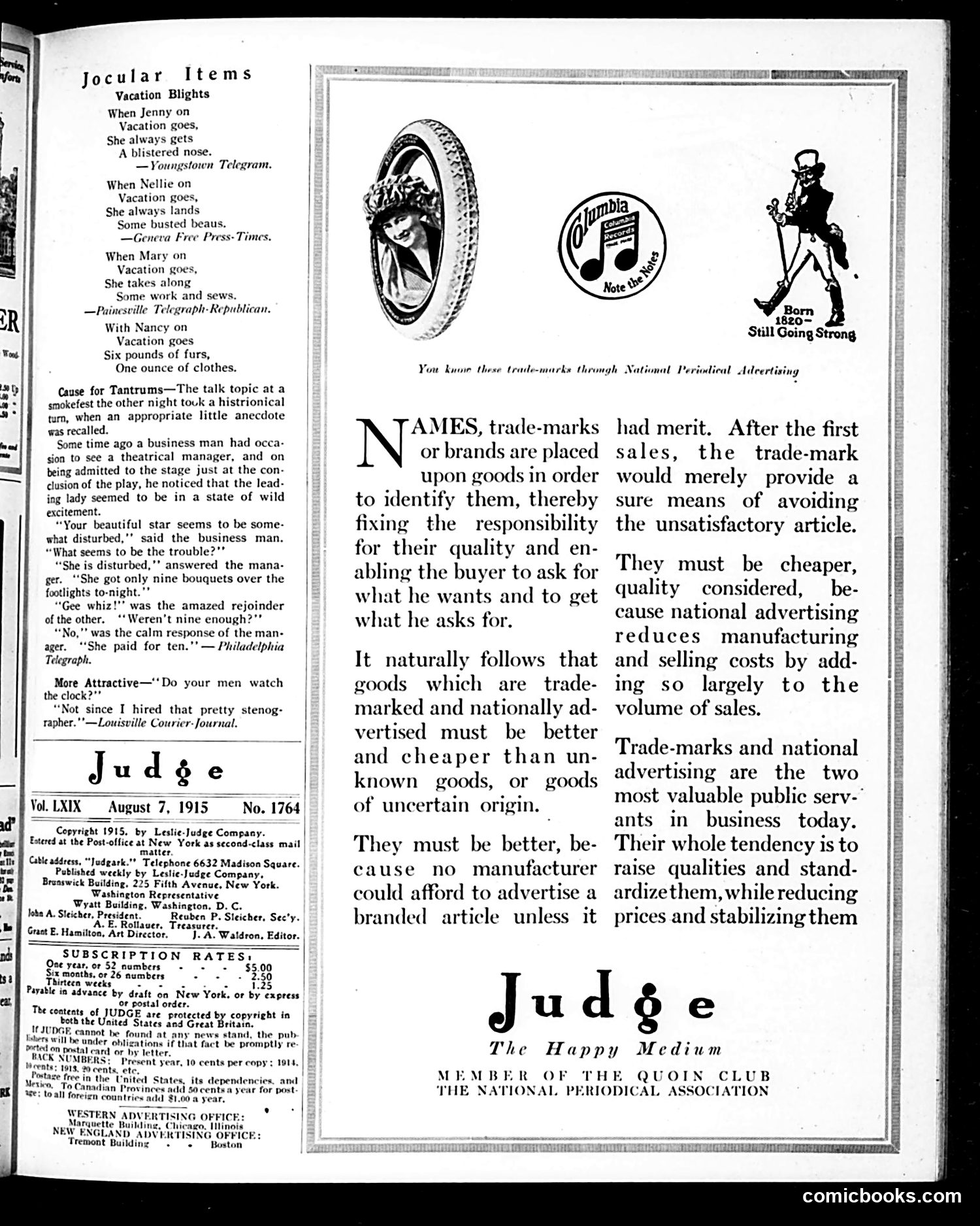
This page combines humor and advertising. The left column contains "Jocular Items"—brief jokes about vacation mishaps (sunburned noses, excessive luggage) and workplace observations (actresses demanding unearned bouquets, male employees distracted by attractive stenographers). These are light social satire reflecting early 20th-century middle-class anxieties. The right side is primarily a full-page advertisement promoting the value of trade-marks and national advertising. It argues that branded, nationally-advertised products must be superior and cheaper than unknown goods because manufacturers wouldn't risk advertising inferior items. The advertisement showcases recognizable brand logos (Columbia Records, 1820—Still Going Strong) as examples. This juxtaposition is itself revealing: *Judge* used humor to attract readers while relying on brand advertising revenue—demonstrating the exact commercial principle the advertisement promotes. The page illustrates how advertising shaped early 20th-century magazines.
📄 Transcribed text from this page (OCR, searchable)
Machine-transcribed from the original scan — historical spelling and the odd misread are preserved.
Jocular Items Vacation Blights When Jenny on Vacation goes, She always gets A blistered nose. Some busted bea —Geneva Free Press- When Mary on Vacation goes, along ork and sews, —Painesville Telegraph: Republican. With Nancy on Vacation goes Six pounds of furs, One ounce of clothes. Cause for Tantrums—The talk topic at a smokefest the other night touk a histrionical tum, when an appropriate little anecdote was recalled. Some time ago a business man had occa- sion to see a theatrical manager, and on being admitted to the stage just at the con- clusion of the play, he noticed that the lead- | ing lady seemed to be in a state of wild excitement. “Your beautiful star seems to be some- what disturbed,’’ said the business man. “What seems to be the trouble?’’ “She is disturbed,’’ answered the mana- ger. ‘‘She got only nine bouquets over the footlights to-night."" “Gee whiz!'’ was the amazed rejoinder of the other. ‘‘Weren’t nine enough?"’ “No,"’ was the calm response of the man- ager. ‘‘She paid for ten.’’ — Philadelphia Telegraph. i fe More Attractive—‘Do your men watch the clock?"’ “Not since I hired that pretty stenog- | rapher.""—Louisville Courier-Journal. Judge | VoL XIX August 7, 1915 No. 1764 Copyright 1915. by Lestie-Judge Company. | Estered at the Post-office at New York as second-class mail | matter, Cable address, “Judgark."* Telephone 6632 Madison Square. Published weekly by Leslie-Judge Company, Broaswick Building, 225 Fifth Avenue, New York. Washington Representative Wyatt Building, Washington, D.C. Joba A. Steicher, President. Reuben P. Sleicher. Sec'y. . E. Rollauer, Treasurer. Gnet E. Hamilton, Art Director. J. A. Waldron. Editor. SUBSCRIPTION RATES: Qee year, or 52 numbers = - - $5.00 Six months, or 26 numbers + + + 250 Payatytirtee weeks me = 125 | ‘avatle in advance by draft on New York. or by express 8 of E are protected by copyright in h the United States aod Great Britains | Jat any news stand, the pub- that fact be promptly re- re & Passe - 8IF Ls Weents: 1913, 29 cent. ae Postaze free in the United Metieo, To Canadian Province We: toall foreign countrie F, 10 cents per copy: 1914, | M NEW D ‘Tremont Buildi Boston 1820— Still Going Strong You know these trade-marks through National Periodical Adcertising AMES, trade-marks or brands are placed upon goods in order to identify them, thereby fixing the responsibility for their quality and en- abling the buyer to ask for what he wants and to get what he asks for. It naturally follows that goods which are trade- marked and nationally ad- vertised must be better and cheaper than un- known goods, or goods of uncertain origin. They must be better, be- cause no manufacturer could afford to advertise a branded article unless it had merit. After the first sales, the trade-mark would merely provide a sure means of avoiding the unsatisfactory article. They must be cheaper, quality considered, _ be- cause national advertising reduces manufacturing and selling costs by add- ing so largely to the volume of sales. Trade-marks and national advertising are the two most valuable public serv-" ants in business today. Their whole tendency is to raise qualities and stand- ardizethem, while reducing prices and stabilizing them Judge The MEMBER OF Happy THE Medium QUOIN CLUB THE NATIONAL PERIODICAL ASSOCIATION comicbooks.com eee B |] | |] E