
Judge, 1915-08-07 · page 17 of 28
Judge — August 7, 1915 — page 17: what you’re looking at
What you’re looking at
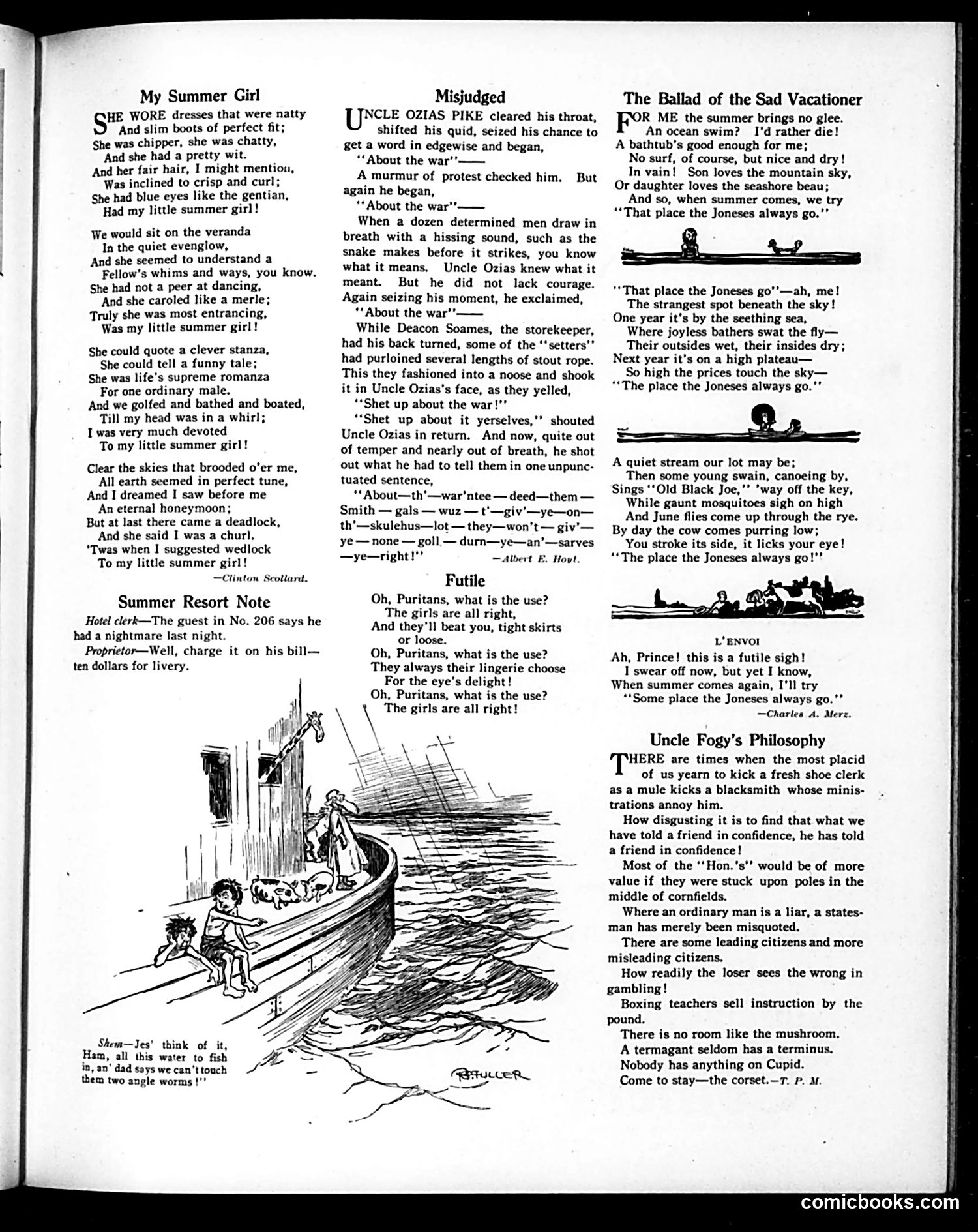
This page contains three satirical pieces reflecting early 20th-century American leisure and social anxieties: **"My Summer Girl"** (poem): A romantic narrative where a suitor falls for a charming woman during summer vacation, only to be rejected when he proposes marriage—satirizing the gap between vacation romance and real commitment. **"Misjudged"** (short story): Uncle Ozias Pike attempts to discuss war but is violently silenced by townsmen who fashion a noose, threatening him. The satire critiques small-town conformity and suppression of dissent, though the specific war referenced is unclear from the image alone. **"Futile"** (poem): Mocks Puritan attempts to restrict women's fashion, suggesting women will always choose attractive undergarments regardless of moral pressure—satirizing futile moral censorship. **"The Ballad of the Sad Vacationer"** (poem): Chronicles a reluctant family repeatedly visiting "where the Joneses go"—satirizing status-conscious vacation culture and keeping up with neighbors' expectations, despite uncomfortable accommodations. The page illustrates Judge's typical satire of American social conventions, romance, conformity, and class anxiety.
📄 Transcribed text from this page (OCR, searchable)
Machine-transcribed from the original scan — historical spelling and the odd misread are preserved.
My Summer Girl HE WORE dresses that were natty S And slim boots of perfect fit; She was chipper, she was chatty, And she had a pretty wit. And her fair hair, I might mention, Was inclined to crisp and curl; She had blue eyes like the gentian, Had my little summer girl! We would sit on the veranda In the quiet evenglow, And she seemed to understand a Fellow’s whims and ways, you know. She had not a peer at dancing, And she caroled like a merle; Truly she was most entrancing, Was my little summer girl! She could quote a clever stanza, She could tell a funny tale; She was life’s supreme romanza For one ordinary male. And we golfed and bathed and boated, Till my head was in a whirl; I was very much devoted To my little summer girl! Clear the skies that brooded o'er me, All earth seemed in perfect tune, And I dreamed I saw before me An eternal honeymoon; But at last there came a deadlock, And she said I was a churl. ‘Twas when I suggested wedlock To my little summer girl! —Clinton Scollard, Summer Resort Note Hotel clerk—The guest in No. 206 says he had a nightmare last night. Proprietor—Well, charge it on his bill— ten dollars for livery. Shem—Jes’ think of it, Ham, all this water to fish in, an’ dad says we can't touch them two angle worms !"* Misjudged NCLE OZIAS PIKE cleared his throat, shifted his quid, seized his chance to get a word in edgewise and began, “*About the war’’—— A murmur of protest checked him. But again he began, ‘About the war’’—— When a dozen determined men draw in breath with a hissing sound, such as the snake makes before it strikes, you know what it means. Uncle Ozias knew what it meant. But he did not lack courage. Again seizing his moment, he exclaimed, “*About the war’’—— While Deacon Soames, the storekeeper, had his back turned, some of the ‘‘setters’’ had purloined several lengths of stout rope. This they fashioned into a noose and shook it in Uncle Ozias’s face, as they yelled, ‘*Shet up about the war!"* “*Shet up about it yerselves,"’ shouted Uncle Ozias in return. And now, quite out of temper and nearly out of breath, he shot out what he had to tell them in one unpunc- tuated sentence, “‘ About—th'—war'ntee — deed—them — Smith — gals — wuz — t’—giv’—ye—on— th’—skulehus—lot — they—won't — giv’— ye — none — goll — durn—ye—an'’—sarves —ye—right!"" —Albert E. Hovt. Futile Oh, Puritans, what is the use? The girls are all right, And they'll beat you, tight skirts or loose. Oh, Puritans, what is the use? They always their lingerie choose For the eye’s delight! Oh, Puritans, what is the use? \ \ The girls are all right! \aie\ | \ The Ballad of the Sad Vacationer Fe ME the summer brings no glee. An ocean swim? I'd rather die! A bathtub’s good enough for me; No surf, of course, but nice and dry! In vain! Son loves the mountain sky, Or daughter loves the seashore beau; And so, when summer comes, we try “That place the Joneses always go.’’ a we “That place the Joneses go’’—ah, me! The strangest spot beneath the sky! One year it's by the seething sea, Where joyless bathers swat the fly— Their outsides wet, their insides dry; Next year it's on a high plateau— So high the prices touch the sky— “The place the Joneses always go."’ ae A quiet stream our lot may be; Then some young swain, canoeing by, Sings ‘Old Black Joe,'’ ’way off the key, While gaunt mosquitoes sigh on high And June flies come up through the rye. By day the cow comes purring low; You stroke its side, it licks your eye! “The place the Joneses always go!"’ EF L’ENVOI Ah, Prince! this is a futile sigh! I swear off now, but yet I know, When summer comes again, I'll try **Some place the Joneses always go.'’ —Charles A, Merz. Uncle Fogy’s Philosophy (THERE are times when the most placid of us yearn to kick a fresh shoe clerk as a mule kicks a blacksmith whose minis- trations annoy him. How disgusting it is to find that what we have told a friend in confidence, he has told a friend in confidence! Most of the ‘‘Hon.’s’’ would be of more value if they were stuck upon poles in the middle of cornfields. Where an ordinary man is a liar, a states- man has merely been misquoted. There are some leading citizens and more misleading citizens. How readily the loser sees the wrong in gambling! Boxing teachers sell instruction by the pound. There is no room like the mushroom. A termagant seldom has a terminus. Nobody has anything on Cupid. Come to stay—the corset.—T. P. Mf. comicbooks.com