
Judge, 1915-08-07 · page 10 of 28
Judge — August 7, 1915 — page 10: what you’re looking at
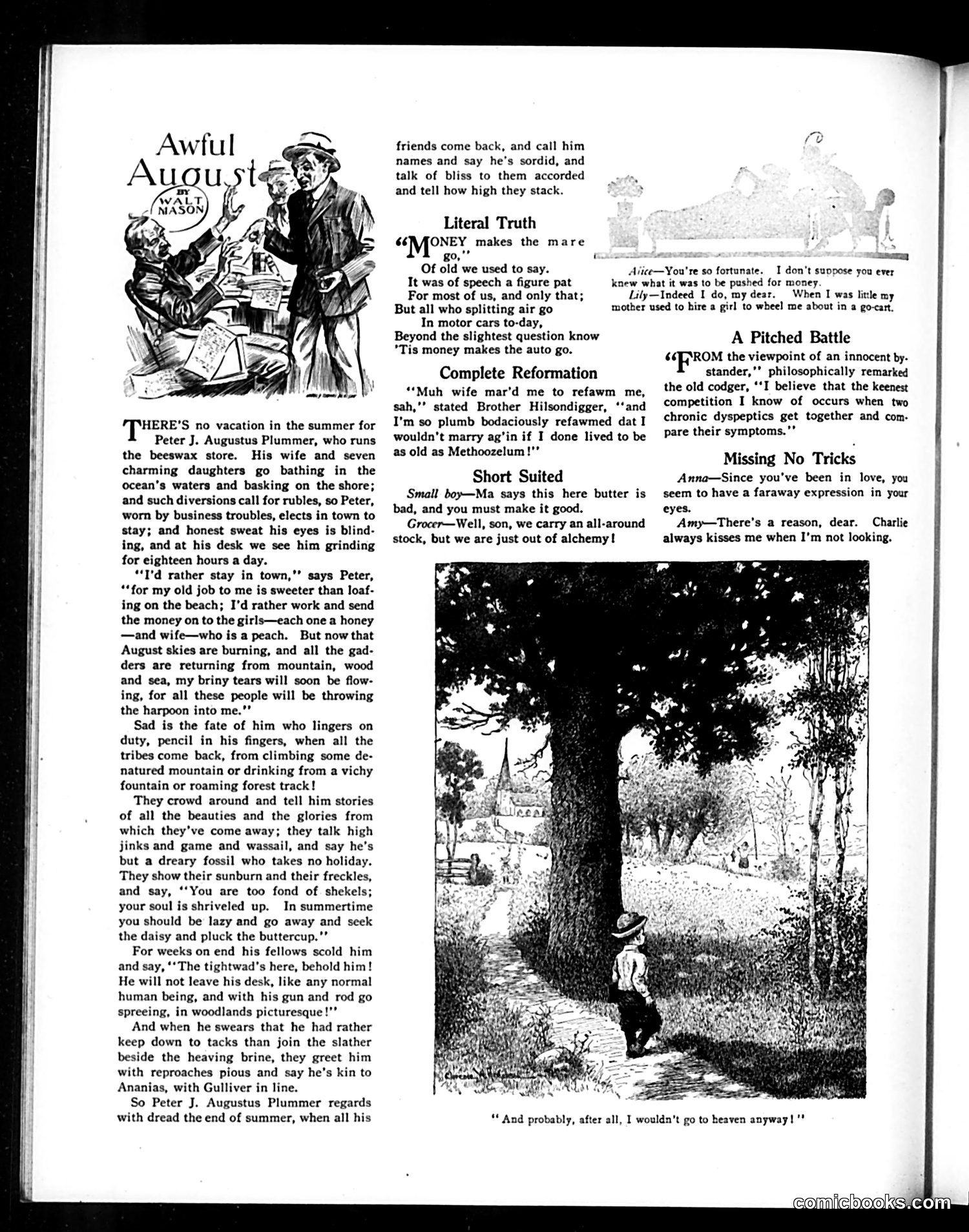
What you’re looking at
This page satirizes the social pressure of summer vacation culture among the American middle class. The main story concerns **Peter J. Augustus Plummer**, a beeswax store owner forced to remain working while his wife and seven daughters vacation at the beach. The satire targets two contradictory social anxieties: the expectation to spend money on leisure ("shekels"), yet the shame of prioritizing work over vacation. Upon their return, Plummer's friends mock him as stingy and soulless, comparing him to biblical miser Ananias. The joke critiques how summer leisure had become a status marker—those who vacationed displayed sunburns and stories; those who worked were deemed unambitious. The page also contains brief comic vignettes mocking other social pretenses: a grocer's inability to improve bad butter, and romantic clichés about love and attention. The overall tone reflects fin-de-siècle anxieties about American consumerism and the performative nature of leisure.
📄 Transcribed text from this page (OCR, searchable)
Machine-transcribed from the original scan — historical spelling and the odd misread are preserved.
'HERE’S no vacation in the summer for Peter J. Augustus Plummer, who runs the beeswax store. His wife and seven charming daughters go bathing in the ocean’s waters and basking on the shore; and such diversions call for rubles, so Peter, worn by business troubles, elects in town to stay; and honest sweat his eyes is blind- ing, and at his desk we see him grinding for eighteen hours a day. “I'd rather stay in town,’’ says Peter, “for my old job to me is sweeter than loaf- ing on the beach; I'd rather work and send the money on to the girls—each one a honey —and wife—who is a peach. But now that August skies are burning, and all the gad- ders are returning from mountain, wood and sea, my briny tears will soon be flow- ing, for all these people will be throwing the harpoon into me."’ Sad is the fate of him who lingers on duty, pencil in his fingers, when all the tribes come back, from climbing some de- natured mountain or drinking from a vichy fountain or roaming forest track! They crowd around and tell him stories of all the beauties and the glories from which they've come away; jinks and game and wassa' but a dreary fossil who takes no holiday. They show their sunburn and their freckles, and say, ‘‘You are too fond of shekels; your soul is shriveled up. In summertime you should be lazy and go away and seek the daisy and pluck the buttercup.’’ For weeks on end his fellows scold him and say, ‘*The tightwad's here, behold him! He will not leave his desk, like any normal human being, and with his gun and rod go spreeing, in woodlands picturesque!" And when he swears that he had rather keep down to tacks than join the slather beside the heaving brine, they greet him with reproaches pious and say he’s kin to Ananias, with Gulliver in line. So Peter J. Augustus Plummer regards with dread the end of summer, when all his friends come back, and call him names and say he’s sordid, and talk of bliss to them accorded and tell how high they stack. Literal Truth 66QYJONEY makes the mare go,” Of old we used to say. It was of speech a figure pat For most of us, and only that; But all who splitting air go In motor cars to-day, Beyond the slightest question know ’Tis money makes the auto go. Complete Reformation “*Muh wife mar'd me to refawm me, sah,’’ stated Brother Hilsondigger, ‘‘and I'm so plumb bodaciously refawmed dat I wouldn't marry ag’in if I done lived to be as old as Methoozelum!'" Short Suited Small boy—Ma says this here butter is bad, and you must make it good. Grocer—Well, son, we carry an all-around stock, but we are just out of alchemy! Alice—You' re so fortunate. knew what it was to be pushed for money. Lily—Indeed I do, my dear. mother used to hire a girl to wheel me about in a go-cart, I don’t suppose you ever When I was litle my A Pitched Battle 66]Q.ROM the viewpoint of an innocent by- stander,’’ philosophically remarked the old codger, ‘‘I believe that the keenest competition I know of occurs when two chronic dyspeptics get together and com. pare their symptoms.’’ Missing No Tricks Anna—Since you've been in love, you seem to have a faraway expression in your eyes. Amy—There’s a reason, dear. Charlie always kisses me when I'm not looking. Cod &