
Judge, 1915-08-07 · page 4 of 28
Judge — August 7, 1915 — page 4: what you’re looking at
What you’re looking at
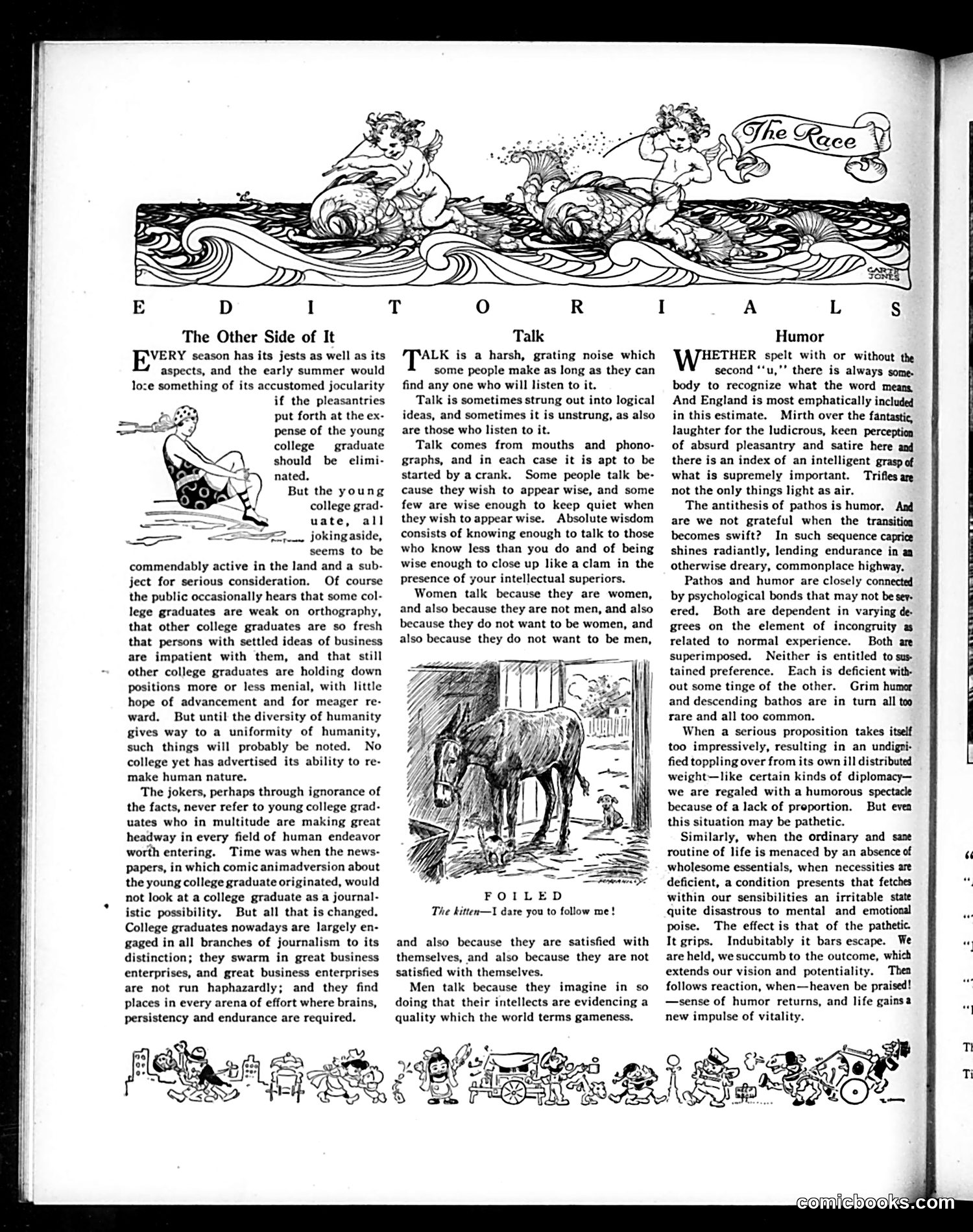
This page contains three humorous essays about social behavior ("The Other Side of It," "Talk," and "Humor"), accompanied by decorative illustrations rather than political cartoons. The main illustration shows a horse that has kicked over a bucket, captioned "Foiled—I can you to follow me!" This appears to be a visual pun supporting the essay on "Talk"—the horse's stubborn refusal to follow illustrates the human tendency to resist persuasion through talk alone. The essays critique college graduates' pretentiousness, excessive talkativeness (particularly women's), and the role of humor in society. The content is social satire rather than political commentary, aimed at early 20th-century American attitudes toward education, gender, and etiquette.
📄 Transcribed text from this page (OCR, searchable)
Machine-transcribed from the original scan — historical spelling and the odd misread are preserved.
The Other Side of It ‘VERY season has its jests as well as its aspects, and the early summer would loze something of its accustomed jocularity if the pleasantries put forth at the ex- pense of the young college graduate should be elimi- nated. But the young college grad- uate, all joking aside, seems to be commendably active in the land and a sub- ject for serious consideration. Of course =, the public occasionally hears that some col- lege graduates are weak on orthography, that other college graduates are so fresh that persons with settled ideas of business are impatient with them, and that still other college graduates are holding down positions more or less menial, with little hope of advancement and for meager re- ward. But until the diversity of humanity gives way to a uniformity of humanity, such things will probably be noted. No college yet has advertised its ability to re- make human nature. The jokers, perhaps through ignorance of the facts, never refer to young college grad- uates who in multitude are making great headway in every field of human endeavor worth entering. Time was when the news- papers, in which comic animadversion about the young college graduate originated, would not look at a college graduate as a journal- istic possibility. But all that is changed. College graduates nowadays are largely en- gaged in all branches of journalism to its distinction; they swarm in great business enterprises, and great business enterprises are not run haphazardly; and they find places in every arena of effort where brains, persistency and endurance are required. ‘ALK is a harsh, grating noise which some people make as long as they can find any one who will listen to it. Talk is sometimes strung out into logical ideas, and sometimes it is unstrung, as also are those who listen to it. Talk comes from mouths and phono- graphs, and in each case it is apt to be started by acrank. Some people talk be- cause they wish to appear wise, and some few are wise enough to keep quiet when they wish to appear wise. Absolute wisdom consists of knowing enough to talk to those who know less than you do and of being wise enough to close up like a clam in the presence of your intellectual superiors. Women talk because they are women, and also because they are not men, and also because they do not want to be women, and also because they do not want to be men, The kitten—I dare you to follow me! and also because they are satisfied with themselves, and also because they are not satisfied with themselves. Men talk because they imagine in so doing that their intellects are evidencing a quality which the world terms gameness, WHETHER spelt with or without the second ‘‘u,’’ there is always some. body to recognize what the word means And England is most emphatically included in this estimate. Mirth over the fantastic, laughter for the ludicrous, keen perception of absurd pleasantry and satire here and there is an index of an intelligent grasp of what is supremely important. Trifles are not the only things light as air. The antithesis of pathos is humor, And are we not grateful when the transition becomes swift? In such sequence caprice shines radiantly, lending endurance in an otherwise dreary, commonplace highway, Pathos and humor are closely connected by psychological bonds that may not be sey- ered. Both are dependent in varying de- grees on the element of incongruity as related to normal experience. Both are superimposed. Neither is entitled to sus tained preference. Each is deficient with- out some tinge of the other. Grim humor and descending bathos are in turn all too rare and all too common. When a serious proposition takes itself too impressively, resulting in an undigni- fied toppling over from its own ill distributed weight—like certain kinds of diplomacy— we are regaled with a humorous spectacle because of a lack of preportion. But even this situation may be pathetic. Similarly, when the ordinary and sane routine of life is menaced by an absence of wholesome essentials, when necessities are deficient, a condition presents that fetches within our sensibilities an irritable state quite disastrous to mental and emotional poise. The effect is that of the pathetic. It grips. Indubitably it bars escape. We are held, we succumb to the outcome, which extends our vision and potentiality. Then follows reaction, when—heaven be praised! —sense of humor returns, and life gainsa new impulse of vitality.