
A complete issue · 28 pages · 1915
Judge — July 31, 1915
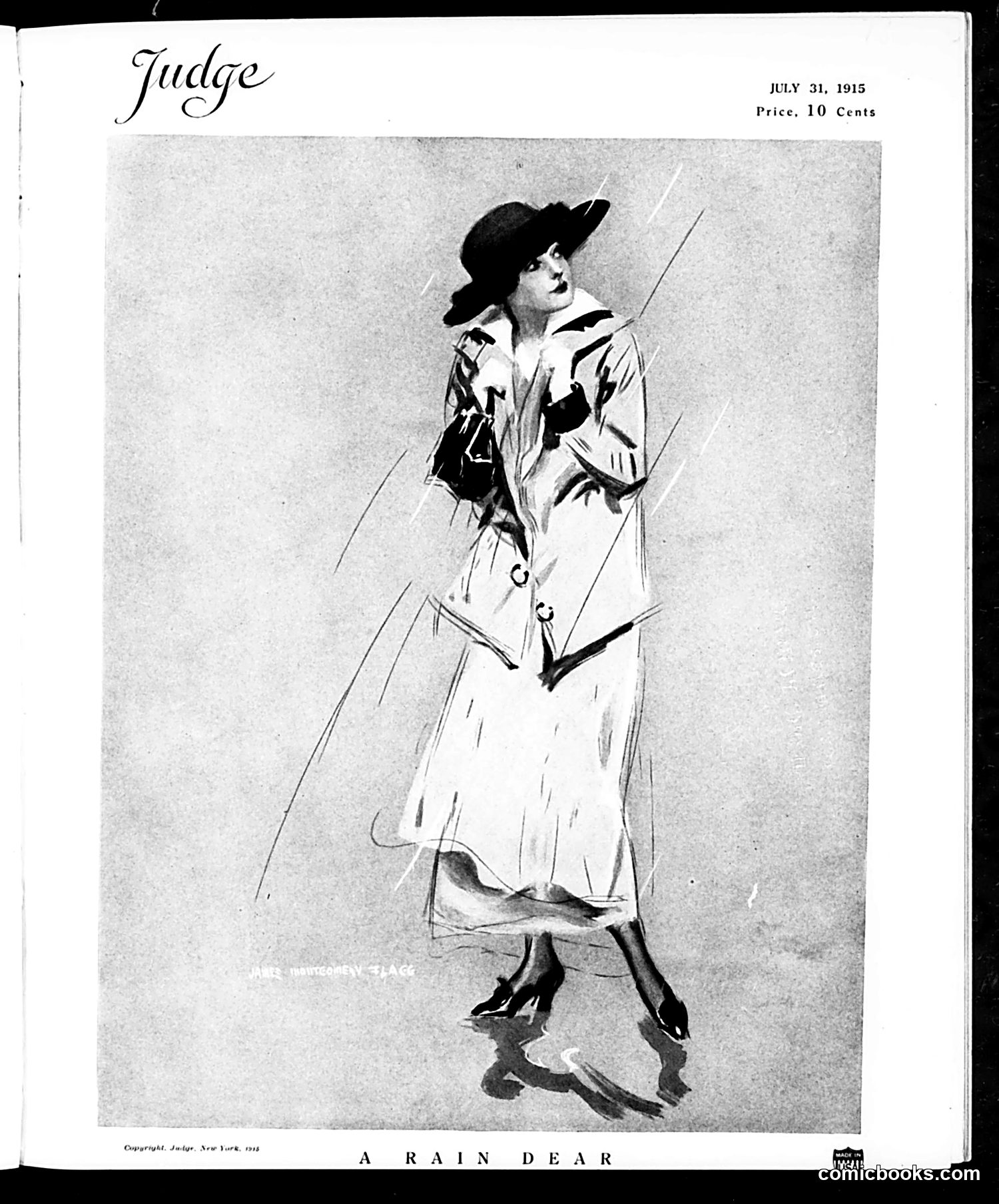
This July 31, 1915 Judge magazine cover presents a fashion illustration titled "A Rain Dear" — a visual pun playing on "rainwear" (rain gear/clothing). The image depicts a stylishly dressed woman in rain attire: a long coat, wide-brimmed hat, and heeled shoes, posed against diagonal lines suggesting rainfall. The satire appears to mock the pretension of making raingear fashionable and attractive despite its purely functional purpose. The woman's elegant posture and sophisticated styling contrast humorously with the practical necessity of protecting oneself from rain — suggesting that even mundane protective clothing could be marketed as high fashion to female consumers. This reflects early 20th-century satirical commentary on women's fashion industry practices and consumer culture.

This page is primarily an advertisement rather than editorial content. It advertises Columbia Records' double-disc records priced at 65 cents, emphasizing that they "fit your machine." The ad features the Columbia Graphophone Company logo and lists their New York headquarters (Box G-445, Woolworth Building) and Toronto office address. The messaging suggests this is from an era when phonograph machines were becoming common household items, and record compatibility was a selling point—different manufacturers used different formats. The advertisement targets consumers concerned about whether records would work with their existing equipment, a practical concern of the early phonograph industry.
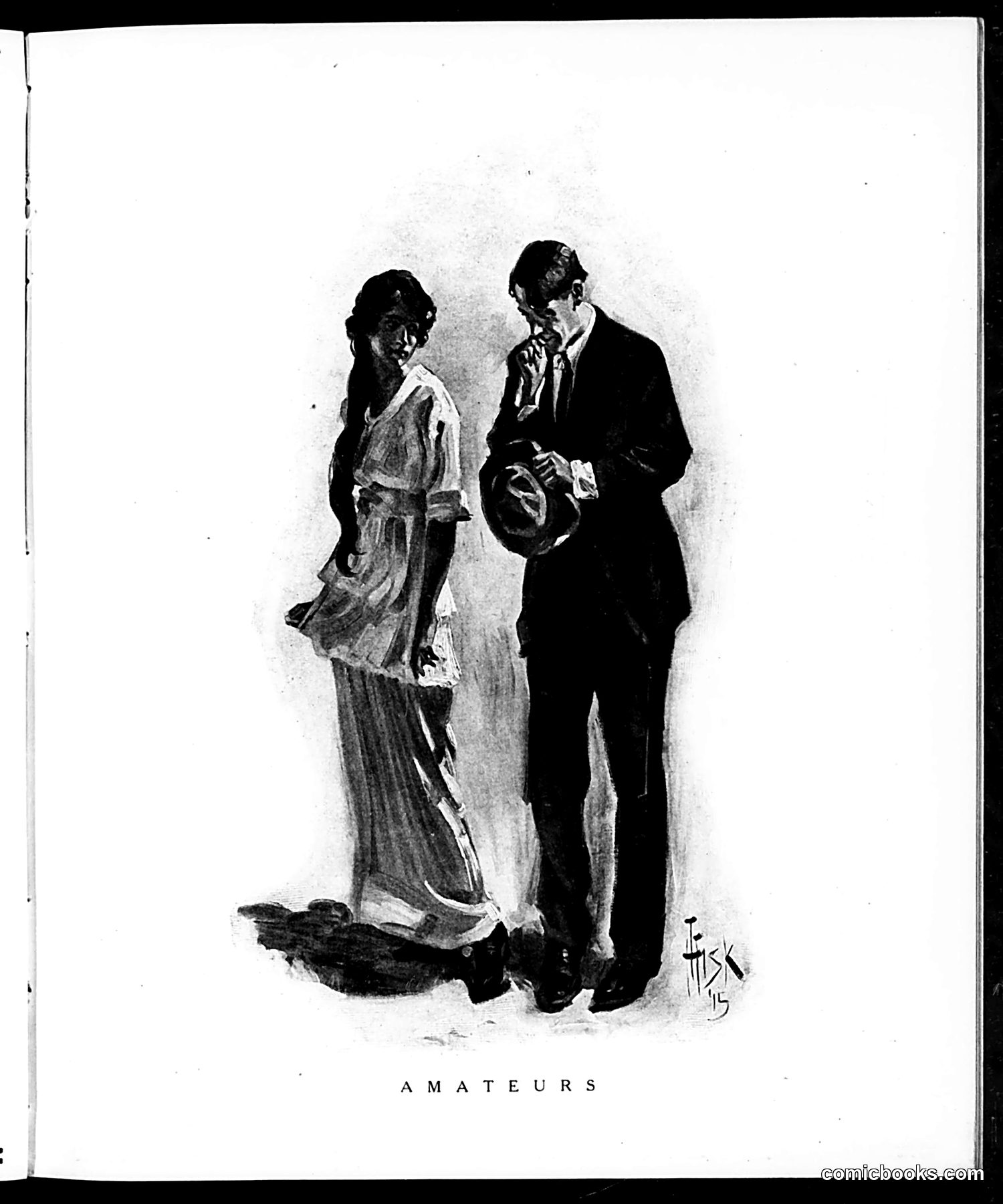
This illustration by artist Fisk depicts a well-dressed man showing a hat to a young woman in modest dress. The title "Amateurs" suggests social satire about inexperienced or unskilled people. The cartoon likely critiques amateur performers or participants in some activity—possibly theater, music, or another entertainment field popular in Judge's era (early 20th century). The man's formal attire and the woman's simpler dress suggest a class or experience difference, which may be central to the joke. Without additional context from the magazine issue, the specific target of satire remains unclear—whether it mocks aspiring performers, social pretension, or courtship rituals among the inexperienced. The hat appears significant to the humor but its exact meaning is uncertain today.
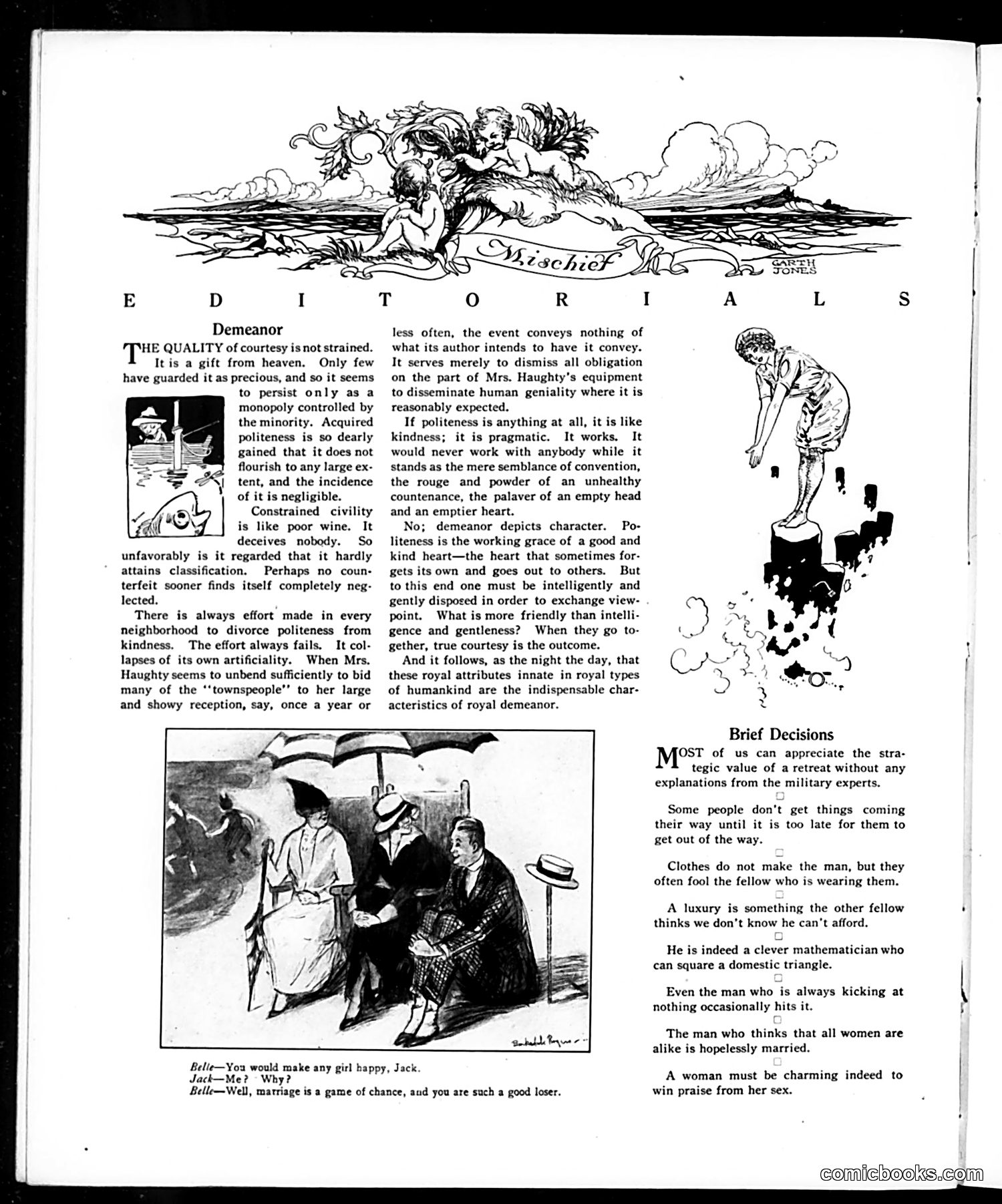
This page from *Judge* magazine presents an editorial titled "Editorial Demeanor" discussing the nature of true politeness. The main text argues that genuine courtesy is "a gift from heaven" and "the working grace of a good and kind heart," not mere superficial convention or social pretense. The cartoon below depicts three figures—apparently a couple and a gentleman—under an umbrella in the rain. The caption suggests a satirical exchange about marriage as "a game of chance," poking fun at romantic courtship rituals. The "Brief Decisions" section offers witty aphorisms about human nature and society, typical of *Judge*'s satirical commentary on American social conventions. The page critiques both artificial politeness and naive romanticism, using humor to question genuine versus performative social behavior.
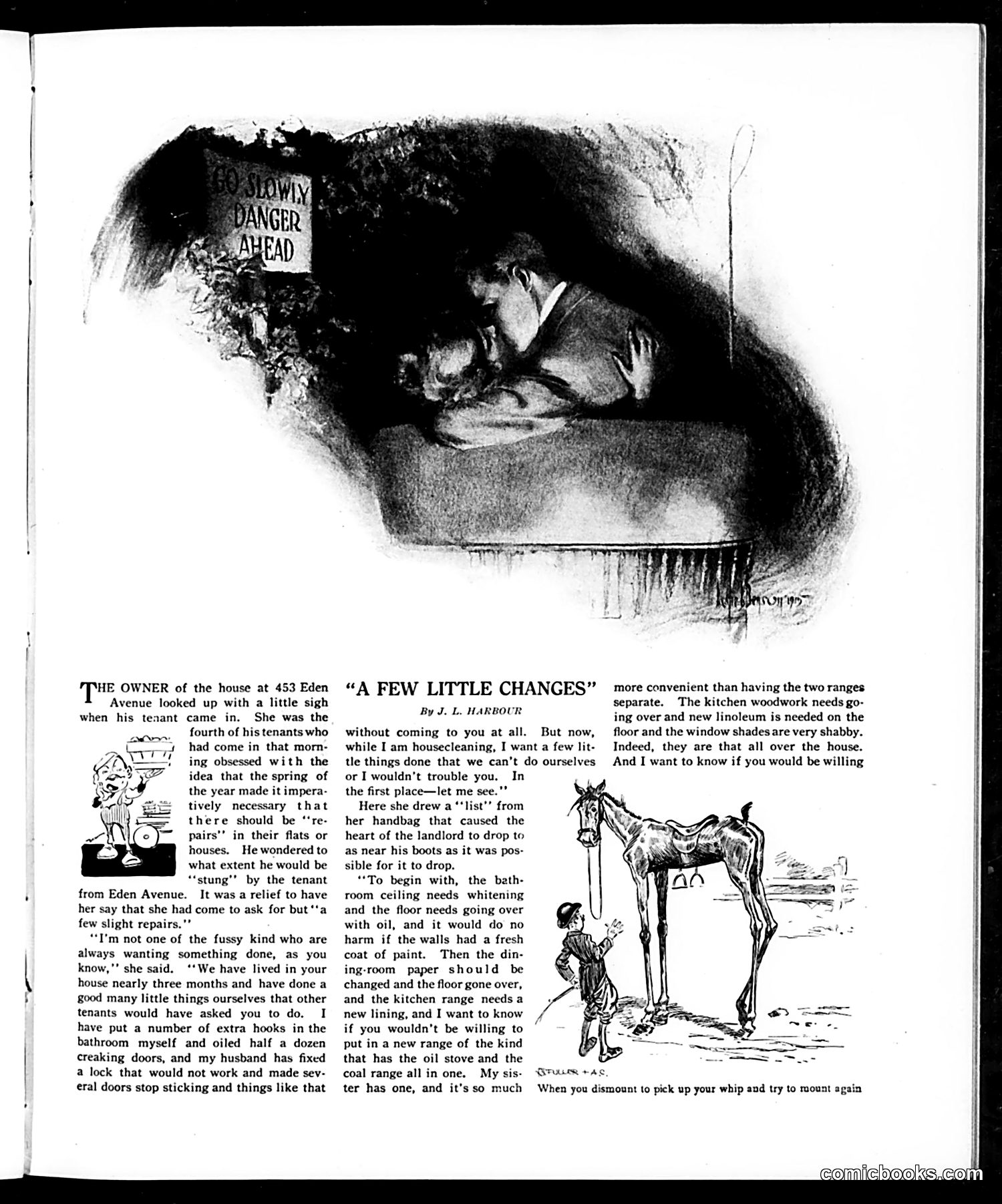
This page from *Judge* magazine contains an article titled "A Few Little Changes" by J.L. Harbour about a landlord at 453 Eden Avenue. The piece satirizes the common tension between landlords and tenants over home repairs. The landlord complains that a tenant demands numerous fixes—bathroom ceiling whitening, dining-room redecorating, kitchen range replacement, and floor work. The satire lies in the landlord's exasperation: he's already made many repairs himself but finds tenants perpetually unsatisfied, always requesting "something done." The accompanying illustrations show the tenant presenting her list of demands and a humorous scene of a horse refusing to be mounted (captioned about unwillingness to comply). The joke satirizes the endless cycle of maintenance requests that frustrate property owners.
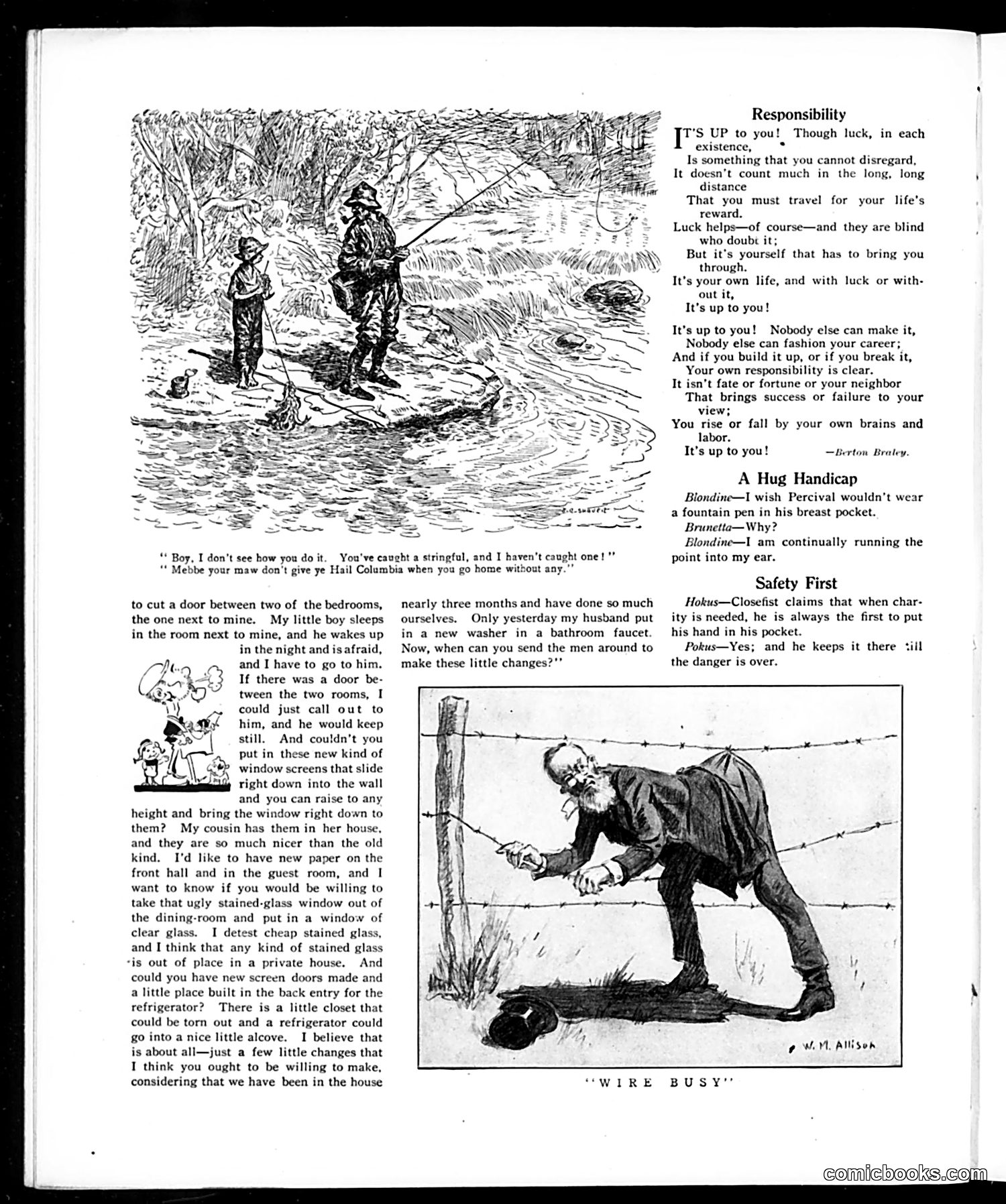
This page contains multiple satirical pieces typical of early 20th-century Judge magazine humor: **Top cartoon ("Wire Busy"):** Shows a man struggling with barbed wire, illustrating the caption's pun about being literally "busy" with wire rather than figuratively occupied. The humor is visual wordplay. **"Responsibility" poem by Berton Braley:** A motivational verse emphasizing self-reliance and personal agency—reflecting Progressive Era ideals that success depends on individual effort, not luck or circumstance. **"A Hug Handicap":** A brief joke about a blonde woman repeatedly jabbing her ear on her boyfriend Percival's fountain pen—shallow humor based on blonde stereotypes and physical comedy. **"Safety First":** Social commentary mocking a miserly character who claims to always prioritize charity but conveniently keeps his hand in his pocket "until the danger is over"—satirizing hypocrisy about charitable giving. **Long letter excerpt:** Apparently a humorous complaint from a homeowner making endless renovation demands, illustrating domestic absurdity. The page reflects Judge's mix of motivational content, gentle domestic humor, and light social satire typical of the era.
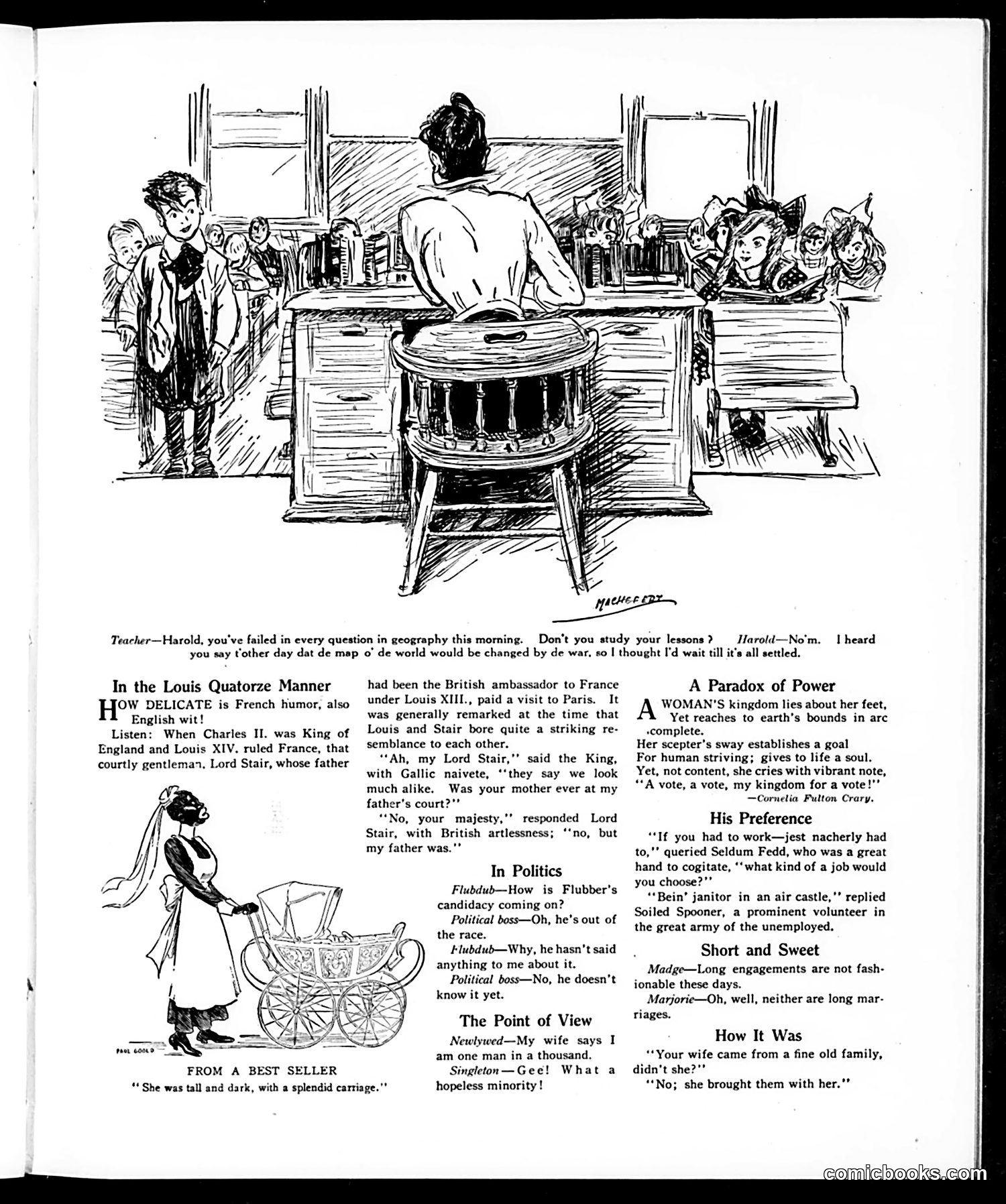
**Main Cartoon (top):** A schoolboy's excuse for failing geography—he won't study because "the map of the world would be changed by de war," so he'll wait until it settles. This satirizes WWI's redrawing of European borders and reflects contemporary anxiety about geopolitical upheaval. **Historical Anecdotes:** "In the Louis Quatorze Manner" recounts a witty 17th-century exchange where Lord Stair implies King Louis XIV resembles his (Stair's) father, insinuating royal illegitimacy—sophisticated court humor contrasting French and British styles. **Remaining Content:** Brief satirical jokes about politics (a candidate's campaign ending without his knowledge), women's suffrage ("A vote, a vote, my kingdom for a vote"—parodying *Richard III*), unemployment, and marriage. The magazine's mix reflects typical 1910s-era Judge content: topical political humor and genteel wit aimed at educated readers.
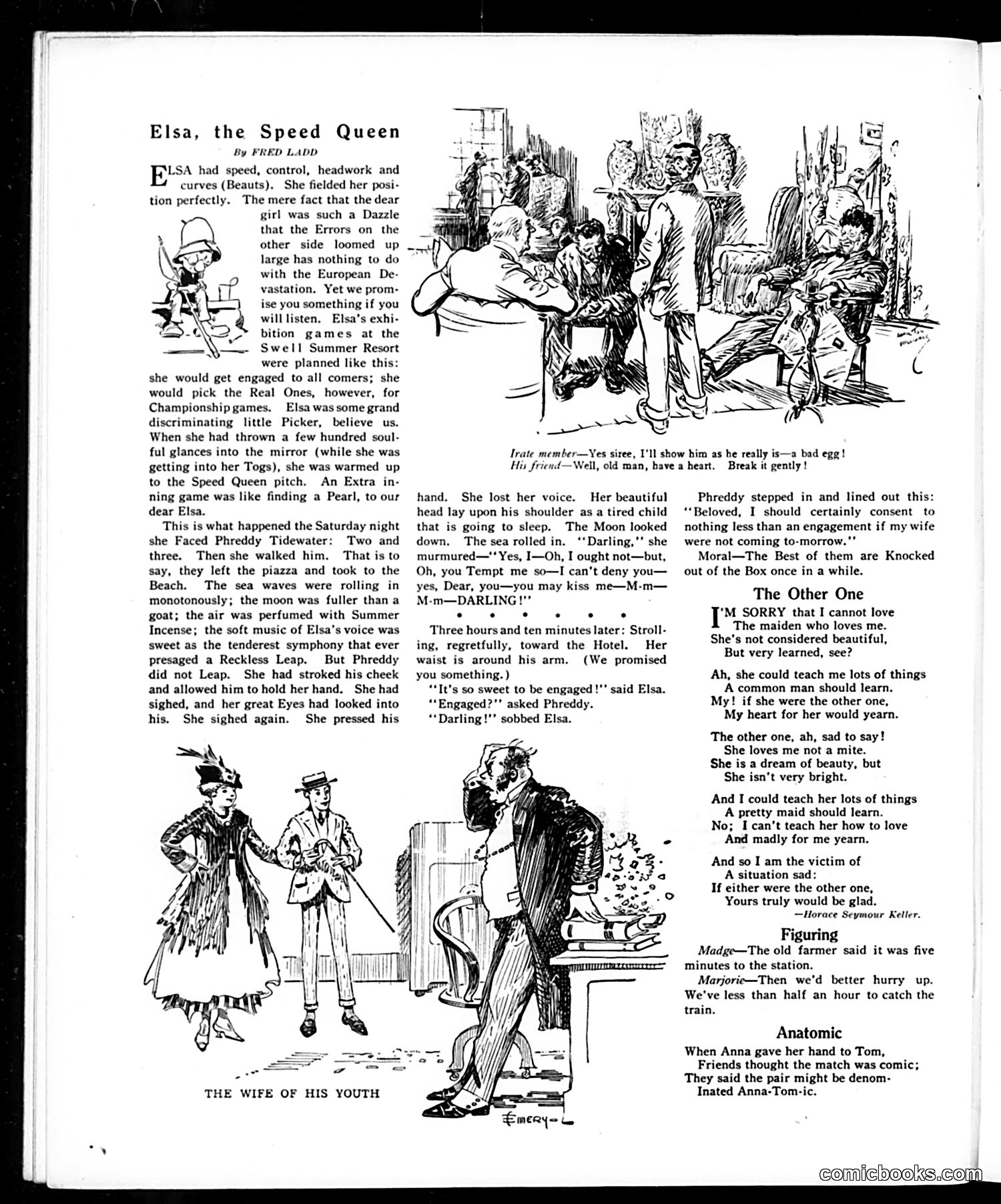
This Judge magazine page contains three distinct pieces of satirical humor: **"Elsa, the Speed Queen"** (main story with illustrations): A comedic narrative about a woman athlete named Elsa who uses flirtation to distract opposing players during sports competitions. The joke culminates when she becomes engaged to a man named Phreddy during a romantic beach walk—only to discover he's already married. The "moral" satirizes unpredictability: even skilled operators ("the Best of them") can fail unexpectedly. **"The Other One"** (poem): A humorous lament about romantic frustration—the speaker loves one woman who doesn't return his affection, while an unloving woman loves him. It satirizes the cruel ironies of attraction and incompatibility. **Bottom section**: Brief joke pieces including wordplay ("Anatomic" puns on Anna-Tom-ic when Anna marries Tom) and a logic joke about time calculations. The overall tone reflects early 20th-century American humor: light romantic comedy, gentle mockery of courtship rituals, and paradox-based jokes. The "Speed Queen" story gently satirizes flirtation tactics while respecting athletic competition.
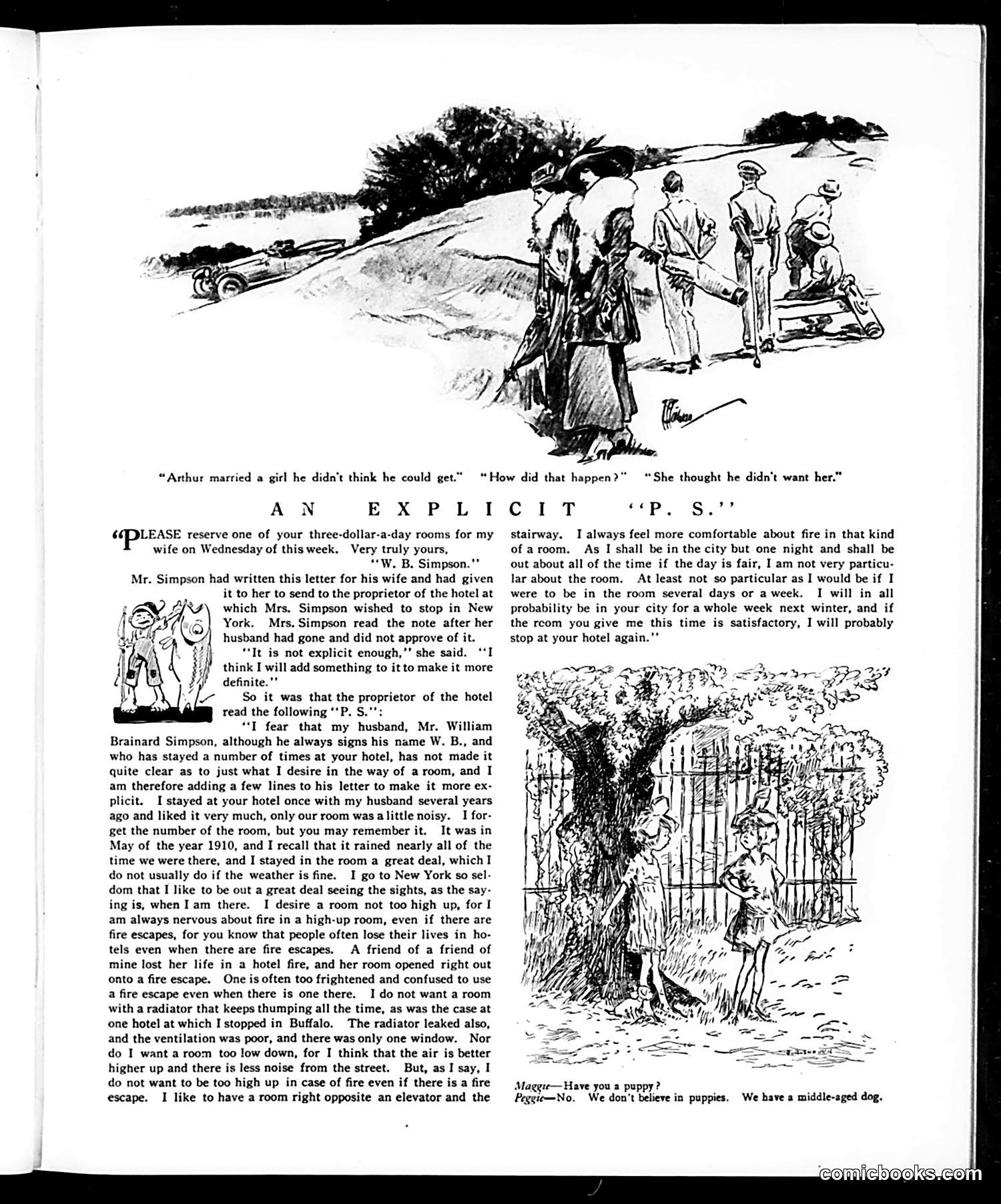
This is a humorous piece about marital miscommunication and female verbosity. The setup: Mr. Simpson writes a brief, businesslike hotel reservation letter for his wife. Mrs. Simpson reads it and decides it's "not explicit enough," then adds an enormous P.S. that rambles on for paragraphs—detailing a 1910 visit, fire safety concerns, radiator complaints, noise worries, and contradictory preferences about room height. The satire targets the stereotype of wives as verbose and obsessive about trivial domestic details, contrasting sharply with her husband's concise approach. The joke's irony: despite all her "explicit" elaboration, she admits she'll barely be in the room anyway. The bottom cartoon (unrelated) makes a quick joke about puppies and modern attitudes. The magazine used such domestic humor to satirize contemporary gender roles and marital dynamics for early 20th-century readers.
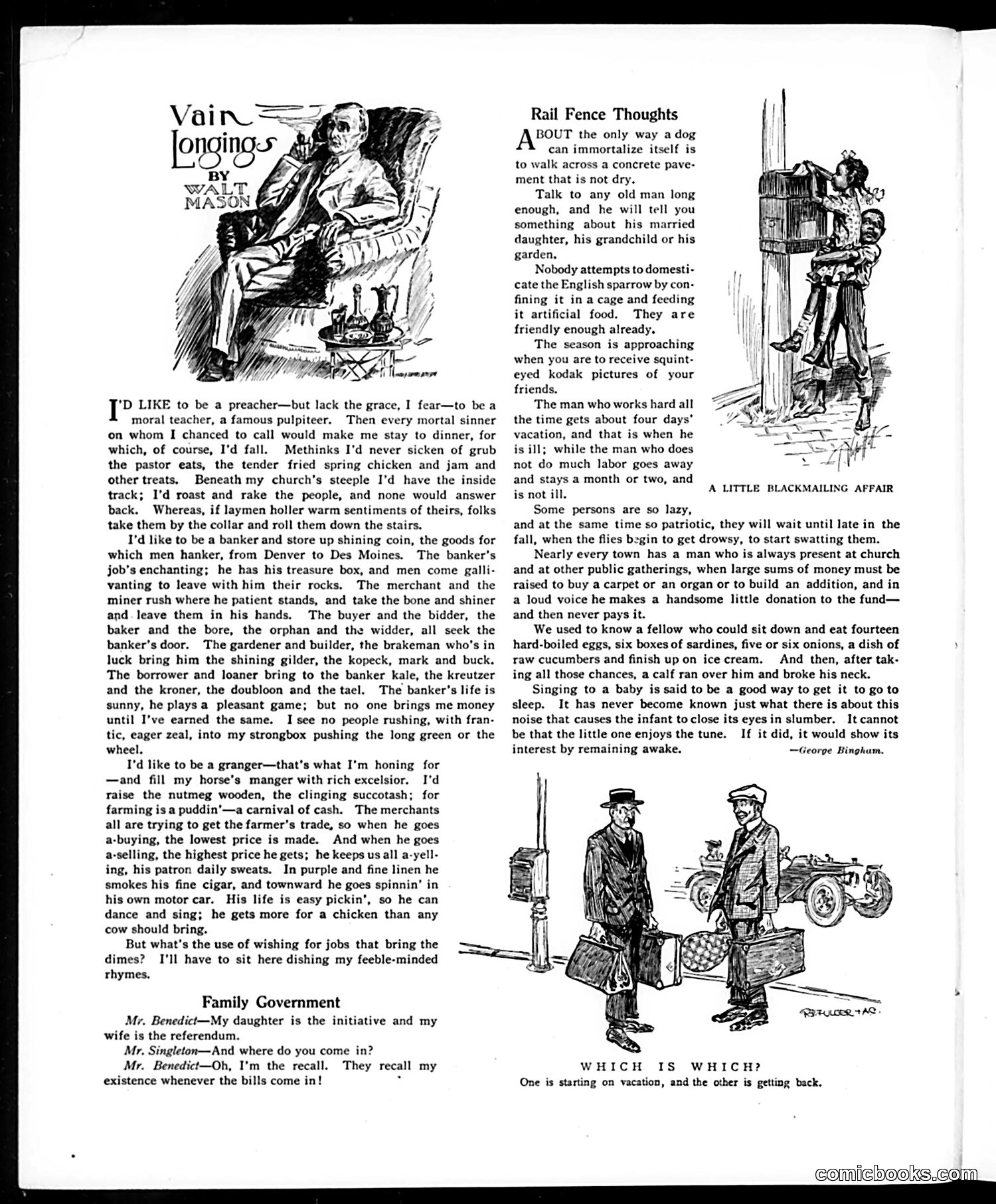
**"Vain Longings"** by Walt Mason presents a speaker fantasizing about prestigious careers—preacher, banker, farmer—while remaining in obscure poverty. The satire mocks American class aspiration: each envied profession brings effortless wealth and respect, yet the speaker lacks clients or capital to pursue them. The joke underscores economic inequality and the speaker's resignation to mediocrity. **"Family Government"** parodies Progressive Era political reforms (initiative, referendum, recall—mechanisms for direct democracy). The humor lies in applying these abstract governmental concepts to marriage: the daughter controls decisions, the wife overrides them, and the husband exists only to be "recalled" when bills arrive. It satirizes how modern democratic theory becomes domestically irrelevant to husbands' actual powerlessness. Both pieces use humor to critique American social hierarchies and changing gender dynamics during the early 20th century.
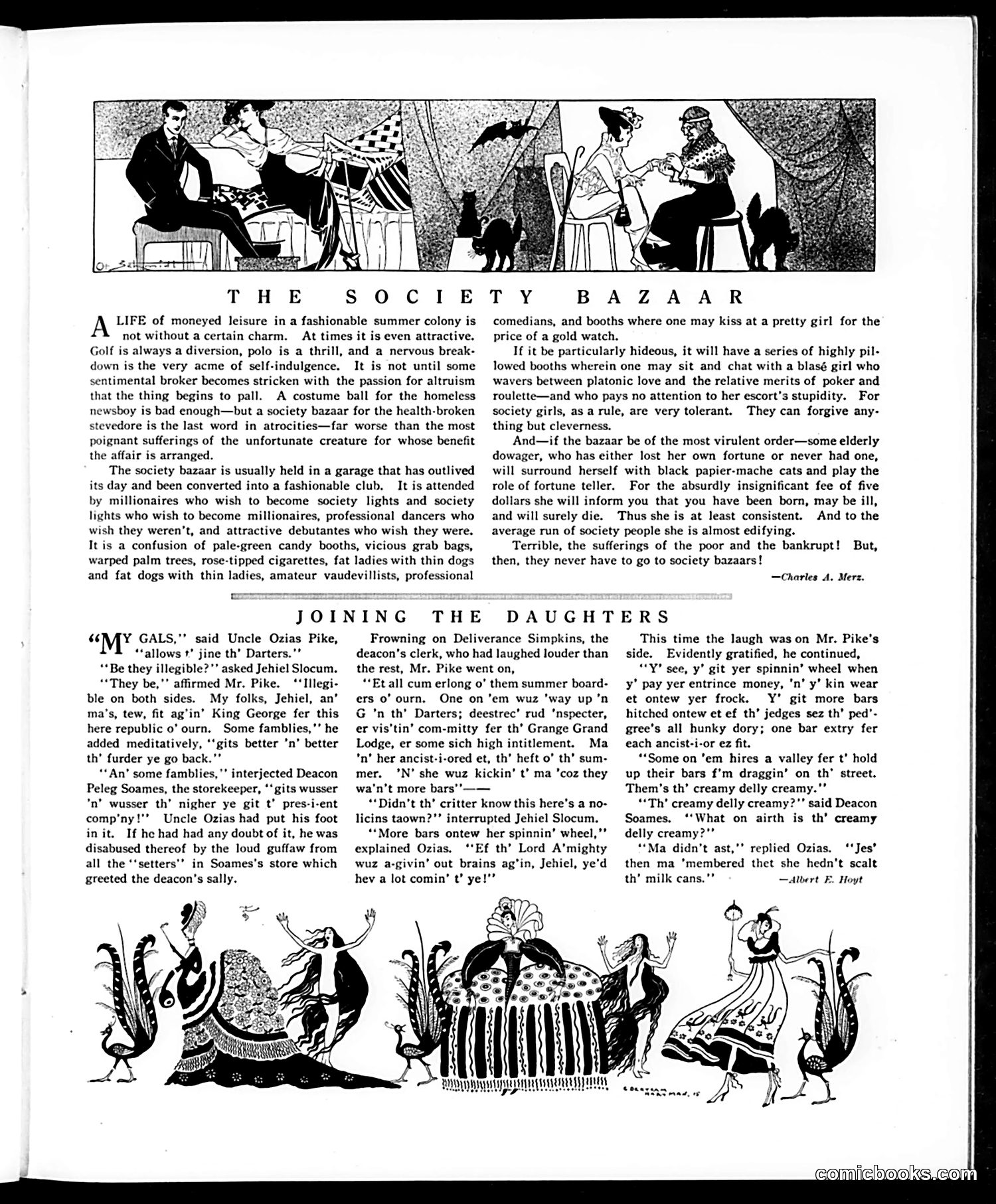
This page contains two satirical pieces mocking wealthy leisure culture. **"The Society Bazaar"** (top) ridicules fashionable summer colonies where rich people organize charity fundraisers ostensibly for the poor but really as social events for themselves. The author criticizes the pretense and absurdity: millionaires wanting to "become society lights," debutantes wishing they were different, and a fortune-teller dowager who "plays the role" while charging five dollars to tell people they'll die. The satire targets the gap between charitable intent and self-interested performance. **"Joining the Daughters"** (bottom) is a dialect-heavy rural humor piece where Uncle Ozias Pike boasts his family's Revolutionary War ancestry qualifies them for "the Daughters" (likely the Daughters of the American Revolution). A visiting summer boarder criticizes his ancestor's accomplishments, and Pike jokes that if God were "a-givin' out brains ag'in," the boarder would "have a lot comin'"—mocking both social-climbing pretension and outsider condescension toward rural folk.
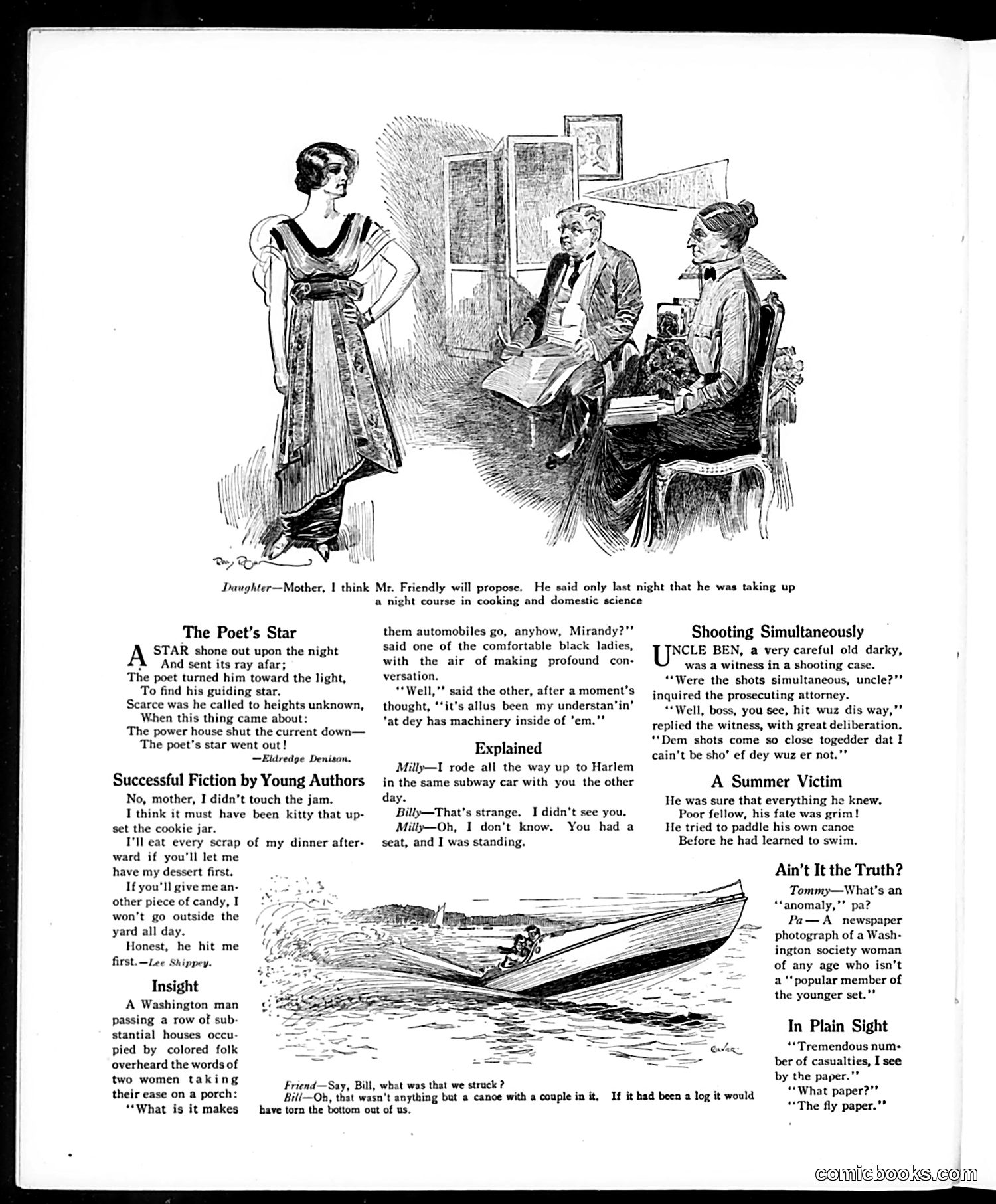
This page from the satirical magazine *Judge* contains multiple short humorous pieces targeting early 20th-century social attitudes and situations: **Main Cartoon (top):** A young woman announces an impending marriage proposal to her mother while two men (likely her parents or guardians) listen. The humor suggests the men are discussing the suitor's recent enrollment in a "cooking and domestic science" course—implying he's unprepared for marriage, or that such education is an unusual/comical qualification for a husband. **Racial Humor:** Several pieces ("Insight," "Shooting Simultaneously") feature dialect humor mocking African Americans, reflecting the period's casual racism. The "Insight" piece presents Black women as ignorant about automobiles; "Shooting Simultaneously" depicts an elderly Black man as inarticulate in court testimony. **Other Items:** "The Poet's Star" jokes about a power outage; "Successful Fiction" mocks children's obvious lies; "A Summer Victim" plays on the phrase "paddle his own canoe." The page reflects *Judge's* satirical approach: social commentary mixed with casual period stereotyping that modern readers would find offensive.
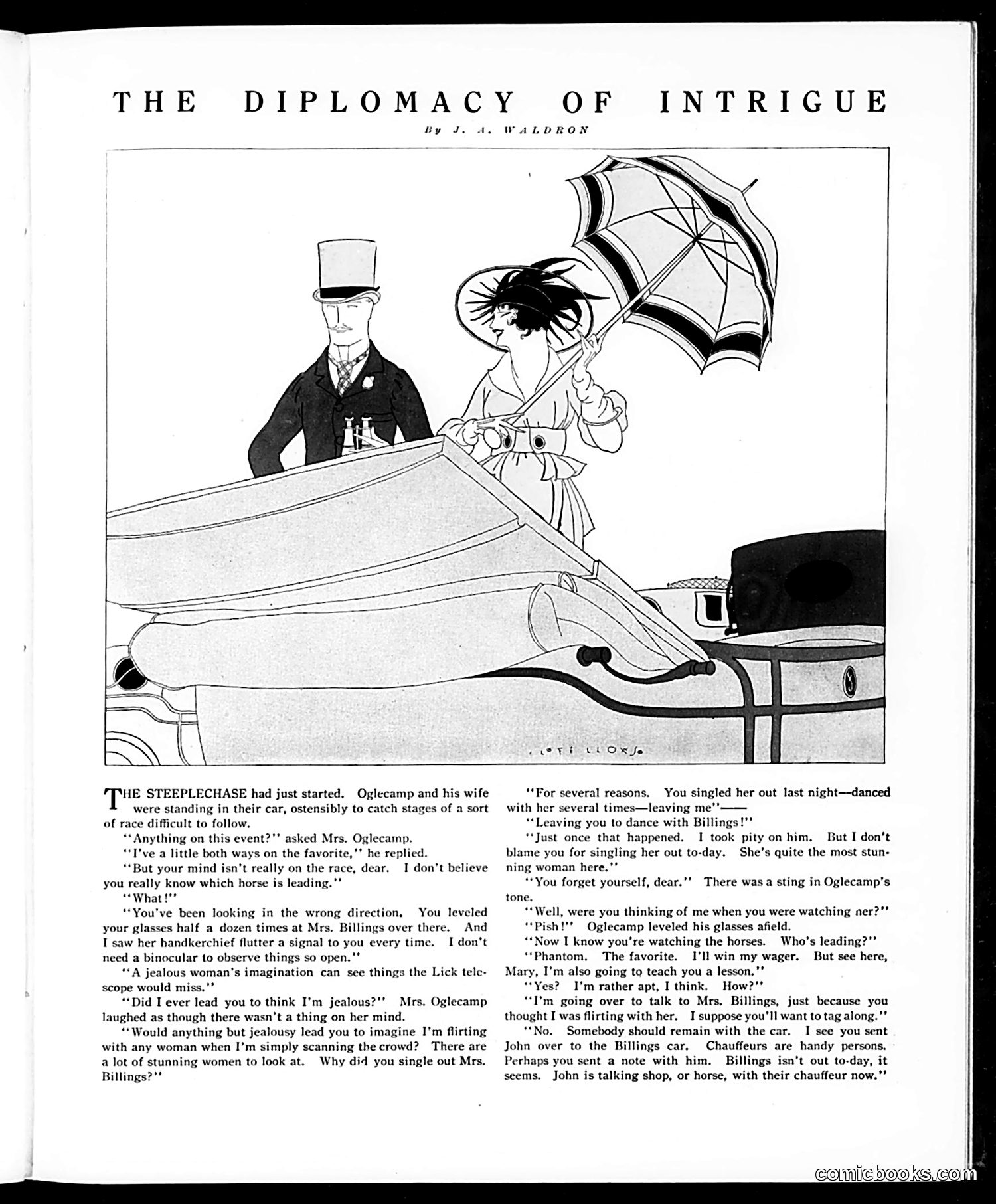
This is a satirical story illustrated by J. A. Waldron depicting marital jealousy among the wealthy leisure class. At a steeplechase horse race, Mr. Oglecamp is caught by his wife paying excessive attention to another woman, Mrs. Billings, rather than watching the race. The "intrigue" is Mrs. Oglecamp's calculated response: she appears to forgive him while subtly demonstrating her own awareness and suspicions—noting that he sent their chauffeur John to the Billings car, implying he may have passed a note. The cartoon satirizes upper-class social conventions, where marital tension is masked by politeness and veiled accusations delivered through seemingly innocent observations. The joke targets both the husband's transparent flirtation and the wife's clever psychological counter-strategy, exposing the performative nature of "civilized" behavior among society's elite.
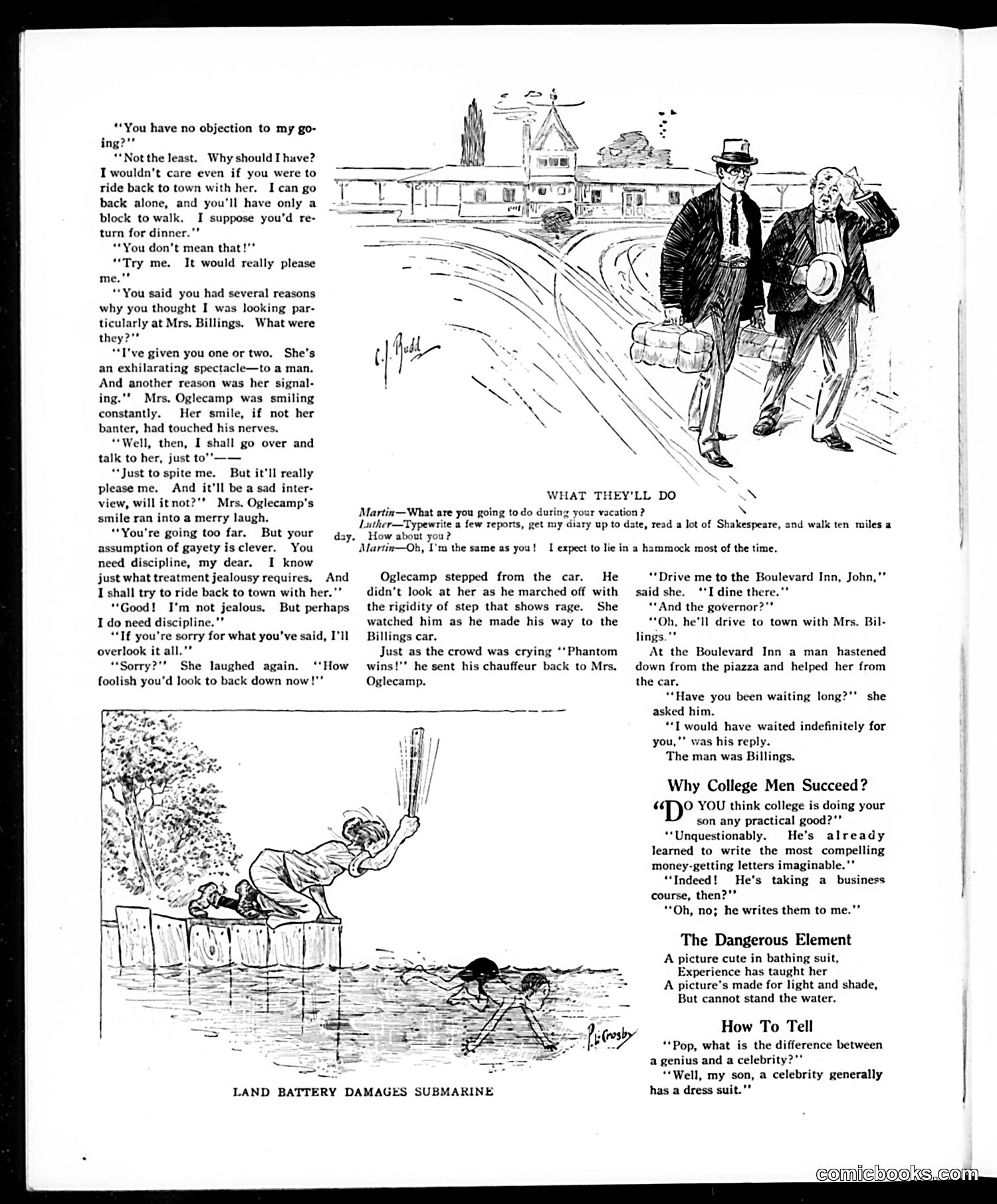
This page contains a marital comedy sketch titled "What They'll Do," depicting a calculated domestic power play. Mrs. Oglecamp pretends indifference when her husband shows interest in Mrs. Billings, claiming his attention would "please" her. Her psychological manipulation—feigning cheerfulness while clearly irritating him—ultimately works: he angrily departs with Mrs. Billings, only to have his chauffeur redirect Mrs. Oglecamp to the Boulevard Inn, where a man named Billings (presumably Mrs. Billings's husband) awaits her. The satire mocks early 20th-century upper-class social games: ostentatious vacation plans, automobile outings as romantic opportunities, and wives' tactical use of reverse psychology. The page also includes brief unrelated jokes about college men writing home for money and the distinction between geniuses and celebrities (those with dress suits). A separate cartoon about land battery damaging a submarine appears below, likely referencing World War I naval warfare.
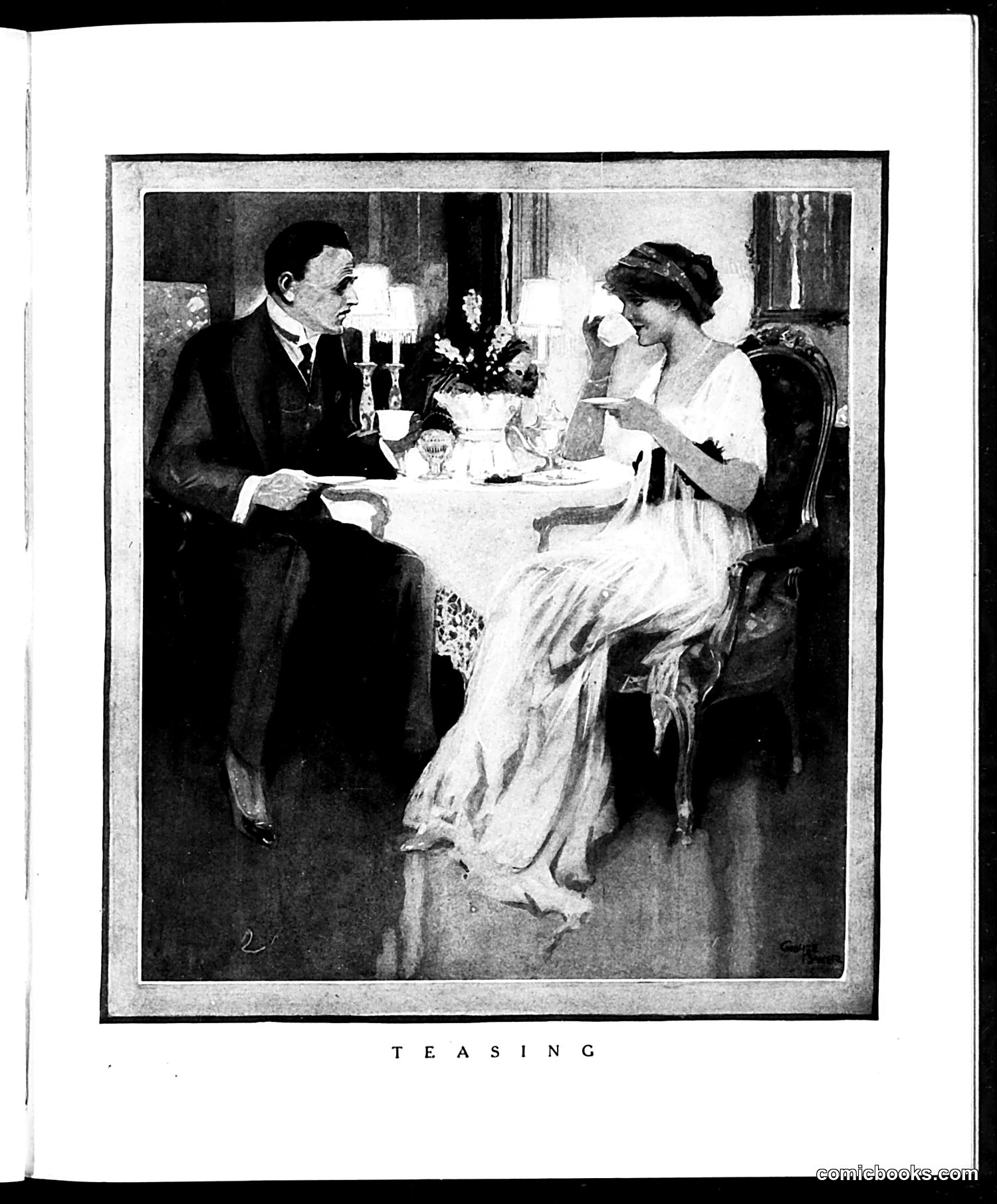
This illustration depicts a flirtatious social interaction captioned "Teasing." A well-dressed man in formal attire sits across from a woman in an elegant white gown at an intimate dinner table. The woman appears to be playfully teasing or flirting with the man while dining, as suggested by her coy expression and body language. The cartoon likely satirizes early-20th-century courtship rituals and gender dynamics of the era, where "teasing" represented a socially acceptable form of flirtation between unmarried people. Judge magazine frequently featured such scenes of romantic or social interaction, often poking gentle fun at contemporary dating customs and the performative nature of courtship among the upper classes.
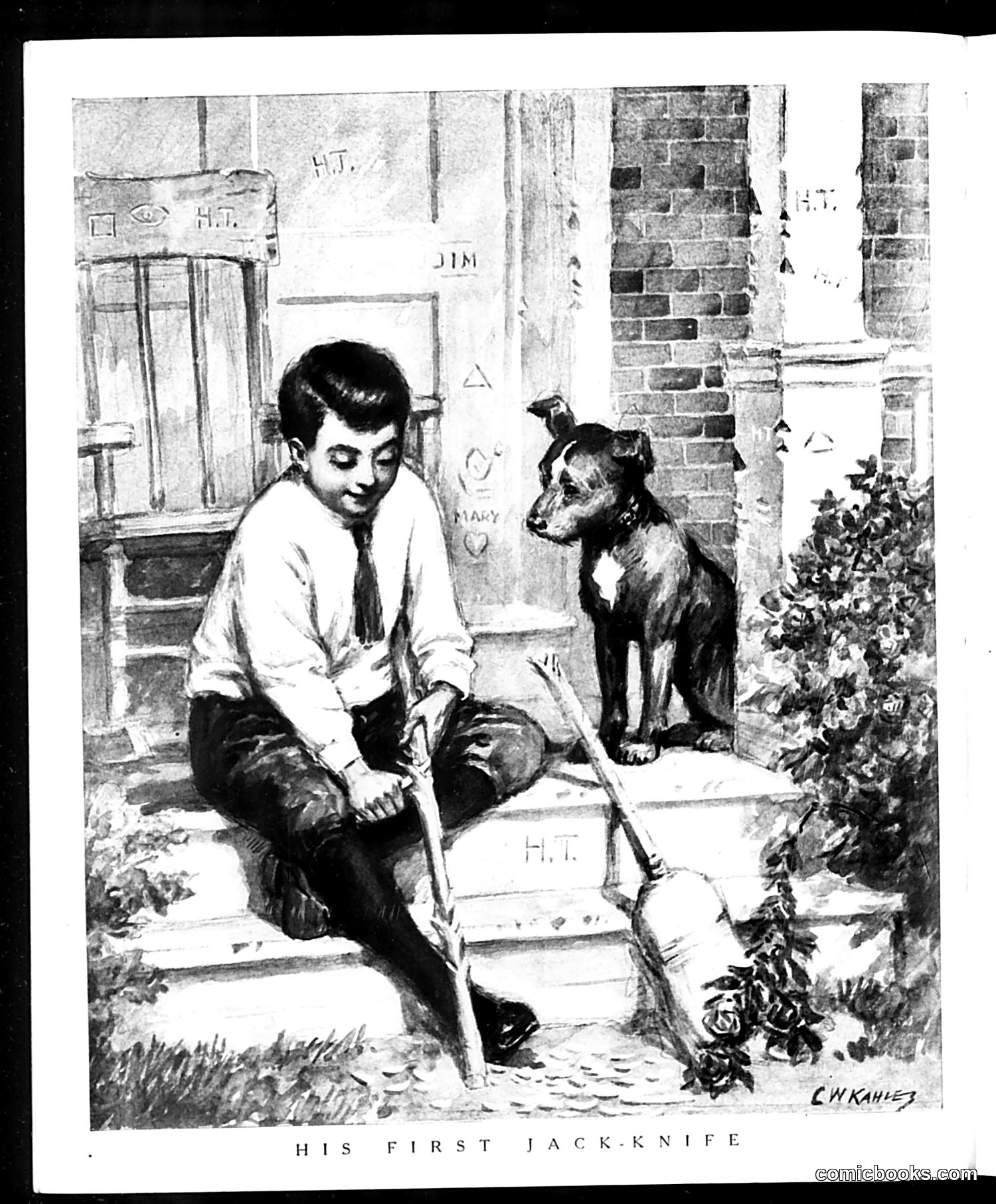
This illustration depicts a young boy crouching in an alley or courtyard, examining what appears to be a jack-knife with a dog beside him. The setting shows brick walls and graffiti with names scratched or written on them ("H.T.", "JIM", "MARY"). The cartoon's humor likely plays on a coming-of-age theme common to American boyhood—acquiring one's first pocket knife was a significant milestone and sign of growing up. The boy's careful, almost reverent inspection of the knife, combined with the dog as a companion, suggests innocent childhood adventure. The graffiti-marked urban setting adds authenticity to the street-boy experience being depicted. The artist is credited as "L.W. KAHLES."
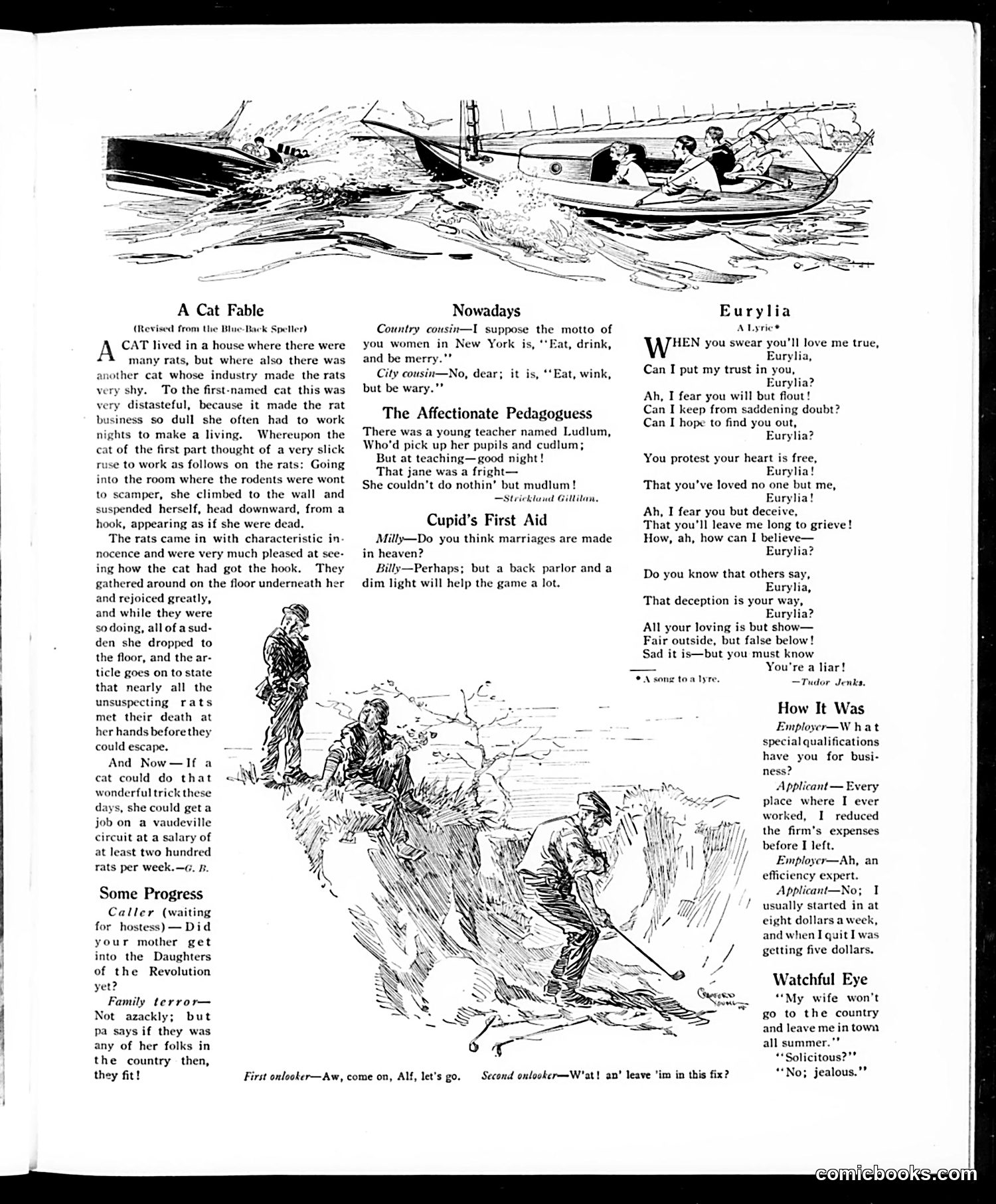
This page contains several short satirical pieces typical of early 20th-century humor: **"A Cat Fable"** mocks modern employment by extending a Aesop's fable: a clever cat tricks rats by feigning death. The joke concludes that such a deceptive performer could earn good money on the vaudeville circuit—satirizing both the entertainment industry's rewards for cunning and the precarious "rat race" of modern work. **"Some Progress"** jokes about American genealogy obsession. A caller asks if someone's mother joined the Daughters of the Revolution (a prestigious hereditary society). The response suggests that while the family has no documented ancestors in America, they were definitely fighters if they were present—poking fun at working-class families' lack of documented pedigree while sardonically claiming martial ancestry. The remaining pieces are light romantic/domestic humor: a pedagogical joke, a cynical dialogue about marriage, a love song expressing jealous suspicion, job interview humor about cost-cutting, and marital jealousy. None reference specific political events; instead, they target universal social pretensions and relationship dynamics.
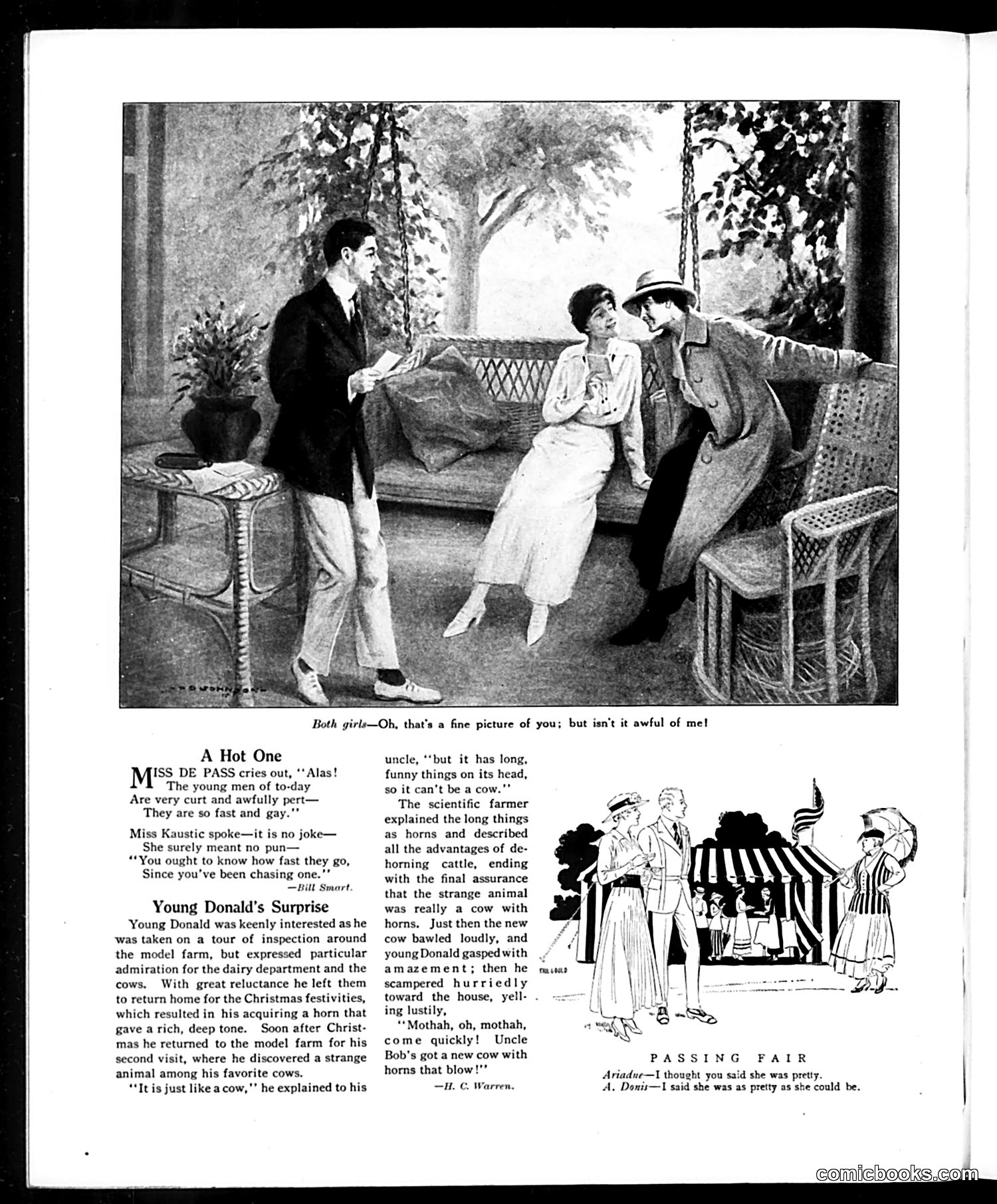
This page contains three separate pieces of humor from *Judge* magazine: **"A Hot One"**: A brief joke mocking a woman (Miss De Pass) who criticizes young men as "fast" (morally loose). Miss Kaustic's retort suggests De Pass herself has been "chasing" young men, making her a hypocrite. **"Young Donald's Surprise"**: A longer comic story about a boy visiting a farm who can't identify a dehorned cow because it now has horns (after dehorning procedures became standard practice). His misidentification and panicked reaction to the cow's sound creates the humor—playing on children's literal thinking and rural unfamiliarity. **"Passing Fair"**: A brief pun-based joke. A man claims a woman is "as pretty as she could be"—which sounds like a compliment but actually means she's as unattractive as one could possibly be while still existing. The overall page reflects early 20th-century magazine humor: wordplay, gentle social mockery, and domestic/rural scenarios treated as amusing.
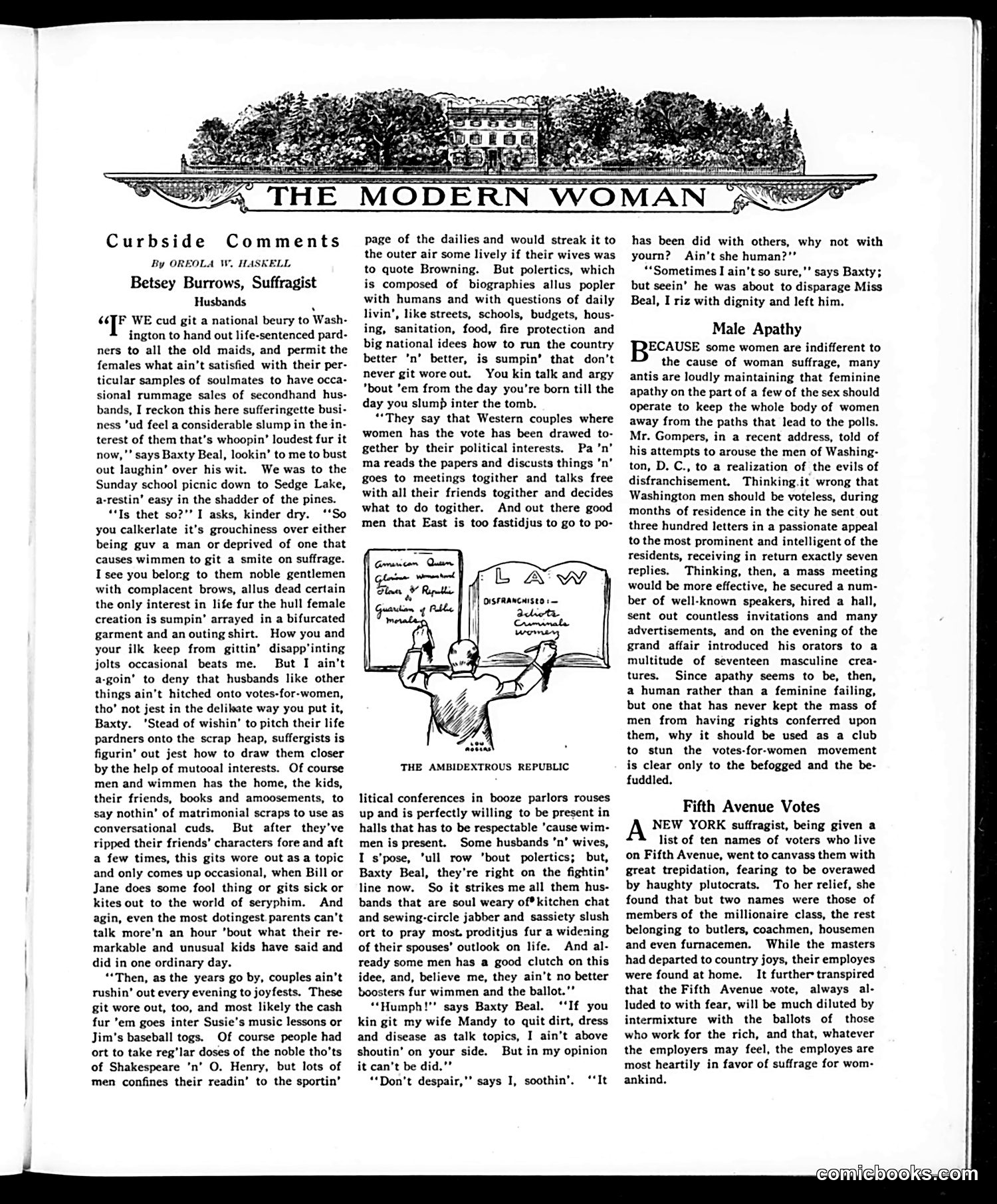
This page satirizes anti-suffrage arguments through a rural character's rebuttal. "Baxty Beal," a complacent husband, jokingly suggests women want suffrage only because they're dissatisfied with their marriages. The unnamed female narrator (representing suffragists) counters that women seek voting rights to gain *shared intellectual interests* with their husbands—specifically politics, which never grows tiresome unlike gossip or domestic talk. The satire's point: anti-suffragists reduce women's political aspirations to marital grievances, when suffragists actually argue that voting would strengthen marriages by giving couples meaningful topics to discuss together. The western states' experience (where women already voted) proves this works—couples attend political meetings together, debate respectably, and husbands behave better in women's presence. The cartoon "The Ambidextrous Republic" (visible but unclear) likely comments on political hypocrisy regarding suffrage.
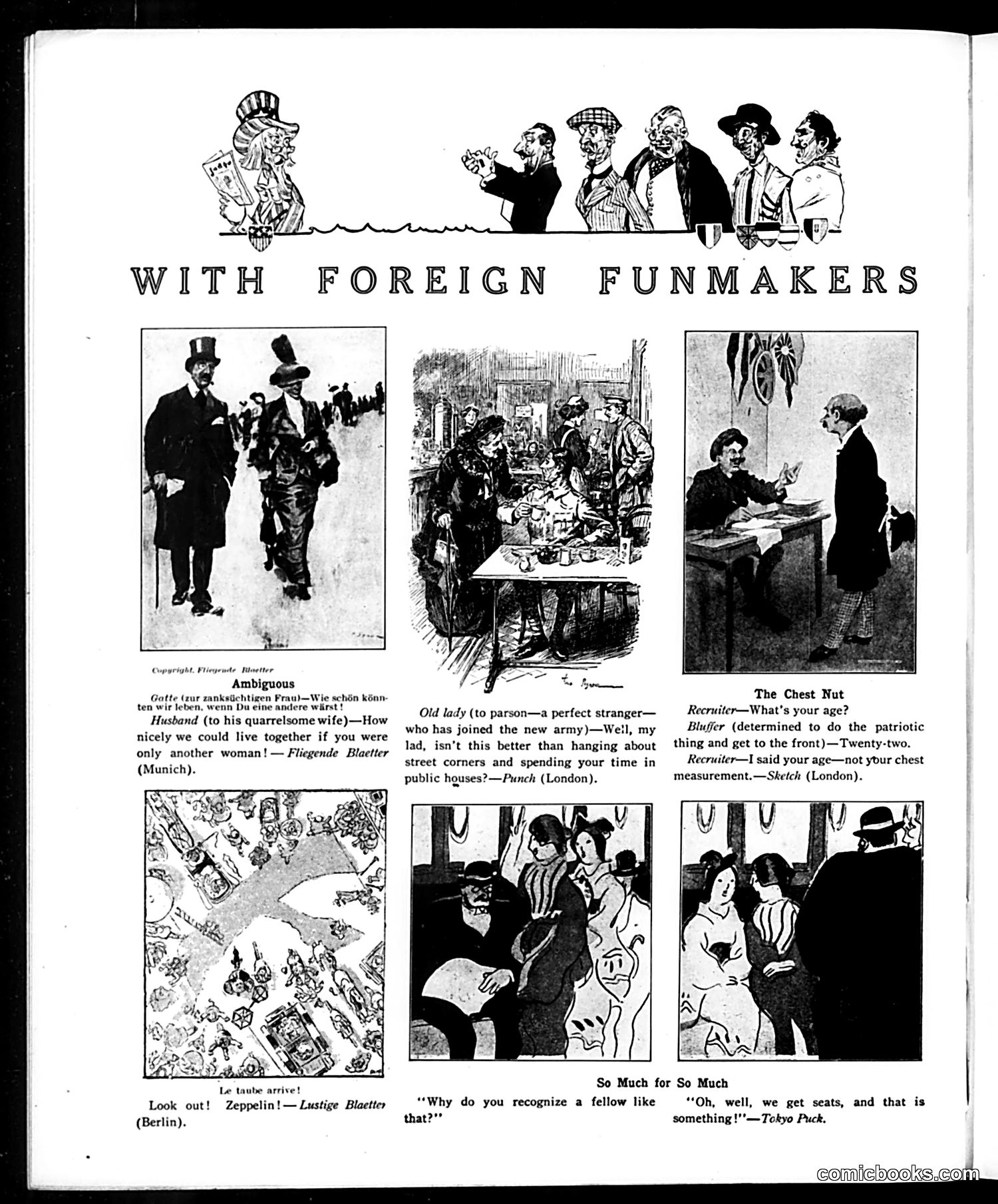
This page collects humorous cartoons from European satirical magazines, republished in the American *Judge* to show how different countries' publications handled similar social themes. The cartoons satirize wartime realities and social dynamics, likely from World War I era: - **"Ambiguous"** mocks marital discord—a husband suggests his quarrelsome wife's absence would improve their finances, implying even unhappy marriages have economic benefits. - **"The Chest Nut"** satirizes military recruiting deception: a young man lies about his age (claiming twenty-two when younger), but the recruiter calls him out for exaggerating his chest measurement instead—highlighting how recruits and officials both bend truth. - **"So Much for So Much"** mocks social opportunism during wartime: civilians endure air-raid warnings and crowded shelters, yet treat the danger as merely an excuse for socializing ("we get seats"). The page demonstrates how *Judge* positioned itself as cosmopolitan, sharing European wit while implicitly critiquing wartime absurdities affecting civilians across multiple nations.
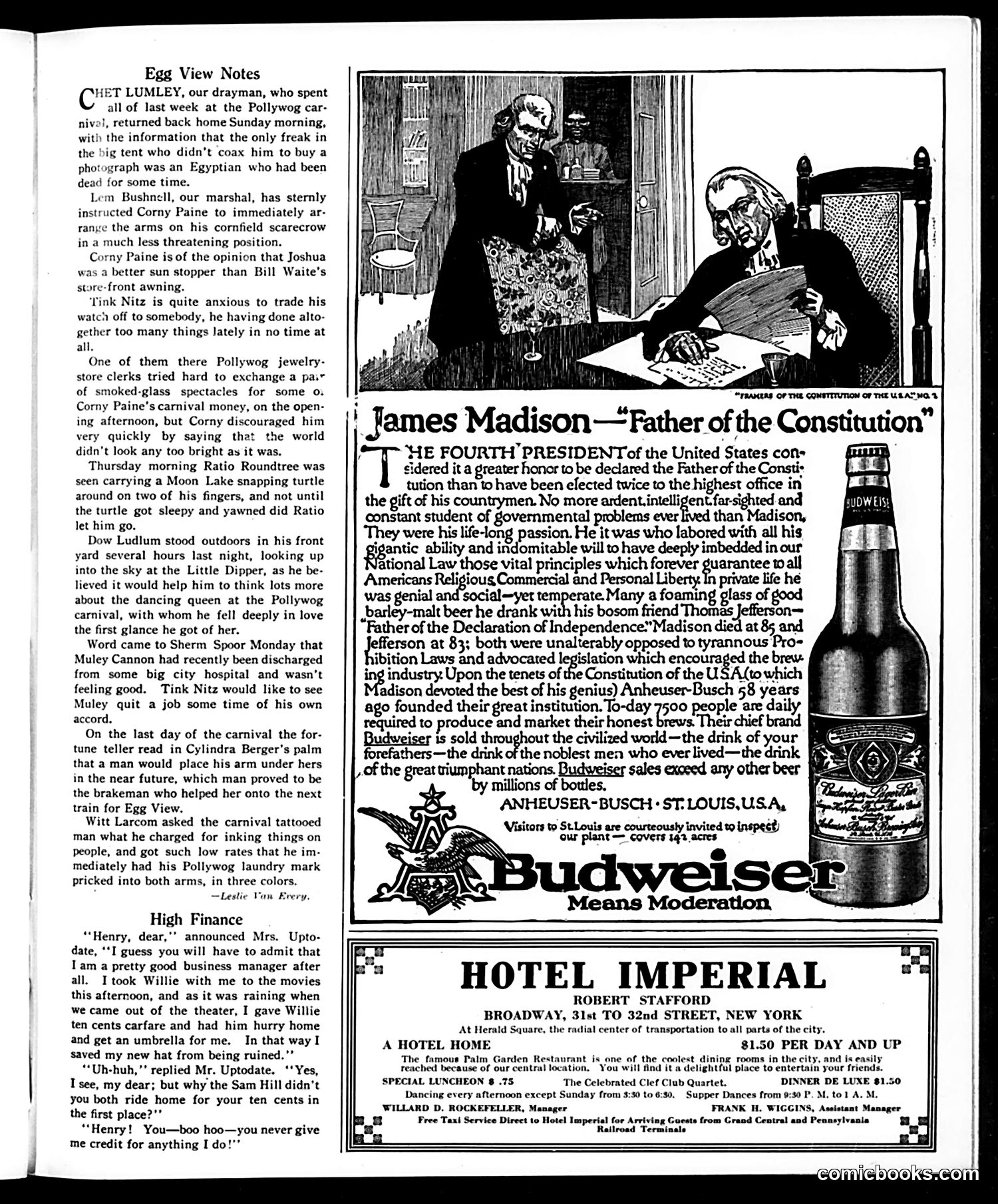
This page contains two distinct sections: **"Egg View Notes"** (left column): A humorous local gossip column by Leslie Van Every, cataloging small-town absurdities from a carnival visit—people trading carnival money, a man staring at the Little Dipper to think about a carnival dancer, tattoo mishaps. It's gentle small-town satire with no specific political content. **James Madison Advertisement** (center/right): A Budweiser ad that hijacks the "Founding Fathers" narrative. It claims Madison and Jefferson—presented as the Constitution's architects—were beer drinkers who opposed Prohibition. The ad uses their authority to legitimize alcohol consumption, explicitly linking the Constitution to "the drink of the greatest triumphant nations." This is pre-Prohibition (or early Prohibition-era) propaganda using patriotic imagery to defend brewing industry interests. The page also includes a "High Finance" joke and Hotel Imperial advertisement. The Madison ad represents corporate political messaging disguised as historical tribute—using revered figures to argue that beer drinking is fundamentally American.
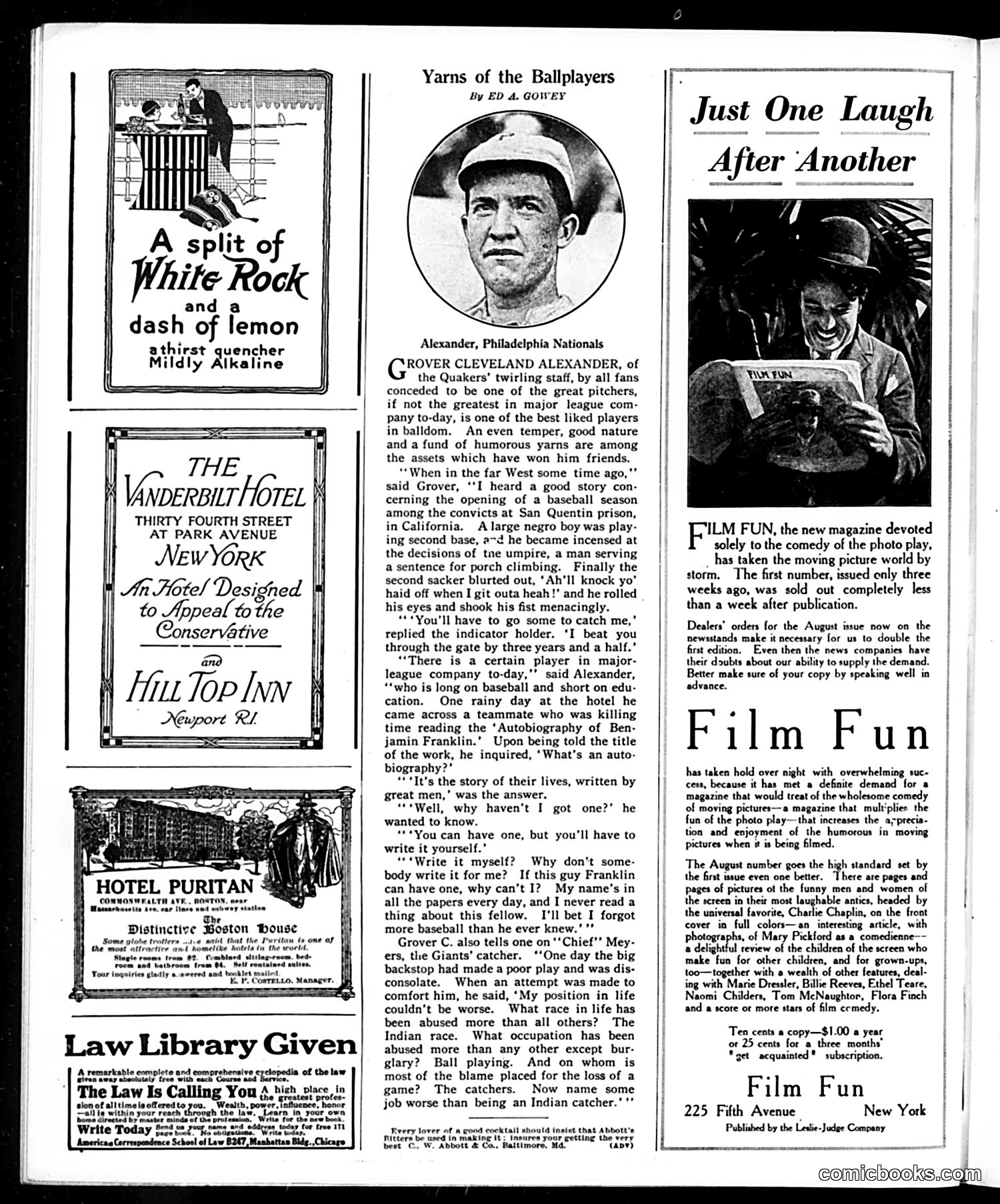
This page mixes advertising with sports content. The central feature is "Yarns of the Ballplayers," anecdotes attributed to Grover Cleveland Alexander, a famous Philadelphia Nationals pitcher. The stories are dialect humor typical of the era: **First story**: Convicts at San Quentin prison—an umpire (serving time for "porch climbing"/burglary) and a Black player argue. The joke relies on the umpire's sarcastic comeback about already beating him "through the gate." **Second story**: A baseball player, unfamiliar with "autobiography," wants one written about him since his name appears in papers daily. The humor centers on his ignorance and inflated self-importance. **Third story**: A Native American catcher ("Chief" Meyers) laments being simultaneously a member of an abused race *and* playing baseball—the most-blamed position—compounding his misery. These reflect early 20th-century attitudes toward race and education as comedy fodder. The sidebar advertises "Film Fun" magazine, devoted to movie comedy.
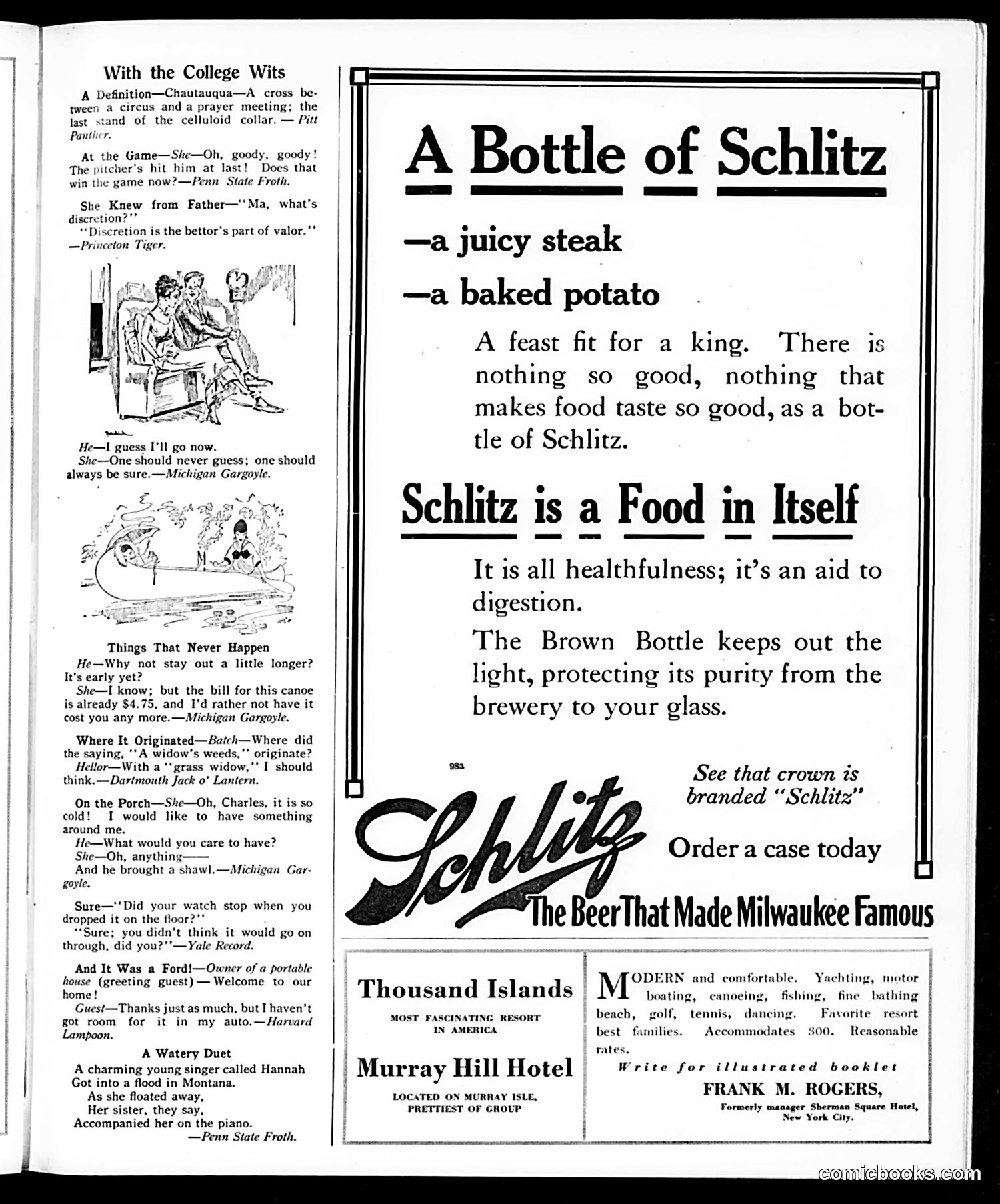
This page combines college humor with advertising. The left side features "With the College Wits"—a collection of brief jokes sourced from various college humor magazines (Penn State Froth, Princeton Tiger, Michigan Gargoyle, etc.). These jokes mock college students' romantic misadventures and dating conventions of the era: couples at games, awkward porch scenes, and the prevalence of Ford automobiles among young people. The right side is dominated by a Schlitz beer advertisement claiming beer is "a Food in Itself" that aids digestion—a common health claim for beer during Prohibition's approach or pre-Prohibition era. The ad emphasizes the brown bottle's protective qualities. The page also advertises the Thousand Islands resort and Murray Hill Hotel. **What modern readers miss**: The college humor reflects early 20th-century dating rituals and social conventions; the Schlitz ad's health claims would be considered false advertising today.
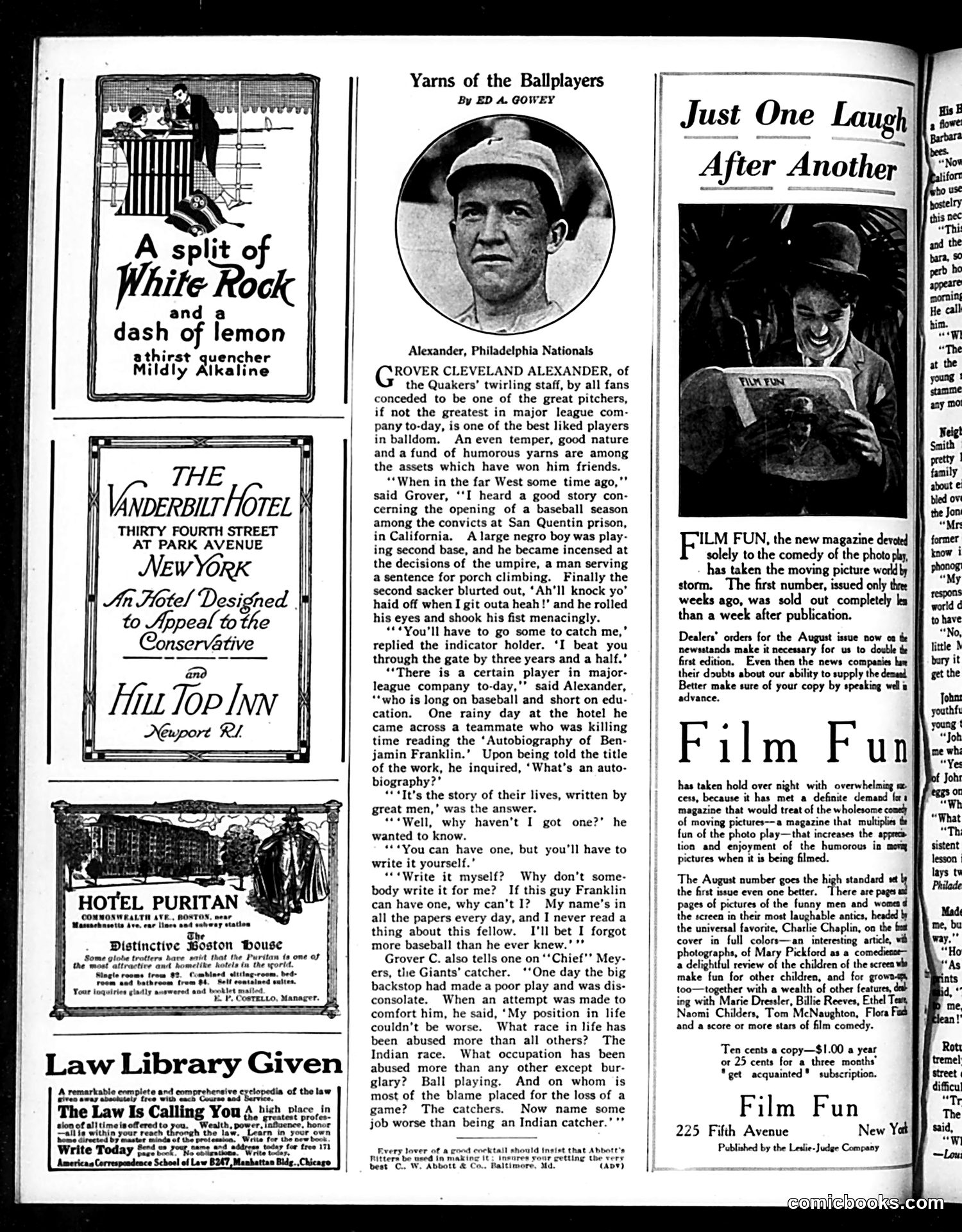
This page from Judge (an American satirical weekly) contains primarily **advertisements and sports entertainment content** rather than political satire. The main feature is "Yarns of the Ballplayers," profiling **Grover Cleveland Alexander**, a celebrated Philadelphia Nationals pitcher. The anecdotes illustrate early 20th-century baseball culture and social attitudes. One story jokes about an uneducated baseball player who hasn't read Benjamin Franklin's autobiography, assuming famous people write autobiographies about themselves. Another mocks "Chief" Meyers (a Giants catcher, likely Native American) with a pun about "Indian catcher"—wordplay that trades on period stereotypes treating Native Americans as objects of ridicule. The advertisements (hotels, law school, cocktail bitters) target affluent, conservative readers. The "Film Fun" section promotes a new comedy magazine focused on moving pictures, reflecting cinema's emerging popularity. **Overall**: This is a leisure-focused magazine page celebrating sports personalities and consumer products, with casual prejudices embedded in the humor rather than intentional political commentary.
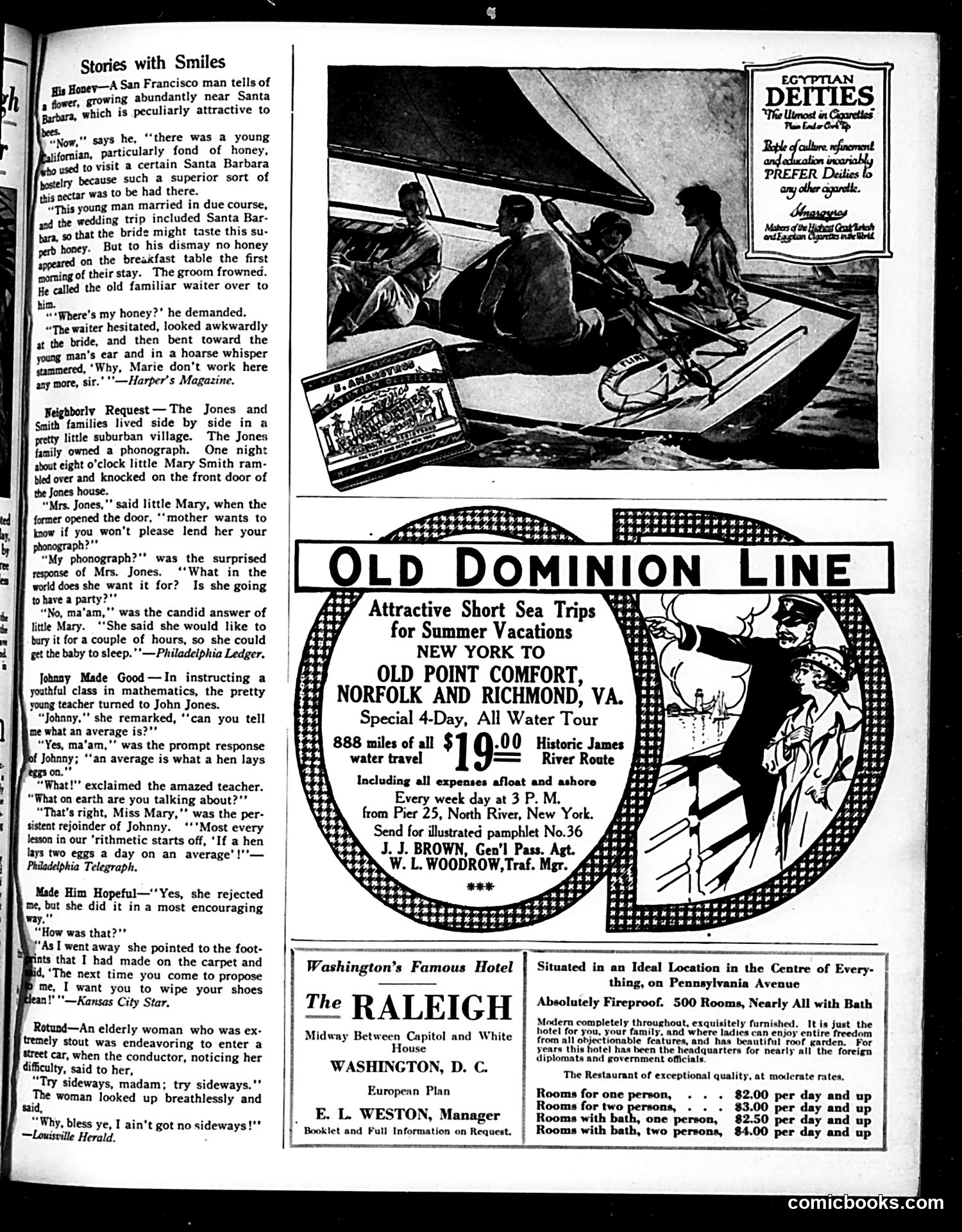
This is primarily an **advertising and humor page** from Judge magazine, typical of early 20th-century American publications. ## Content: **"Stories with Smiles"** features five brief, genteel comic anecdotes: - A newlywed's confusion when "honey" (his bride) isn't available at breakfast - A neighbor requesting to borrow a phonograph to help a baby sleep - A student defining "average" as what hens lay - A rejected suitor encouraged by footprints on a carpet - A stout woman told to enter a streetcar "sideways" These rely on wordplay, double meanings, and innocent misunderstandings—typical "clean" humor for family magazines of the era. ## Advertisements: The page prominently features travel and hotel ads: the **Old Dominion Line** (4-day Virginia cruise), and the **Raleigh Hotel** in Washington, D.C. The decorative illustration shows sailors or workers in a boat—standard maritime imagery for travel promotion. **No political satire or caricature** appears on this page. It's straightforward period advertising and light domestic humor.
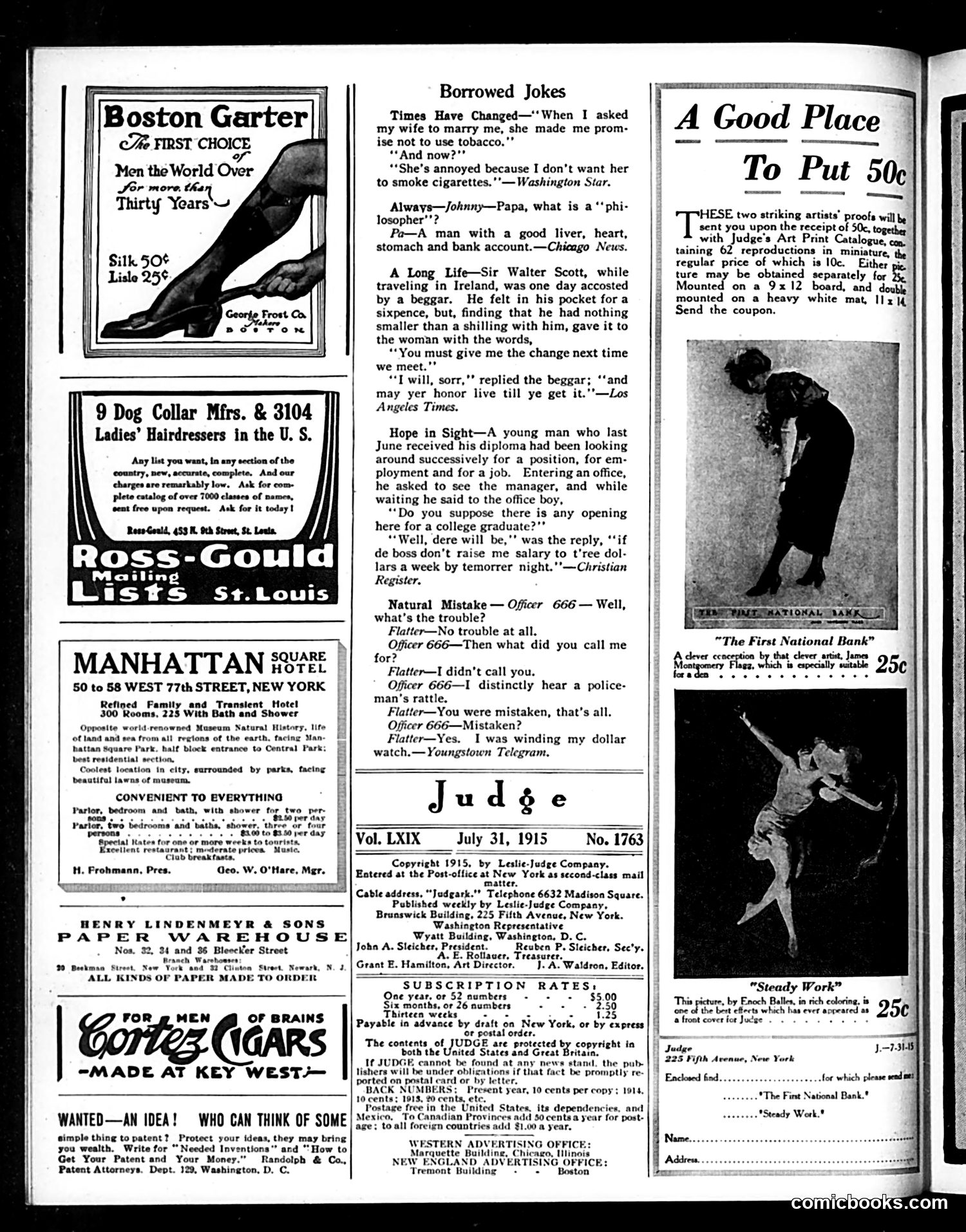
This is primarily an **advertising page** from Judge magazine, July 31, 1915, with advertisements for Boston garter hosiery, hairdressers' business lists, hotels, paper warehouses, and patent attorneys. The "Borrowed Jokes" section contains brief humor pieces reflecting **early 20th-century social attitudes**: - A joke about women's changing behavior regarding smoking and tobacco use (gender role shift) - A definition of "philosopher" as a man with good organs and money (materialist humor) - An Irish beggar anecdote about social obligation - A youth hoping for employment after graduating (post-diploma job-seeking frustration) - A misunderstanding involving a police officer and a winding watch (mistaken identity humor) These jokes reflect contemporary anxieties about **women's independence, social aspiration, immigration, employment**, and class differences. The humor is mild by modern standards—mostly puns and situational comedies without sharp political edge.
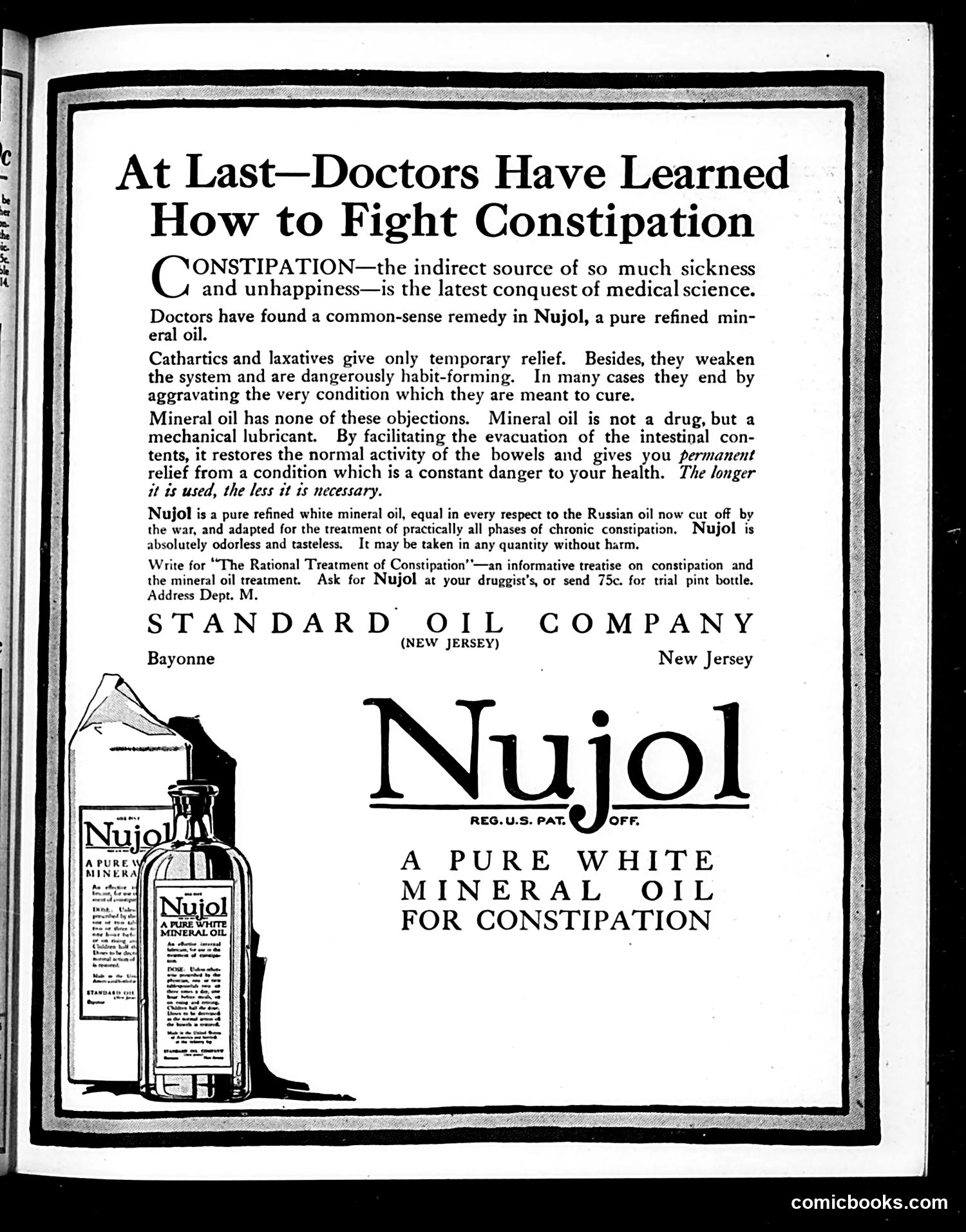
This is **not a cartoon or satire**, but a **pharmaceutical advertisement** from Standard Oil Company's Judge magazine placement. The page promotes Nujol, a mineral oil laxative. The ad makes claims typical of early-20th-century patent medicine marketing: that constipation causes widespread sickness, that traditional cathartics are dangerous and habit-forming, and that mineral oil offers a superior "mechanical" (non-drug) solution. Notable contextual elements for modern readers: - References "Russian oil now cut off by the war" (likely WWI era) - Claims the product requires no doctor and can be taken "in any quantity without harm" — assertions that would violate modern FDA regulations - Offers a free informative pamphlet, a common marketing tactic of the period - The emphasis on constipation as a major health threat reflects era-specific medical beliefs The ad represents a historical moment before strict pharmaceutical regulation, when such broad health claims and self-treatment messaging were commonplace and unregulated.
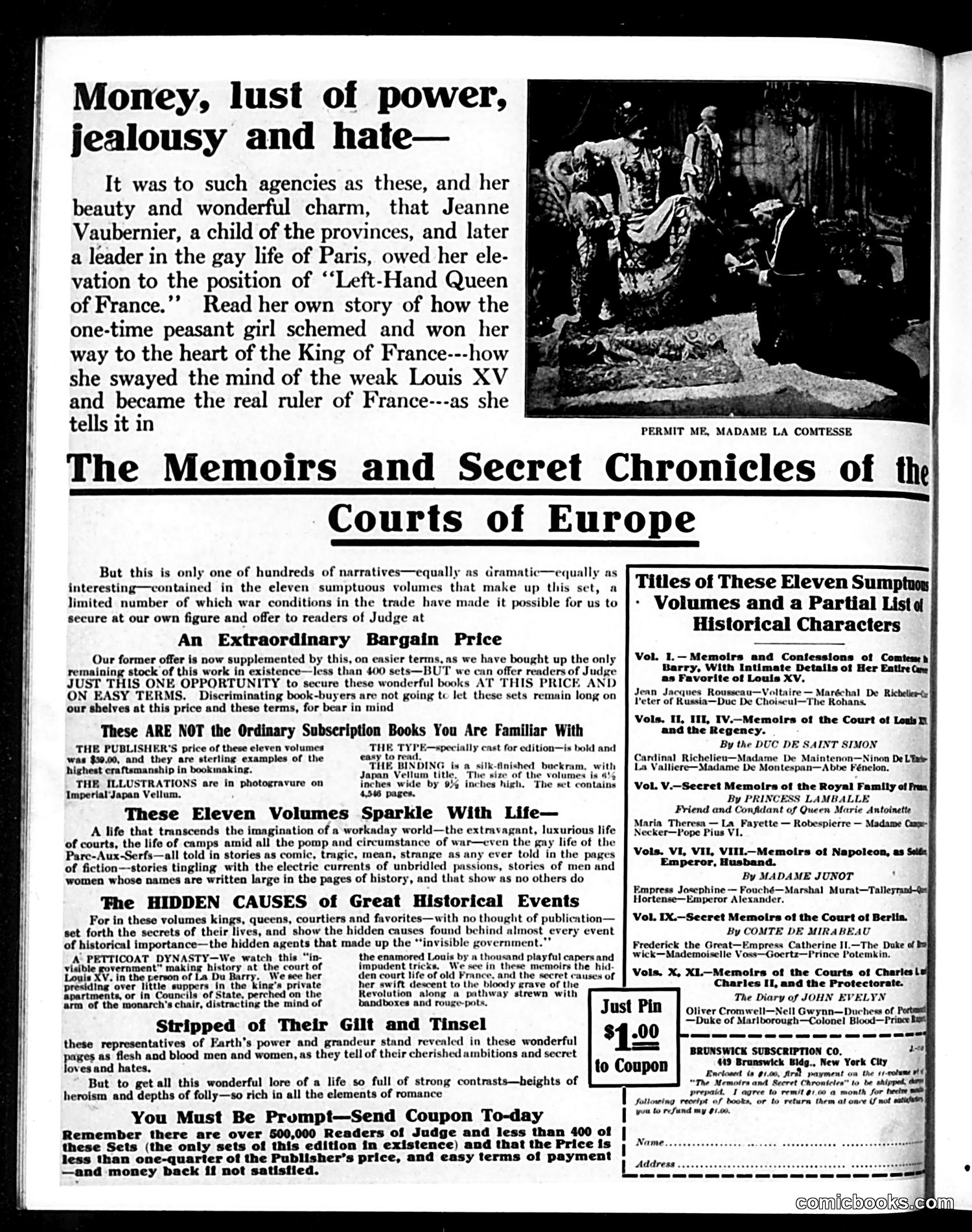
This is primarily a **book advertisement**, not a political cartoon. It promotes an eleven-volume set of purported court memoirs, using sensationalized historical narratives to attract readers. The featured subject is **Jeanne Vaubernier (Madame du Barry)**, mistress of King Louis XV of France, presented as a "one-time peasant girl" who manipulated the "weak" king and became France's true ruler through "beauty and wonderful charm." The ad emphasizes scandal and intrigue—her "swift descent to the bloody grave" during the Revolution. The appeal to Judge's 1920s readers was escapist: exotic court intrigue, "unbridled passions," and behind-the-scenes "invisible government" secrets. The framing suggests these memoirs reveal hidden historical causes through intimate revelations from the powerful themselves. This reflects period taste for sensationalized history marketed as forbidden insider knowledge—mixing class aspiration with gossip.