
Judge, 1915-07-31 · page 10 of 28
Judge — July 31, 1915 — page 10: what you’re looking at
What you’re looking at
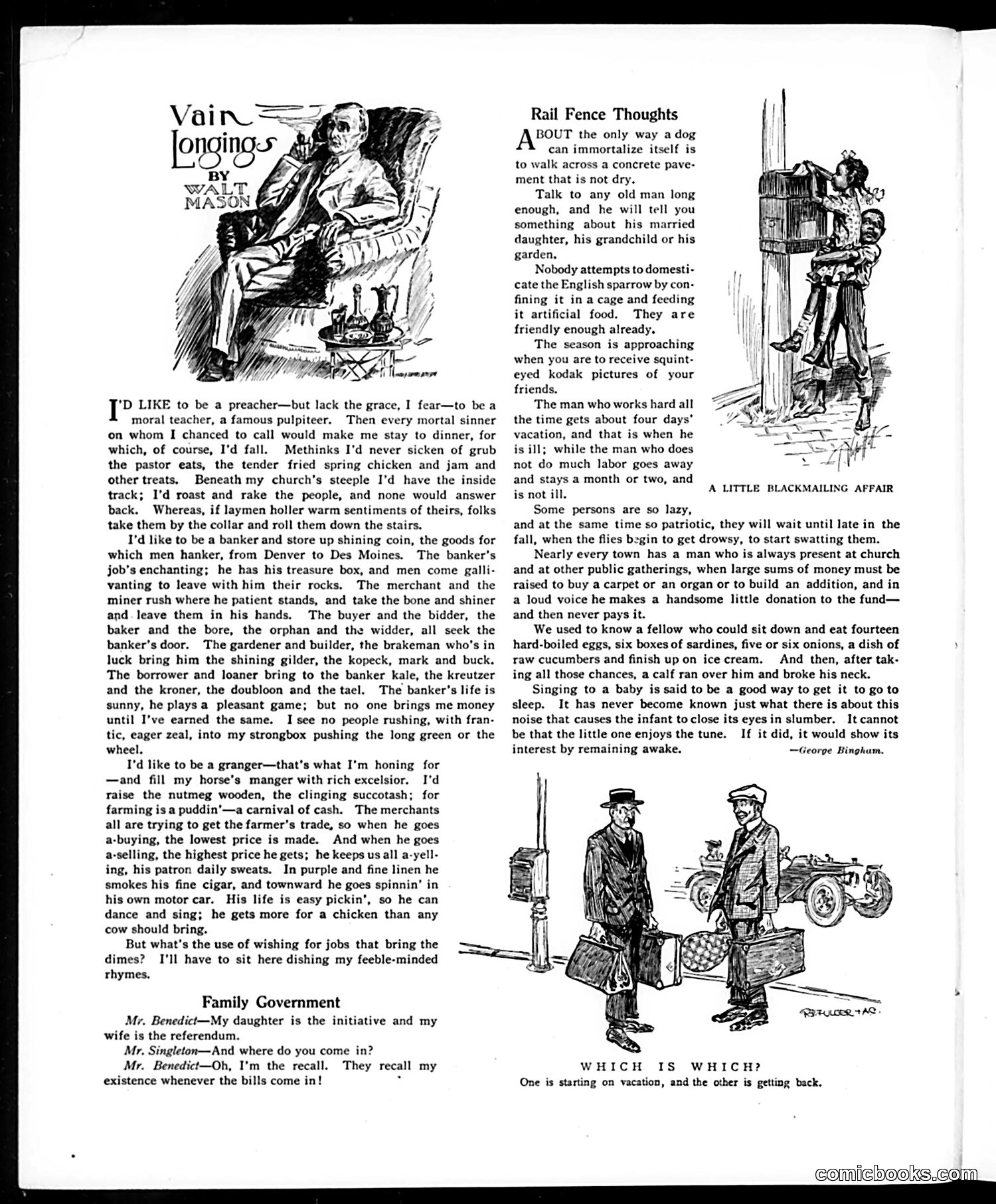
**"Vain Longings"** by Walt Mason presents a speaker fantasizing about prestigious careers—preacher, banker, farmer—while remaining in obscure poverty. The satire mocks American class aspiration: each envied profession brings effortless wealth and respect, yet the speaker lacks clients or capital to pursue them. The joke underscores economic inequality and the speaker's resignation to mediocrity. **"Family Government"** parodies Progressive Era political reforms (initiative, referendum, recall—mechanisms for direct democracy). The humor lies in applying these abstract governmental concepts to marriage: the daughter controls decisions, the wife overrides them, and the husband exists only to be "recalled" when bills arrive. It satirizes how modern democratic theory becomes domestically irrelevant to husbands' actual powerlessness. Both pieces use humor to critique American social hierarchies and changing gender dynamics during the early 20th century.
📄 Transcribed text from this page (OCR, searchable)
Machine-transcribed from the original scan — historical spelling and the odd misread are preserved.
Ae eA 1 Veepwm sere J? LIKE to be a preacher—but lack the grace, I fear—to be a moral teacher, a famous pulpiteer. Then every mortal sinner on whom I chanced to call would make me stay to dinner, for which, of course, I'd fall. Methinks I'd never sicken of grub the pastor eats, the tender fried spring chicken and jam and other treats. Beneath my church’s steeple I'd have the inside track; I'd roast and rake the people, and none would answer back. Whereas, if laymen holler warm sentiments of theirs, folks take them by the collar and roll them down the stairs. I'd like to be a banker and store up shining coin, the goods for which men hanker, from Denver to Des Moines. The banker’s job’s enchanting; he has his treasure box, and men come galli- vanting to leave with him their rocks. The merchant and the miner rush where he patient stands, and take the bone and shiner and leave them in his hands. The buyer and the bidder, the baker and the bore, the orphan and the widder, all seek the banker's door. The gardener and builder, the brakeman who's in luck bring him the shining gilder, the kopeck, mark and buck. The borrower and loaner bring to the banker kale, the kreutzer and the kroner, the doubloon and the tael. The banker's life is sunny, he plays a pleasant game; but no one brings me money until I've earned the same. I see no people rushing, with fran- tic, eager zeal, into my strongbox pushing the long green or the wheel. I'd like to be a granger—that’s what I'm honing for —and fill my horse’s manger with rich excelsior. I'd raise the nutmeg wooden, the clinging succotash; for farming is a puddin’'—a carnival of cash. The merchants all are trying to get the farmer’s trade, so when he goes a-buying, the lowest price is made. And when he goes a-selling, the highest price he gets; he keeps us all a-yell- ing, his patron daily sweats. In purple and fine linen he smokes his fine cigar, and townward he goes spinnin’ in his own motor car. His life is easy pickin’, so he can dance and sing; he gets more for a chicken than any cow should bring. But what's the use of wishing for jobs that bring the dimes? I'll have to sit here dishing my feeble-minded rhymes, Family Government Mr. Benedict—My daughter is the initiative and my wife is the referendum. Mr. Singleton—And where do you come in? Mr. Benedict—Oh, I'm the recall. They recall my existence whenever the bills come in! ® Rail Fence Thoughts | BOUT the only way a dog can immortalize itself is to walk across a concrete pave- ment that is not dry. Talk to any old man long enough, and he will tell you something about his married daughter, his grandchild or his garden. Nobody attempts to domesti- cate the English sparrow by con- fining it in a cage and feeding it artificial food. They are friendly enough already, The season is approaching when you are to receive squint- eyed kodak pictures of your friends. The man who works hard all the time gets about four days’ vacation, and that is when he is ill; while the man who does not do much labor goes away and stays a month or two, and is not ill. Some persons are so lazy, and at the same time so patriotic, they will wait until late in the fall, when the flies begin to get drowsy, to start swatting them. Nearly every town has a man who is always present at church and at other public gatherings, when large sums of money must be raised to buy a carpet or an organ or to build an addition, and in a loud voice he makes a handsome little donation to the fund— and then never pays it. We used to know a fellow who could sit down and eat fourteen hard-boiled eggs, six boxes of sardines, five or six onions, a dish of raw cucumbers and finish up on ice cream. And then, after tak- ing all those chances, a calf ran over him and broke his neck. Singing to a baby is said to be a good way to get it to goto sleep. It has never become known just what there is about this noise that causes the infant to close its eyes in slumber. It cannot be that the little one enjoys the tune. If it did, it would show its interest by remaining awake. —George Bingham. A LITTLE BLACKMAILING AFFAIR WHICH One is starting on vacation, and the other is getting back. IS WHICH? comichooks.