
Judge, 1915-07-31 · page 11 of 28
Judge — July 31, 1915 — page 11: what you’re looking at
What you’re looking at
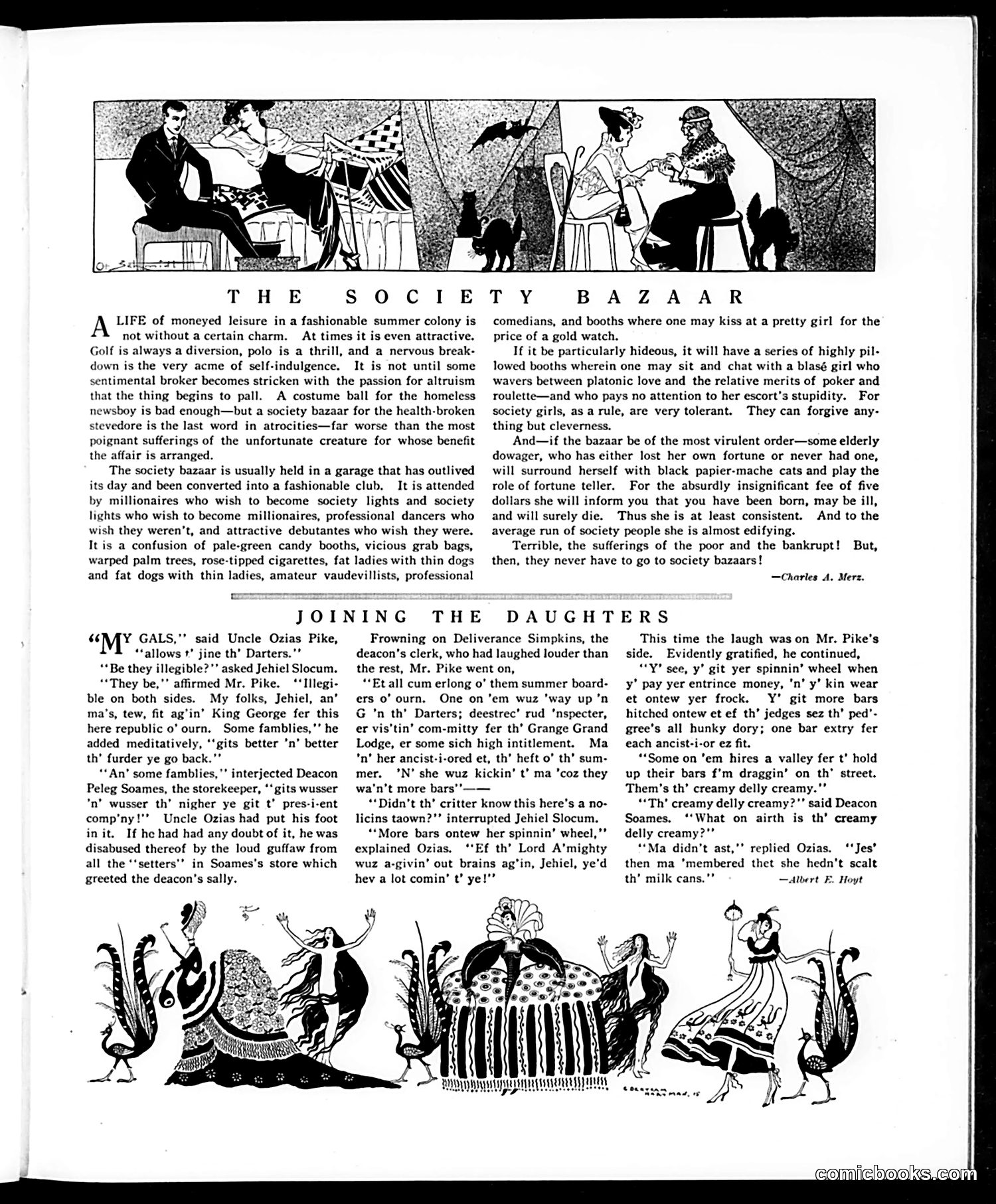
This page contains two satirical pieces mocking wealthy leisure culture. **"The Society Bazaar"** (top) ridicules fashionable summer colonies where rich people organize charity fundraisers ostensibly for the poor but really as social events for themselves. The author criticizes the pretense and absurdity: millionaires wanting to "become society lights," debutantes wishing they were different, and a fortune-teller dowager who "plays the role" while charging five dollars to tell people they'll die. The satire targets the gap between charitable intent and self-interested performance. **"Joining the Daughters"** (bottom) is a dialect-heavy rural humor piece where Uncle Ozias Pike boasts his family's Revolutionary War ancestry qualifies them for "the Daughters" (likely the Daughters of the American Revolution). A visiting summer boarder criticizes his ancestor's accomplishments, and Pike jokes that if God were "a-givin' out brains ag'in," the boarder would "have a lot comin'"—mocking both social-climbing pretension and outsider condescension toward rural folk.
📄 Transcribed text from this page (OCR, searchable)
Machine-transcribed from the original scan — historical spelling and the odd misread are preserved.
THE LIFE of moneyed leisure in a fashionable summer colony is not without a certain charm. At times it is even attractive. Golf is always a diversion, polo is a thrill, and a nervous break- down is the very acme of self-indulgence. It is not until some sentimental broker becomes stricken with the passion for altruism that the thing begins to pall. A costume ball for the homeless newsboy is bad enough—but a society bazaar for the health-broken. stevedore is the last word in atrocities—far worse than the most poignant sufferings of the unfortunate creature for whose benefit the affair is arranged. The society bazaar is usually held in a garage that has outlived its day and been converted into a fashionable club. It is attended by millionaires who wish to become society lights and society lights who wish to become millionaires, professional dancers who wish they weren’t, and attractive debutantes who wish they were. It is a confusion of pale-green candy booths, vicious grab bags, warped palm trees, rose-tipped cigarettes, fat ladies with thin dogs and fat dogs with thin ladies, amateur vaudevillists, professional SOCIETY BAZAAR comedians, and booths where one may kiss at a pretty girl for the price of a gold watch. If it be particularly hideous, it will have a series of highly pil- lowed booths wherein one may sit and chat with a blasé girl who wavers between platonic love and the relative merits of poker and roulette—and who pays no attention to her escort’s stupidity. For society girls, as a rule, are very tolerant. They can forgive any- thing but cleverness. And—if the bazaar be of the most virulent order—some elderly dowager, who has either lost her own fortune or never had one, will surround herself with black papier-mache cats and play the role of fortune teller. For the absurdly insignificant fee of five dollars she will inform you that you have been born, may be ill, and will surely die. Thus she is at least consistent. And to the average run of society people she is almost edifying. Terrible, the sufferings of the poor and the bankrupt! then, they never have to go to society bazaars! —Charles A, Merz. But, SEEN séMAY GALS,"’ said Uncle Ozias Pike, “allows t’ jine th’ Darters.’’ “*Be they illegible?’’ asked Jehiel Slocum. “They be,’’ affirmed Mr. Pike. ‘‘Illegi- ble on both sides. My folks, Jehiel, an’ ma’s, tew, fit ag’in’ King George fer this here republic 0’ ourn. Some famblies,’’ he added meditatively, ‘‘gits better 'n’ better th’ furder ye go back."" **An’ some fambli interjected Deacon Peleg Soames, the storekeeper, ‘*gits wusser ‘n’ wusser th’ nigher ye git t’ pres-i-ent comp'ny!"? Uncle Ozias had put his foot in it. If he had had any doubt of it, he was disabused thereof by the loud guffaw from all the ‘‘setters’’ in Soames's store which greeted the deacon’s sally. Frowning on Deliverance Simpkins, the deacon's clerk, who had laughed louder than the rest, Mr. Pike went on, “Et all cum erlong o’ them summer board- ers o’ ourn. One on ’em wuz ’way up ’n G 'n th’ Darters; deestrec’ rud ‘nspecter, er vis’tin’ com-mitty fer th’ Grange Grand Lodge, er some sich high intitlement. Ma ‘n’ her ancist-i-ored et, th’ heft o’ th’ sum- mer. ’N’ she wuz kickin’ t’ ma ’coz they wa'n’t more bars'’—— “*Didn’t th’ critter know this here's a no- licins taown?”’ interrupted Jehiel Slocum. **More bars ontew her spinnin’ wheel,’’ explained Ozias. ‘‘Ef th’ Lord A’mighty wuz a-givin’ out brains ag’in, Jehiel, ye'd hev a lot comin’ t’ ye!"’ JOINING THE DAUGHTERS This time the laugh was on Mr. Pike's side. Evidently gratified, he continued, “Y" see, y’ git yer spinnin’ wheel when y’ pay yer entrince money, 'n’ y’ kin wear et ontew yer frock. Y'’ git more bars hitched ontew et ef th’ jedges sez th’ ped’- gree’s all hunky dory; one bar extry fer each ancist-i-or ez fit. “*Some on ‘em hires a valley fer t’ hold up their bars f’m draggin’ on th’ street. Them's th’ creamy delly creamy.'’ “Th’ creamy delly creamy?"’ said Deacon Soames. ‘What on airth is th’ creamy delly creamy?"’ “*Ma didn’t ast,’’ replied Ozias. ‘‘Jes’ then ma 'membered thet she hedn't scalt th’ milk cans."’ —Albert FE. Hoyt