
Judge, 1915-07-31 · page 17 of 28
Judge — July 31, 1915 — page 17: what you’re looking at
What you’re looking at
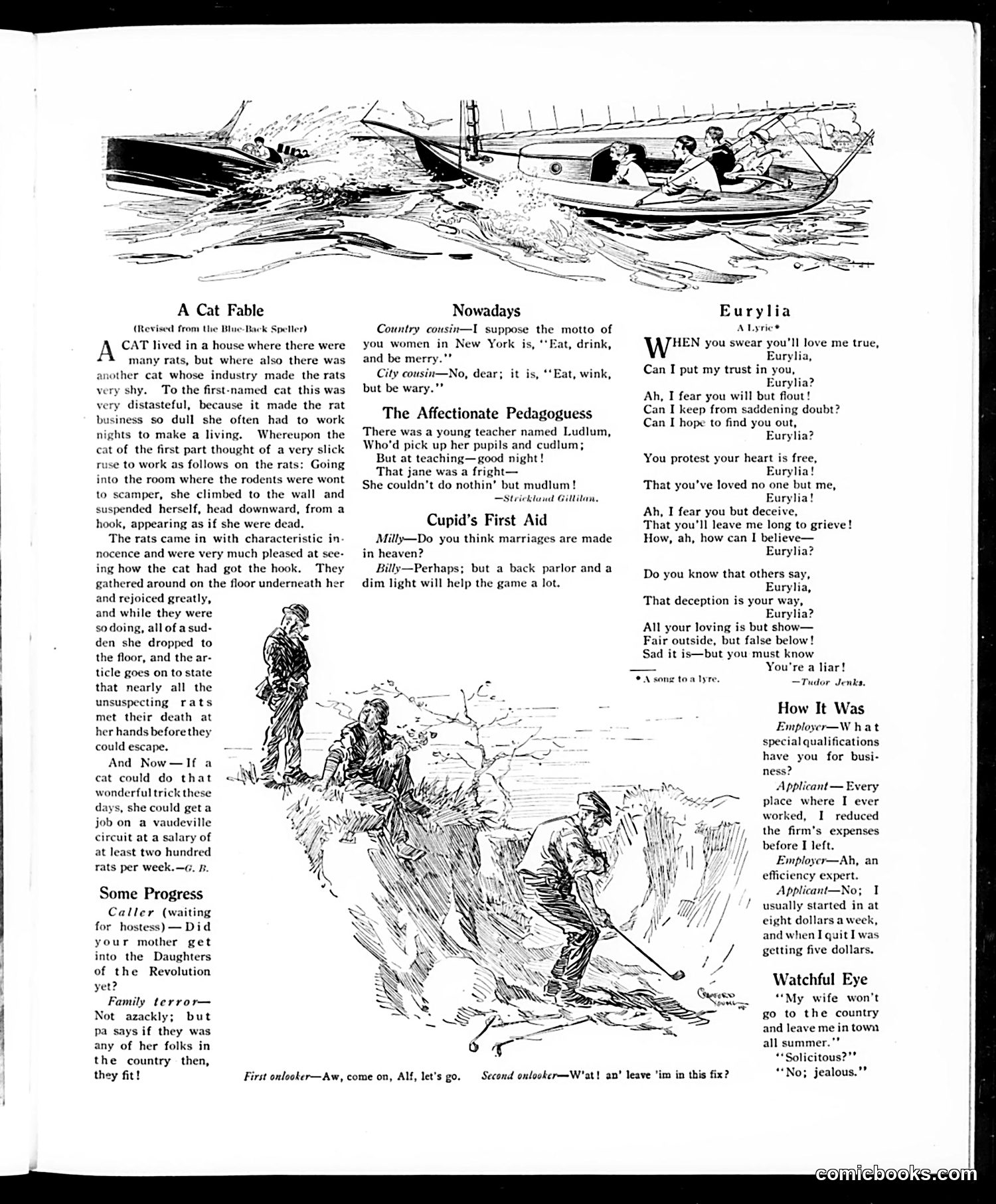
This page contains several short satirical pieces typical of early 20th-century humor: **"A Cat Fable"** mocks modern employment by extending a Aesop's fable: a clever cat tricks rats by feigning death. The joke concludes that such a deceptive performer could earn good money on the vaudeville circuit—satirizing both the entertainment industry's rewards for cunning and the precarious "rat race" of modern work. **"Some Progress"** jokes about American genealogy obsession. A caller asks if someone's mother joined the Daughters of the Revolution (a prestigious hereditary society). The response suggests that while the family has no documented ancestors in America, they were definitely fighters if they were present—poking fun at working-class families' lack of documented pedigree while sardonically claiming martial ancestry. The remaining pieces are light romantic/domestic humor: a pedagogical joke, a cynical dialogue about marriage, a love song expressing jealous suspicion, job interview humor about cost-cutting, and marital jealousy. None reference specific political events; instead, they target universal social pretensions and relationship dynamics.
📄 Transcribed text from this page (OCR, searchable)
Machine-transcribed from the original scan — historical spelling and the odd misread are preserved.
A Cat Fable (Revised from the Bluc-Rack Speller) CAT lived in a house where there were many rats, but where also there was another cat whose industry made the rats very shy. To the first-named cat this was very distasteful, because it made the rat business so dull she often had to work nights to make a living. Whereupon the cat of the first part thought of a very slick ruse to work as follows on the rats: Going into the room where the rodents were wont to scamper, she climbed to the wall and suspended herself, head downward, from a hook, appearing as if she were dead. The rats came in with characteristic in- nocence and were very much pleased at see- ing how the cat had got the hook. They gathered around on the floor underneath her and rejoiced greatly, and while they were so doing, all of asud- den she dropped to the floor, and the ar- ticle goes on to state that nearly all the unsuspecting rats met their death at her hands before they could escape. And Now—If a, cat could do that <1} wonderful trick these days, she could get a job on a vaudeville circuit at a salary of at least two hundred rats per week.—@. B. Some Progress Caller (waiting for hostess) — Did your mother get into the Daughters of the Revolution yet? Family terror— Not azackly; but pa says if they was any of her folks in the country then, they fit! First onlooker—Aw, come on, Alf, let's go. Nowadays Country cousin—I suppose the motto of you women in New York is, ‘Eat, drink, and be merry City cousin—No, dear; it is, ‘Eat, wink, but be wary."” The Affectionate Pedagoguess There was a young teacher named Ludlum, Who'd pick up her pupils and cudlum; But at teaching—good night! That jane was a fright— She couldn't do nothin’ but mudlum! Strickland Gillitan, Cupid’s First Aid Milly—Do you think marriages are made in heaven? Billy—Perhaps; but a back parlor and a dim light will help the game a lot. Second onlooker—W'at! an’ leave ‘im in this fix? Eurylia ALyric® HEN you swear you'll love me true, Eurylia, Can I put my trust in you, Eurylia? Ah, I fear you will but fiout! Can I keep from saddening doubt? Can I hope to find you out, Eurylia? You protest your heart is free, Eurylia! That you've loved no one but me, Eurylia! Ah, I fear you but deceive, That you'll leave me long to grieve! How, ah, how can I believe— Eurylia? Do you know that others say, Eurylia, That deception is your way Eurylia? All your loving is but show— Fair outside, but false below! Sad it is—but you must know You're a liar! * A song toa lyre. —Tudor Jenks. How It Was Emple special qual have you for busi- ness? pplicant — Every place where I ever worked, I reduced the firm's expenses before I left. Employer—Ah, an efficiency exper Applicant—: usually started in at eight dollars a week, and when I quit I was getting five dollars. Watchful Eye “My wife won't go to the country and leave me in town all summer. **Solicitous?”* **No; jealous.’