
A complete issue · 28 pages · 1915
Judge — July 24, 1915
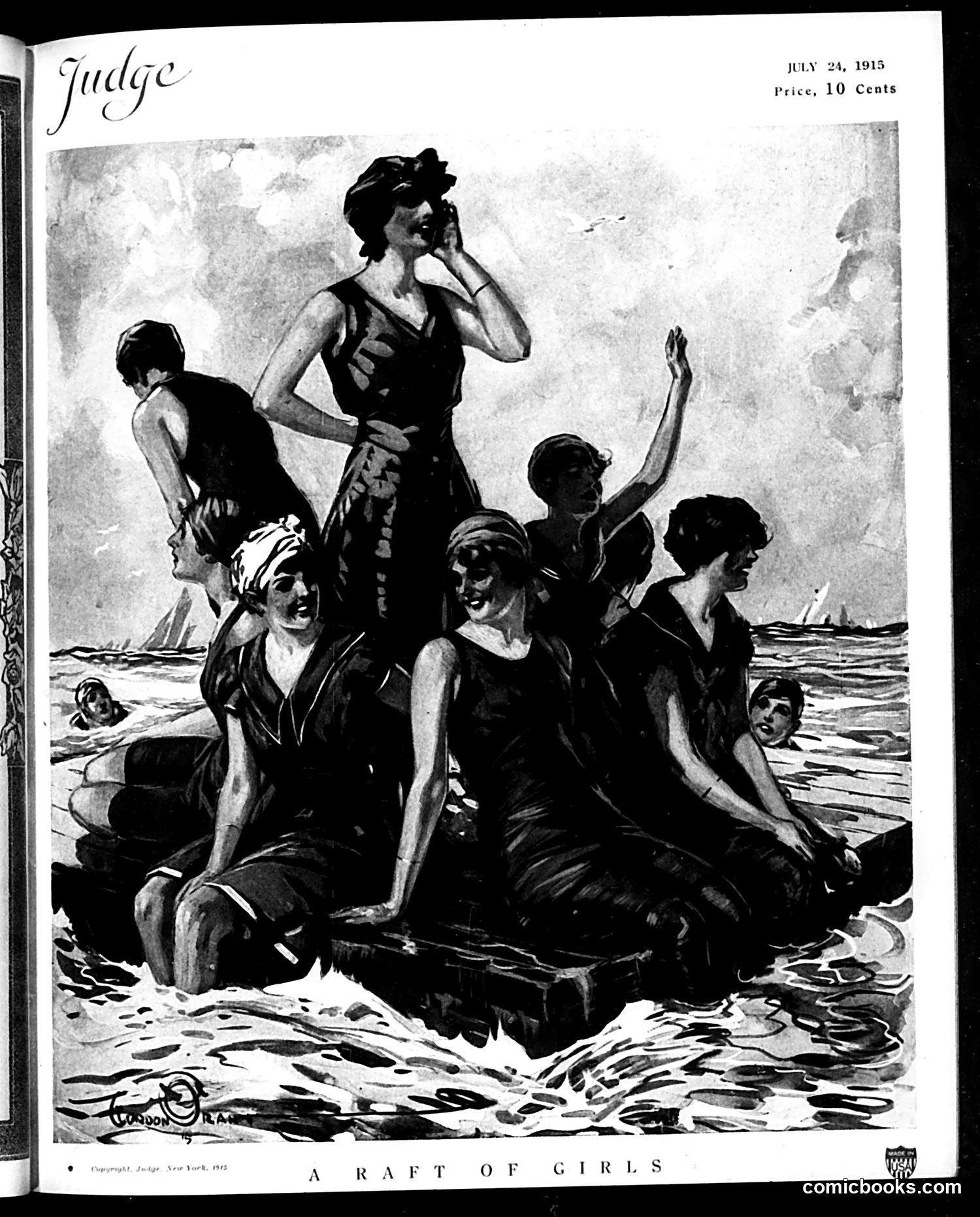
This July 1915 cartoon depicts a group of women on a raft at sea, with one woman standing and gesturing dramatically while others sit or recline around her. The title "A Raft of Girls" suggests a shipwreck scenario. Given the date and *Judge* magazine's satirical nature, this likely comments on women's roles or behavior during the era. The composition—with one woman commanding attention while others appear distressed or dependent—may satirize contemporary anxieties about women's independence or changing social roles during the Progressive Era. The dramatic posturing could mock either women's perceived histrionics or, conversely, critique male assumptions about female helplessness in crisis situations. Without additional context, the specific event or social commentary remains unclear.
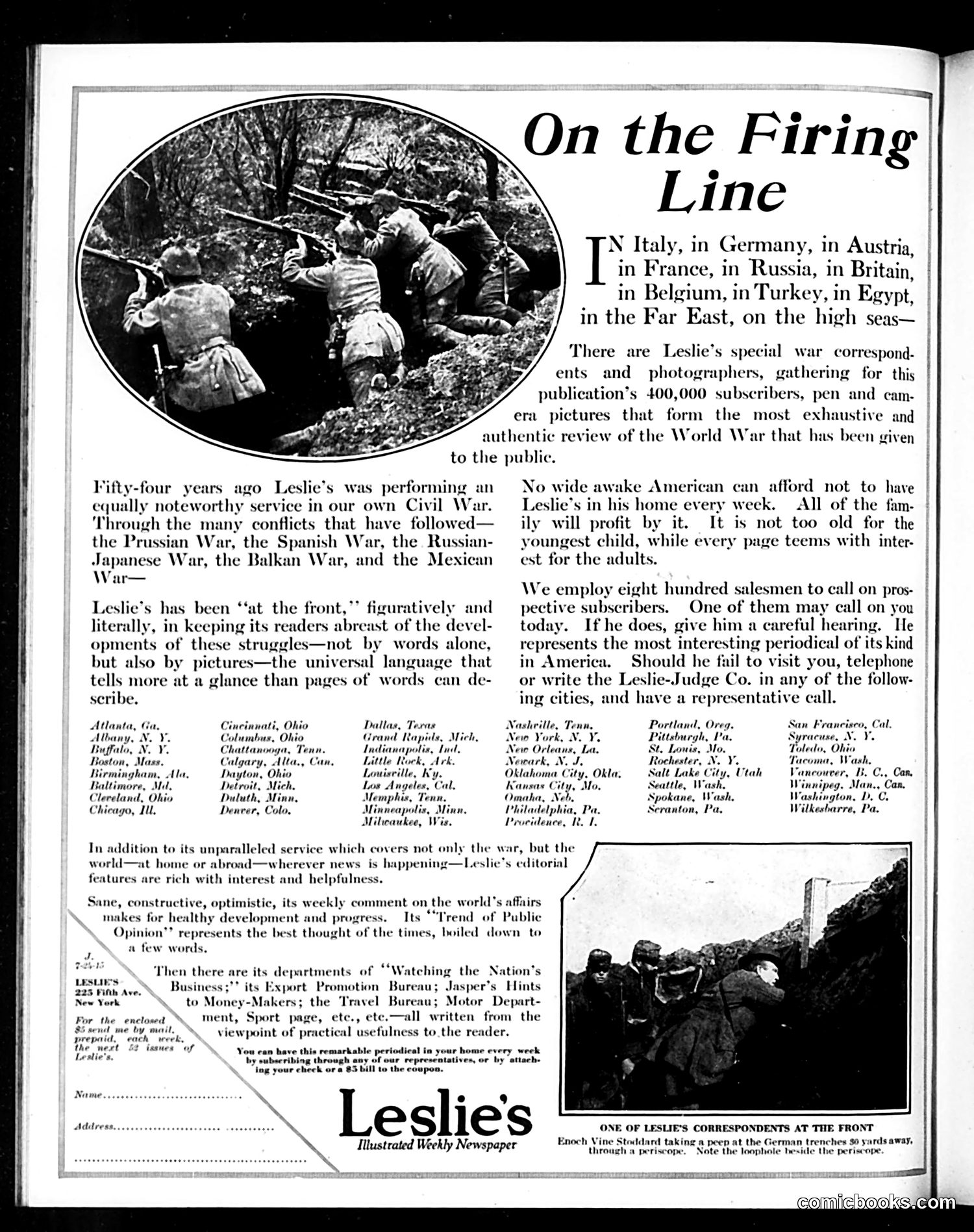
This page is primarily **advertising copy** for Leslie's Illustrated Weekly Newspaper during World War I. The text boasts that Leslie's employs war correspondents and photographers across multiple theaters—Italy, Germany, Austria, France, Russia, Britain, Belgium, Turkey, Egypt, and the Far East—to provide readers with authentic coverage of the conflict. The left oval photograph shows soldiers in a trench, exemplifying the frontline documentation Leslie's claims to offer. The right photograph shows a correspondent at the front observing German trenches through a periscope. The advertisement emphasizes Leslie's 54-year history covering major conflicts and appeals to American subscribers' patriotic duty to stay informed about the war. It includes a subscription coupon and lists 800+ salesmen available to solicit new subscribers across major American cities.
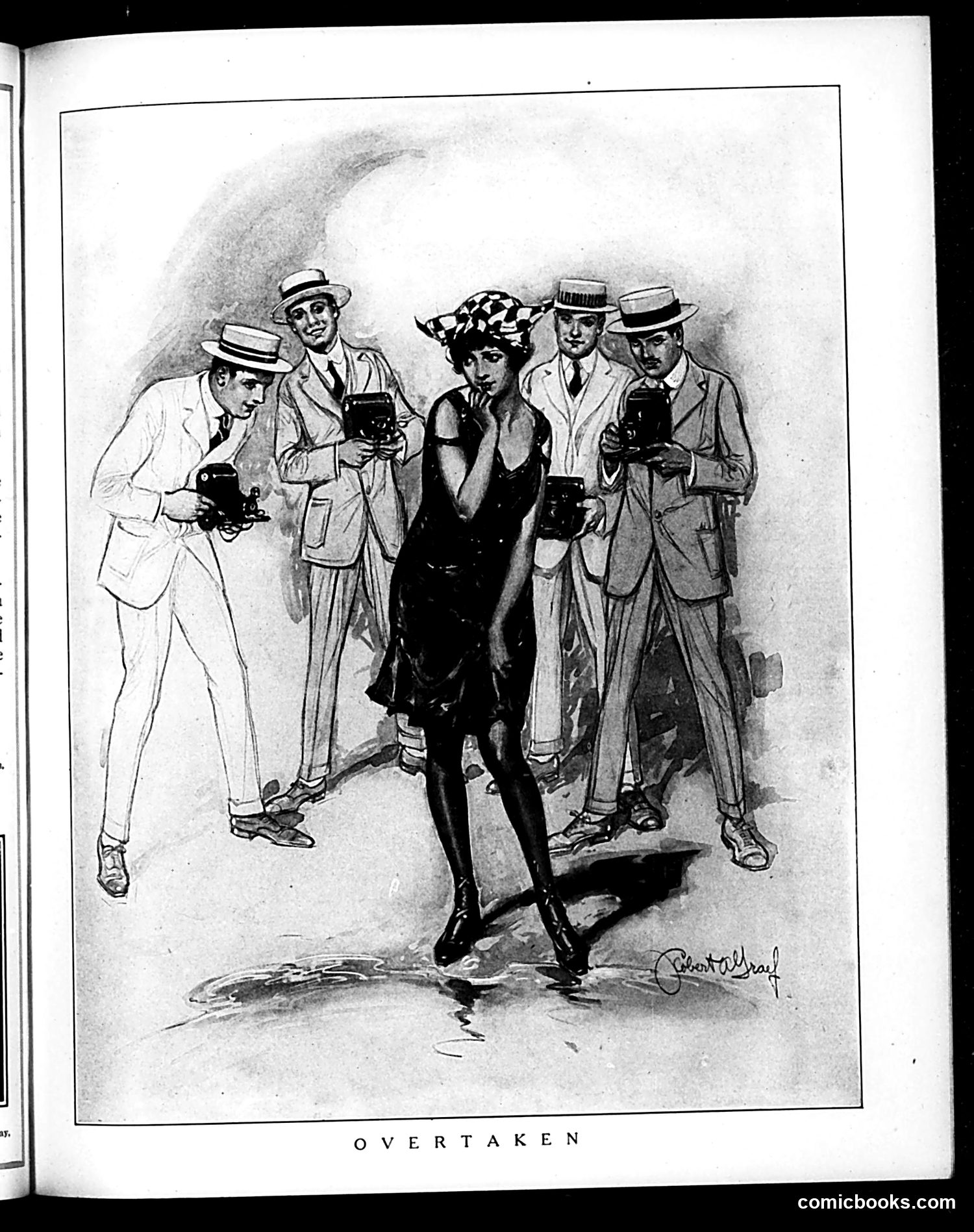
This cartoon depicts five men in suits and straw hats surrounding a woman in a dark dress and wide hat, all holding cameras. The title "Overtaken" suggests the satire's subject: the relentless pursuit of a woman by photographers or journalists. The image satirizes the invasive nature of press photography and paparazzi culture in the early 20th century. The woman appears cornered or overwhelmed by the cameramen closing in from all sides, illustrating how subjects—likely celebrities or society figures—were pursued aggressively by the media. This reflects Judge magazine's commentary on the growing power of photography and journalism, and how their practitioners could hound individuals. The cartoon critiques both the photographers' aggressive tactics and the broader cultural obsession with capturing images of notable figures.
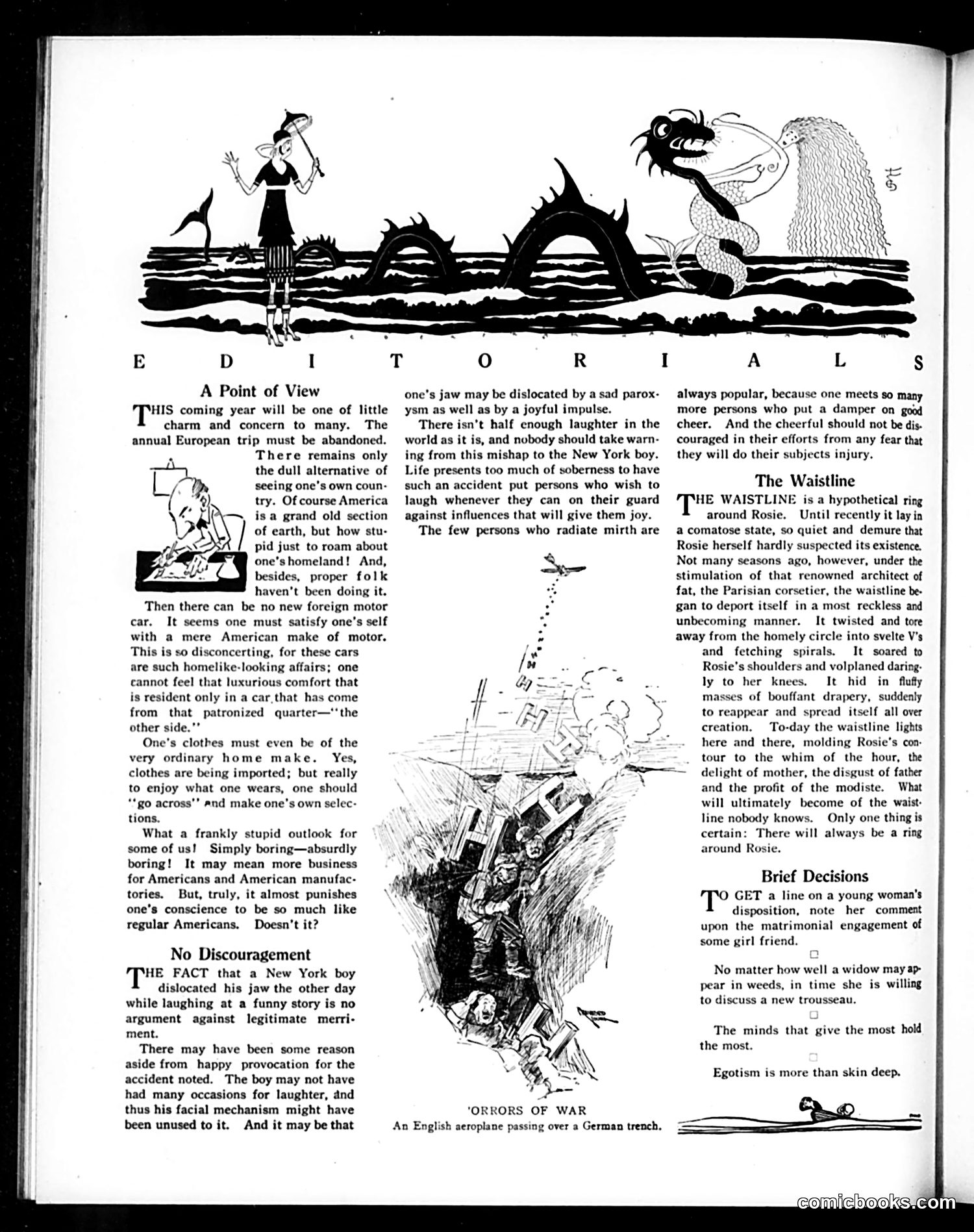
This page contains three distinct sections: **Top Illustration ("Editorials"):** A satirical drawing of a sea serpent labeled with letters spelling "EDITORIALS," mocking sensationalist newspaper stories about the legendary creature. **Middle Section ("A Point of View"):** Editorial commentary criticizing Americans' obsession with European travel and foreign motor cars, arguing this shows lack of patriotism and self-confidence in American manufacturing and culture. **Right Column ("The Waistline" and "Brief Decisions"):** A fashion critique about women's corsets (the "waistline" around a character named Rosie) becoming distorted and unflattering, followed by brief aphoristic statements about relationships and human nature. **Bottom Illustration ("Errors of War"):** A sketch showing an English airplane over a German trench during World War I. The page reflects early 20th-century American attitudes toward consumerism, patriotism, women's fashion, and WWI.
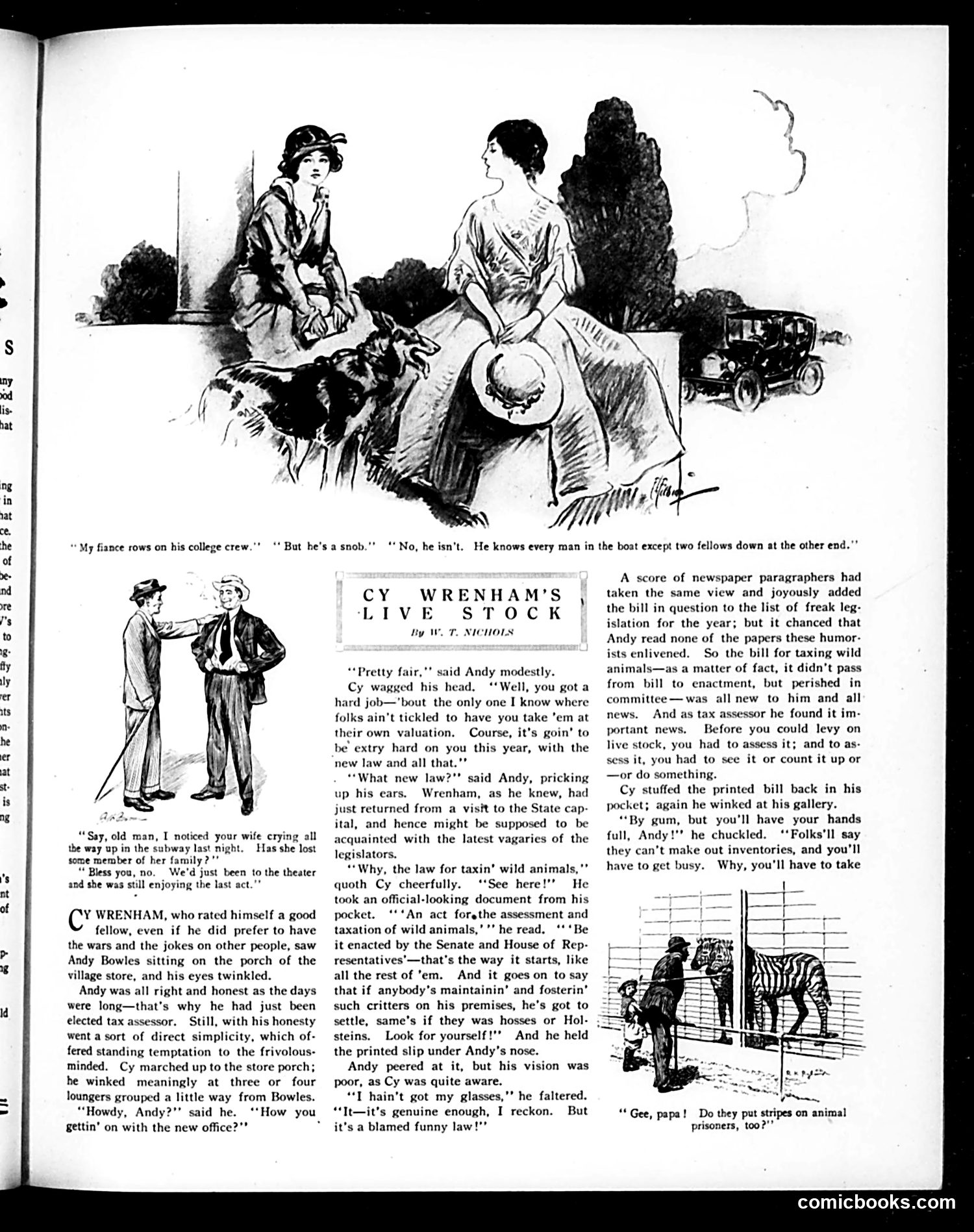
This story satirizes a naive legislator named Cy Wrenham who naively supports a bill taxing wild animals. The humor centers on Cy's innocent misunderstanding of legislative complexity: he believes the law will straightforwardly assess taxes on wild creatures kept on premises. His friend Andy Bowles mocks him, explaining that such legislation inevitably becomes riddled with loopholes and unintended consequences—"it goes on to say that if anybody's maintainin' and fosterin' such critters...he's got to settle." The cartoon illustrates the gap between legislative intent and practical reality, poking fun at well-meaning but politically unsophisticated rural legislators who don't grasp how special interests exploit bills for personal advantage.
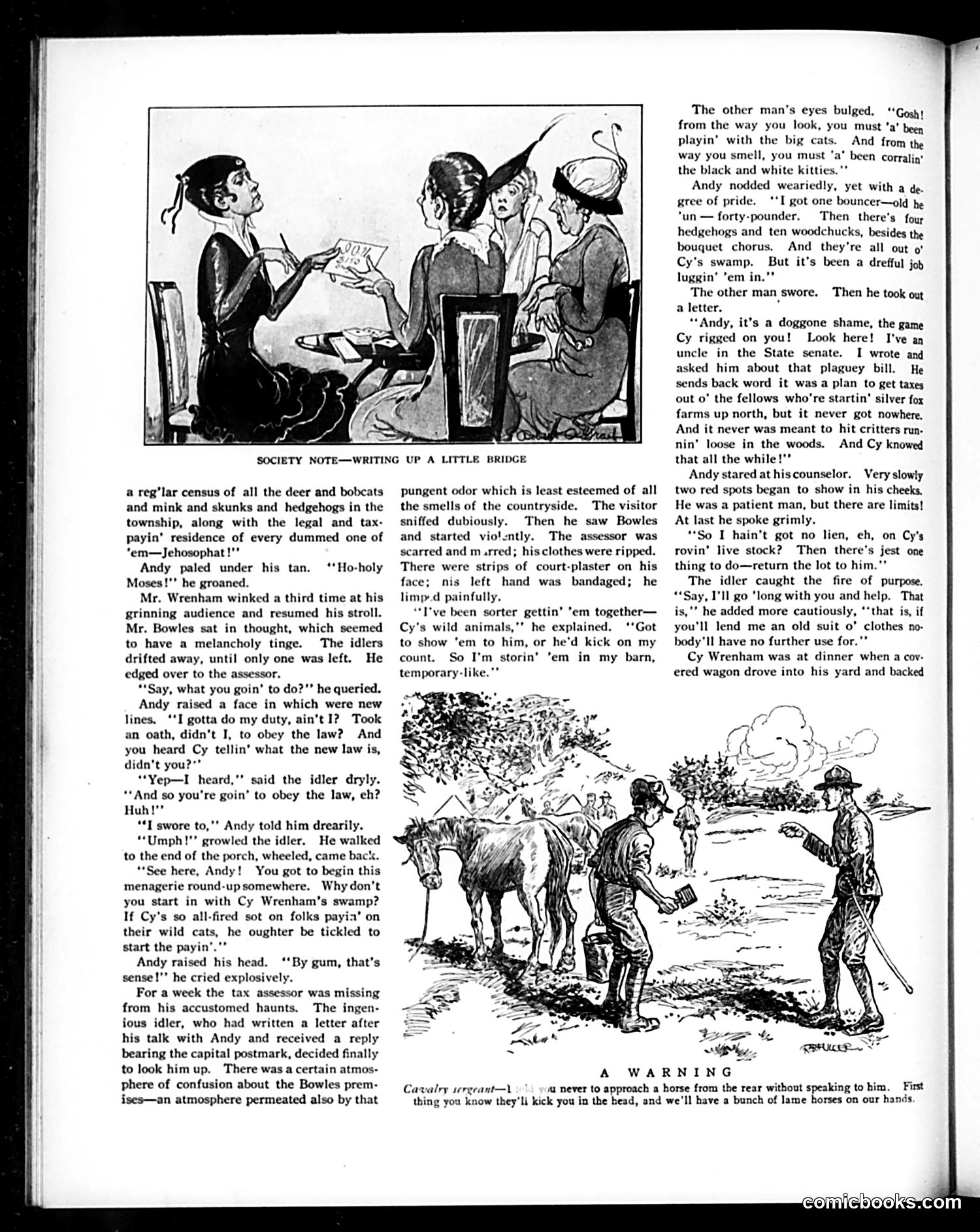
This Judge magazine story satirizes small-town politics and the unintended consequences of poorly conceived legislation. The plot: A new state tax law targeting silver fox farms (a trendy agricultural venture) inadvertently applies to *all* wild animals. Tax assessor Andy Bowles, bound by oath, must catalog Cy Wrenham's livestock—which includes deer, bobcats, skunks, and hedgehogs living wild on his property. Cy, who championed the law, maliciously suggests Andy start collecting from Cy's swamp, knowing it will be a nightmare. **The satire**: The joke mocks both bureaucratic overreach and political hypocrisy. Cy gets the last laugh by weaponizing his own legislation against the honest assessor. Andy ends up badly injured collecting dangerous animals, discovering the law was never meant to apply this way. The irony: An uncle in the state senate confirms the bill was targeting northern silver fox farmers, not local wildlife—yet Cy "knowed that all the while." The humor derives from rural characters outsmarting each other through technicalities while innocent Andy suffers the consequences.
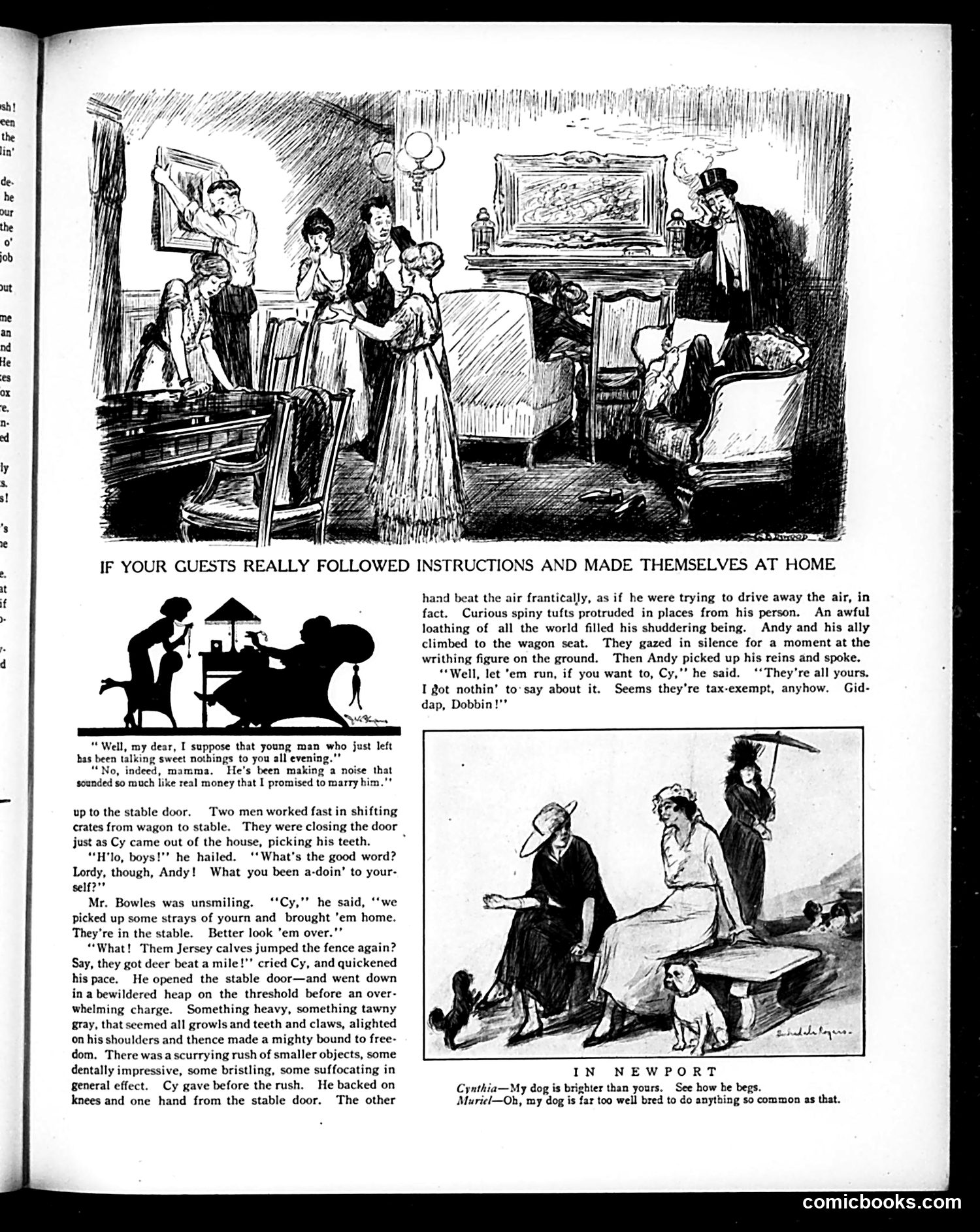
This page contains two separate satirical pieces: **Top cartoon:** "If Your Guests Really Followed Instructions and Made Themselves at Home" depicts chaos when literal hospitality goes wrong—guests treating a host's home as their own, with children climbing furniture and running wild. The satire mocks the common social phrase "make yourself at home," showing absurd consequences. **Middle story:** A rural prank narrative where city visitors (Mr. Bowles and Andy) trick a farmer named Cy by releasing wild animals—apparently a lion or large cat plus smaller creatures—from his stable. The humor targets rural naiveté and city-folk trickery, with Andy's final joke about the animals being "tax-exempt" (unable to be caught/controlled by law) adding wordplay. **Bottom cartoon:** "In Newport" satirizes wealthy leisure-class pretension. Two socialites compare their dogs' breeding/manners, with one claiming superior breeding because her dog refuses to beg—an absurd measure of status and refinement among the idle rich. The overall page mocks both rural gullibility and urban/upper-class affectation.
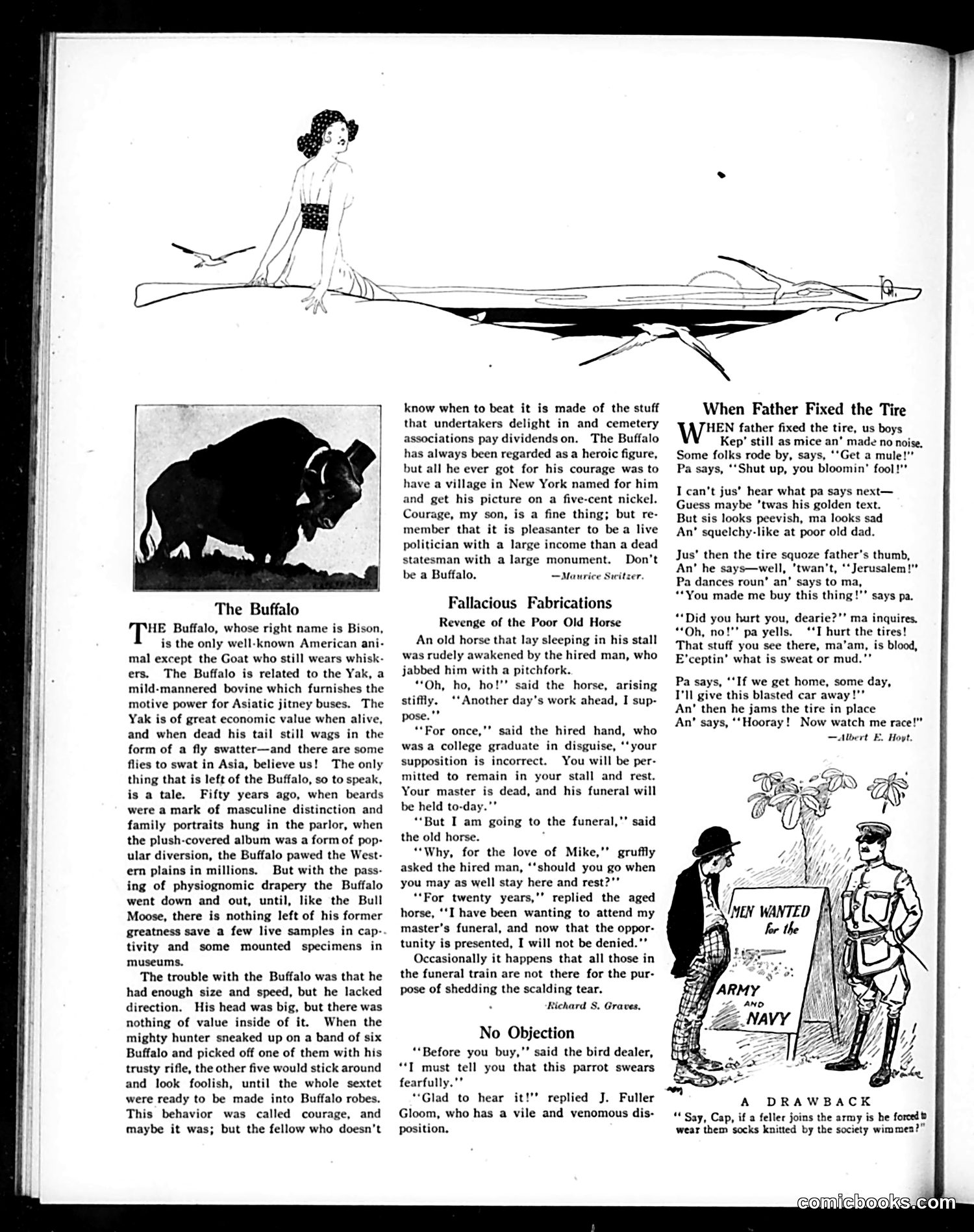
This page from *Judge* contains several humorous pieces satirizing American life and character. **"The Buffalo"** is a moral allegory comparing the extinct buffalo to foolish human behavior. The author argues buffaloes lacked direction and intelligence—they'd stand around after one was shot instead of fleeing. The satire suggests Americans shouldn't emulate such "courage"; it's better to be "a live politician with a large income than a dead statesman with a large monument." This critiques blind patriotism and reckless sacrifice. **"Fallacious Fabrications"** presents three joke vignettes mocking human pretension: a horse wanting to attend his master's funeral (ironic devotion), and a bird dealer selling a profane parrot to a man with a "vile and venomous disposition" (suggesting he'll fit right in). **"When Father Fixed the Tire"** humorously depicts a father's profanity-laden frustration while repairing a car tire, with his family uncomfortable at his outbursts—poking fun at working-class masculinity and automobile-age domestic chaos. The satirical tone throughout targets human foolishness rather than specific political targets.
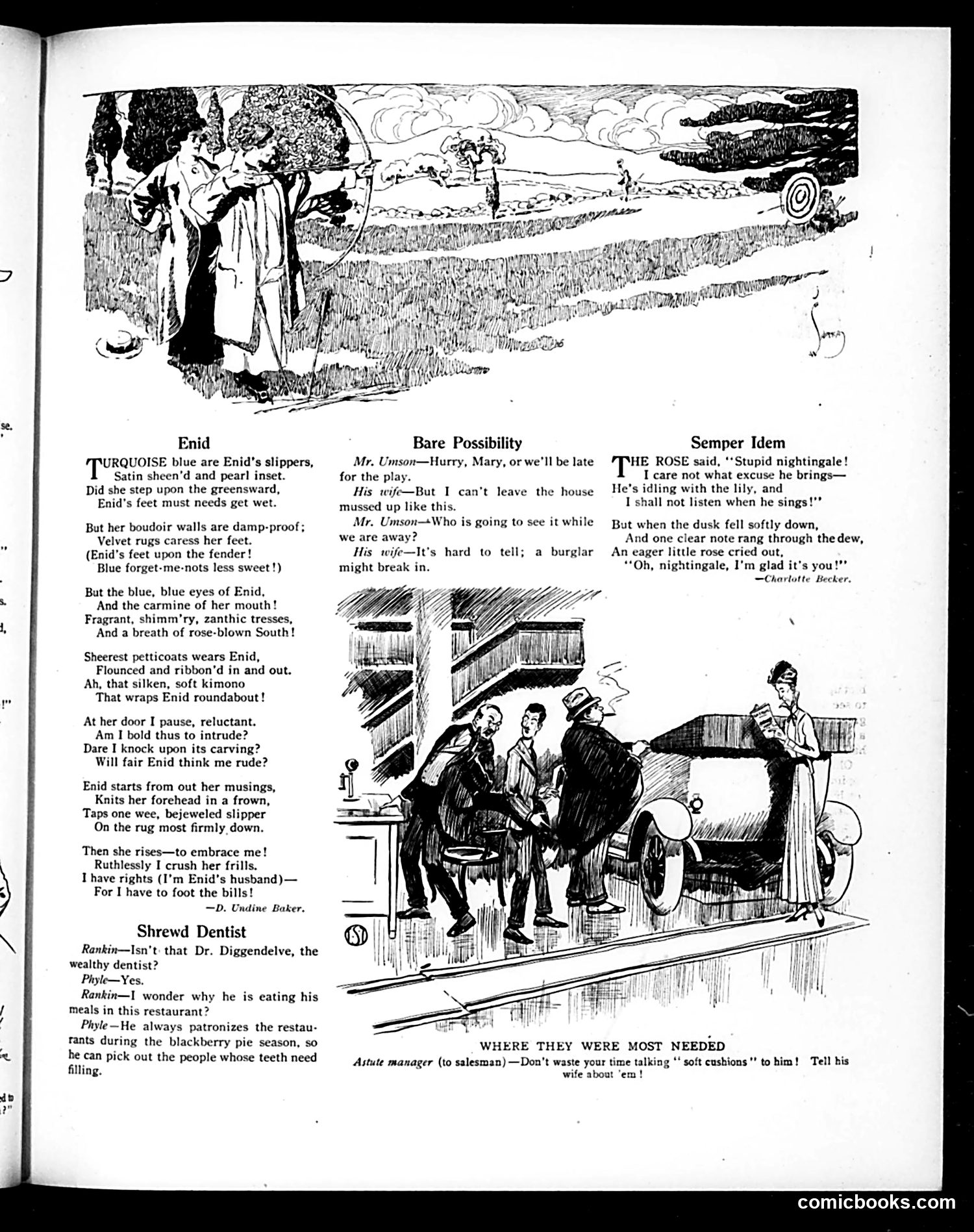
This page contains four separate humorous pieces typical of early 20th-century satirical magazines: **"Enid"** mocks the disparity between romantic idealization and marital reality. A poem describes a woman's luxurious appearance and delicate furnishings, building romantic anticipation—until the reveal: her husband crushes her carefully arranged appearance because he "has to foot the bills," asserting husbandly rights over aesthetic concerns. The satire targets both sentimental romanticism and marital power dynamics. **"Shrewd Dentist"** jokes darkly about professional opportunism: a wealthy dentist eats at restaurants during blackberry pie season specifically to identify customers with bad teeth needing expensive dental work. **"Bare Possibility"** plays on domestic anxiety: a husband wants to leave for the theater, but the wife refuses because she's worried a burglar might break in—to an already messy house. The joke targets household vanity as absurdly prioritized over practical security. **"Semper Idem"** offers sentimental poetry about a rose rejecting a nightingale's song until hearing it at dusk, then welcoming him—satirizing fickleness and inconsistency. The bottom cartoon about "soft cushions" suggests salesmen should appeal to wives' comfort preferences rather than husbands' purchasing decisions.
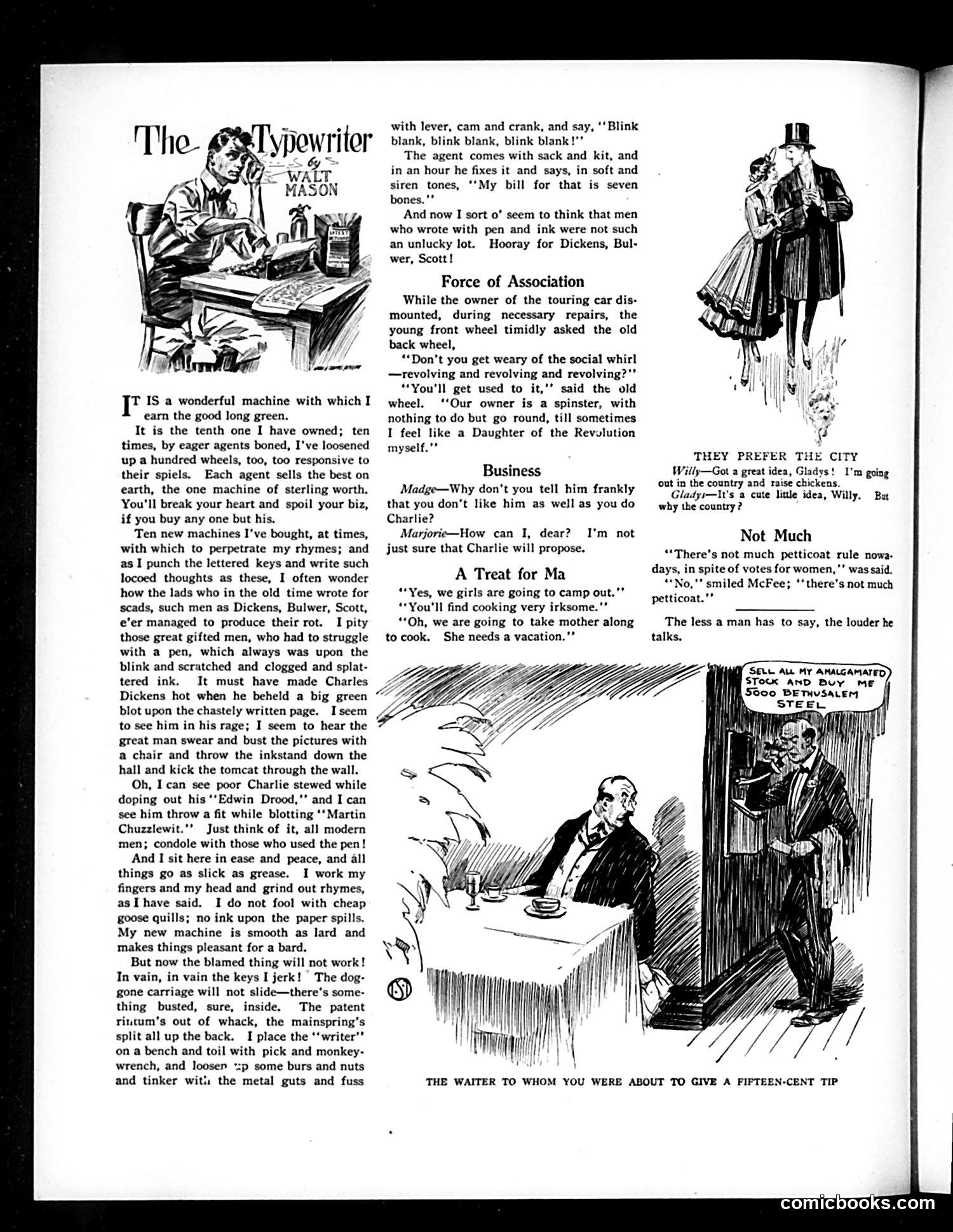
This page from *Judge* contains several satirical pieces typical of early 20th-century American humor: **"The Typewriter"** (main piece): A writer humorously contrasts the modern typewriter's convenience with classical authors' struggles using pens. He celebrates his machine's reliability—until it breaks down, requiring an expensive repairman charging "seven bones" (dollars). The satire mocks both aggressive typewriter salesmen making inflated claims and the irony of technological "progress" creating new frustrations. **Smaller satirical items** include jokes about women's suffrage ("not much petticoat rule"), automobile culture, courtship customs, and class dynamics (the waiter cartoon). The cartoons employ visual gags and dialogue to mock consumer culture, gender relations, and the gap between advertising promises and reality—standard *Judge* fare of social observation through humor rather than pointed political commentary.
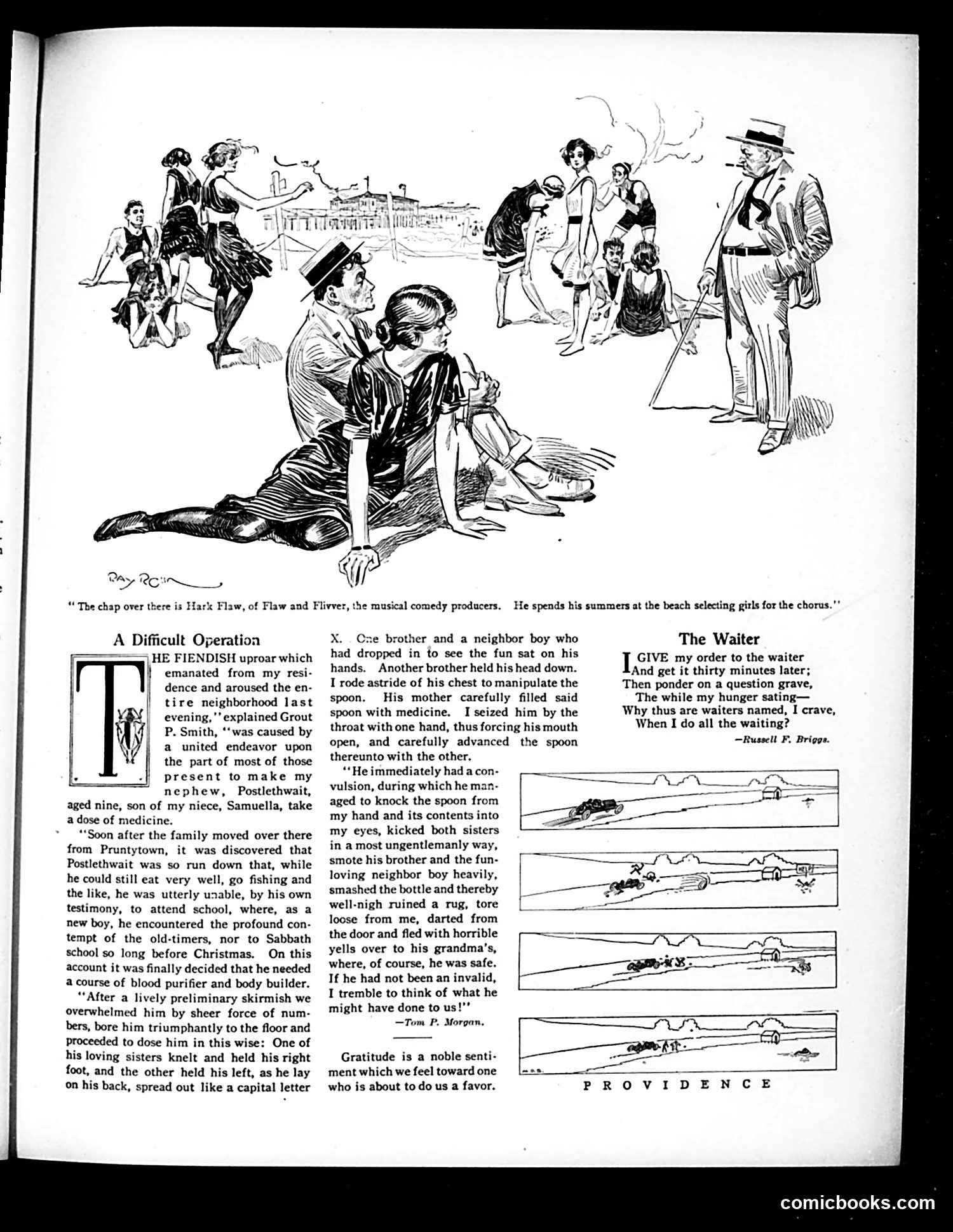
This page contains satirical humor about early 20th-century American life: **"A Difficult Operation"** satirizes the challenge of medicating a reluctant child. The anecdote describes a family's chaotic attempt to force medicine down their young, sickly nephew Postlethwait. The joke reveals the humor in the child's violent resistance—he manages to injure multiple family members, destroy property, and escape. The satire targets both overzealous parenting and the child's physical weakness (he's described as unable to attend school). **"The Waiter"** is a brief comedic poem by Russell F. Briggs complaining that despite waiters being "named" for waiting, customers actually do all the waiting. It's a simple pun on job titles and customer service frustrations. **The top illustration** references "Hark Flaw, of Flaw and Flivver," apparently a musical comedy producer who hires chorus girls at beaches—poking fun at entertainment industry practices and exploitation. These pieces represent Judge's typical blend of domestic humor and mild social criticism aimed at middle-class readers.
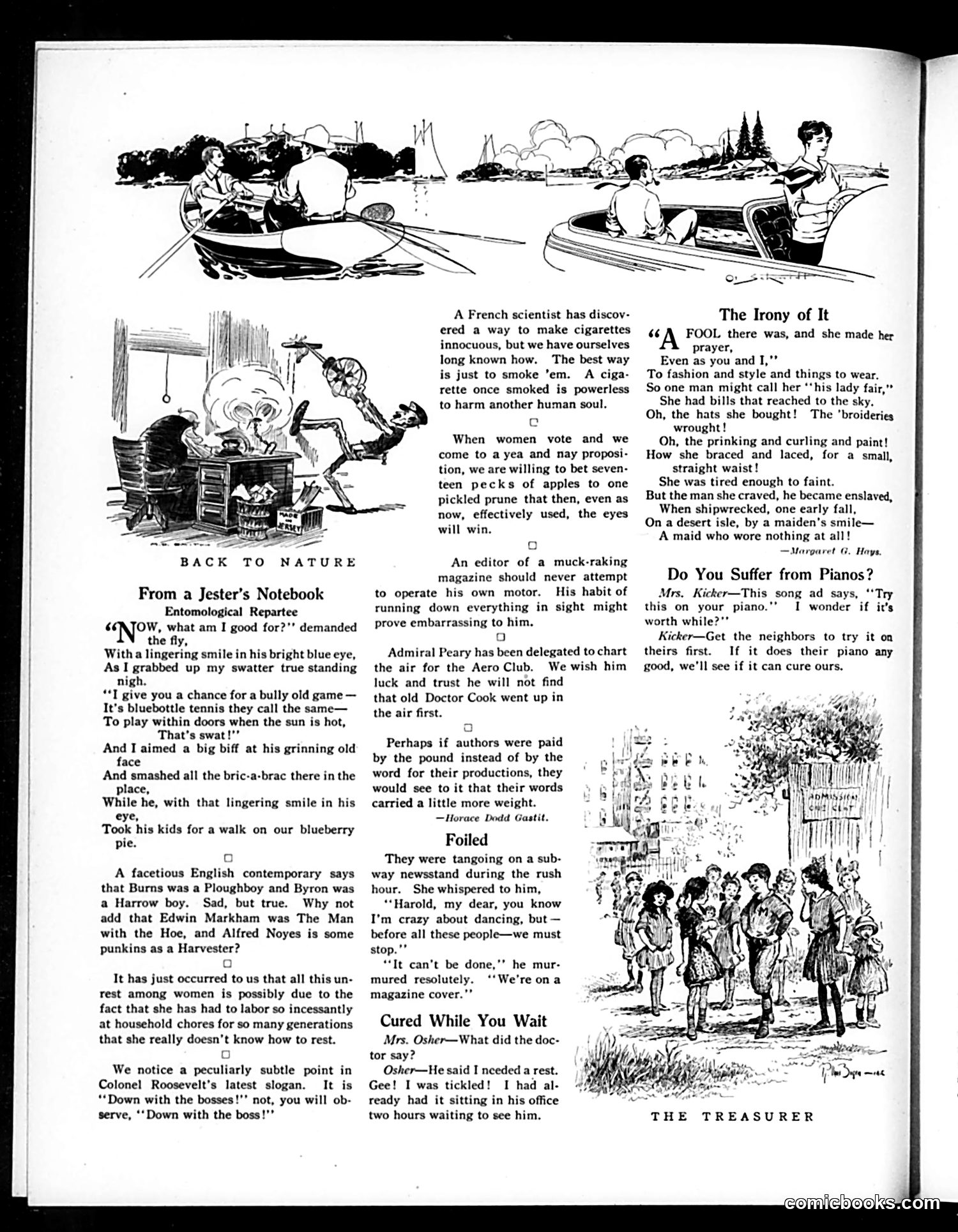
This page from *Judge* contains humorous short pieces satirizing early 20th-century American social concerns: **"The Irony of It"** poem mocks women's vanity and fashion obsession, referencing Kipling's "The Fool There Was." The joke: a woman exhausts herself with elaborate styling and expensive fashions to attract a man, yet that same man abandons her for a plain island woman wearing nothing. It satirizes both female consumerism and male fickleness. **Other pieces** target contemporary issues: women's suffrage (suggesting women will use persuasion rather than logic in voting), Theodore Roosevelt's populist rhetoric ("Down with the bosses"), and the emerging "muck-raking" journalism movement. The sketches show boating scenes and a subway couple "tangoing"—the latter a dated reference to the then-scandalous dance craze. Overall, the page reflects *Judge*'s conservative satirical stance on women's rights, emerging modernity, and political reform movements of the Progressive Era.
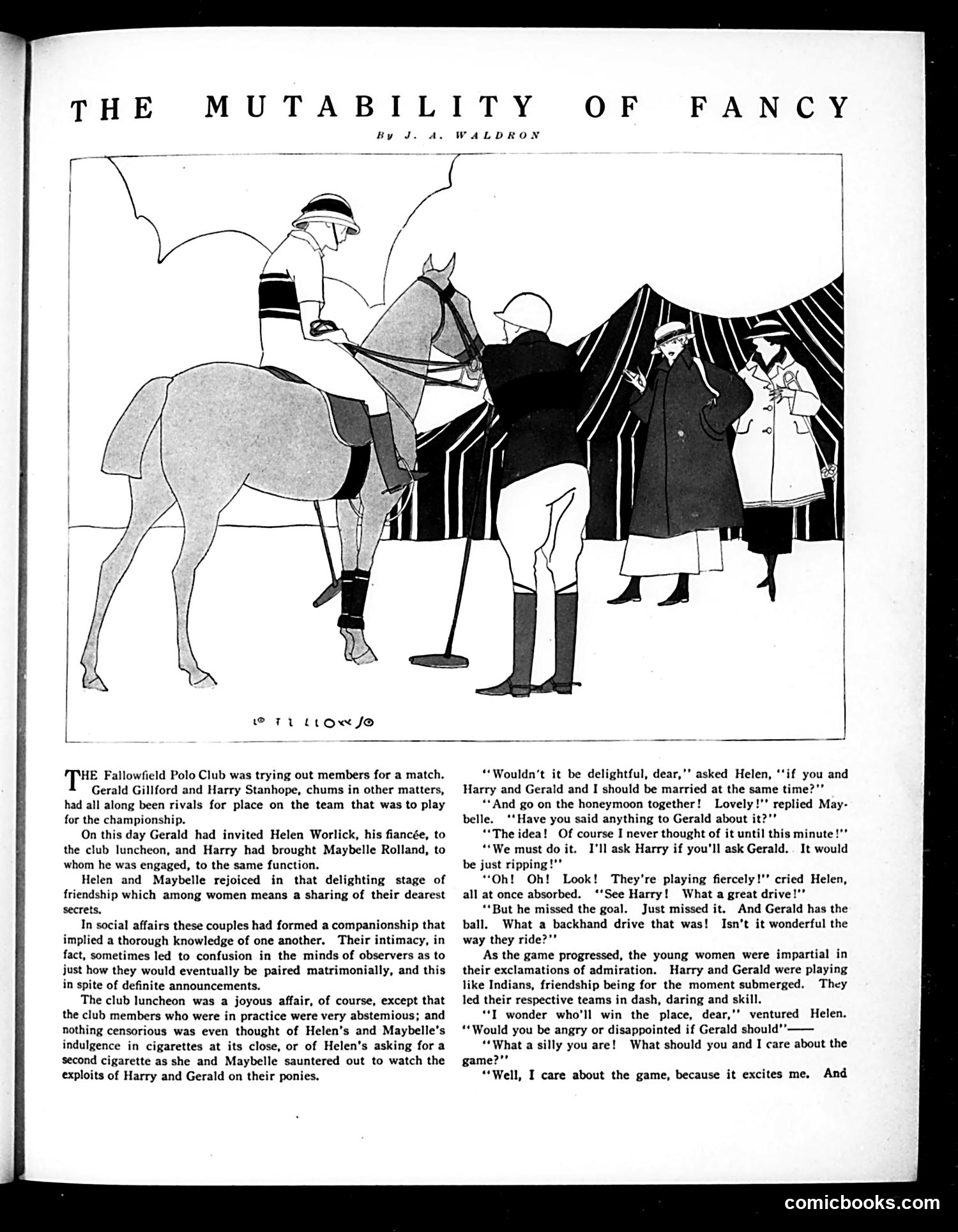
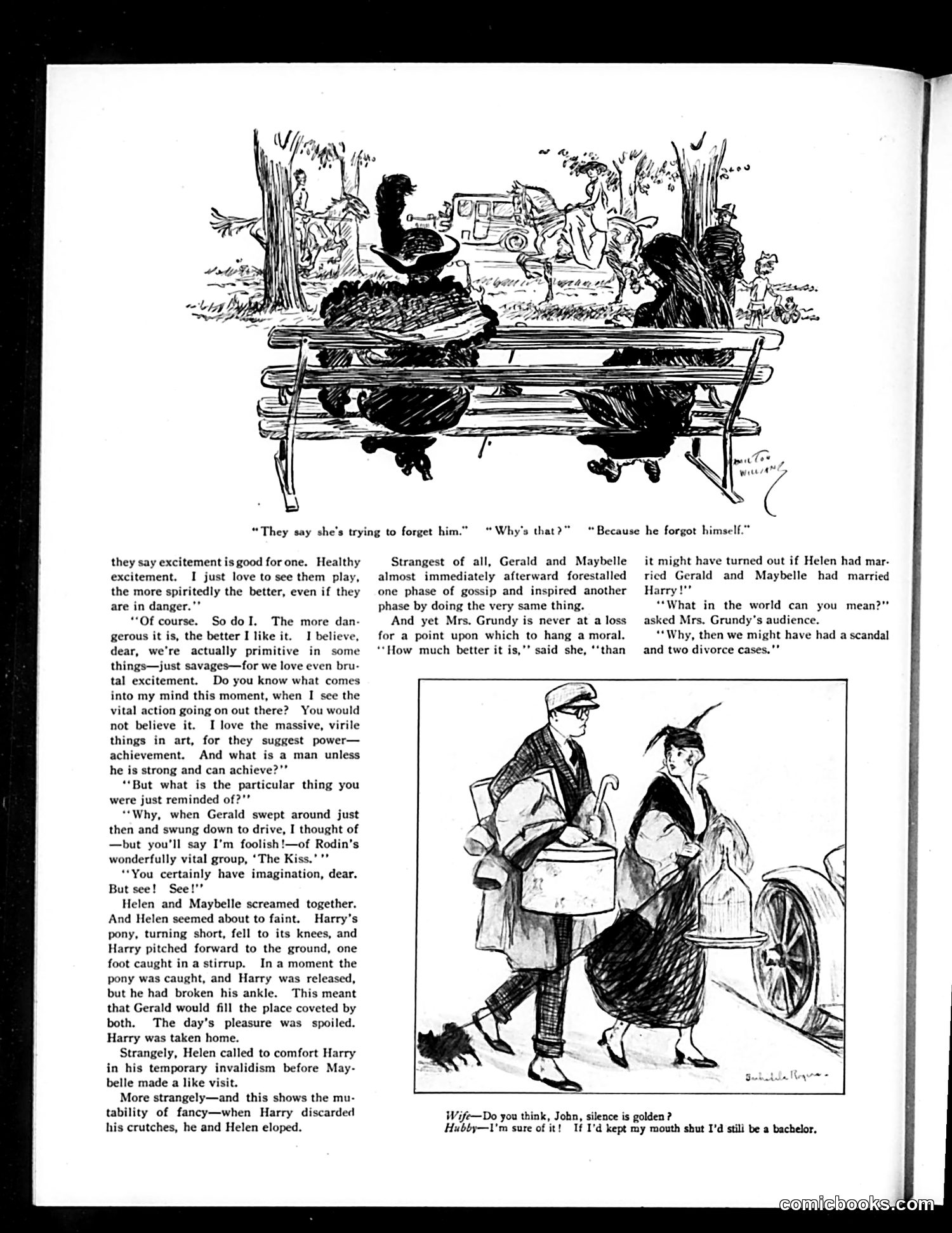
This Judge magazine page satirizes Victorian social hypocrisy and the gossiping figure of "Mrs. Grundy" (a stock character representing prudish moral judgment). **The Main Story:** Two couples—Helen/Harry and Maybelle/Gerald—attend a polo match. The women discuss how they enjoy watching dangerous sports because they find "vital" masculine achievement attractive. After Harry is injured in an accident, both couples eventually elope with *each other* (Helen with Gerald, Maybelle with Harry). Mrs. Grundy then smugly claims this outcome is morally superior to if they'd married their original partners, because it avoided "scandal and divorce." **The Satire:** The joke mocks Mrs. Grundy's arbitrary moralizing. She celebrates outcomes (the couples switching partners through elopement) that would normally be considered scandalous, simply because they avoid the *appearance* of impropriety. The satire exposes how Victorian morality cared more about seeming respectable than actual ethics. **The Bottom Cartoon:** A brief domestic joke about a husband's silence being "golden"—he stayed single by keeping quiet.
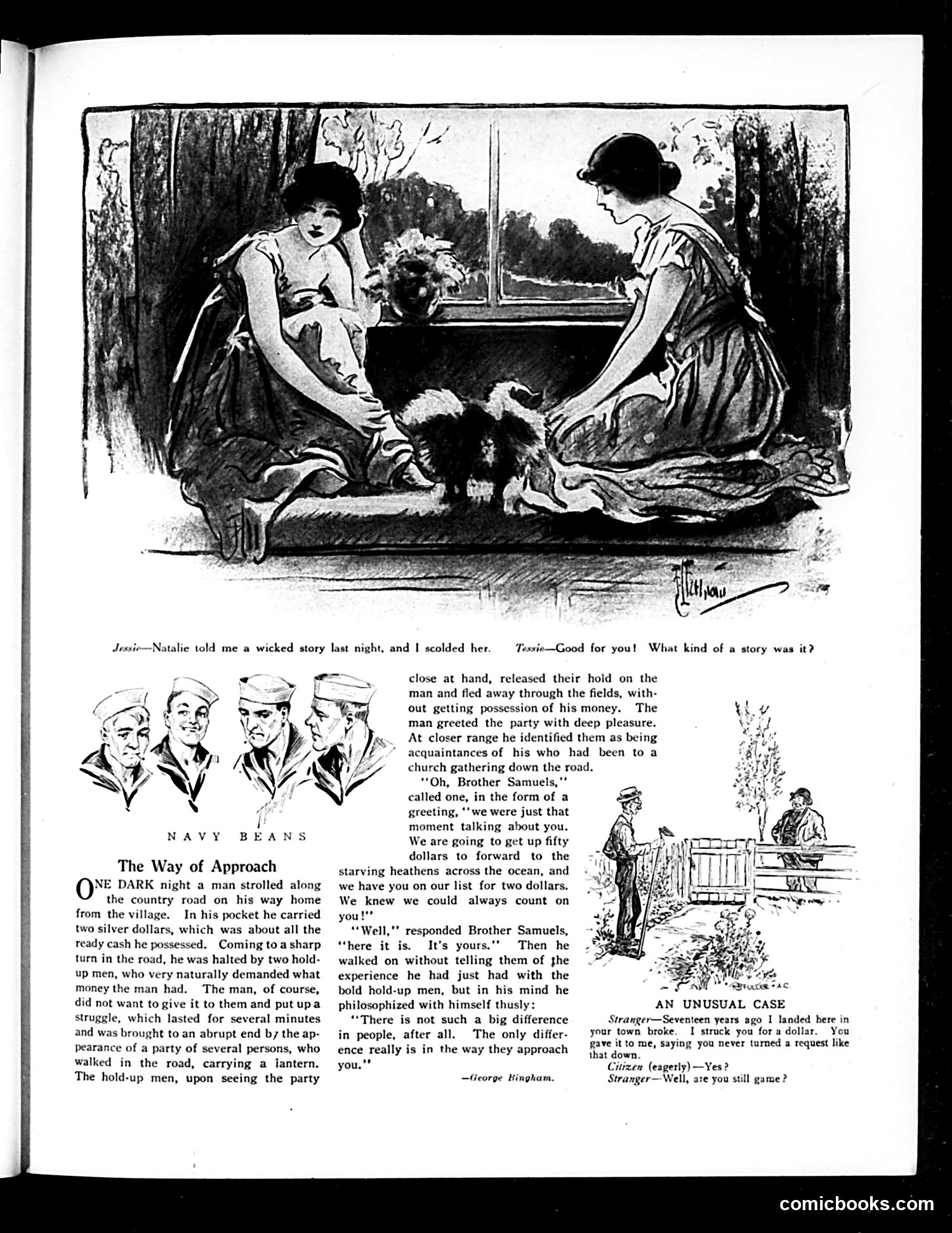
This page contains two distinct pieces of satirical content: **"The Way of Approach"** (main story): A man is robbed at gunpoint on a dark road but is rescued by churchgoers. Later, those same churchgoers—identifying themselves as church members—solicit the man for donations to starving heathens overseas. The satire points out the hypocrisy: both the robbers and the religious solicitors use coercion to extract money, but one is criminalized while the other is morally sanctified. The moral is explicit: the only difference between criminals and respectable people is their "approach"—the manner and social legitimacy of their demands, not the fundamental act itself. **"An Unusual Case"** (bottom): A stranger recalls lending money to a town citizen seventeen years prior, then asks if the citizen will give him another dollar now. The joke satirizes selective charity and memory—people may pride themselves on past generosity but rarely repeat it. Both pieces mock middle-class morality and the gap between professed values and actual behavior.
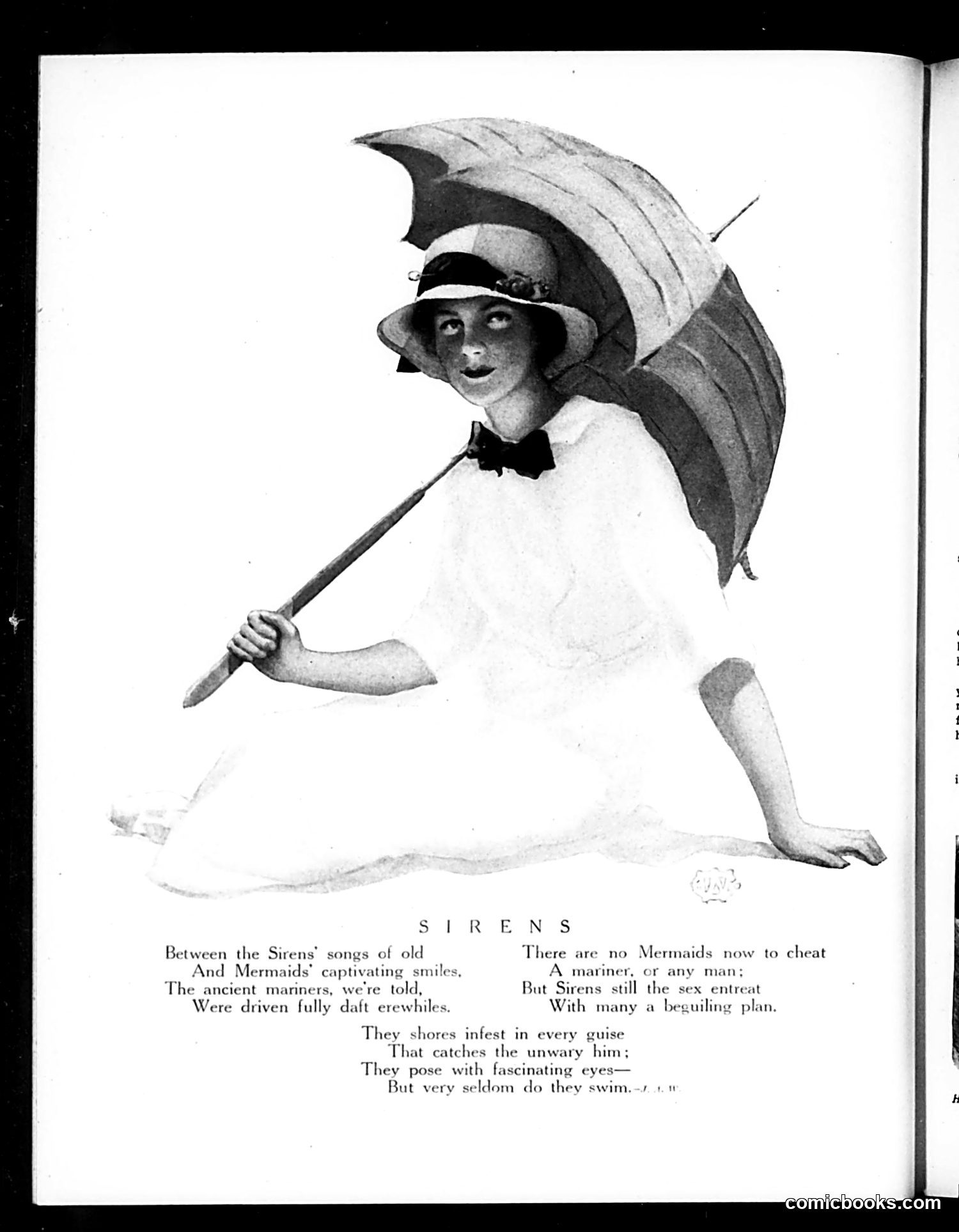
This illustration depicts a woman as a modern "siren"—a contemporary temptress. The accompanying verse compares mythological sirens (who lured sailors to their doom) with modern women who seduce men using charm and deception rather than supernatural powers. The satire's point: while ancient sirens are gone, modern women employ similar manipulative tactics ("beguiling plans," "fascinating eyes") to entrap men. The humor plays on the irony that these modern sirens "very seldom do they swim"—they're landlocked seductresses rather than actual mythological creatures. The illustration shows a fashionably dressed woman with an umbrella and headband, presented as an attractive but calculated temptress. This reflects early 20th-century anxieties about female sexuality and independence, portraying women's attractiveness as inherently deceptive. The satire targets what Judge's male audience likely viewed as female manipulation in courtship and romance.
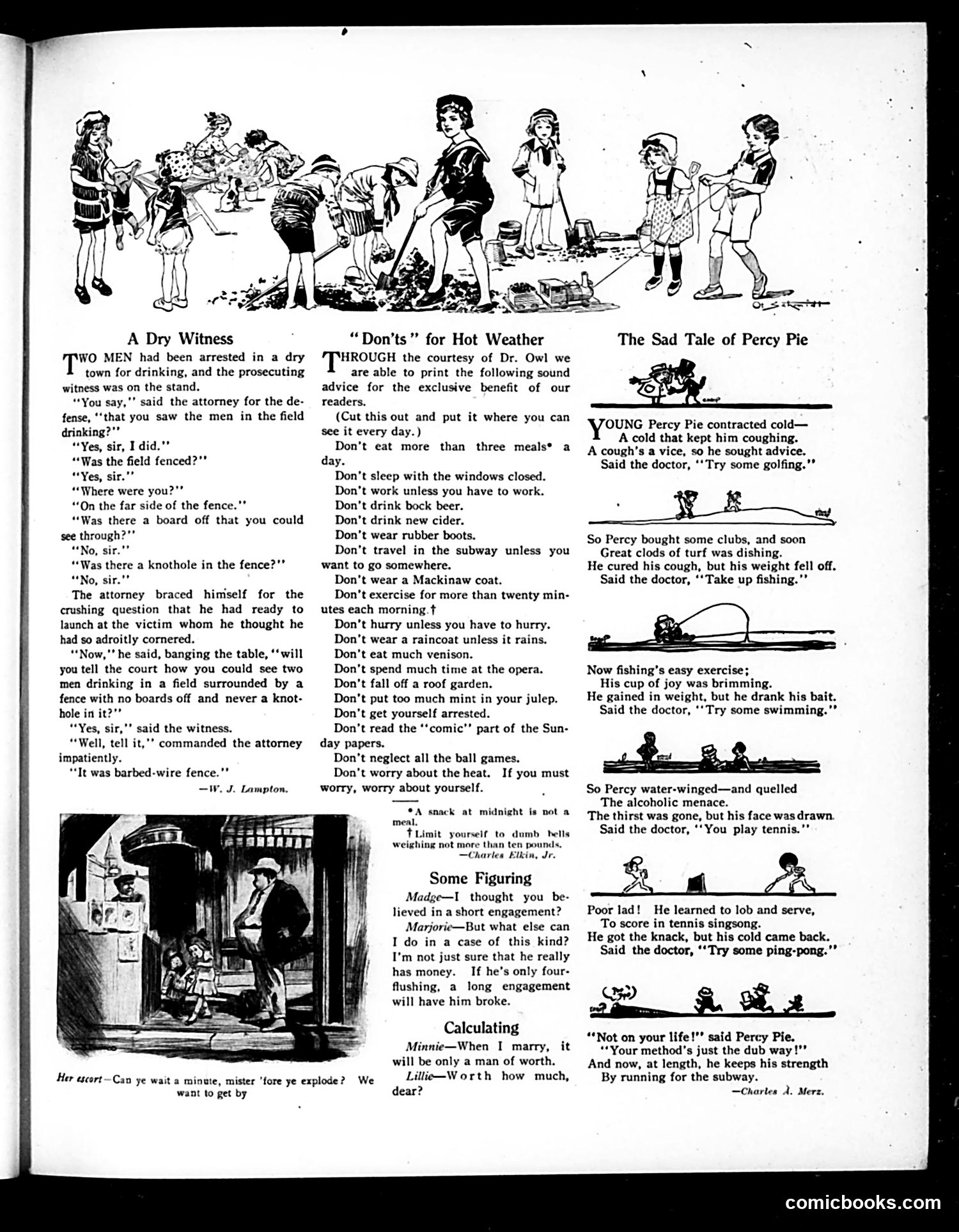
This page contains three unrelated humorous pieces typical of early 20th-century American satirical magazines: **"A Dry Witness"** is a legal joke playing on the literal absurdity of courtroom testimony. A clever defense attorney cross-examines a witness about how he saw men drinking in a fenced field with no gaps—only to be outwitted when the witness simply answers: the fence was barred wire, allowing clear sight lines. The humor lies in the attorney's overconfidence and the witness's straightforward logic. **"Don'ts for Hot Weather"** offers satirical summer health advice supposedly from "Dr. Owl," mocking contemporary wellness trends and overly cautious living (don't wear raincoats unless it rains, don't read Sunday comics, don't fall off roof gardens). It's gentle social satire about silly rules. **"The Sad Tale of Percy Pie"** is a humorous narrative poem about a young man chasing medical advice—golfing cures his cough but causes weight loss; fishing helps weight but leads to drinking; each "cure" creates new problems, until he finally keeps healthy by "running for the subway." The page reflects pre-Depression American middle-class concerns: legal cleverness, health fads, and comedic understatement.
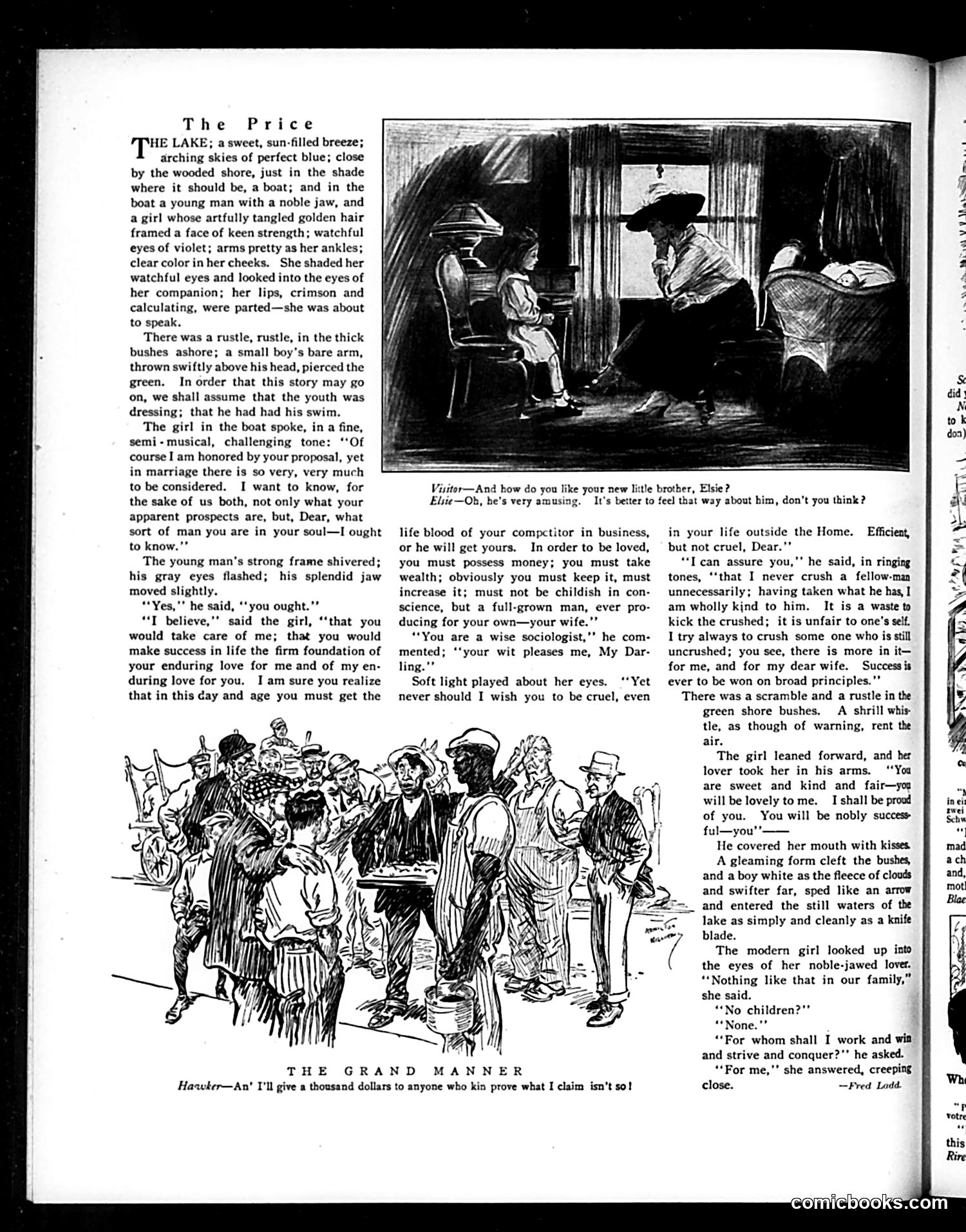
This story mocks the mercenary nature of early 20th-century courtship and marriage among the modern upper class. A young man proposes to an attractive woman by a lake, expecting romantic acceptance. Instead, she delivers a cold, calculating speech demanding he ruthlessly accumulate wealth and crush business competitors—acknowledging this contradicts traditional ideals of kindness but justifying it as necessary for supporting her. The satire's punch arrives when a boy (likely her younger brother) interrupts their embrace by diving into the lake, prompting her satisfied comment: "Nothing like that in our family"—implying the boy's innocent purity contrasts with her opportunistic worldview. The accompanying cartoon "The Grand Manner" (below) shows a carnival huckster making exaggerated claims, likely reinforcing the page's theme that modern society rewards bold assertions and material success over genuine character or integrity.
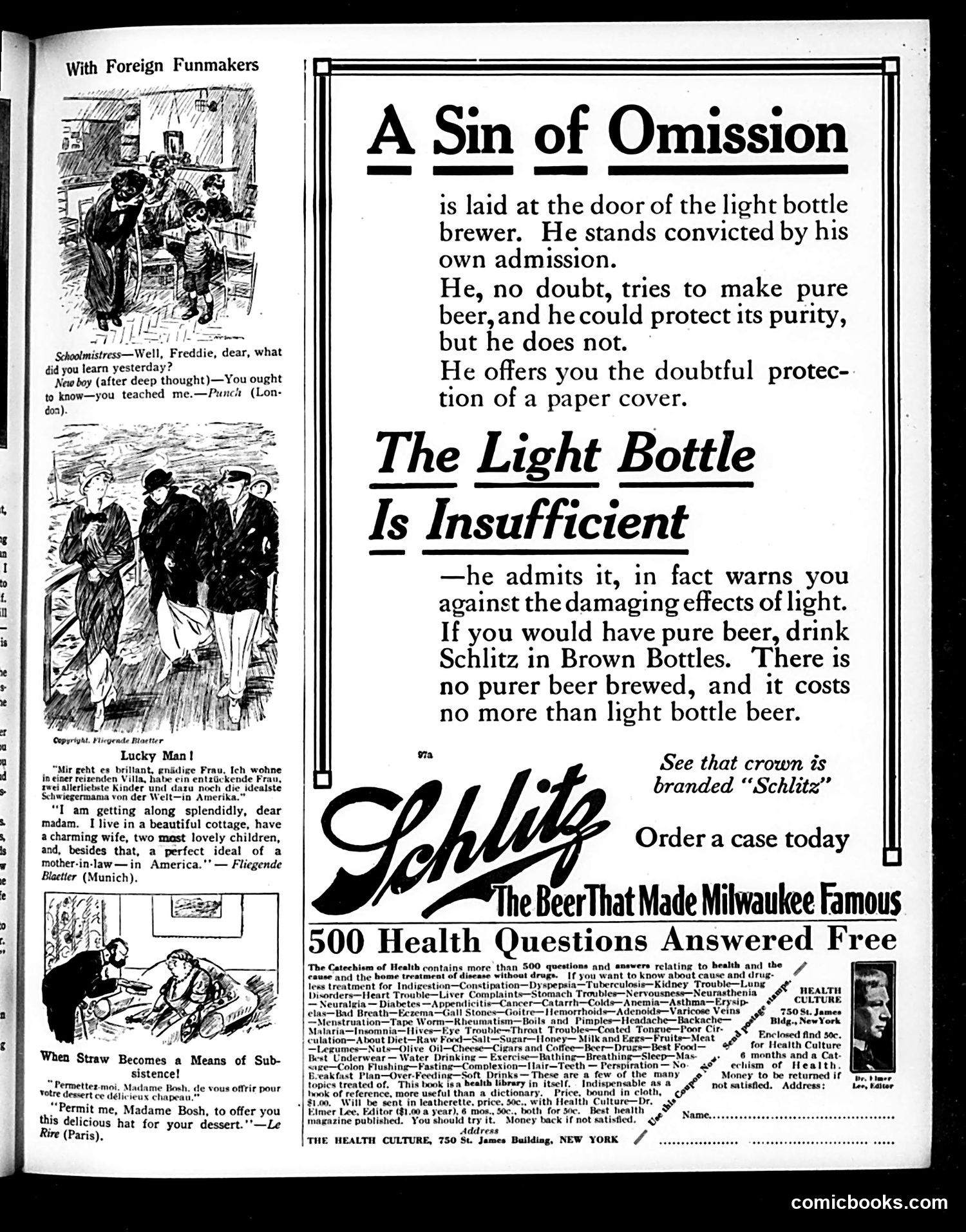
This page mixes international cartoons with advertising. The left side presents three brief satirical comics reprinted from foreign publications (Punch London, Fliegende Blätter Munich, Le Rire Paris): 1. A schoolboy admits his teacher taught him nothing 2. A German immigrant boasts about his perfect American life, including an ideal mother-in-law (likely satirizing unrealistic American promises) 3. A Frenchman absurdly offers a hat as dessert The right side is a **Schlitz beer advertisement** attacking competitors who use light bottles. The ad claims light bottles damage beer quality, and that Schlitz's brown bottles preserve purity better—at no extra cost. This appears to be early 20th-century competitive marketing disguised as consumer advice. Below is a separate advertisement for "Health Culture" magazine offering health advice via mail. The page reflects Judge magazine's typical format: reprinting amusing European humor alongside American advertising, targeting an educated readership familiar with international publications.
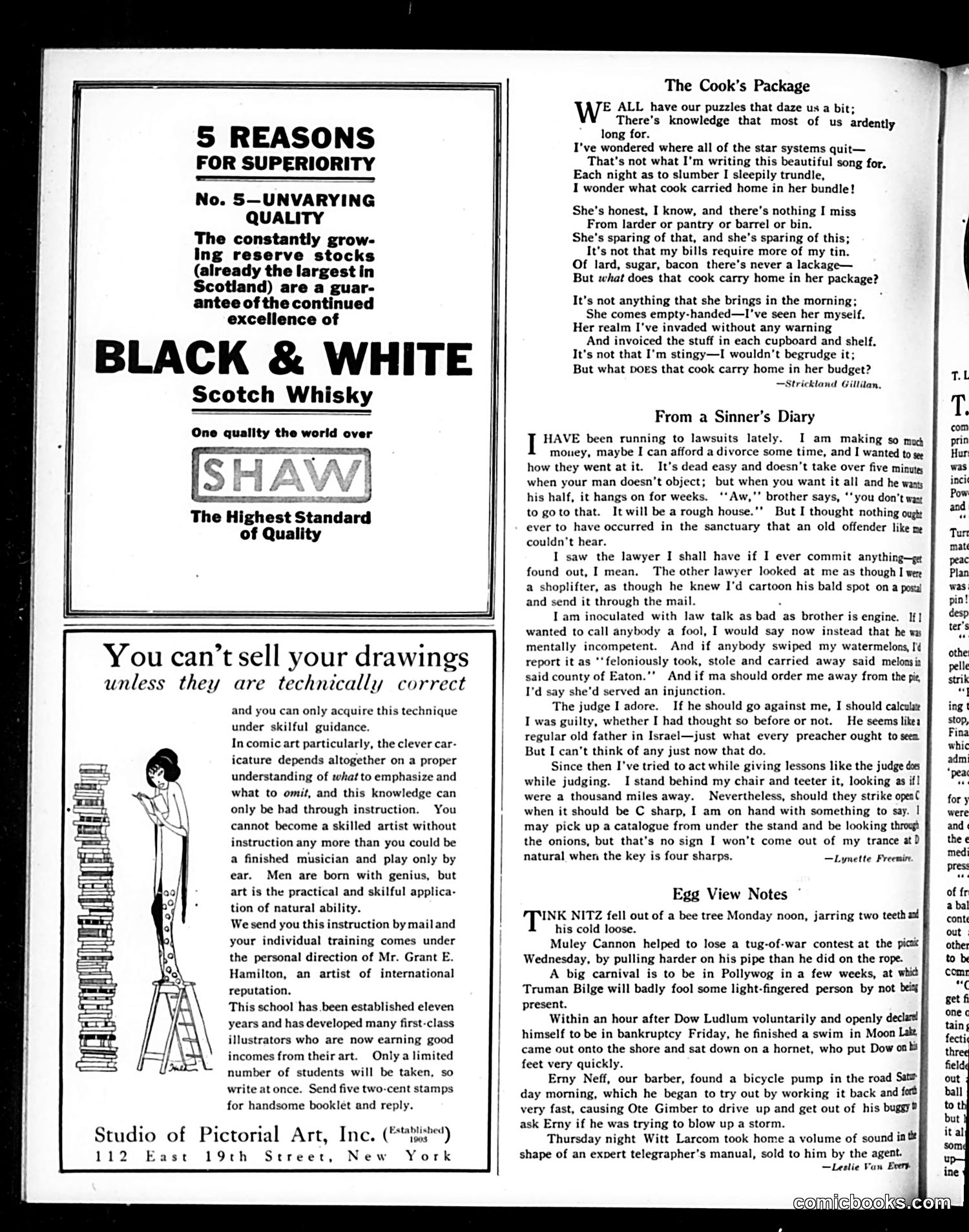
This page mixes **advertising with humor columns** typical of Judge magazine's format. The main content includes: 1. **"The Cook's Package"** — A humorous poem by Strickland Gillilan about a middle-class employer puzzling over what his cook takes home daily. The joke plays on class anxiety: despite checking pantries and accounts, he cannot account for mysterious items she removes. It's satirical commentary on the employer-servant relationship and unspoken theft or perquisites common in domestic service. 2. **"From a Sinner's Diary"** — A gossipy personal essay about divorce proceedings and observing lawyers. The humor relies on social satire about legal formality, class distinctions (the narrator assuming lawyers judge her morally), and the contrast between dignified courtroom language and everyday speech. The **advertisements** include Black & White Scotch Whisky and the Studio of Pictorial Art, promoting correspondence instruction in cartooning under artist Grant E. Hamilton.
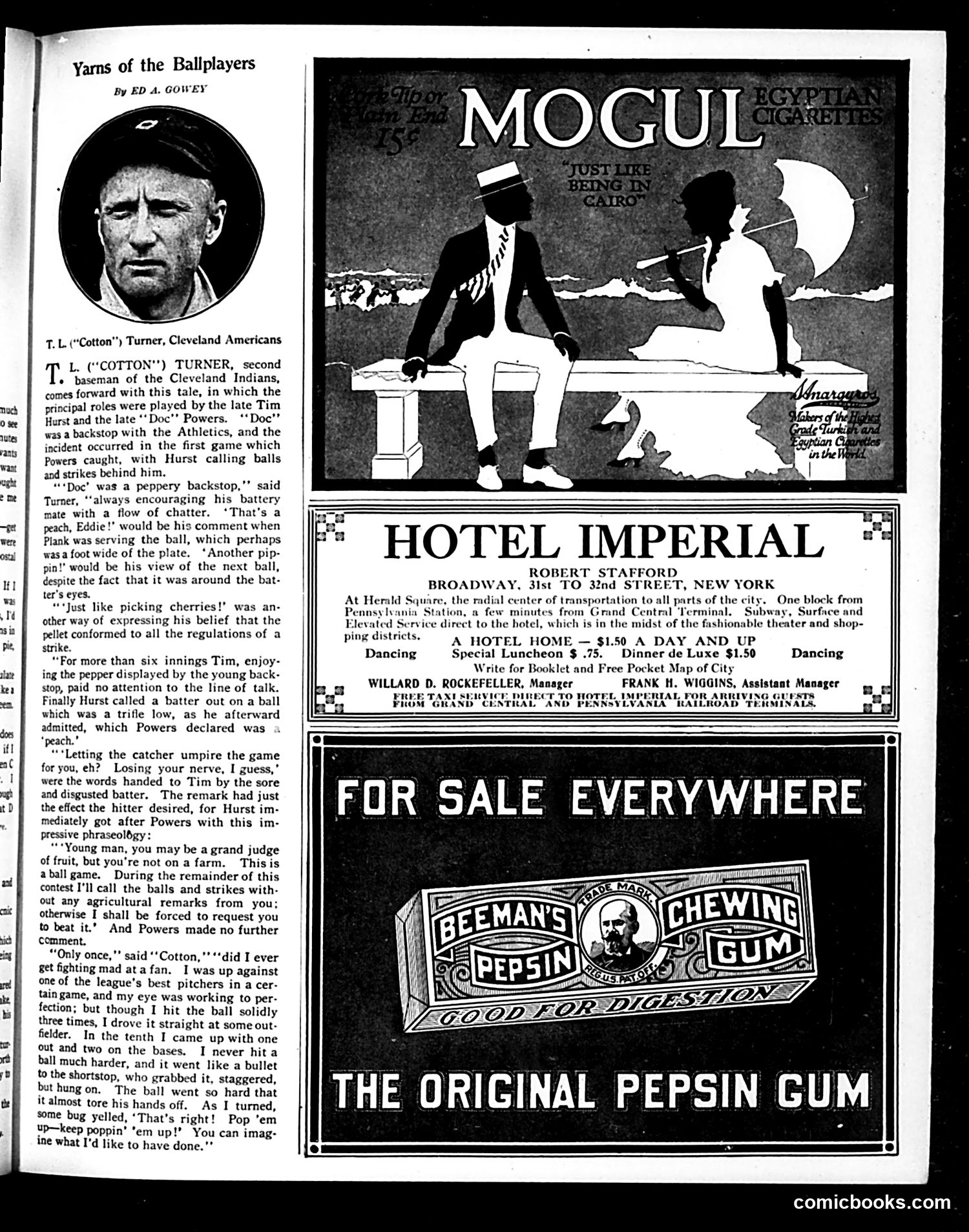
This page contains two distinct elements: **The Main Article: "Yarns of the Ballplayers"** A humorous anecdote about early baseball (circa 1900s) featuring real figures: T.L. "Cotton" Turner (Cleveland Indians player), umpire Tim Hurst, and catcher "Doc" Powers. The story satirizes baseball officiating and player temperament. The joke involves Powers enthusiastically praising obviously bad pitches as "strikes," prompting Hurst to sharply rebuke him—essentially telling him to stop acting like a fruit inspector and remember this is a competitive game where proper calls matter. **The Advertisements** The page also features period advertisements: Hotel Imperial (a Broadway luxury hotel), Mogul Egyptian cigarettes, and Beeman's Pepsin chewing gum. The article reflects early 20th-century baseball culture where umpires, catchers, and players engaged in colorful verbal sparring. The satire mocks overenthusiasm and lack of professionalism in officiating.
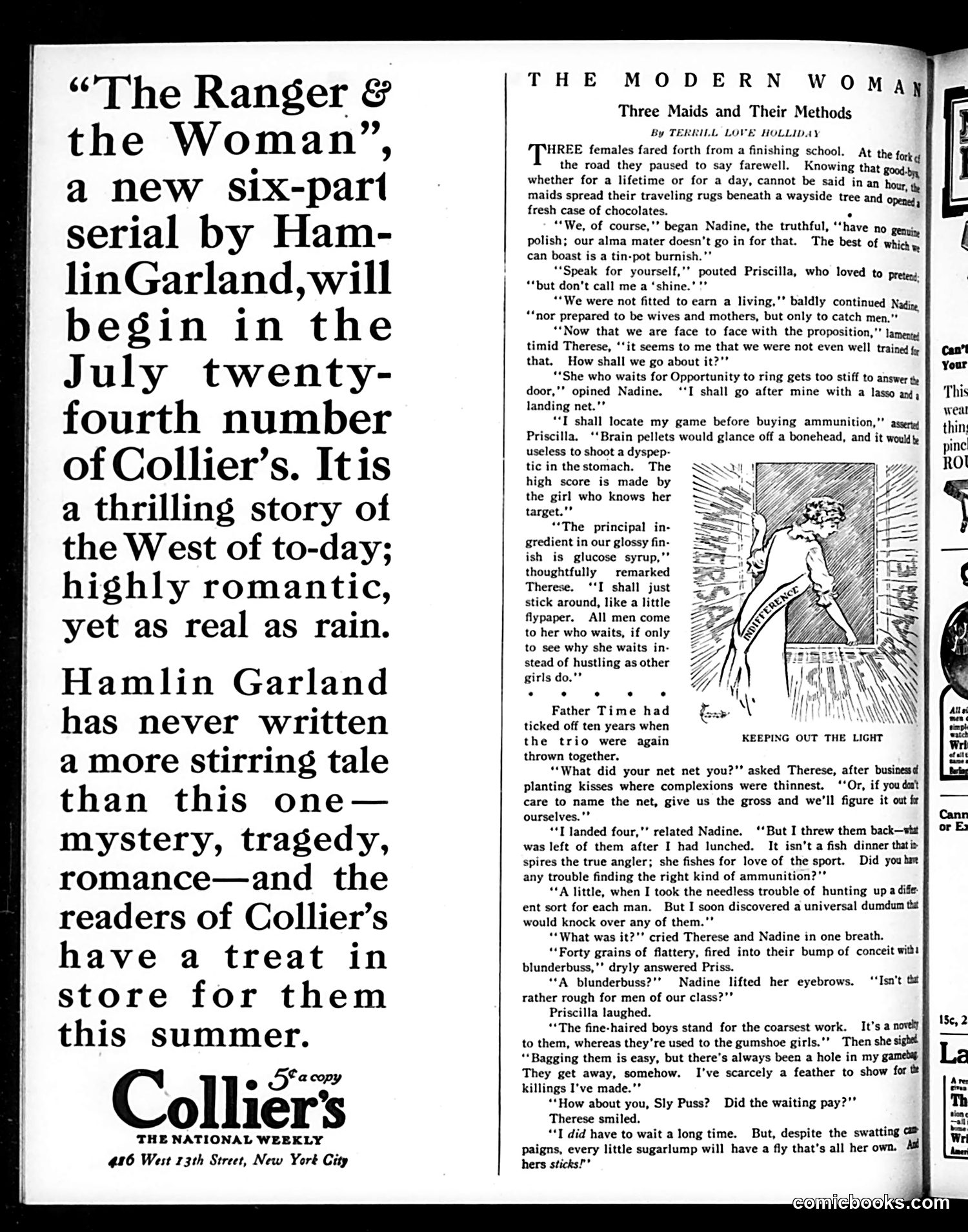
This satirical story mocks the marriage strategies of three young women from finishing school. The piece presents three contrasting approaches to "catching men": **Nadine** pursues aggressively ("lasso and landing net"), treating courtship like hunting. **Priscilla** uses intellectual calculation, employing "flattery" as ammunition—she calls it a "dumdum" (explosive bullet), sardonically suggesting that even refined gentlemen respond to crude flattery about their vanity. **Therese** takes a passive approach, comparing herself to "flypaper" and "sugarlump," waiting for men to come to her. The satire targets the artificiality of upper-class courtship and women's limited life options: these finishing-school graduates are trained only to "catch men," not to work or live independently. By framing marriage-hunting as literal warfare with ammunition and targets, the author mocks both the desperation of women's economic dependence and the shallow nature of courtship itself in this era.
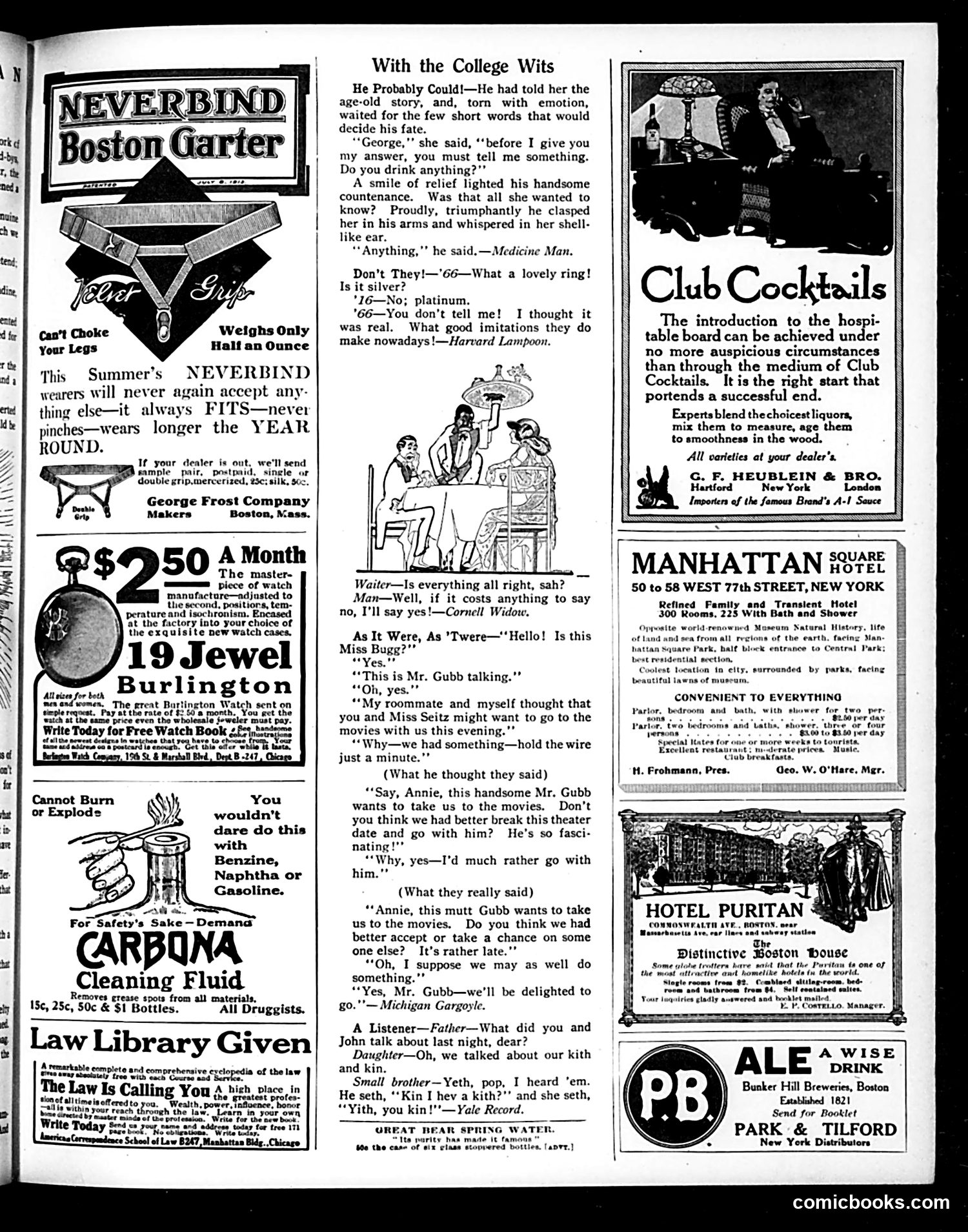
This page is primarily **advertising with comic filler content**. The "College Wits" section reprints jokes from university humor magazines (Harvard Lampoon, Cornell Widow, Michigan Gargoyle, Yale Record)—a common Judge feature. The jokes reflect 1920s college social anxieties: a young man's relief that his date only asks if he drinks (implying prohibition-era concerns), confusion about whether jewelry is "real," and miscommunication between a nervous suitor (Mr. Gubb) and unimpressed young women. The humor hinges on the gap between what people say versus what they think—the women politely accept a movie date while internally considering it a last resort. **The satire targets**: male romantic earnestness, female indifference, and the social performativity required in courtship. The jokes assume a reader familiar with college life and contemporary dating rituals. The surrounding ads (watches, garters, cleaning fluid, hotels, cocktails) suggest the magazine's affluent male readership.
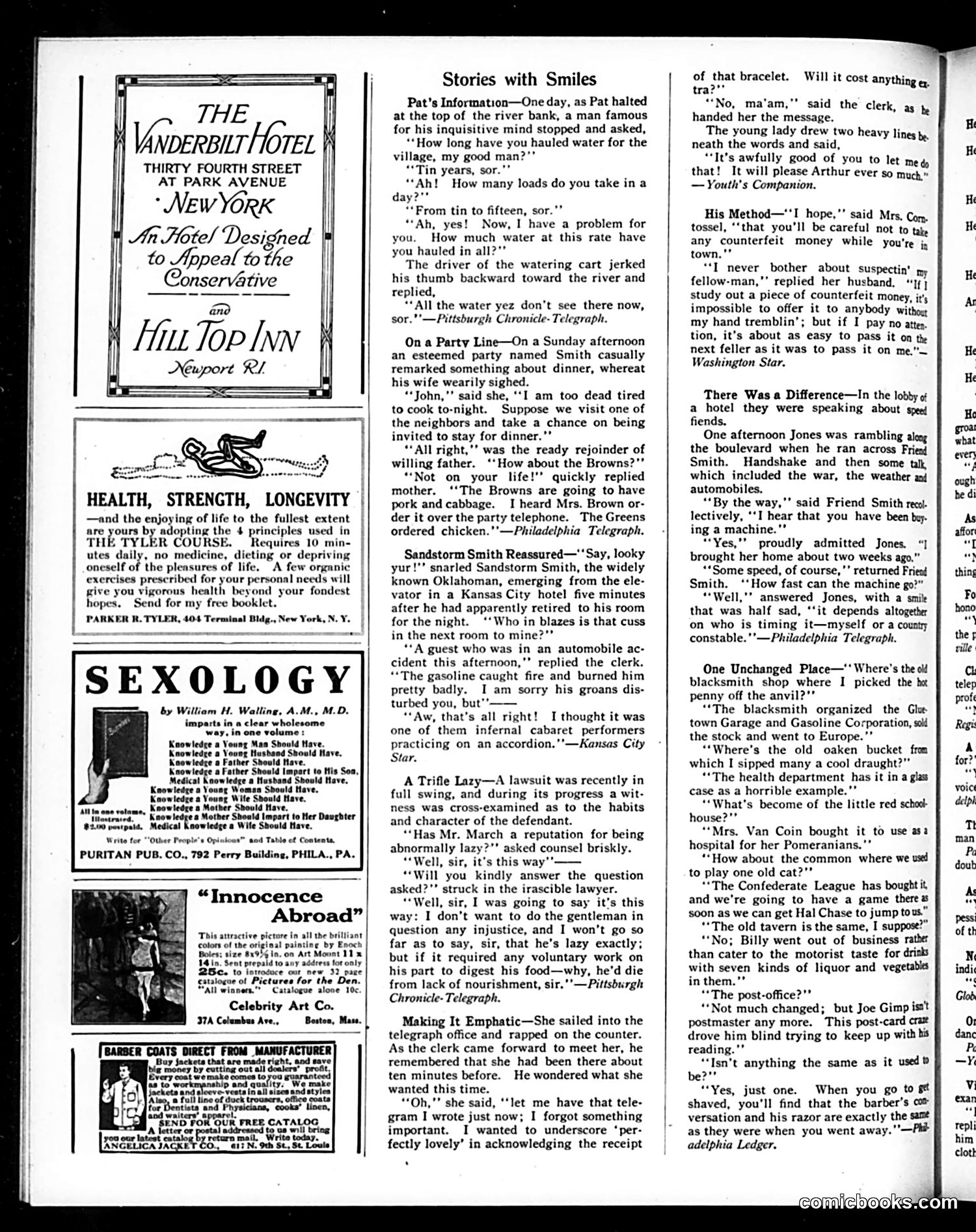
This page collects humorous anecdotes typical of Judge's "Stories with Smiles" section. The jokes rely on working-class characters and wordplay: **"Pat's Information"** features an Irish laborer (Pat) outwitting an inquisitive gentleman with circular logic—when asked how much water he's hauled in years, Pat points to the river itself, implying the impossible task of quantifying it. **"On a Party Line"** satirizes early telephone culture, where multiple households shared one line, allowing neighbors to eavesdrop. Mrs. Smith exploits this to spy on neighbors' dinners before inviting herself. **"Sandstorm Smith"** plays on regional stereotypes, presenting an Oklahoman so accustomed to frontier chaos that he mistakes a hotel guest's accident screams for cabaret entertainment. **"A Trifle Lazy"** depicts courtroom humor where a witness refuses direct answers, instead implying the defendant is so lazy he'd starve rather than exert effort digesting. The page also advertises self-help books ("The Tyler Course," "Sexology") and a painting titled "Innocence Abroad"—typical early-20th-century magazine content.
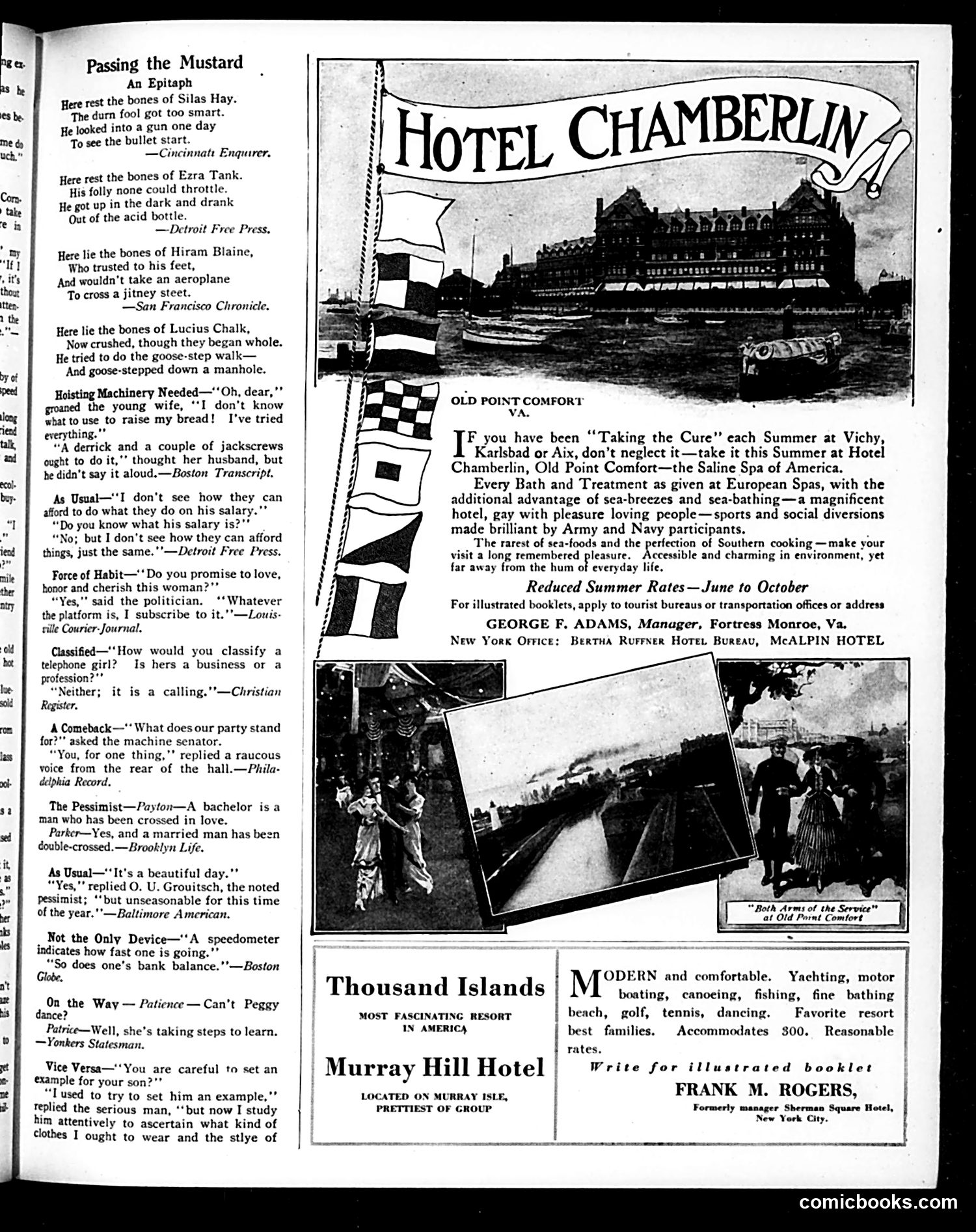
This page contains primarily **humorous epitaphs and short joke columns** with period advertisements, rather than political cartoons. The epitaphs mock Darwin-award-style deaths: a man shooting himself to see a bullet's trajectory, someone drinking acid in darkness, a man refusing to fly (trusting his feet instead), and another "goose-stepping" into a manhole. These target human foolishness and overconfidence. The remaining jokes satirize common social absurdities: wives unable to bake, politicians subscribing to whatever platform suits them, telephone operators' ambiguous professional status, pessimists complaining even on beautiful days, and parents learning fashion from their children rather than setting examples. The humor relies on **wordplay, irony, and observational comedy** about middle-class American life—reflecting Judge magazine's tradition of satirizing everyday social pretensions and human folly rather than specific political figures or events.
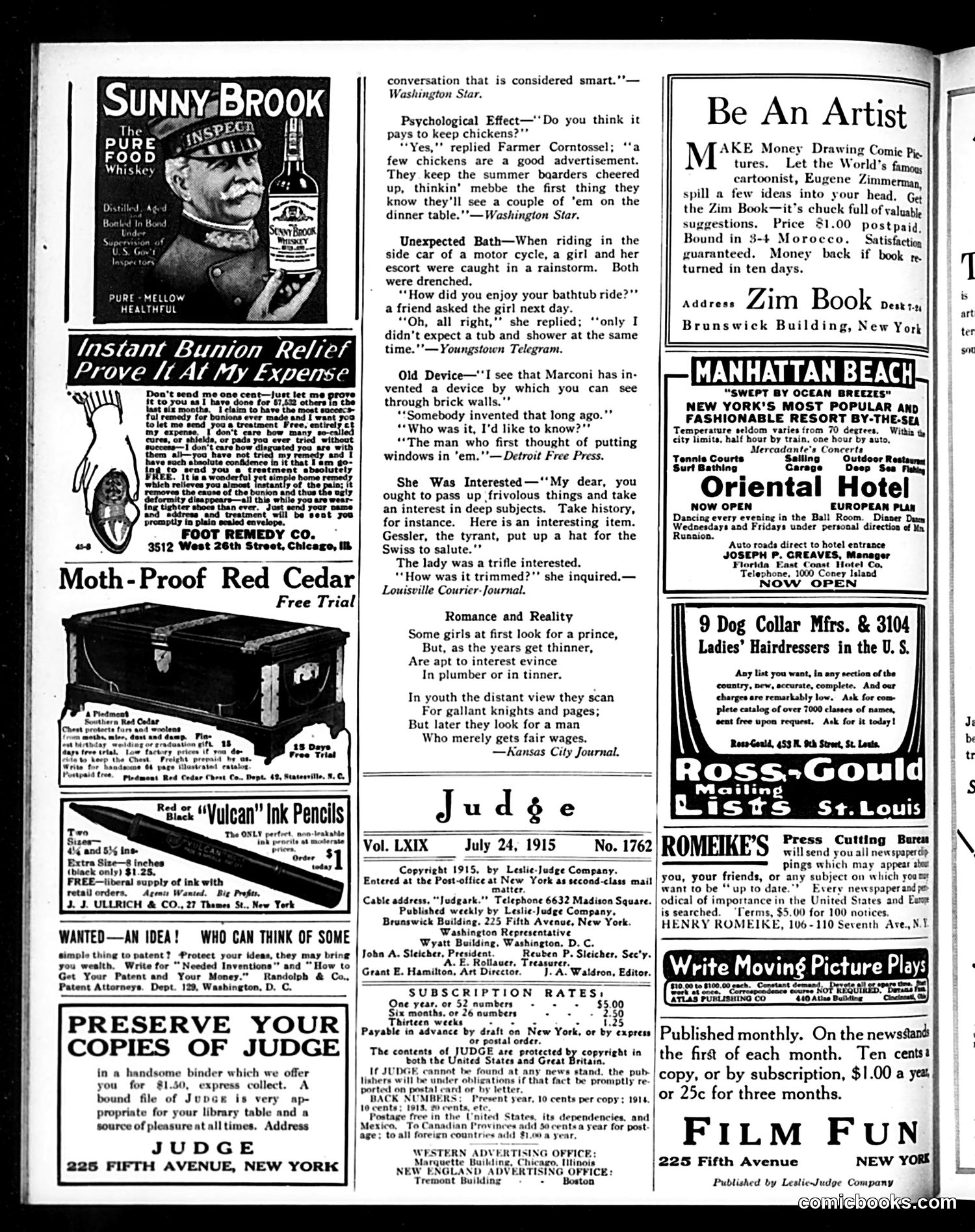
This is primarily a **title/contents page with advertisements and humor columns**, not political cartoons. The page features **humorous anecdotes** typical of Judge's satirical style: - **"Psychological Effect"**: A farmer explains keeping chickens entertains summer boarders who hope to eat them—mocking rural hospitality and naive tourists. - **"Unexpected Bath"**: A girl caught in rain during a motorcycle ride makes a pun about receiving an unwanted "bathtub" shower—light domestic humor. - **"Old Device"**: A joke about Marconi's invention of seeing through brick walls, revealing the "old device" is simply windows—poking fun at overwrought technological claims. - **"She Was Interested"**: A woman dismisses history until hearing about a hat—mocking women's supposed superficiality about fashion over substance. - **"Romance and Reality"**: A poem contrasting girls' youthful dreams of princes with practical adult preferences for steady workers—satirizing economic realities and changing female expectations. The surrounding **advertisements** (ink pencils, moth-proofing, patent services) reflect 1915 commercial concerns.
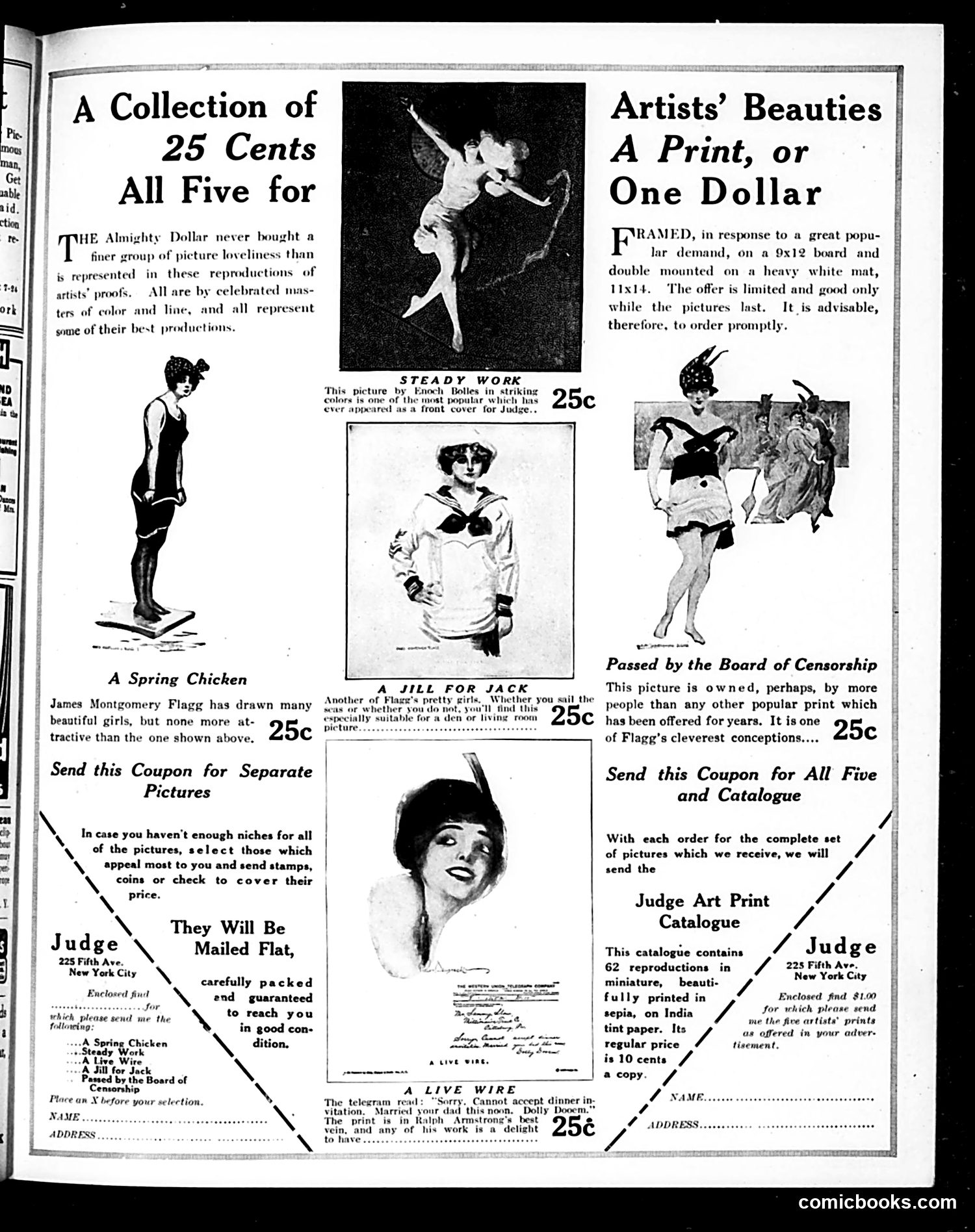
This is primarily a **mail-order advertisement**, not political satire. Judge magazine is selling illustration prints by celebrated artist James Montgomery Flagg, featuring attractive women in various poses and scenarios ("A Spring Chicken," "Steady Work," "A Jill for Jack," "A Live Wire"). The prints cost 25 cents each or all five for one dollar, framed. The repeated notation "**Passed by the Board of Censorship**" is the only satirical element—a tongue-in-cheek reference to the era's moral guardianship. By labeling these images of fashionable young women as "censored," Judge humorously suggests they're mildly risqué or scandalous, when they appear to be standard commercial illustrations of the period. This reflects early 20th-century American print culture, where illustrated pin-up style images were legitimate commercial products sold through magazines.
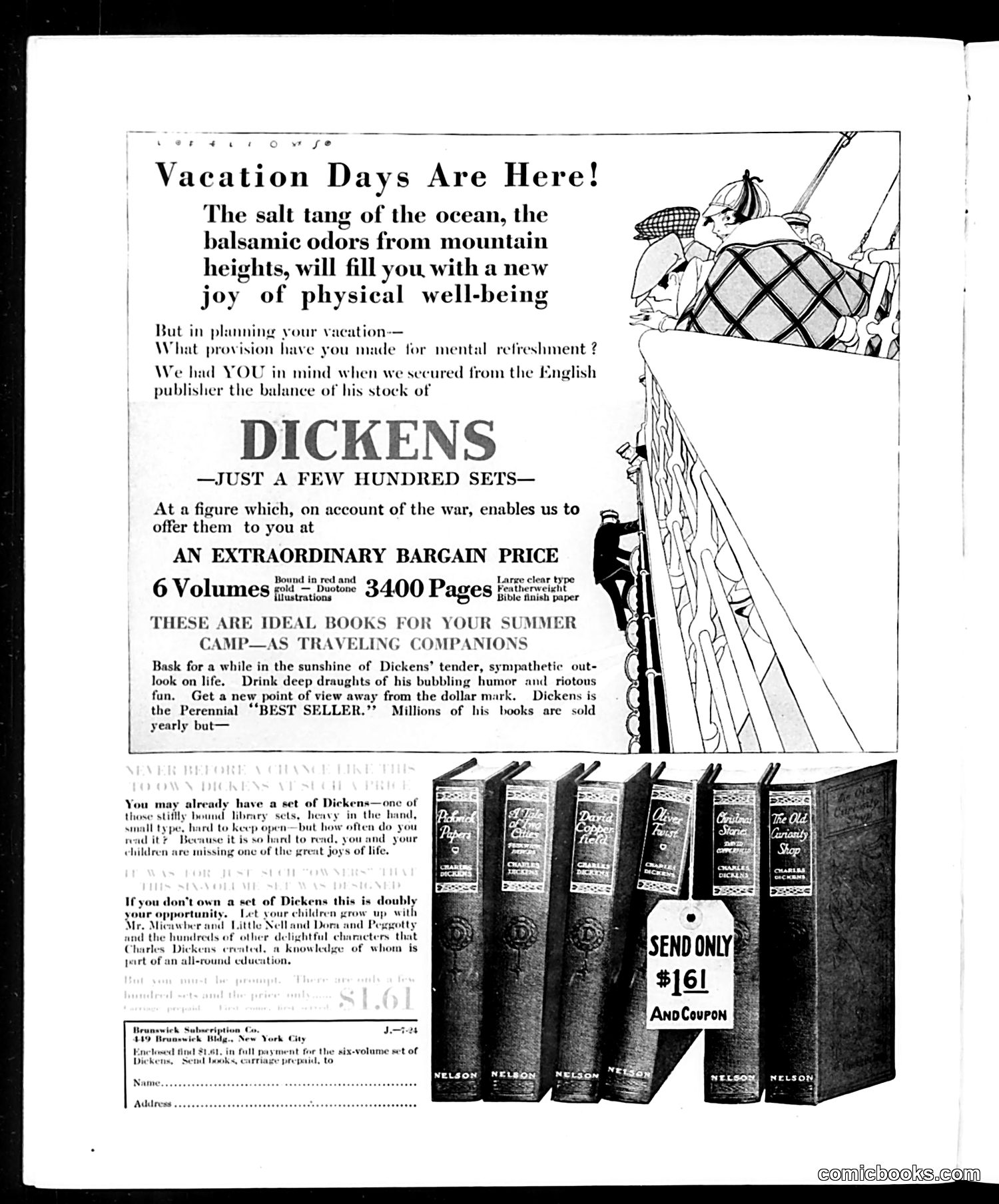
This is primarily **advertising, not satire or political commentary**. The page promotes a discounted set of Charles Dickens' complete works (6 volumes, 3,400 pages) being sold by Brunswick Subscription Co. for $1.61. The illustrations are purely decorative: a couple relaxing on a boat at the top, and a sailor climbing rigging on the side—generic vacation imagery meant to evoke leisure and travel. The sales pitch frames Dickens as "mental refreshment" for vacationers, positioning literature as intellectual balance against materialism ("away from the dollar mark"). The advertisement acknowledges readers may already own Dickens but argues this set is superior to "stiffly bound library sets" with small type. The reference to "the war" (likely WWI, given Judge's publication period) explains the bargain pricing—they're liquidating excess English publisher stock. This is a straightforward mail-order advertisement, not satirical commentary.