
Judge, 1915-07-24 · page 18 of 28
Judge — July 24, 1915 — page 18: what you’re looking at
What you’re looking at
This story mocks the mercenary nature of early 20th-century courtship and marriage among the modern upper class. A young man proposes to an attractive woman by a lake, expecting romantic acceptance. Instead, she delivers a cold, calculating speech demanding he ruthlessly accumulate wealth and crush business competitors—acknowledging this contradicts traditional ideals of kindness but justifying it as necessary for supporting her. The satire's punch arrives when a boy (likely her younger brother) interrupts their embrace by diving into the lake, prompting her satisfied comment: "Nothing like that in our family"—implying the boy's innocent purity contrasts with her opportunistic worldview. The accompanying cartoon "The Grand Manner" (below) shows a carnival huckster making exaggerated claims, likely reinforcing the page's theme that modern society rewards bold assertions and material success over genuine character or integrity.
📄 Transcribed text from this page (OCR, searchable)
Machine-transcribed from the original scan — historical spelling and the odd misread are preserved.
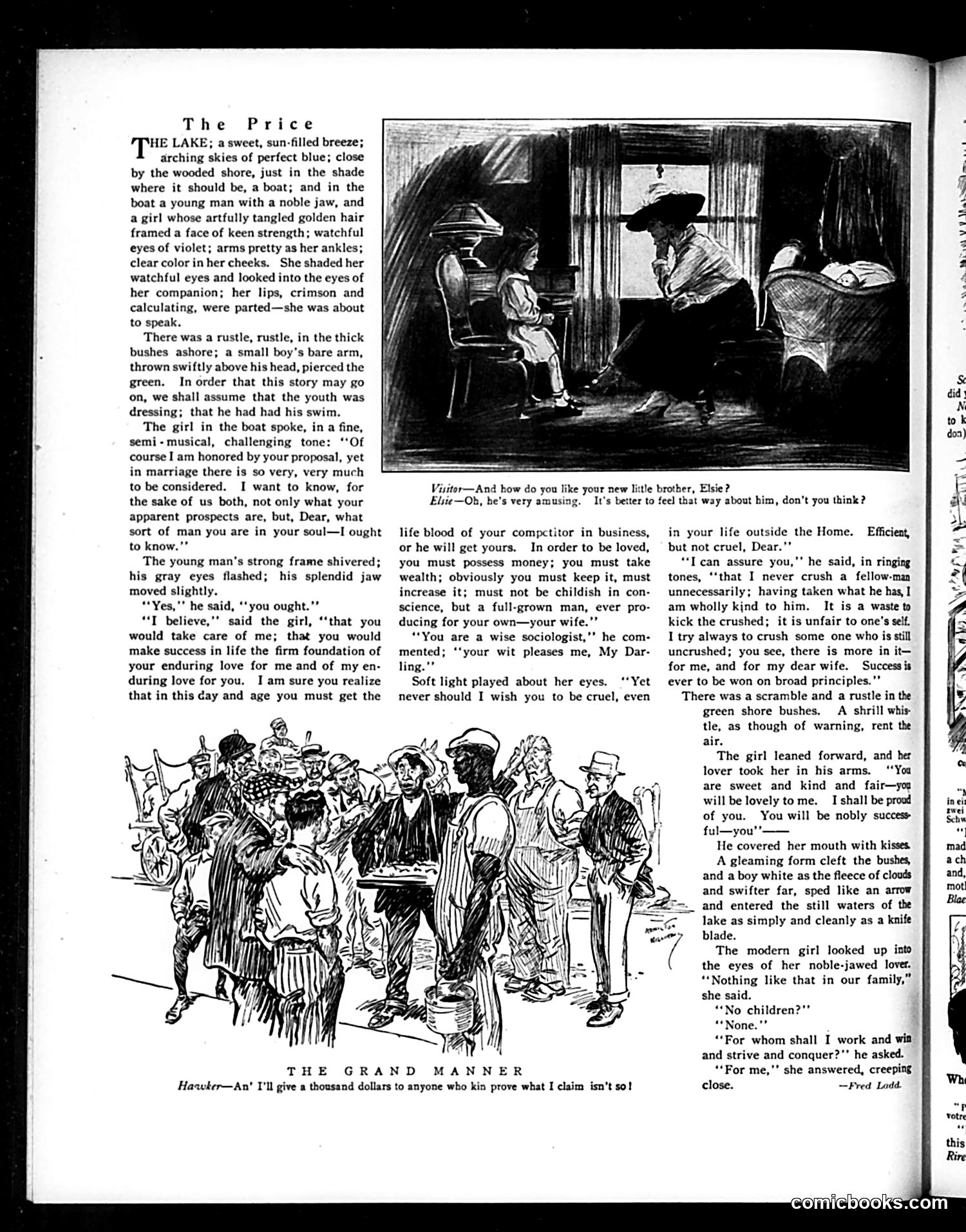
The Price HE LAKE; a sweet, sun-filled breeze; arching skies of perfect blue; close by the wooded shore, just in the shade where it should be, a boat; and in the boat a young man with a noble jaw, and a girl whose artfully tangled golden hair framed a face of keen strength; watchful eyes of violet; arms pretty as her ankles; clear color inher cheeks. She shaded her watchful eyes and looked into the eyes of her companion; her lips, crimson and calculating, were parted—she was about to speak. There was a rustle, rustle, in the thick bushes ashore; a small boy's bare arm, thrown swiftly above his head, pierced the green. In order that this story may go on, we shall assume that the youth was dressing; that he had had his swim. The girl in the boat spoke, in a fine, semi- musical, challenging tone: ‘‘Of course I am honored by your proposal, yet in marriage there is so very, very much to be considered. I want to know, for the sake of us both, not only what your apparent prospects are, but, Dear, what sort of man you are in your soul—I ought to know.’’ The young man's strong frame shivered; his gray eyes flashed; his splendid jaw moved slightly. **Yes,"” he said, ‘you ought.’’ “I believe,’’ said the girl, ‘‘that you would take care of me; that you would make success in life the firm foundation of your enduring love for me and of my en- during love for you. I am sure you realize that in this day and age you must get the Visiter—And how do you like your new little brother, Elsie? Elsie—Ob, he's very amusing. life blood of your compctitor in business, or he will get yours. In order to be loved, you must possess money; you must take wealth; obviously you must keep it, must increase it; must not be childish in con- science, but a full-grown man, ever pro- ducing for your own—your wife.” **You are a wise sociologist,’’ he com- mented; ‘‘your wit pleases me, My Dar- ling.’’ Soft light played about her eyes. “Yet never should I wish you to be cruel, even THE GRAND MANNER Hazwker—An' I'll give a thousand dollars to anyone who kin prove what I claim isn't so! It's better to feel that way about him, don’t you think? in your life outside the Home. but not cruel, Dear.’’ “‘Ican assure you,"’ he said, in ringing tones, ‘that I never crush a fellow-man unnecessarily; having taken what he has, I am wholly kjnd to him. It is a waste to kick the crushed; it is unfair to one’s self. I try always to crush some one who is still uncrushed; you see, there is more in it— for me, and for my dear wife. Success is ever to be won on broad principles."” There was a scramble and a rustle in the green shore bushes. A shrill whis- tle, as though of warning, rent the air. The girl leaned forward, and her lover took her in his arms. ‘You are sweet and kind and fair—you will be lovely tome. I shall be proud of you. You will be nobly success ful—you’'—— He covered her mouth with kisses. A gleaming form cleft the bushes, and a boy white as the fleece of clouds and swifter far, sped like an arrow and entered the still waters of the lake as simply and cleanly as a knife blade. The modern girl looked up into the eyes of her noble-jawed lover. “Nothing like that in our family,” she said. ‘0 children?’’ Efficient, “For whom shall I work and wit and strive and conquer?"’ he asked. “‘For me,"’ she answered, creeping close. —Fred Ladd. PuK RY RC | ey