
Judge, 1915-07-24 · page 10 of 28
Judge — July 24, 1915 — page 10: what you’re looking at
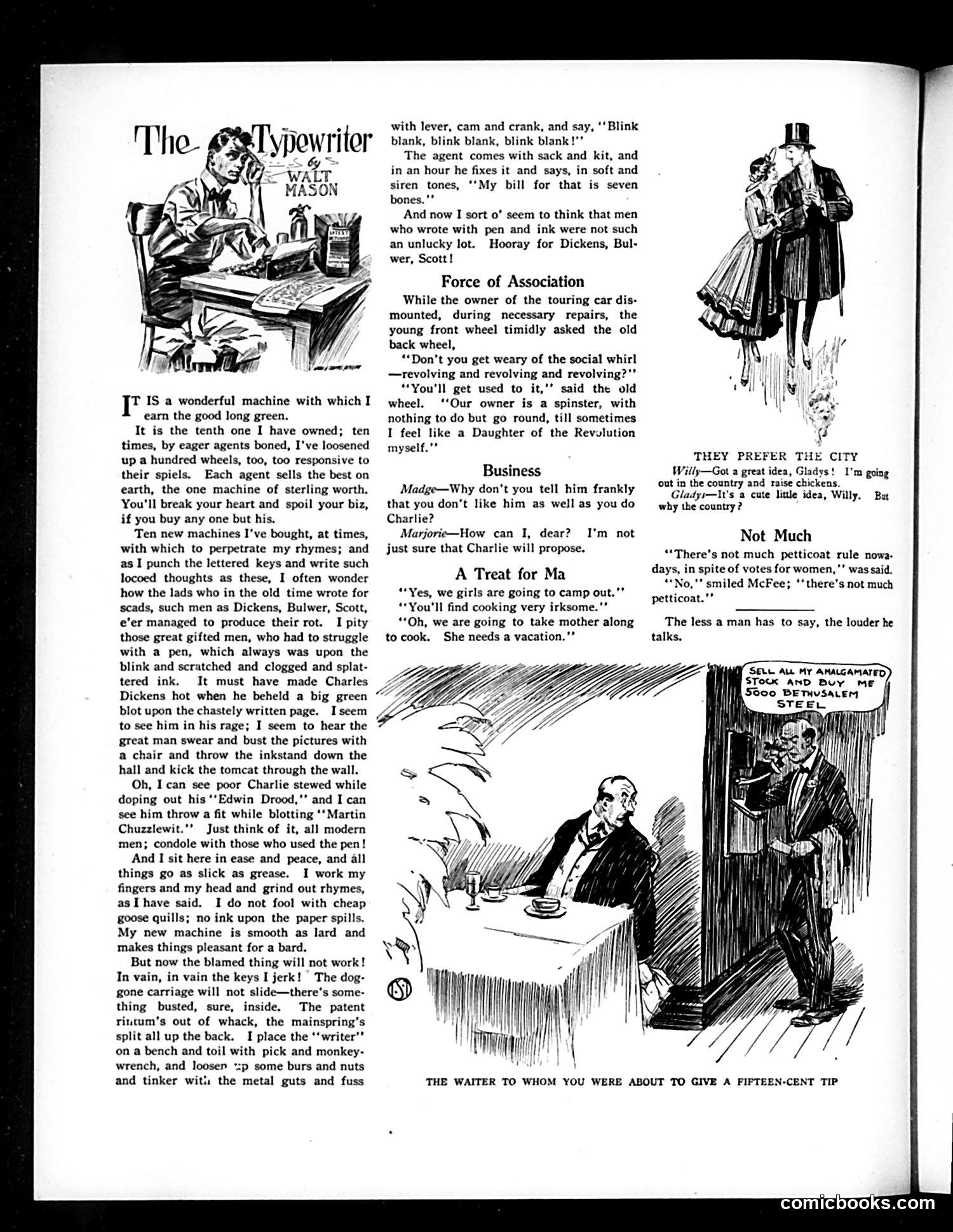
What you’re looking at
This page from *Judge* contains several satirical pieces typical of early 20th-century American humor: **"The Typewriter"** (main piece): A writer humorously contrasts the modern typewriter's convenience with classical authors' struggles using pens. He celebrates his machine's reliability—until it breaks down, requiring an expensive repairman charging "seven bones" (dollars). The satire mocks both aggressive typewriter salesmen making inflated claims and the irony of technological "progress" creating new frustrations. **Smaller satirical items** include jokes about women's suffrage ("not much petticoat rule"), automobile culture, courtship customs, and class dynamics (the waiter cartoon). The cartoons employ visual gags and dialogue to mock consumer culture, gender relations, and the gap between advertising promises and reality—standard *Judge* fare of social observation through humor rather than pointed political commentary.
📄 Transcribed text from this page (OCR, searchable)
Machine-transcribed from the original scan — historical spelling and the odd misread are preserved.
j ypewritor yew ~ MASON T IS a wonderful machine with which I earn the good long green. It is the tenth one I have owned; ten times, by eager agents boned, I've loosened up a hundred wheels, too, too responsive to their spiels. Each agent sells the best on earth, the one machine of sterling worth. You'll break your heart and spoil your biz, if you buy any one but his. Ten new machines I've bought, at times, with which to perpetrate my rhymes; and as I punch the lettered keys and write such locoed thoughts as these, I often wonder how the lads who in the old time wrote for scads, such men as Dickens, Bulwer, Scott, e’er managed to produce their rot. I pity those great gifted men, who had to struggle with a pen, which always was upon the blink and scratched and clogged and splat- tered ink. It must have made Charles Dickens hot when he beheld a big green blot upon the chastely written page. I seem to see him in his rage; I seem to hear the great man swear and bust the pictures with a chair and throw the inkstand down the hall and kick the tomcat through the wall. Oh, I can see poor Charlie stewed while doping out his ‘‘Edwin Drood,’’ and I can see him throw a fit while blotting ‘* Martin Chuzzlewit.’’ Just think of it, all modern men; condole with those who used the pen! And I sit here in ease and peace, and 4ll things go as slick as grease. I work my fingers and my head and grind out rhymes, as Ihave said. I do not fool with cheap goose quills; no ink upon the paper spills. My new machine is smooth as lard and makes things pleasant for a bard. But now the blamed thing will not work! In vain, in vain the keys I jerk! The dog- gone carriage will not slide—there’s some- thing busted, sure, inside. The patent rintum'’s out of whack, the mainspring’s split all up the back. I place the ‘‘writer’’ on a bench and toil with pick and monkey- wrench, and loosen <p some burs and nuts and tinker with the metal guts and fuss with lever, cam and crank, and say, ‘* Blink blank, blink blank, blink blank!"’ The agent comes with sack and kit, and in an hour he fixes it and says, in soft and siren tones, ‘‘My bill for that is seven bones.”* And now I sort 0’ seem to think that men who wrote with pen and ink were not such an unlucky lot. Hooray for Dickens, Bul- wer, Scott! Force of Association While the owner of the touring car dis- mounted, during necessary repairs, the young front wheel timidly asked the old back wheel, “Don’t you get weary of the social whirl —revolving and revolving and revolving?"’ “*You'll get used to it,’’ said the old wheel. ‘‘Our owner is a spinster, with nothing to do but go round, till sometimes I feel like a Daughter of the Revylution myself."” Business Madge—Why don’t you tell him frankly that you don’t like him as well as you do Charlie? Marjorie—How can I, dear? just sure that Charlie will propose. A Treat for Ma “Yes, we girls are going to camp ou! **You'll find cooking very irksome.’’ “‘Oh, we are going to take mother along to cook. She needs a vacation.’’ I'm not THEY PREFER THE CITY Witly—Got a great idea, Gladys! I'm going out in the country and raise chickens. Gladys—It's ‘a cute little idea, Willy. Bat why the country ? Not Much “*There’s not much petticoat rule nowa- days, in spite of votes for women, "’ was said. “*No,"’ smiled McFee; ‘‘there’s not much petticoat.’" The less a man has to say, the louder he talks. O/ Seu Au My AnaLcamareD STotx AND Buy mE G7 |" | HN o sae 8 Il sila in | i THE WAITER TO WHOM YOU WERE ABOUT TO GIVE A FIFTEEN-CENT TIP comicbooks.com