
A complete issue · 28 pages · 1915
Judge — June 5, 1915
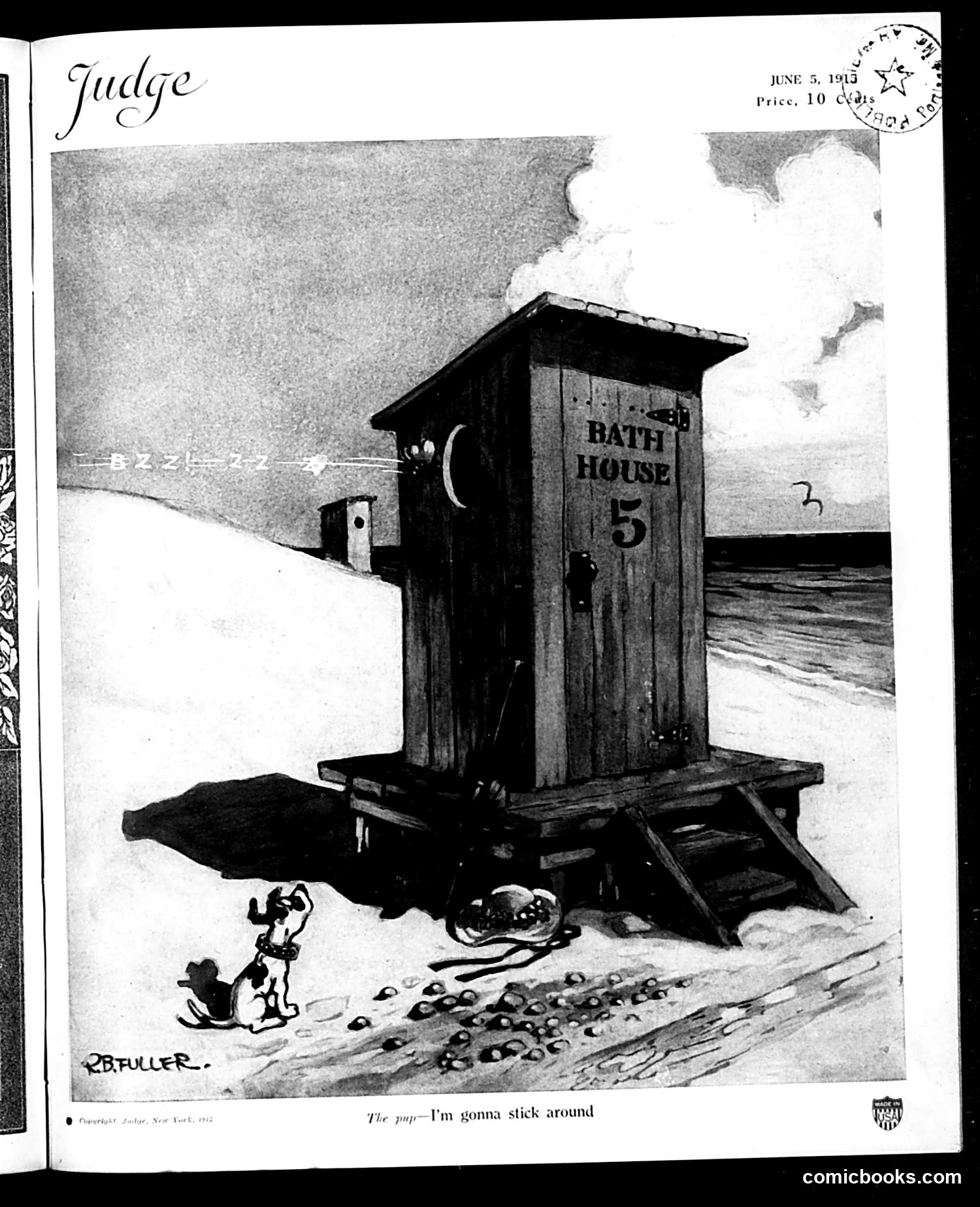
This cartoon depicts a small dog sitting outside a wooden "Bath House 5" structure on a beach, with the caption "The pup—I'm gonna stick around." The humor appears to be a visual pun: the dog, excluded from the bathhouse (likely due to period social customs that barred animals), has decided to wait outside rather than leave. The joke plays on the dog's apparent determination to remain near its owner, despite being unable to enter. The cartoon is signed by R. Fuller. Given Judge magazine's satirical nature, this is likely simple observational humor about beach culture and pet behavior rather than political commentary. The 1913 date places it during the era when beach bathing was becoming increasingly popular American recreation.
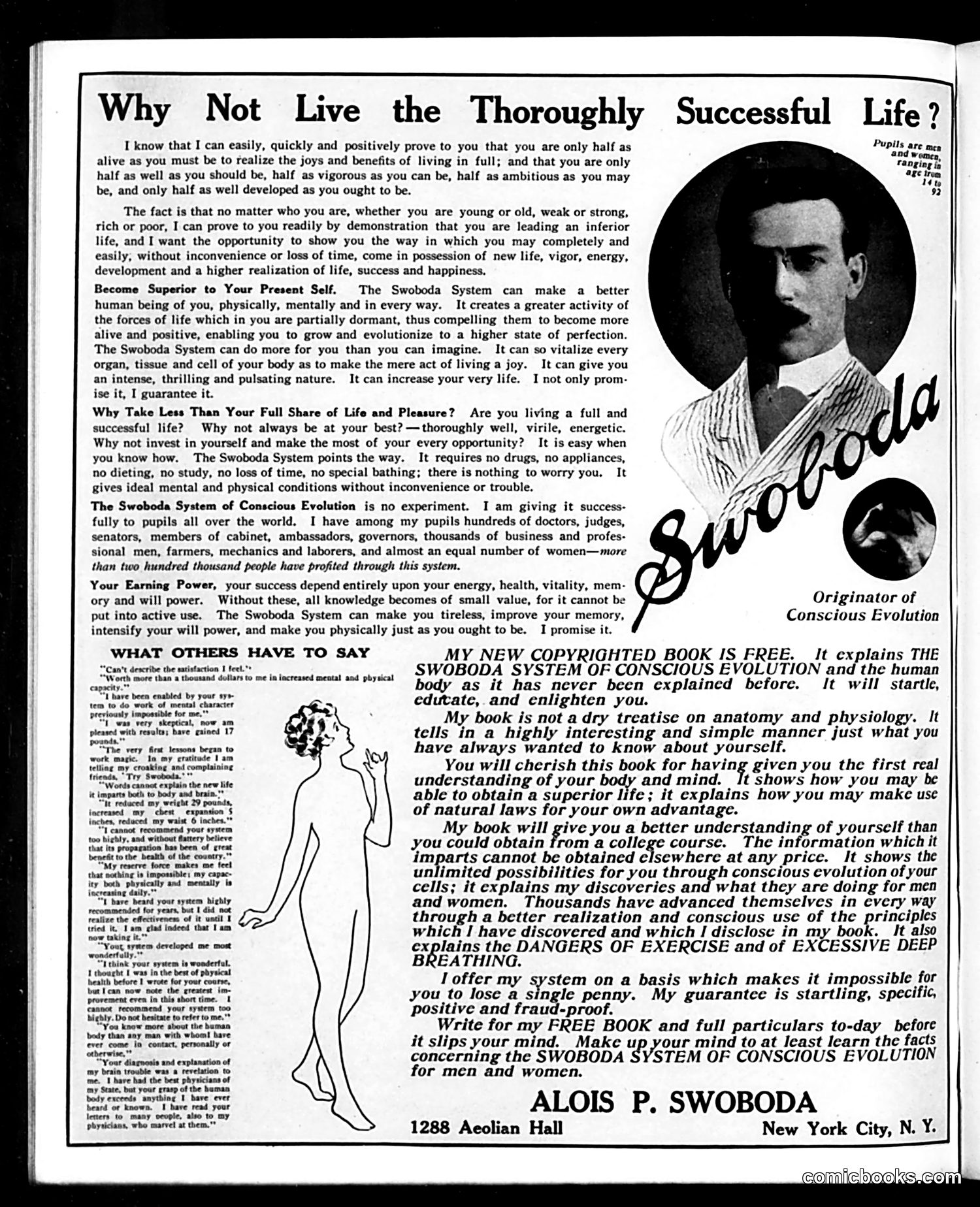
This page is primarily **advertising, not satire**. It's a full-page advertisement for Alois P. Swoboda's "System of Conscious Evolution"—a self-improvement program from early 20th-century New York. The content promises physical and mental enhancement through Swoboda's method, claiming it requires "no drugs, no appliances, no dieting." Testimonials from unnamed satisfied customers appear in the left column, praising results like improved memory and vitality. The illustration shows a simplified human figure demonstrating the system's focus on bodily development. Swoboda positions himself as an "Originator of Conscious Evolution," offering a free book explaining his techniques. This represents typical early 1900s pseudoscientific self-help marketing—promising transformation through special systems not available through conventional education or medicine.
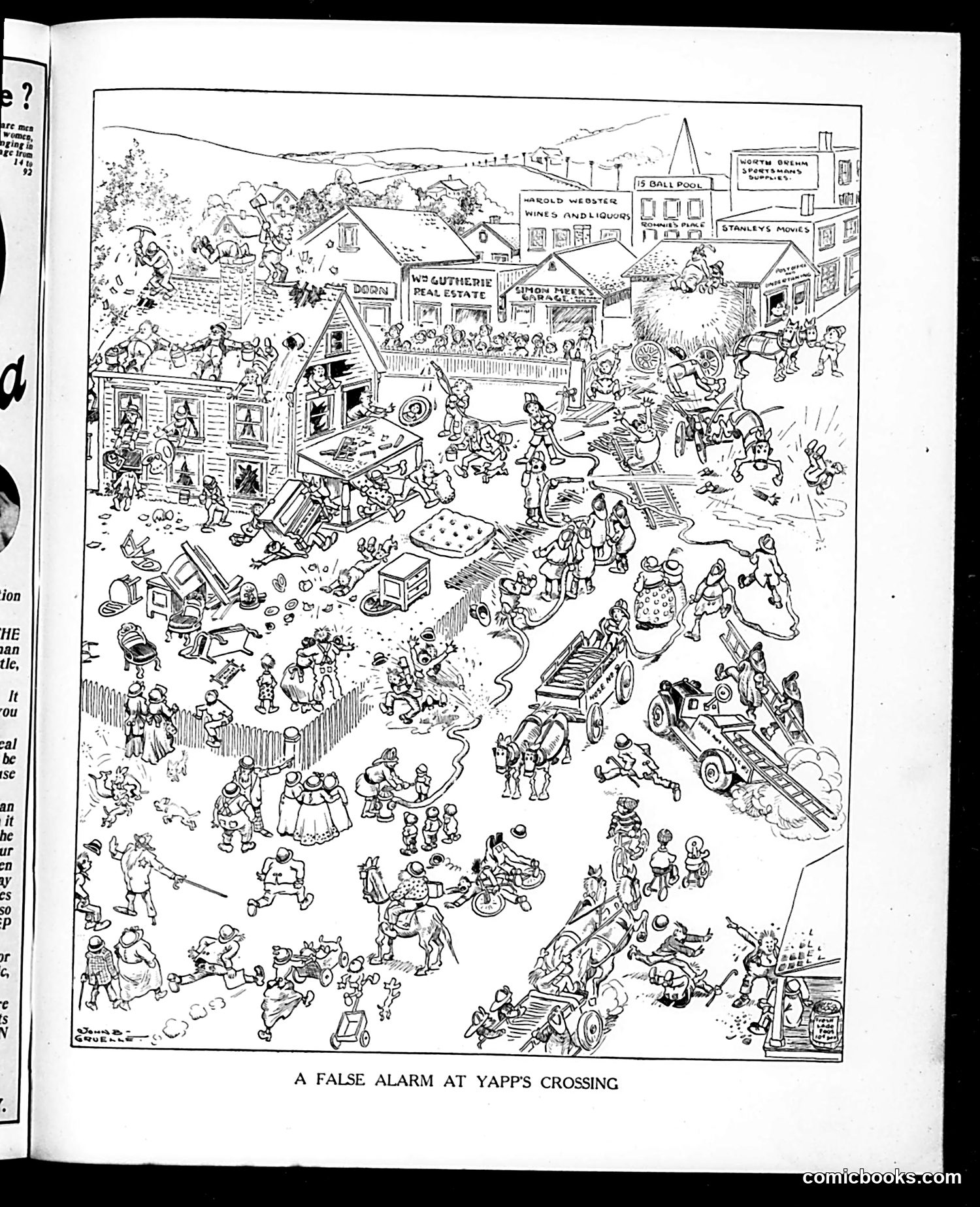
This is a crowded, chaotic scene depicting a railroad crossing in what appears to be a small town or village. The cartoon shows panic and disorder erupting—people running in different directions, vehicles overturned, children scattered about—apparently triggered by a false alarm. The visible business signs include "Harold Webster Wines and Liquors," "Gutherie Real Estate," "Simon Peer Garage," and others, establishing this as a commercial district. The humor derives from the exaggerated mayhem caused by what turns out to be an unfounded emergency at the railroad crossing—a common feature of daily life in early 20th-century America that could cause significant disruption. The satirical point appears to be social commentary on mass panic and the vulnerability of small-town communities to transportation-related disturbances.
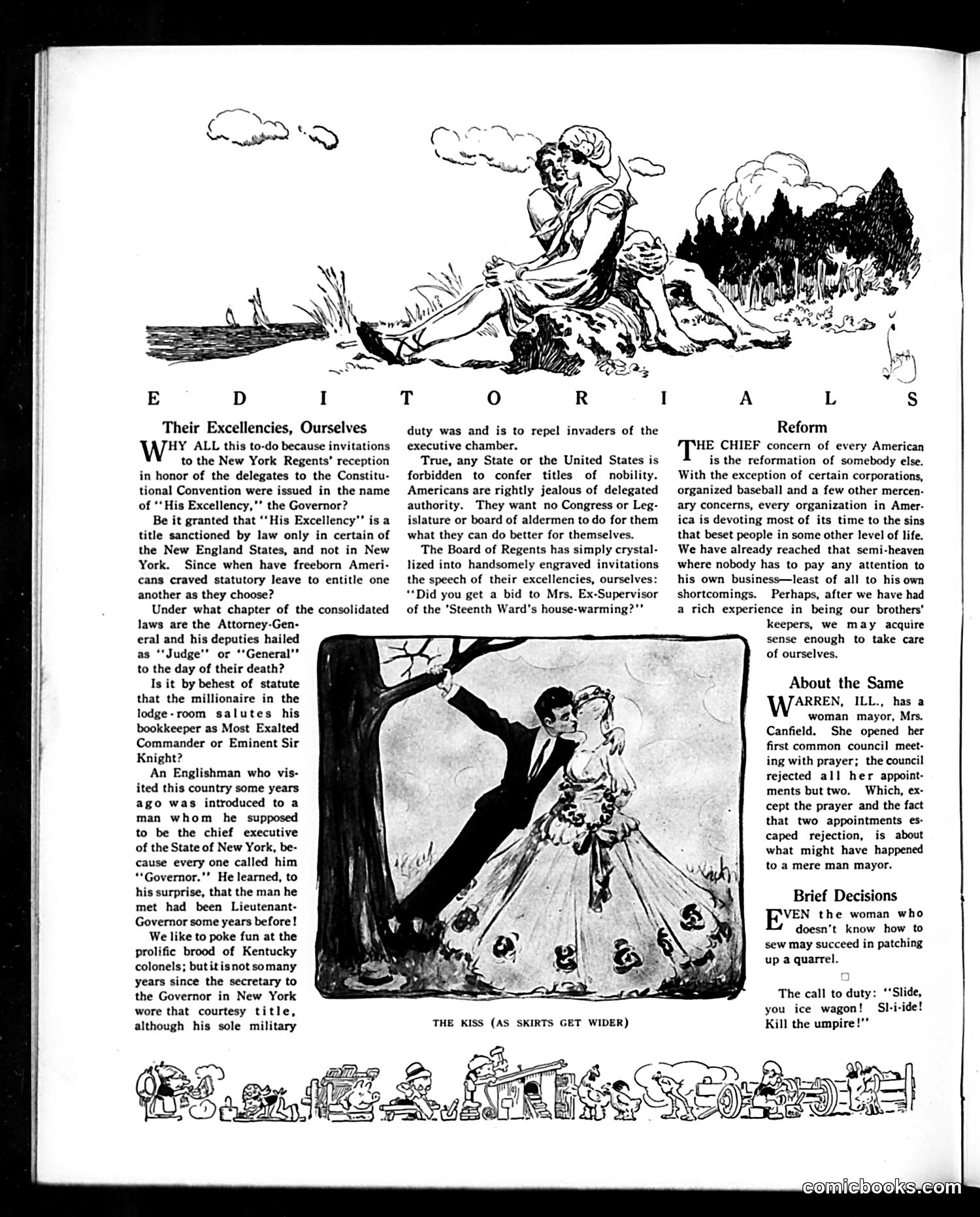
This page contains satirical commentary on American governance and social issues, circa early 20th century. **Top Section ("Editorials"):** The main article critiques the use of honorific titles (like "His Excellency") for American officials, arguing such pretensions contradict democratic principles. It mocks New York State officials conferring grandiose titles on each other—comparing this to European monarchical practices—and questions whether a state attorney general should be called "Judge" or "General." **Central Illustration ("The Kiss"):** A romantic scene captioned ironically, likely commenting on political or social hypocrisy. **Right Column:** Brief items mock Warren, Illinois's female mayor (Mrs. Canfield) and a woman unfamiliar with practical skills. The overall tone satirizes American officials adopting aristocratic pretenses while claiming democratic values.
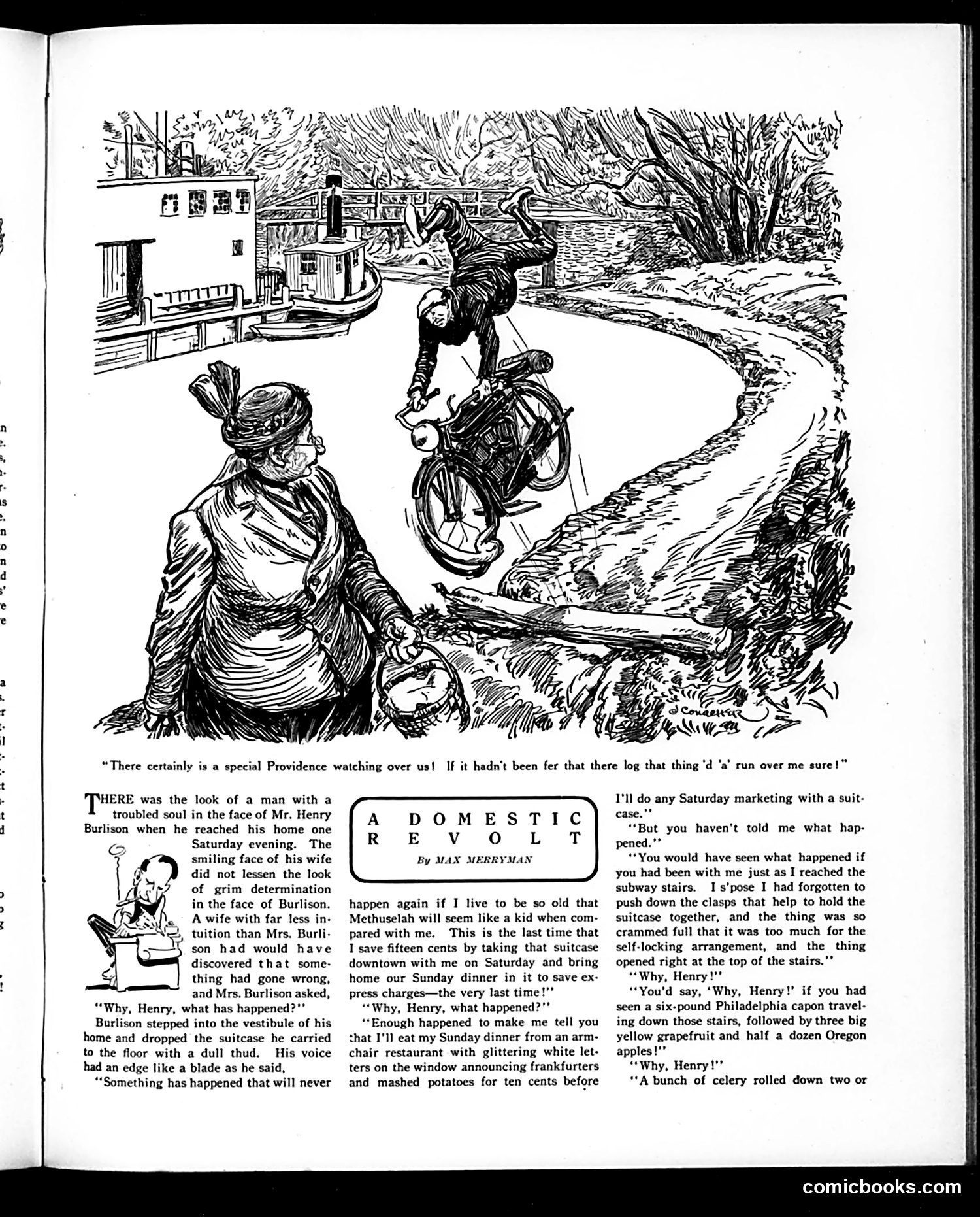
This is a humorous domestic story about a husband named Henry whose wife has discovered something troubling. The illustration shows a woman watching Henry ride away on a bicycle while she sits by the roadside looking distressed. The narrative reveals Henry's wife is upset because Henry took their suitcase downtown to bring home their Sunday dinner in it—apparently to save express charges. The wife is mortified by this undignified use of luggage, viewing it as beneath their social standing. The satire mocks both Henry's penny-pinching (using a suitcase as a food container) and the wife's concern with appearances and propriety. It's a gentle joke about domestic economics and marital disagreements over practical versus respectable behavior in early 20th-century middle-class life.
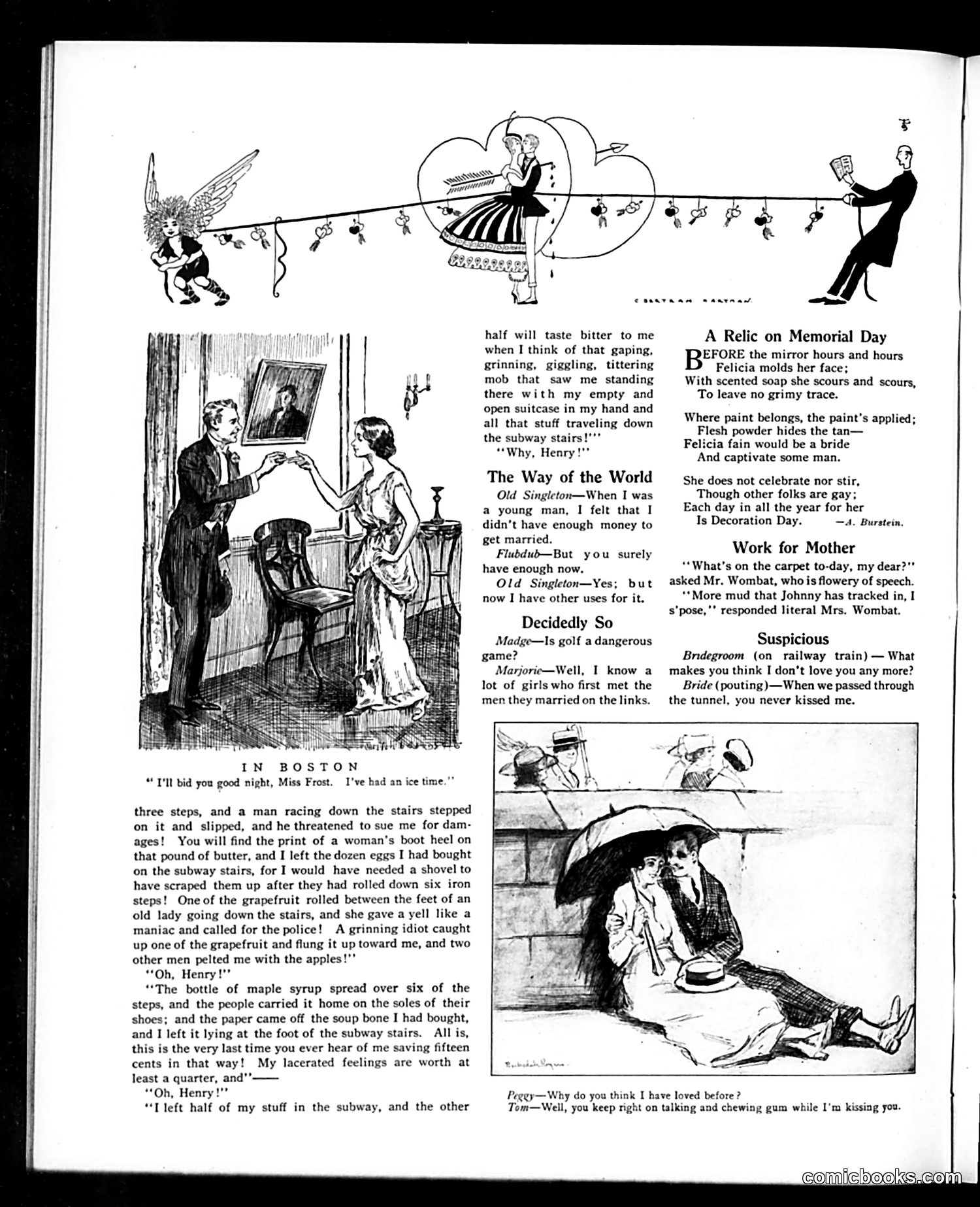
This page contains several short humorous pieces typical of early 20th-century American satire: **"In Boston"** depicts a husband recounting a subway shopping disaster—groceries spilled down stairs, causing chaos. The humor relies on the contrast between his attempt to save money and the resulting expenses (cleaning bills, threatened lawsuits, his injured dignity). **"The Way of the World"** satirizes marriage economics: a young man couldn't afford to marry; now older and wealthier, he has "other uses" for his money—poking fun at how priorities shift with age and marriage's financial demands. **"A Relic on Memorial Day"** ironically portrays Felicia obsessively grooming year-round, treating every day like Decoration Day (Memorial Day), desperately seeking a husband rather than honoring the holiday's solemn purpose. The remaining pieces ("Decidedly So," "Work for Mother," "Suspicious") are brief romantic/domestic jokes about golf, household chores, and marital affection—standard period humor about courtship and married life. The tone throughout is gently mocking of ordinary American domesticity and gender relations.
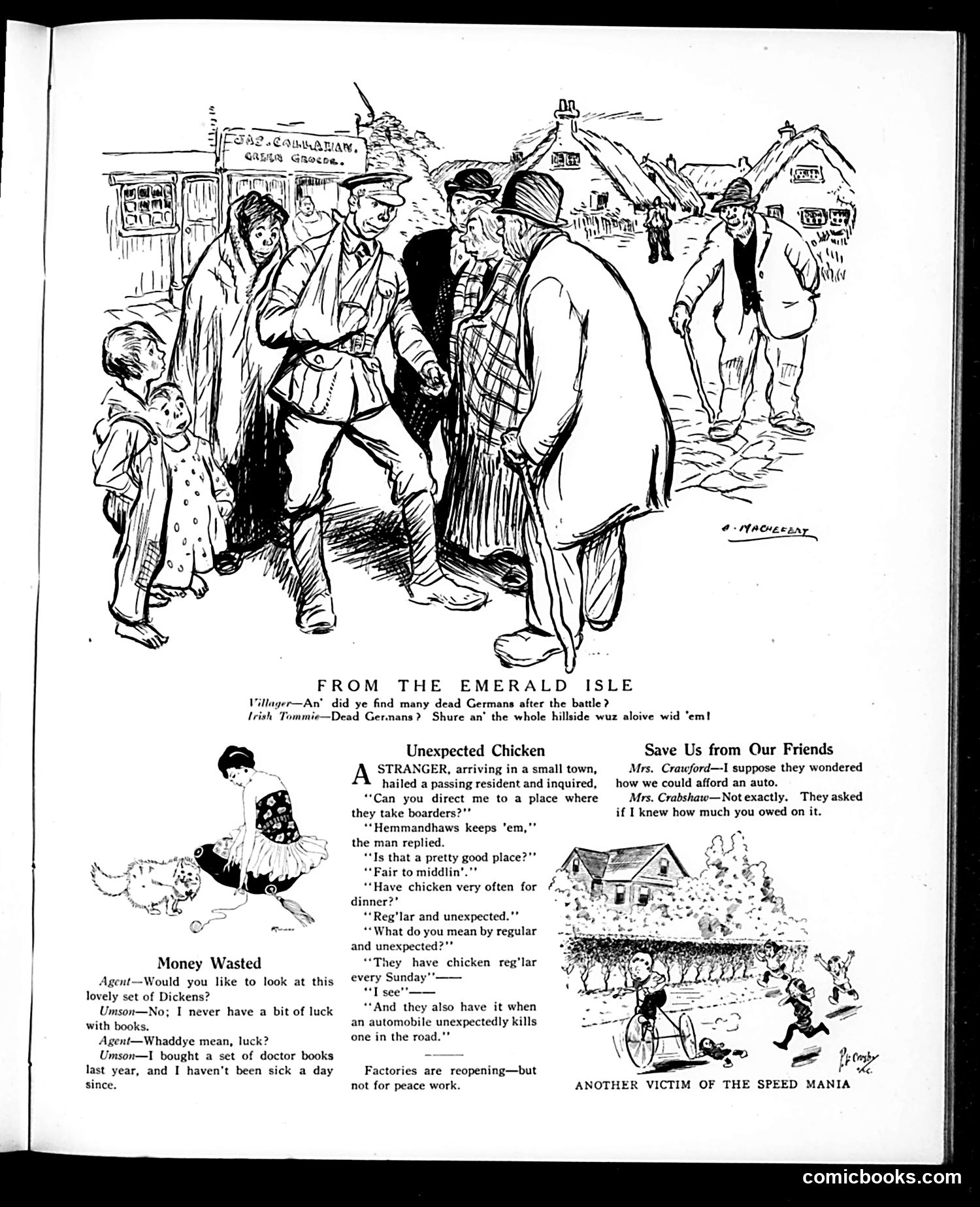
This page from *Judge* magazine contains WWI-era humor and social commentary: **"From the Emerald Isle"** mocks Irish soldiers' dialect while referencing WWI combat, presenting a stereotypical Irish brogue ("aloive wid 'em"). **"Money Wasted"** jokes about superstition—a man believes doctor books caused his good health, confusing correlation with causation. **"Unexpected Chicken"** satirizes rural poverty: a boarding house serves chicken both on Sundays (regularly) and when automobiles kill livestock on roads—dark humor about rural America's relationship with new technology and economic hardship. **"Save Us from Our Friends"** critiques social pretension: neighbors assume the car is mortgaged rather than owned outright, mocking judgmental attitudes among the middle class. **"Another Victim of the Speed Mania"** warns about automobile dangers, a contemporary concern as cars were still novel and deadly. The page reflects post-WWI American anxieties: class anxiety, technology's dangers, and stereotyping of immigrants and rural populations.
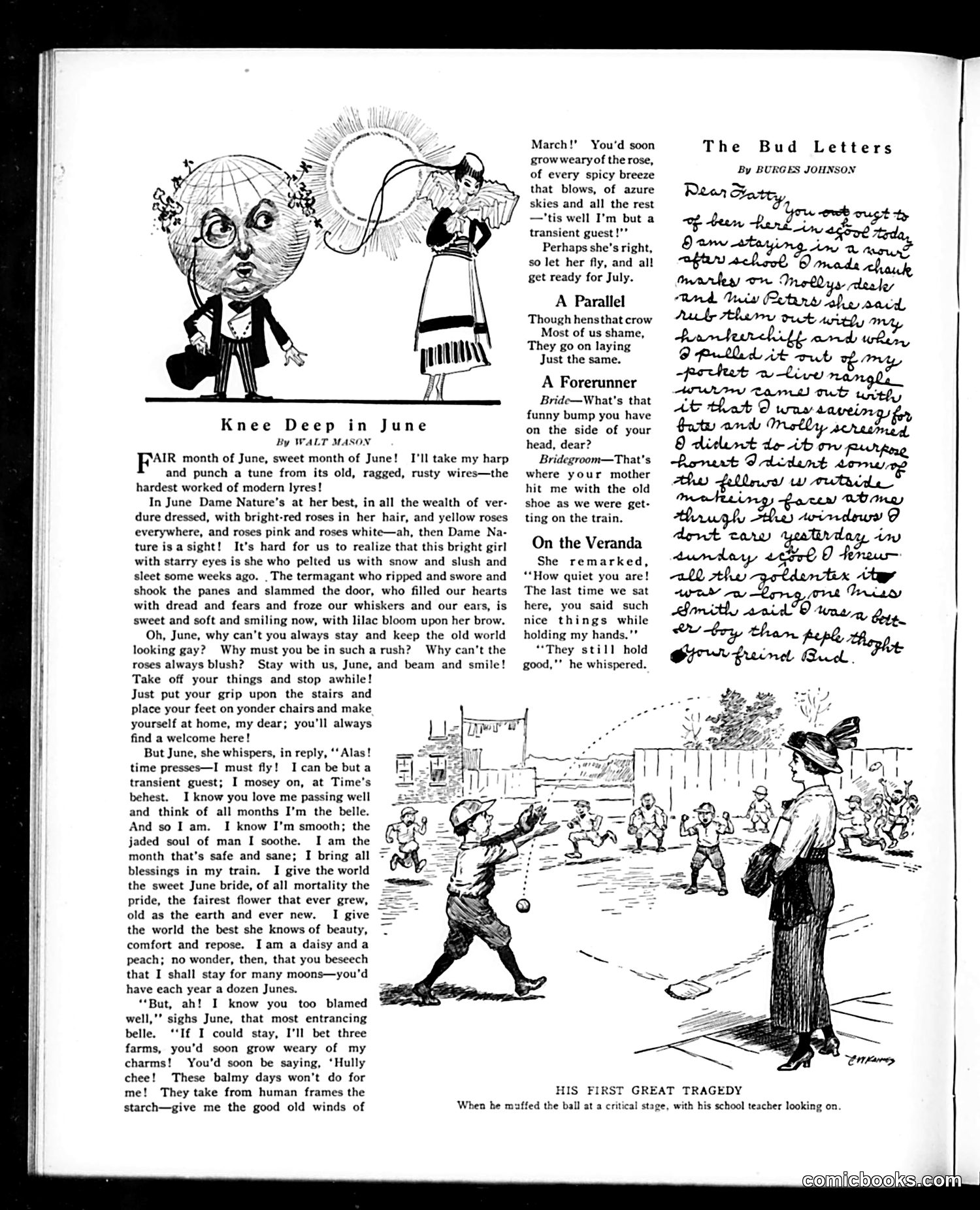
This page contains light satirical humor typical of early 20th-century American magazines: **"Knee Deep in June"** (center): A sentimental poem personifying June as a beautiful woman who must leave. The satire is gentle—mocking romantic idealization of the month while acknowledging human nature's tendency to take beauty for granted. The poem plays on the contrast between June's harsh winter persona and her current charm. **Small comic bits** (top and sides): Brief jokes about marriage ("A Forerunner" mocks the tradition of hitting grooms with shoes), domestic relationships ("On the Veranda" jokes about a husband repeating compliments), and gender behavior ("A Parallel" compares humans unfavorably to hens). **"His First Great Tragedy"** (bottom): Depicts a boy failing at baseball with his teacher watching—a gentle mockery of childhood embarrassment over minor failures. The page reflects **Edwardian-era humor**: sentimental yet cynical about romance, focused on domestic situations, and mildly self-mocking about American middle-class life. No specific political content is evident. The handwritten letter column ("Bud Letters") suggests reader correspondence.
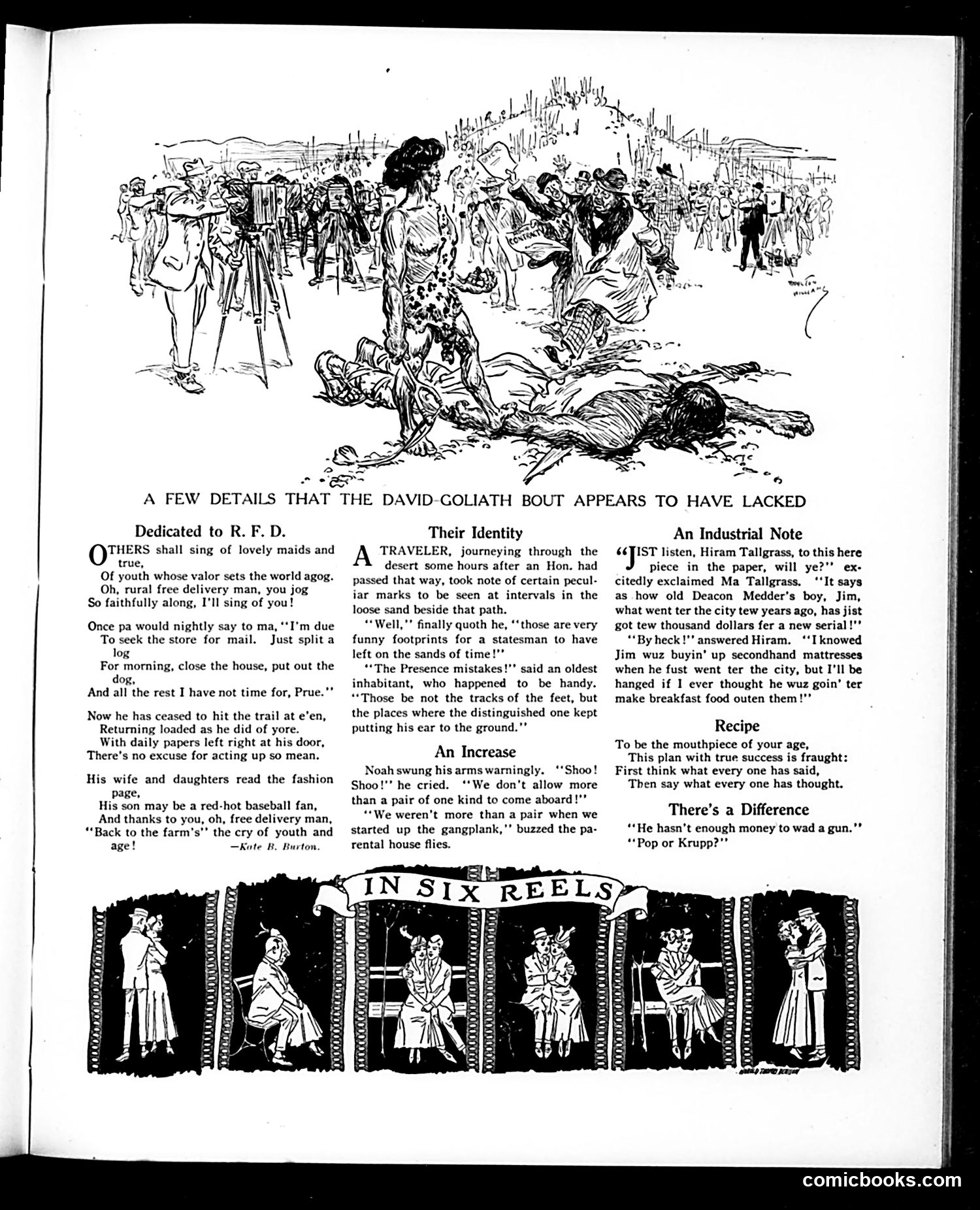
This page contains satirical commentary on early 20th-century American life, centered around Rural Free Delivery (RFD) mail service. **Main Content:** The opening poem celebrates the RFD mail carrier, crediting him with transforming rural life. Previously, farmers had to travel to town for mail; now delivery comes directly home. The satire praises this modern convenience while suggesting it has eliminated excuses for avoiding farm work. **Side Jokes:** - A "David-Goliath" reference mocking a politician (unnamed) who puts his "ear to the ground" rather than leaving footprints—implying empty populist posturing - Noah's Ark joke about house flies multiplying despite population controls - A rural anecdote where a farmer mistakes his neighbor's newspaper story about serial fiction income for breakfast cereal manufacturing **"In Six Reels"** (film strip at bottom) depicts courtship scenarios, unrelated to the main content. The page reflects period anxieties about modernization, rural life, and political deception, using humor to make social commentary accessible.
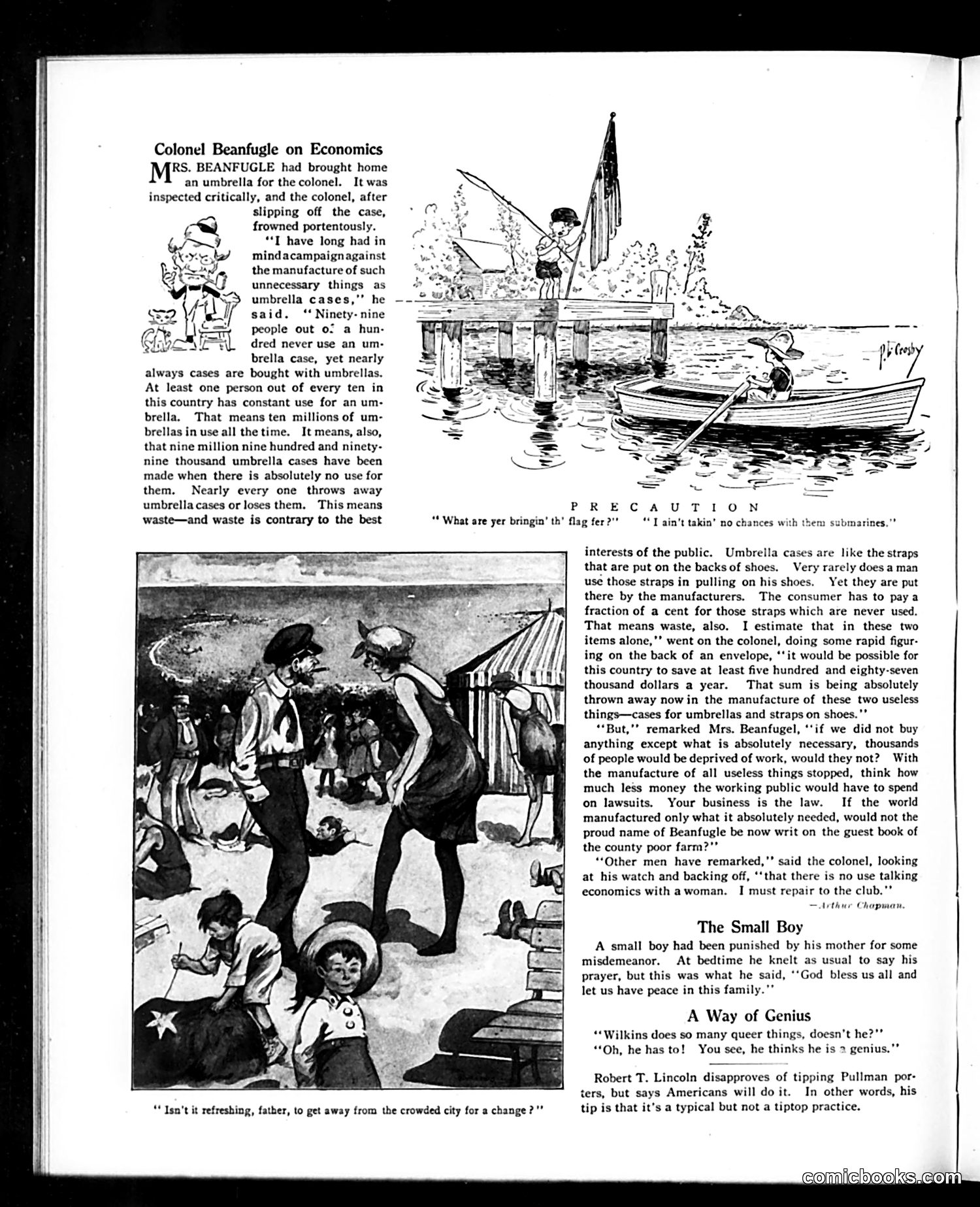
This page satirizes a pompous lawyer character ("Colonel Beanfugle") who campaigns against wasteful manufacturing—specifically umbrella cases and shoe straps that consumers rarely use. The joke is that his economizing argument backfires: his wife points out that eliminating "useless" production would throw workers out of jobs and impoverish him, since his legal practice depends on the economic activity that such waste generates. The cartoon at bottom right ("Precaution") references WWI submarine warfare, showing civilians taking absurd protective measures—flying a flag to avoid being torpedoed—reflecting American anxiety about German U-boats. The page also includes brief humorous anecdotes about a child's bedtime prayer and a character named Wilkins, plus commentary on tipping Pullman porters. These are light social observations typical of Judge magazine's satirical format.
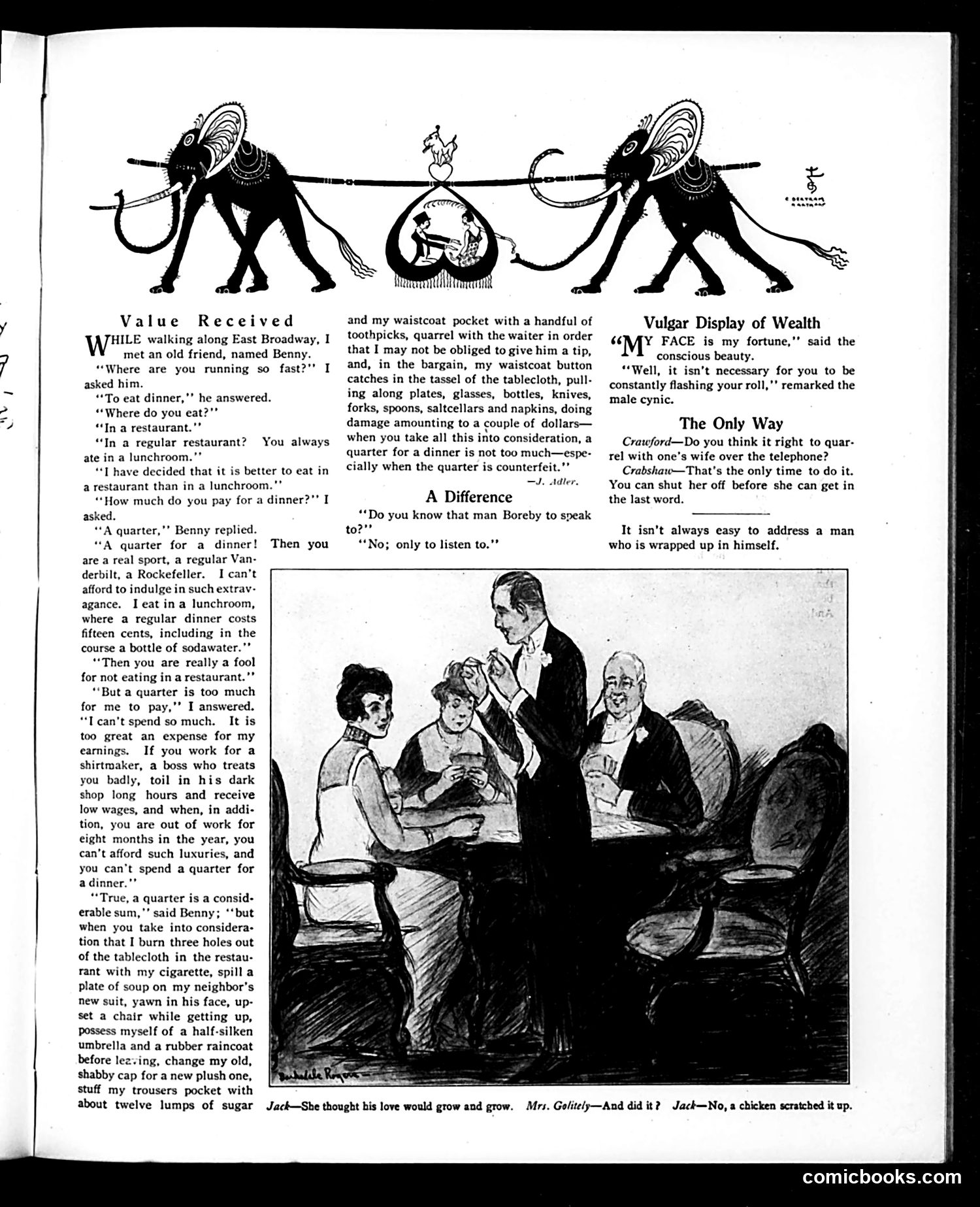
This page contains several humorous short pieces satirizing working-class and middle-class American life, likely from the early 1900s. **"Value Received"** mocks the false economy of eating in restaurants versus lunchrooms. Benny argues that a quarter dinner is reasonable when factoring in the "hidden costs" of his destructive behavior—burning tablecloth holes, spilling soup, stealing sugar and utensils, swapping his shabby cap for a plush one. The satire targets both the working poor who stint on food, and the casual dishonesty/entitlement of customers who feel justified stealing from establishments. **The illustration** shows what appears to be a domestic scene with three figures, captioned with wordplay about a woman's appearance and romantic prospects. The page's multiple brief jokes share a common theme: satirizing lower-income New Yorkers' petty schemes, damaged pride, and attempts at social climbing on minimal budgets. The humor depends on recognizing the absurdity of their rationalizations.
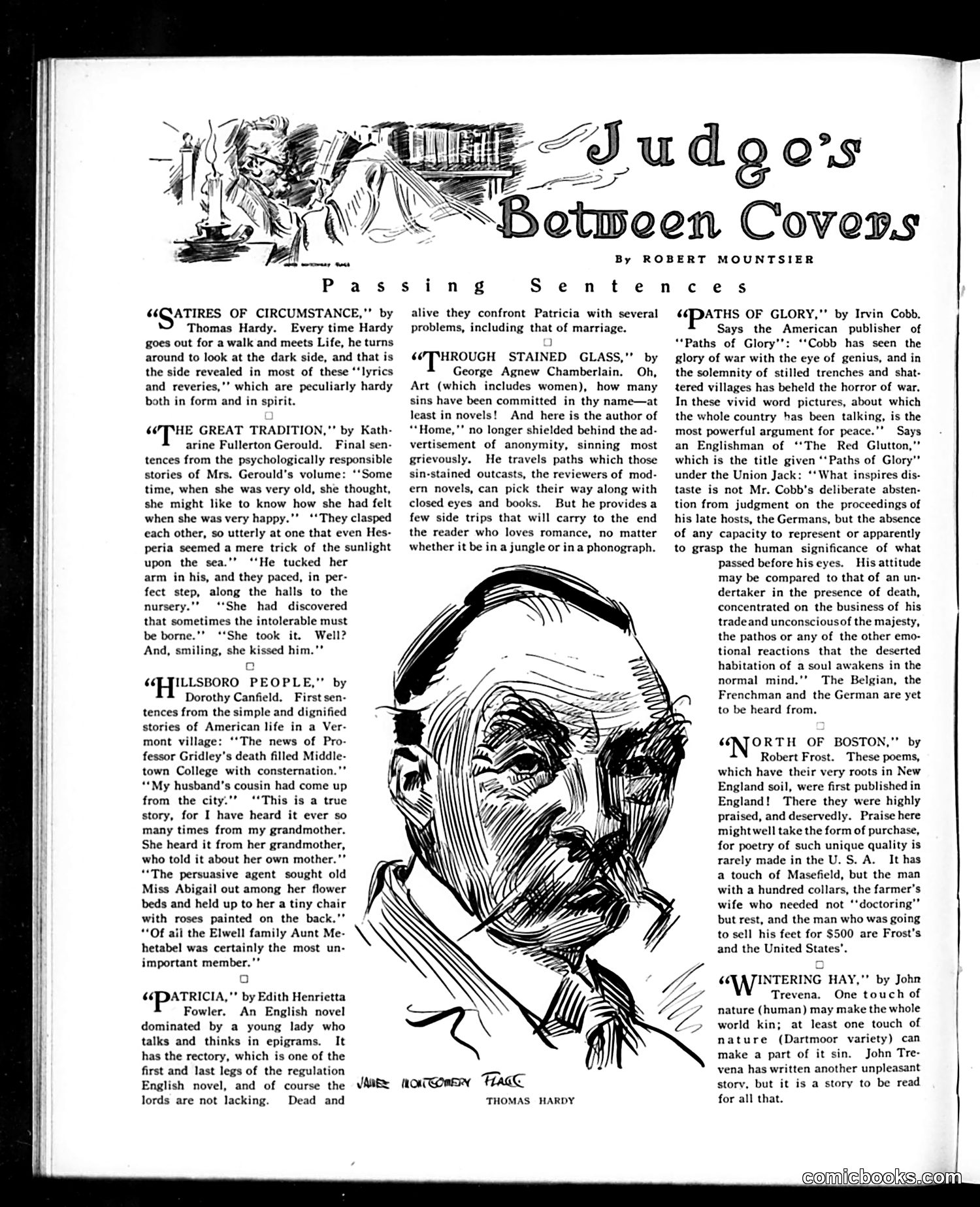
This is a literary review section featuring book critiques by Robert Mountsier. The central illustration is a portrait sketch of **Thomas Hardy**, the celebrated English novelist, identified by the caption below. The page reviews five contemporary books with satirical summaries of their opening lines and themes: - Hardy's *Satires of Circumstance* (poetry focusing on life's dark side) - Gerould's *The Great Tradition* (domestic romance) - Canfield's *Hillsboro People* (Vermont village stories) - Fowler's *Patricia* (English society novel with witty heroine) - Chamberlain's *Through Stained Glass* (war and romance) The satire targets literary conventions: overwrought emotional conclusions, predictable English novel settings ("the rectory...and of course the lords"), and formulaic American regionalism. The longest critique of Cobb's *Paths of Glory* contrasts American and English views on war literature—the American publisher sees it as pacifist propaganda, while an Englishman criticizes Cobb's emotional detachment toward German suffering.
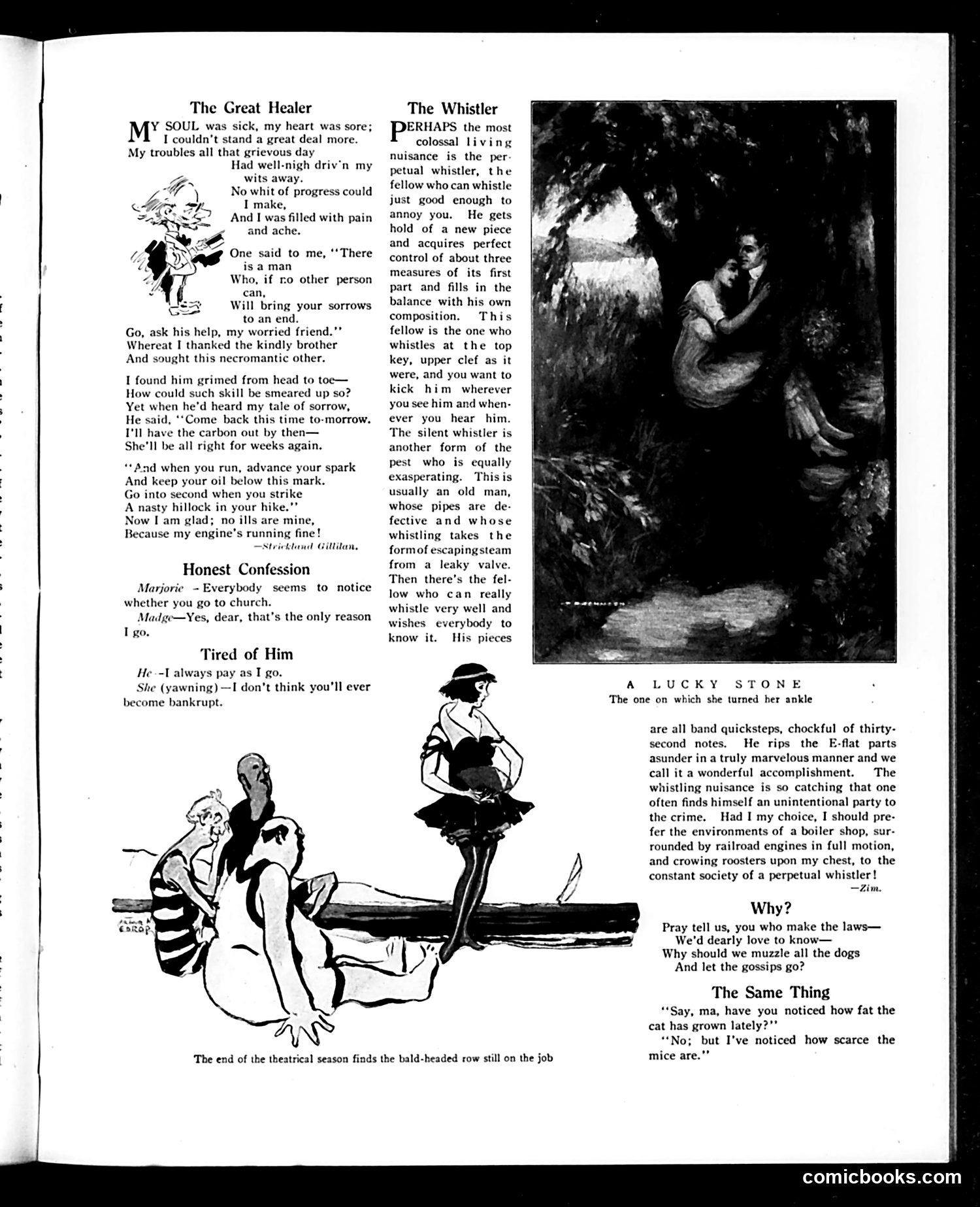
This page contains several short humorous pieces typical of early 20th-century satirical magazines: **"The Great Healer"** parodies the emerging automobile age. A troubled man seeks a mechanic (described mysteriously as "necromantic") who fixes his car engine. The joke: the "great healer" treats machines, not people—reflecting how cars were transforming daily life and becoming objects of quasi-religious devotion. **"The Whistler"** is a social complaint about an annoying character type: the person who whistles badly or incessantly in public. The author catalogs different whistler varieties with genuine irritation, satirizing how minor social annoyances preoccupy polite society. The remaining items are brief joke exchanges about marital dynamics ("Honest Confession," "Tired of Him") and absurdist humor ("The Same Thing"—implying the fat cat and scarce mice are connected). "The Bald-Headed Row" cartoon references theater patrons, likely mocking older men's attendance at performances. Overall, the page reflects working-class and middle-class preoccupations of the era: mechanization, social etiquette, and marriage dynamics.
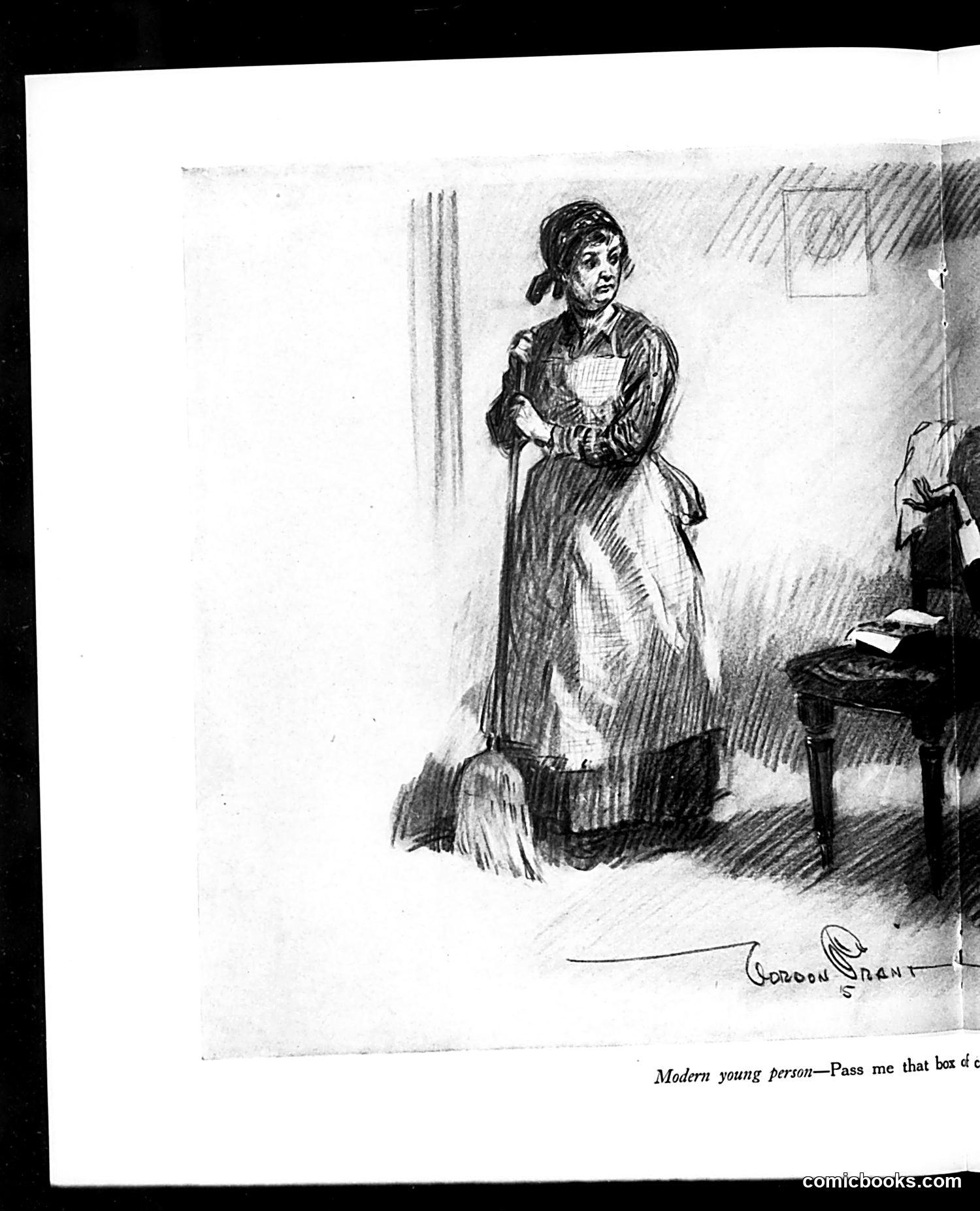
This sketch by Gordon Grant depicts a domestic scene featuring a young woman in early 20th-century servant or working-class attire (apron and long dress). The caption reads "Modern young person—Pass me that box of..." with the text cut off. The satire appears to target changing social behaviors among young women of the era. The "modern young person" likely refers to the New Woman—a contemporary figure challenging traditional gender roles through independence and casual behavior. The incomplete caption suggests she's requesting something in an informal, presumptuous manner, satirizing what the publication viewed as improper or overly bold conduct from younger generations. The sketch's tone mocks evolving social standards rather than endorsing them.
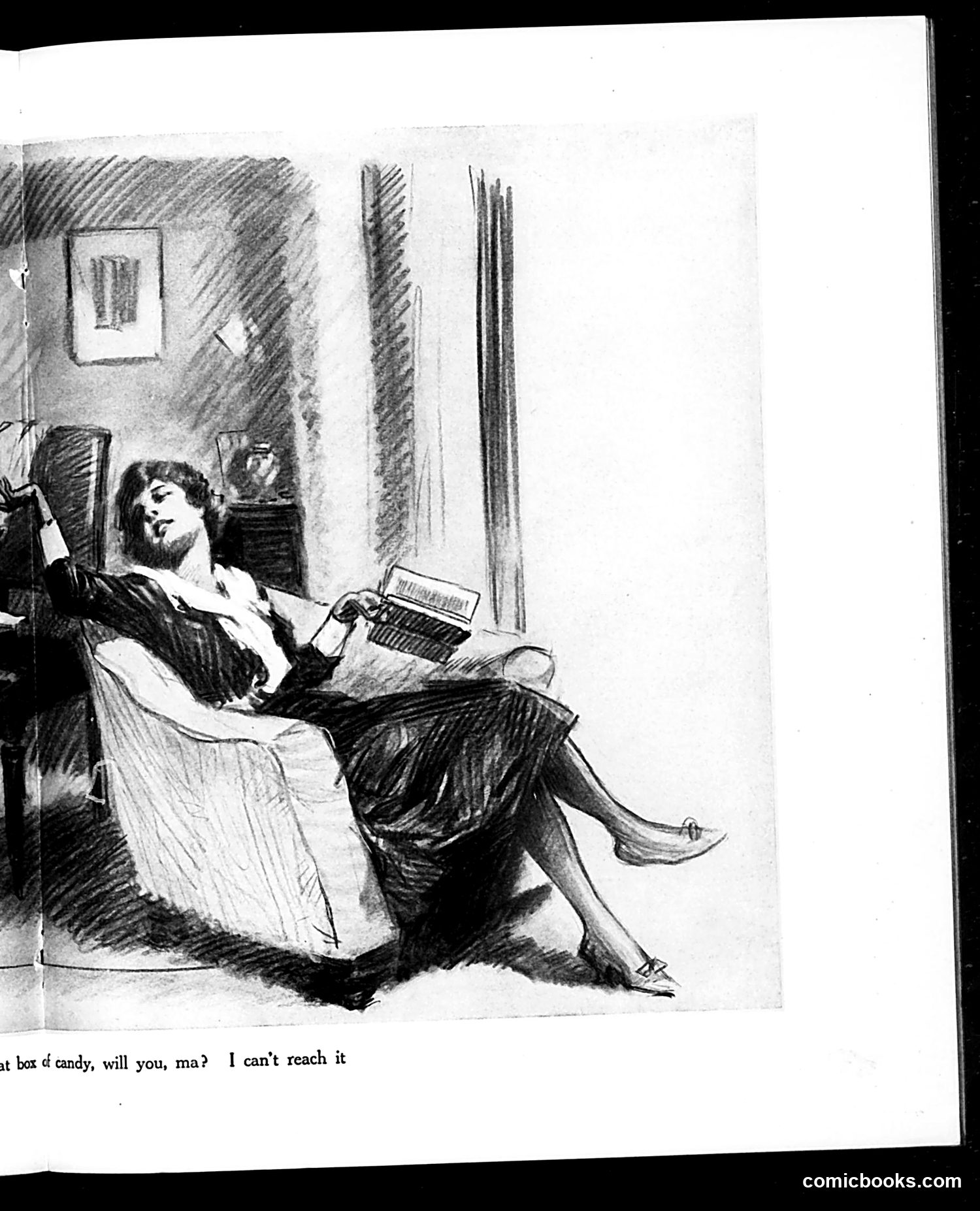
This appears to be a humorous domestic sketch from Judge magazine depicting a flirtatious or suggestive scene. A woman reclines in a chair reading while a man (partially visible on the left) makes a request about candy, claiming he "can't reach it." The joke likely plays on double entendre—the literal request masks a more suggestive intent. The woman's relaxed posture, styled appearance, and the intimate domestic setting suggest this is social satire about courtship, romantic relationships, or gender dynamics of the era. Without a visible date or artist signature, the specific historical context remains unclear, but the cartoon exemplifies Judge's typical blend of mild sexual innuendo and domestic comedy aimed at adult readers of the early-to-mid 20th century.
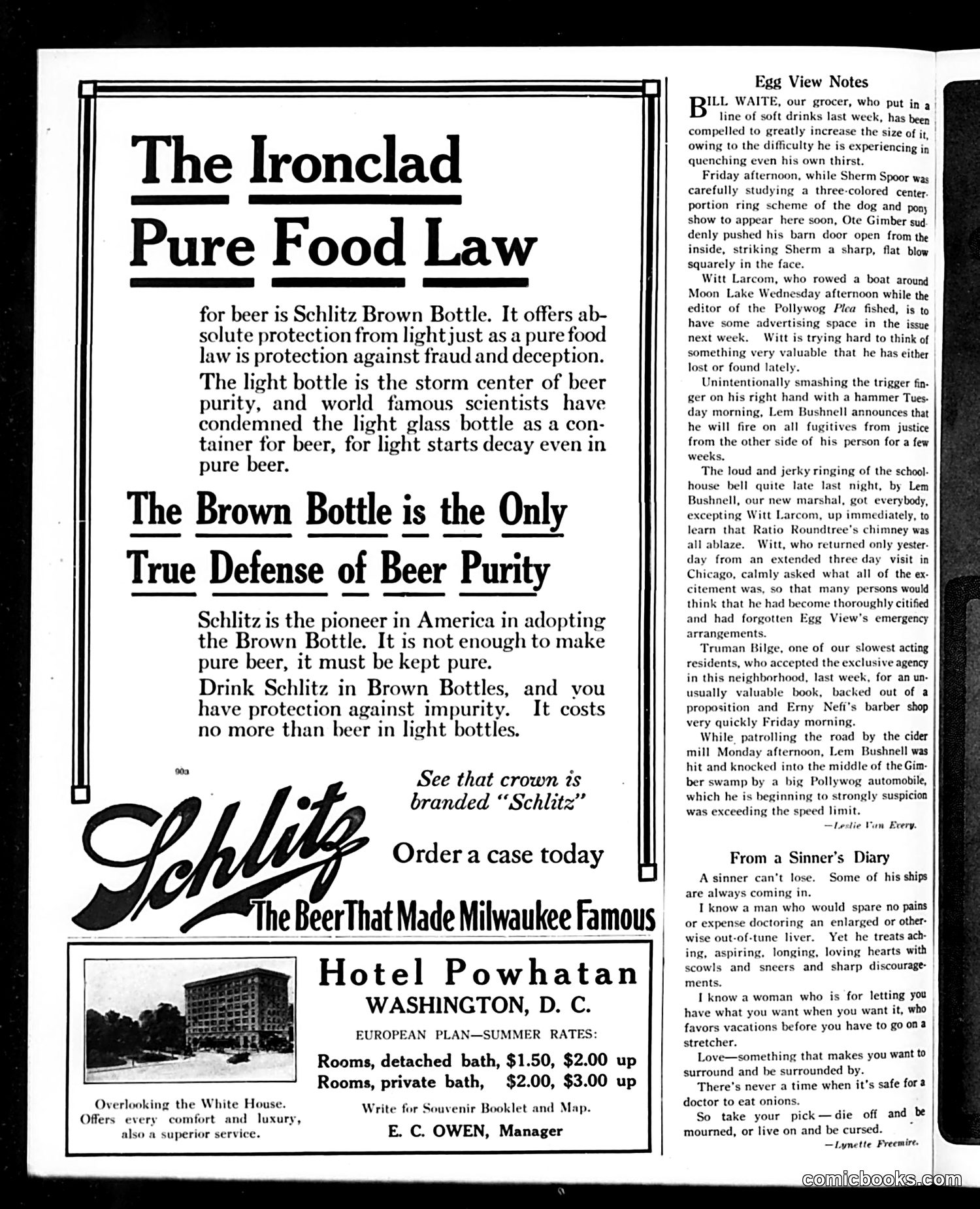
This page consists primarily of **advertising**, not political satire. The main content is a Schlitz beer advertisement claiming brown bottles preserve beer purity better than clear bottles—framing the brown bottle as equivalent to food safety regulations ("The Ironclad Pure Food Law"). The satire is **commercial**, not political: Schlitz positions itself as a quality protector, though the "Pure Food Law" comparison is hyperbolic marketing rather than genuine commentary. The right side contains lighter content: "Egg View Notes" appears to be **small-town gossip/humor** from a fictional rural community, with jokes about local characters like grocer Bill Waite and marshal Lem Bushnell. Below that, "From a Sinner's Diary" offers brief philosophical observations. A Hotel Powhatan advertisement rounds out the page. **No significant political cartoon or satire** is present here—this is primarily a commercial magazine page mixing advertisements with humorous local-interest columns typical of Judge magazine's format.
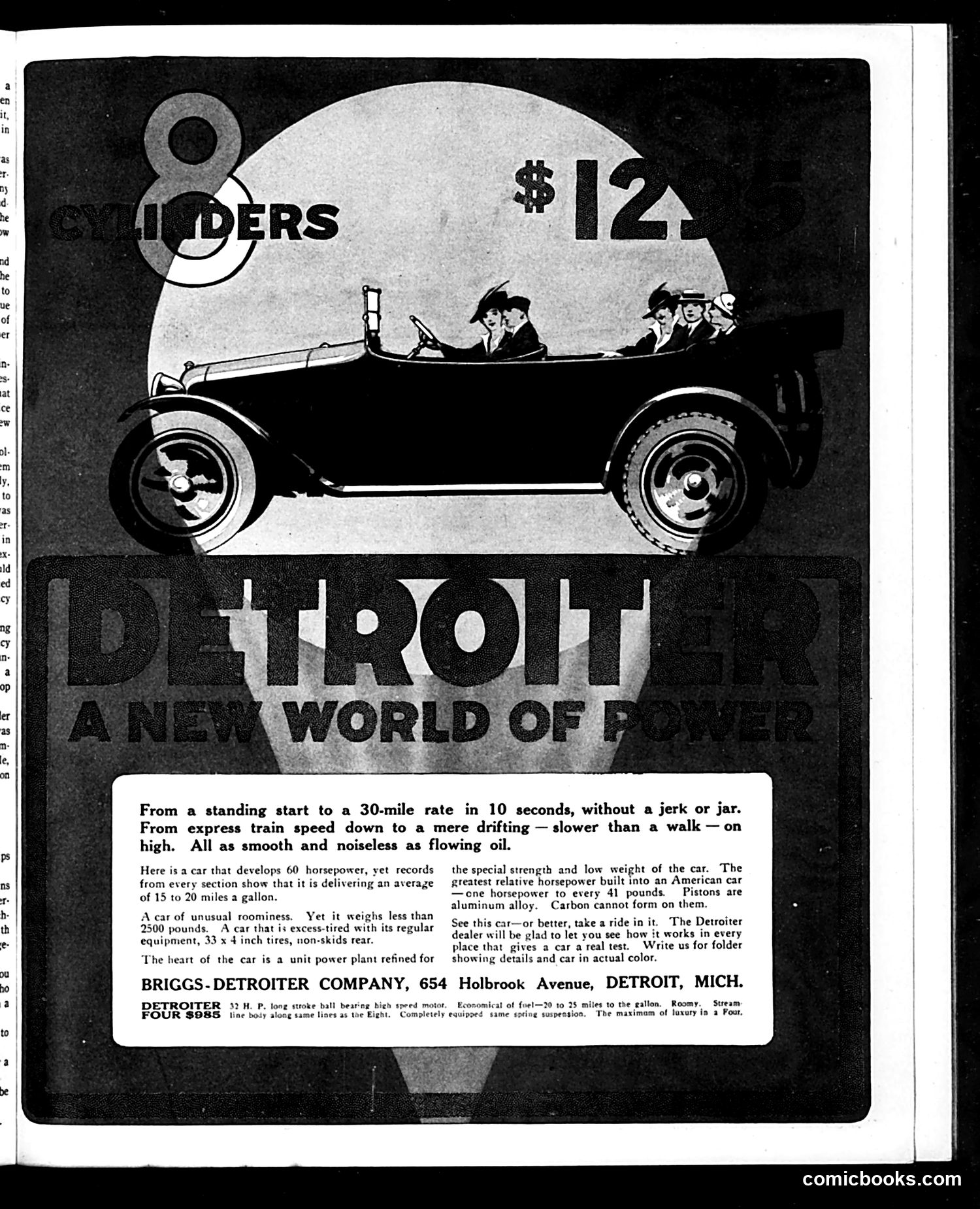
This is primarily **automobile advertising**, not political satire. The page features a full-page ad for the Briggs-Detroiter car, priced at $12 (visible in the upper right). The illustrated automobile carries well-dressed businessmen/gentlemen in the vehicle, set against a large moon backdrop—a common artistic device in 1910s-1920s advertising to suggest modernity and aspiration. The text emphasizes the car's remarkable features for its era: rapid acceleration (0-30 mph in 10 seconds), fuel efficiency (15-20 mpg), smoothness, light weight (under 2500 pounds despite 60 horsepower), and roominess. These claims were genuinely competitive selling points during early automobile development. The satire, if any, is subtle—the grandiose claims about "a new world of power" typify the hyperbolic marketing language of the era. However, this appears to be **straightforward advertising** rather than editorial cartoon commentary. Judge magazine regularly featured such advertisements alongside satirical content.
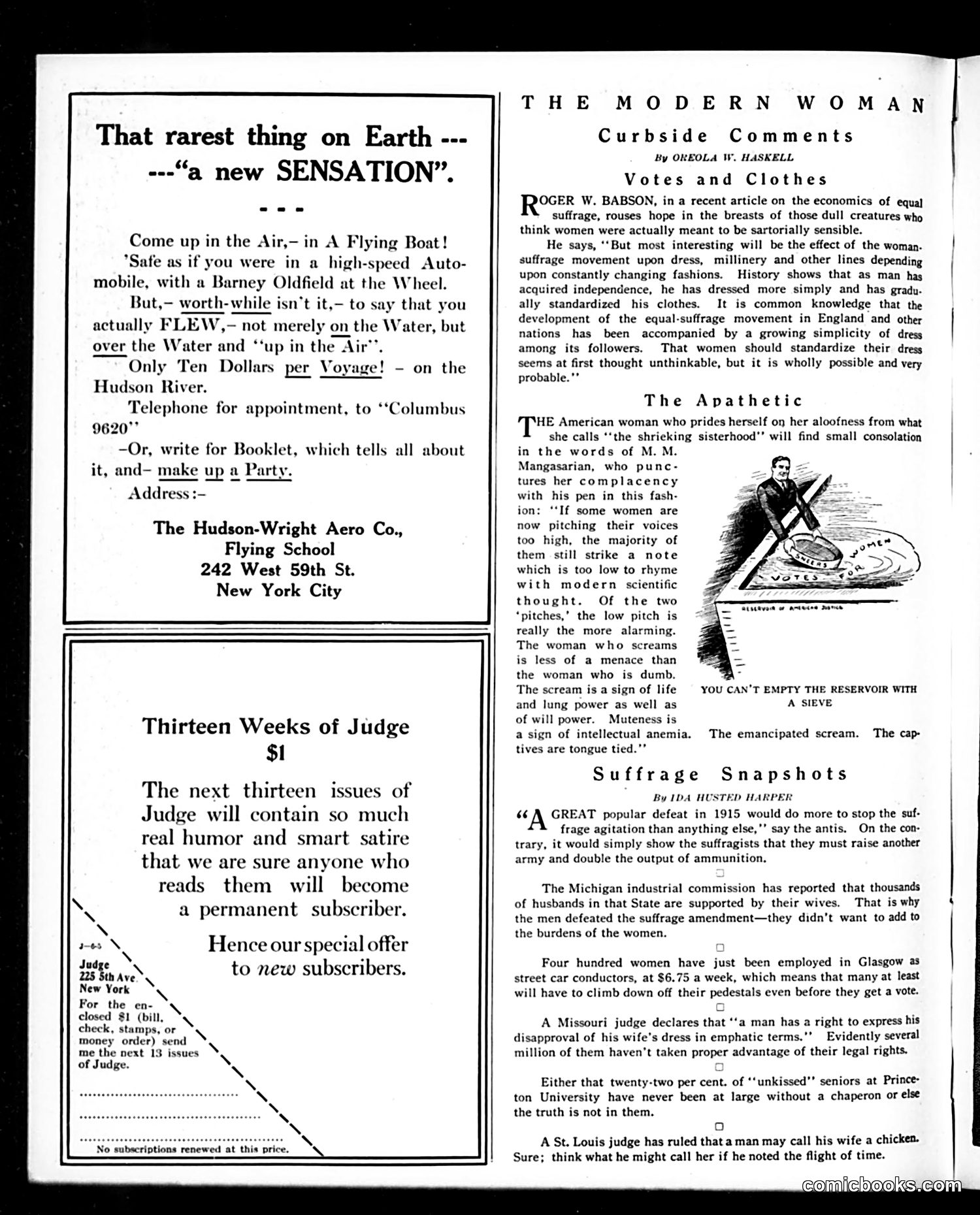
This page contains advertisements and satirical commentary on women's suffrage and social issues circa 1910s. **Left side:** Two ads—one promoting flying boat rides on the Hudson River (a novelty attraction), the other advertising a Judge magazine subscription. **Right side:** "The Modern Woman" column addresses how women's increasing independence and the suffrage movement might affect fashion. The article notes that historically, as men gained independence, they dressed more simply; suffragists predict women will similarly standardize their dress rather than constantly chase fashion trends. **"The Apathetic" section:** Critiques women who distance themselves from the "shrieking sisterhood" (derisive term for loud female suffragists). The commentary argues that vocal women activists, despite being annoying, show more intellectual vigor than silent, apathetic women. **"Suffrage Snapshots":** Short satirical observations about anti-suffrage arguments and women's economic participation, suggesting suffrage opponents' real motivation is protecting male comfort rather than principle. The overall tone is pro-suffrage while mocking both anti-suffragists and women who claim neutrality on women's rights.
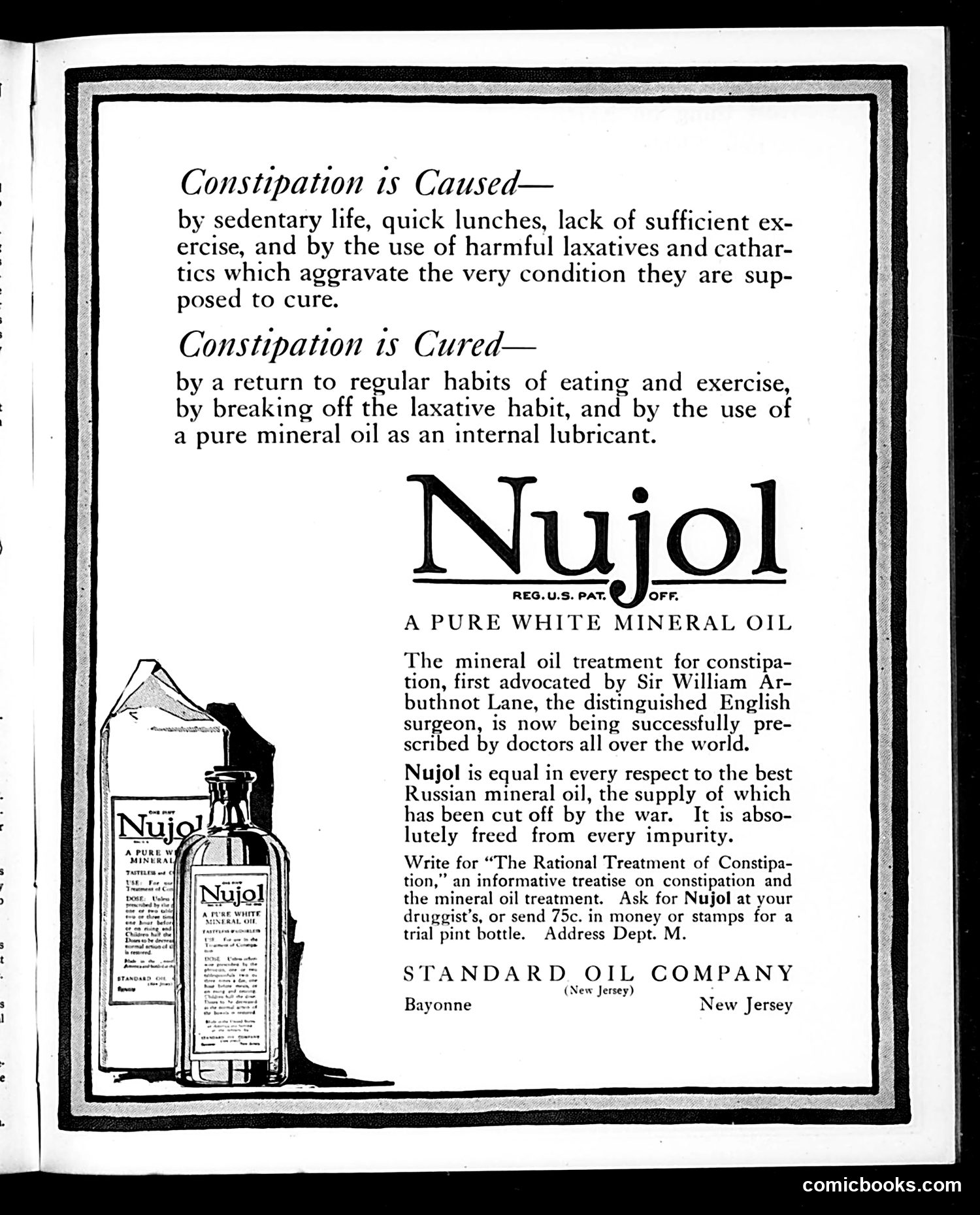
This is primarily a **patent medicine advertisement**, not satire. The page promotes Nujol, a mineral oil laxative made by Standard Oil Company (New Jersey), positioned as a cure for constipation. The ad's key claims reflect early 20th-century medical thinking: it blames constipation on modern sedentary lifestyles and "harmful laxatives," then promotes mineral oil as a gentler alternative endorsed by Sir William Arbuthnot Lane, a real English surgeon known for advocating this treatment. A notable detail: the ad mentions Russian mineral oil's supply has been "cut off by the war"—likely referencing WWI disruptions—and positions Nujol as an American substitute. For modern readers, this represents an era when Standard Oil diversified into pharmaceuticals, and when such remedies were advertised in prestigious magazines like *Judge* without FDA regulation. The "scientific" framing and celebrity doctor endorsement were standard marketing tactics of the period.
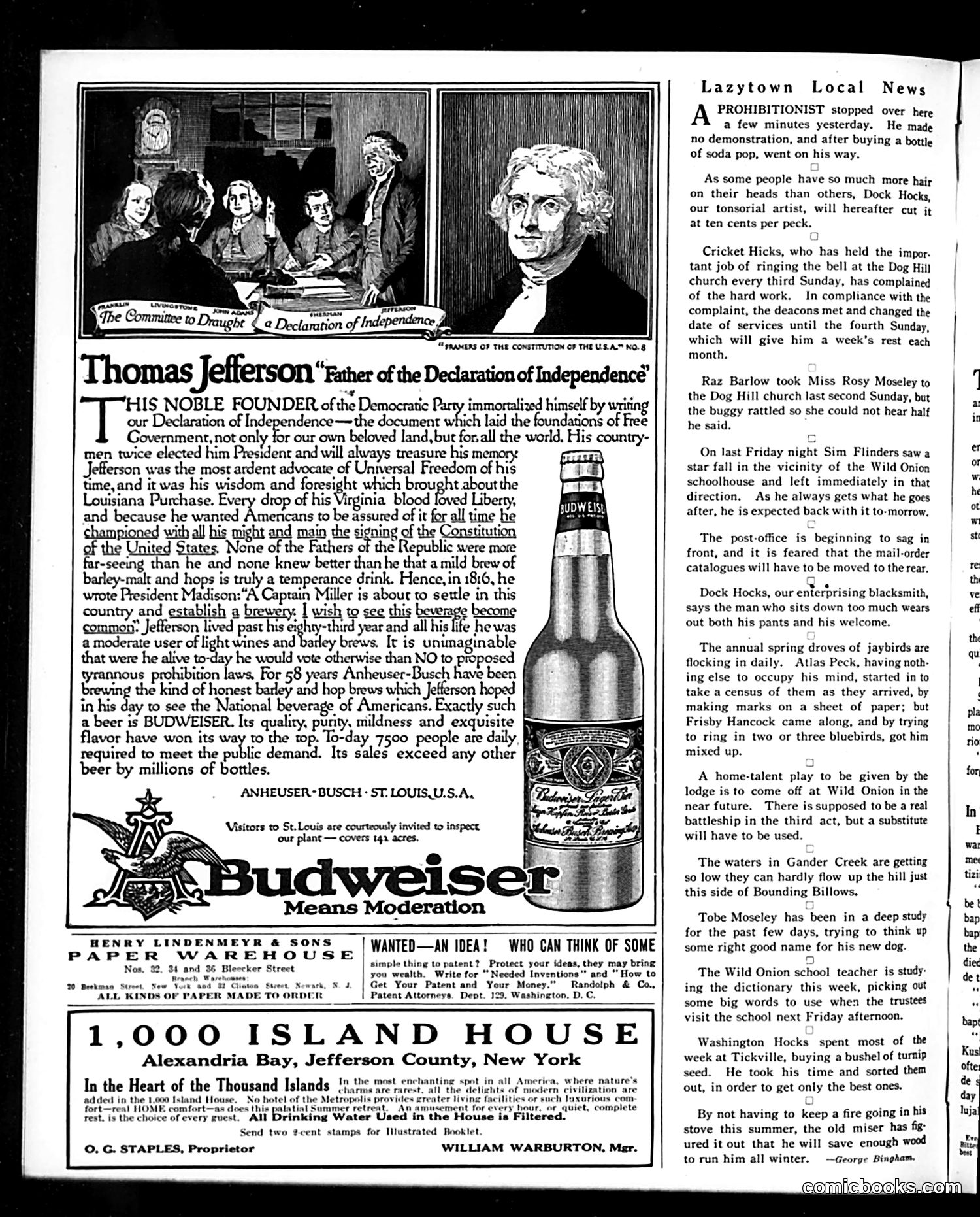
This page is primarily **pro-alcohol advertising disguised as editorial content**. The main article uses Thomas Jefferson as a propaganda tool, falsely claiming he advocated for breweries and "moderate" beer consumption. The text fabricates a Jefferson quote endorsing brewing as a national "common" beverage—completely inventing evidence to suggest the Founding Father would oppose Prohibition. The satire targets **Prohibition advocates** through the "Lazytown Local News" section on the right, which mocks anti-alcohol activists with condescending humor (the prohibitionist buying soda pop, the joke about "hard work"). The advertisement falsely associates democratic values and the Declaration of Independence with beer consumption—equating opposition to Prohibition with American patriotism. This is a commercial manipulation of founding mythology, designed to persuade readers that voting against Prohibition laws aligns with Jefferson's vision of freedom. The page dates from the Prohibition era (1920s), when such propaganda was common.
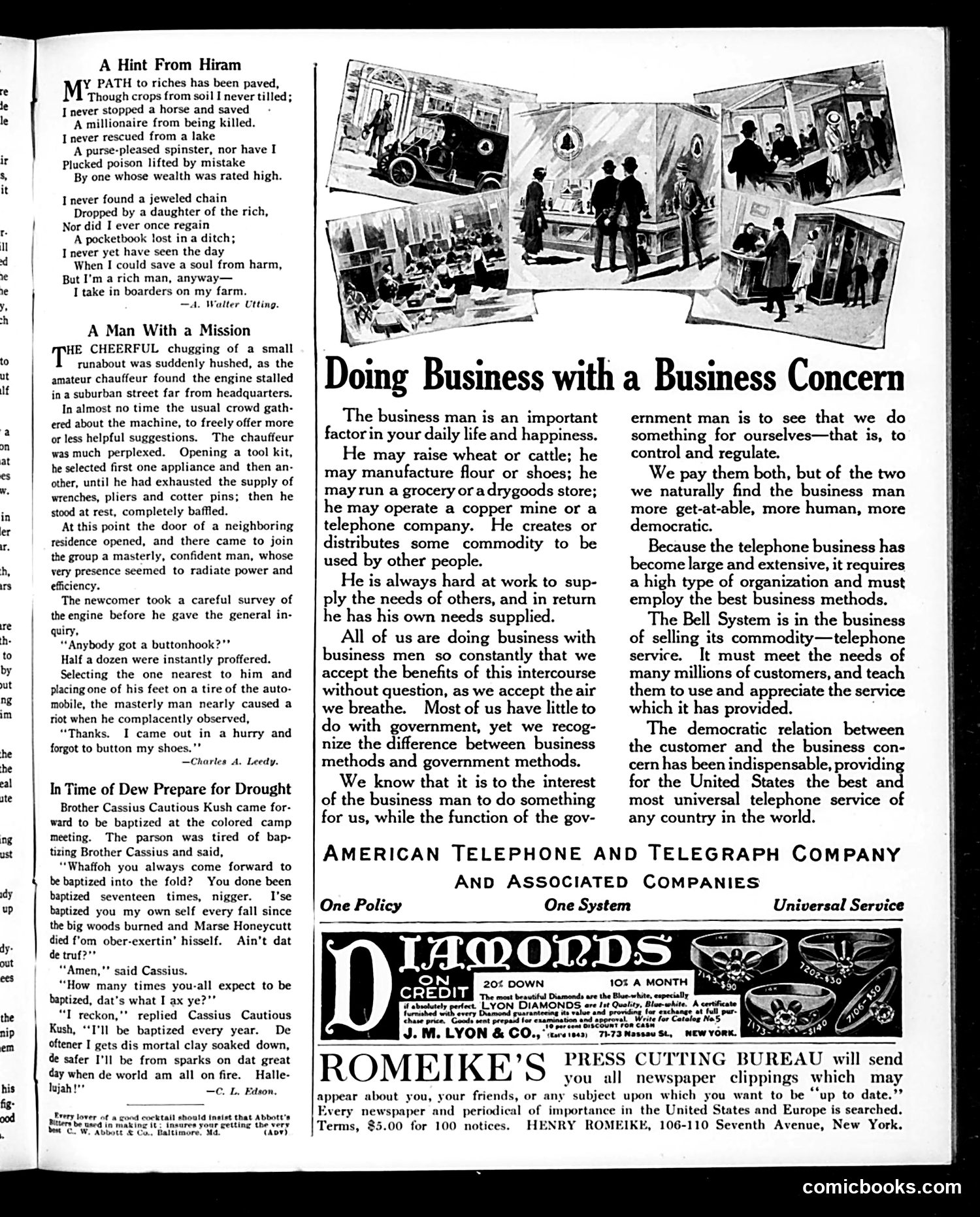
This page contains three humorous stories and advocacy advertising for the Bell Telephone System. **"A Hint From Hiram"** satirizes the American rags-to-riches myth. The speaker claims wealth without the dramatic rescue scenarios typical of success stories (saving a millionaire, finding jewels). His mundane method—taking in boarders on his farm—deflates romantic notions of how fortunes are made, suggesting ordinary business is more reliable than luck. **"A Man With a Mission"** jokes about an overconfident man who interrupts a stalled car repair to complain about his unbuttoned shoes, offering a buttonhook when what's needed is mechanical help. The humor lies in his misplaced authority and irrelevant contribution. **"In Time of Dew"** uses dialect humor (problematic by modern standards) about a man repeatedly baptized for spiritual "insurance" against damnation—mocking superstitious faith practice. The page's main content, however, is a **Bell System advertisement** disguised as editorial advocacy, arguing that business methods are more "democratic" and "human" than government regulation—essentially promoting corporate efficiency over public oversight during an era of telephone monopoly debates.
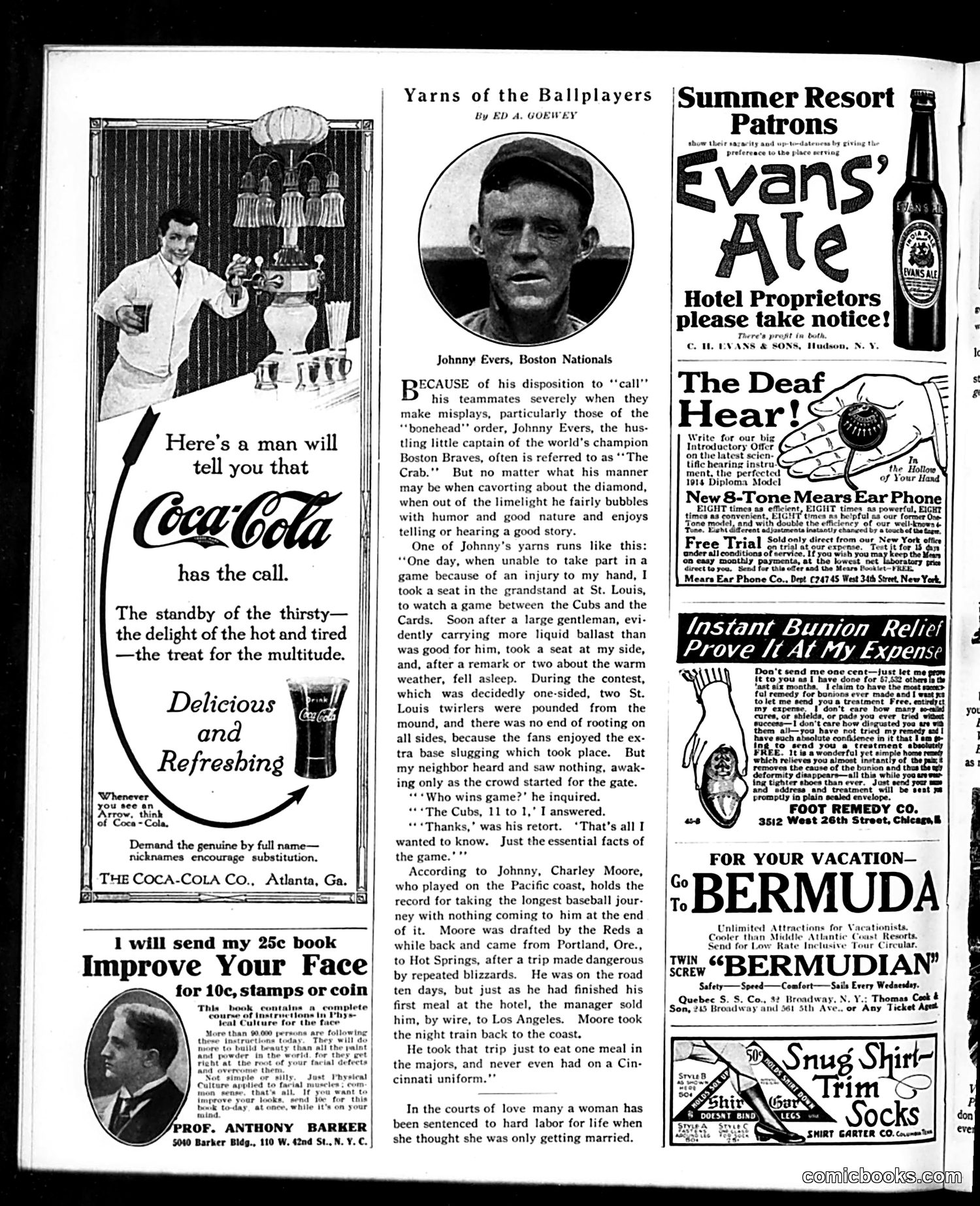
This page from *Judge* magazine contains primarily **advertisements and sports content**, not political satire. The main editorial content is "Yarns of the Ballplayers" by Ed A. Goewey, featuring **Johnny Evers**, captain of the 1914 World Series champion Boston Braves. Evers was nicknamed "The Crab" for his irritable temperament and harsh criticism of teammates' mistakes. The article presents anecdotes showing his humorous, good-natured side away from the ballfield—contrasting his public reputation. The page is dominated by period advertisements: Coca-Cola, a beauty improvement book, Evans' Ale, The Deaf Hear hearing aid device, Bermuda tourism, and medical remedies. These ads reflect early-20th-century consumer culture and the prevalence of dubious medical devices marketed directly to readers. The final proverb about women sentenced to "hard labor" in marriage is typical of the era's casual, somewhat cynical humor about matrimony.
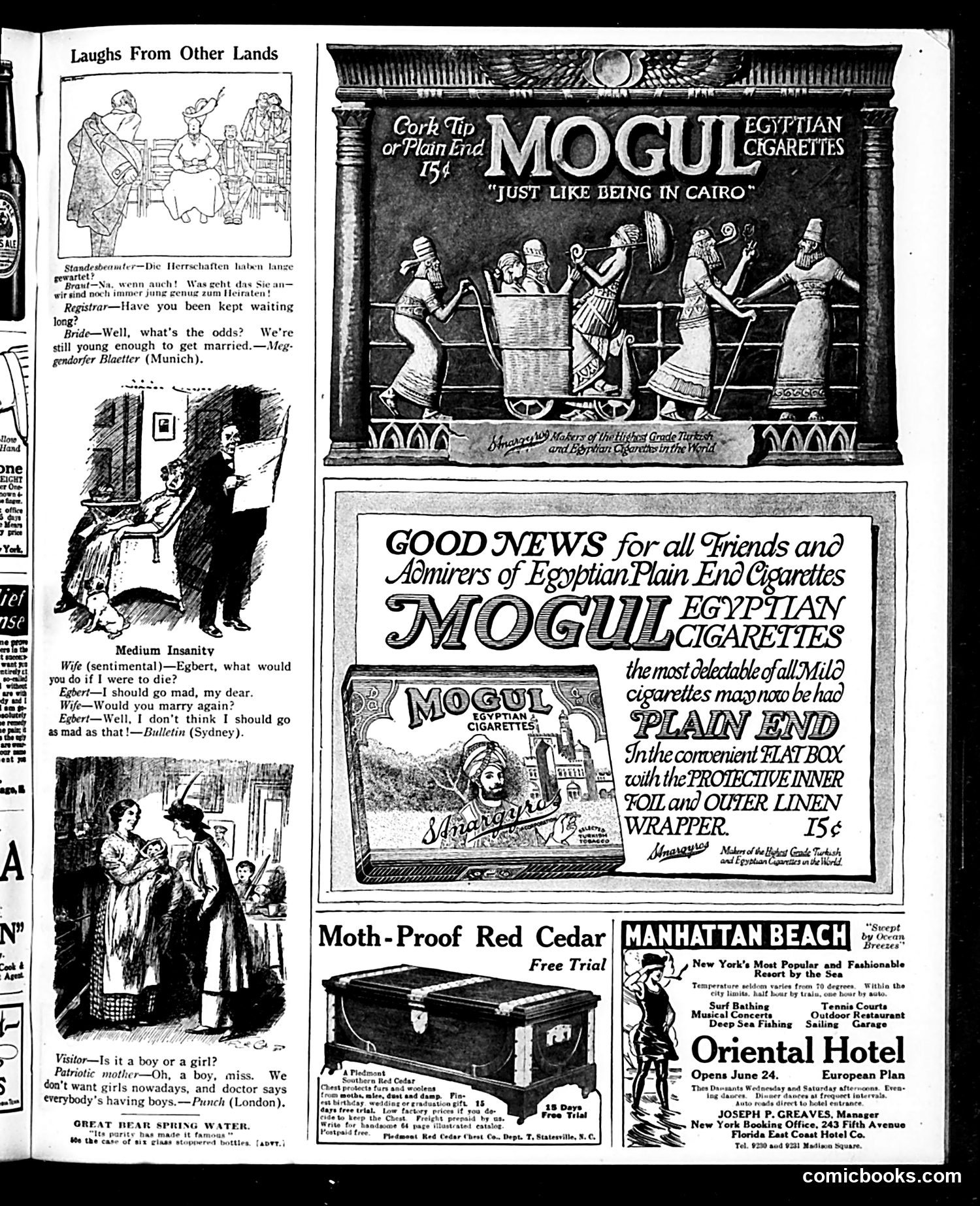
This page mixes **humor reprints from international sources** (top left) with **advertisements** (right side and bottom). The cartoon section titled "Laughs From Other Lands" collects brief jokes translated from European publications—Munich's *Megendorfer Blätter*, Sydney's *Bulletin*, and London's *Punch*. The jokes are domestic/marital humor typical of the era: a bride unconcerned about her long engagement, a husband's contradictory feelings about remarriage, and a patriotic mother claiming boys are being born more frequently (likely referencing anxieties about population and military strength during the pre-WWI era). The **dominant content is advertising**: Mogul Egyptian Cigarettes (marketing "exotic" Cairo lifestyle appeal), a moth-proof cedar chest, and Manhattan Beach's Oriental Hotel resort. These ads reflect early 1900s consumer culture and leisure travel. The cartoons require no political interpretation—they're simply mild domestic satire exported internationally, reflecting what middle-class magazine readers found amusing across English-speaking countries.
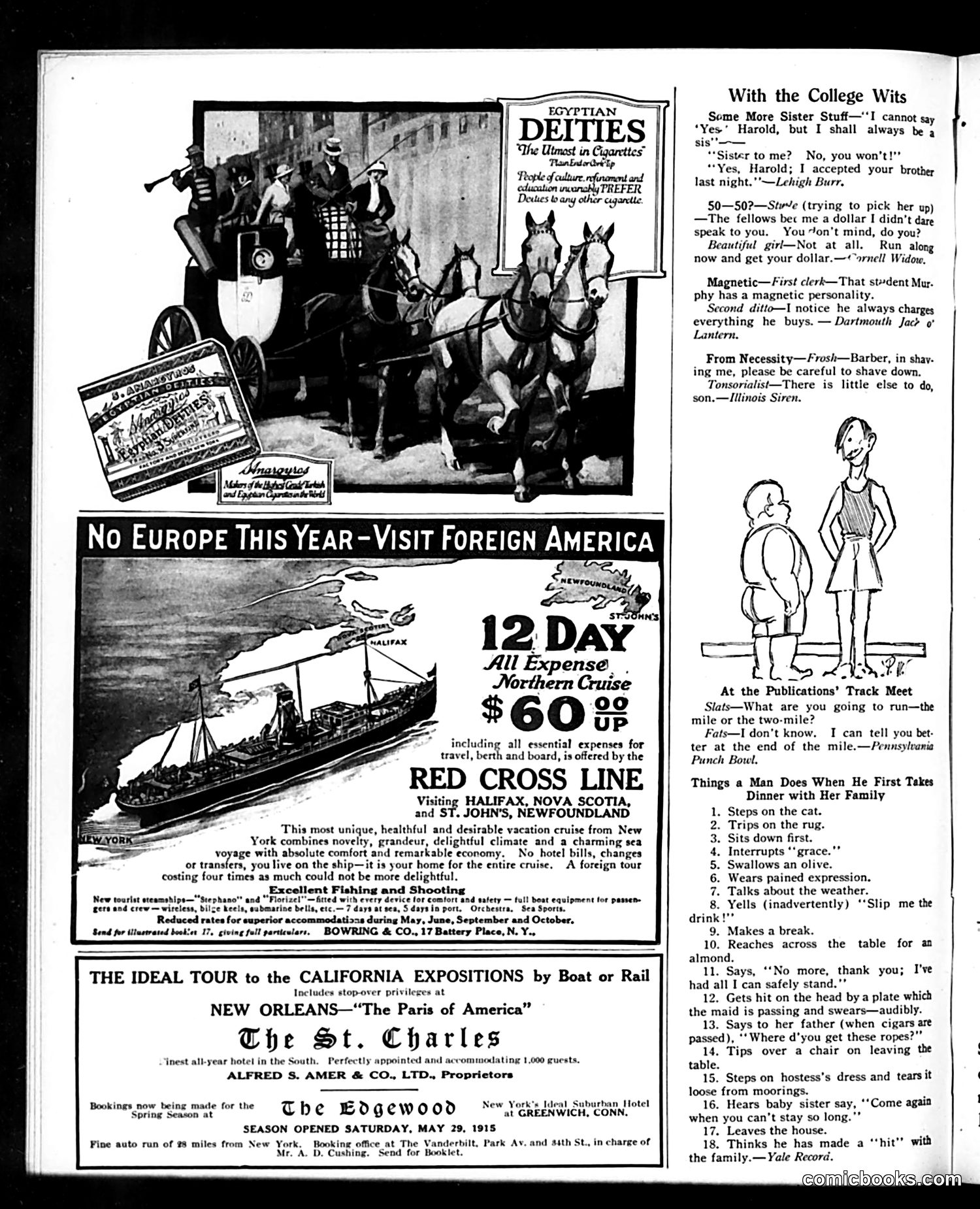
This page is primarily **advertisements and humor columns** rather than political satire. The main advertisements promote vacation travel: Red Cross Line cruises to Halifax and Newfoundland ($60 for 12 days), and tours to California Expositions via New Orleans. These reflect early-20th-century leisure tourism marketing. The **"With the College Wits"** section contains short, campus-based humor jokes from various universities (Lehigh, Cornell, Dartmouth, Pennsylvania, Yale). These are gentle, non-satirical gags about college romance and social awkwardness—typical light entertainment of the era. The final list, **"Things a Man Does When He First Takes Dinner with Her Family,"** is an observational humor piece satirizing social anxiety and clumsiness in formal dining situations (stepping on cats, spilling drinks, breaking chairs). It pokes gentle fun at masculine social incompetence rather than addressing serious political or social issues. The page demonstrates Judge's mix of advertising revenue and collegiate-targeted humor—entertainment rather than pointed satire.
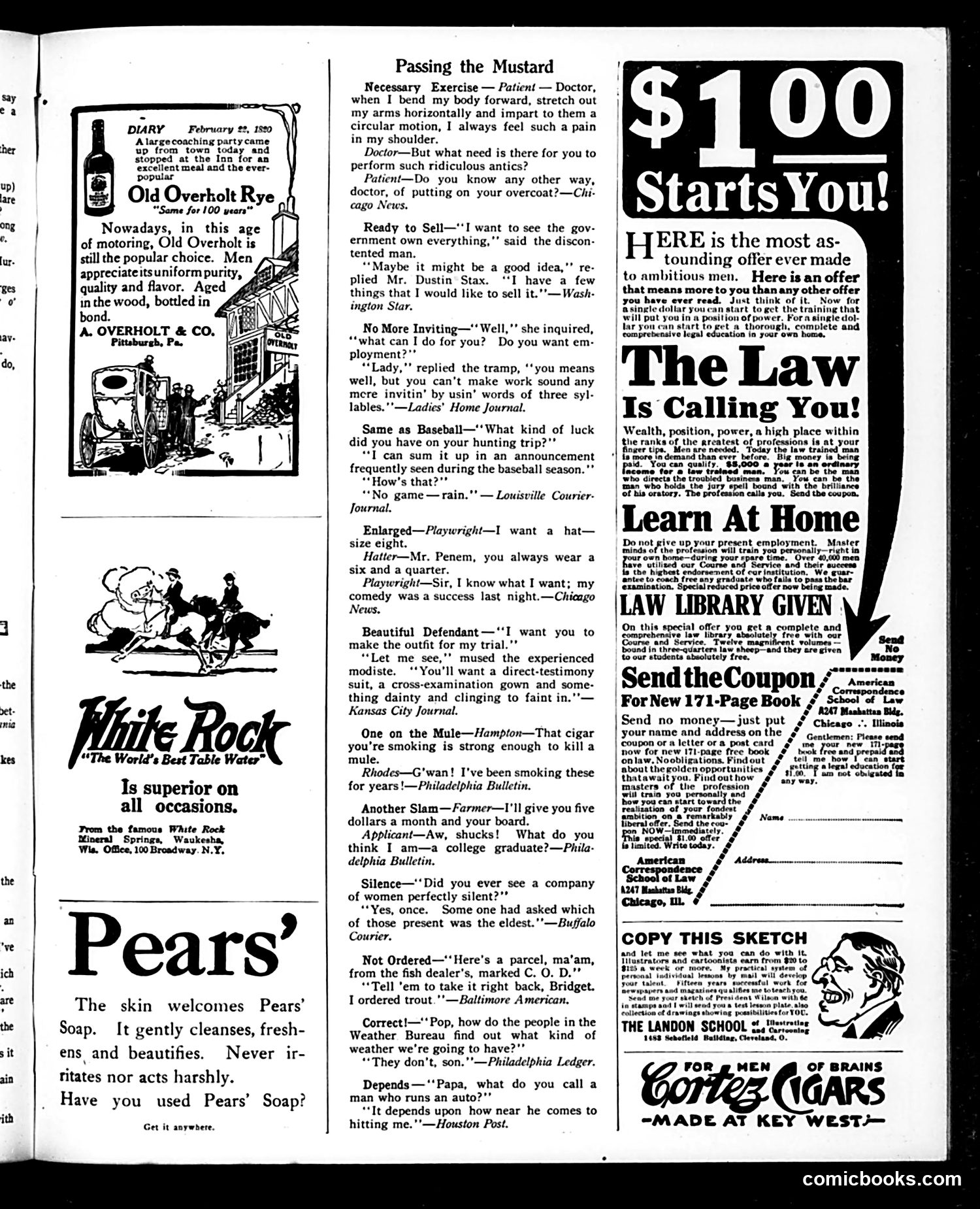
This page is primarily **advertising**, featuring multiple brand ads (Old Overholt Rye, White Rock Water, Pears' Soap) and a prominent law school correspondence course offer. The main editorial content is a humor column titled "Passing the Mustard"—a collection of brief jokes culled from newspapers. These reflect early 1920s sensibilities: a man in pain from putting on his overcoat; a discontented socialist wanting to sell his belongings to the government; a tramp rejecting employment language as too formal; a playwright's hat size enlarged by success; a woman selecting courtroom outfits for trial testimony; and dated humor about mules, college graduates, silent women, and automobiles. The jokes rely on wordplay, physical comedy mishaps, and gentle social commentary typical of era newspaper filler. The content is lighthearted rather than sharply political—reflecting Judge's position as mainstream humor rather than aggressive satire by this period.
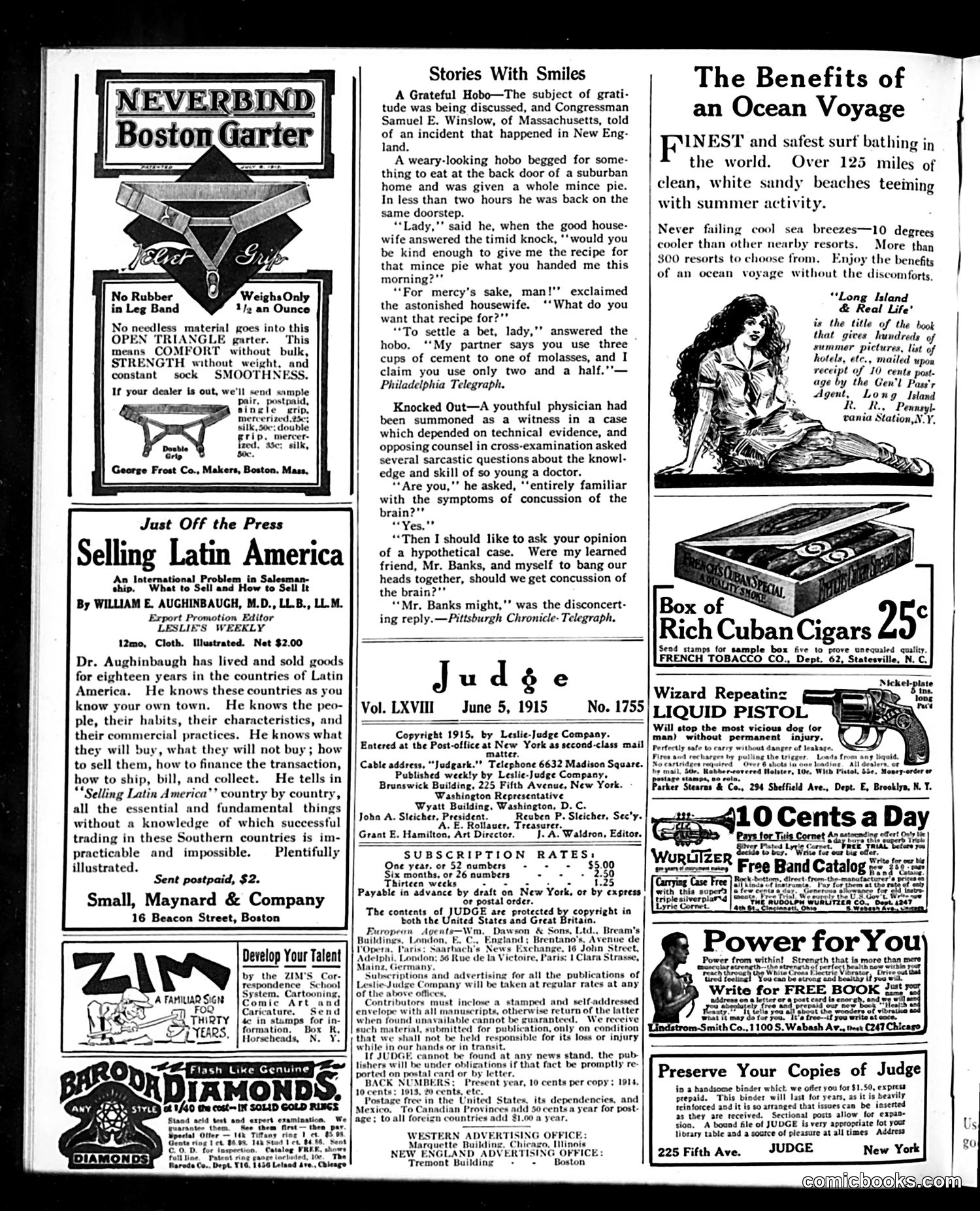
This page is primarily **advertising and miscellaneous content** rather than satirical cartoons. The layout includes: **"Stories With Smiles"** section: Three brief humorous anecdotes, apparently by Congressman Samuel E. Winslow. These are genteel jokes typical of early 20th-century periodicals—a hobo's complaint about "cement" in a mince pie recipe, and a lawyer's sarcastic exchange with a young physician implying the opposing counsel would suffer brain damage if they struck each other. **Advertisements**: Dominate the page—garters, a book on selling in Latin America, correspondence schools, cigars, a "liquid pistol," and other products. **Masthead information**: Shows Judge as a weekly satirical magazine published by Leslie-Judge Company in New York. The page lacks the political cartoons one might expect from Judge. The humor is domesticated and apolitical—suitable for general family readership rather than biting social commentary.
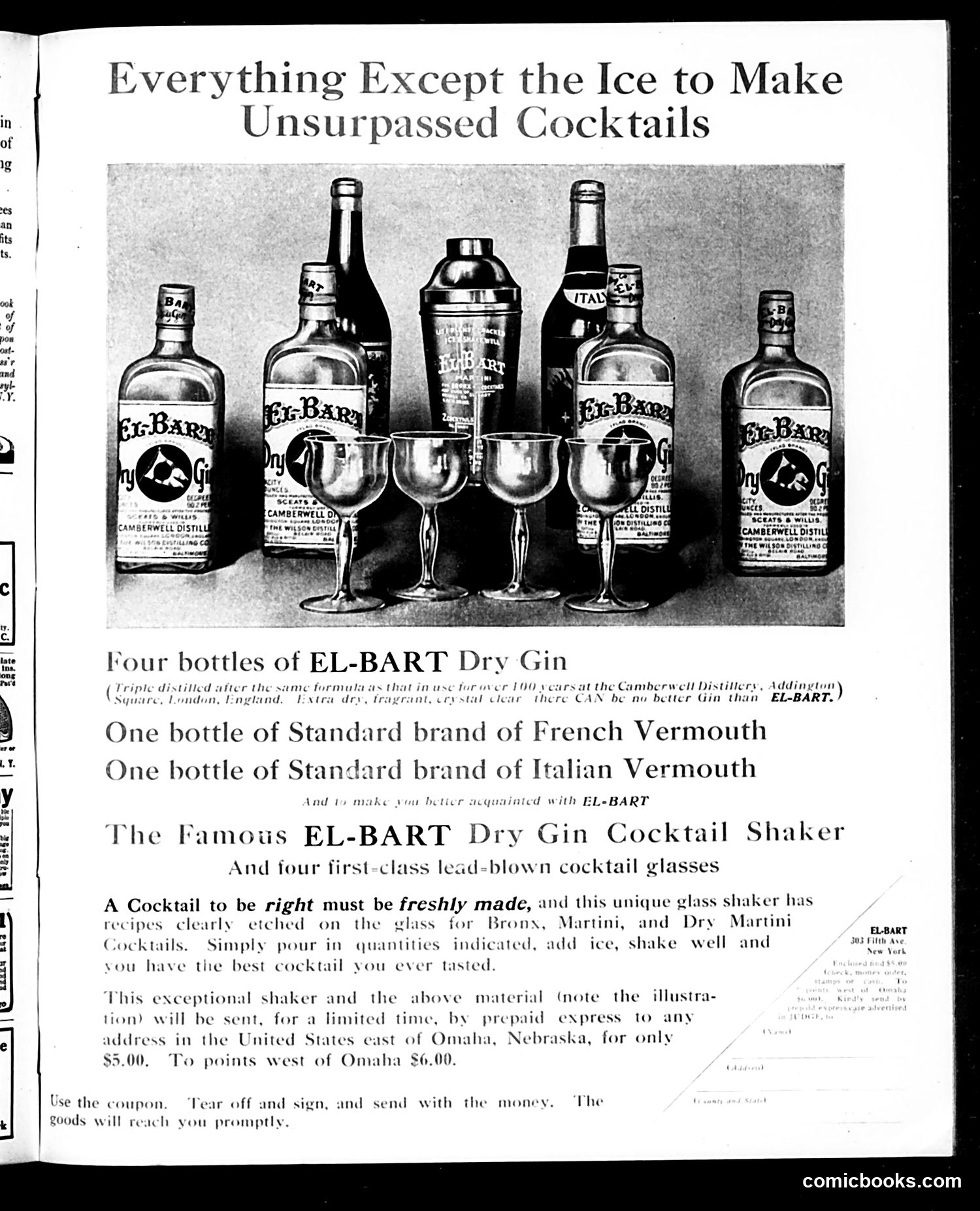
This is a **full-page advertisement**, not a cartoon or satire. It promotes EL-BART Dry Gin and cocktail-making supplies during what appears to be the Prohibition era or immediately after (based on the explicit marketing of alcohol). The ad emphasizes quality ingredients (four bottles of gin, French and Italian vermouths) and sells a "Famous EL-BART Dry Gin Cocktail Shaker" with etched recipes for Bronx, Martini, and Dry Martini cocktails. The humorous headline—"Everything Except the Ice"—appears to be a clever play on words, since ice is the one essential ingredient *not* included in the kit being sold. The ad ran in *Judge*, a satirical magazine, but this page itself is commercial advertising rather than editorial satire. It's aimed at middle-class consumers who could afford pre-packaged cocktail kits, reflecting the 1920s-30s cocktail culture craze.
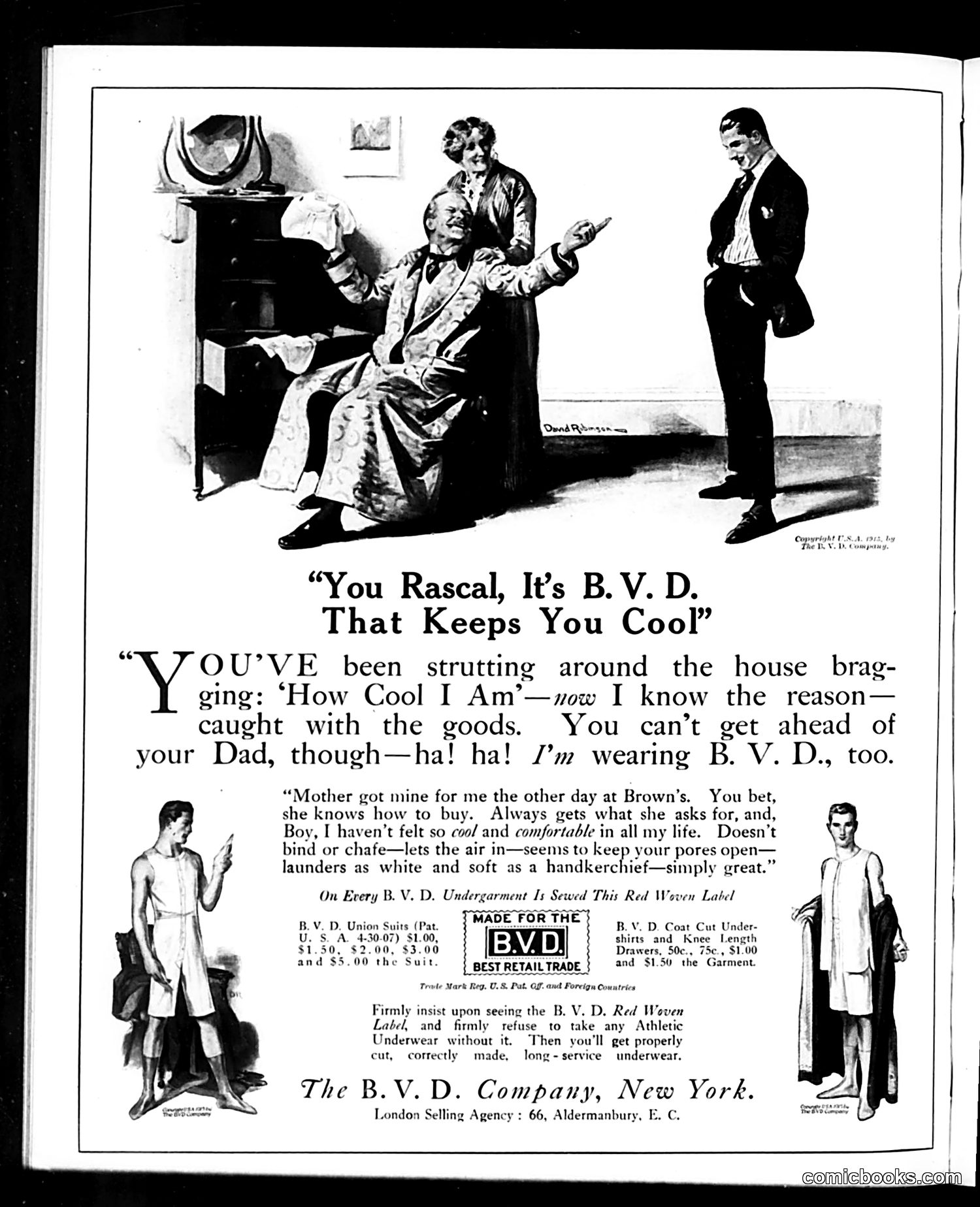
This is primarily a **product advertisement**, not political satire. It promotes B.V.D. brand men's underwear using a humorous domestic scenario. The "joke" depicts a father catching his son bragging about staying cool, then revealing he wears B.V.D. underwear too—suggesting the product's quality is what truly keeps one cool and comfortable. The father playfully "one-ups" the son by also wearing the brand. The advertisement emphasizes practical benefits: breathability ("lets the air in"), comfort, durability ("long-service"), and easy laundering. The red woven label is presented as a mark of authenticity to ensure customers buy genuine B.V.D. products. This reflects early 20th-century advertising strategy: using relatable family scenarios and competitive banter to market basic menswear essentials. The page includes product listings and prices ($1-$5 range) along with illustrations of the undergarments themselves.