
Judge, 1915-06-05 · page 4 of 28
Judge — June 5, 1915 — page 4: what you’re looking at
What you’re looking at
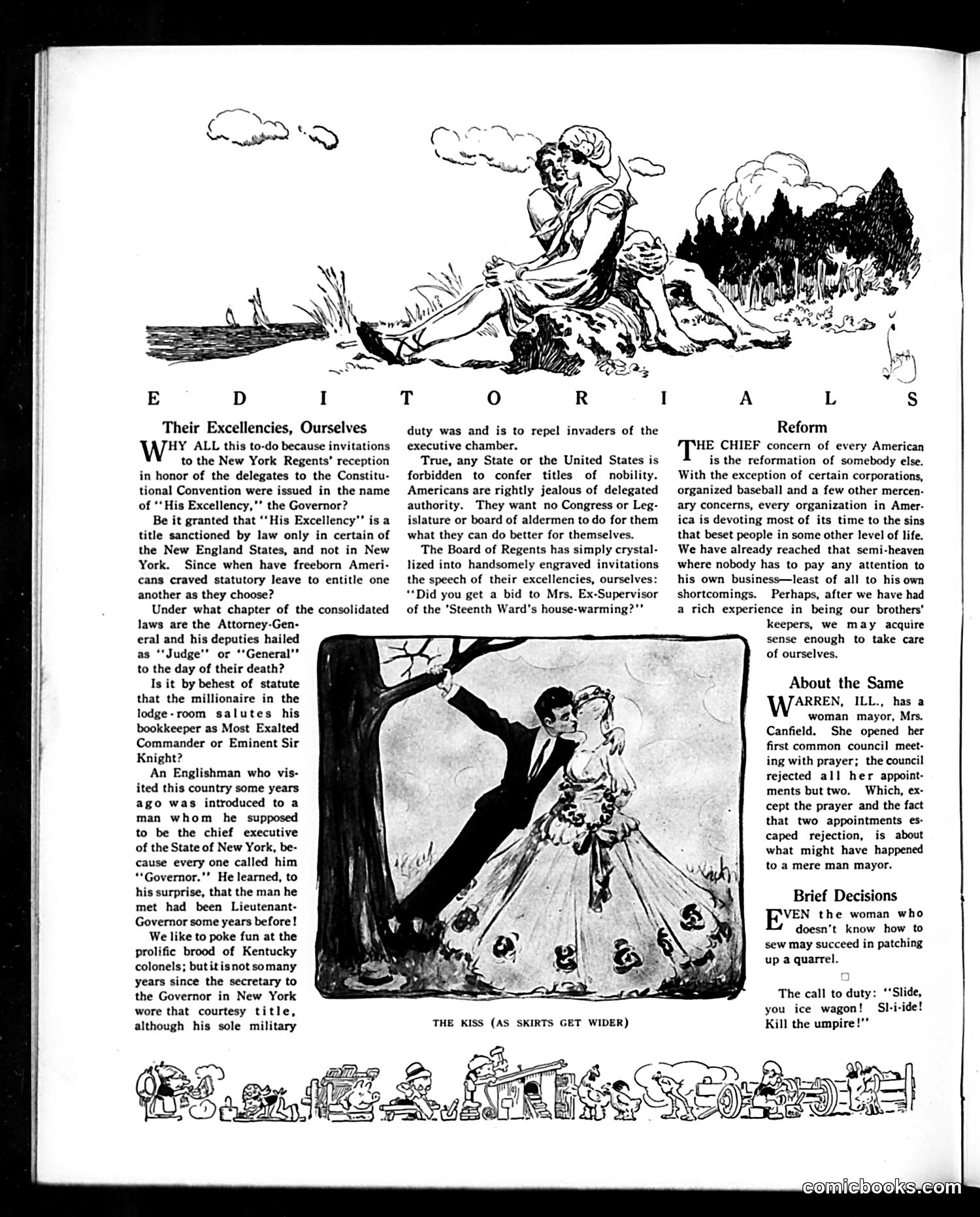
This page contains satirical commentary on American governance and social issues, circa early 20th century. **Top Section ("Editorials"):** The main article critiques the use of honorific titles (like "His Excellency") for American officials, arguing such pretensions contradict democratic principles. It mocks New York State officials conferring grandiose titles on each other—comparing this to European monarchical practices—and questions whether a state attorney general should be called "Judge" or "General." **Central Illustration ("The Kiss"):** A romantic scene captioned ironically, likely commenting on political or social hypocrisy. **Right Column:** Brief items mock Warren, Illinois's female mayor (Mrs. Canfield) and a woman unfamiliar with practical skills. The overall tone satirizes American officials adopting aristocratic pretenses while claiming democratic values.
📄 Transcribed text from this page (OCR, searchable)
Machine-transcribed from the original scan — historical spelling and the odd misread are preserved.
Their Excellencies, Ourselves HY ALL this to-do because invitations to the New York Regents’ reception in honor of the delegates to the Constitu- tional Convention were issued in the name of *‘ His Excellency,’’ the Governor? Be it granted that ‘His Excellency’’ is a title sanctioned by law only in certain of the New England States, and not in New York. Since when have freeborn Ameri- cans craved statutory leave to entitle one another as they choose? Under what chapter of the consolidated laws are the Attorney-Gen- eral and his deputies hailed as ‘‘Judge’’ or ‘‘General’’ to the day of their death? Is it by behest of statute that the millionaire in the lodge-room salutes his bookkeeper as Most Exalted Commander or Eminent Sir Knight? An Englishman who vis- ited this country some years ago was introduced to a man whom he supposed to be the chief executive of the State of New York, be- cause every one called him “*Governor.’’ He learned, to his surprise, that the man he met had been Lieutenant- Governor some years before! We like to poke fun at the prolific brood of Kentucky colonels; butitisnot somany years since the secretary to the Governor in New York wore that courtesy title, although his sole military duty was and is to repel invaders of the executive chamber. True, any State or the United States is forbidden to confer titles of nobility. Americans are rightly jealous of delegated authority. They want no Congress or Leg- islature or board of aldermen to do for them what they can do better for themselves. The Board of Regents has simply crystal- lized into handsomely engraved invitations the speech of their excellencies, ourselves: “Did you get a bid to Mrs, Ex-Supervisor of the 'Steenth Ward's house-warming?"’ Reform ‘HE CHIEF concern of every American is the reformation of somebody else. With the exception of certain corporations, organized baseball and a few other mercen- ary concerns, every organization in Amer- ica is devoting most of its time to the sins that beset people in some other level of life. We have already reached that semi-heaven where nobody has to pay any attention to his own business—least of all to his own shortcomings. Perhaps, after we have had a rich experience in being our brothers’ keepers, we may acquire sense enough to take care of ourselves. About the Same 'ARREN, ILL., has a woman mayor, Mrs. Canfield. She opened her first common council meet- ing with prayer; the council rejected all her appoint- ments but two. Which, ex- cept the prayer and the fact that two appointments es- caped rejection, is about what might have happened to a mere man mayor. Brief Decisions VEN the woman who doesn't know how to sew may succeed in patching up a quarrel. The call to duty: ‘‘Slide, you ice wagon! Sl-i-ide! Kill the umpire!"’