
Judge, 1915-06-05 · page 13 of 28
Judge — June 5, 1915 — page 13: what you’re looking at
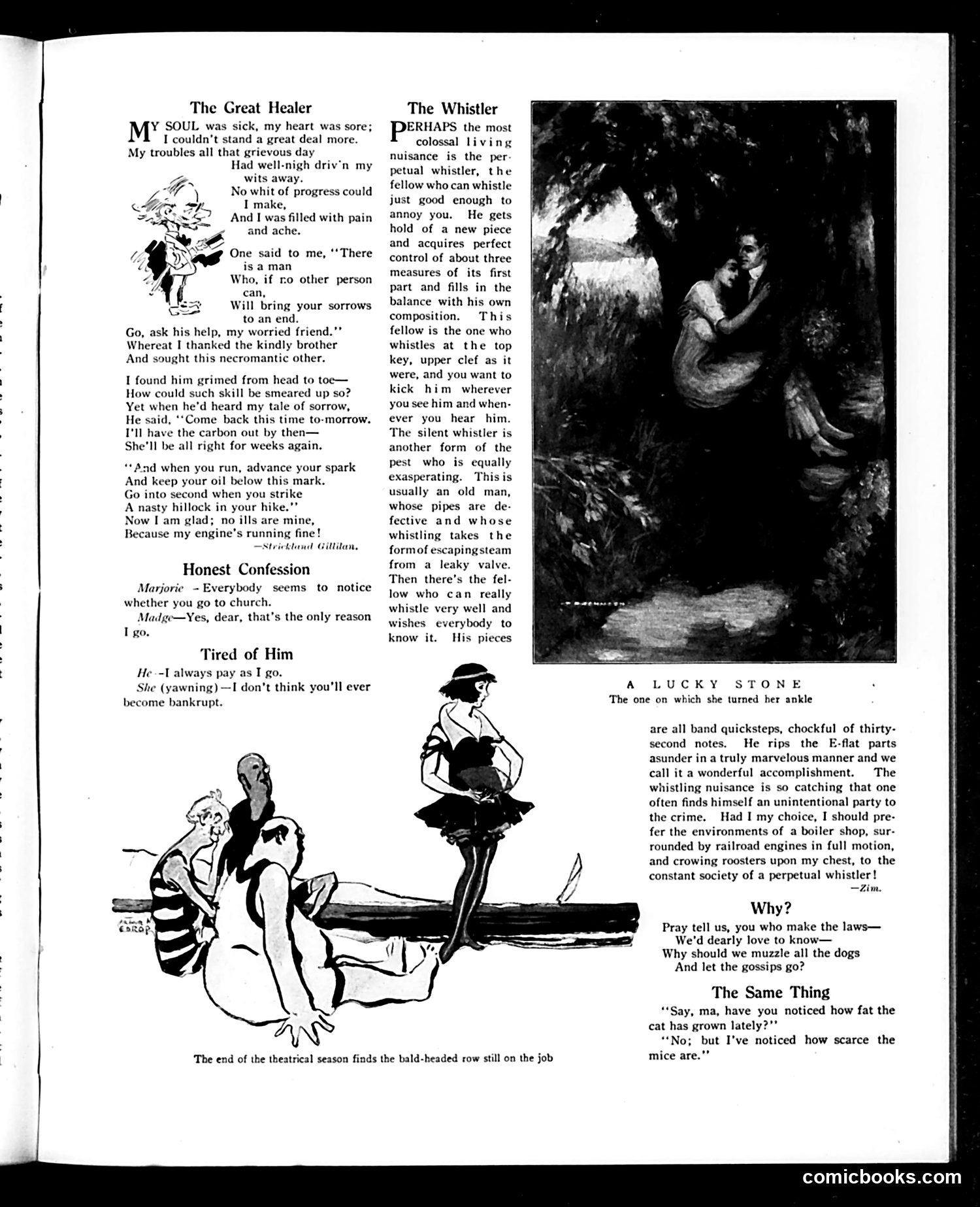
What you’re looking at
This page contains several short humorous pieces typical of early 20th-century satirical magazines: **"The Great Healer"** parodies the emerging automobile age. A troubled man seeks a mechanic (described mysteriously as "necromantic") who fixes his car engine. The joke: the "great healer" treats machines, not people—reflecting how cars were transforming daily life and becoming objects of quasi-religious devotion. **"The Whistler"** is a social complaint about an annoying character type: the person who whistles badly or incessantly in public. The author catalogs different whistler varieties with genuine irritation, satirizing how minor social annoyances preoccupy polite society. The remaining items are brief joke exchanges about marital dynamics ("Honest Confession," "Tired of Him") and absurdist humor ("The Same Thing"—implying the fat cat and scarce mice are connected). "The Bald-Headed Row" cartoon references theater patrons, likely mocking older men's attendance at performances. Overall, the page reflects working-class and middle-class preoccupations of the era: mechanization, social etiquette, and marriage dynamics.
📄 Transcribed text from this page (OCR, searchable)
Machine-transcribed from the original scan — historical spelling and the odd misread are preserved.
The Great Healer Y SOUL wa: sick, my heart was sore; I couldn't stand a great deal more. My troubles all that grievous day Had well-nigh driv'n my wits away. Zh > No whit of progress could I make, And I was filled with pain and ache. One said to me, ‘‘There is a man Who, if ro other person can, Will bring your sorrows to an end. Go, ask his help, my worried friend.’” Whereat I thanked the kindly brother And sought this necromantic other. I found him grimed from head to toe— How could such skill be smeared up so? Yet when he'd heard my tale of sorrow, He said, ‘‘Come back this time to-morrow. I'll have the carbon out by then— She'll be all right for weeks again. “And when you run, advance your spark And keep your oil below this mark. Go into second when you strike A nasty hillock in your hike Now I am glad; no ills are mine, Because my engine's running fine! Strickland Giltitan, Honest Confession Marjorie - Everybody seems to notice whether you go to church. Madge—Yes, dear, tha I go. 's the only reason Tired of Him He --I always pay as I go. She (yawning) —I don't think you'll ever become bankrupt. The end of the theatrical season finds the bald-headed row still on the job The Whistler IERHAPS the most colossal living nuisance is the per petual whistler, the fellow who can whistle just good enough to annoy you. He gets hold of a new piece and acquires perfect control of about three measures of its first part and fills in the balance with his own composition. This fellow is the one who whistles at the top key, upper clef as it were, and you want to kick him wherever you see him and when- ever you hear him. The silent whistler is another form of the pest who is equally sperating. This is usually an old man, whose pipes are de- fective and whose whistling takes the formof escapingsteam from a leaky valve. Then there’s the fel- low who can really whistle very well and wishes everybody to know it. His pieces A LUCKY STONE The one on which she turned her ankle are all band quicksteps, chockful of thirty- second notes. He rips the E-flat parts asunder in a truly marvelous manner and we call it a wonderful accomplishment. The whistling nuisance is so catching that one often finds himself an unintentional party to the crime. Had I my choice, I should pre- fer the environments of a boiler shop, sur- rounded by railroad engines in full motion, and crowing roosters upon my chest, to the constant society of a perpetual whistler! —Zim, Why? Pray tell us, you who make the laws— We'd dearly love to know— Why should we muzzle all the dogs And let the gossips go? The Same Thing “Say, ma, have you noticed how fat the cat has grown lately?’’ “No; but I've noticed how scarce the mice are."” comicbooks.com