
Judge, 1915-06-05 · page 8 of 28
Judge — June 5, 1915 — page 8: what you’re looking at
What you’re looking at
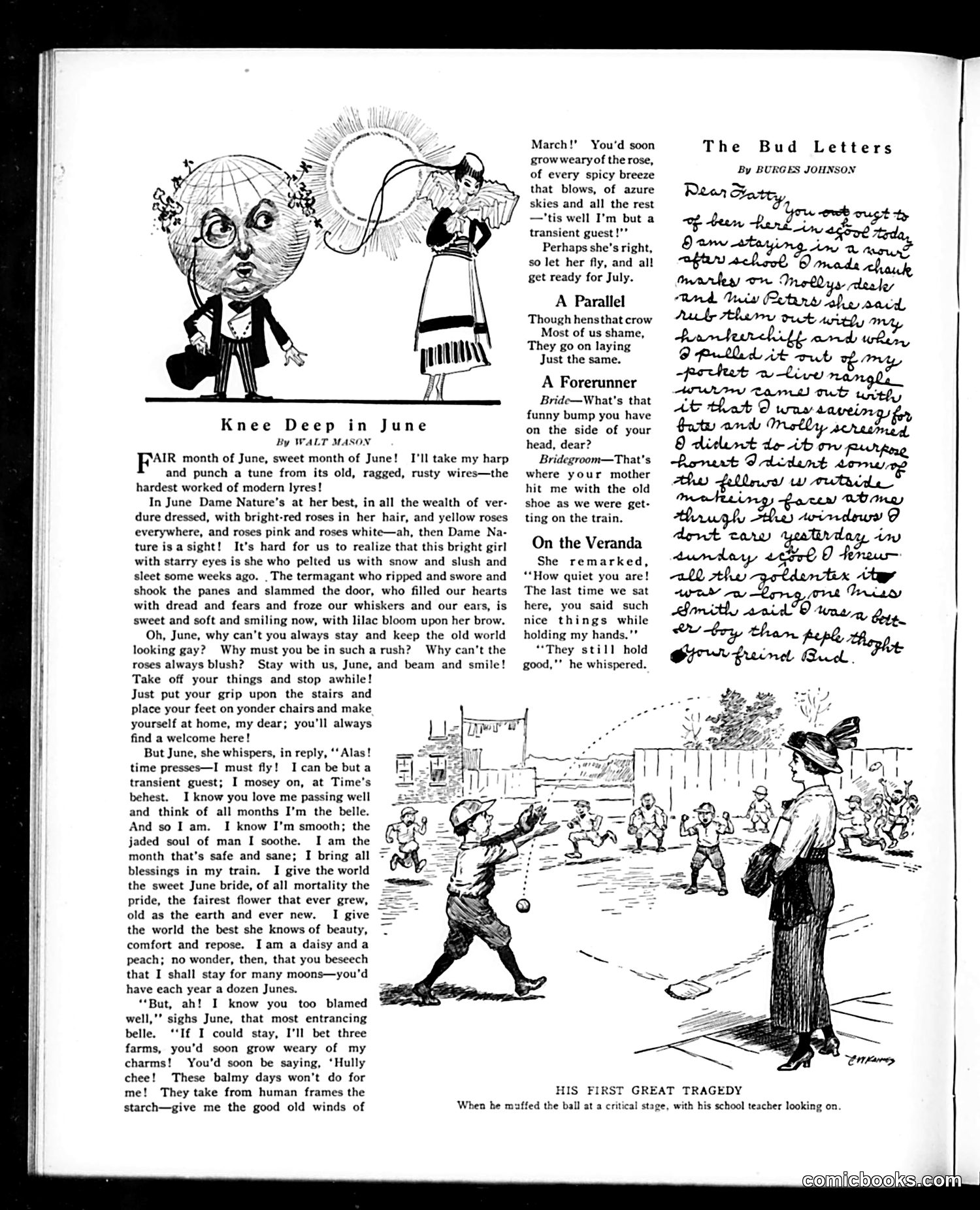
This page contains light satirical humor typical of early 20th-century American magazines: **"Knee Deep in June"** (center): A sentimental poem personifying June as a beautiful woman who must leave. The satire is gentle—mocking romantic idealization of the month while acknowledging human nature's tendency to take beauty for granted. The poem plays on the contrast between June's harsh winter persona and her current charm. **Small comic bits** (top and sides): Brief jokes about marriage ("A Forerunner" mocks the tradition of hitting grooms with shoes), domestic relationships ("On the Veranda" jokes about a husband repeating compliments), and gender behavior ("A Parallel" compares humans unfavorably to hens). **"His First Great Tragedy"** (bottom): Depicts a boy failing at baseball with his teacher watching—a gentle mockery of childhood embarrassment over minor failures. The page reflects **Edwardian-era humor**: sentimental yet cynical about romance, focused on domestic situations, and mildly self-mocking about American middle-class life. No specific political content is evident. The handwritten letter column ("Bud Letters") suggests reader correspondence.
📄 Transcribed text from this page (OCR, searchable)
Machine-transcribed from the original scan — historical spelling and the odd misread are preserved.
March!’ You'd soon grow weary of the rose, of every spicy breeze that blows, of azure ies and all the rest well I'm but a transient guest !"’ Perhaps she's right, so let her fly, and all! get ready for July. A Parallel Though hensthat crow Most of us shame, They go on laying Just the same. A Forerunner Bride—What's that funny bump you have on the side of your head, dear? Bridegroom—That's where your mother hit me with the old shoe as we were get- ting on the train. On the Veranda She remarked, “How quiet you are! The last time we sat here, you said such nice things while holding my hands."’ “They still hold good,’’ he whispered. Knee Deep in June By WALT MASON ‘AIR month of June, sweet month of June! I'll take my harp and punch a tune from its old, ragged, rusty wires—the hardest worked of modern lyres! In June Dame Nature’s at her best, in all the wealth of ver- dure dressed, with bright-red roses in her hair, and yellow roses j everywhere, and roses pink and roses white—ah, then Dame Na- | ture isa sight! It’s hard for us to realize that this bright girl with starry eyes is she who pelted us with snow and slush and sleet some weeks ago. . The termagant who ripped and swore and i] shook the panes and slammed the door, who filled our hearts }} with dread and fears and froze our whiskers and our ears, is i| sweet and soft and smiling now, with lilac bloom upon her brow. | Oh, June, why can’t you always stay and keep the old world i} looking gay? Why must you be in such a rush? Why can’t the ; roses always blush? Stay with us, June, and beam and smile! Take off your things and stop awhile! Just put your grip upon the stairs and } place your feet on yonder chairs and make. } yourself at home, my dear; you'll always | find a welcome here! | But June, she whispers, in reply, ‘Alas! i time presses—I must fly! I can be but a transient guest; I mosey on, at Time's behest. I know you love me passing well and think of all months I’m the belle. | And so I am. I know I'm smooth; the jaded soul of man I soothe. I am the month that’s safe and sane; I bring all blessings in my train. I give the world the sweet June bride, of all mortality the pride, the fairest flower that ever grew, old as the earth and ever new. I give the world the best she knows of beauty, comfort and repose. Iam a daisy anda peach; no wonder, then, that you beseech that I shall stay for many moons—you'd have each year a dozen Junes. | “But, ah! I know you too blamed well,’’ sighs June, that most entrancing 1 belle. ‘‘If I could stay, I'll bet three farms, you'd soon grow weary of my charms! You'd soon be saying, ‘Hully chee! These balmy days won't do for me! They take from human frames the starch—give me the good old winds of The Bud Letters By BURGES JOHNSON Reo Darts, hw w rutedcde_ neki face DI dont cow aw HIS FIRST GREAT TRAGEDY When he muffed the ball at a critical stage, with his school teacher looking on.