
Judge, 1915-06-05 · page 10 of 28
Judge — June 5, 1915 — page 10: what you’re looking at
What you’re looking at
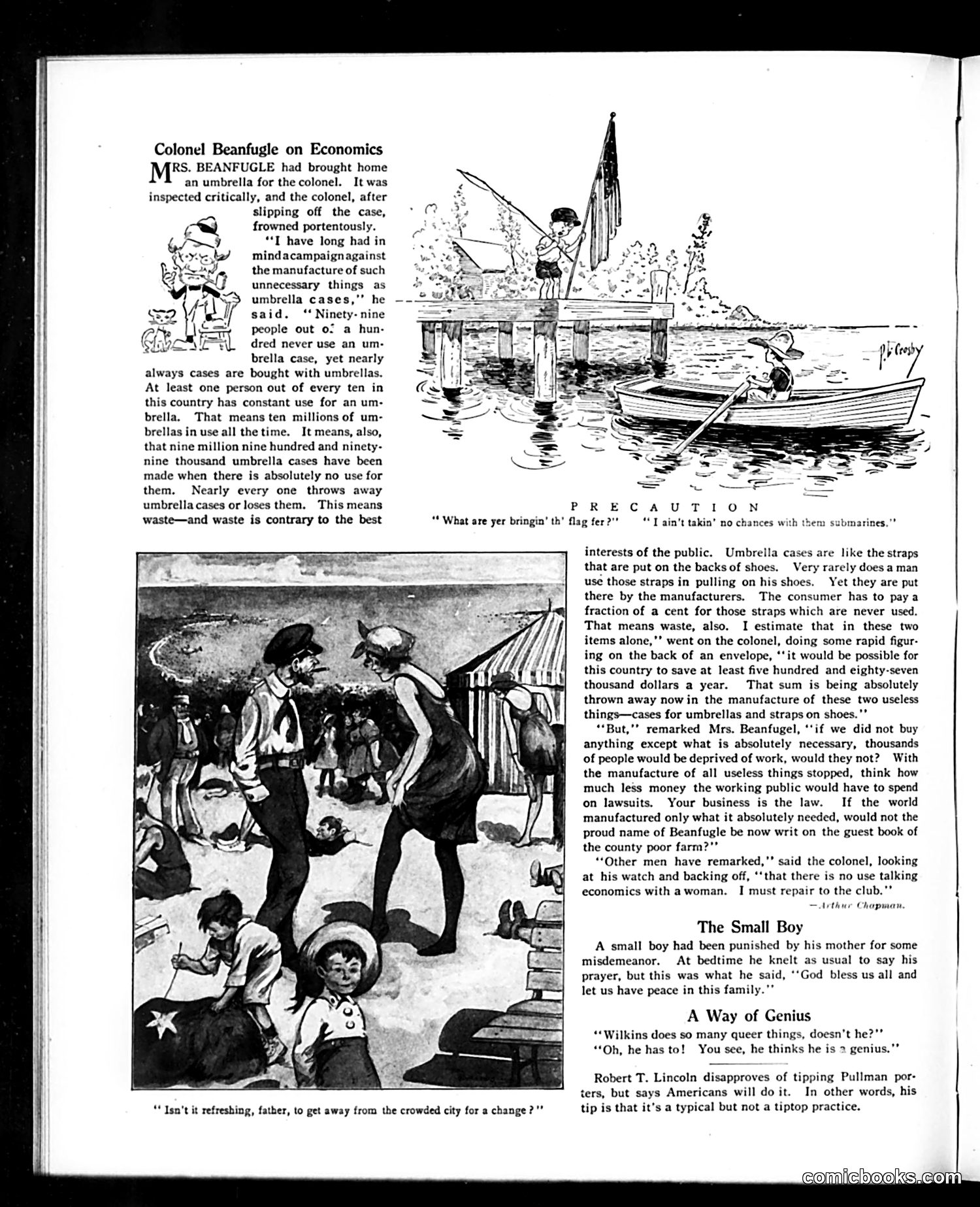
This page satirizes a pompous lawyer character ("Colonel Beanfugle") who campaigns against wasteful manufacturing—specifically umbrella cases and shoe straps that consumers rarely use. The joke is that his economizing argument backfires: his wife points out that eliminating "useless" production would throw workers out of jobs and impoverish him, since his legal practice depends on the economic activity that such waste generates. The cartoon at bottom right ("Precaution") references WWI submarine warfare, showing civilians taking absurd protective measures—flying a flag to avoid being torpedoed—reflecting American anxiety about German U-boats. The page also includes brief humorous anecdotes about a child's bedtime prayer and a character named Wilkins, plus commentary on tipping Pullman porters. These are light social observations typical of Judge magazine's satirical format.
📄 Transcribed text from this page (OCR, searchable)
Machine-transcribed from the original scan — historical spelling and the odd misread are preserved.
Colonel Beanfugle on Economics RS. BEANFUGLE had brought home an umbrella for the colonel. It was inspected critically, and the colonel, after slipping off the case, frowned portentously. “T have long had in mindacampaignagainst the manufacture of such unnecessary things as umbrella cases,’’ he —-—— said. ‘* Ninety-nine people out 0: a hun- dred never use an um- brella case, yet nearly always cases are bought with umbrellas. t At least one person out of every ten in this country has constant use for an um- brella. That means ten millions of um- brellas in use all the time. It means, also, that nine million nine hundred and ninety- nine thousand umbrella cases have been made when there is absolutely no use for them. Nearly every one throws away umbrella cases or loses them. This means PRECAUTION waste—and waste is contrary to the best “* What are yer bringin’ th’ flag fer?" “*T ain't takin’ no chances with them submarines.”” interests of the public. Umbrella cases are like the straps that are put on the backs of shoes. Very rarely does a man use those straps in pulling on his shoes. Yet they are put there by the manufacturers. The consumer has to pay a fraction of a cent for those straps which are never used. That means waste, also. I estimate that in these two items alone,’’ went on the colonel, doing some rapid figur- ing on the back of an envelope, ‘it would be possible for this country to save at least five hundred and eighty-seven thousand dollars a year. That sum is being absolutely thrown away now in the manufacture of these two useless things—cases for umbrellas and straps on shoes."’ “*But,’’ remarked Mrs. Beanfugel, ‘‘if we did not buy anything except what is absolutely necessary, thousands of people would be deprived of work, would they not? With the manufacture of all useless things stopped, think how much less money the working public would have to spend on lawsuits. Your business is the law. If the world manufactured only what it absolutely needed, would not the proud name of Beanfugle be now writ on the guest book of the county poor farm?"’ “Other men have remarked,"’ said the colonel, looking at his watch and backing off, ‘‘that there is no use talking economics with a woman. I must repair to the club."* —Arthue Chapman. The Small Boy A small boy had been punished by his mother for some misdemeanor. At bedtime he knelt as usual to say his prayer, but this was what he said, ‘‘God bless us all and let us have peace in this family."" A Way of Genius “Wilkins does so many queer things, doesn’t he?"* “Oh, he has to! You see, he thinks he is 2 genius."* Robert T. Lincoln disapproves of tipping Pullman por- ters, but says Americans will do it. In other words, his “Isn't it refreshing, father, to get away from the crowded city for a change ?"’ tip is that it's a typical but not a tiptop practice.