
Judge, 1915-06-05 · page 12 of 28
Judge — June 5, 1915 — page 12: what you’re looking at
What you’re looking at
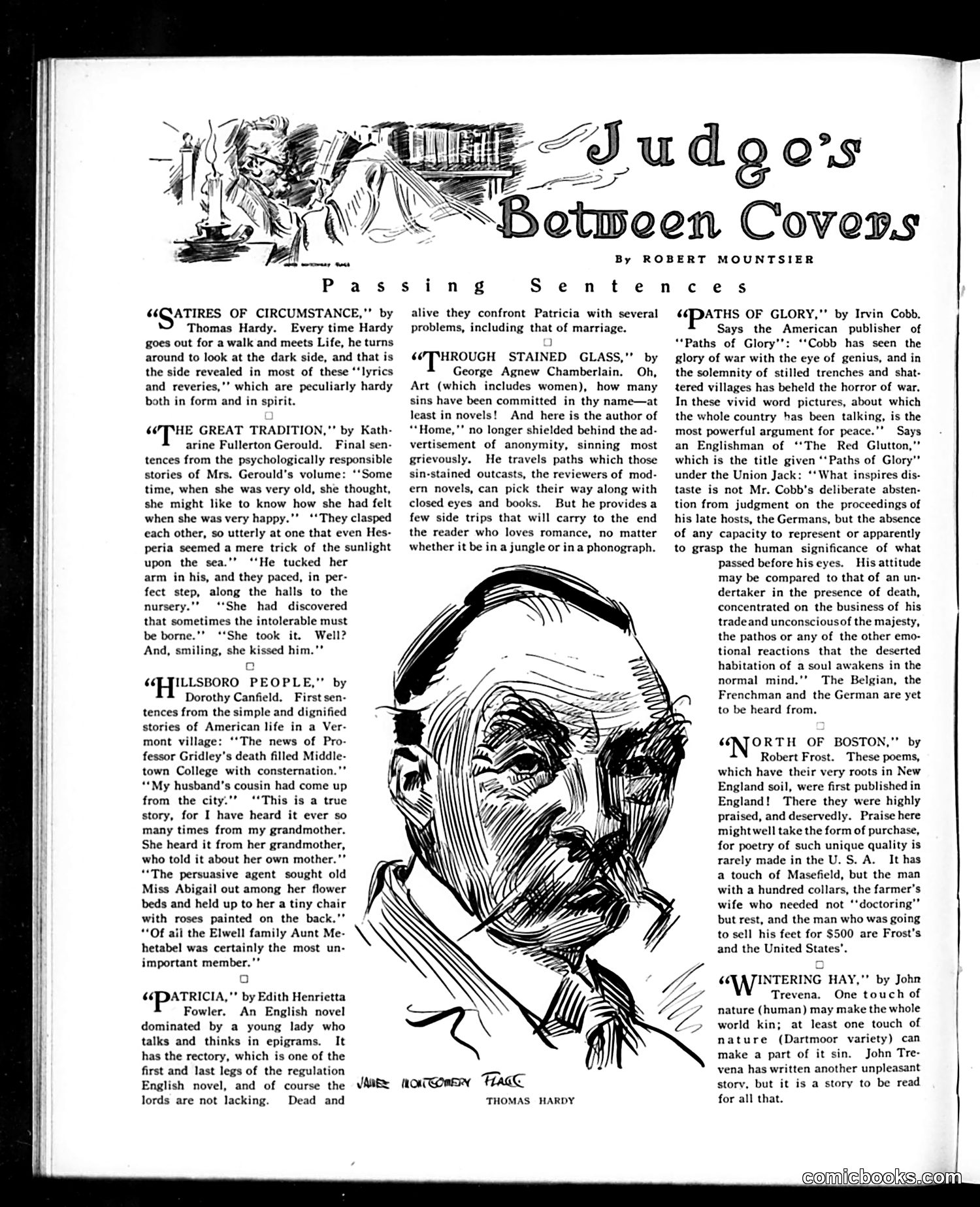
This is a literary review section featuring book critiques by Robert Mountsier. The central illustration is a portrait sketch of **Thomas Hardy**, the celebrated English novelist, identified by the caption below. The page reviews five contemporary books with satirical summaries of their opening lines and themes: - Hardy's *Satires of Circumstance* (poetry focusing on life's dark side) - Gerould's *The Great Tradition* (domestic romance) - Canfield's *Hillsboro People* (Vermont village stories) - Fowler's *Patricia* (English society novel with witty heroine) - Chamberlain's *Through Stained Glass* (war and romance) The satire targets literary conventions: overwrought emotional conclusions, predictable English novel settings ("the rectory...and of course the lords"), and formulaic American regionalism. The longest critique of Cobb's *Paths of Glory* contrasts American and English views on war literature—the American publisher sees it as pacifist propaganda, while an Englishman criticizes Cobb's emotional detachment toward German suffering.
📄 Transcribed text from this page (OCR, searchable)
Machine-transcribed from the original scan — historical spelling and the odd misread are preserved.
66QATIRES OF CIRCUMSTANCE,"’ by Thomas Hardy. Every time Hardy goes out for a walk and meets Life, he turns around to look at the dark side, and that is the side revealed in most of these ‘lyrics and reveries,"’ which are peculiarly hardy both in form and in spirit. 607T.HE GREAT TRADITION," by Kath- arine Fullerton Gerould. Final sen- tences from the psychologically responsible stories of Mrs. Gerould’s volume: ‘‘Some time, when she was very old, she thought, she might like to know how she had felt when she was very happy."’ ‘‘They clasped each other, so utterly at one that even Hes- peria seemed a mere trick of the sunlight upon the sea.’’ ‘‘He tucked her arm in his, and they paced, in per- fect step, along the halls to the nursery."" ‘*She had discovered that sometimes the intolerable must be borne.’ ‘‘She took it. Well? And, smiling, she kissed him.” o é¢LJILLSBORO PEOPLE," by Dorothy Canfield. First sen- tences from the simple and dignified stories of American life in a Ver- mont village: ‘*The news of Pro- fessor Gridley’s death filled Middle- town College with consternation."’ “My husband’s cousin had come up from the city." ‘‘This is a true story, for I have heard it ever so many times from my grandmother. She heard it from her grandmother, who told it about her own mother."’ “The persuasive agent sought old Miss Abigail out among her flower beds and held up to her a tiny chair with roses painted on the back."’ “Of ail the Elwell family Aunt Me- hetabel was certainly the most un- important member.’" ie] é66PDATRICIA,”* by Edith Henrietta Fowler. An English novel dominated by a young lady who talks and thinks in epigrams. It has the rectory, which is one of the first and last legs of the regulation English novel, and of course the lords are not lacking. Dead and “JSudgo's Between Covon.s By ROBERT MOUNTSIER Sentences alive they confront Patricia with several problems, including that of marriage. ) 6¢T'HROUGH STAINED GLASS," George Agnew Chamberlain. Art (which includes women), how many sins have been committed in thy name—at least in novels!’ And here is the author of “*Home,"’ no longer shielded behind the ad- vertisement of anonymity, sinning most grievously. He travels paths which those sin-stained outcasts, the reviewers of mod- ern novels, can pick their way along with closed eyes and books. But he provides a few side trips that will carry to the end the reader who loves romance, no matter whether it be in a jungle or ina phonograph. VM mormon Face THOMAS HARDY 66PDATHS OF GLORY,"’ by Irvin Cobb. Says the American publisher of “Paths of Glory “Cobb has seen the glory of war with the eye of genius, and in the solemnity of stilled trenches and shat- tered villages has beheld the horror of war. In these vivid word pictures, about which the whole country bas been talking, is the most powerful argument for peace.’" Says an Englishman of ‘*The Red Glutton,” which is the title given ‘‘Paths of Glory” under the Union Jack: ‘‘What inspires dis- taste is not Mr. Cobb's deliberate absten- tion from judgment on the proceedings of his late hosts, the Germans, but the absence of any capacity to represent or apparently to grasp the human significance of what passed before his eyes. His attitude may be compared to that of an un- dertaker in the presence of death, concentrated on the business of his tradeand unconsciousof the majesty, the pathos or any of the other emo- tional reactions that the deserted habitation of a soul awakens in the normal mind.’’ The Belgian, the Frenchman and the German are yet to be heard from. ‘ ORTH OF BOSTON,” by Robert Frost. These poems, which have their very roots in New England soil, were first published in England! There they were highly praised, and deservedly. Praise here might well take the form of purchase, for poetry of such unique quality is rarely made in the U.S. A. It has a touch of Masefield, but the man with a hundred collars, the farmer's wife who needed not ‘‘doctoring’’ but rest, and the man who was going to sell his feet for $500 are Frost's and the United States’. 6“ INTERING HAY," by John Trevena. One touch of nature (human) may make the whole world kin; at least one touch of nature (Dartmoor variety) can make a part of it sin. John Tre- vena has written another unpleasant story, but it is a story to be read for all that.