
A complete issue · 24 pages · 1914
Judge — December 12, 1914
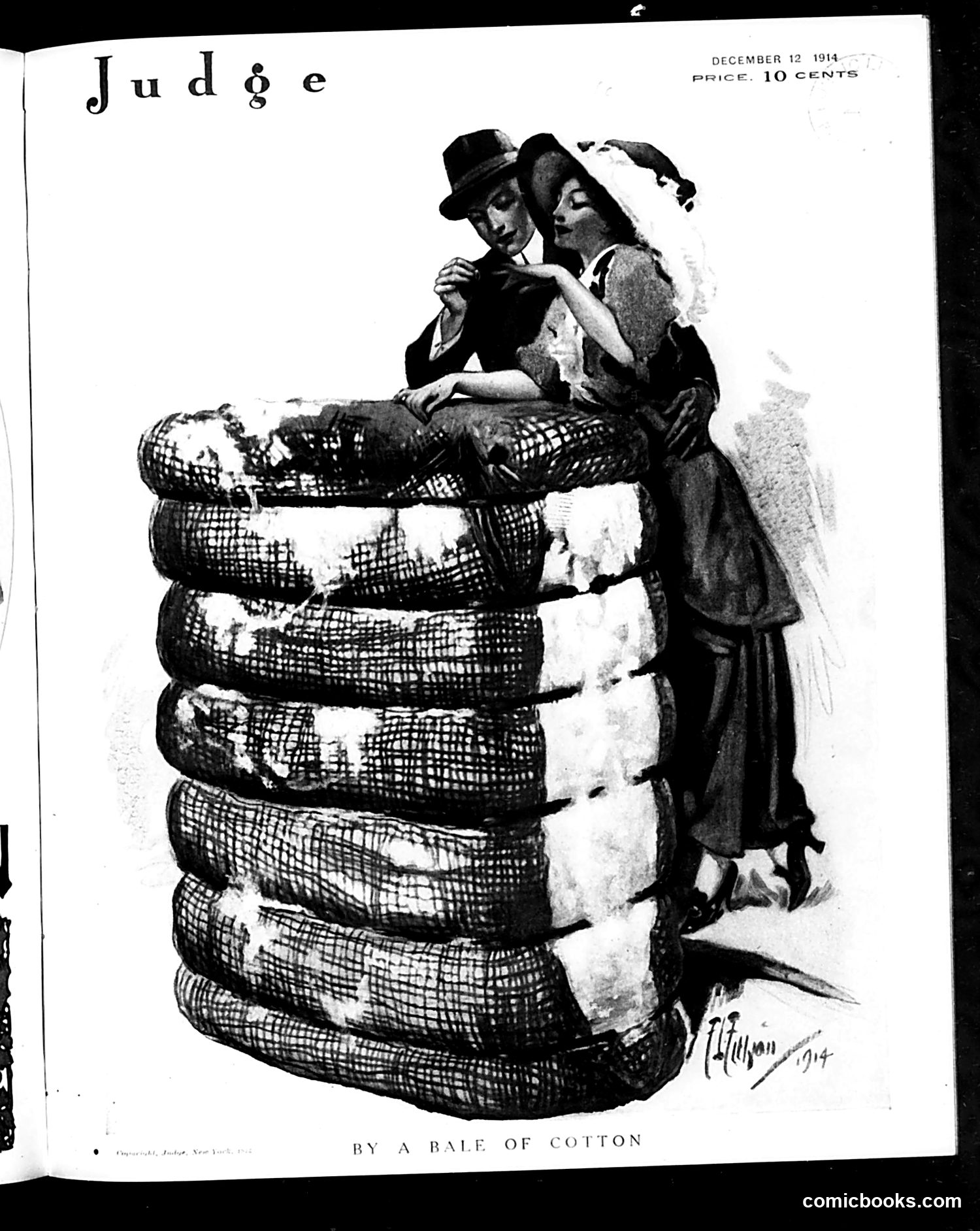
This Judge magazine cover from December 12, 1914, depicts a couple perched atop a large bale of cotton. The title's meaning appears satirical, likely commenting on romance or relationships through a commercial lens—suggesting love or courtship is being measured or commodified "by" cotton, perhaps a valuable commodity. Given the 1914 date, this may reference cotton's economic importance to America, or possibly comment on dating/marriage practices among the wealthy or mercantile classes. The couple's elegant dress and intimate pose contrasts humorously with the industrial, bundled cotton beneath them, creating satire about materialism in romance or class dynamics. Without additional historical context, the exact political or social target remains unclear, though it appears to mock commercialism or economic anxiety of the era.
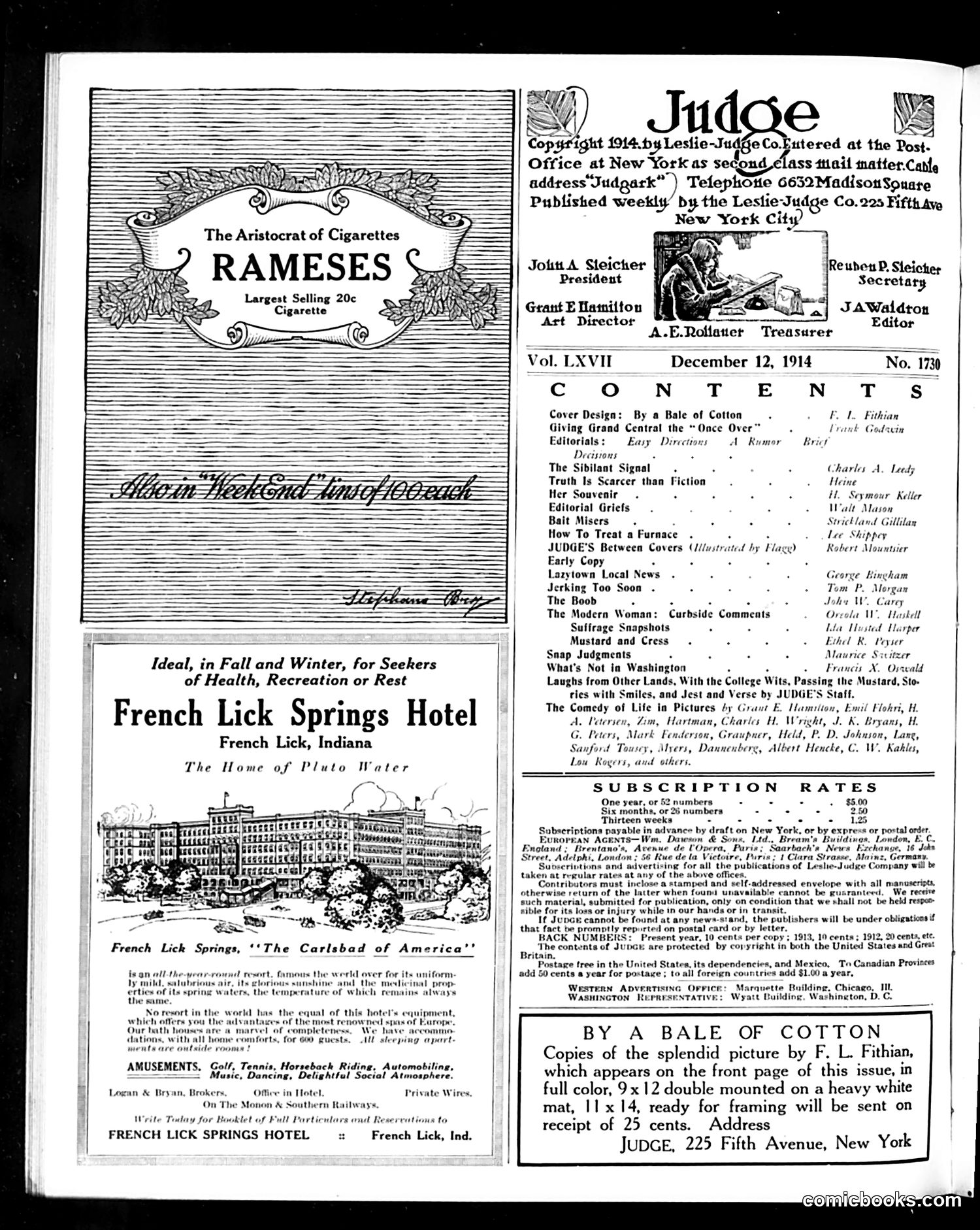
This page is primarily **advertising and masthead content** rather than political satire. The left side features a Rameses cigarette advertisement ("The Aristocrat of Cigarettes") and promotional material for French Lick Springs Hotel in Indiana, emphasizing its mineral water and health benefits. The right side displays the magazine's masthead and subscription information. The contents list mentions various articles and illustrations, though the specific cartoons aren't clearly visible in this image. The page represents a typical early 20th-century magazine layout combining editorial content with commercial advertising. Without seeing the actual cartoon illustrations clearly, specific satirical commentary cannot be reliably identified.
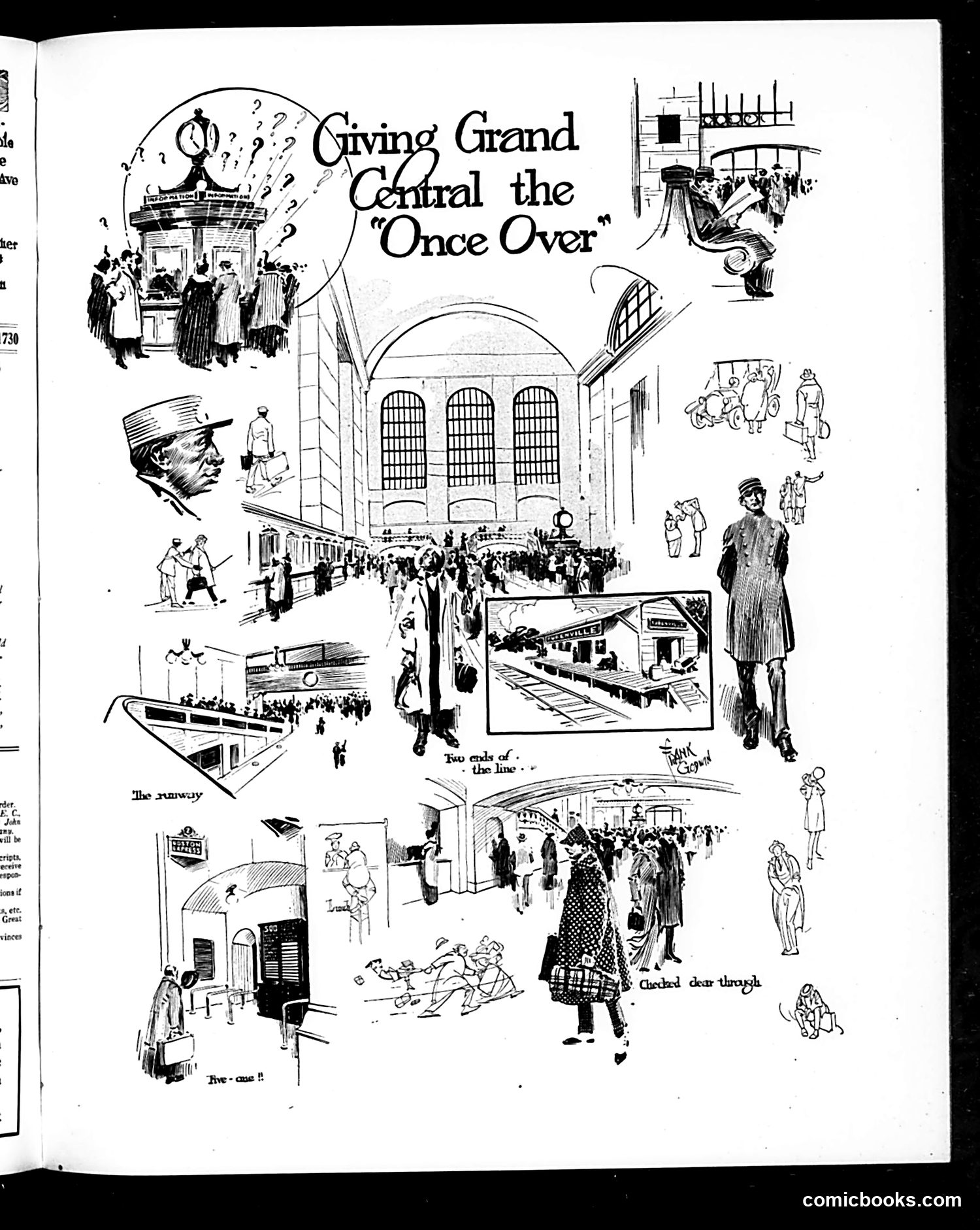
This page satirizes the experience of Grand Central Terminal in New York City. The central illustration shows the iconic terminal's main concourse with its distinctive arched windows, crowded with travelers. Surrounding vignettes depict various activities: the subway entrance, the railway platform, ticket windows, and station corridors labeled "Two ends of the line" and "Checked clear through." The smaller sketches humorously illustrate typical passenger experiences—waiting in line ("live—one it"), navigating crowds, and checking baggage. The phrase "Once Over" suggests a comprehensive tour or overview of the terminal's operations and the diverse human traffic flowing through this major transportation hub, capturing the busy, chaotic nature of urban transit life.
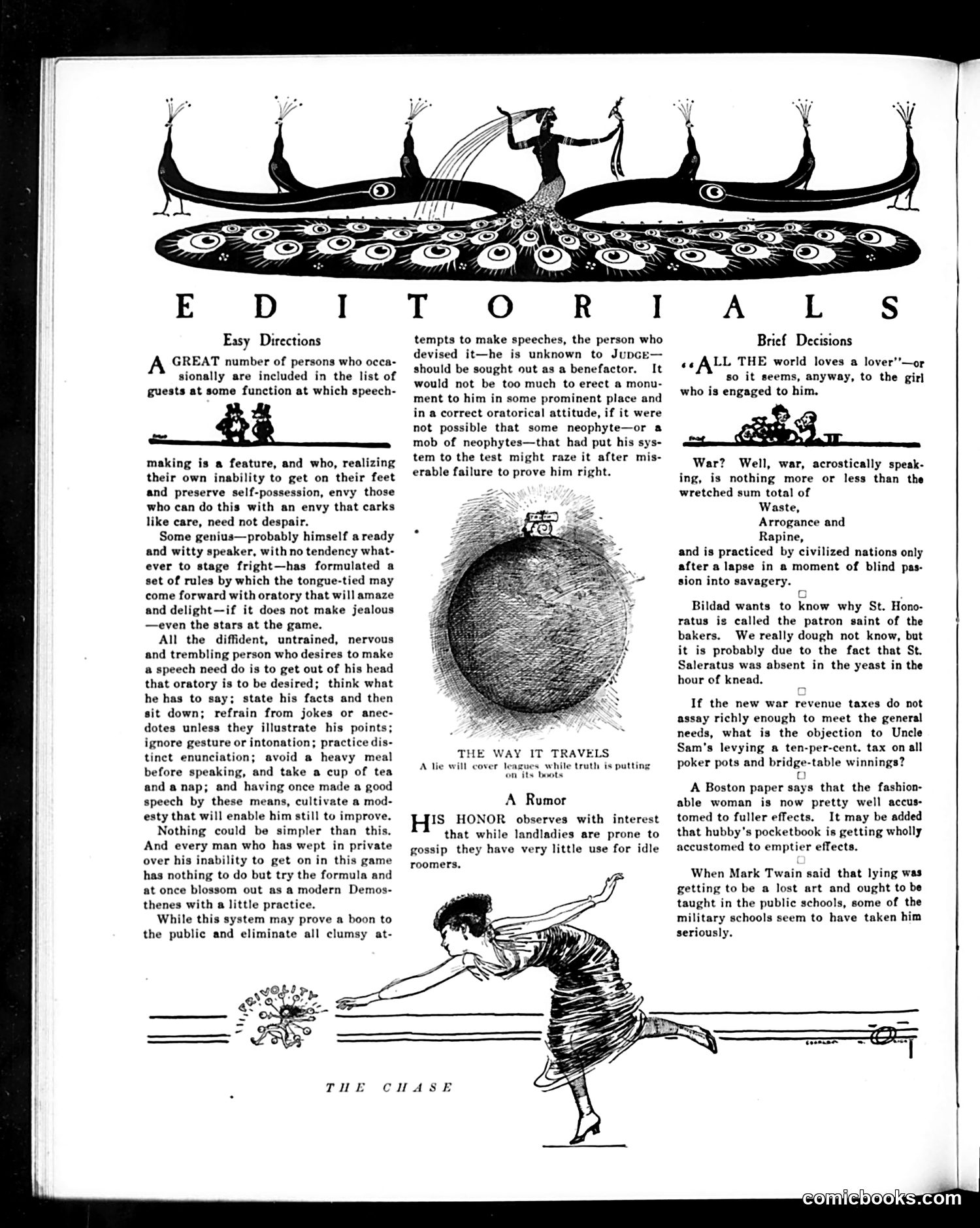
This page contains three satirical pieces typical of Judge's format: **"Easy Directions"** offers tongue-in-cheek advice for making public speeches, mocking nervous speakers who memorize rules but still flounder—suggesting even formula-based approaches can't save a clumsy orator. **"The Way It Travels"** (accompanying illustration) appears to be a visual pun about gossip spreading, though the exact reference is unclear. **"A Rumor"** satirizes society gossip, particularly women's tendency toward idle chatter, suggesting fashionable women are especially prone to empty conversation. **"The Chase"** (illustration) shows a woman in pursuit, likely satirizing modern women's increasing independence or changing social roles—a common Judge theme of this era. The page's overall tone mocks social pretension, gender stereotypes, and public behavior typical of early 20th-century American satire.
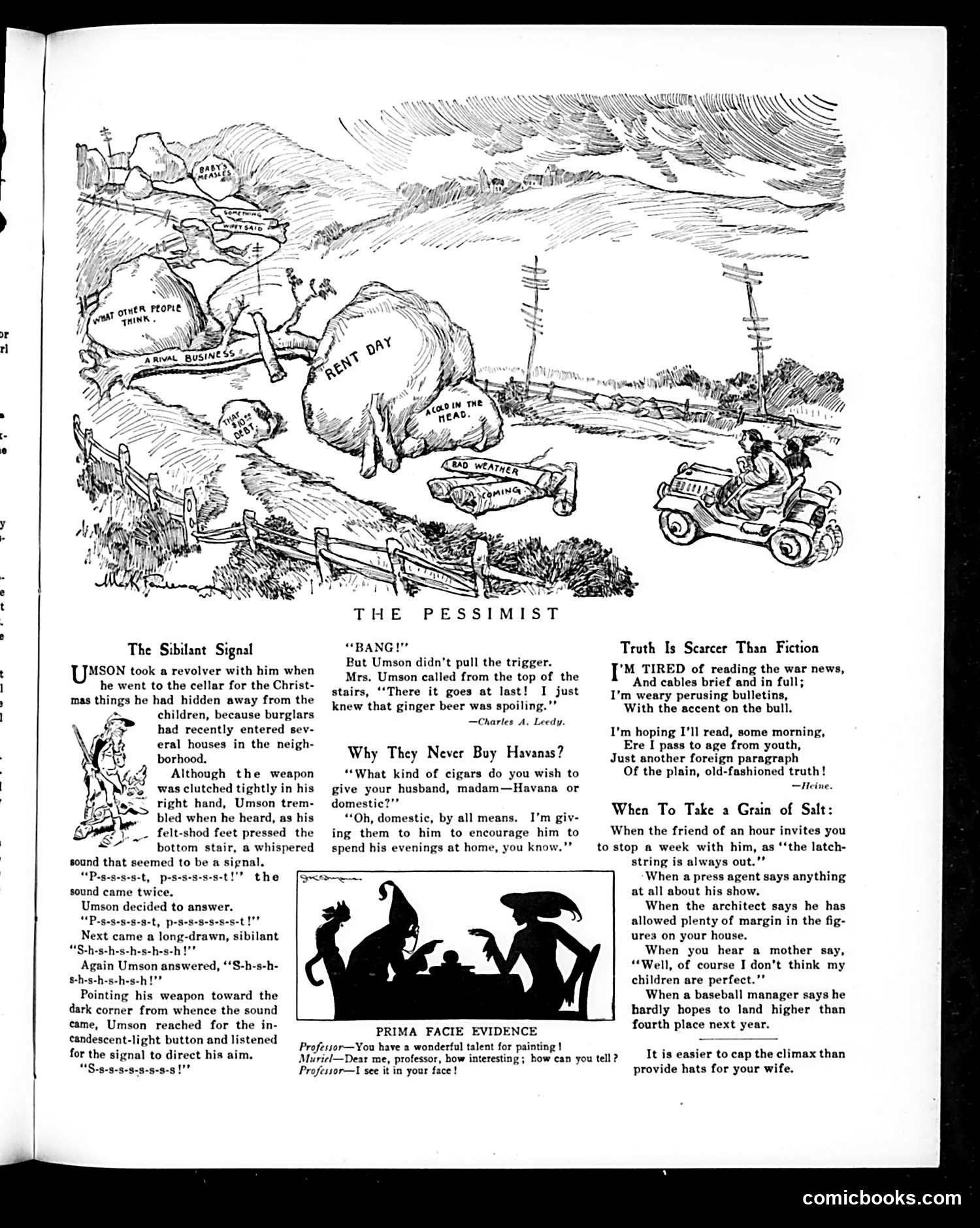
**Main Cartoon ("The Pessimist")**: This is a humorous illustration satirizing the worries of a pessimistic character who sees problems everywhere. The cow labeled with various concerns ("Right Day," "Corn in the fields," "Bad Weather," "Worrying") and surrounding chaos (car mishaps, bad omens) represents how pessimists catastrophize ordinary situations. **"The Sibilant Signal" Story**: A comedic narrative about Umson, who attempts to signal with a revolver hidden in his pocket. The humor derives from the absurd onomatopoeia ("P-s-s-s-t, p-s-s-s-t") used to describe gunshots—treating the weapon's sound as a mere whisper. **Additional Jokes**: The page includes various one-liners mocking human nature, marital relationships, and social pretension—typical Judge magazine fare of witty social commentary.
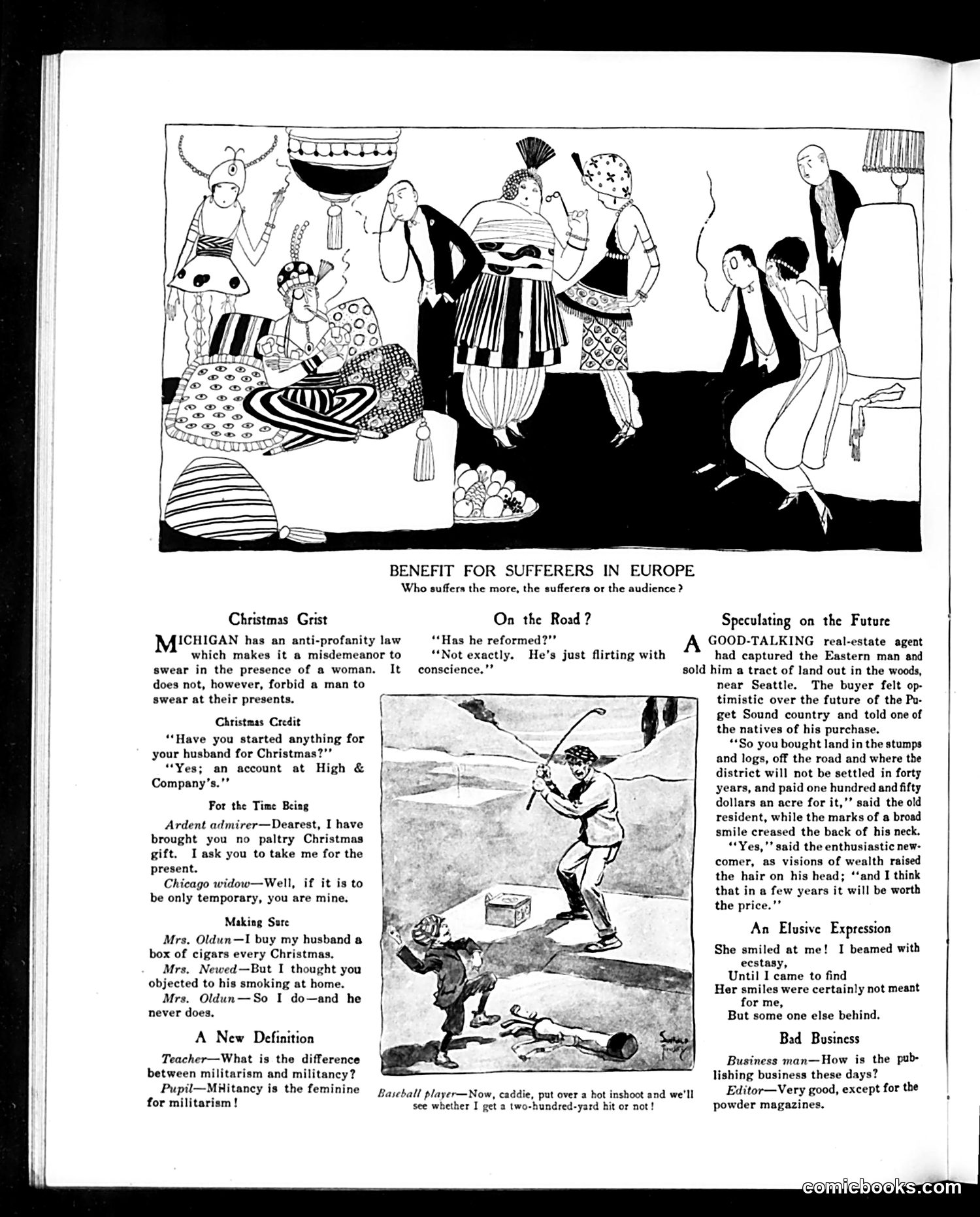
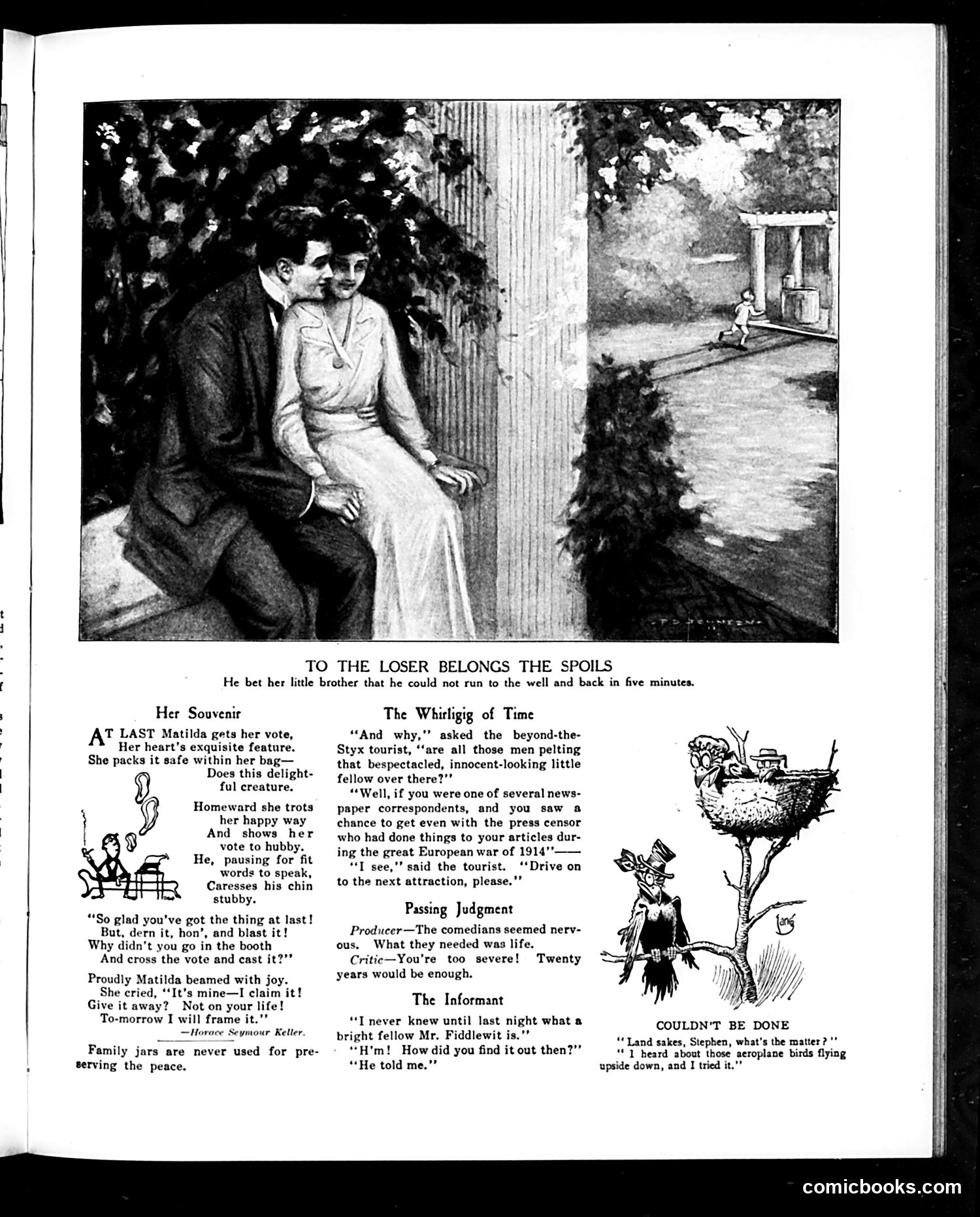
This page satirizes early women's suffrage, likely from the 1910s-1920s. The main cartoon mocks a woman named Matilda who just cast her first vote. The joke: she removes her ballot from the polling booth and takes it home as a "souvenir" rather than depositing it in the box. Her husband is exasperated—she's so proud of possessing the vote itself that she's forgotten its actual purpose. The satire cuts two ways: it ridicules both women voters (portrayed as confused about the voting process) and suffragists' opponents who viewed women's political participation as frivolous. The accompanying verse emphasizes her vanity ("It's mine—I claim it!") and intention to frame it rather than use it meaningfully. Other humorous pieces mock journalists, theater critics, and human foolishness, typical of Judge's satirical approach.
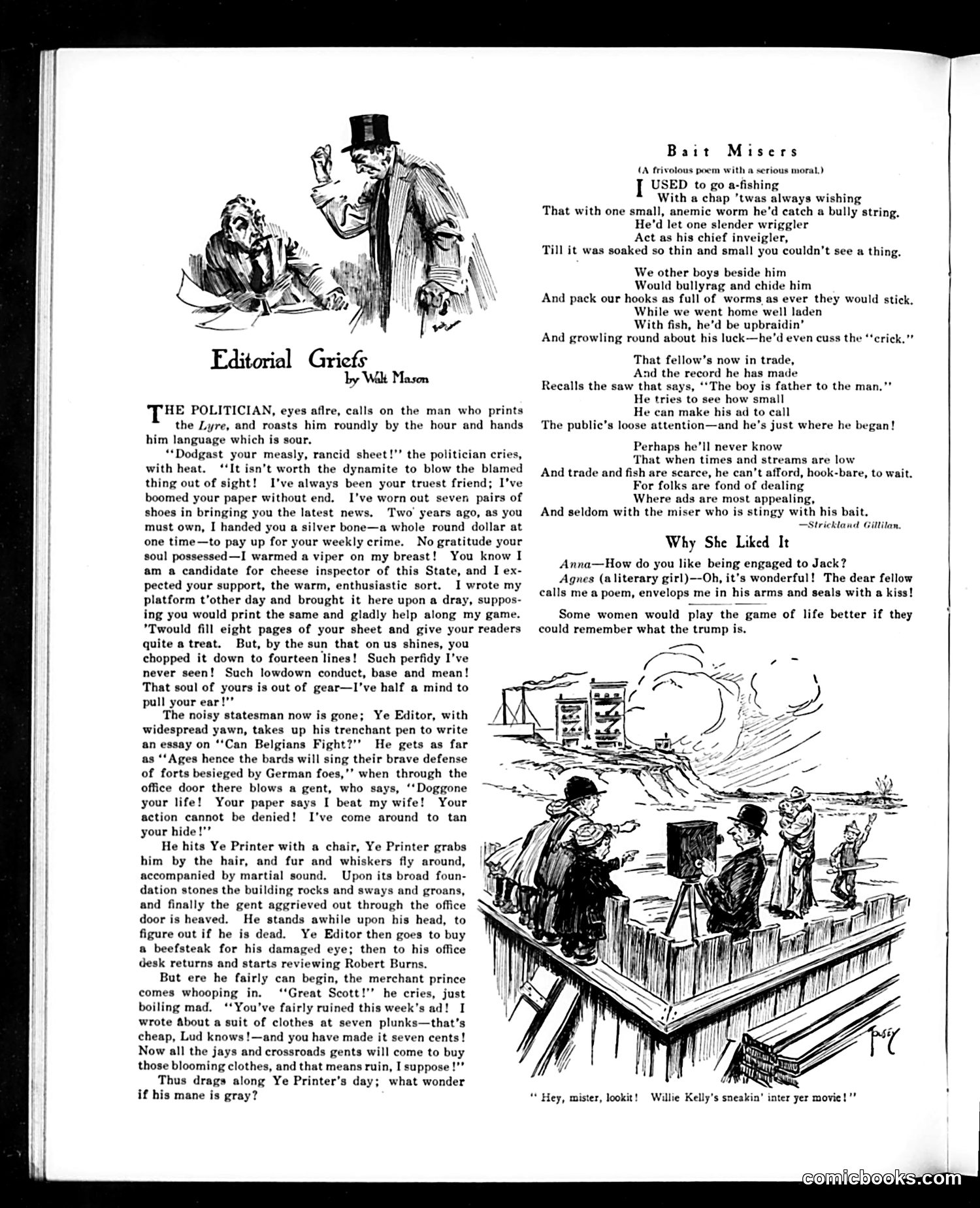
**"Editorial Griefs" by Walt Mason** satirizes newspaper editors' impossible position in early 20th-century America. An angry politician demands free advertising space, threatening the editor after his platform receives inadequate coverage. The editor is then attacked by an irate citizen claiming the paper falsely reported he beat his wife, followed by a merchant furious that a typographical error (changing "seven plunks" to "seven cents") will destroy his clothing business by attracting too many bargain-hunters. The cartoon illustrates how editors face constant abuse from politicians, angry readers, and advertisers—hence the editor's graying hair. **"Bait Misers"** is a morality poem contrasting two boys fishing: one stingy with worms (using one tiny, overused worm), the other generous (using many full worms). The poem argues this childhood trait predicts adult behavior—the stingy boy becomes a businessman who runs minimal advertisements, failing to understand that advertising investment attracts customers and profits, just as generous bait attracts fish.
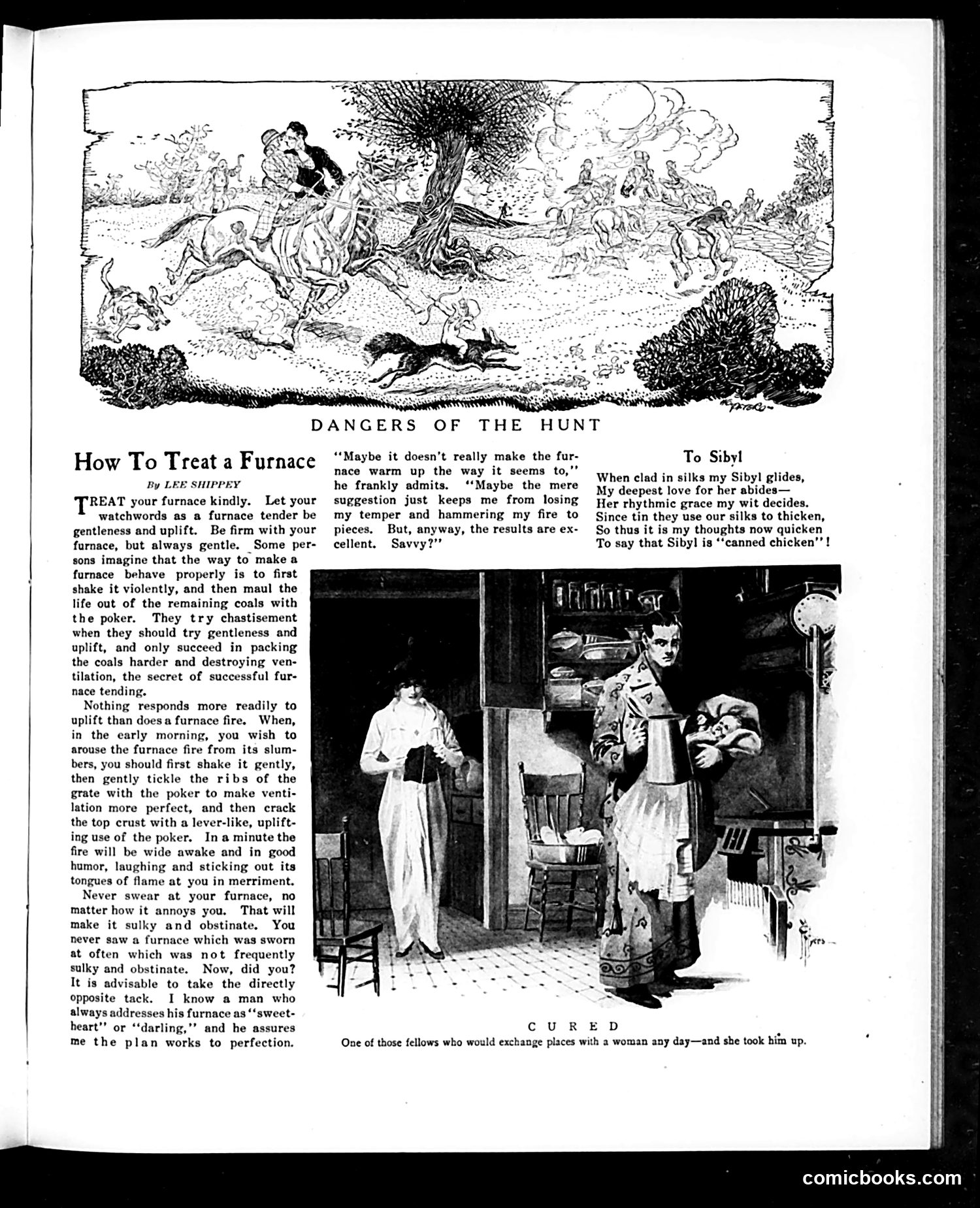
This page contains three distinct pieces of humor content: **"How to Treat a Furnace"** (main article by Lee Shippey): A humorous anthropomorphization of furnace maintenance. The "joke" treats a furnace like a temperamental person—it responds better to gentle, kind treatment ("sweetheart," "darling") than to aggressive poking and swearing. This is gentle domestic satire about household management, likely resonating with readers who maintained coal furnaces. **"Dangers of the Hunt"** (top illustration): A hunting scene showing chaos and mishap, accompanying the caption about a man who "would exchange places with a woman any day—and she took him up." This appears to be slapstick humor about gender role reversal—a man willing to trade places discovers the "danger" of women's responsibilities (the illustration suggests accident or injury). **"To Sibyl"** (poem): A trivial romantic verse making a pun: the speaker loves Sibyl in her silk dresses, but since tin is now used to thicken silk (likely a WWI-era metal rationing reference), Sibyl becomes "canned chicken"—wordplay on tinned/canned goods. The overall tone is light domestic and romantic humor typical of early 20th-century satirical magazines.
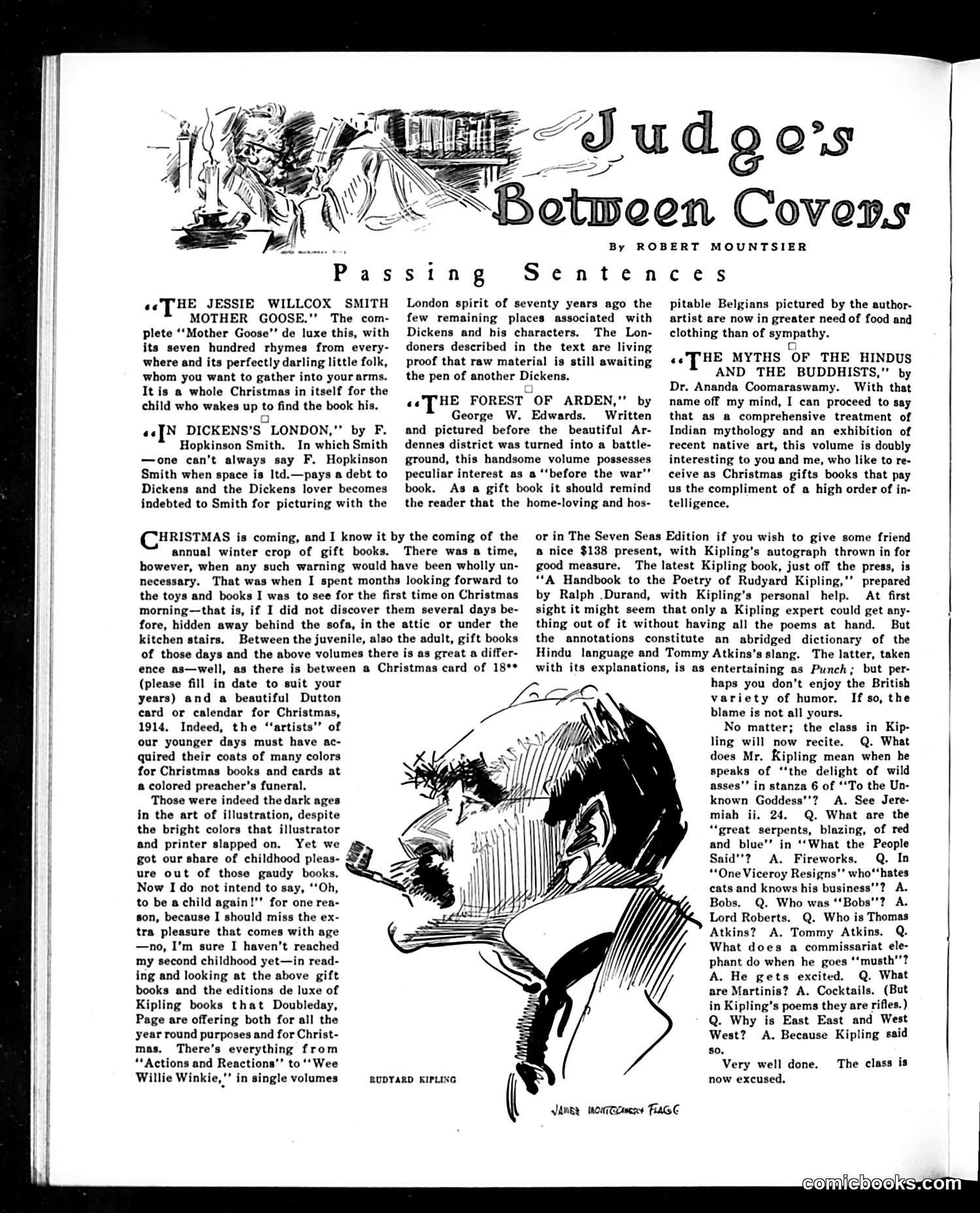
This is primarily a **book review column** titled "Judo's Between Covers" by Robert Mountsier, not a political cartoon page. The single illustration shows **Rudyard Kipling**, identified by the caption. The page reviews Christmas gift books, including illustrated editions of *Mother Goose* and *Dickens's London*. One review notably mentions *The Forest of Arden*—a pre-World War I illustrated book of Belgium—observing that "the home-loving and hospitable Belgians pictured by the author-artist are now in greater need of food and clothing than of sympathy." This **wartime reference** reflects WWI's ongoing humanitarian crisis in Belgium (the article appears to be from around 1914-1915). The Kipling illustration and discussion of his work as a gift option reflects his popularity as a contemporary author. The nostalgic opening contrasts modern deluxe book editions with simpler childhood Christmas gifts, establishing that this is consumer-focused holiday content for Judge's educated, affluent readership.
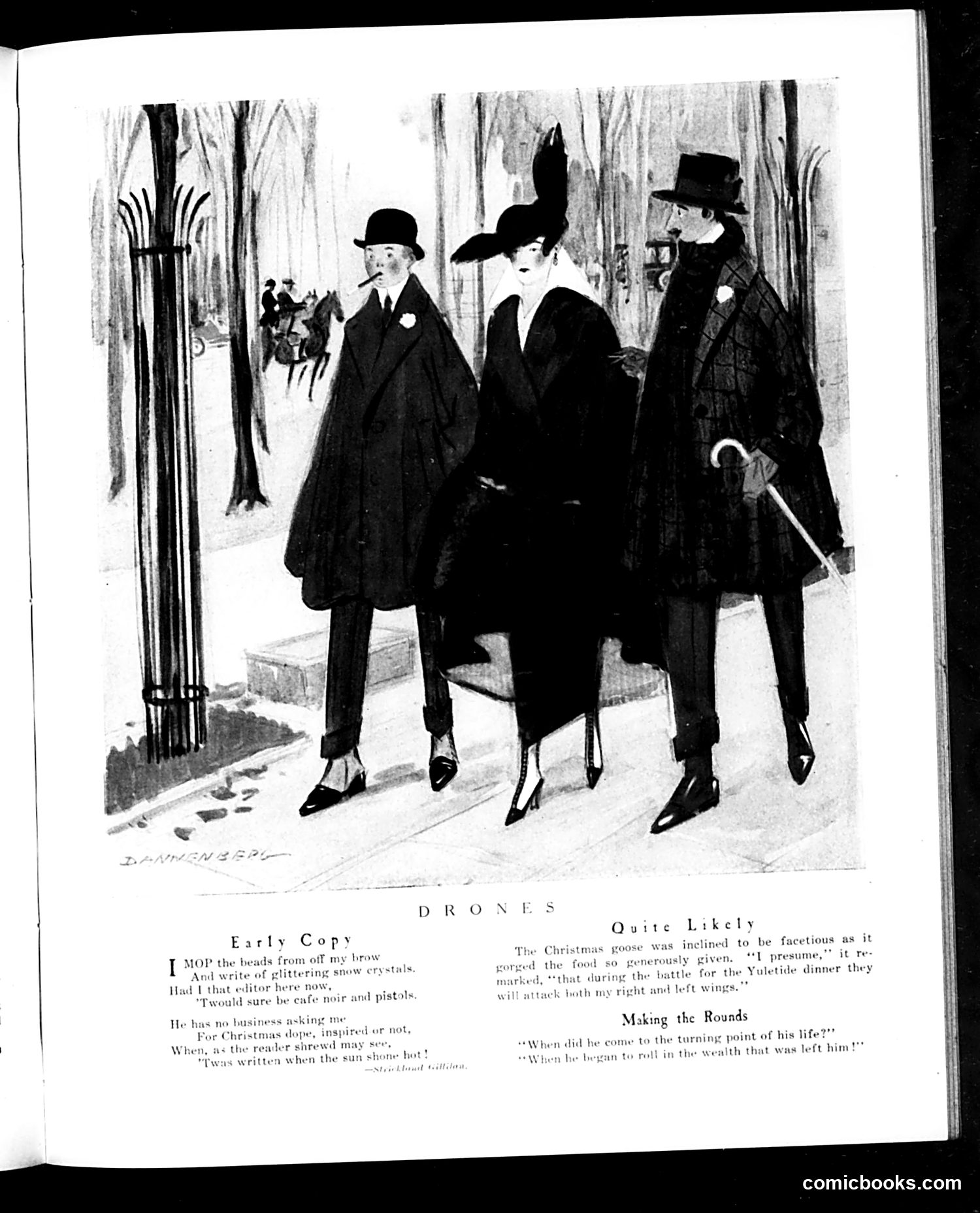
This cartoon satirizes wealthy idlers of the Gilded Age—three fashionably dressed men in top hats and overcoats, carrying canes, depicted as useless "drones" (a reference to male bees that contribute nothing to the hive). The accompanying text mocks their parasitic lifestyle. "Early Copy" complains about their existence; "Quite Likely" jokes that a Christmas goose was "as facetious" (mocking) as their behavior at dinner. "Making the Rounds" features a cynical dialogue: when asked when someone "came to the turning point of his life," the answer is "when he began to roll in the wealth that was left him"—criticizing inherited wealth and idle privilege. The satire targets the non-working upper classes who contribute nothing to society while living luxuriously off inherited money.
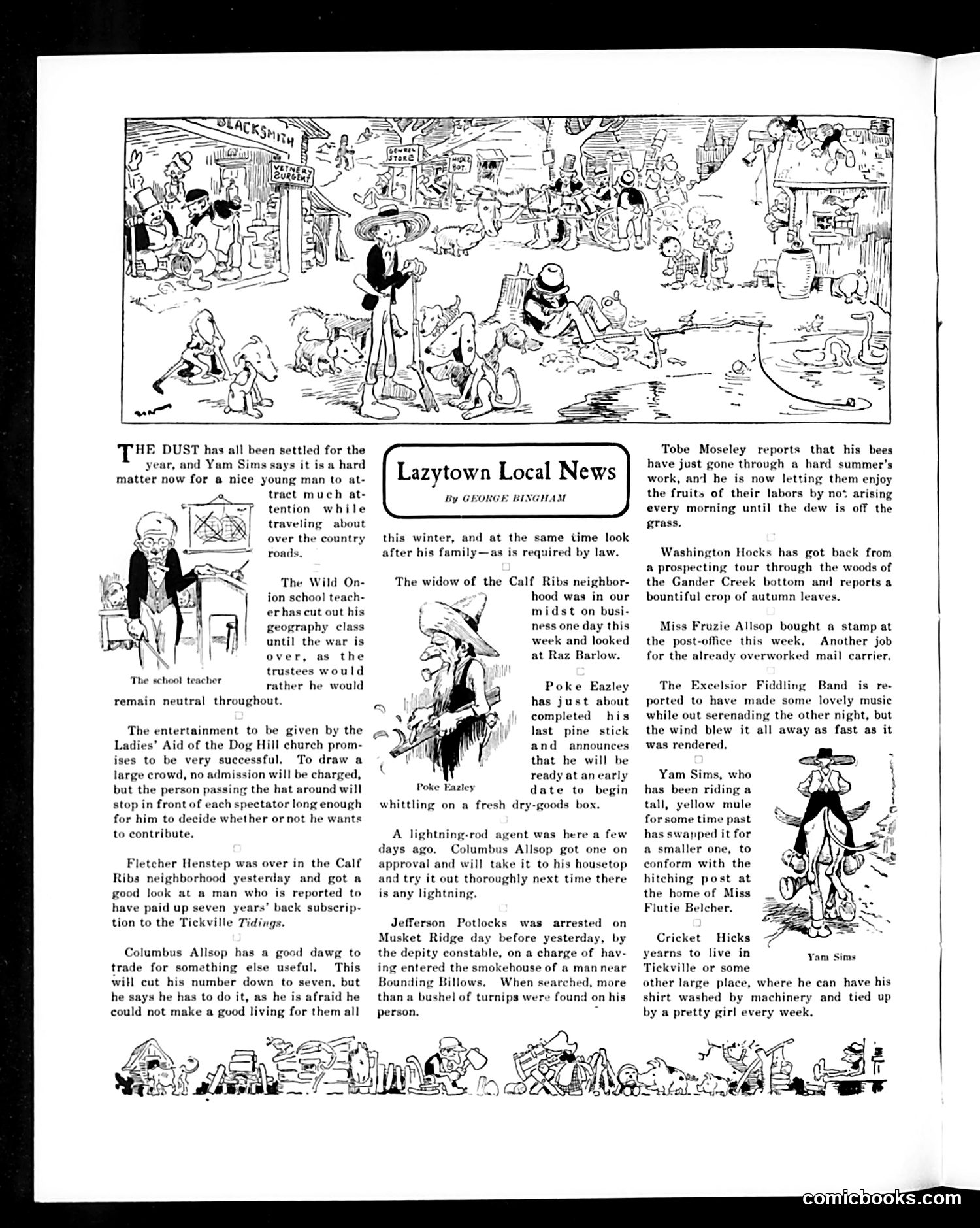
This page satirizes small-town life through humorous local news items from a fictional rural community. Written by George Bingham, it mocks the triviality and absurdity of backwoods existence. Key satirical targets include: **economic desperation** (Columbus Allsop can't afford seven dogs), **religious hypocrisy** (a church fundraiser that pressures attendees to donate), and **general laziness and incompetence** (a teacher avoiding geography during wartime; a man finally paying seven years of subscription fees; someone testing a lightning rod during a storm). The humor relies on exaggeration and deadpan delivery—treating minor, ridiculous events with mock-serious newspaper tone. References to "Tickville Tidings" and place names like "Calf Ribs" and "Musket Ridge" suggest this is parody of actual rural newspapers. The accompanying illustrations (showing country folk and a man on a mule) reinforce the rural comedy. This represents early 20th-century urban magazines' gentle mockery of rural American life.
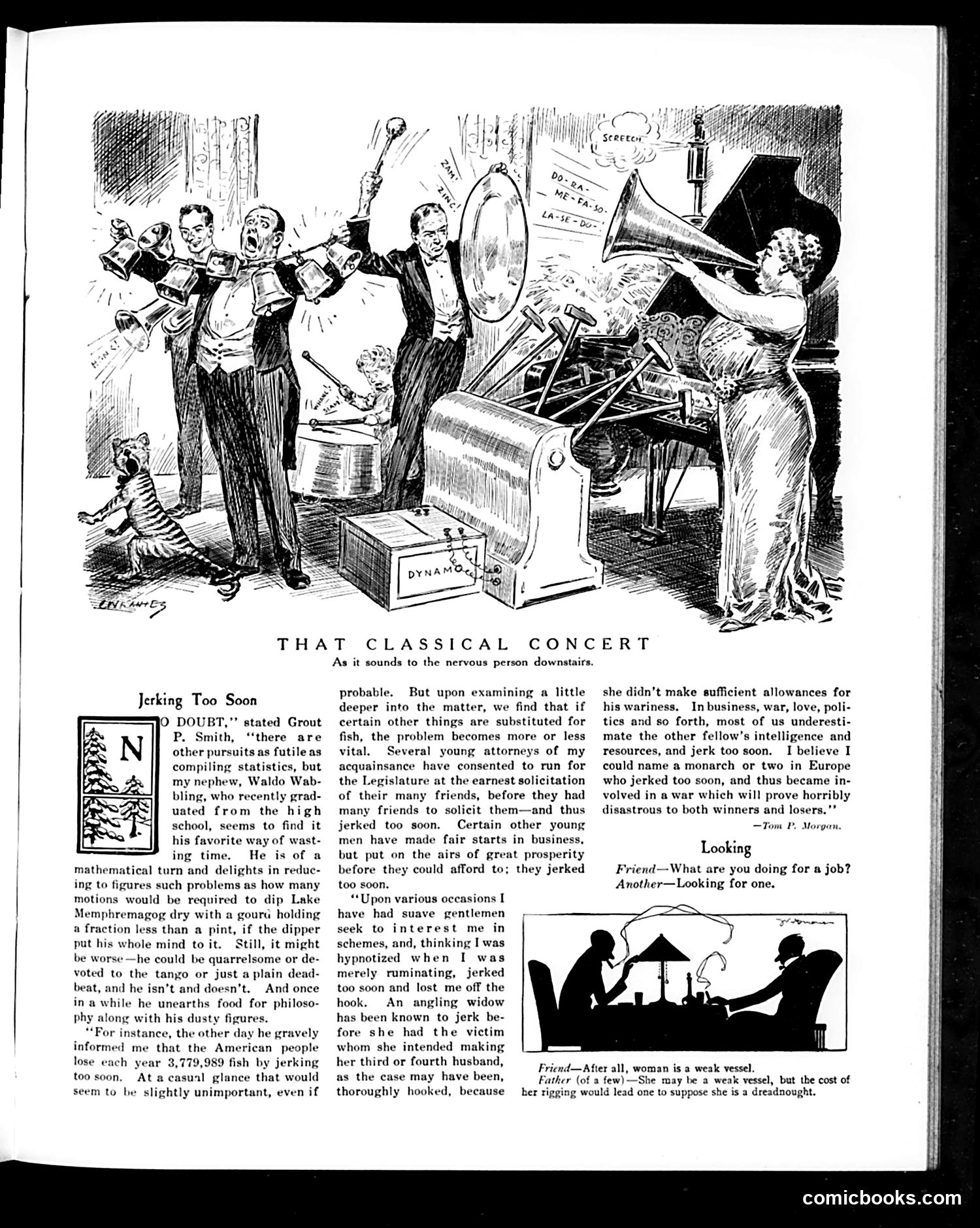
**"Jerking Too Soon"** is a humorous allegory about premature action. The narrator describes his nephew's statistical hobby, then pivots to broader life lessons. The "jerking" metaphor—abandoning a fishing line too early—represents rushing decisions across multiple domains: young lawyers running for office before building support, businessmen displaying wealth prematurely, and political leaders entering conflicts unprepared. The piece appears to reference European monarchs entering WWI without adequate resources or strategy, suggesting this was written during or shortly after that conflict. **"That Classical Concert"** is a cartoon depicting a loud orchestral performance disturbing residents downstairs—a sight gag about noise pollution from upstairs neighbors. **"Looking"** is a brief joke: someone asks another person about employment; the reply is he's "looking for one," playing on the double meaning of "looking" as both searching and appearance. The page blends gentle satire about human folly with lighthearted domestic humor typical of early-20th-century *Judge* magazine.
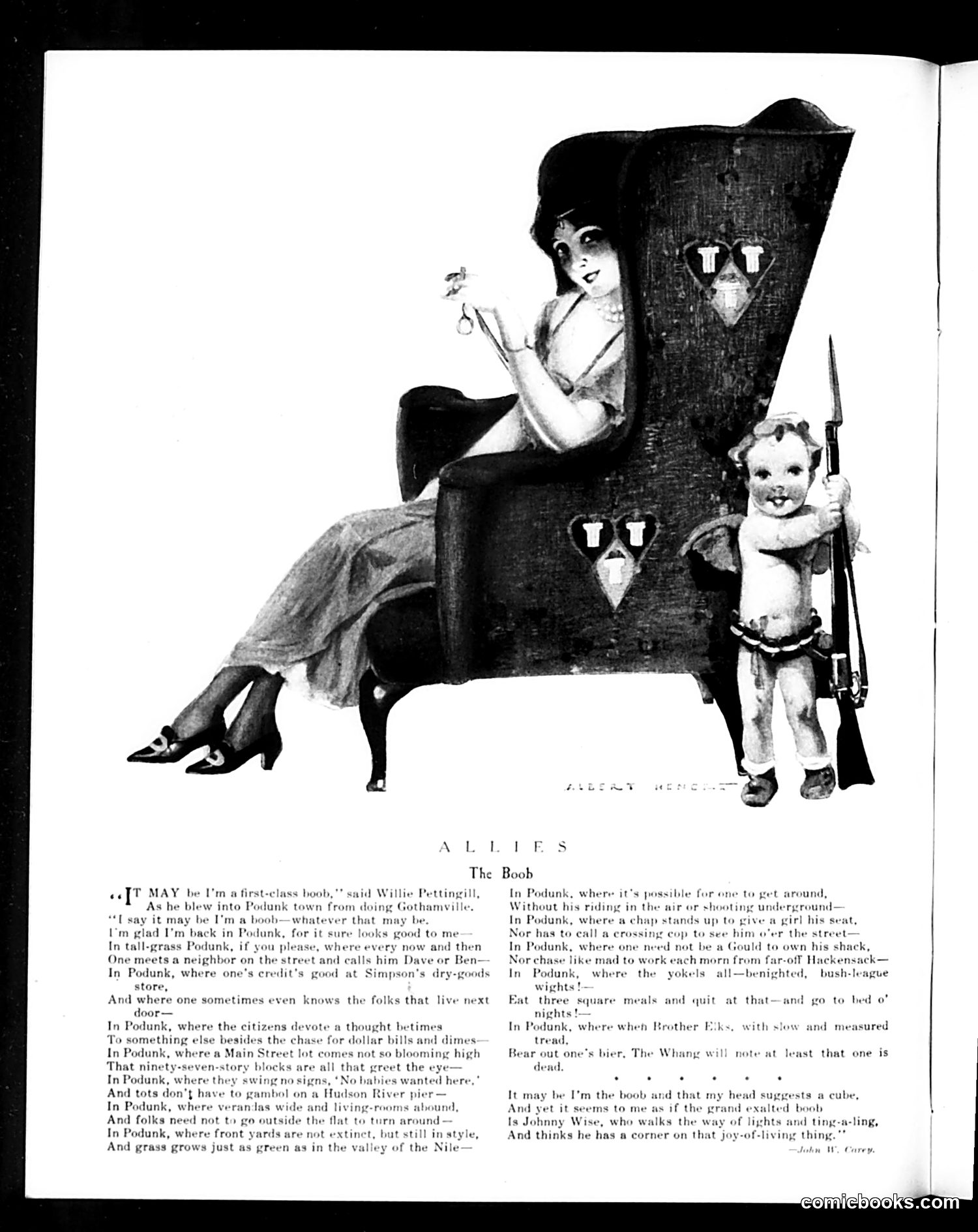
This satirical piece contrasts small-town American values ("Podunk") with urban sophistication. The illustration shows a fashionable woman lounging in an oversized chair decorated with skull-and-crossbones symbols, accompanied by a cherub holding a rifle—imagery suggesting danger and decadence. The poem, attributed to John H. Coxe, defends small-town simplicity against urban pretension. The narrator, called "the boob," celebrates Podunk's honest virtues: people know their neighbors, credit is trusted, life moves at a natural pace, and honest labor suffices. He satirizes "Johnny Wise"—the sophisticated urbanite who thinks he's found enlightenment ("the way of lights") but is actually the real fool. The satire targets turn-of-the-century American anxieties about urbanization: the corruption of city life, loss of community, and the false superiority of cosmopolitan attitudes. The "boob" ironically proves wiser than those who dismiss rural values.
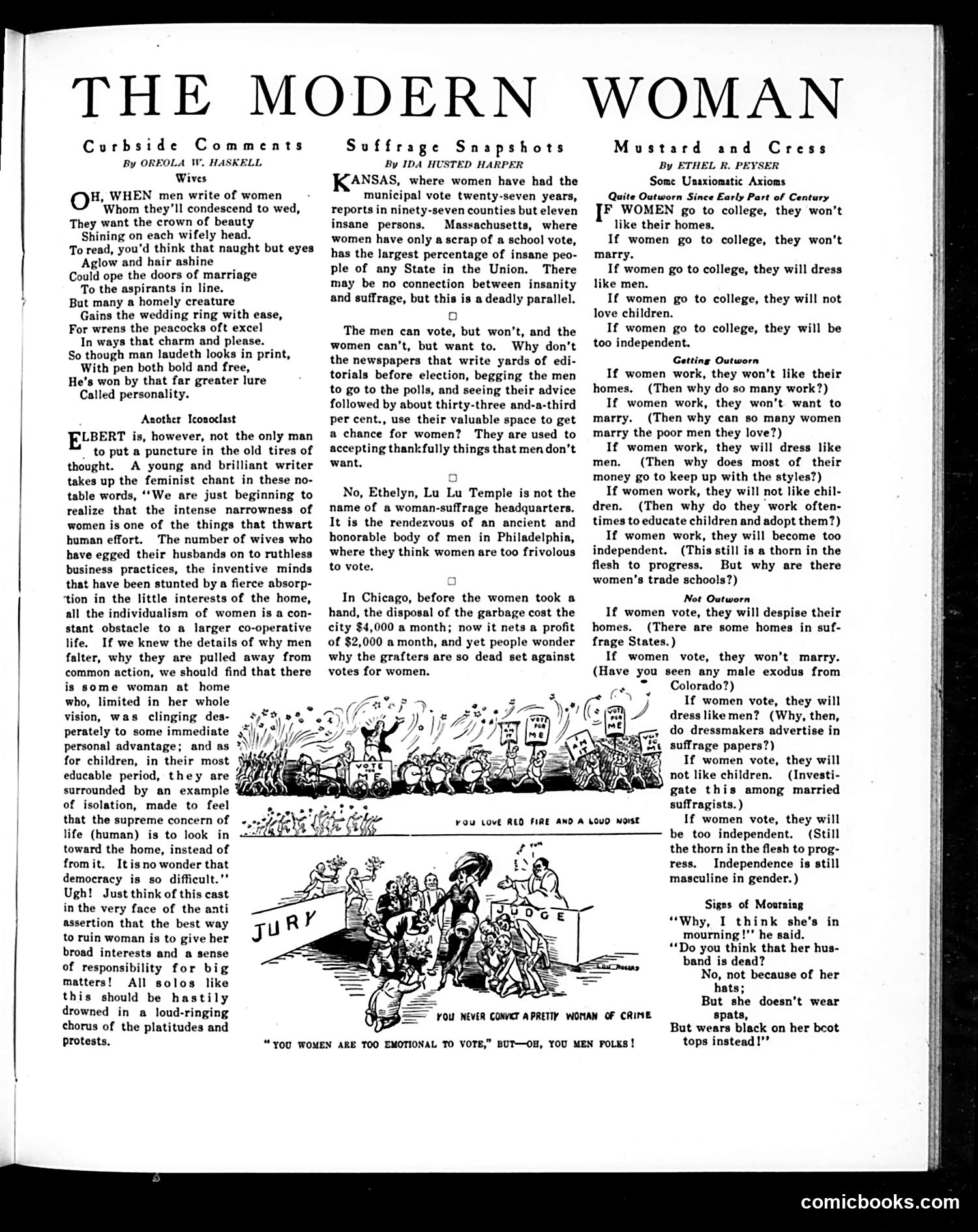
This *Judge* magazine page satirizes opponents of women's suffrage through three columns. **Left column**: defends women's value beyond physical appearance, arguing "personality" matters more than beauty in marriage. **Center column** (by Ida Husted Harper): presents pro-suffrage data—Kansas women voted 27 years with low insanity rates versus Massachusetts without suffrage but high rates. It mocks male voters' inconsistency: men who won't vote are urged by newspapers, yet those same papers won't encourage women's voting. **Right column** (by Ethel R. Peyser): uses ironic "axioms" listing anti-suffrage claims—that college-educated women won't marry, will dress like men, won't love children, become too independent. The format exposes these predictions as absurd contradictions and outdated fears. The cartoons below show suffragists as loud/chaotic and women as criminals—visual anti-suffrage propaganda the text implicitly mocks. The page collectively argues: suffrage opponents rely on emotional fearmongering and logical inconsistencies rather than evidence.
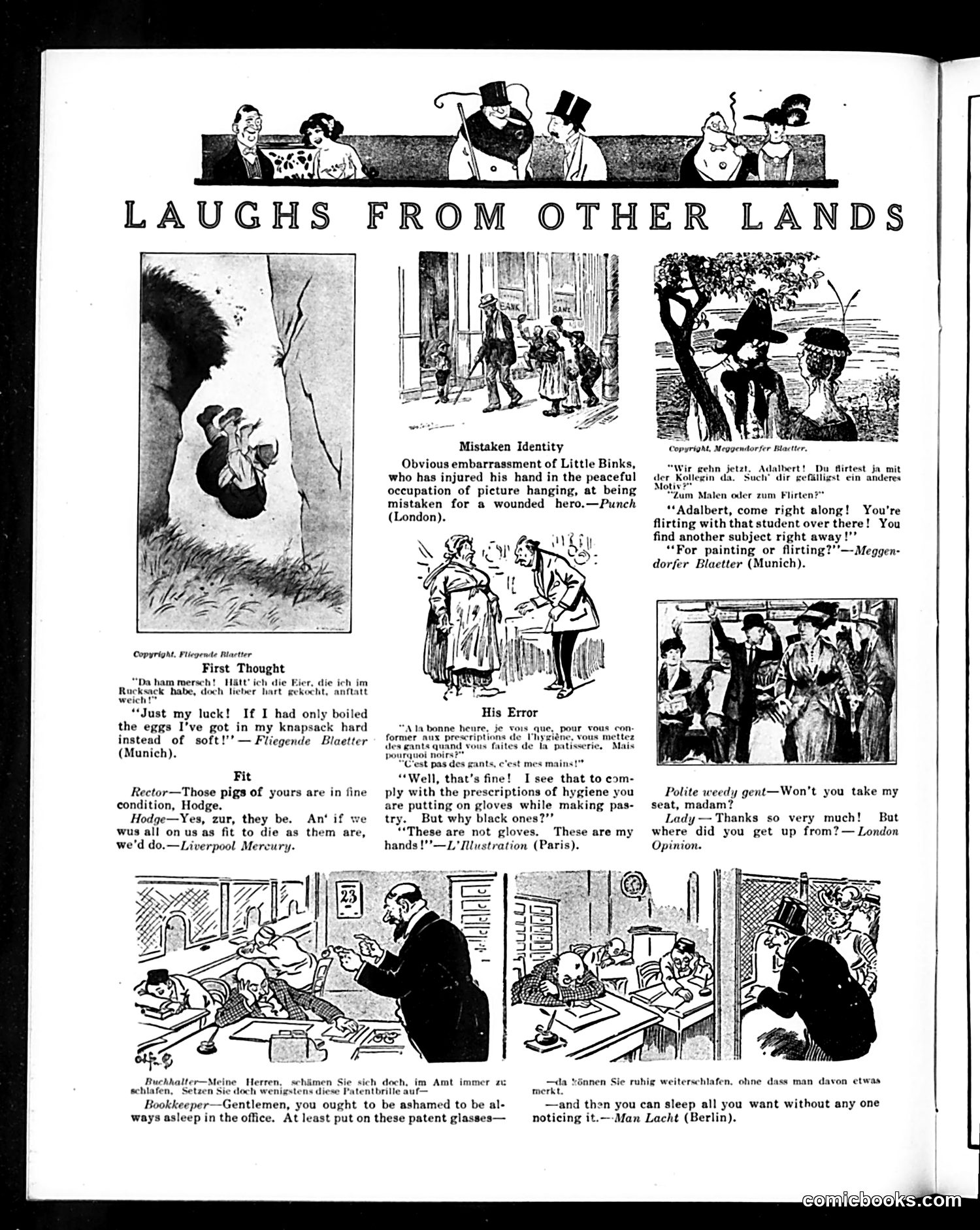
This page collects humorous cartoons and jokes translated from European publications (German, French, British). The humor relies on cultural observation and mild social satire rather than political commentary. **Key jokes include:** - **"Mistaken Identity"**: A man injured hanging pictures is mistaken for a war hero—satirizing public eagerness to celebrate soldiers. - **"His Error"**: A doctor scolds a pastry chef for wearing black gloves, but they're actually the chef's blackened hands—absurdist humor about hygiene prescriptions. - **"Bookkeeper"**: An office manager suggests "patent glasses" to keep sleepy employees awake at work—mocking both office tedium and dubious patent remedies (common in this era). - **Various domestic vignettes**: Including flirtation, courtship etiquette, and spousal behavior. The page exemplifies *Judge*'s practice of reprinting international humor, showcasing how different cultures found comedy in everyday social situations, workplace dynamics, and marital mishaps.
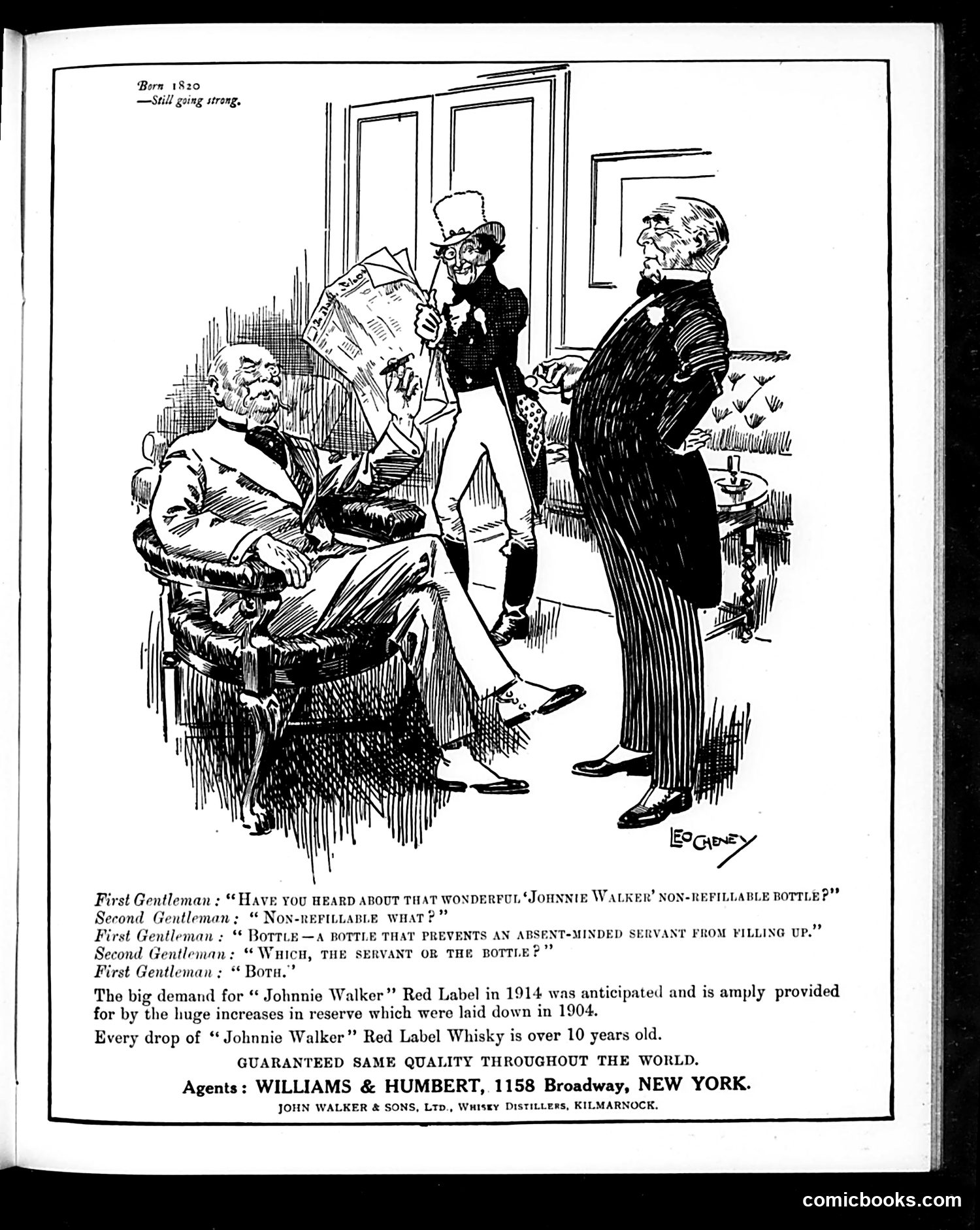
This is a **Johnnie Walker Whisky advertisement disguised as humorous editorial content** in Judge magazine (circa 1914). **The "Joke":** Three gentlemen discuss a fictional "non-refillable bottle" designed to prevent servants from secretly refilling themselves drinks. The humor plays on the punchline: when asked which gets filled—servant or bottle—the answer is "both," suggesting servants are habitual drinkers. **The Satire:** This gently mocks the widespread assumption that working-class servants were prone to pilfering alcohol from their employers' supplies—a common concern among wealthy households of the era. **The Advertisement:** The bulk of the page is actually promotional copy touting Johnnie Walker's quality, claiming the whisky "born 1820" has been aged over 10 years and that 1904 reserves were stockpiled to meet anticipated 1914 demand. **Historical Context:** This reflects early 20th-century class attitudes and servant-management anxieties, while presenting the product as premium and reliable. The ad cleverly uses humor to embed marketing messaging in what appears to be editorial cartoon content.
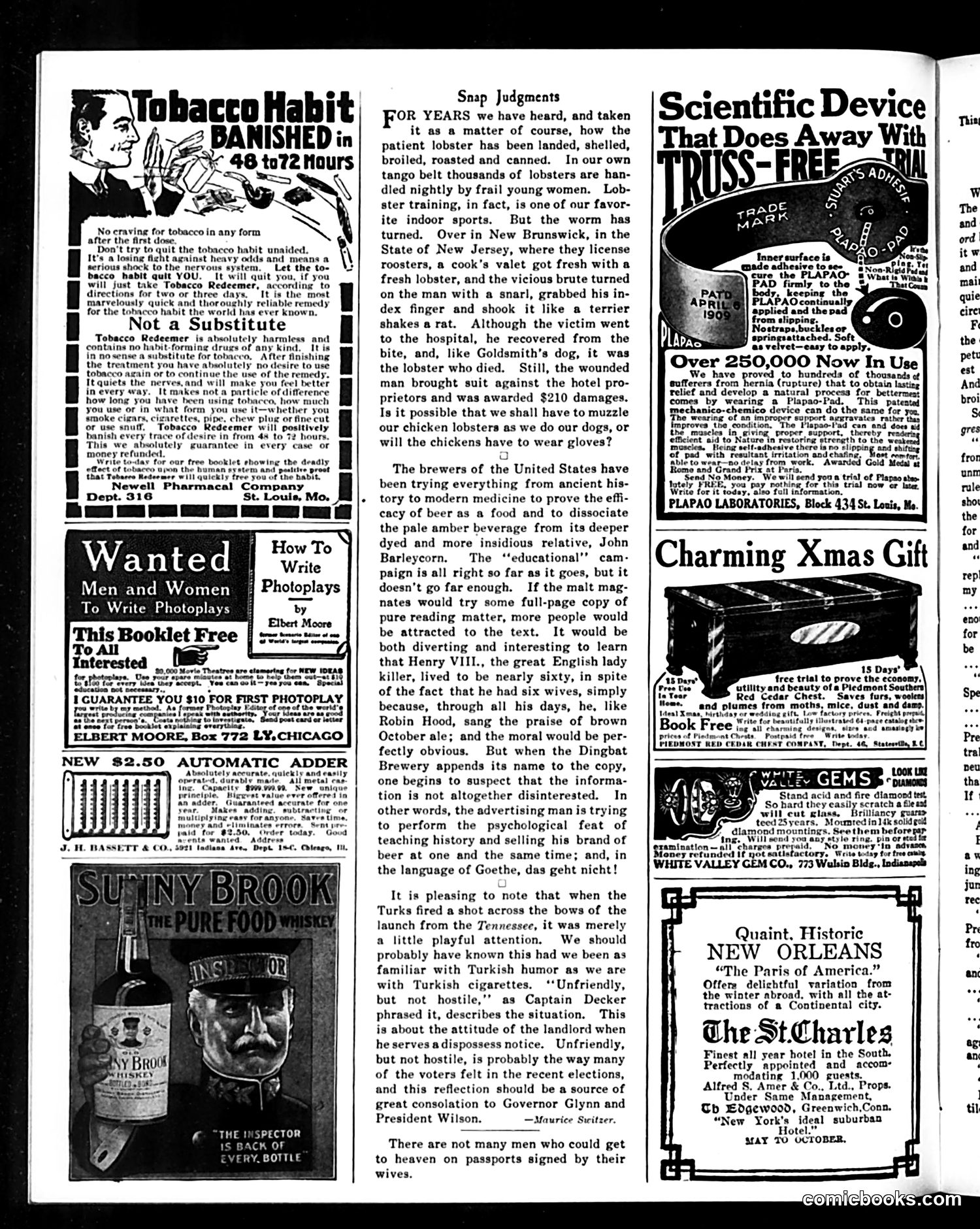
This page combines advertisements with satirical commentary ("Snap Judgments"). The main cartoon/satirical content includes: **"Snap Judgments" section:** Social commentary pieces mocking American institutions and advertising. One notable item describes a lobster lawsuit in New Jersey—a cook was bitten by a lobster and sued for damages, prompting the writer to humorously question whether lobsters should now be muzzled like dogs. Another item satirizes beer breweries' attempts to legitimize beer as a "food" by mixing advertising with historical "education" (citing Henry VIII). The writer mocks this strategy as transparent manipulation—the brewery name attached to historical content undermines credibility. A final note jokes about Turkish-American relations, referencing a Turkish shot fired at the USS Tennessee, treating it as mere "playful attention." **The advertisements** promote dubious patent medicines and services typical of the era: tobacco-cessation pills, photoplay writing courses, and an "automatic adder" device. The page reflects early 20th-century American skepticism toward corporate advertising while also showcasing period prejudices and the magazine's satirical voice.
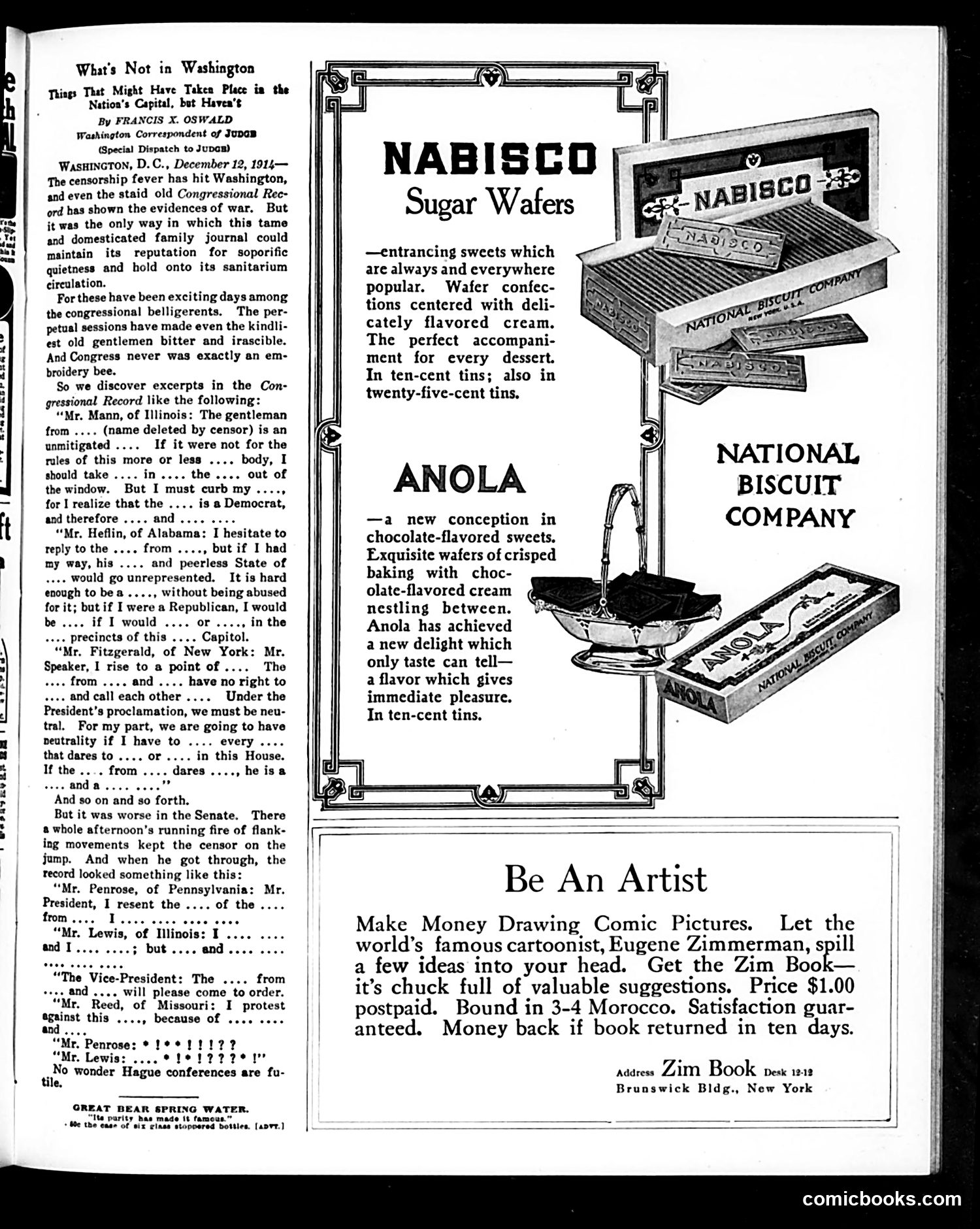
This satirical piece by Francis X. Oswald mocks Congressional censorship during World War I (dated December 1914). The joke: congressmen's heated partisan debates are so bitter and profane that the *Congressional Record*—normally a dry, sanitized official document—requires heavy censorship to maintain decorum. The humor comes from reproducing fake Congressional exchanges filled entirely with redacted passages (dots and blanks), suggesting the original text was too inflammatory or insulting to print. Named figures like Mann (Illinois), Heflin (Alabama), Fitzgerald (New York), Penrose (Pennsylvania), Lewis (Illinois), and Reed (Missouri) are real congressmen depicted as so acrimonious they can barely speak without violating neutrality or basic civility. The satire critiques both Congressional dysfunction and wartime censorship—implying that American politicians are so divided they need censoring like wartime propaganda. The page also contains unrelated period advertisements (Nabisco wafers, art instruction).
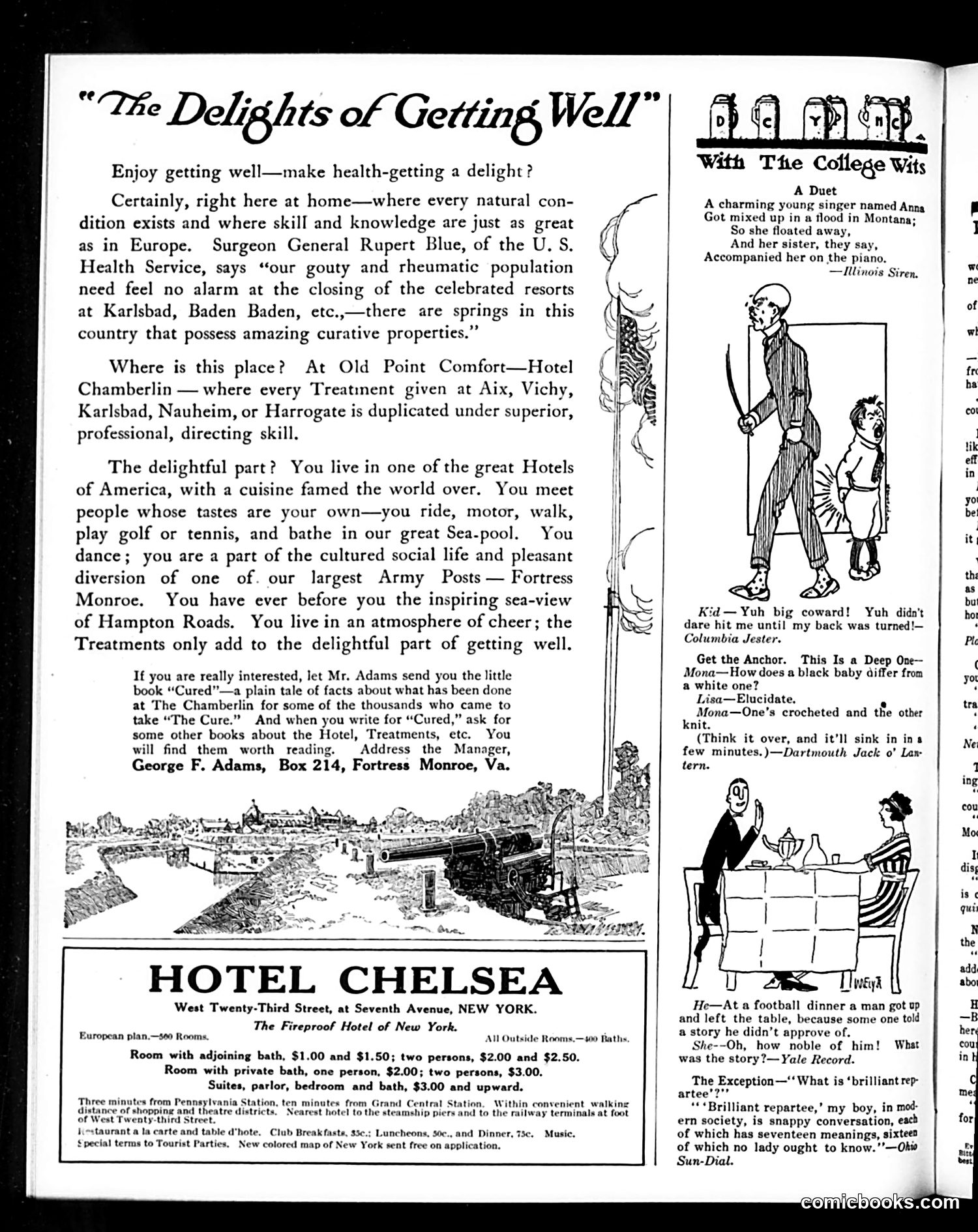
This Judge magazine page mixes advertising with humor columns typical of early 20th-century satirical publications. **Main Content:** The left side advertises Old Point Comfort's Hotel Chamberlin as a domestic alternative to European spa towns (Karlsbad, Baden-Baden), claiming American mineral springs offer equal curative properties. It targets wealthy invalids seeking health treatments without trans-Atlantic travel. **"College Wits" Humor Section (right):** This column contains brief jokes and riddles, mostly nonsensical or pun-based wordplay aimed at college-age readers: - A girl named Anna floods in Montana (crude rhyme humor) - A "deep one" riddle about differences between Black and white babies (reflects period racial stereotypes without clear punchline) - Football dinner anecdote about disapproved stories - Definition joke about "brilliant repartee" **The Cartoons:** Small illustrations accompany the jokes—a man with a child, a couple at dinner—depicting the scenarios humorously. The page reflects Judge's blend of upscale advertising and light collegiate humor, with casual racism typical of the era.
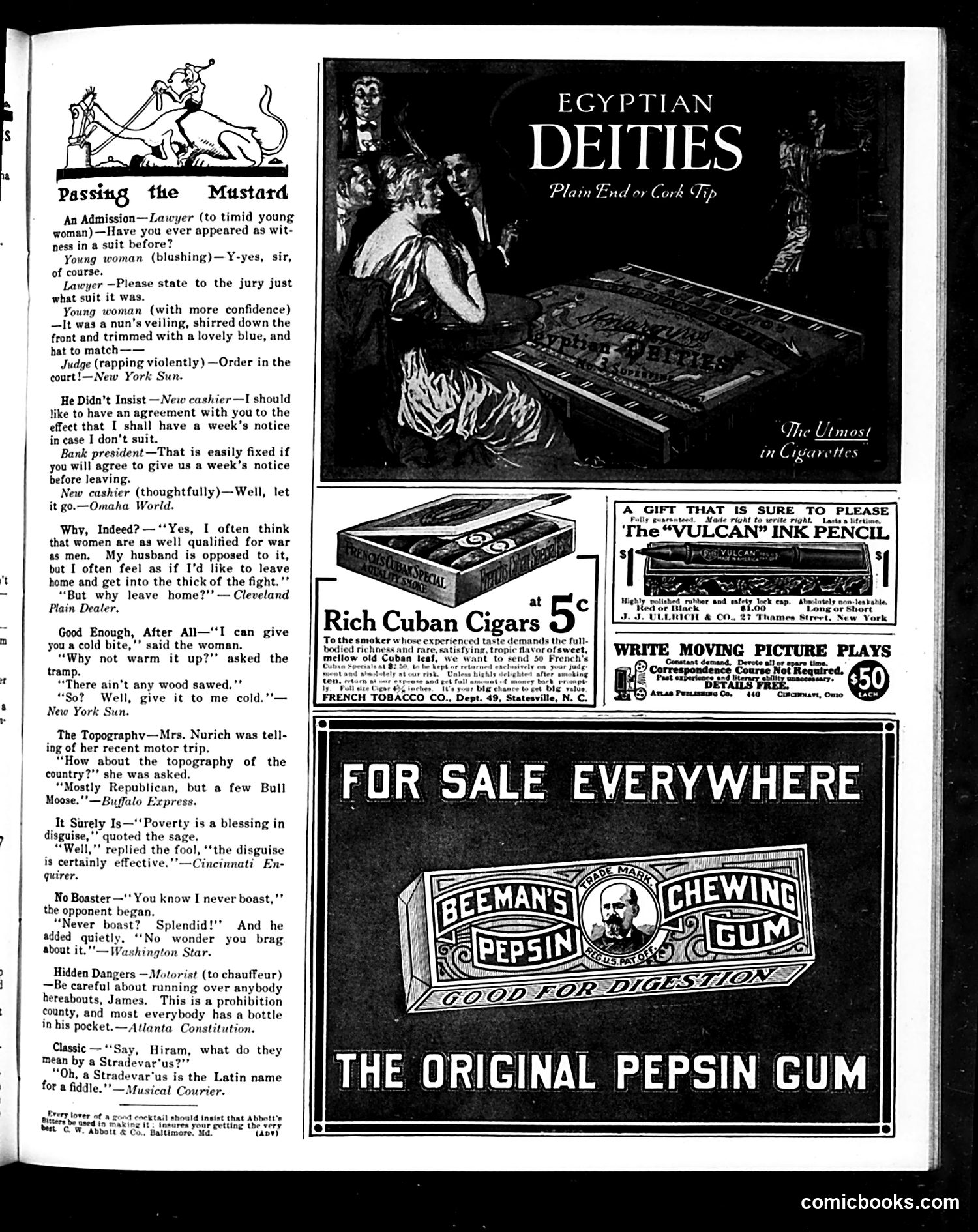
This page is primarily **advertising and humor columns** rather than political cartoons. The content includes: **Humor Sections**: Multiple short jokes republished from newspapers (New York Sun, Omaha World, Cleveland Plain Dealer, etc.) on topics like courtroom mishaps, employment negotiations, and domestic life. These reflect early 20th-century social attitudes—notably one joke mocking women's war ambitions. **One Topical Reference**: A joke mentioning "Bull Moose," likely referencing Theodore Roosevelt's 1912 Progressive Party split, suggests this page dates around that era. **Advertisements**: The bulk of the page features product ads (Egyptian Deities cigarettes, Rich Cuban Cigars, Beeman's Pepsin Gum, Vulcan ink pencils, and moving picture play courses). These are typical Judge magazine revenue. **No clear political satire** targeting specific figures is visible. The page functions as entertainment and commercial space rather than as political commentary. The humor reflects period gender roles and class attitudes rather than advocating positions.
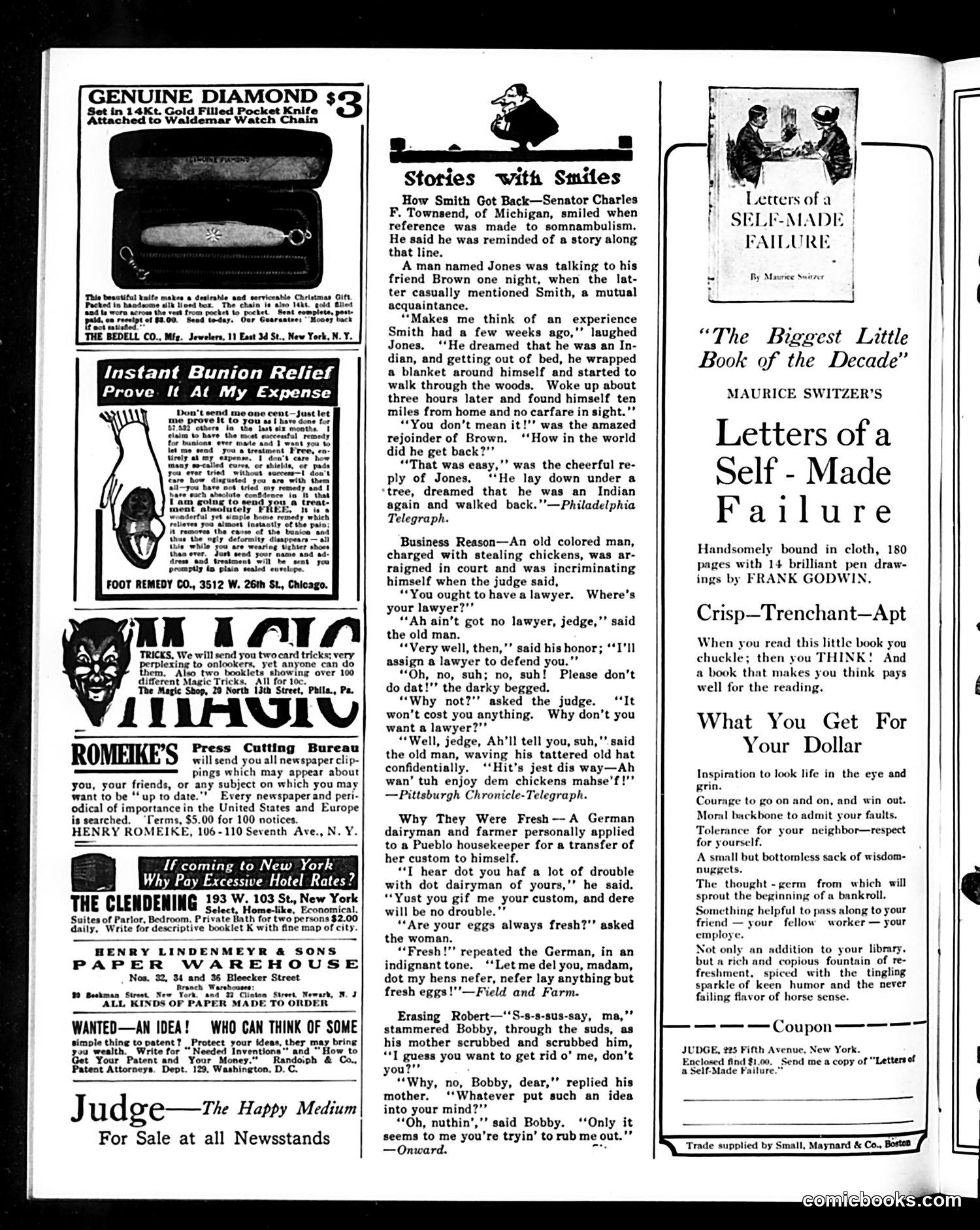
This page is primarily **advertising and humorous anecdotes**, not political satire. The main content consists of: **"Stories with Smiles"** — three brief jokes reflecting early-20th-century humor conventions: 1. A story about a man who sleepwalked as an Indian — humor based on absurdist logic 2. A racist dialect joke featuring a Black defendant claiming he wants to keep the stolen chickens rather than hire a lawyer — reflecting the casual racism common in period publications 3. An incomplete anecdote about a German dairyman The page is dominated by **advertisements** for consumer goods (diamond knife, bunion relief, magic tricks, hotels, newspapers clipping services) and services typical of the era. There are no identifiable political cartoons or figures. The "Magic Tricks" advertisement features a demon/devil illustration but purely for commercial purposes. The humor reflects early-1900s sensibilities: slapstick logic, ethnic stereotypes, and wordplay — not political commentary.
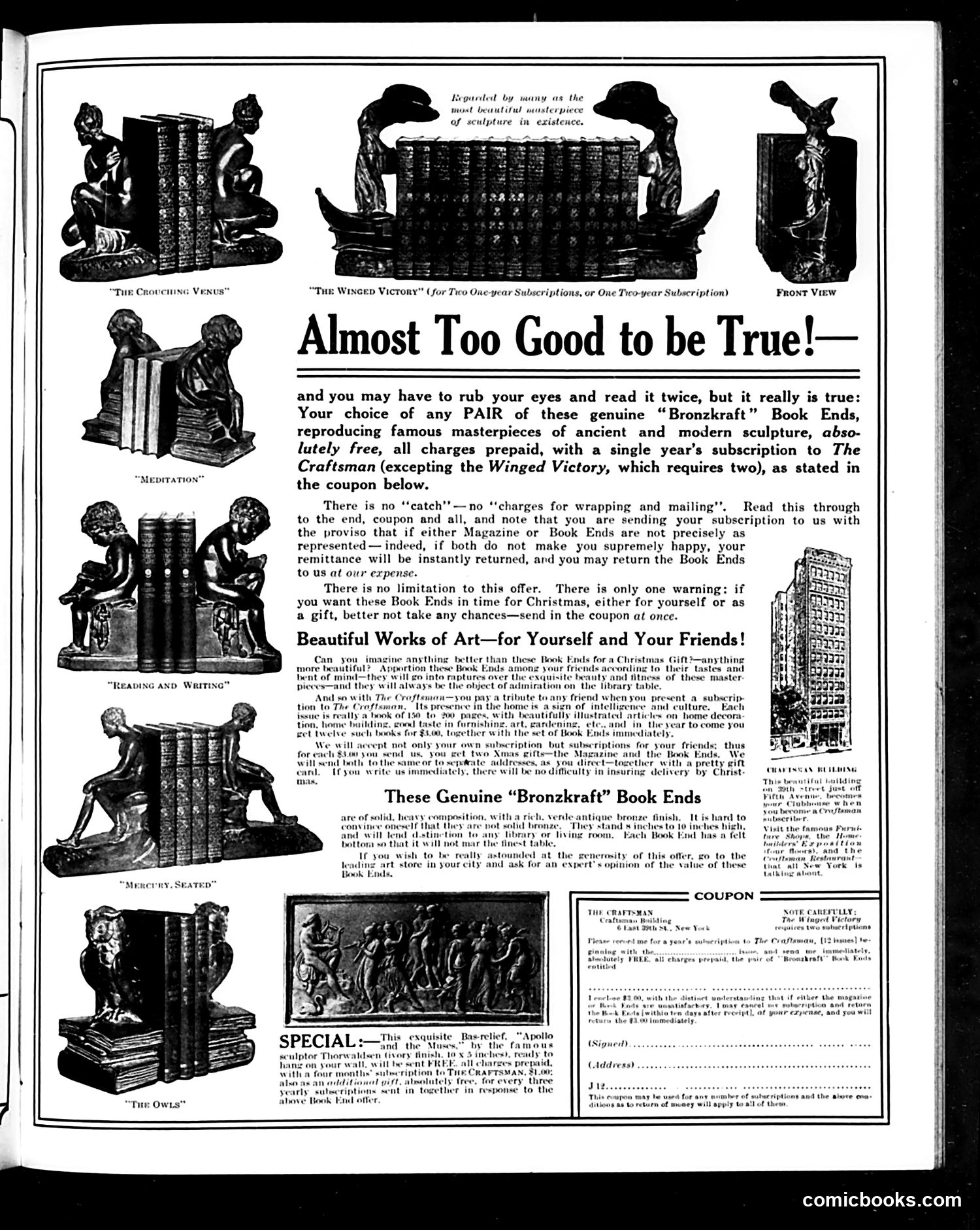
This is primarily a **product advertisement**, not a political cartoon. It promotes "Bronzkraft" book ends—decorative sculptures reproducing famous classical artworks like "The Winged Victory" and "The Crouching Venus"—offered as free premiums with subscriptions to *The Craftsman* magazine. The appeal targets early 20th-century middle-class consumers seeking cultural refinement. The phrase "Almost Too Good to be True!" uses faux-surprise marketing ("rub your eyes") to overcome reader skepticism about such a generous offer. The copy emphasizes quality, honesty ("no 'catch'"), and aesthetic value—positioning these bronze-finished book ends as affordable "Beautiful Works of Art." The coupon at bottom confirms this is a straightforward subscription drive. The satirical *Judge* magazine simply provided advertising space, likely for revenue. There is **no political satire or social commentary** visible on this page—it's commercial promotion dressed in period marketing language.
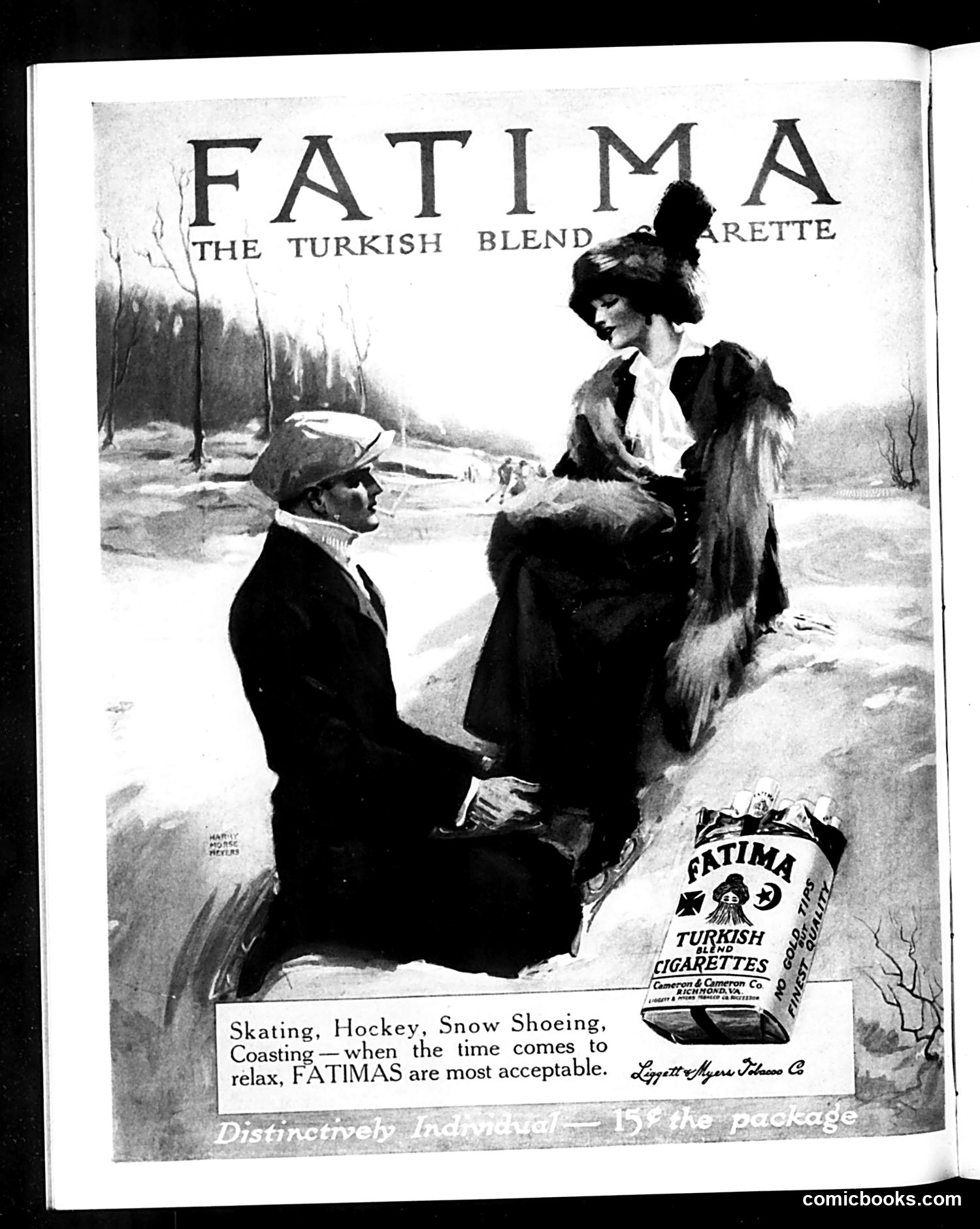
This is a **cigarette advertisement**, not political satire. It advertises Fatima Turkish Blend cigarettes (made by Cameron & Cameron Co., Richmond, Virginia). The ad depicts two elegantly dressed figures in winter clothing in a snowy landscape. The copy suggests that after active winter sports like skating and hockey, relaxing with a Fatima cigarette is "most acceptable." The phrase "Turkish blend" references the cigarette's flavor profile—a marketing approach popular in early 20th-century tobacco advertising that emphasized exotic or premium tobacco sources. The "distinctively individual" tagline at the bottom emphasizes the product's unique character. This represents typical period advertising that associated smoking with leisure, sophistication, and social respectability—before modern health warnings existed.