
Judge, 1914-12-12 · page 8 of 24
Judge — December 12, 1914 — page 8: what you’re looking at
What you’re looking at
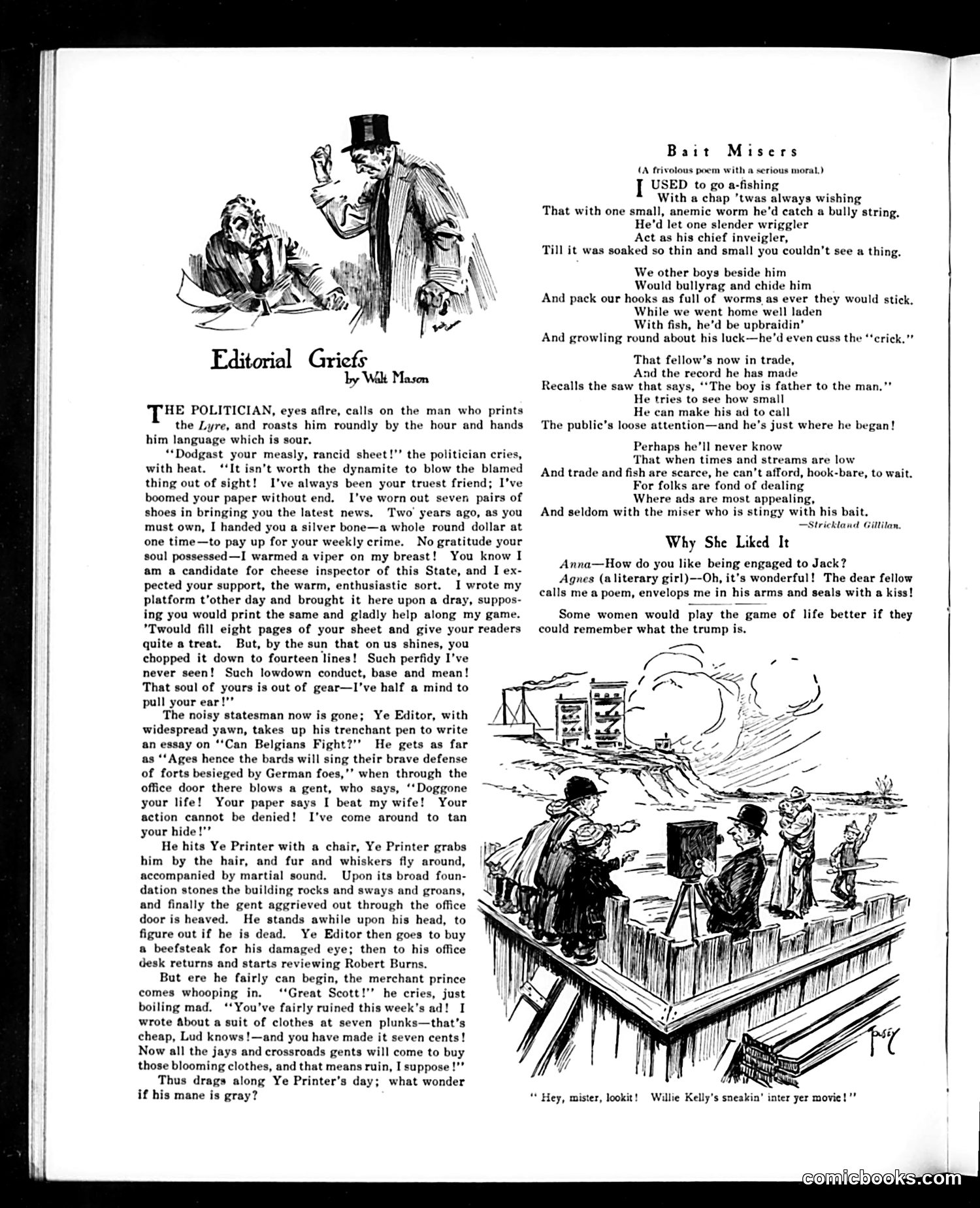
**"Editorial Griefs" by Walt Mason** satirizes newspaper editors' impossible position in early 20th-century America. An angry politician demands free advertising space, threatening the editor after his platform receives inadequate coverage. The editor is then attacked by an irate citizen claiming the paper falsely reported he beat his wife, followed by a merchant furious that a typographical error (changing "seven plunks" to "seven cents") will destroy his clothing business by attracting too many bargain-hunters. The cartoon illustrates how editors face constant abuse from politicians, angry readers, and advertisers—hence the editor's graying hair. **"Bait Misers"** is a morality poem contrasting two boys fishing: one stingy with worms (using one tiny, overused worm), the other generous (using many full worms). The poem argues this childhood trait predicts adult behavior—the stingy boy becomes a businessman who runs minimal advertisements, failing to understand that advertising investment attracts customers and profits, just as generous bait attracts fish.
📄 Transcribed text from this page (OCR, searchable)
Machine-transcribed from the original scan — historical spelling and the odd misread are preserved.
Editorial Griets by Wak Mason HE POLITICIAN, eyes aflre, calls on the man who prints the Lyre, and roasts him roundly by the hour and hands him language which is sour. ‘‘Dodgast your measly, rancid sheet!"’ the politician cries, with heat. ‘‘It isn’t worth the dynamite to blow the blamed thing out of sight! I've always been your truest friend; I’ve boomed your paper without end. I’ve worn out seven pairs of shoes in bringing you the latest news. Two’ years ago, as you must own, I handed you a silver bone—a whole round dollar at one time—to pay up for your weekly crime. No gratitude your soul possessed—I warmed a viper on my breast! You know I am a candidate for cheese inspector of this State, and I ex- pected your support, the warm, enthusiastic sort. I wrote my platform t’other day and brought it here upon a dray, suppos- ing you would print the same and gladly help along my game. ’Twould fill eight pages of your sheet and give your readers quite a treat. But, by the sun that on us shines, you chopped it down to fourteen lines! Such perfidy I’ve never seen! Such lowdown conduct, base and mean! That soul of yours is out of gear—I've half a mind to pull your ear!"’ The noisy statesman now is gone; Ye Editor, with widespread yawn, takes up his trenchant pen to write an essay on ‘‘Can Belgians Fight?"’ He gets as far as ‘‘Ages hence the bards will sing their brave defense of forts besieged by German foes,’’ when through the office door there blows a gent, who says, ‘Doggone your life! Your paper says I beat my wife! Your action cannot be denied! I've come around to tan your hide !’” He hits Ye Printer with a chair, Ye Printer grabs him by the hair, and fur and whiskers fly around, accompanied by martial sound. Upon its broad foun- dation stones the building rocks and sways and groans, and finally the gent aggrieved out through the office door is heaved. He stands awhile upon his head, to figure out if he is dead. Ye Editor then goes to buy a beefsteak for his damaged eye; then to his office desk returns and starts reviewing Robert Burns. But ere he fairly can begin, the merchant prince comes whooping in. ‘‘Great Scott!’ he cries, just boiling mad. ‘*You’ve fairly ruined this week's ad! I wrote About a suit of clothes at seven plunks—that’s cheap, Lud knows !—and you have made it seven cents! Now all the jays and crossroads gents will come to buy those blooming clothes, and that means ruin, I suppose !"" Thus drags along Ye Printer’s day; what wonder if his mane is gray? “ Hey, mister, lookit! Bait Misers (A frivolous poem with a serious moral.) [ USED to go a-fishing With a chap ’twas always wishing That with one small, anemic worm he'd catch a bully string. He'd let one slender wriggler Act as his chief inveigler, Till it was soaked so thin and small you couldn't see a thing. We other boys beside him Would bullyrag and chide And pack our hooks as full of worms as ever they would stick. While we went home well laden With fish, he’d be upbraidin’ And growling round about his luck—he’d even cuss the “‘crick.”” That fellow’s now in trade, And the record he has made Recalls the saw that says, ‘‘The boy is father to the man."" He tries to see how small He can make his ad to call The public’s loose attention—and he's just where he began! Perhaps he’ll never know That when times and streams are low And trade and fish are scarce, he can’t afford, hook-bare, to wait. For folks are fond of dealing Where ads are most appealing, And seldom with the miser who is stingy with his bait. Strickland Gillilan. Why She Liked It Anna—How do you like being engaged to Jack? Agnes (aliterary girl)--Oh, it’s wonderful! The dear fellow calls me a poem, envelops me in his arms and seals with a kiss! Some women would play the game of life better if they could remember what the trump is. Willie Kelly's sneakin’ inter yer movie!"