
Judge, 1914-12-12 · page 4 of 24
Judge — December 12, 1914 — page 4: what you’re looking at
What you’re looking at
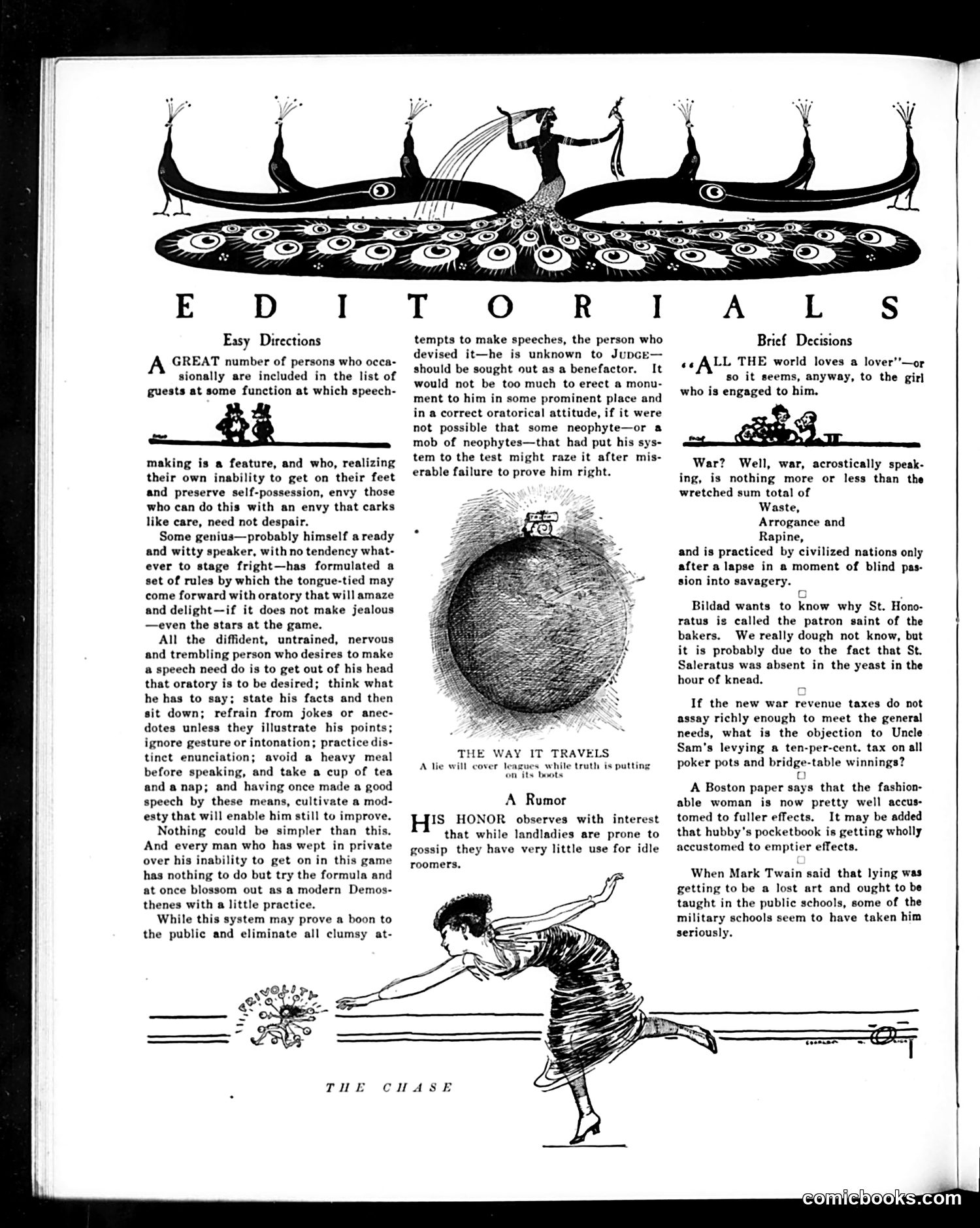
This page contains three satirical pieces typical of Judge's format: **"Easy Directions"** offers tongue-in-cheek advice for making public speeches, mocking nervous speakers who memorize rules but still flounder—suggesting even formula-based approaches can't save a clumsy orator. **"The Way It Travels"** (accompanying illustration) appears to be a visual pun about gossip spreading, though the exact reference is unclear. **"A Rumor"** satirizes society gossip, particularly women's tendency toward idle chatter, suggesting fashionable women are especially prone to empty conversation. **"The Chase"** (illustration) shows a woman in pursuit, likely satirizing modern women's increasing independence or changing social roles—a common Judge theme of this era. The page's overall tone mocks social pretension, gender stereotypes, and public behavior typical of early 20th-century American satire.
📄 Transcribed text from this page (OCR, searchable)
Machine-transcribed from the original scan — historical spelling and the odd misread are preserved.
Easy Directions GREAT number of persons who occa- sionally are included in the list of guests at some function at which speech- - $$ making is a feature, and who, realizing their own inability to get on their feet and preserve self-possession, envy those who can do this with an envy that carks like care, need not despair. Some genius—probably himself a ready and witty speaker, with no tendency what- ever to stage fright—has formulated a set of rules by which the tongue-tied may come forward with oratory that will amaze and delight—if it does not make jealous —even the stars at the game. All the diffident, untrained, nervous and trembling person who desires to make a speech need do is to get out of his head that oratory is to be desired; think what he has to say; state his facts and then sit down; refrain from jokes or anec- dotes unless they illustrate his points; ignore gesture or intonation; practice dis- tinct enunciation; avoid a heavy meal before speaking, and take a cup of tea and a nap; and having once made a good speech by these means, cultivate a mod- esty that will enable him still to improve. Nothing could be simpler than this. And every man who has wept in private over his inability to get on in this game has nothing to do but try the formula and at once blossom out as a modern Demos- thenes with a little practice. While this system may prove a boon to the public and eliminate all clumsy at- THE CHASE tempts to make speeches, the person who devised it—he is unknown to Jupce— should be sought out as a benefactor. It would not be too much to erect a monu- ment to him in some prominent place and in a correct oratorical attitude, if it were not possible that some neophyte—or a mob of neophytes—that had put his sys- tem to the test might raze it after mis- erable failure to prove him right. THE WAY IT TRAVELS A lie will cover leagues white truth is putting ‘on its boots A Rumor H's HONOR observes with interest that while landladies are prone to gossip they have very little use for idle roomers. Brief Decisions oe ALL THE world loves a lover’’—or so it seems, anyway, to the girl who is engaged to him. a eS War? Well, war, acrostically speak- ing, is nothing more or less than the wretched sum total of Waste, Arrogance and Rapine, and is practiced by civilized nations only after a lapse in a moment of blind pas- sion into savagery. c Bildad wants to know why St. Hono- ratus is called the patron saint of the bakers. We really dough not know, but it is probably due to the fact that St. Saleratus was absent in the yeast in the hour of knead. If the new war revenue taxes do not assay richly enough to meet the general needs, what is the objection to Uncle Sam's levying a ten-per-cent. tax on all poker pots and bridge-table winnings? As A Boston paper says that the fashion- able woman is now pretty well accus- tomed to fuller effects. It may be added that hubby's pocketbook is getting wholly accustomed to emptier effects. When Mark Twain said that lying was getting to be a lost art and ought to be taught in the public schools, some of the military schools seem to have taken him seriously.