
Judge, 1914-12-12 · page 10 of 24
Judge — December 12, 1914 — page 10: what you’re looking at
What you’re looking at
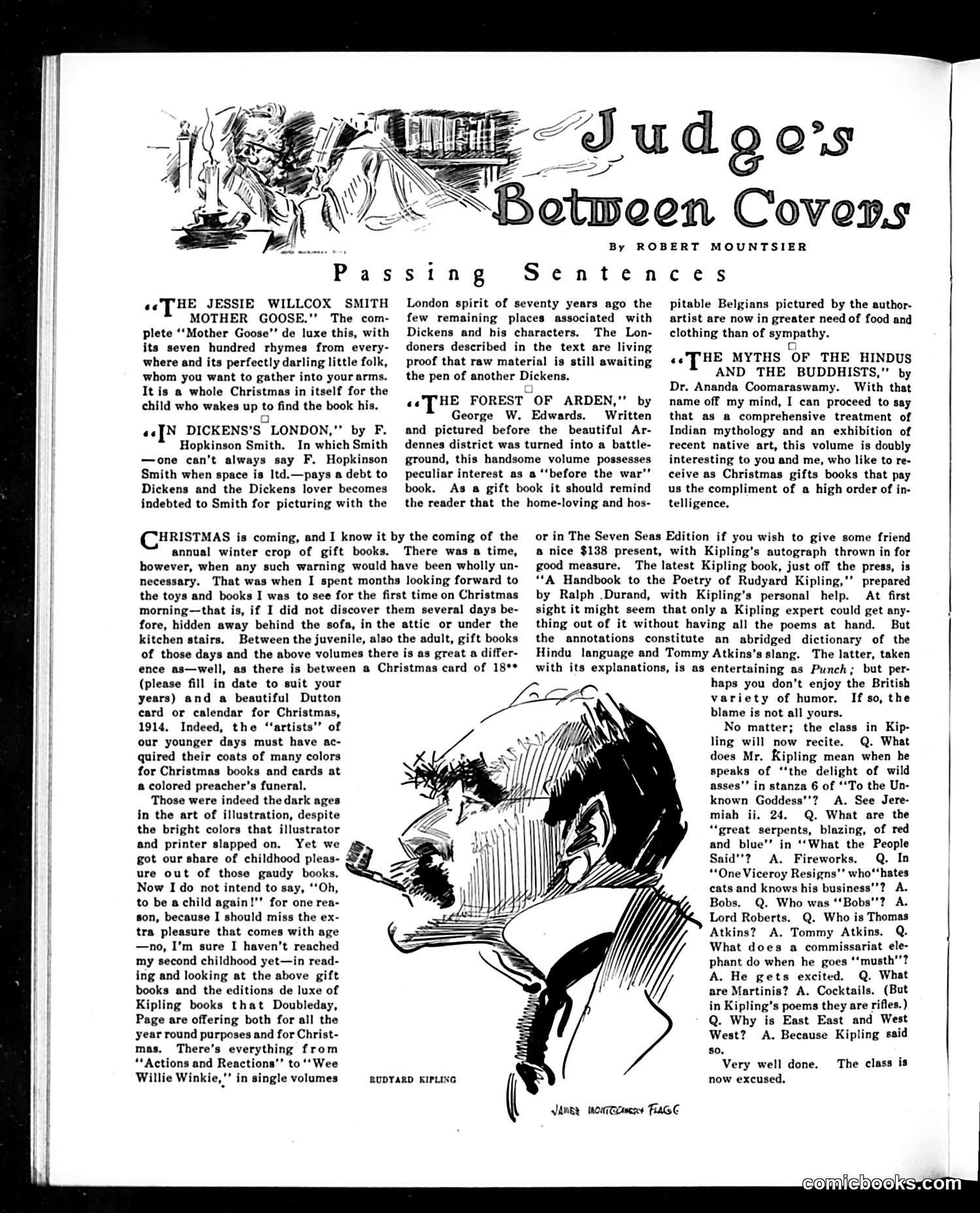
This is primarily a **book review column** titled "Judo's Between Covers" by Robert Mountsier, not a political cartoon page. The single illustration shows **Rudyard Kipling**, identified by the caption. The page reviews Christmas gift books, including illustrated editions of *Mother Goose* and *Dickens's London*. One review notably mentions *The Forest of Arden*—a pre-World War I illustrated book of Belgium—observing that "the home-loving and hospitable Belgians pictured by the author-artist are now in greater need of food and clothing than of sympathy." This **wartime reference** reflects WWI's ongoing humanitarian crisis in Belgium (the article appears to be from around 1914-1915). The Kipling illustration and discussion of his work as a gift option reflects his popularity as a contemporary author. The nostalgic opening contrasts modern deluxe book editions with simpler childhood Christmas gifts, establishing that this is consumer-focused holiday content for Judge's educated, affluent readership.
📄 Transcribed text from this page (OCR, searchable)
Machine-transcribed from the original scan — historical spelling and the odd misread are preserved.
ee THE JESSIE WILLCOX SMITH MOTHER GOOSE."’ The com- plete ‘‘Mother Goose’’ de luxe this, with its seven hundred rhymes from every- where and its perfectly darling little folk, whom you want to gather into yourarms. It is a whole Christmas in itself for the child who wakes up to find the book his. s) esJN DICKENS’S LONDON,” by F. Hopkinson Smith. In which Smith —one can’t always say F. Hopkinson Smith when space is Itd.—pays a debt to Dickens and the Dickens lover becomes indebted to Smith for picturing with the Passing B< Jud Q 0% Between Covers By ROBERT MOUNTSIER London spirit of seventy years ago the few remaining places associated with Dickens and his characters. The Lon- doners described in the text are living proof that raw material is still awaiting the pen of another Dickens. ee THE FOREST OF ARDEN,’’ by George W. Edwards. Written and pictured before the beautiful Ar- dennes district was turned into a battle- ground, this handsome volume possesses peculiar interest as a ‘‘before the war’’ book. As a gift book it should remind the reader that the home-loving and hos- Sentences pitable Belgians pictured by the author- artist are now in greater need of food and clothing than of sympathy. rs ee THE MYTHS OF THE HINDUS AND THE BUDDHISTS,” by Dr. Ananda Coomaraswamy. With that name off my mind, I can proceed to say that as a comprehensive treatment of Indian mythology and an exhibition of recent native art, this volume is doubly interesting to you and me, who like to re- ceive as Christmas gifts books that pay us the compliment of a high order of in- telligence. (CHRISTMAS is coming, and I know it by the coming of the annual winter crop of gift books. There was a time, however, when any such warning would have been wholly un- necessary. That was when I spent months looking forward to the toys and books I was to see for the first time on Christmas morning—that is, if I did not discover them several days be- fore, hidden away behind the sofa, in the attic or under the kitchen stairs. Between the juvenile, also the adult, gift books of those days and the above volumes there is as great a differ- ence as—well, as there is between a Christmas card of 18** or in The Seven Seas Edition if you wish to give some friend a nice $138 present, with Kipling’s autograph thrown in for good measure. The latest Kipling book, just off the press, is “*A Handbook to the Poetry of Rudyard Kipling,’’ prepared by Ralph .Durand, with Kipling’s personal help. At first sight it might seem that only a Kipling expert could get any- thing out of it without having all the poems at hand. But the annotations constitute an abridged dictionary of the Hindu language and Tommy Atkins’s slang. The latter, taken with its explanations, is as entertaining as Punch; but per- (please fill in date to suit your years) and a beautiful Dutton card or calendar for Christmas, 1914. Indeed, the “‘artists’’ of our younger days must have ac- quired their coats of many colors for Christmas books and cards at a colored preacher's funeral. Those were indeed the dark ages in the art of illustration, despite the bright colors that illustrator and printer slapped on. Yet we got our share of childhood pleas- ure out of those gaudy books, Now I do not intend to say, ‘‘Oh, to be achild again!’’ for one rea- son, because I should miss the ex- tra pleasure that comes with age —no, I’m sure I haven't reached my second childhood yet—in read- ing and looking at the above gift books and the editions de luxe of Kipling books that Doubleday, Page are offering both for all the year round purposes and for Christ- mas. There’s everything from “*Actions and Reactions’’ to ‘‘Wee Willie Winkie,”’ in single volumes RUDYARD KIPLING dng MOWTeLiERt FAG haps you don’t enjoy the British variety of humor. If so, the blame is not all yours. No matter; the class in Kip- ling will now recite. Q. What does Mr. Kipling mean when he speaks of ‘‘the delight of wild asses’’ in stanza 6 of ‘‘To the Un- known Goddess'’? A. See Jere- miah ij. 24. Q. What are the “great serpents, blazing, of red and blue’’ in ‘‘What the People Said"? A. Fireworks. Q. In “One Viceroy Resigns’’ who“‘hates cats and knows his business’? A. Bobs. Q. Who was ‘‘Bobs'’? A. Lord Roberts. Q. Who is Thomas Atkins? A. Tommy Atkins. Q. What does a commissariat ele- phant do when he goes ‘‘musth’’? A. He gets excited. Q. What are Martinis? A. Cocktails. (But in Kipling’s poems they are rifles.) Q. Why is East East and West West? A. Because Kipling said so. Very well done. The class is now excused,