
Judge, 1914-12-12 · page 15 of 24
Judge — December 12, 1914 — page 15: what you’re looking at
What you’re looking at
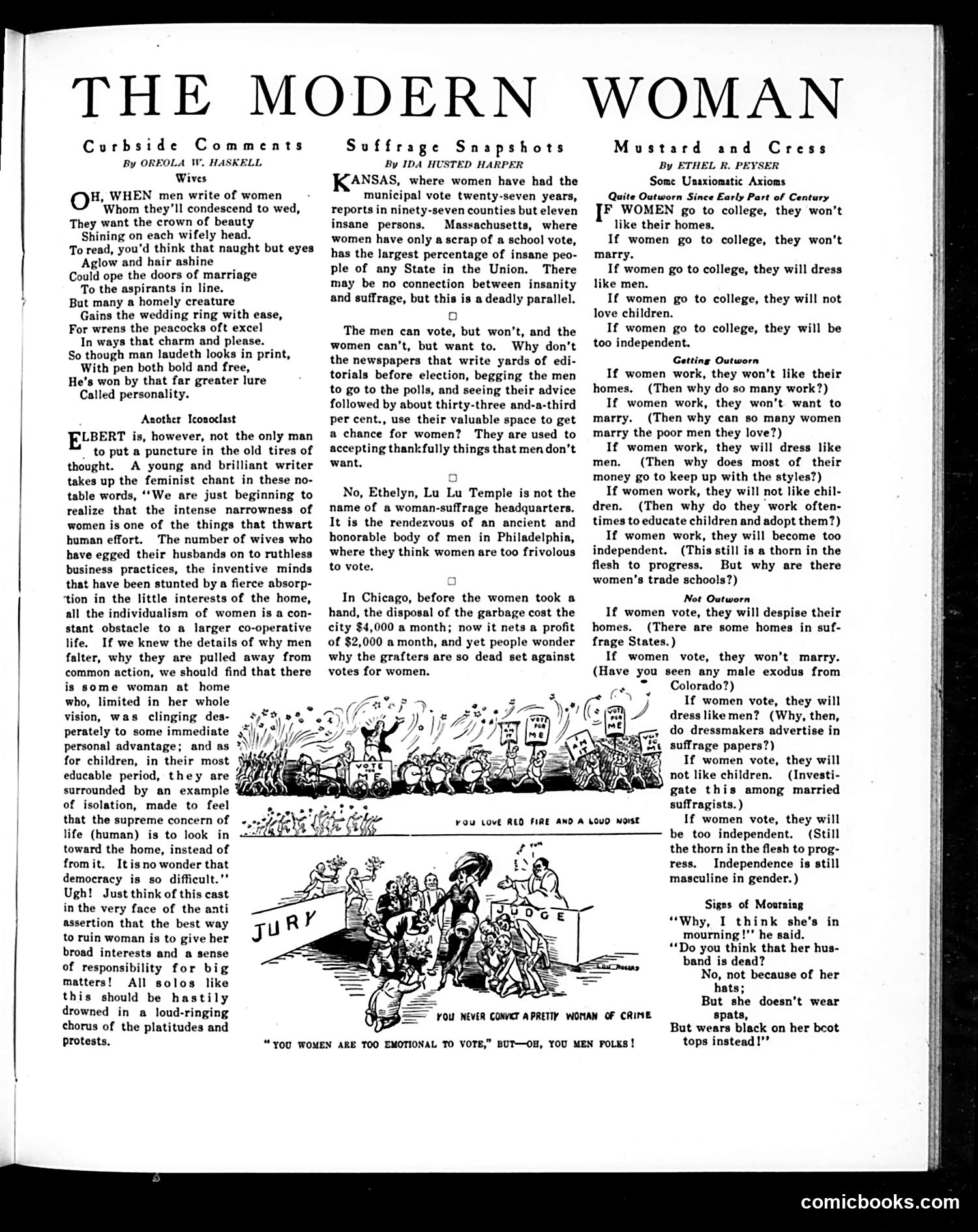
This *Judge* magazine page satirizes opponents of women's suffrage through three columns. **Left column**: defends women's value beyond physical appearance, arguing "personality" matters more than beauty in marriage. **Center column** (by Ida Husted Harper): presents pro-suffrage data—Kansas women voted 27 years with low insanity rates versus Massachusetts without suffrage but high rates. It mocks male voters' inconsistency: men who won't vote are urged by newspapers, yet those same papers won't encourage women's voting. **Right column** (by Ethel R. Peyser): uses ironic "axioms" listing anti-suffrage claims—that college-educated women won't marry, will dress like men, won't love children, become too independent. The format exposes these predictions as absurd contradictions and outdated fears. The cartoons below show suffragists as loud/chaotic and women as criminals—visual anti-suffrage propaganda the text implicitly mocks. The page collectively argues: suffrage opponents rely on emotional fearmongering and logical inconsistencies rather than evidence.
📄 Transcribed text from this page (OCR, searchable)
Machine-transcribed from the original scan — historical spelling and the odd misread are preserved.
Curbside Comments By OREOLA W. HASKELL Wives O#. WHEN men write of women Whom they’ll condescend to wed, They want the crown of beauty Shining on each wifely head. To read, you'd think that naught but eyes ‘Aglow and hair ashine Could ope the doors of marriage To the aspirants in line. But many a homely creature Gains the wedding ring with ease, For wrens the peacocks oft excel In ways that charm and please. So though man laudeth looks in print, With pen both bold and free, He’s won by that far greater lure Called personality. Another Iconoclast ELBERT is, however, not the only man to put a puncture in the old tires of thought. A young and brilliant writer takes up the feminist chant in these no- table words, ‘‘We are just beginning to realize that the intense narrowness of women is one of the things that thwart human effort. The number of wives who have egged their husbands on to ruthless business practices, the inventive minds that have been stunted by a fierce absorp- ‘tion in the little interests of the home, all the individualism of women is a con- stant obstacle to a larger co-operative life. If we knew the details of why men falter, why they are pulled away from common action, we should find that there is some woman at home who, limited in her whole vision, was clinging des- perately to some immediate personal advantage; and as for children, in their most educable period, they are 4 surrounded by an example of isolation, made to feel that the supreme concern of life (human) is to look in toward the home, instead of fromit. Itis no wonder that democracy is so difficult.’’ Ugh! Just think of this cast in the very face of the anti assertion that the best way to ruin woman is to give her broad interests and a sense of responsibility for big matters! All solos like this should be hastily drowned in a loud-ringing chorus of the platitudes and protests, “YOU WOMEN ARE TOO EMOTI Suffrage Snapshots By IDA HUSTED HARPER ANSAS, where women have had the municipal vote twenty-seven years, reports in ninety-seven counties but eleven insane persons. Massachusetts, where women have only a scrap of a school vote, has the largest percentage of insane peo- ple of any State in the Union. There may be no connection between insanity and suffrage, but this is a deadly parallel. oO The men can vote, but won't, and the women can’t, but want to. Why don’t the newspapers that write yards of edi- torials before election, begging the men to go to the polls, and seeing their advice followed by about thirty-three and-a-third per cent., use their valuable space to get a chance for women? They are used to accepting thankfully things that mendon’t want. No, Ethelyn, Lu Lu Temple is not the name of a woman-suffrage headquarters. It is the rendezvous of an ancient and honorable body of men in Philadelphia, where they think women are too frivolous to vote. In Chicago, before the women took a hand, the disposal of the garbage cost the city $4,000 a month; now it nets a profit of $2,000 a month, and yet people wonder why the grafters are so dead set against votes for women. THE MODERN WOMAN Mustard and Cress By ETHEL R. PEYSER Some Unaxiomatic Axioms Quite Outworn Since Early Part of Century F WOMEN go to college, they won’t like their homes. If women go to college, they won’t marry. If women go to college, they will dress like men. If women go to college, they will not love children. If women go to college, they will be too independent. Getting Outworn If women work, they won’t like their homes. (Then why do so many work?) If women work, they won’t want to marry. (Then why can so many women marry the poor men they love?) If women work, they will dress like men. (Then why does most of their money go to keep up with the styles?) If women work, they will not like chil- dren. (Then why do they work often- times to educate children and adopt them?) If women work, they will become too independent. (This still is a thorn in the flesh to progress. But why are there women’s trade schools?) Not Outworn If women vote, they will despise their homes. (There are some homes in suf- frage States.) If women vote, they won’t marry. (Have you seen any male exodus from * Colorado?) If women vote, they will dress like men? (Why, then, do dressmakers advertise in suffrage papers?) If women vote, they will not like children. (Investi- gate this among married suffragists. ) If women vote, they will be too independent. (Still ONAL TO VOTE,” BUT—OH, YOU MEN FOLKS! the thorn in the flesh to prog- ress. Independence is still masculine in gender.) Signs of Moorning “Why, I think she’s in mourning!’’ he said. “Do you think that her hus- band is dead? No, not because of her hats; But she doesn’t wear spats, But wears black on her beot tops instead!’’ comicbooks.com