
A complete issue · 24 pages · 1914
Judge — November 7, 1914
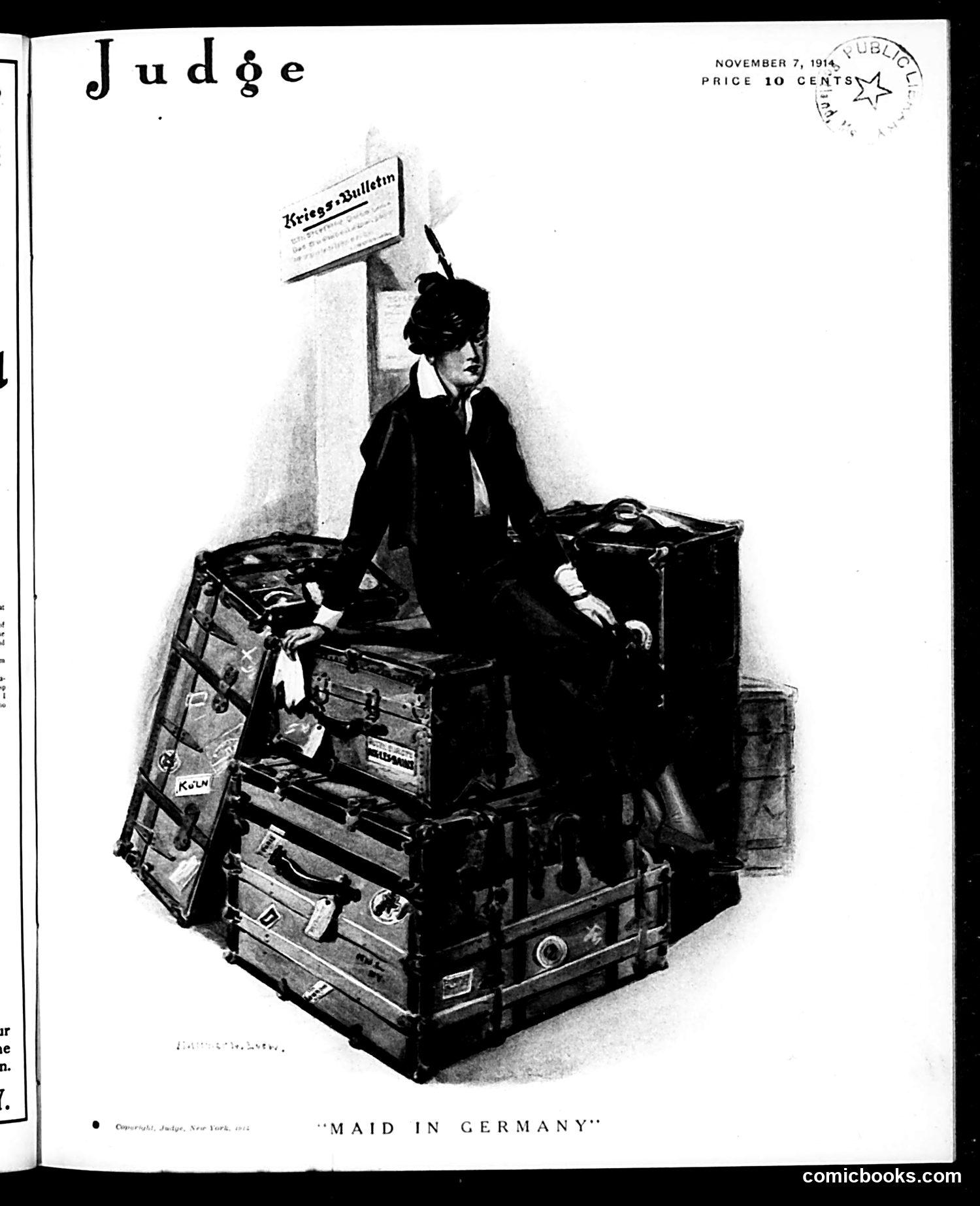
This political cartoon satirizes Germany during World War I, which had begun just months earlier. The image shows a woman (representing Germany) surrounded by heavily-packed trunks and luggage, with a "Kriegs-Bulletin" (war bulletin) sign above her head. The title "Maid in Germany" is a pun suggesting Germany as a "maid" or servant being burdened by war's preparations and consequences. The stacked trunks likely represent the material burdens, refugees, or displacement caused by the ongoing conflict. The cartoon criticizes Germany's war effort and its mounting costs—both human and material. This reflects American sentiment during the early war period, before the U.S. officially entered in 1917, when Judge magazine frequently ran anti-German propaganda material.
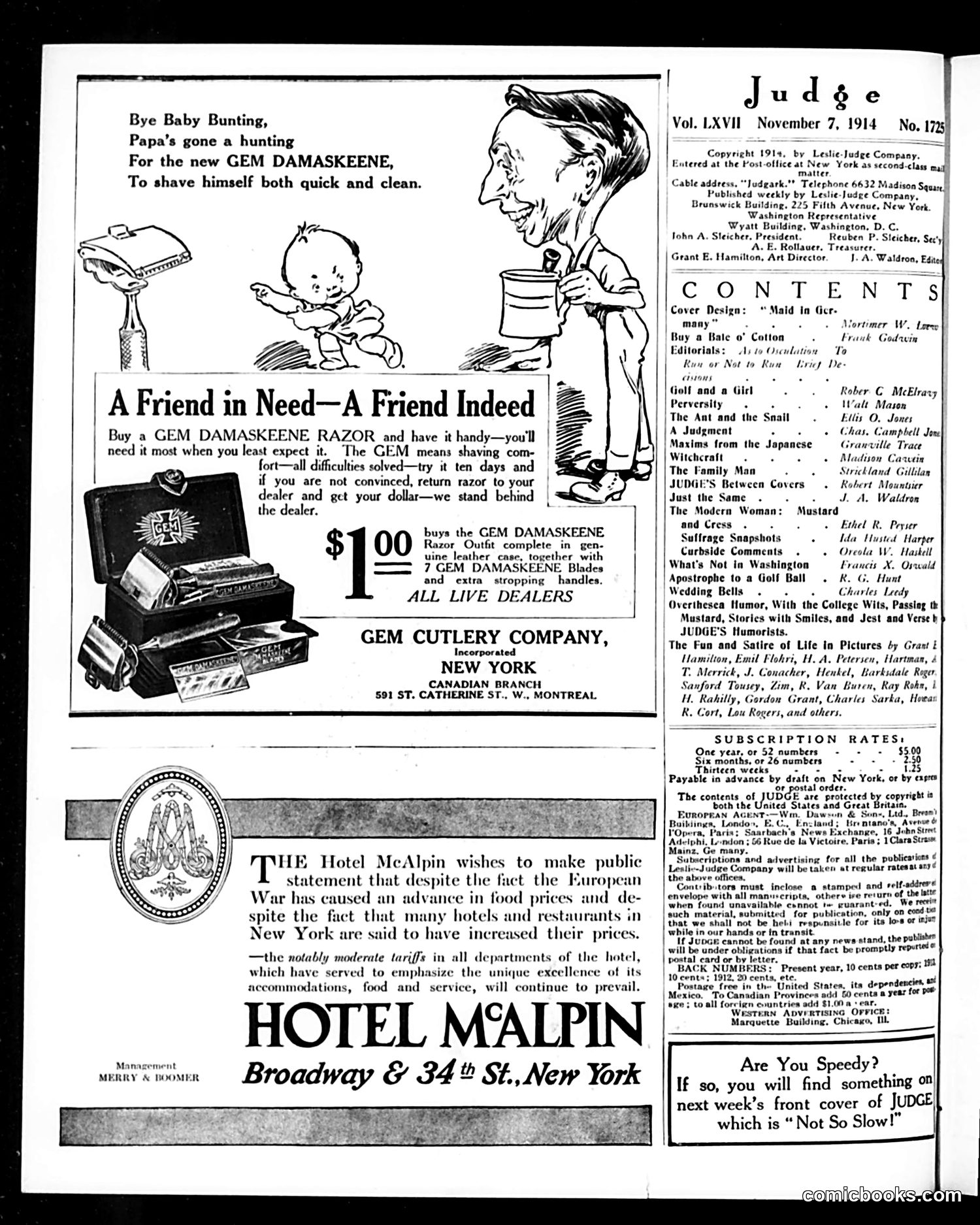
This page is primarily **advertising and administrative content** rather than political satire. The main illustrations are: 1. **"Bye Baby Bunting" cartoon** (top left): A father figure with a baby and shaving equipment, advertising Gem Damascene razors. The joke plays on the nursery rhyme, suggesting razors as practical gifts. 2. **Hotel McAlpin advertisement** (center): Features a lengthy statement defending the hotel's "notably moderate tariffs" despite European War-induced food price increases in New York—indicating wartime economic concerns affecting American businesses. The page reflects **1914 America**: pre-U.S. entry into WWI, when European conflict was already impacting domestic prices and commerce. The content emphasizes consumer products and hospitality rather than political commentary.
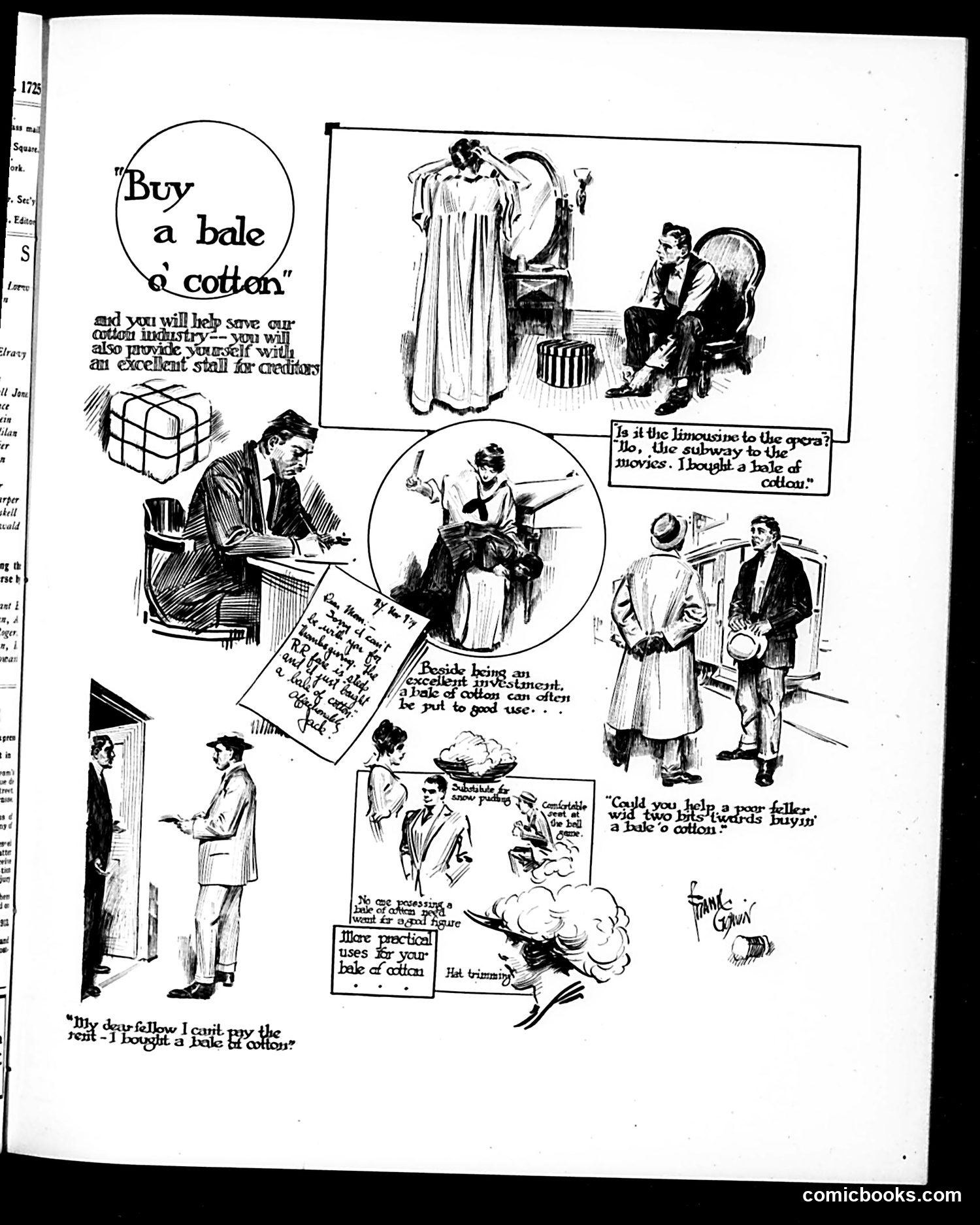
This cartoon satirizes an economic campaign encouraging citizens to purchase cotton bales to support America's cotton industry and provide "an excellent stall for creditors." The comic strips show various scenarios where people cite buying cotton as an excuse for financial problems—unable to pay rent, avoid the opera, or help the poor. The repeated refrain "I bought a bale o' cotton" becomes an absurd, catch-all justification for irresponsible behavior. The satire critiques how patriotic appeals to "support American industry" can be cynically exploited as cover for personal financial mismanagement. By showing characters using cotton purchases to dodge their obligations to creditors and those in need, the cartoonist mocks both the promotional campaign itself and those who might use such nationalism as convenient excuse-making.
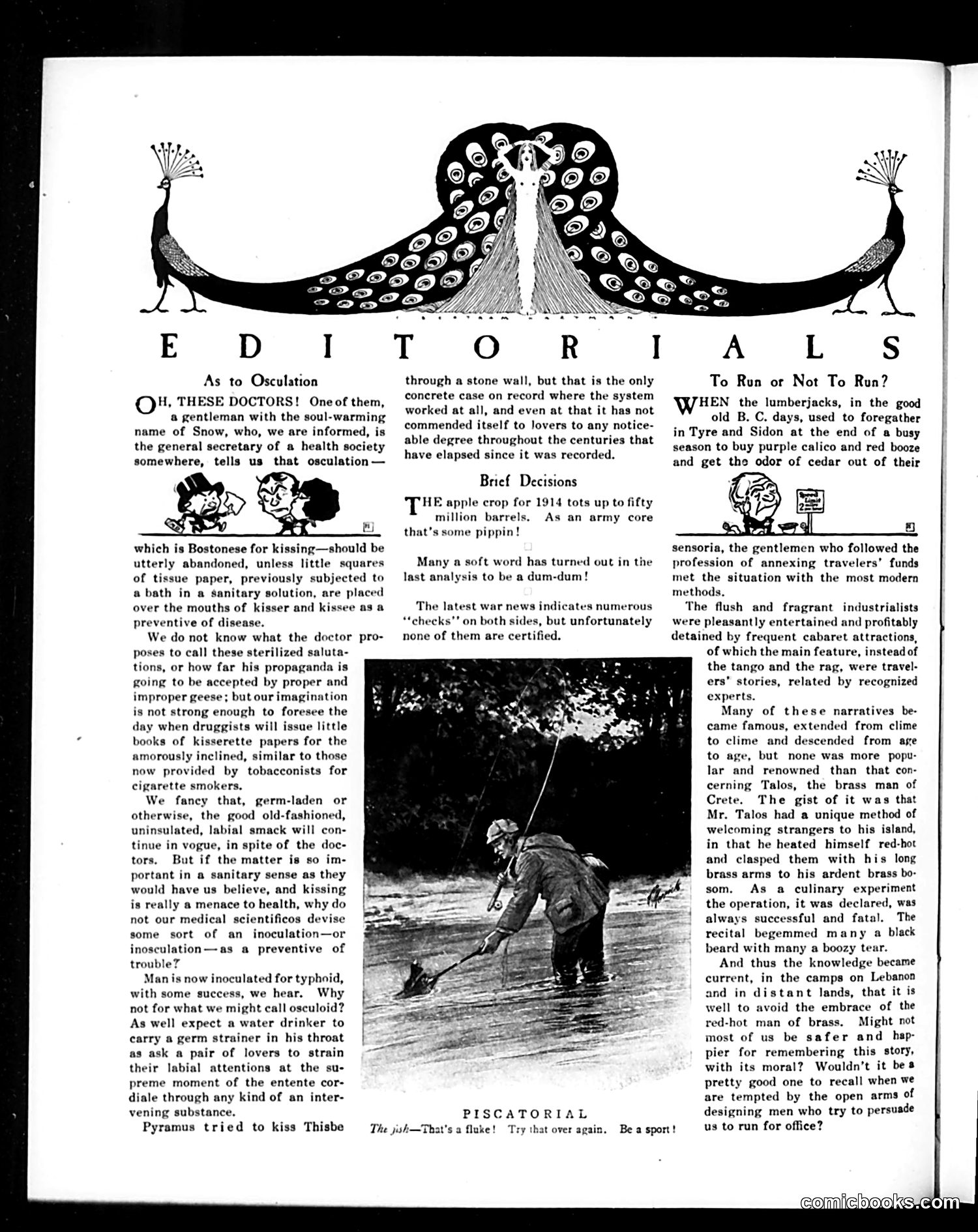
This page contains editorials and a photo-essay rather than political cartoons. The "Editorials" section discusses medical controversies of the era—specifically debates about sterilization, inoculation against typhoid, and germ theory as disease prevention. The author sarcastically supports these progressive medical practices while mocking doctors' resistance to change. The decorative peacock header suggests elegance and display, contrasting with the mundane medical topics below. The photograph labeled "Piscatorial" shows a fishing scene with the caption "That's a fluke! Try that over again. Be a sport!"—appearing to be a humorous anecdote about fishing rather than political satire. Overall, this page emphasizes social commentary through medical debate rather than visual political cartoons.
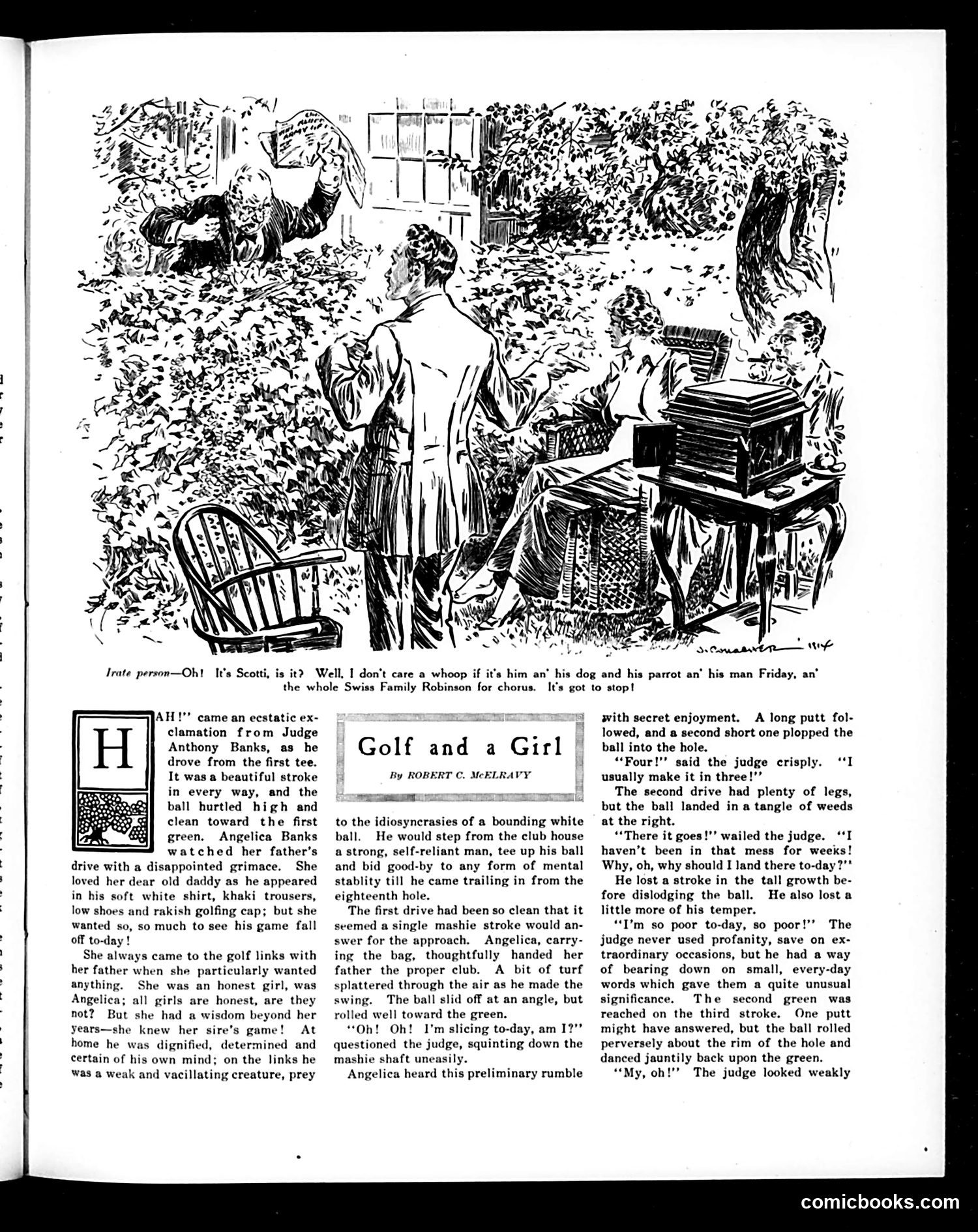
This is a short story illustration rather than political satire. The sketch shows a golf outing where Judge Anthony Banks drives from the first tee while his daughter Angelica watches. The narrative describes Banks as a "strong, self-reliant man" disappointed by his poor drive, while Angelica—characterized as an "honest girl" with wisdom beyond her years—carries her father's clubs. The story's humor derives from domestic gender dynamics: the capable daughter accompanies her father to the golf links, and complications ensue during play. This reflects early 20th-century attitudes toward women's roles in traditionally male sporting spaces. The piece appears to be light social comedy rather than political commentary.
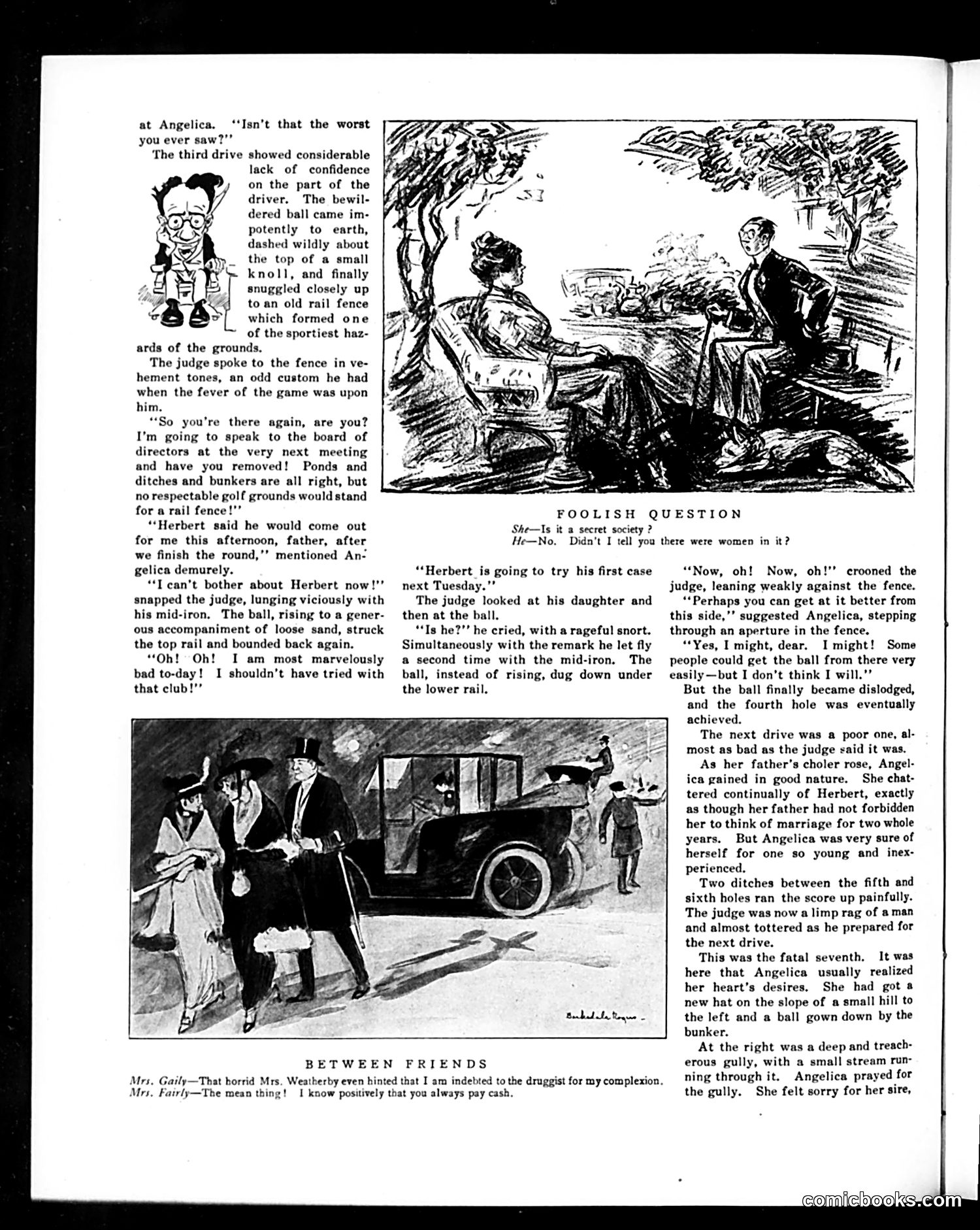
This page contains two satirical pieces from Judge magazine: **"Foolish Question"** (top right): A brief joke mocking secret societies. A woman naively asks if something is a secret society; the man's response—that he wouldn't mention women members if it were secret—implies women's gossip makes secrecy impossible. This reflects early 20th-century stereotypes about female talkativeness. **The Golf Story**: The main narrative satirizes a bad-tempered judge playing golf with his daughter Angelica. The humor centers on his mounting frustration with poor shots and a rail fence that repeatedly interferes with play. Angelica, meanwhile, cheerfully mentions her suitor Herbert despite her father's prohibition on marriage discussion, suggesting youthful female defiance of paternal authority. The story appears to mock both masculine rage over sports performance and generational conflict over courtship. **"Between Friends"** (bottom): A quip about women's perceived vanity and financial dishonesty regarding cosmetics.
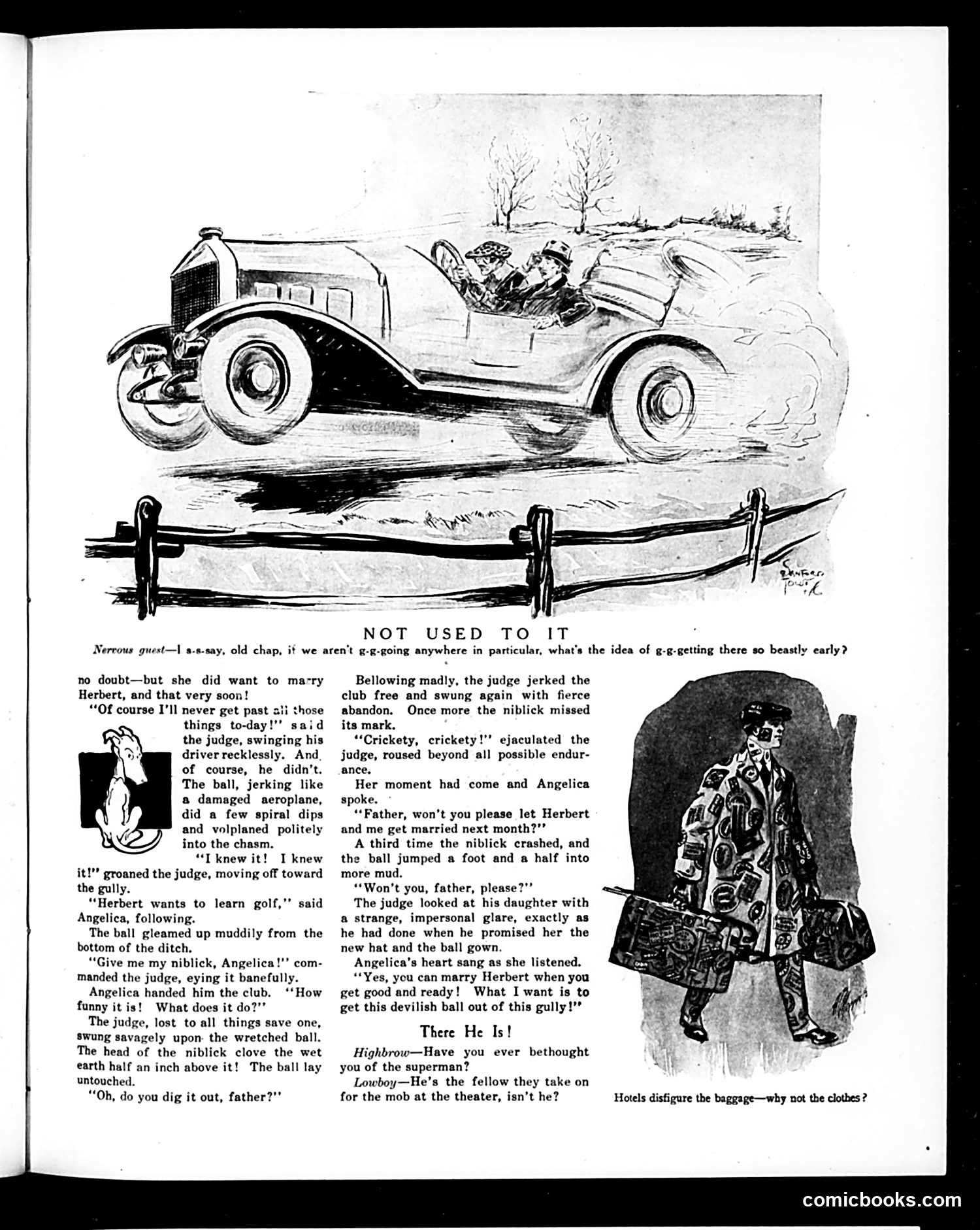
This is a two-part humor page. The top cartoon mocks an impatient motorist driving recklessly early in the morning, with a nervous passenger stammering complaints about the dangerous speed. The main story satirizes a father's obsession with golf. A judge is so frustrated trying to hit a golf ball out of a gully that his daughter Angelica repeatedly asks permission to marry Herbert—but the father is too absorbed in the game to pay attention. Only when the judge finally succeeds does he casually grant permission, having barely registered the request. The satire targets golf's addictive appeal and how it distracted men from family matters. The bottom section contains two brief joke exchanges: one mocking intellectual pretension (confusing "superman" philosophy with circus performers), and another about hotels ruining guests' appearances. The humor assumes a largely male, upper-class readership familiar with golf culture and early-automotive mishaps.
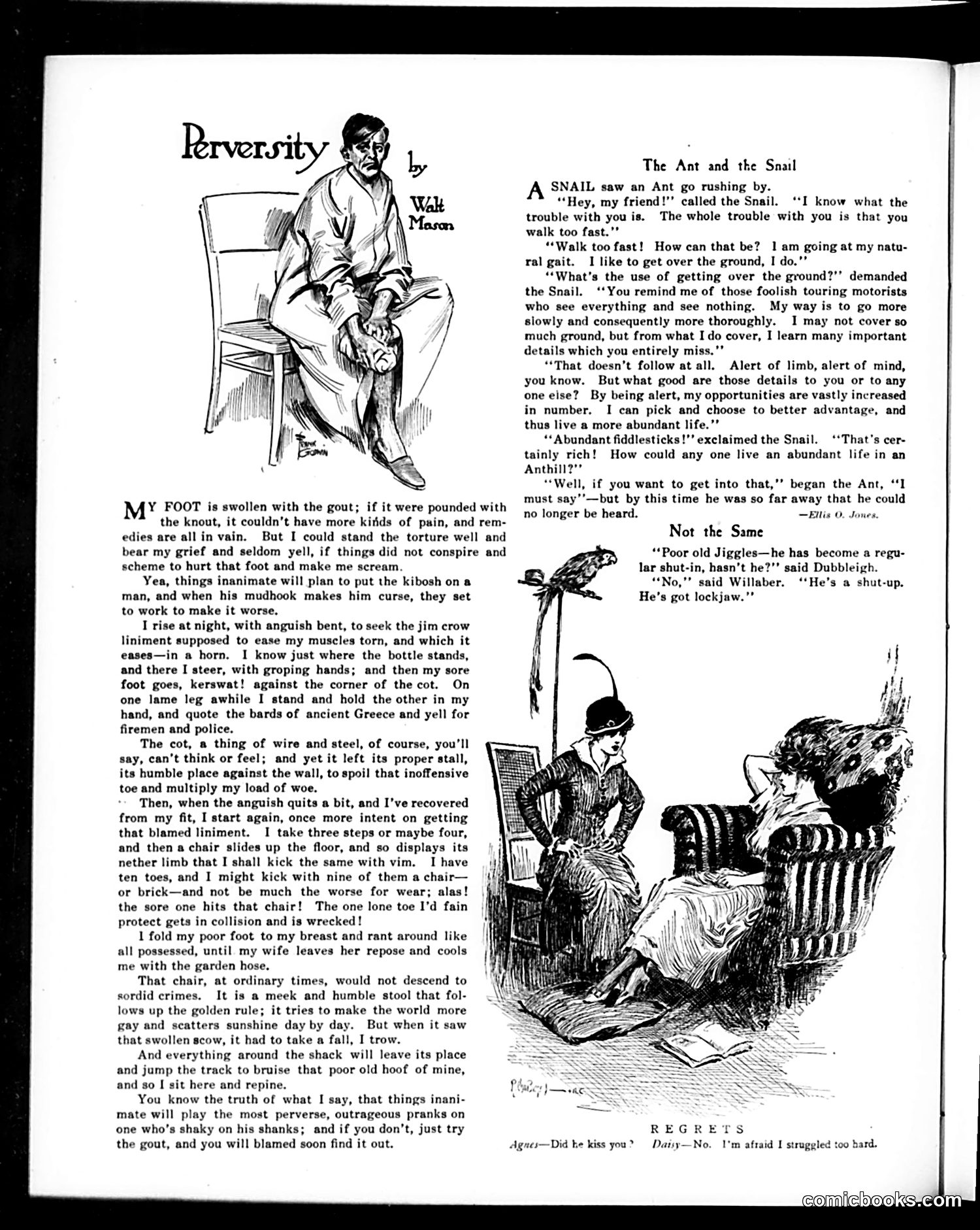
This page contains three distinct pieces of satirical humor: **"Perversity" (main text, left):** A humorous complaint poem about inanimate objects conspiring against a man suffering from gout. The narrator describes his foot's suffering and how furniture, bottles, and chairs seem deliberately positioned to re-injure his swollen toe. The satire mocks how we anthropomorphize objects when misfortune strikes, blaming external things rather than our own clumsiness. **"The Ant and the Snail" (top right):** A fable-style debate between two creatures about life philosophy. The fast-moving Ant prioritizes covering ground and seizing opportunities for an "abundant life," while the slow Snail advocates thorough observation of details. The satire critiques two competing American values—hustle culture versus contemplative living—with neither character convincing the other before the Ant rushes away. **"Not the Same" (bottom right):** An incomplete joke about someone named Jiggles becoming a "shut-up" or "lockjaw" (unclear reference), likely social commentary on changed circumstances or reputation. The illustrations are typical Judge-style engravings supporting the text-heavy satirical content.
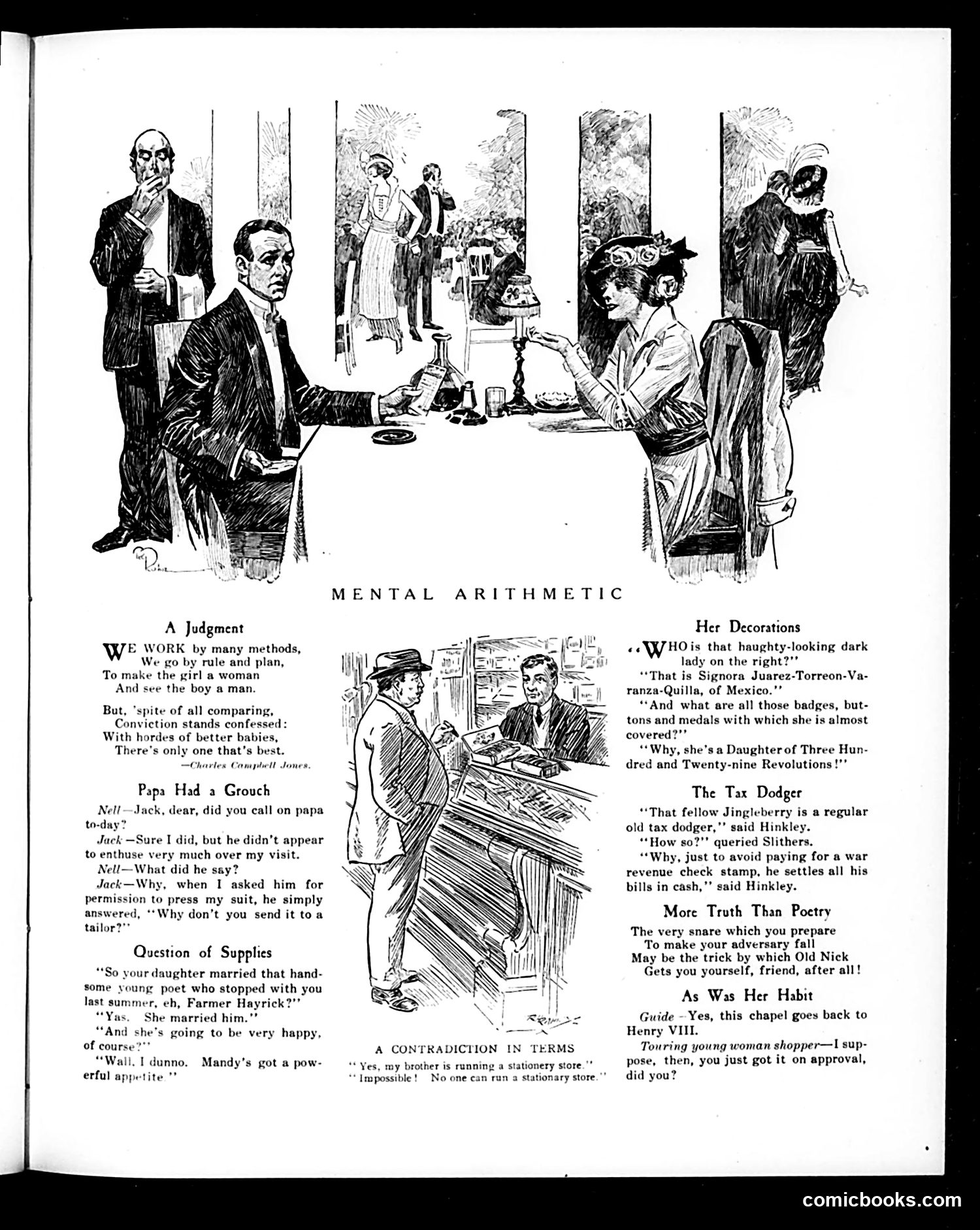
This page from *Judge* magazine contains six separate humor pieces satirizing early 20th-century American life and manners. **Top illustration** ("Mental Arithmetic"): Shows a man and woman at dinner with guests in background. The satire likely concerns miscalculation in courtship or marriage—the title suggests one party is mentally "calculating" differently than the other. **"Papa Had a Grouch"**: A young man seeks his girlfriend's father's permission to marry, but the father dismisses him, suggesting the suitor lacks adequate means or status. **"Question of Supplies"**: A farmer's daughter married a poor poet. The joke: the bride will exhaust their resources because she has a hearty appetite—ironic given her husband's poverty. **"Her Decorations"**: Satirizes Latin American political instability. A woman proudly displays medals from 329 revolutions, mocking the region's frequent governmental upheaval. **"The Tax Dodger"** and remaining pieces: Mock various social hypocrisies—tax avoidance and tourism pretense. The overall tone ridicules romantic folly, class pretension, and social contradictions common to the era.
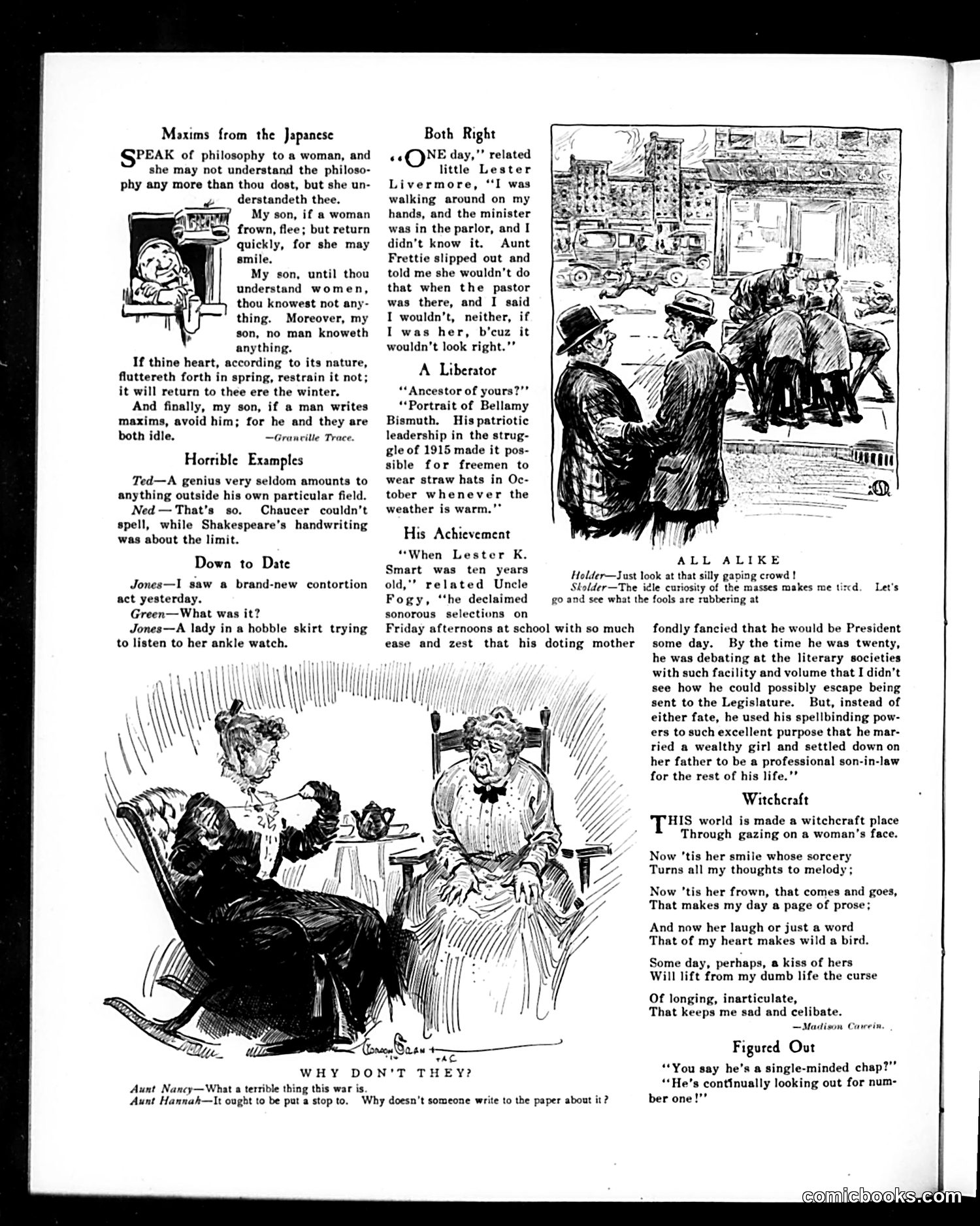
This page contains several brief satirical pieces mocking contemporary American society circa 1910s: **"Maxims from the Japanese"** parodies pseudo-philosophical advice by attributing contradictory wisdom about women to "Japanese" sources—a common Orientalist trope. The final maxim undercuts the entire exercise, calling such maxim-writers idle. **"Horrible Examples"** jokes about specialists' incompetence outside their fields (Chaucer's spelling, Shakespeare's handwriting). **"Down to Date"** satirizes the fashionable "hobble skirt"—restrictive women's fashion so constraining that a woman wearing one cannot bend to listen to her ankle watch. **"A Liberator"** appears to reference a satirical future (1915) where some "Bellamy Bismuth" liberated people to wear straw hats in warm October weather—trivial "freedom." **"Why Don't They?"** mocks elderly women's naive suggestion that someone simply "write to the paper" to stop World War I. The cartoons and verse are typical Judge magazine humor: gentle social commentary on fashion, gender relations, and contemporary foibles.
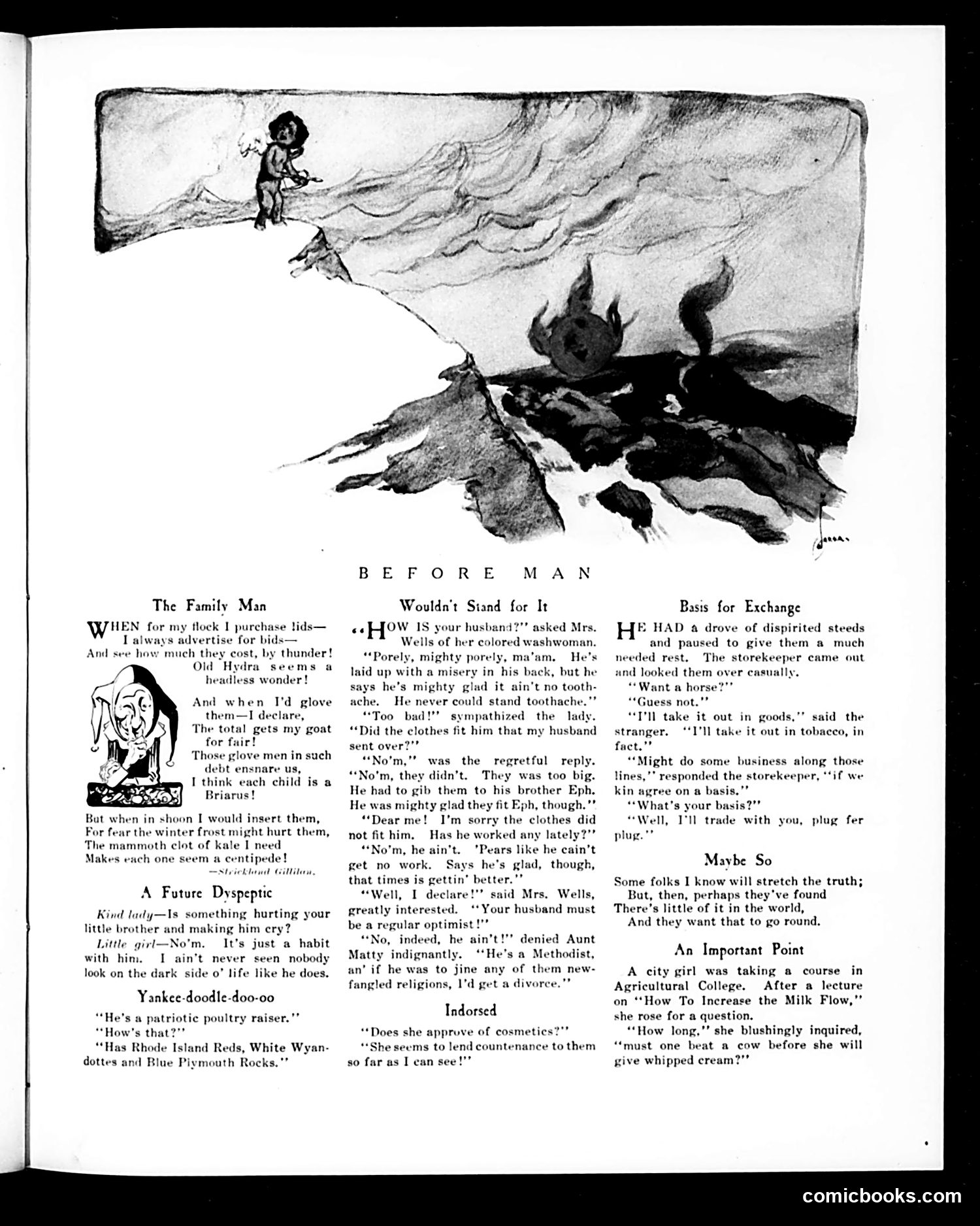
This page contains multiple short humorous pieces satirizing everyday American life, likely early 20th century. **"The Family Man"** mocks the expense and inconvenience of outfitting children—gloves cost exorbitant amounts, and shoes require so much padding ("mammoth clot of kale") that each child appears multi-legged like mythological creatures (Hydra, Briarus). **"Wouldn't Stand for It"** presents a conversation between a white lady and her Black washwoman about the washwoman's husband. The humor relies on ethnic stereotyping and dialect, portraying the husband as optimistic despite unemployment and poverty—though the punchline clarifies he's Methodist, not religious in general. **"Basis for Exchange"** shows a trader attempting to barter a worn-out horse for goods or tobacco. **"Maybe So"** is a brief philosophical observation about scarcity of truth. **"An Important Point"** ends with a naive city girl at agricultural college asking how long to "beat a cow" to produce whipped cream—the joke being her ignorance of dairy farming. The satire targets urban pretension, economic hardship, and rural-urban cultural divides.
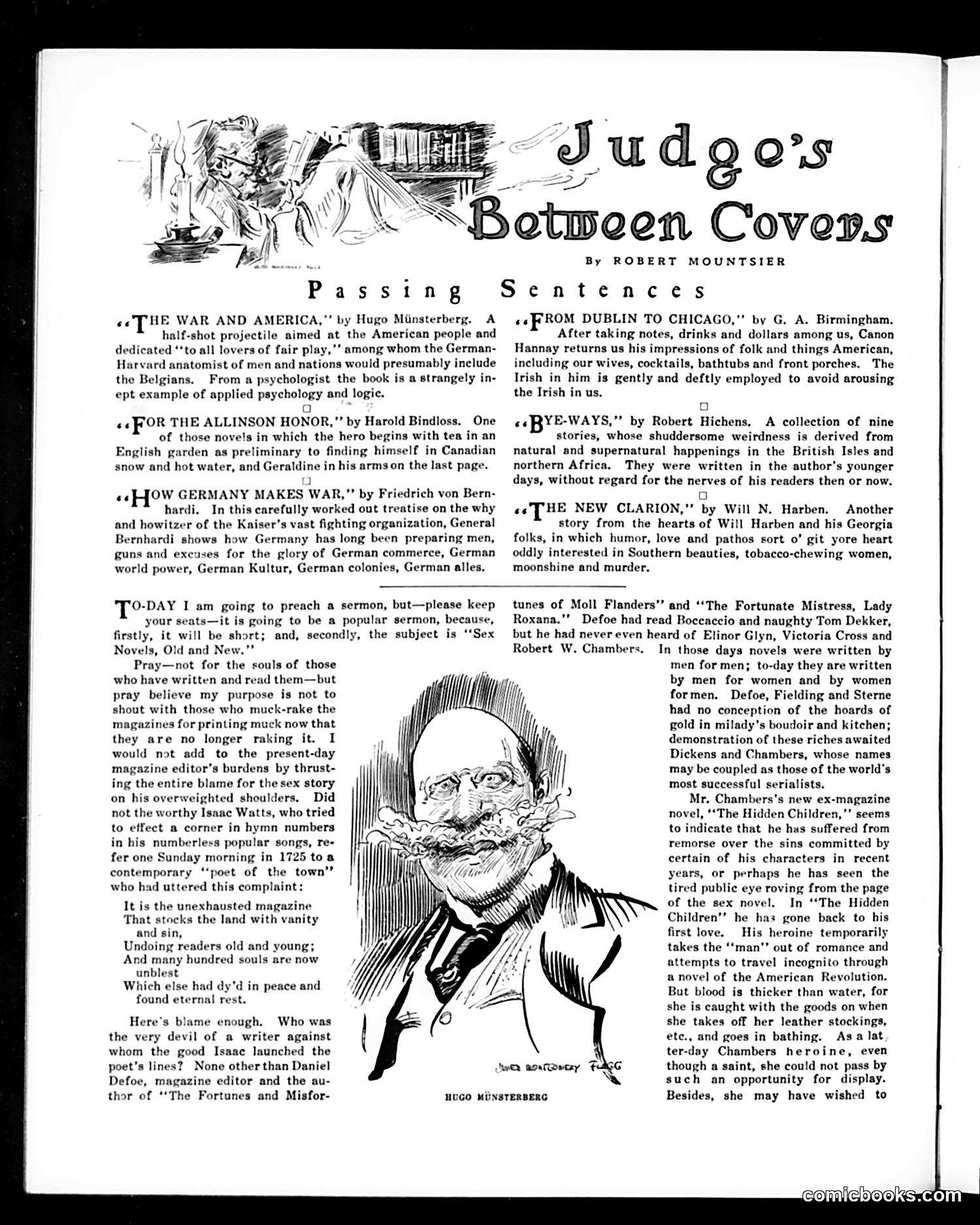
This page features book reviews by Robert Mountsier critiquing recent publications, with satirical commentary on contemporary authors and social issues. The central illustration depicts **Hugo Münsterberg**, a German-American Harvard psychologist whose book "The War and America" is harshly reviewed. Mountsier mocks Münsterberg's attempted defense of German actions during WWI (likely World War I, given references to Belgium and Germany's militarism), calling his psychological analysis "strangely inept." The reviews sarcastically skewer other books: Friedrich von Bernhardt's treatise on German warfare is ridiculed for justifying German imperialism; a travel book by an Irish canon is gently mocked for Irish stereotypes. The essay section attacks "sex novels" by contemporary authors like Elinor Glyn, contrasting them with classic literature by Defoe and Fielding, arguing modern novels pander to female readers' desires rather than serving literary merit. The tone is both prudish and class-conscious—dismissing popular fiction aimed at women as morally corrupting "vanity and sin."
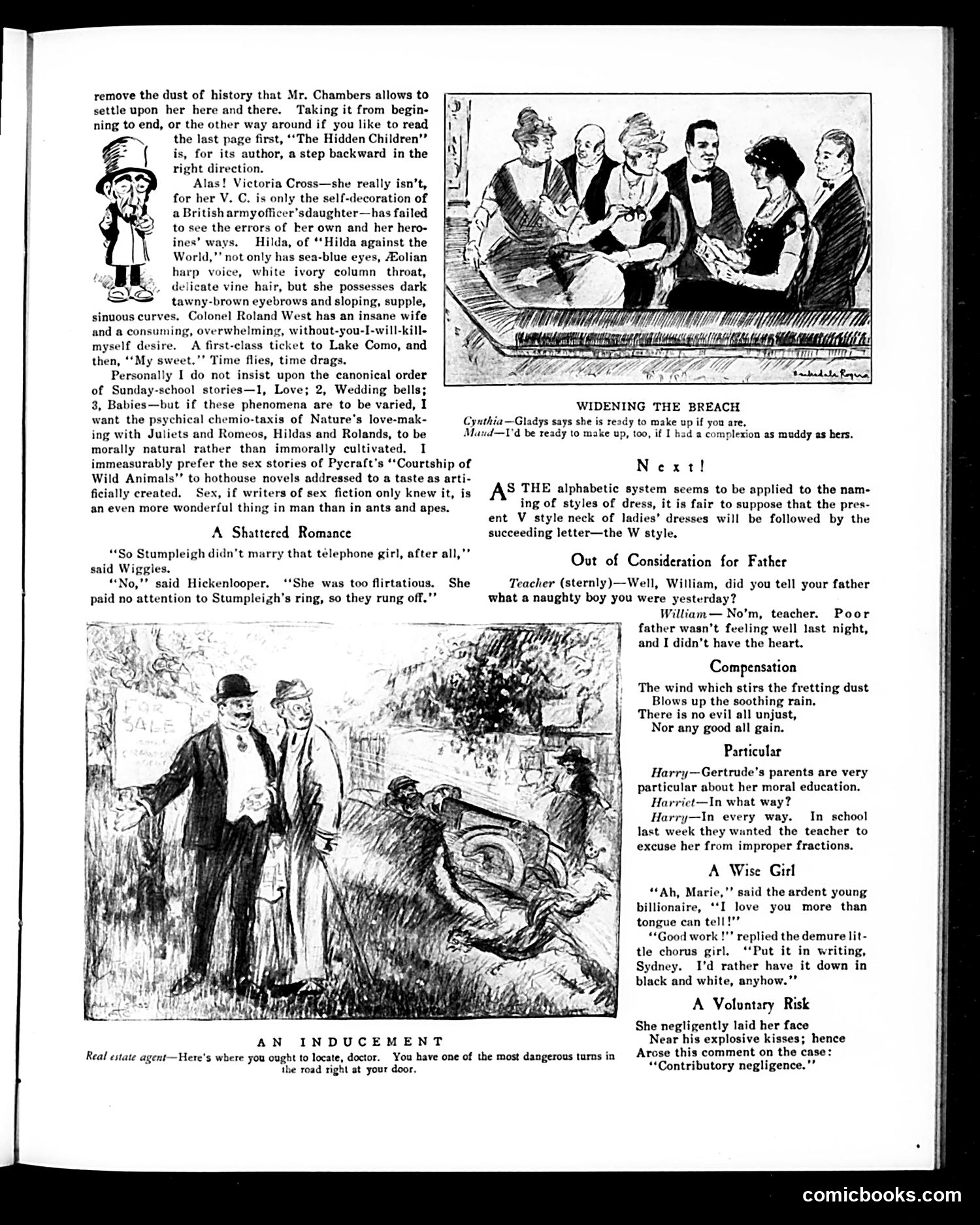
This page from Judge magazine contains several short humorous pieces typical of early 20th-century American satire: **"A Shattered Romance"** mocks a failed courtship: Stumpleigh loses his telephone-operator girlfriend because she was too flirtatious and didn't take his proposal seriously—so "they rung off" (a pun on telephone disconnection). **"An Inducement"** cartoon shows a real estate agent pitching a dangerous property location to a doctor, darkly joking that the sharp road curve will generate business for him. The remaining pieces are brief comedic vignettes about social etiquette and relationships: a boy sparing his ill father's feelings, a girl extracting a written marriage proposal before agreeing to romance, and legal/moral commentary on relationships. The overall tone satirizes Victorian-era courtship conventions, parental supervision, and commercialism, typical of Judge's satirical approach to American social life.
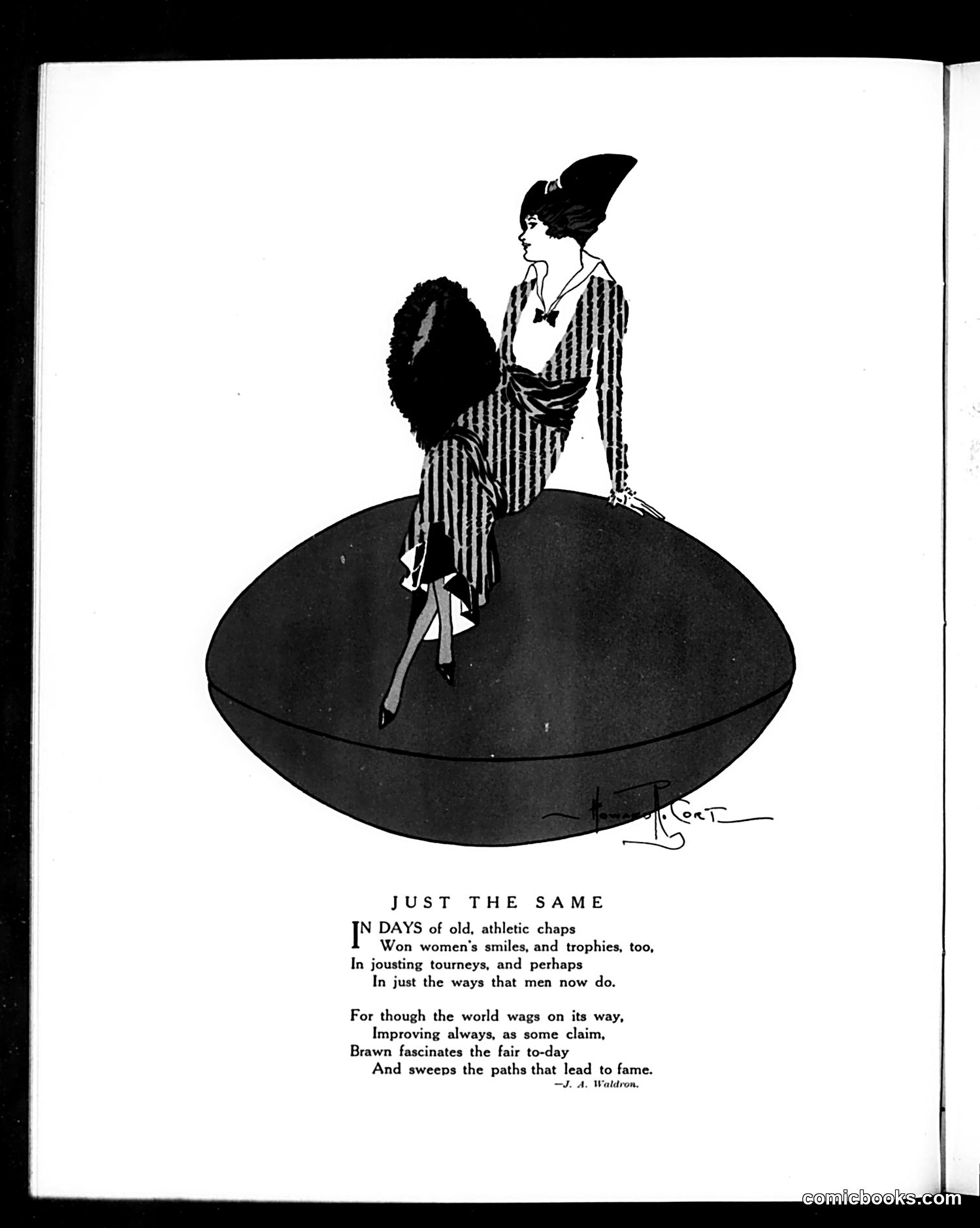
This illustration and poem by J. A. Waldron satirize women's unchanging preferences despite social progress. The image shows a fashionably dressed woman perched atop a large, muscular male figure—depicted as a featureless globe or sphere of pure brawn. The satire argues that despite claims of modern improvement and women's advancement, female attraction remains fixed on physical strength and athleticism, just as in medieval times. The poem's title suggests that regardless of how society evolves, fundamental human nature—particularly women's romantic preferences—stays constant. This reflects early-20th-century attitudes about gender, making a joking point about the limits of social progress when it comes to innate attraction and desire.
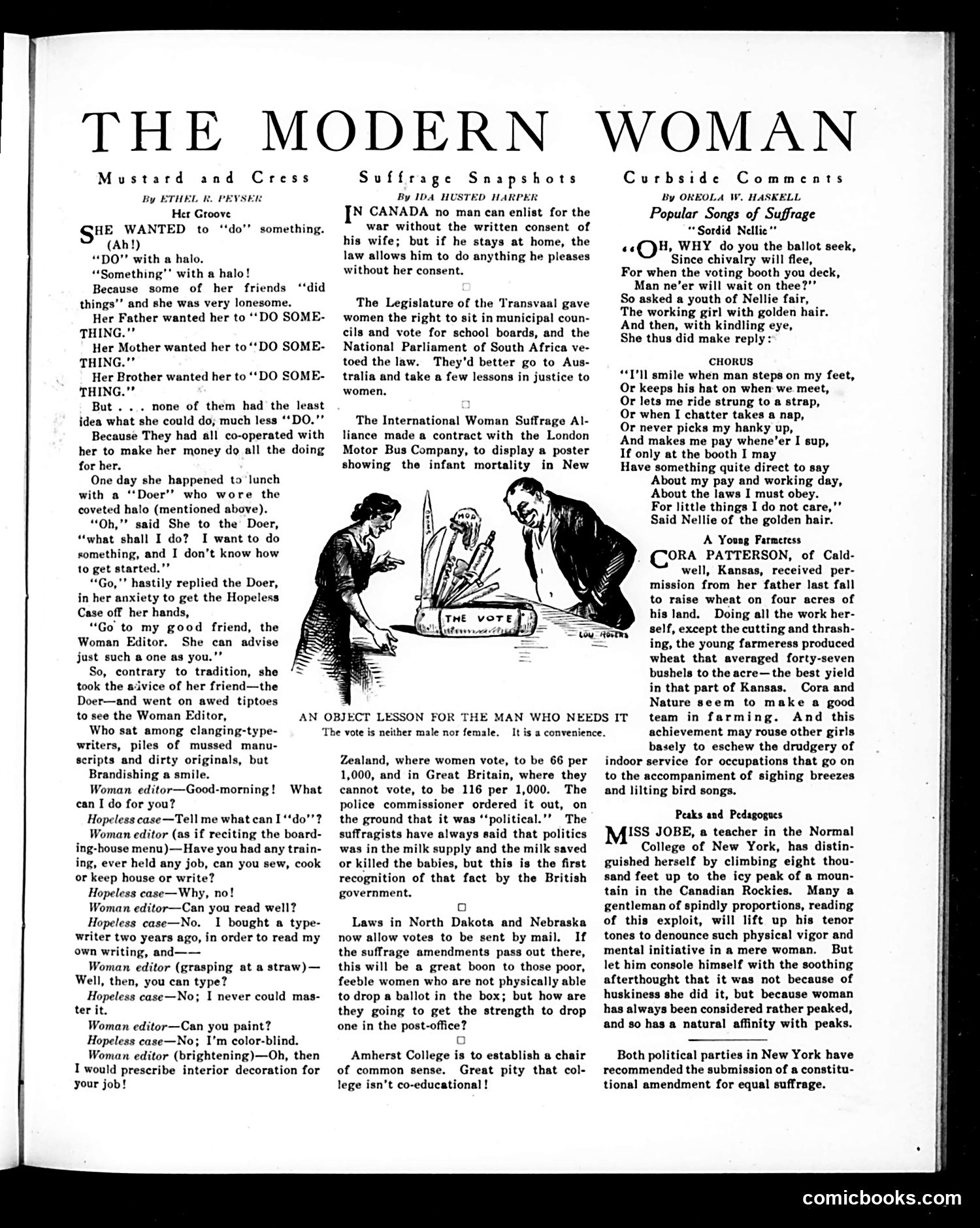
This page satirizes the "modern woman" of the early 20th century through three separate pieces: **Left column ("Her Groove"):** A comic dialogue mocking privileged women who want to "do something" meaningful but lack any actual skills or training. The wealthy protagonist has been kept idle and dependent, so when she seeks advice from a "Woman Editor," the editor discovers she can't sew, cook, write, read well, type, or paint—leading to the absurd suggestion of interior decoration. The satire targets both the useless education of wealthy women and their vague aspirations. **Center:** An illustration captioned "An Object Lesson for the Man Who Needs It" showing suffragists displaying voting statistics to make a political argument—likely mocking both suffragists and male resistance to women's rights. **Right column ("Suffrage Snapshots"):** Sarcastic commentary on women's suffrage laws internationally, using irony to highlight inconsistencies (Canadian wives can't vote but must consent to husbands' military service; British police ban pro-suffrage posters as "political"). The final item mocks women's supposed physical weakness. Overall, the page uses humor to criticize both idle wealthy women and suffrage advocates, reflecting contemporary anti-feminist sentiment.
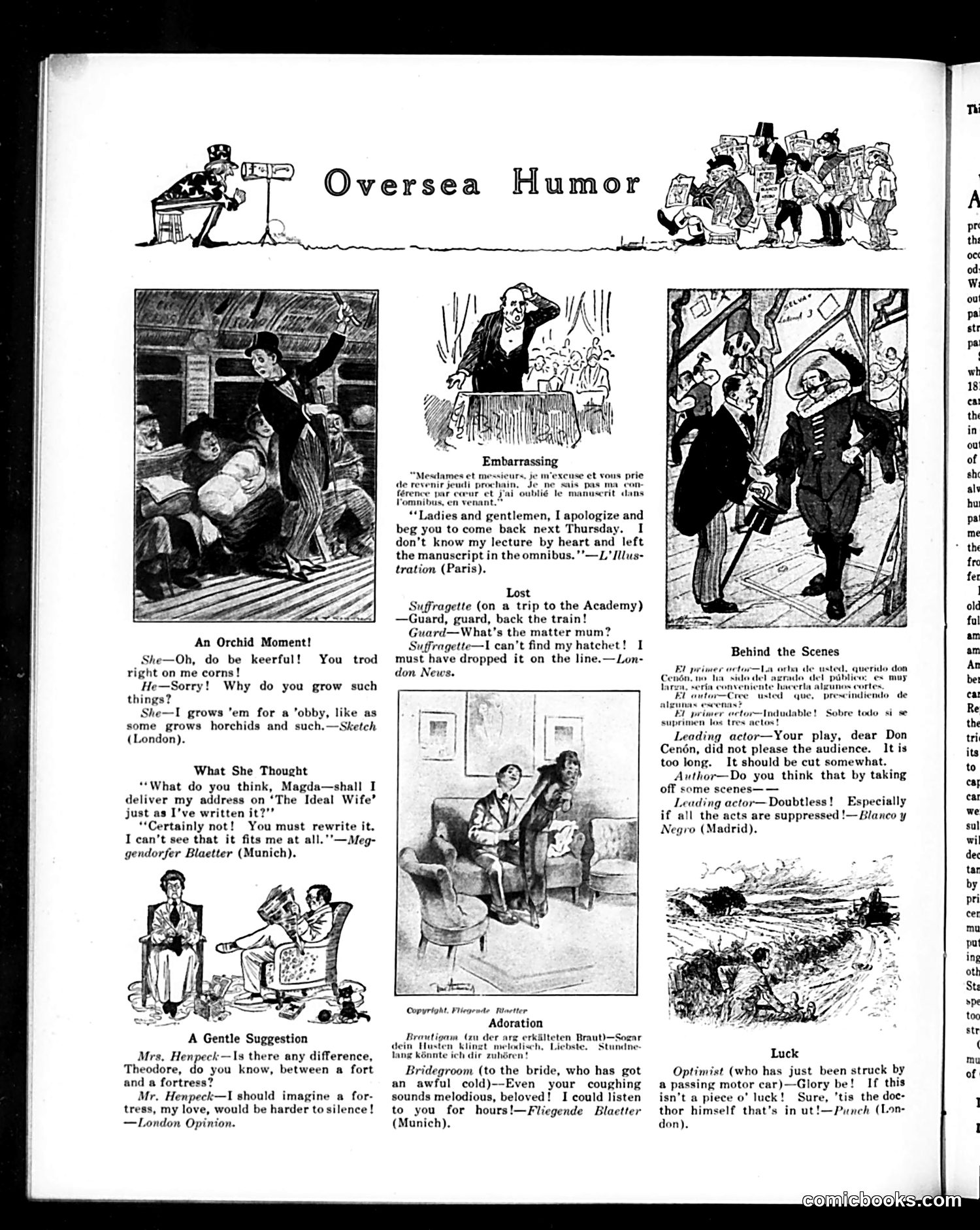
This page collects humorous anecdotes from European satirical magazines, translated for American readers. The jokes target familiar domestic and social situations: **Key themes:** - **Gender dynamics**: "What She Thought" satirizes wives who reject husbands' work; "Mrs. Henpeck" mocks nagging wives; "An Orchid Moment" plays on working-class speech patterns and romance. - **Suffragette satire**: The "Lost" anecdote ridicules suffragettes by suggesting one would carelessly abandon her "hatchet" (likely referencing property destruction associated with militant suffragettes). - **Theater/artistic pretension**: "Adoration" and the "Leading actor" piece mock artistic vanity and impractical creators. - **Irish optimism**: The final "Luck" joke stereotypes Irish fatalism as comical. The page represents *Judge*'s recurring feature of reprinting Continental European humor, offering American audiences supposedly sophisticated Continental wit while reinforcing period prejudices about women's activism, class, and nationality.
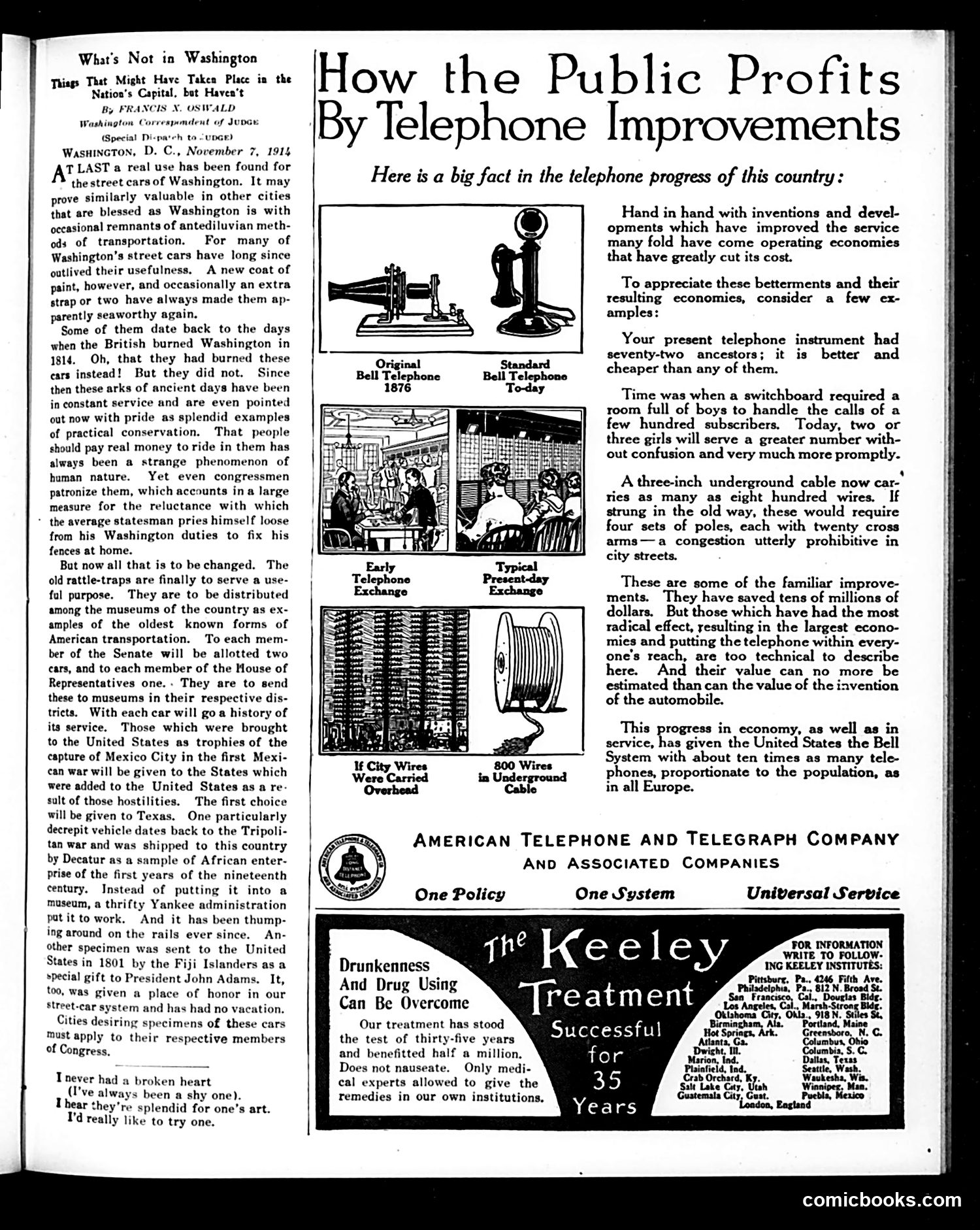
This page contains two distinct pieces: **Left column:** A humorous essay by Francis X. Oswald mocking Washington, D.C.'s decrepit street cars. The satire targets two things: (1) the absurdly ancient public transportation still in use—some allegedly dating to the War of 1812—and (2) congressmen who tolerate this decay. The "joke" proposes distributing these worn-out cars to museums as historical artifacts, with prestigious specimens going to states based on their historical significance (Texas gets those from the Mexican-American War, etc.). This satirizes both governmental neglect of infrastructure and politicians' reluctance to leave Washington to address local problems. **Right side:** A straightforward advertisement by American Telephone and Telegraph Company showcasing telephone technological improvements and cost efficiencies—contrasting primitive early equipment with modern versions, demonstrating reduced labor needs and cable innovations. This is corporate propaganda, not satire. **Bottom:** An unrelated advertisement for "The Keeley Treatment" for alcoholism. The page illustrates Judge's mix of political satire and advertising.
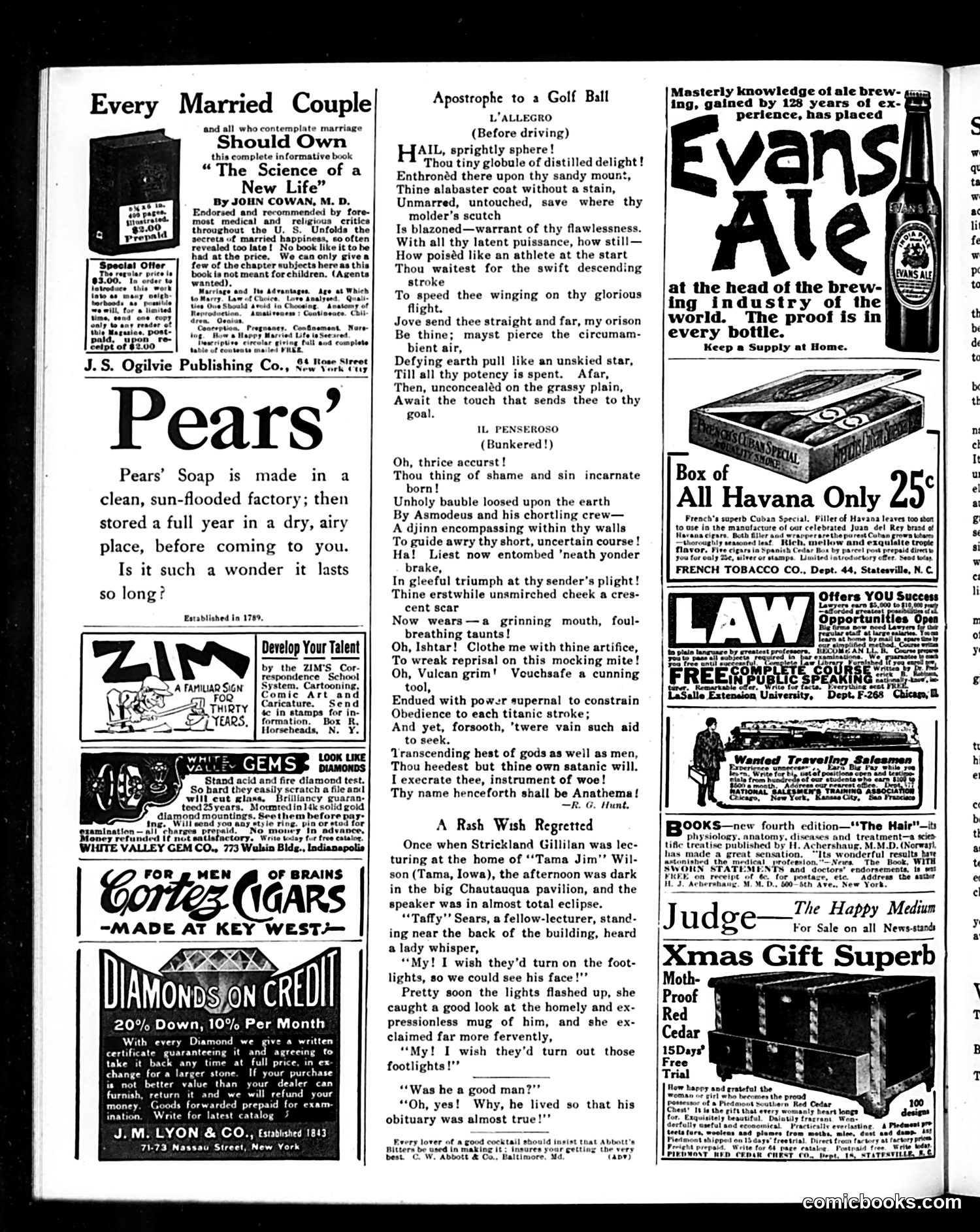
This page is primarily **advertising with some editorial content**, typical of Judge magazine's mixed format. The main substantive content is a two-part poem titled "Apostrophe to a Golf Ball" by R.G. Hunt—a satirical contrast between a golfer's romantic, flowery devotion to the golf ball before hitting it ("L'Allegro," or "the cheerful one") and bitter, curse-filled rage when the shot goes badly and the ball lands in a bunker ("Il Penseroso," or "the thoughtful one"). The joke relies on the classical references (titles borrowed from Milton) being incongruously applied to golf frustration. This mocks both golfers' emotional extremes and pretentious literary allusions. The page also contains "A Rash Wish Regretted," a brief anecdote about speaker Strickland Gillilan being nearly invisible during a dark afternoon lecture. The remainder is period advertising: marriage advice books, Pears' soap, correspondence schools for cartooning, diamonds on credit, and cigars—no political satire present.
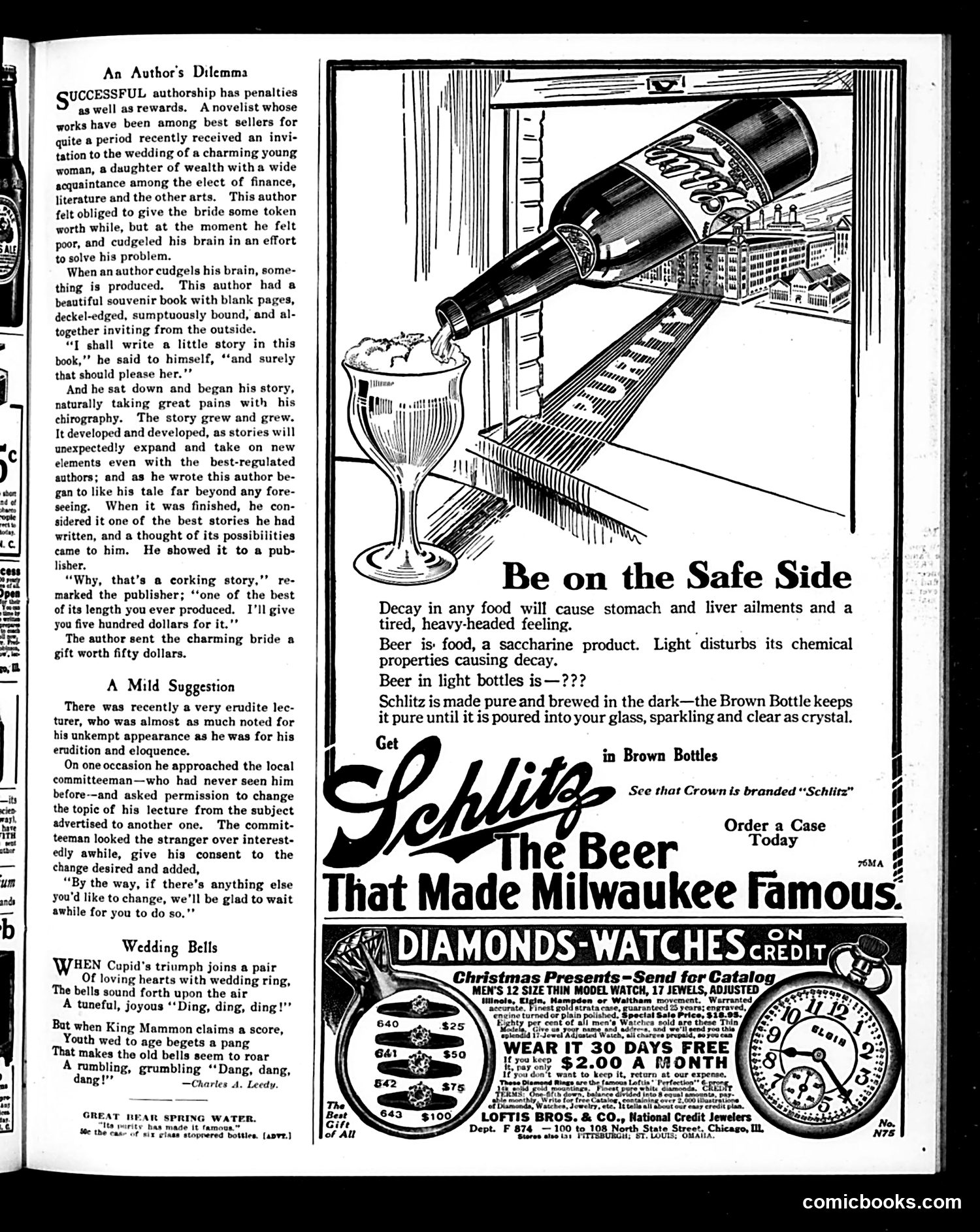
This page contains three satirical pieces and advertisements from *Judge* magazine (date unclear from image). **"An Author's Dilemma"** mocks the financial struggles of successful writers. A novelist, invited to a wealthy woman's wedding, pens a story in a blank book as a gift. The tale becomes so compelling he shows it to a publisher, who offers $500—far exceeding the $50 value of the original gift. The satire targets the irony that artists produce their best work under financial pressure, yet may profit more from unexpected commercial opportunities than from their intended acts of patronage. **"A Mild Suggestion"** jokes about a slovenly academic lecturer whose appearance is so disreputable that a committeeman offers to help him "change" other aspects besides his lecture topic—a gentle jab at scholarly eccentricity. **"Wedding Bells"** contrasts romantic marriages (joyful "ding-ding") with mercenary unions of youth and age (grim "dang-dang"). The right side features advertisements for Schlitz beer and discount watches, typical period marketing.
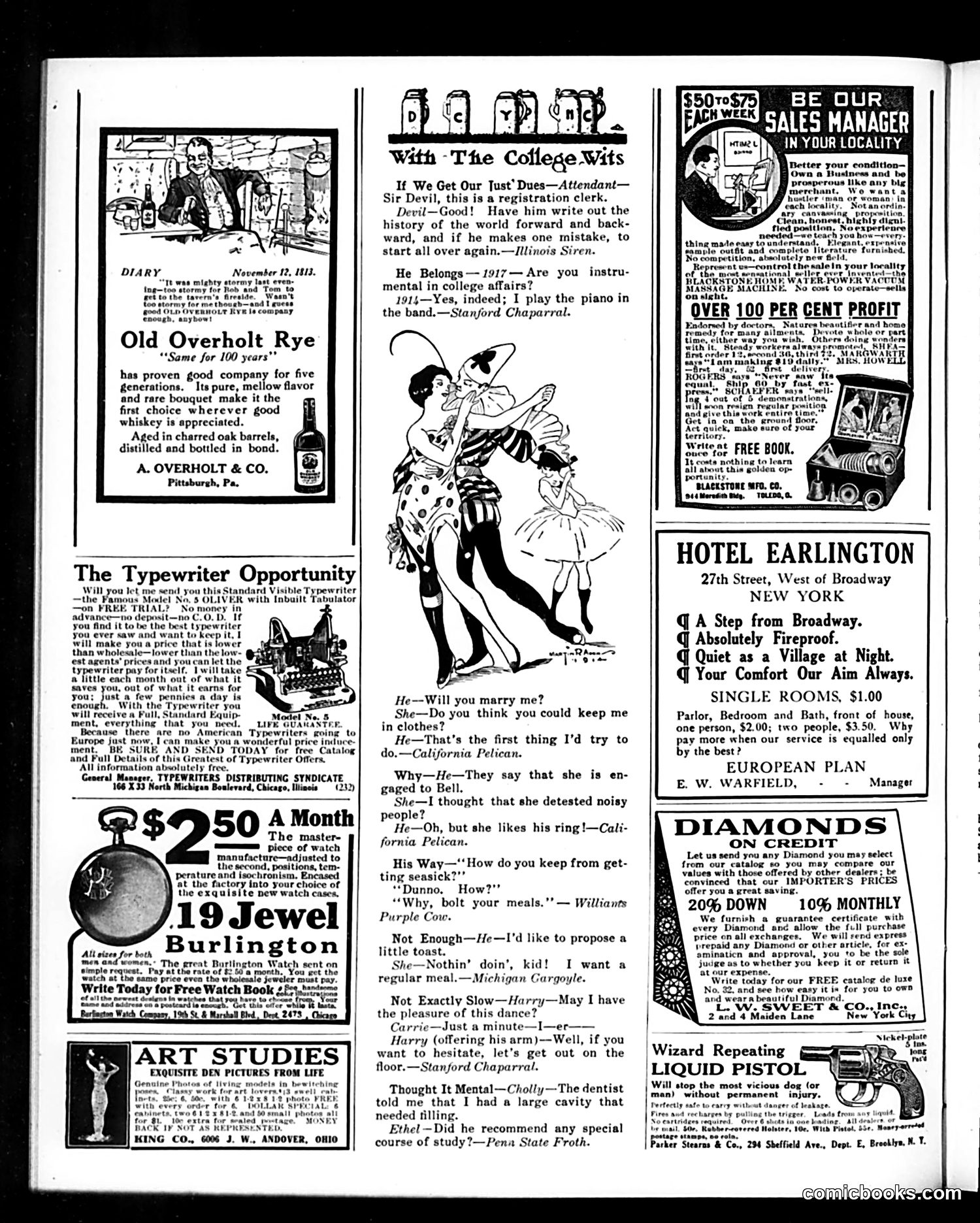
This page is primarily **advertising with satirical humor** from Judge magazine (November 12, 1913). The main content is a cartoon feature titled "With The College Wits"—a collection of brief jokes from college humor publications. The jokes mock **dating customs and courtship** of the era: a woman rejecting a marriage proposal unless he can support her wardrobe; a woman preferring a man's expensive ring over his personality; a couple's awkward dance negotiation. These reflect early 20th-century gender dynamics where women's financial dependence on men was expected but also the subject of gentle ridicule. The surrounding advertisements (Old Overholt whiskey, typewriters, watches, hotels, diamonds "on credit," and a vacuum cleaner) are typical period advertising. Notably, the "Be Our Sales Manager" ad promotes the "Schaefer" vacuum—one of the few ads targeting women's domestic labor, reflecting changing attitudes about housework technology. The satire is gentle social observation rather than political commentary.
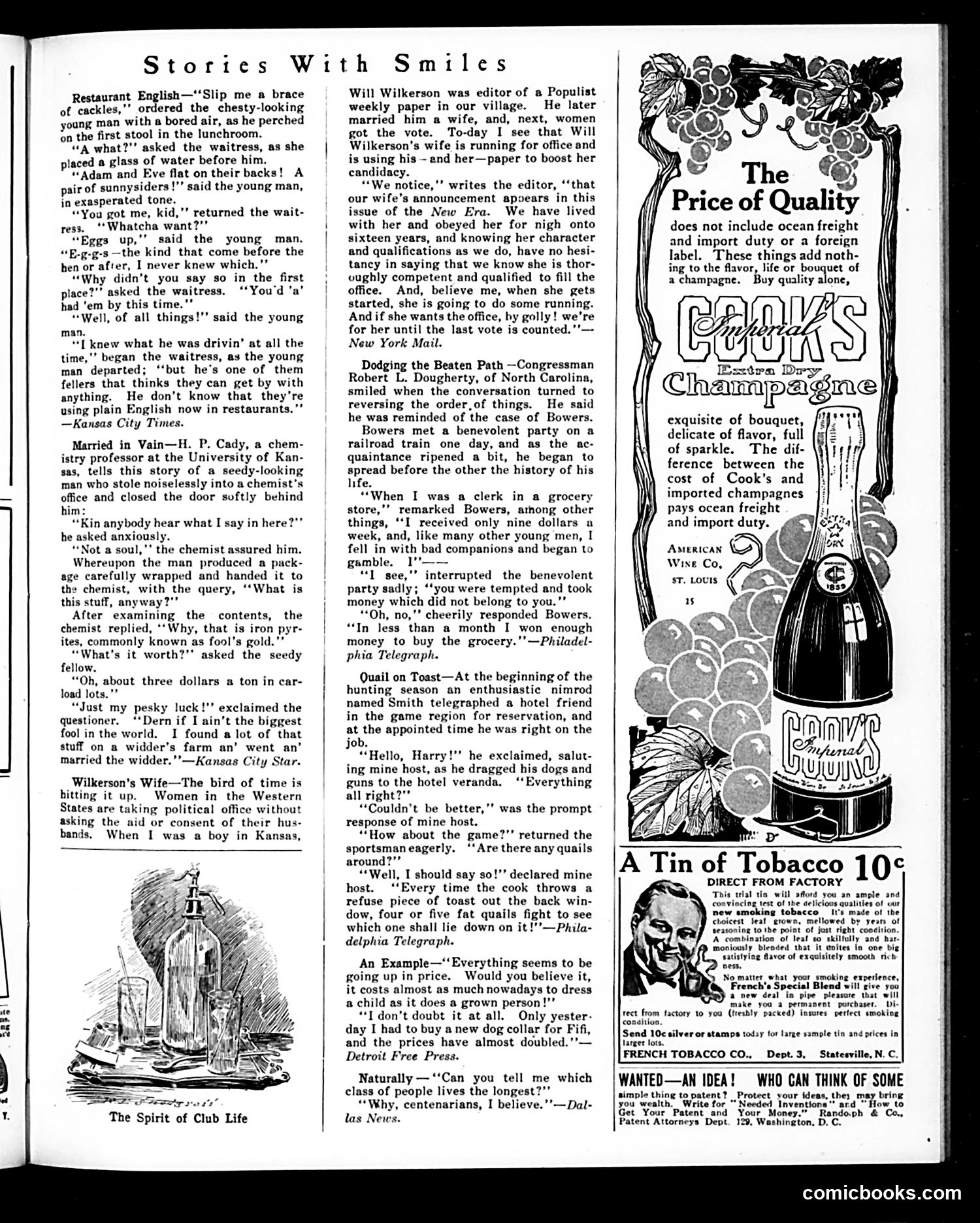
This page contains humorous anecdotes rather than political cartoons. The jokes satirize early-20th-century American social changes: **"Restaurant English"** mocks diner slang—a young man's affected, coded language ("cackles" for eggs, "Adam and Eve") embarrasses a waitress, satirizing pretentious speech and the growing standardization of "plain English." **"Married in Vain"** plays on a con-man who unknowingly marries a woman thinking her farm contains valuable ore (fool's gold), satirizing rural gullibility and hasty marriages. **"Wilkerson's Wife"** directly addresses women's political participation following suffrage. A Populist newspaper editor now supports his wife's candidacy, showing how women entering politics disrupted traditional male authority—presented here as humorous role-reversal. **"Dodging the Beaten Path"** features Congressman Dougherty's anecdote about a man who gambled rather than stole, subverting moral expectations. The page satirizes modernization, changing gender roles, and American social mobility through everyday humor rather than visual caricature.
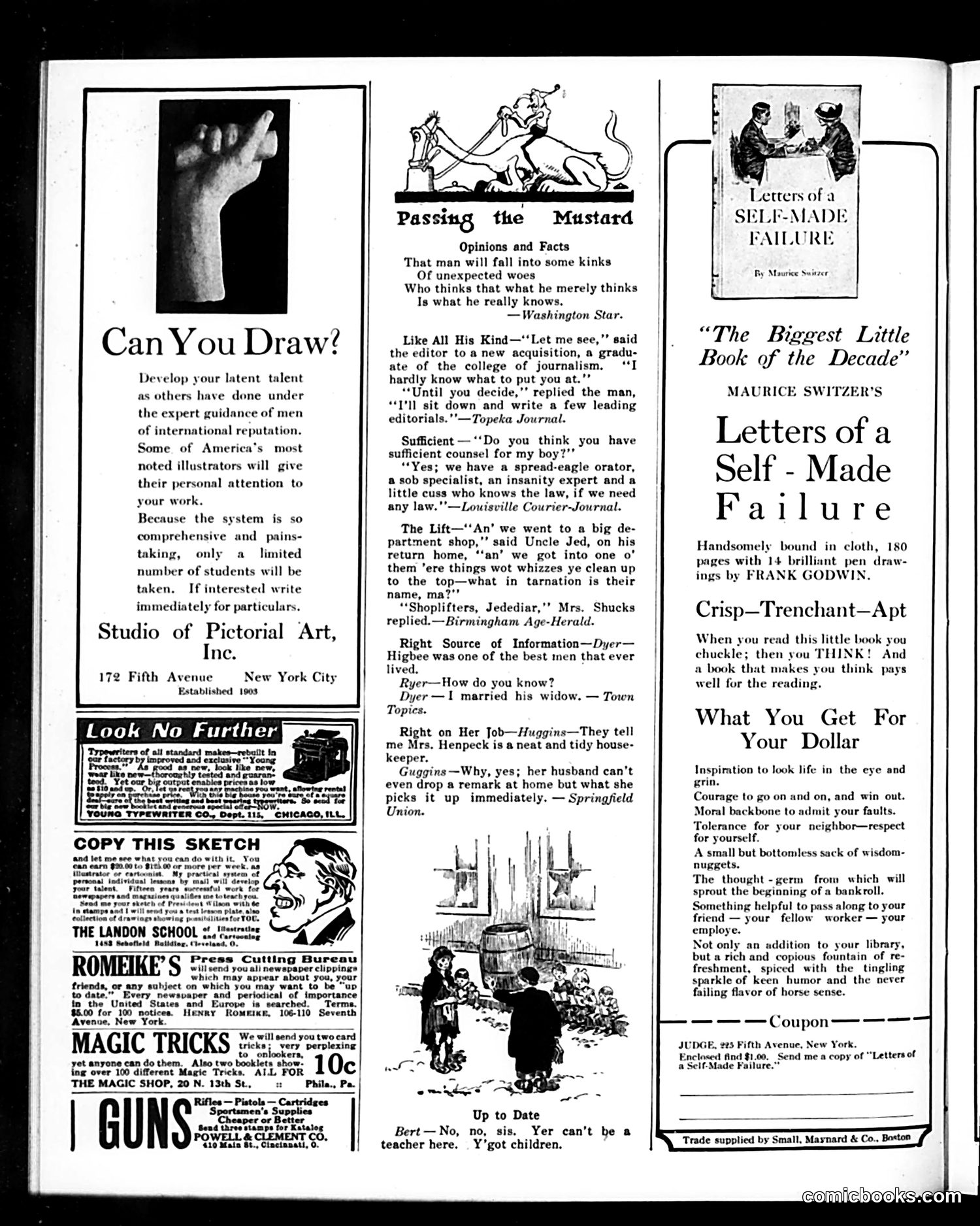
This is primarily an **advertising and humor page** rather than a political cartoon. The main content consists of: **Advertisements** for art instruction, typewriters, magic tricks, and Maurice Switzer's book *Letters of a Self-Made Failure*. **"Passing the Mustard"** is a humor section featuring brief jokes and witticisms from various newspapers. The jokes mock common types: an overconfident journalism graduate, lawyers who specialize in theatrics rather than law, an elderly couple confused by elevators ("shoplifters"), and a domineering wife. These are gentle social satire about everyday American life—professional pretension, rural naivety, and marital dynamics—rather than political commentary. The cartoons are minimal and untitled. One small sketch appears to show a domestic/financial scene, another depicts an urban street. Neither contains identifiable figures or clear satirical targets. This page reflects Judge's mix of advertising revenue and light social humor aimed at middle-class readers, rather than substantive political satire.
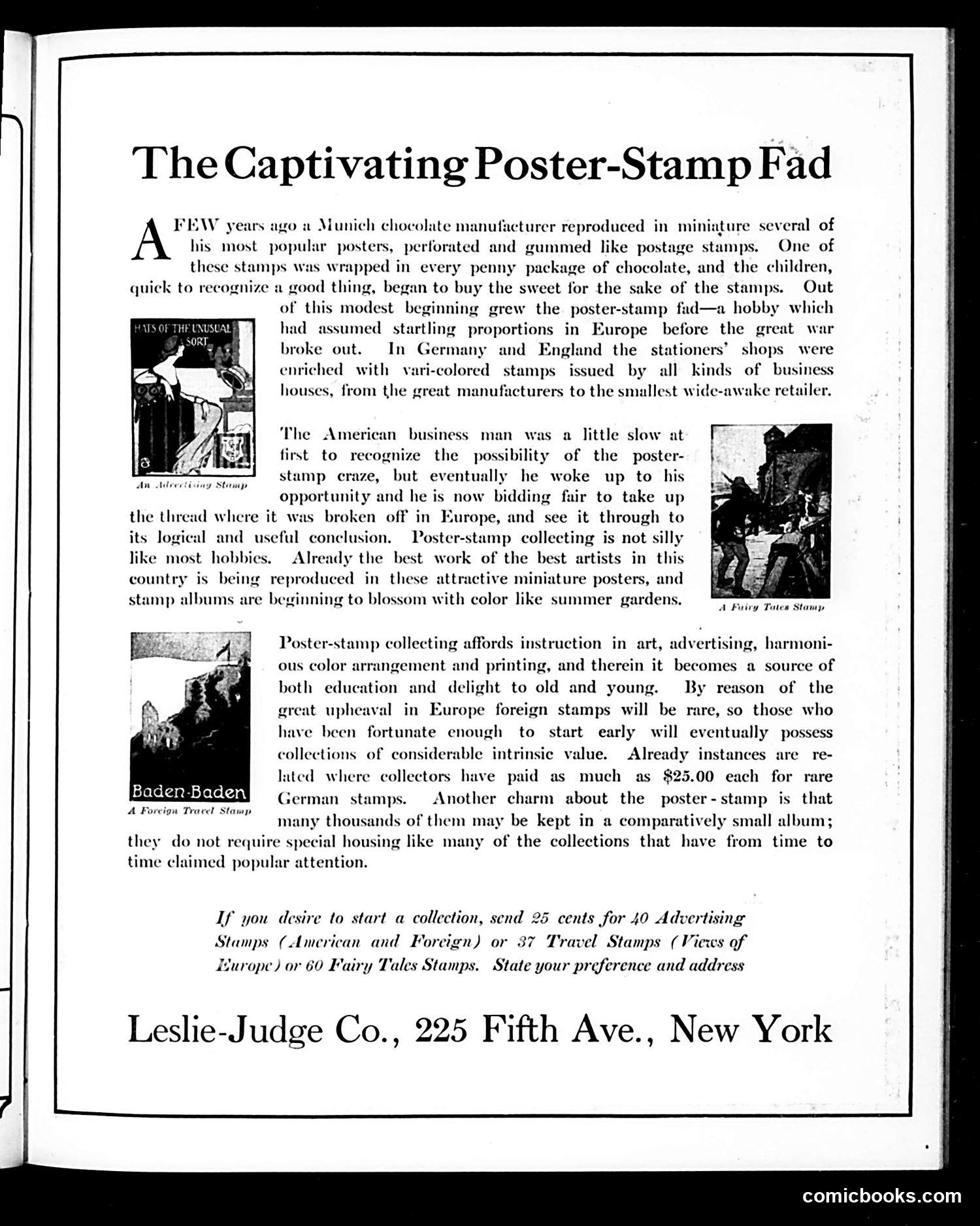
This is primarily **advertising content**, not satire or political commentary. The page promotes a collecting hobby to Judge magazine's readers. **What it describes:** Poster stamps—tiny, gummed decorative stamps modular to actual postage—originated when a Munich chocolate maker included miniatures of his popular posters in penny packages. Children collected them, creating a craze that spread through Europe before WWI. American businesses were slower to capitalize on the trend but eventually recognized its commercial potential. **The pitch:** The text argues poster-stamp collecting is intellectually respectable (unlike "most hobbies"), offering education in art, design, and printing. It hints that European stamps will become rare due to the war, making early collectors wealthy. **The call-to-action:** Leslie-Judge Co. sells starter collections—40 advertising stamps, 37 travel stamps, or 60 fairy-tale stamps—for 25 cents. The three visible stamp images show examples: an advertising stamp, a travel stamp, and a fairy-tale stamp, demonstrating the variety available.
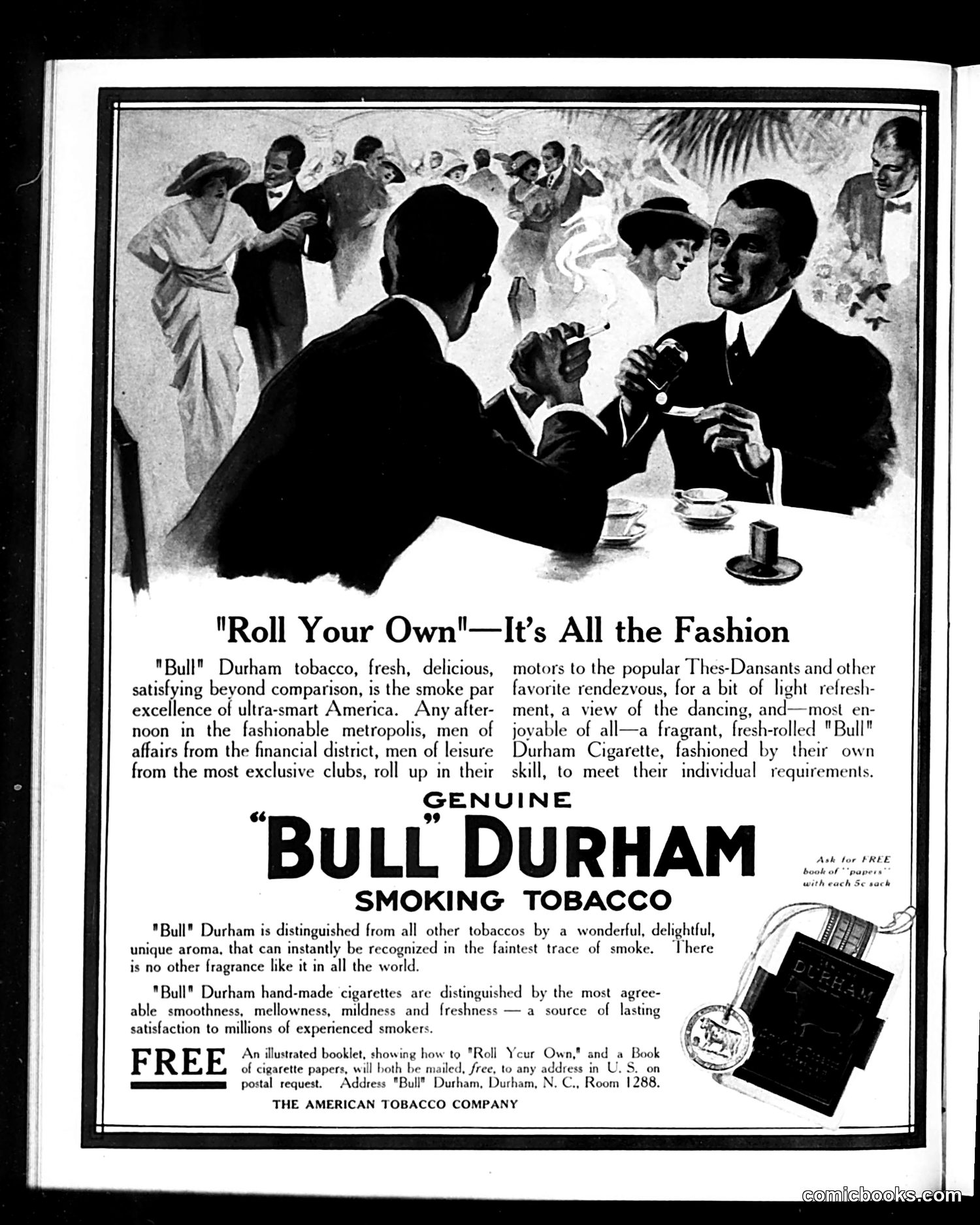
This is a full-page advertisement, not satire. It promotes "Bull" Durham rolling tobacco to wealthy, fashionable men. The illustration depicts well-dressed gentlemen in suits at a social venue (a "Thés-Dansant"—a fashionable afternoon tea-dance). The ad claims that rolling one's own cigarettes has become trendy among Manhattan's elite—financiers and club members arriving by motor car. The social appeal is the pitch: hand-rolling cigarettes signals sophistication and individual taste, distinguishing refined smokers from ordinary ones. The ad emphasizes Durham's unique aroma and smoothness, and offers a free booklet teaching the rolling technique. This reflects early 20th-century marketing that associated manual cigarette-rolling with status and leisure-class masculinity.