
Judge, 1914-11-07 · page 12 of 24
Judge — November 7, 1914 — page 12: what you’re looking at
What you’re looking at
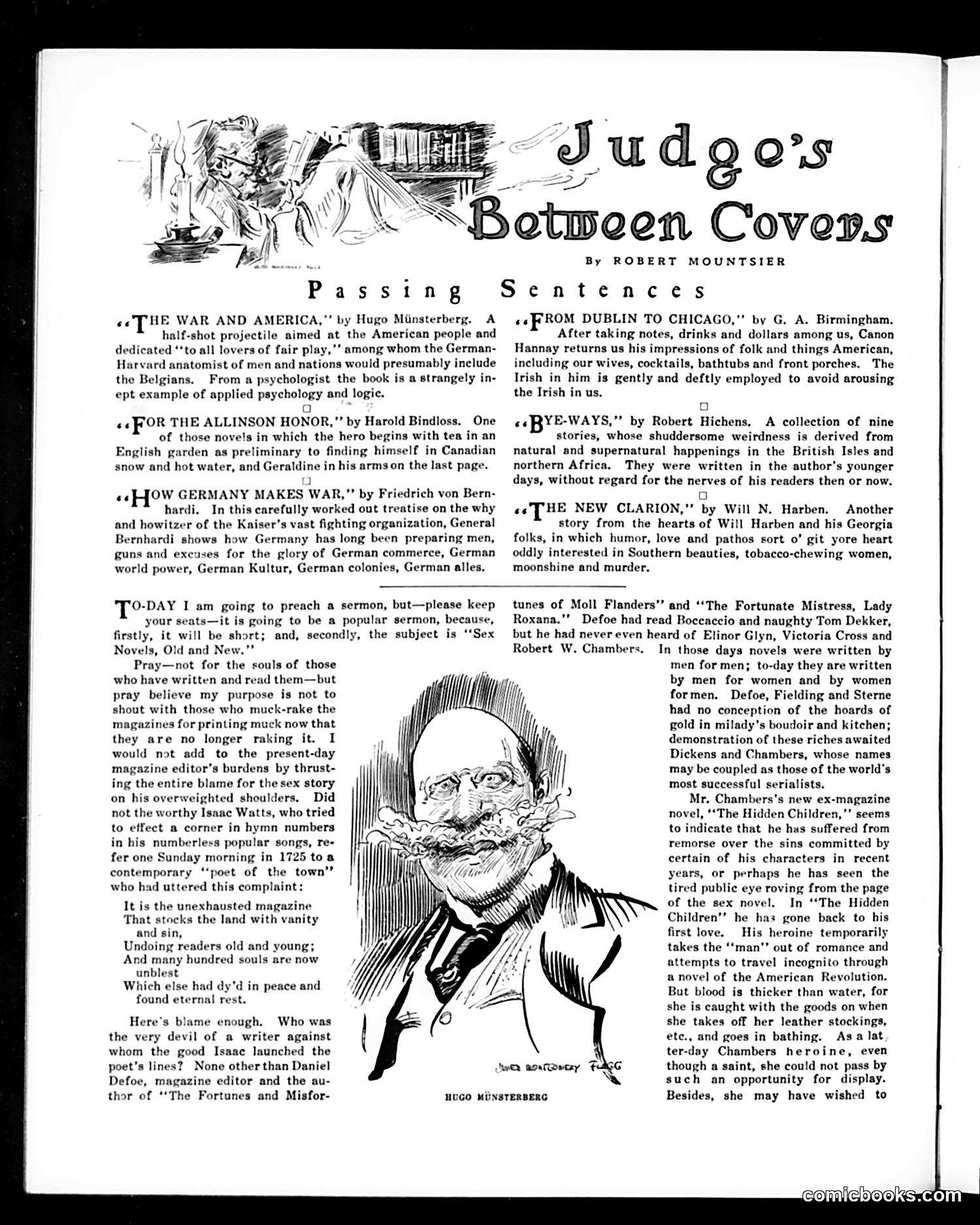
This page features book reviews by Robert Mountsier critiquing recent publications, with satirical commentary on contemporary authors and social issues. The central illustration depicts **Hugo Münsterberg**, a German-American Harvard psychologist whose book "The War and America" is harshly reviewed. Mountsier mocks Münsterberg's attempted defense of German actions during WWI (likely World War I, given references to Belgium and Germany's militarism), calling his psychological analysis "strangely inept." The reviews sarcastically skewer other books: Friedrich von Bernhardt's treatise on German warfare is ridiculed for justifying German imperialism; a travel book by an Irish canon is gently mocked for Irish stereotypes. The essay section attacks "sex novels" by contemporary authors like Elinor Glyn, contrasting them with classic literature by Defoe and Fielding, arguing modern novels pander to female readers' desires rather than serving literary merit. The tone is both prudish and class-conscious—dismissing popular fiction aimed at women as morally corrupting "vanity and sin."
📄 Transcribed text from this page (OCR, searchable)
Machine-transcribed from the original scan — historical spelling and the odd misread are preserved.
a ye =B “Passing ee THE WAR AND AMERICA,"’ by Hugo Minsterberg. A half-shot projectile aimed at the American people and dedicated ‘to all lovers of fair play,’’ among whom the German- Harvard anatomist of men and nations would presumably include the Belgians. From a psychologist the book is a strangely in- ept example of applied psychology and logic. a «« FOR THE ALLINSON HONOR,” by Harold Bindloss. One of those novels in which the hero begins with tea in an English garden as preliminary to finding himself in Canadian snow and hot water, and Geraldine in his armson the last page. ««}YOW GERMANY MAKES WAR,” by Friedrich von Bern- hardi. In this carefully worked out treatise on the why and howitzer of the Kaiser’s vast fighting organization, General Bernhardi shows how Germany has long been preparing men, guns and excuses for the glory of German commerce, German world power, German Kultur, German colonies, German alles. etmeen Coveon.s By ROBERT MOUNTSIER Sentences ««FROM DUBLIN TO CHICAGO," by G. A. Birmingham. After taking notes, drinks and dollars among us, Canon Hannay returns us his impressions of folk and things American, including our wives, cocktails, bathtubs and front porches. The Irish in him is gently and deftly employed to avoid arousing the Irish in us. o ««BYE-WAYS,”” by Robert Hichens. A collection of nine stories, whose shuddersome weirdness is derived from natural and supernatural happenings in the British Isles and northern Africa, They were written in the author's younger days, without regard for the nerves of his readers then or now. a ee THE NEW CLARION,” by Will N. Harben. Another story from the hearts of Will Harben and his Georgia folks, in which humor, love and pathos sort o’ git yore heart oddly interested in Southern beauties, tobacco-chewing women, moonshine and murder. O-DAY I am going to preach a sermon, but—please keep your seats—it is going to be a popular sermon, because, firstly, it will be short; and, secondly, the subject is ‘Sex Novels, Old and New Pray—not for the souls of those who have written and read them—but pray believe my purpose is not to shout with those who muck-rake the magazines for printing muck now that they are no longer raking it. I would not add to the present-day magazine editor’s burdens by thrust- ing the entire blame for the sex story on his overweighted shoulders. Did not the worthy Isaac Watts, who tried to effect a corner in hymn numbers in his numberless popular songs, re- fer one Sunday morning in 1725 toa contemporary ‘‘poet of the town’? who had uttered this complaint: It is the unexhausted magazine That stocks the land with vanity and sin, Undoing readers old and young; Ard many hundred souls are now unblest Which else had dy'd in peace and found eternal rest. Here's blame enough. Who was the very devil of a writer against whom the good Isaac launched the poet’s lines? None other than Daniel Defoe, magazine editor and the au- thor of ‘'The Fortunes and Misfor- nuGo Mi: NSTERBERG tunes of Moll Flanders’ and ‘‘The Fortunate Mistress, Lady Roxana."’ Defoe had read Boccaccio and naughty Tom Dekker, but he had never even heard of Elinor Glyn, Victoria Cross and Robert W. Chambers. In those days novels were written by men for men; to-day they are written by men for women and by women formen. Defoe, Fielding and Sterne had no conception of the hoards of gold in milady’s boudoir and kitchen; demonstration of these riches awaited Dickens and Chambers, whose names may be coupled as those of the world’s most successful serialists. Mr. Chambers’s new ex-magazine novel, ‘The Hidden Children,”’ seems to indicate that he has suffered from remorse over the sins committed by certain of his characters in recent years, or perhaps he has seen the tired public eye roving from the page of the sex novel. In ‘*The Hidden Children’? he has gone back to his first love. His heroine temporarily takes the ‘‘man’’ out of romance and attempts to travel incognito through a novel of the American Revolution. But blood is thicker than water, for she is caught with the goods on when she takes off her leather stockings, ete., and goes in bathing. Asa lat ter-day Chambers heroine, even though a saint, she could not pass by such an opportunity for display. Besides, she may have wished to ih cho monTDecay Frage