
Judge, 1914-11-07 · page 17 of 24
Judge — November 7, 1914 — page 17: what you’re looking at
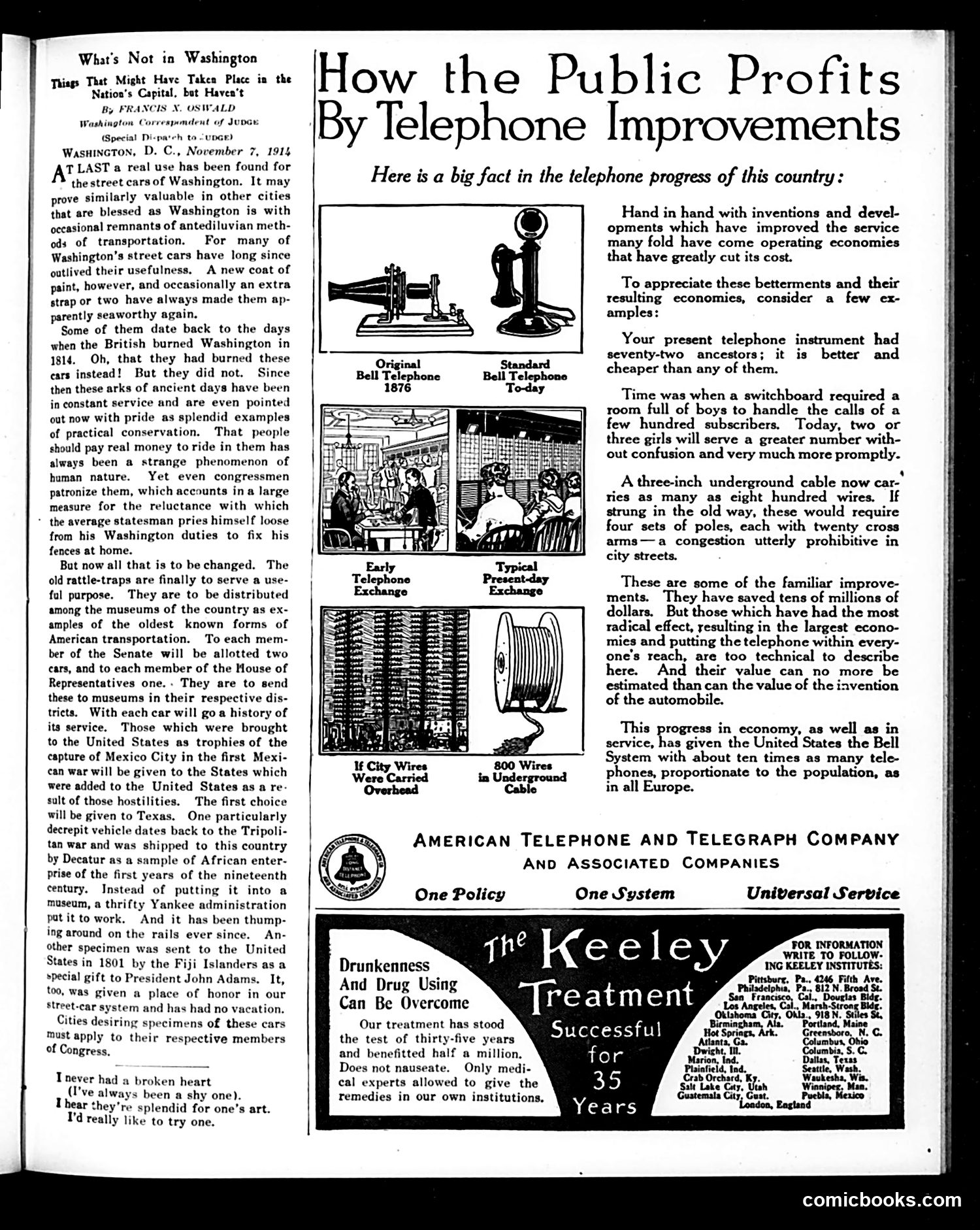
What you’re looking at
This page contains two distinct pieces: **Left column:** A humorous essay by Francis X. Oswald mocking Washington, D.C.'s decrepit street cars. The satire targets two things: (1) the absurdly ancient public transportation still in use—some allegedly dating to the War of 1812—and (2) congressmen who tolerate this decay. The "joke" proposes distributing these worn-out cars to museums as historical artifacts, with prestigious specimens going to states based on their historical significance (Texas gets those from the Mexican-American War, etc.). This satirizes both governmental neglect of infrastructure and politicians' reluctance to leave Washington to address local problems. **Right side:** A straightforward advertisement by American Telephone and Telegraph Company showcasing telephone technological improvements and cost efficiencies—contrasting primitive early equipment with modern versions, demonstrating reduced labor needs and cable innovations. This is corporate propaganda, not satire. **Bottom:** An unrelated advertisement for "The Keeley Treatment" for alcoholism. The page illustrates Judge's mix of political satire and advertising.
📄 Transcribed text from this page (OCR, searchable)
Machine-transcribed from the original scan — historical spelling and the odd misread are preserved.
What's Not in Washington Things That Might Have Taken Place in the Nation’s Capital, but Haven't By FRANCIS X. OSWALD Washington Correspemdent of Juvce (Special Di-parch to “upce) WasnincTon, D. C., November 7, 1914 AT LAST a real use has been found for the street cars of Washington. It may prove similarly valuable in other cities that are blessed as Washington is with occasional remnants of antediluvian meth- ods of transportation. For many of Washington’s street cars have long since outlived their usefulness. A new coat of paint, however, and occasionally an extra strap or two have always made them ap- parently seaworthy again. Some of them date back to the days when the British burned Washington in 1814. Oh, that they had burned these cars instead! But they did not. Since then these arks of ancient days have been in constant service and are even pointed out now with pride as splendid examples of practical conservation. That people should pay real money to ride in them has always been a strange phenomenon of human nature. Yet even congressmen patronize them, which accounts ina large measure for the reluctance with which * the average statesman pries himself loose from his Washington duties to fix his fences at home. But now all that is to be changed. The old rattle-traps are finally to serve a use- ful purpose. They are to be distributed among the museums of the country as ex- amples of the oldest known forms of American transportation. To each mem- ber of the Senate will be allotted two cars, and to each member of the Mouse of Representatives one.. They are to send these to museums in their respective dis- tricts. With each car will goa history of its service. Those which were brought to the United States as trophies of the capture of Mexico City in the first Mexi- can war will be given to the States which were added to the United States as a re- sult of those hostilities. The first choice will be given to Texas. One particularly decrepit vehicle dates back to the Tripoli- tan war and was shipped to this country by Decatur as a sample of African enter- Prise of the first years of the nineteenth century. Instead of putting it into a museum, a thrifty Yankee administration pat it to work. And it has been thump- ing around on the rails ever since. An- other specimen was sent to the United States in 1801 by the Fiji Islanders as a special gift to President John Adams. It, too, was given a place of honor in our Street-car system and has had no vacation. Cities desiring specimens of these cars must apply to their respective members of Congress. Thever had a broken heart (I've always been a shy one). hear they're splendid for one’s art. I'd realiy like to try one. How the Public Profits [By Telephone Improvements Here is a big fact in the telephone progress of this country: Hand in hand with inventions and devel- opments which have improved the service many fold have come operating economies that have greatly cut its cost. To appreciate these betterments and their resulting economies, consider a few ex- amples: Your present telephone instrument had seventy-two ancestors; it is better and cheaper than any of them. Time was when a switchboard required a room full of boys to handle the calls of a few hundred subscribers. Today, two or three girls will serve a greater number with- out confusion and very much more promptly. A three-inch underground cable now car ries as many as eight hundred wires. If strung in the old way, these would require four sets of poles, each with twenty cross arms—a congestion utterly prohibitive in city streets. These are some of the familiar improve- ments. They have saved tens of millions of dollars. But those which have had the most radical effect, resulting in the largest econo- mies and putting the telephone within every- one’s reach, are too technical to describe here. And their value can no more be estimated than can the value of the invention of the automobile. This progress in economy, as well as in service, has given the United States the Bell System with about ten times as many tele- phones, proportionate to the population, as in all Europe. AMERICAN TELEPHONE AND TELEGRAPH COMPANY AND ASSOCIATED COMPANIES One System Universal Service White 70 FOLLOW: Drunkenness ING KEELEY INSTITUTES: Pittsburg, Pa.. 4246 Filth Ave. And Drug Using Panisaace. Ba 46, Filth Ave, Can Be Overcome [ reatm ent we ica, Ca. Dowels Bi Our treatment has stood the test of thirty-five years Successful and benefitted half a million, for Does not nauseate. Only medi- cal experts allowed to give the 3 5 remedies in our own institutions. Years comicbooks.com