
A complete issue · 24 pages · 1914
Judge — August 22, 1914
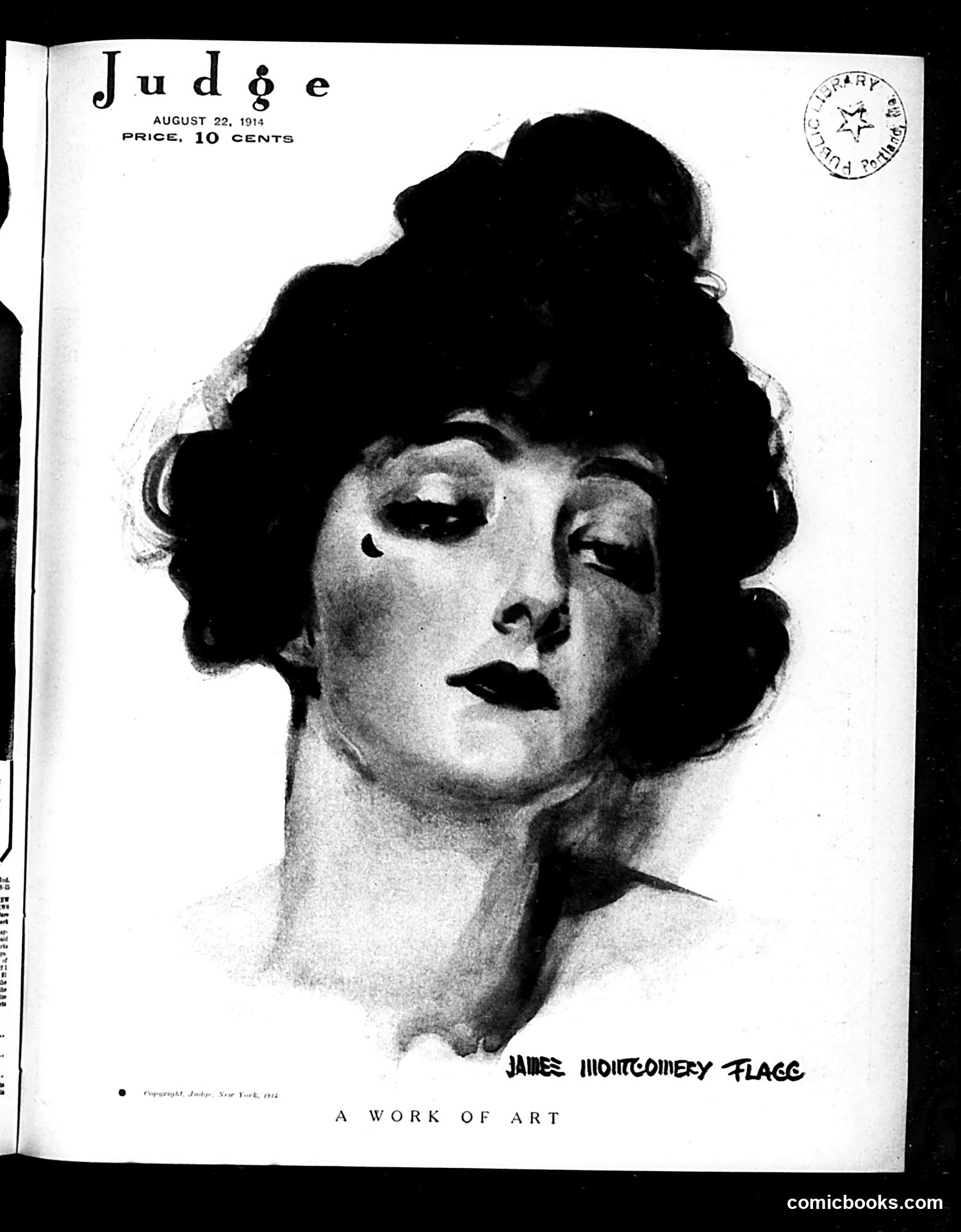
This Judge magazine cover from August 22, 1914, features a portrait credited to "James Montgomery Flagg" labeled "A Work of Art." Rather than political satire, this appears to be a showcase of Flagg's portraiture skills—displaying his artistic technique through a striking charcoal or photographic portrait of a woman with 1914-era styling (bobbed hair, defined makeup). Flagg was a renowned illustrator and artist of the period, so Judge is essentially promoting or celebrating his work. The cover serves as both a magazine cover and an advertisement for the artist's abilities. The price of 10 cents reflects typical magazine pricing of that era. This is more art showcase than political commentary.
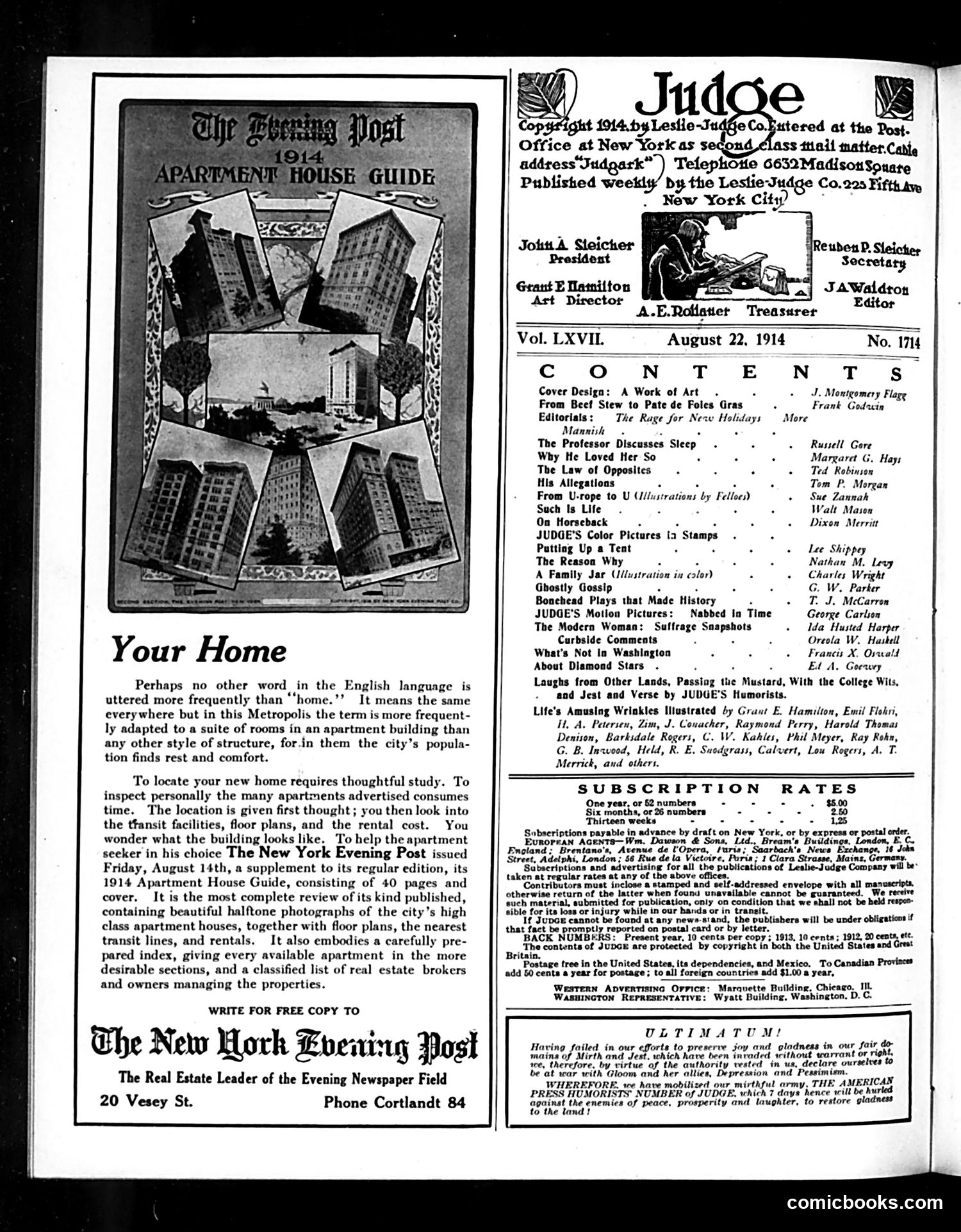
This is primarily a **real estate advertisement** for "The New York Evening Post," promoting their 1914 Apartment House Guide. The cover design showcases apartment buildings—a visual marketing approach highlighting the publication's real estate coverage. The accompanying editorial titled "Your Home" discusses choosing apartments in New York City, emphasizing that selecting residential space requires "thoughtful study" of location, building quality, and rental costs. The left page features the **legitimate advertisement** for The New North Evening Post, positioning it as "The Real Estate Leader of the Evening Newspaper Field." This appears to be a **sponsored content issue** rather than satirical material—Judge's typical domain. The page demonstrates how early 20th-century magazines integrated advertising with editorial content.
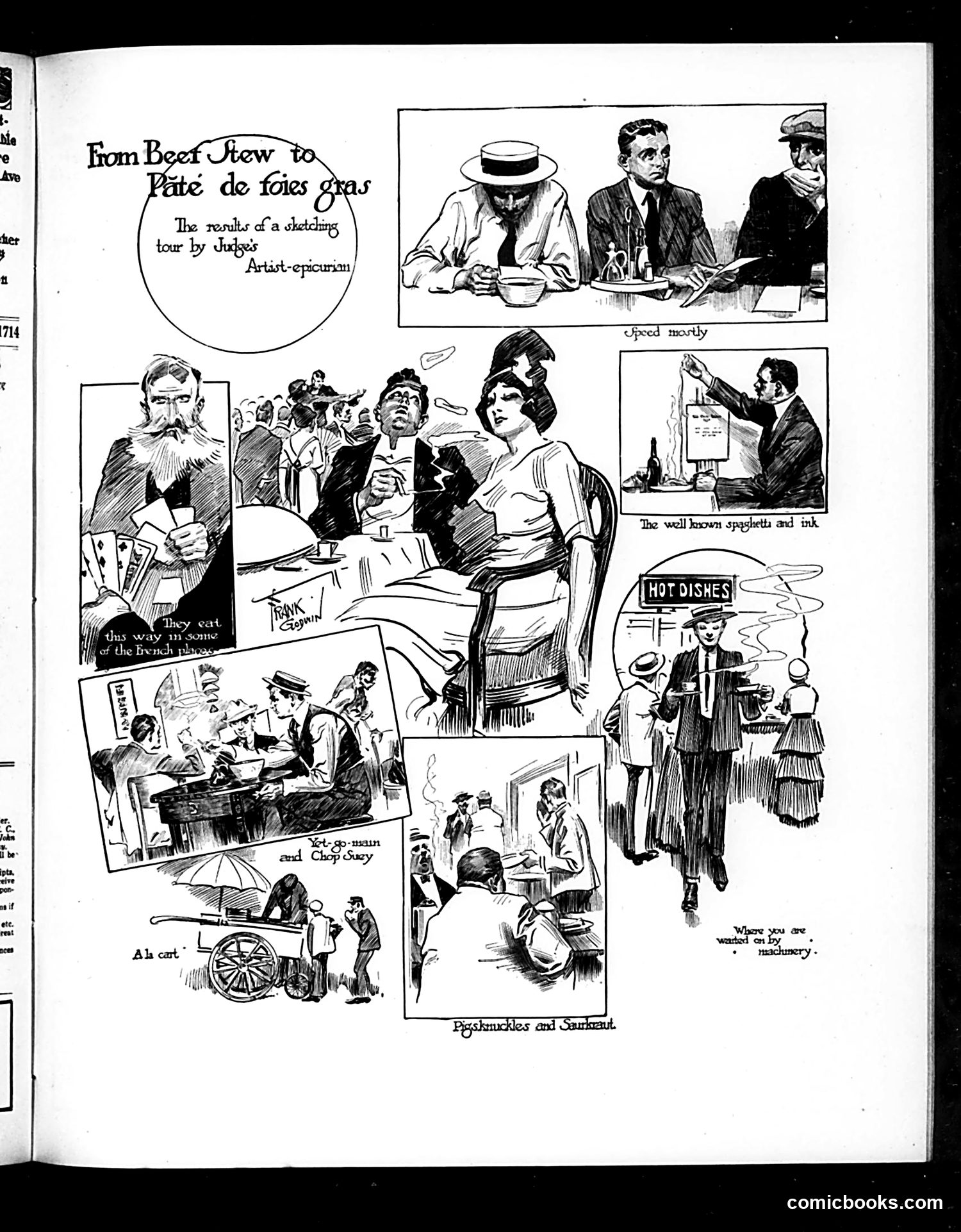
This page satirizes Parisian dining culture and French culinary pretension through a "sketching tour by Judge's Artist-epicurean." The cartoon traces the journey from cheap, working-class French food (beef stew) to haute cuisine (pâté de foies gras). The panels show: - Street vendors and working-class diners eating simply - A bearded man eating "the way of the French places" - Wealthy diners at refined establishments - References to "Hot Dishes" and street food commerce - Working-class meals versus aristocratic dining The satire mocks both French culinary snobbery and American fascination with European sophistication. The "artist-epicurean" documents how Parisians navigate class distinctions through food, suggesting pretension and the gap between everyday French life and romanticized French cuisine that American audiences consumed.
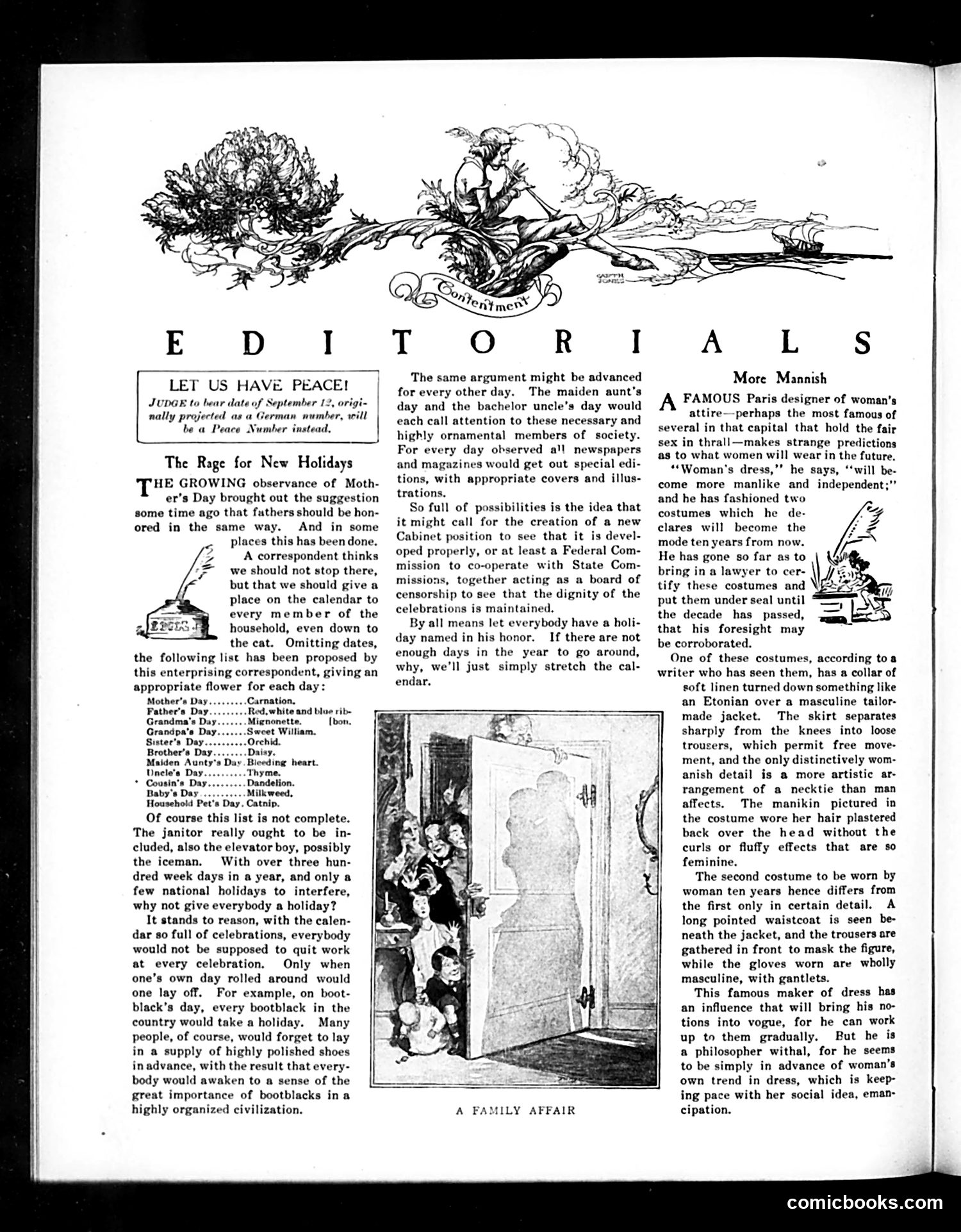
This page contains two distinct editorial pieces from *Judge* magazine: **"Let Us Have Peace!"** critiques the proliferation of new national holidays. The author argues that adding holidays for every family member (Maiden Aunt's Day, Bachelor Uncle's Day, etc.) is impractical and dilutes workplace productivity. The satire suggests that if we honored every possible person with a dedicated day, nobody would work. The editorial advocates for restraint, noting that true holidays require universal observance and shouldn't fragment society into endless special occasions. **"More Mannish"** discusses a famous Paris fashion designer who predicts women's clothing will become "more manlike and independent." The piece describes two proposed costumes—one with masculine tailoring and another featuring gathered trousers—while questioning whether such fashions genuinely reflect women's social progress or merely follow designer trends. Both pieces use gentle satire to comment on contemporary American social customs and European fashion influence.
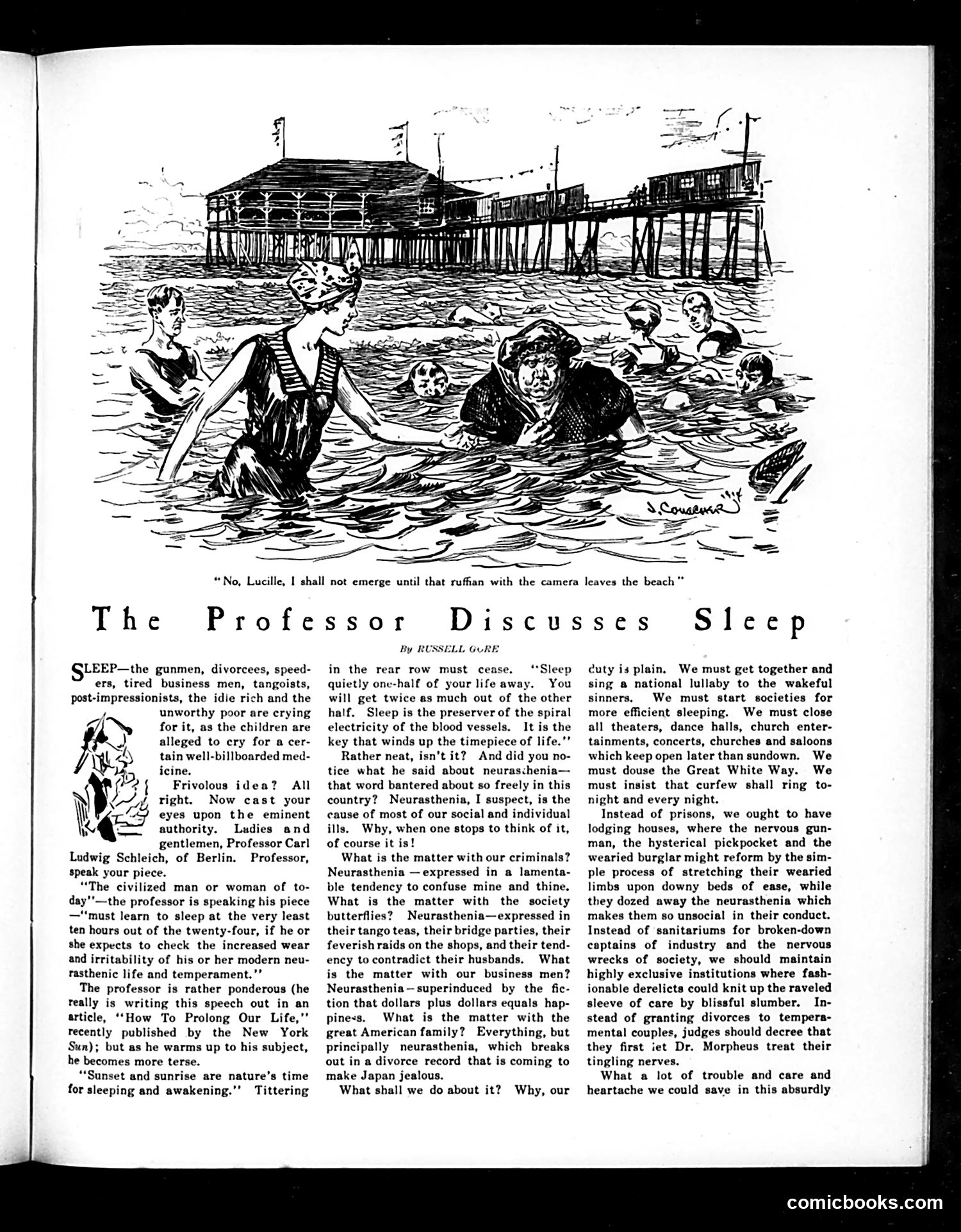
This satirical piece mocks Professor Carl Ludwig Schleich of Berlin, a real physician who published "How To Prolong Our Life" in the *New York Sun*. The cartoon illustrates his advice on sleep hygiene while Gore's article ironically critiques neurasthenia—a period diagnosis for nervous exhaustion affecting the wealthy. The satire targets how the professor's sleep recommendations seem disconnected from actual social problems: neurasthenia caused by modern urban life, failed marriages, business stress, and social anxiety. Gore argues sarcastically that rather than sanitariums and divorce, society should address root causes—suggesting the professor's self-help prescriptions are simplistic solutions to complex societal ailments plaguing contemporary America.
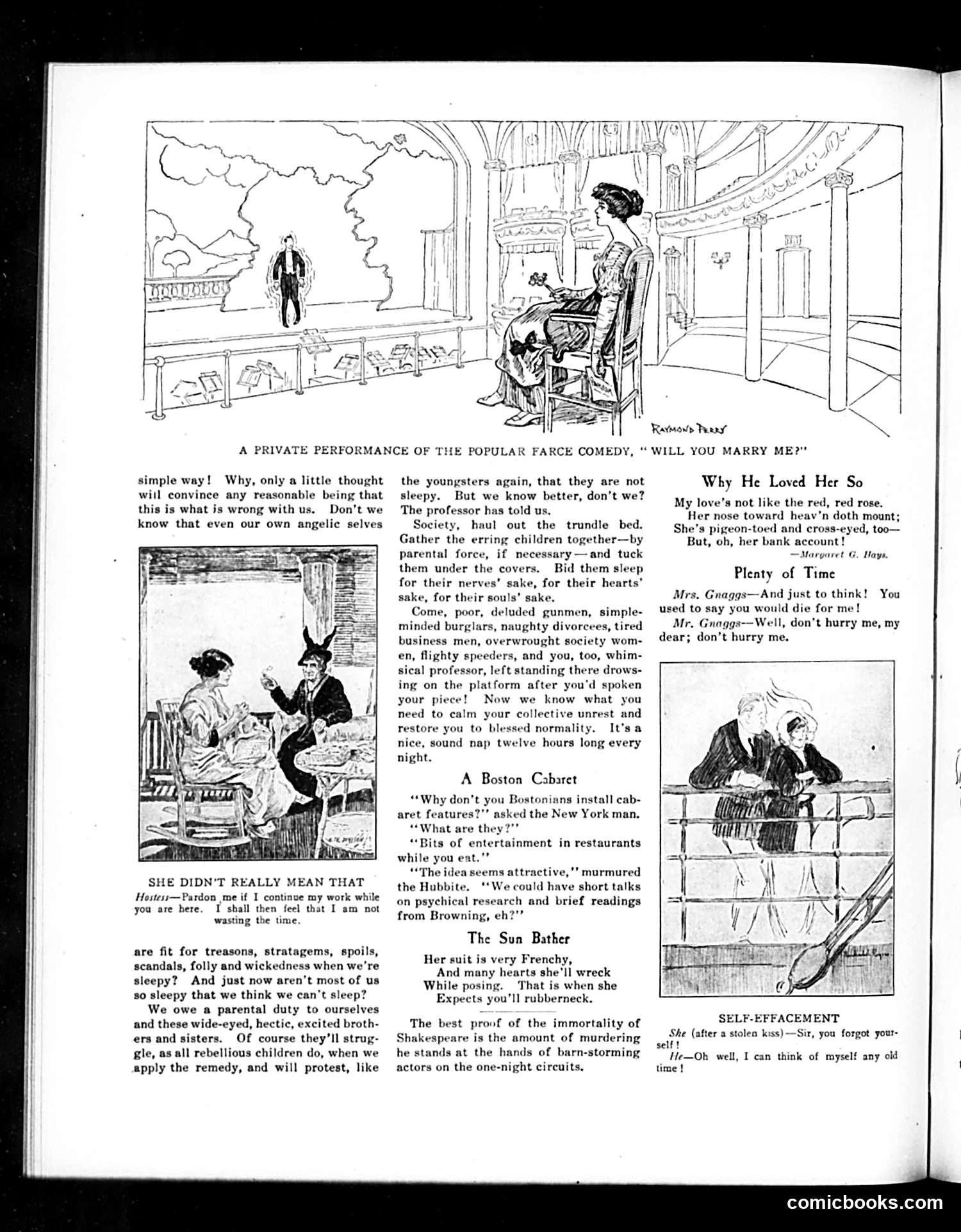
This page contains multiple brief humorous sketches and satirical pieces typical of early-20th-century Judge magazine. **Top cartoon** ("A Private Performance"): Shows a woman watching a theatrical farce performance, satirizing popular entertainment tastes of the era. **"She Didn't Really Mean That"**: A hostess insults a guest by continuing work, claiming she's avoiding wasting time—satirizing false politeness and social hypocrisy. **"A Boston Cabaret"**: Mocks Boston's intellectual culture, imagining cabaret entertainment would consist of "psychical research" lectures and Browning poetry readings rather than actual entertainment—stereotyping Bostonians as pretentiously highbrow. **Other pieces** include gentle domestic humor ("Plenty of Time" about marital apathy), commentary on theatrical quality, and brief romantic quips. The satire targets class pretensions, social conventions, and regional stereotypes—common Judge themes. The material reflects early-1900s attitudes toward entertainment, gender roles, and urban American life.
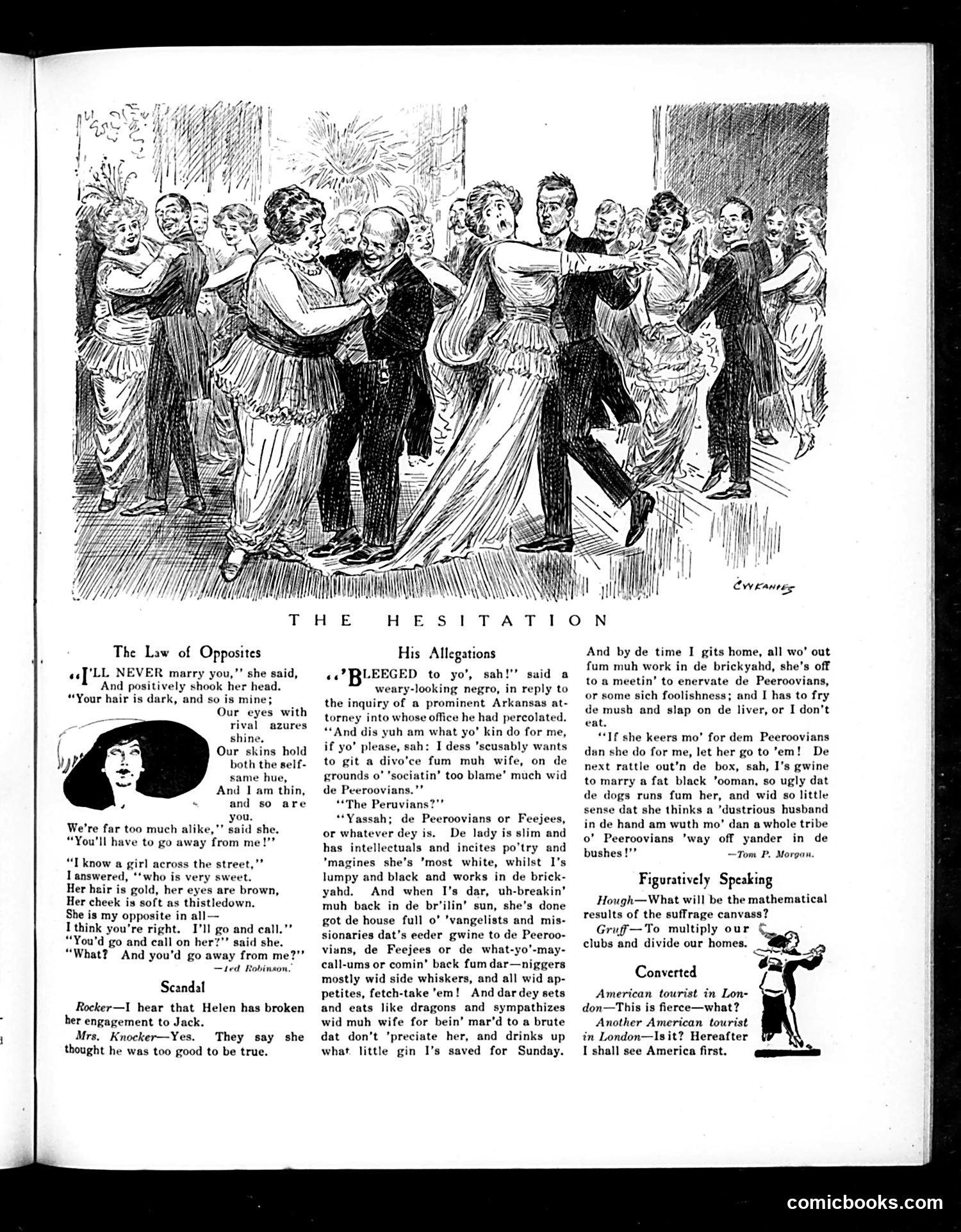
This Judge magazine page contains three satirical pieces mocking contemporary social attitudes: **"The Law of Opposites"** depicts courtship logic—a woman rejects a suitor for being too similar, then grows jealous when he pursues someone opposite to her. The satire targets female inconsistency in romantic expectations. **"His Allegations"** presents a caricatured African American man seeking divorce because his wife associates with missionaries and evangelists (likely working with "Peruvians" or foreign converts). The dialect-heavy humor and depiction rely on racist stereotypes common to the era, mocking both the man's complaint and implicitly the charitable/missionary activities themselves. **Minor pieces** include "Scandal" (about broken engagements), "Figuratively Speaking" (women's suffrage joke about "dividing homes"), and "Converted" (American tourists abroad). The page's humor targets women's inconsistency, missionary zeal, and suffrage—reflecting early-20th-century conservative attitudes. The racist caricature represents period publication standards now recognized as deeply offensive.
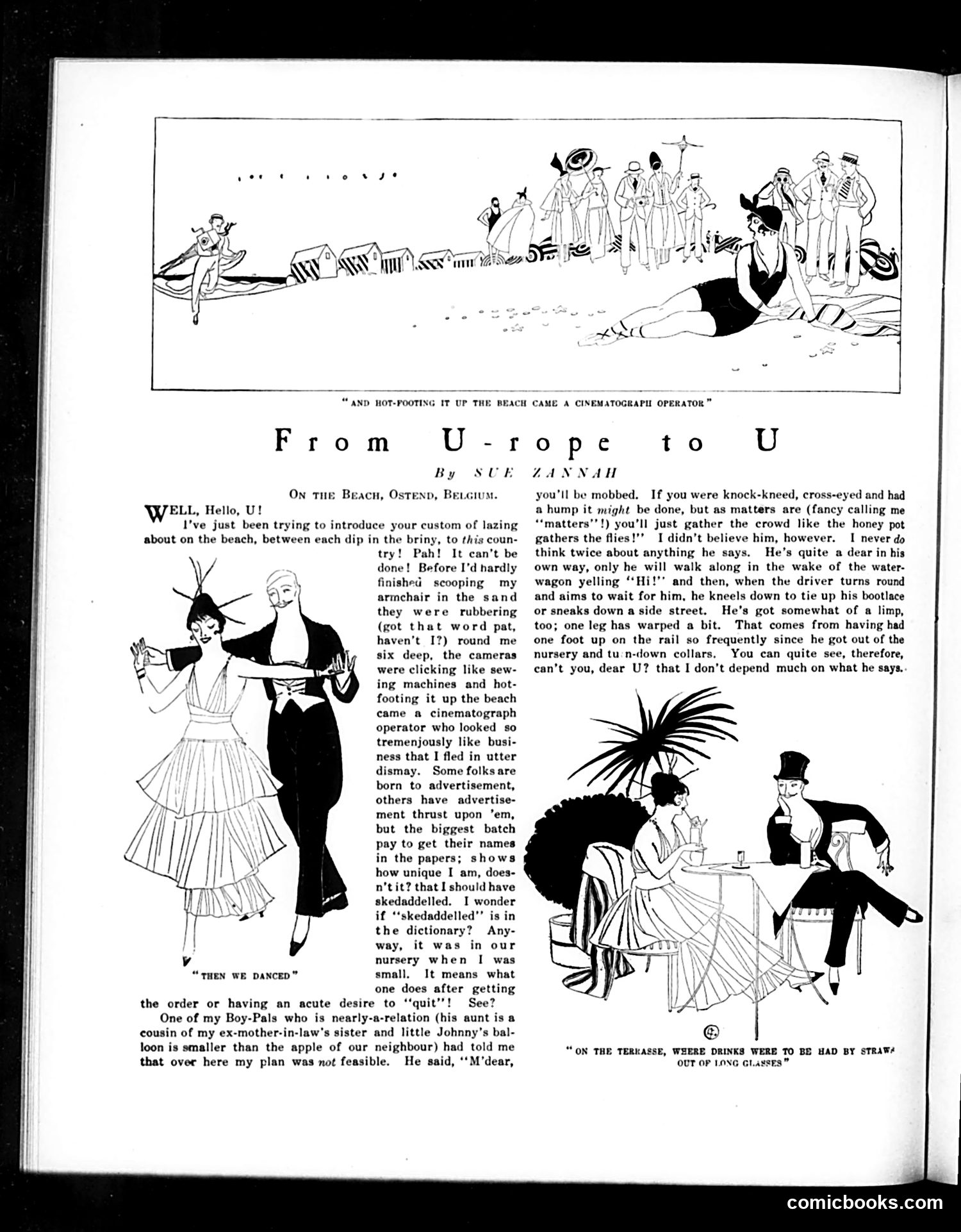
This is a humorous travel column by "Sue Zannah" mocking European beach culture, specifically Belgian customs at Ostend. The satire targets: **The Setup:** The American narrator attempts to introduce "lazying about" on beaches—a practice she assumes is uniquely European—but discovers it's actually universal human behavior. **The Joke:** When she tries to relax on the beach, she's immediately mobbed by cameras and cinematograph operators (early film crews). Rather than being uniquely European, the beach scene attracts the same intrusive modern apparatus everywhere—photographers and filmmakers pursuing "news" content. **The Point:** The satire ridicules how modern media (newsreels, photography) has colonized leisure and travel, turning peaceful moments into performative spectacles. It also gently mocks American tourists' assumptions about European sophistication and distinctiveness—finding that modernity and commercial intrusion are globally uniform. The accompanying illustrations show beach society and terrace dining, emphasizing how even supposed leisure is now mediated through cameras and crowds.
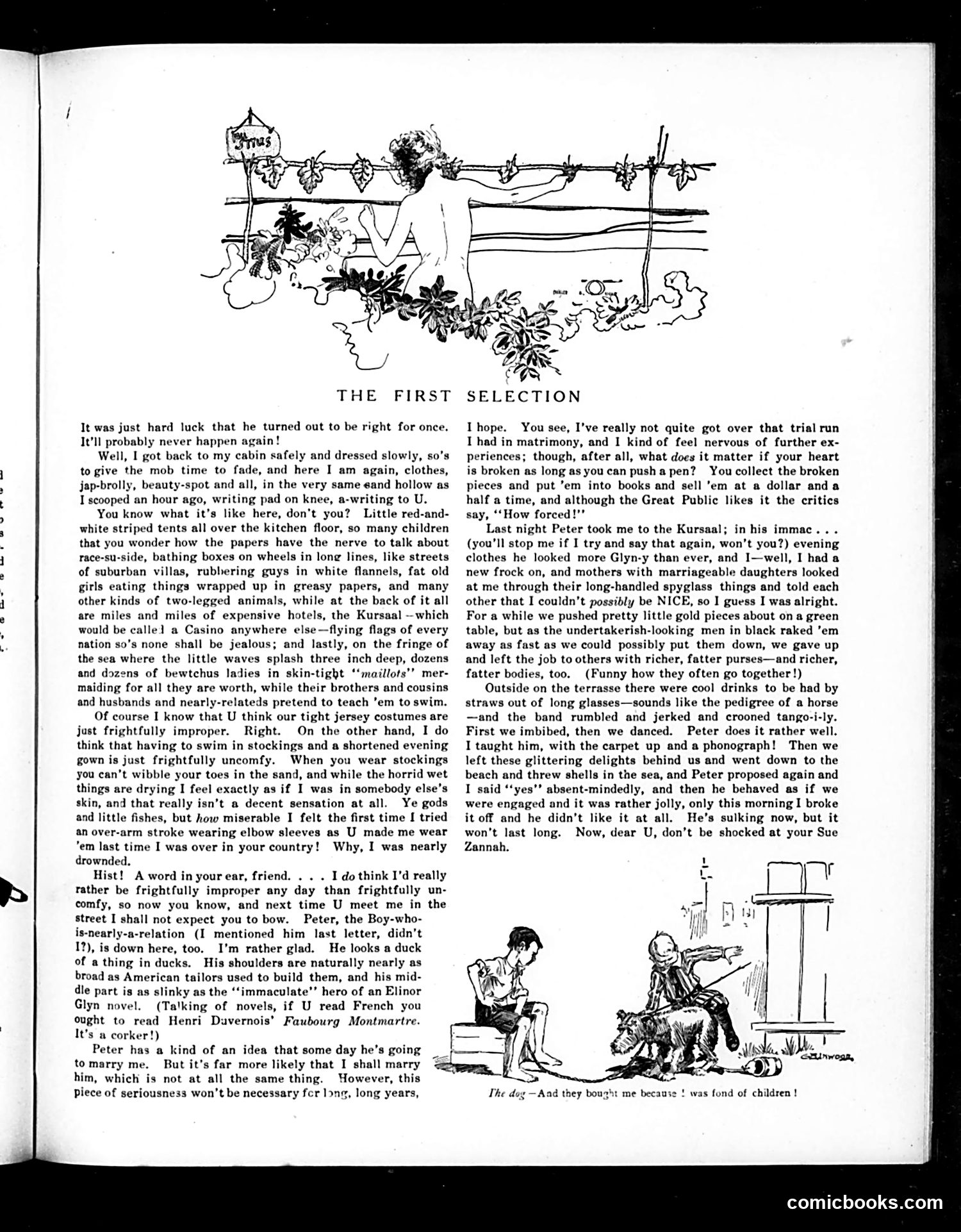
This page presents a humorous letter from a female correspondent describing a seaside holiday (likely British, given references to the Kursaal and Continental customs). The satire targets several Edwardian-era social conventions: **The main joke:** The writer contrasts rigid Victorian propriety (represented by her correspondent "U") with practical comfort. She mocks women forced to swim in stockings and sleeveless evening gowns as "frightfully uncomfy" while being deemed "proper," versus the scandalous French-style bathing costumes ("maillots") that are actually sensible. **Social references:** Elinor Glyn was a famous risqué novelist known for romantic scandals; invoking her name suggests impropriety. The casual mention of a failed marriage and potential suitors (Peter) reflects Edwardian anxieties about unmarried women's behavior and marriage prospects. **The cartoon below** shows a man and woman with a dog, captioned "And they bought me because I was fond of children!" — a joke about being kept as a pet/companion rather than a serious romantic prospect. The overall satire ridicules excessive prudishness while gently mocking modern youth's romantic entanglements.
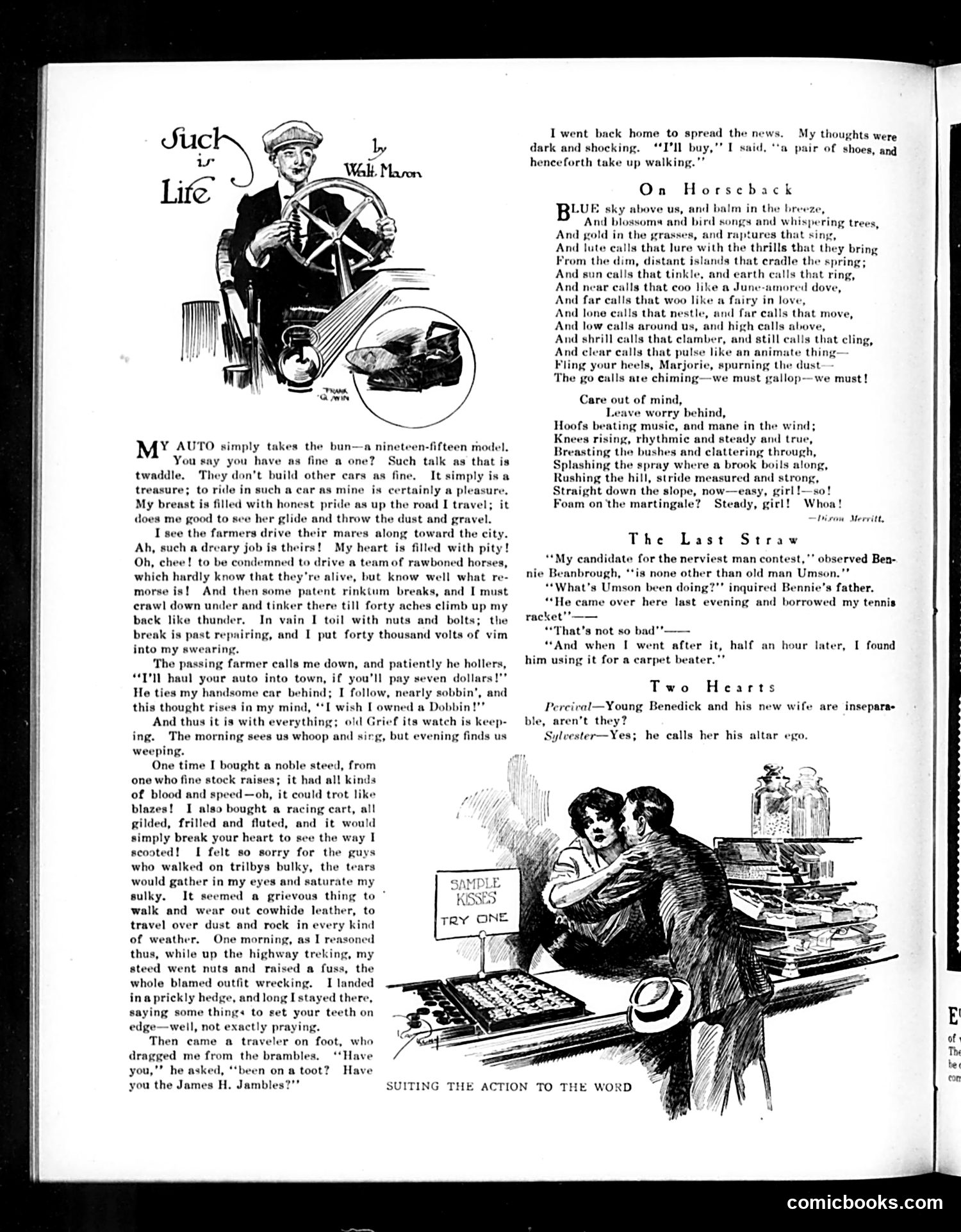
This page satirizes early automotive culture versus traditional transportation. The main story "Such is Life" by Walt Mason ridicules car owners' arrogance. The narrator boasts about his 1915 automobile's superiority over horses, yet repeatedly breaks down, requiring a farmer to tow him—ironically forcing him to wish he owned a simple horse ("Dobbin"). He also recounts buying a racing horse that crashes spectacularly. The satire's point: modern technology owners are smug about progress while constantly humiliated by mechanical failures, making them worse off than those with humble, reliable alternatives. The accompanying poem "On Horseback" romanticizes natural horse travel, contrasting with the automobile's unreliability. "The Last Straw" is a brief joke: a man borrows a tennis racket—presented as the ultimate nerve-testing audacity, mocking how small social transgressions were considered shocking to 1910s sensibilities.
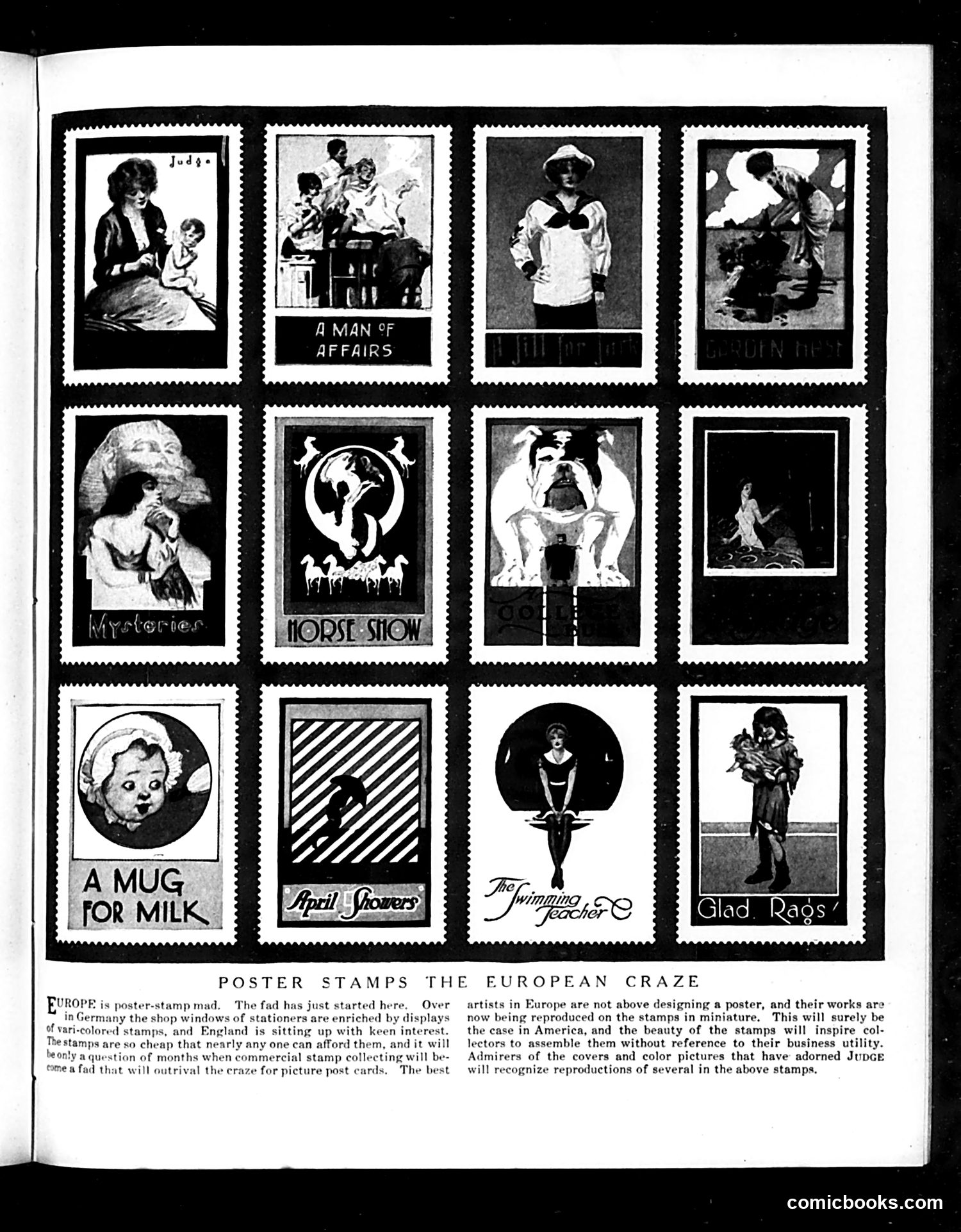
This page documents a collecting trend spreading from Europe to America: miniature poster stamps featuring artwork by prominent artists. The text explains that European stationers' windows display colorful stamps so affordable that mass collecting is becoming viable—potentially rivaling picture postcard collecting. The twelve stamps shown reproduce artwork that previously appeared in *Judge* magazine covers and illustrations, including identifiable titles like "A Man of Affairs," "A Mug for Milk," "Horse Show," "April Showers," "The Swimming Lesson," and "Glad Rags." The satire appears gentle: the piece celebrates European sophistication while predicting Americans will enthusiastically embrace this new fad. The joke seems to be on American consumers' susceptibility to European trends and the commercialization of art into collectible trinkets—turning serious artistic work into cheap, mass-produced novelties for stamp collectors.
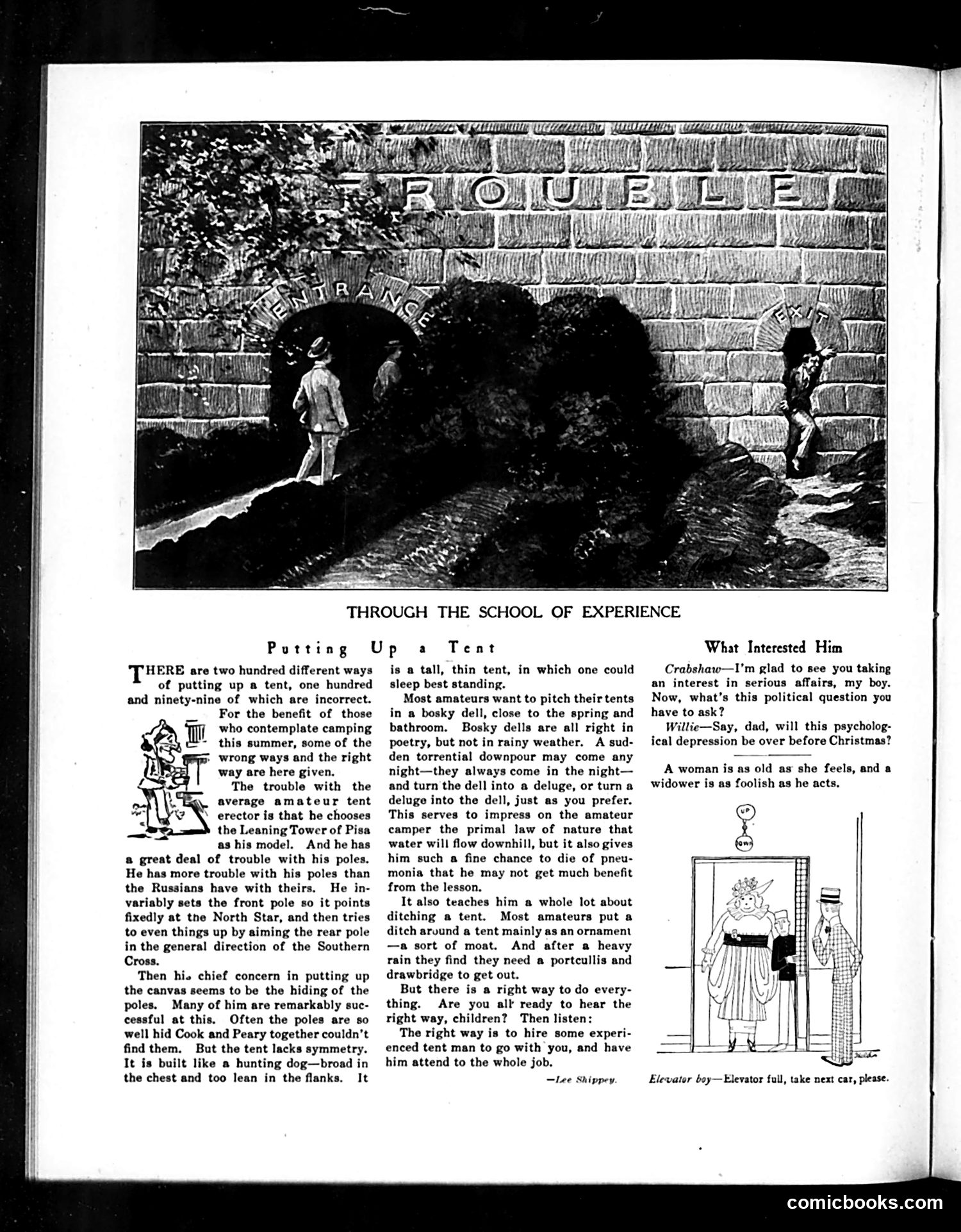
This page contains two distinct pieces of satirical humor: **"Putting Up a Tent"** is a comedic instructional article mocking amateur campers. The author (Lee Shippey) humorously catalogs the incompetent ways inexperienced people pitch tents—leaning structures (referencing the Leaning Tower of Pisa), poles pointed at wrong stars, poorly hidden supports. The satire culminates in the "right way": hire an experienced professional to do it for you. This gently mocks the overconfidence of amateur outdoorsmen attempting tasks beyond their skill. **The three smaller pieces** are brief jokes: "What Interested Him" jokes about a boy asking his father about "psychological depression" (the economic Great Depression), showing children's confusion about adult concerns. The other two are one-liners about women's age and an elevator attendant's quip. The "ROULETE" brick building visible in the illustration appears to be a venue or establishment, though its specific relevance is unclear from context. The overall tone is light domestic humor typical of 1920s-30s American satirical magazines.
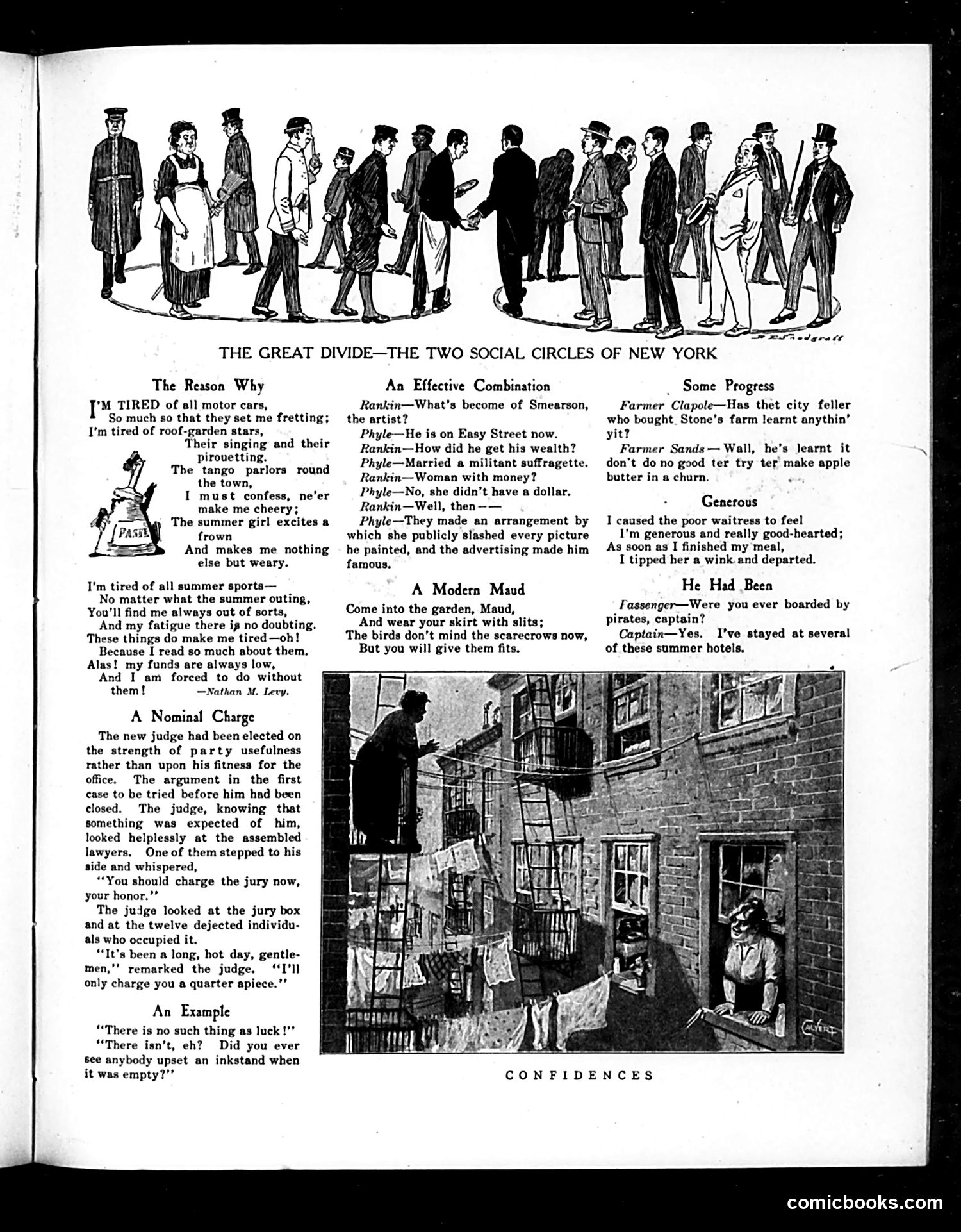
This Judge page satirizes the stark division between New York's wealthy and working classes around the early 1900s. **The Top Cartoon** contrasts two social circles: the wealthy (left) exhausted by fashionable pursuits—motor cars, roof gardens, tango halls—complaining of boredom despite their leisure; and the working poor (right) gathering together. The satire suggests the rich are jaded and empty despite abundance, while the poor find community and meaning. **The Dialogue Sketches** mock specific targets: a "militant suffragette" who married for money (contemporary feminist ridicule); summer hotels exploiting tourists; and a newly-elected judge so unqualified he charges the jury "a quarter apiece" instead of legal instruction (mocking political patronage appointments). **"A Modern Maud"** parodies romantic poetry while advising women to wear revealing skirts—simultaneously mocking both Victorian sentimentality and modest dress. The overall message critiques wealth as spiritually hollow while portraying working-class life as more genuine, though still precarious.
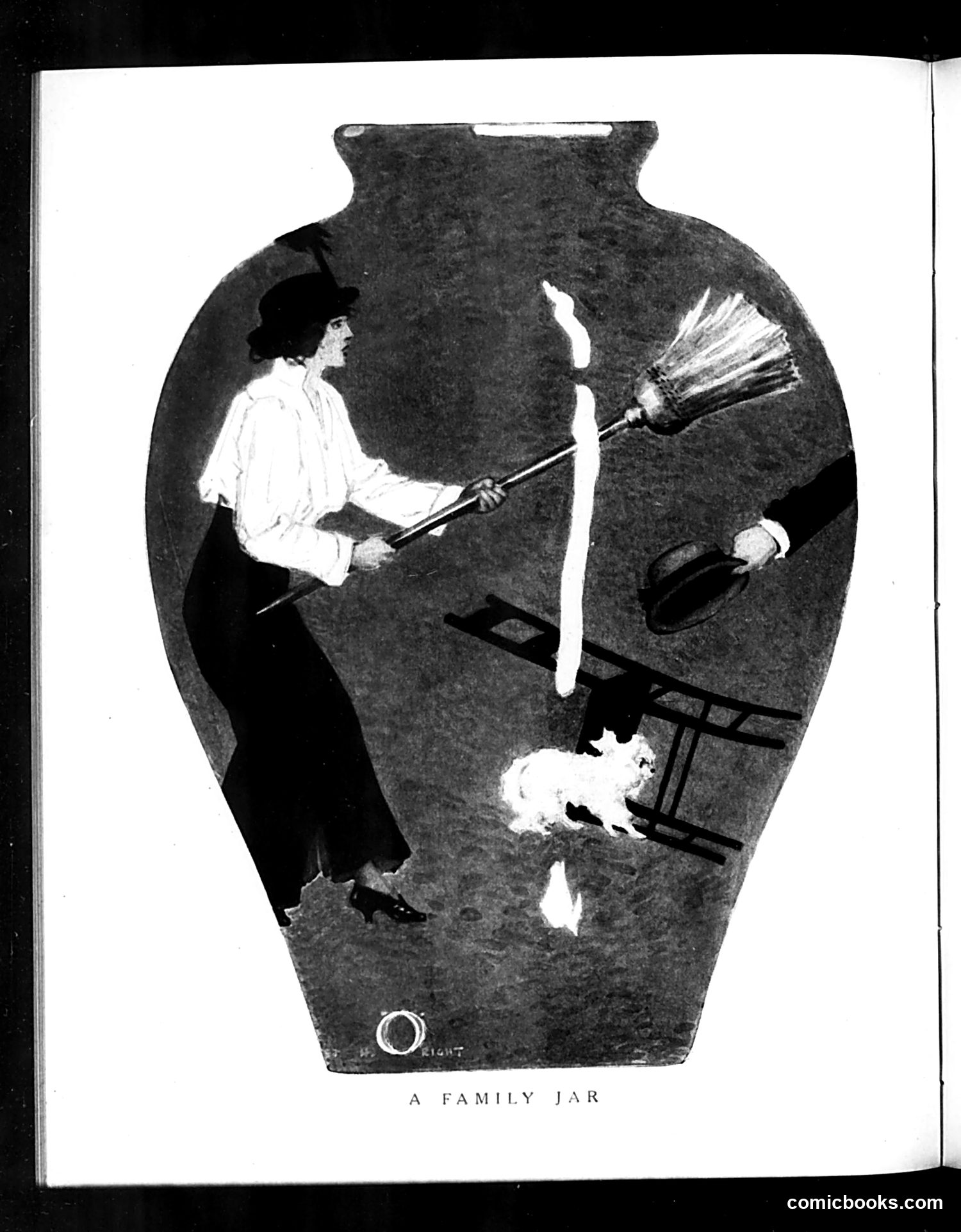
This satirical illustration depicts a large vase or jar containing a domestic scene. A woman holding a broom stands inside what appears to be a confined space, surrounded by household elements: a small child, a chair, and other domestic furnishings. The composition suggests a critique of domestic life—likely satirizing the constraints of marriage and family responsibilities, particularly for women. The "jar" metaphor implies the household functions as a confining container, trapping family members within it. This was a common Judge magazine theme during the early-to-mid 20th century, when satirists frequently commented on domestic confinement, gender roles, and the pressures of family life. The cramped, claustrophobic composition emphasizes the satirical point about limited freedom within domestic structures.
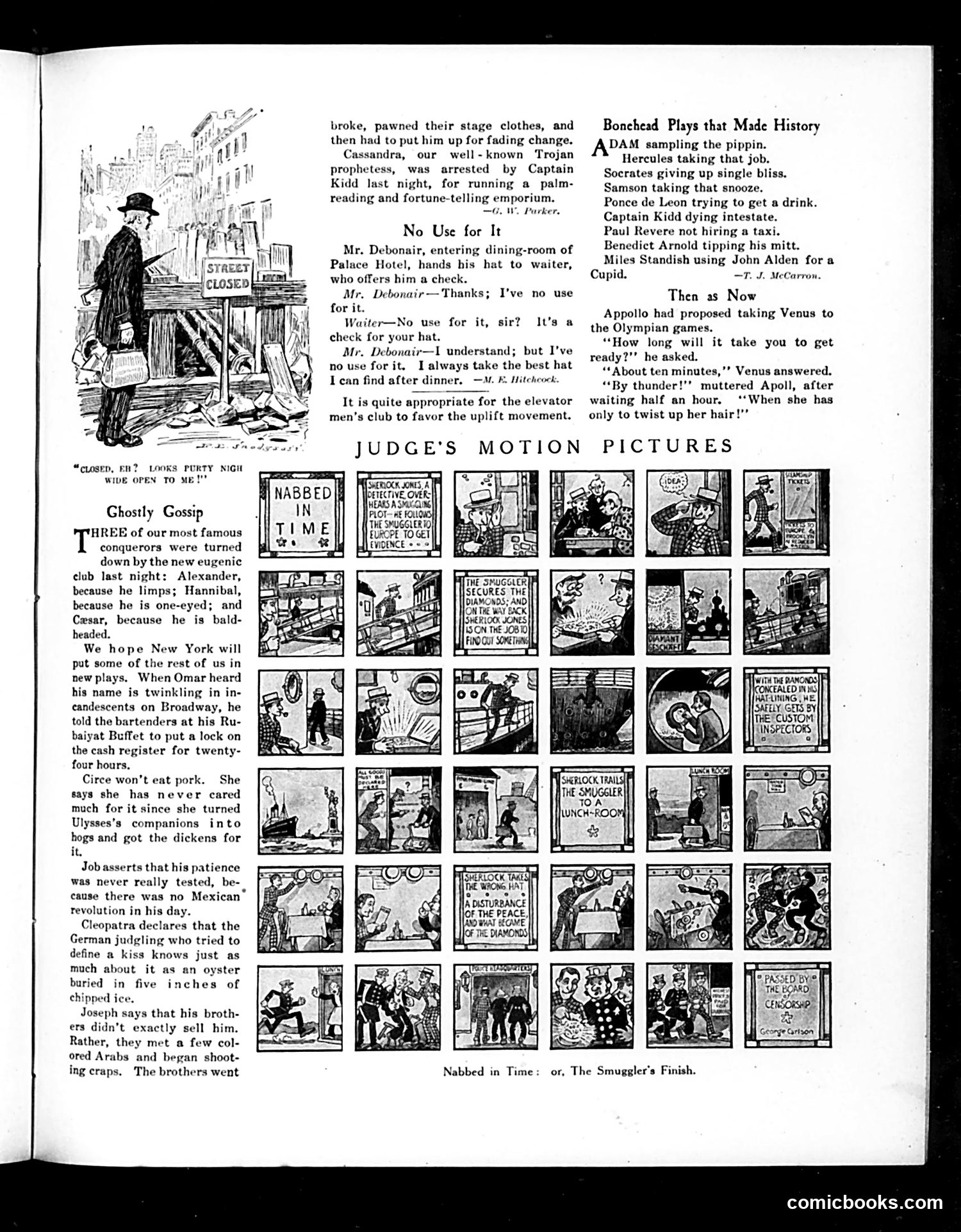
This page from Judge contains three satirical sections reflecting early 20th-century sensibilities: **"Ghostly Gossip"** mocks the era's eugenic movement by imagining famous historical figures rejected by a "eugenic club" for physical imperfections—Alexander for limping, Hannibal for being one-eyed, Caesar for baldness. The satire critiques the pseudoscientific racism gaining popularity at the time. **"No Use for It"** is a brief joke about a man who steals hats after dinner instead of retrieving his checked hat—satire on petty theft and dishonesty among the supposedly genteel. **"Bonehead Plays" and "Then as Now"** present humorous historical "what-ifs" and observations. The film strip below showcases "Nabbed in Time," a Judge motion picture featuring smuggling and crime—typical melodramatic content of early cinema that the magazine both covered and gently mocked. Overall, the page reflects Judge's role satirizing contemporary social trends, gender dynamics, and entertainment culture of the early 1900s.
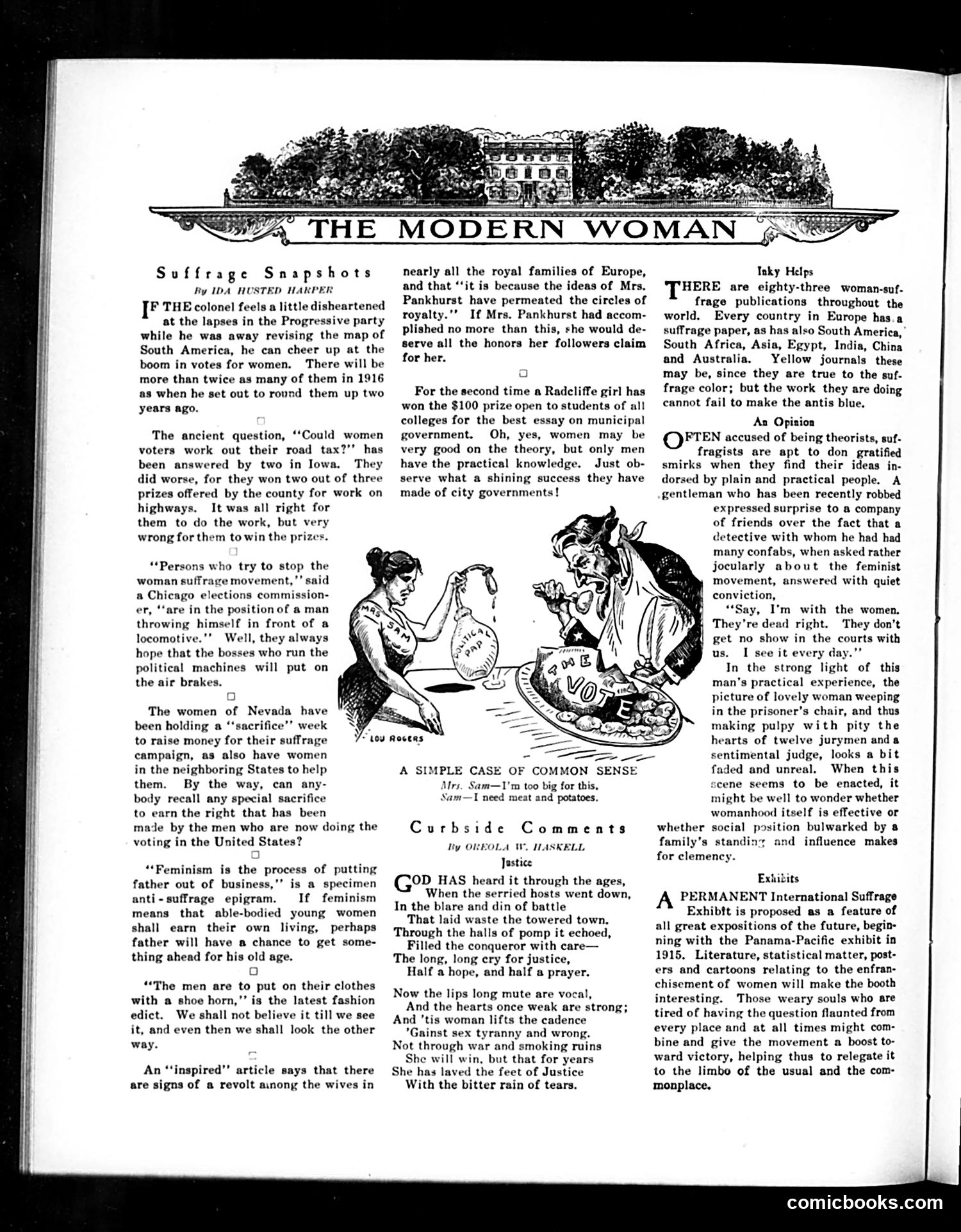
This page satirizes anti-suffrage arguments circa 1915. The central cartoon shows a woman (labeled "Mrs. Sam") too large for her dress while her husband demands meat and potatoes—mocking the anti-suffrage claim that feminism means women neglecting domestic duties. The "Suffrage Snapshots" column by Ida Husted Harper celebrates women's practical competence: Iowa women won highway-work prizes (proving they can handle "road tax" responsibilities), and a Radcliffe girl won an essay contest on municipal government—undermining the argument that women lack practical knowledge. Harper also ridicules anti-suffrage logic: if earning their own living is "feminism," maybe fathers will benefit financially; if men claim women will ruin their clothes without shoe horns, the claim is absurd. The broader context: this represents the suffrage movement's final push before the 1916 election, countering opponents with evidence of women's competence and mocking gender stereotypes used against voting rights.
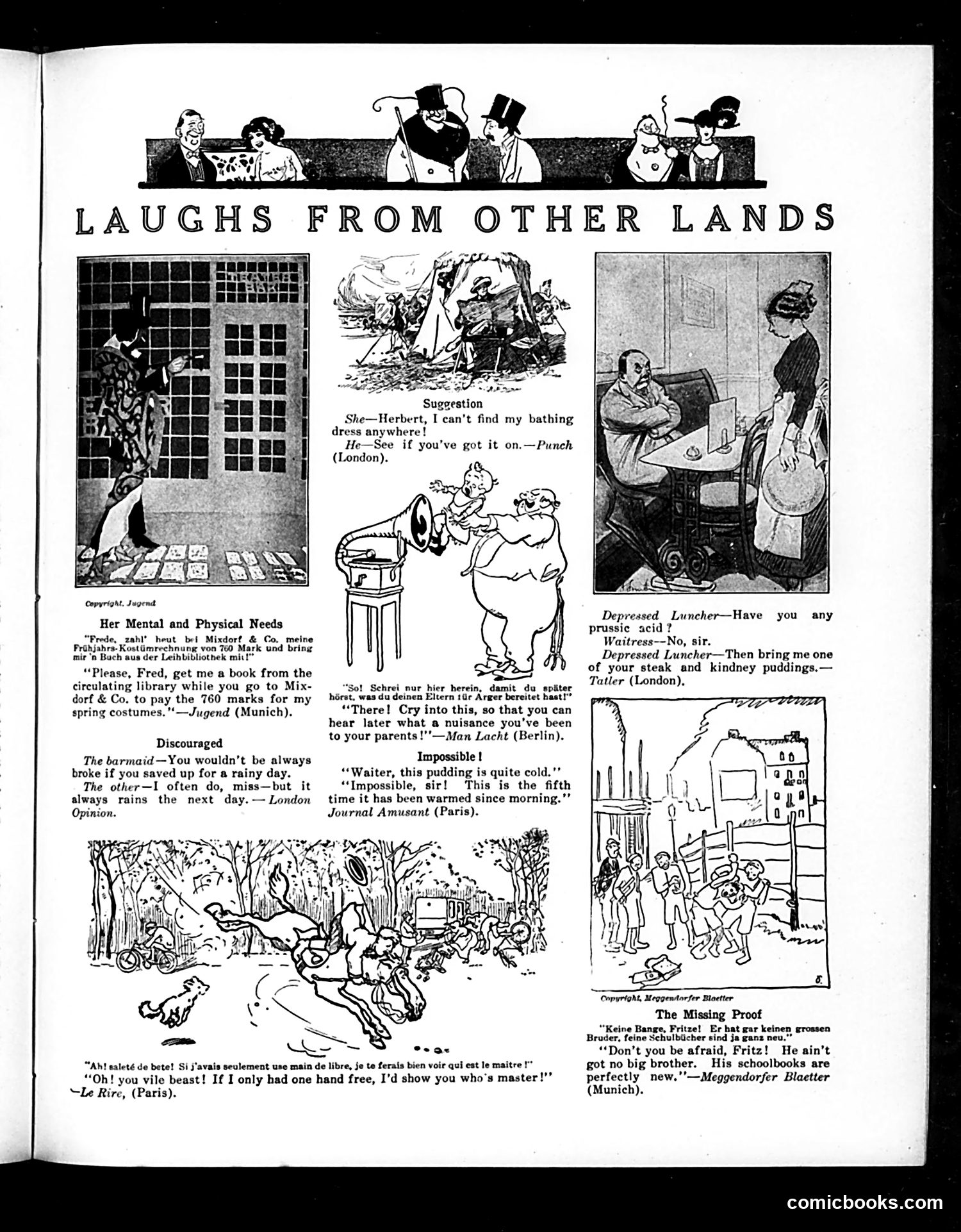
This page presents a curated selection of jokes and comic cartoons translated from European satirical publications—primarily German, British, and French sources. Rather than original American content, Judge reprinted foreign humor to entertain readers. The jokes reflect early 20th-century middle-class anxieties: a wife's expensive clothing purchases ("760 marks for spring costumes"), a barmaid's chronic poverty despite good intentions, marital miscommunication, and restaurant service complaints. One cartoon depicts a mother forcing her child to cry into a funnel so he'll later hear how troublesome he was—reflecting harsh parenting norms. The humor is largely domestic and genteel, mocking minor social irritations rather than addressing political issues. References to "prussic acid" (cyanide) and "steak and kidney puddings" suggest British/Continental obsessions with food quality and class distinctions. The practice of reprinting European humor demonstrates Judge's cosmopolitan aspirations and suggests American audiences enjoyed international perspectives on universal human foibles.
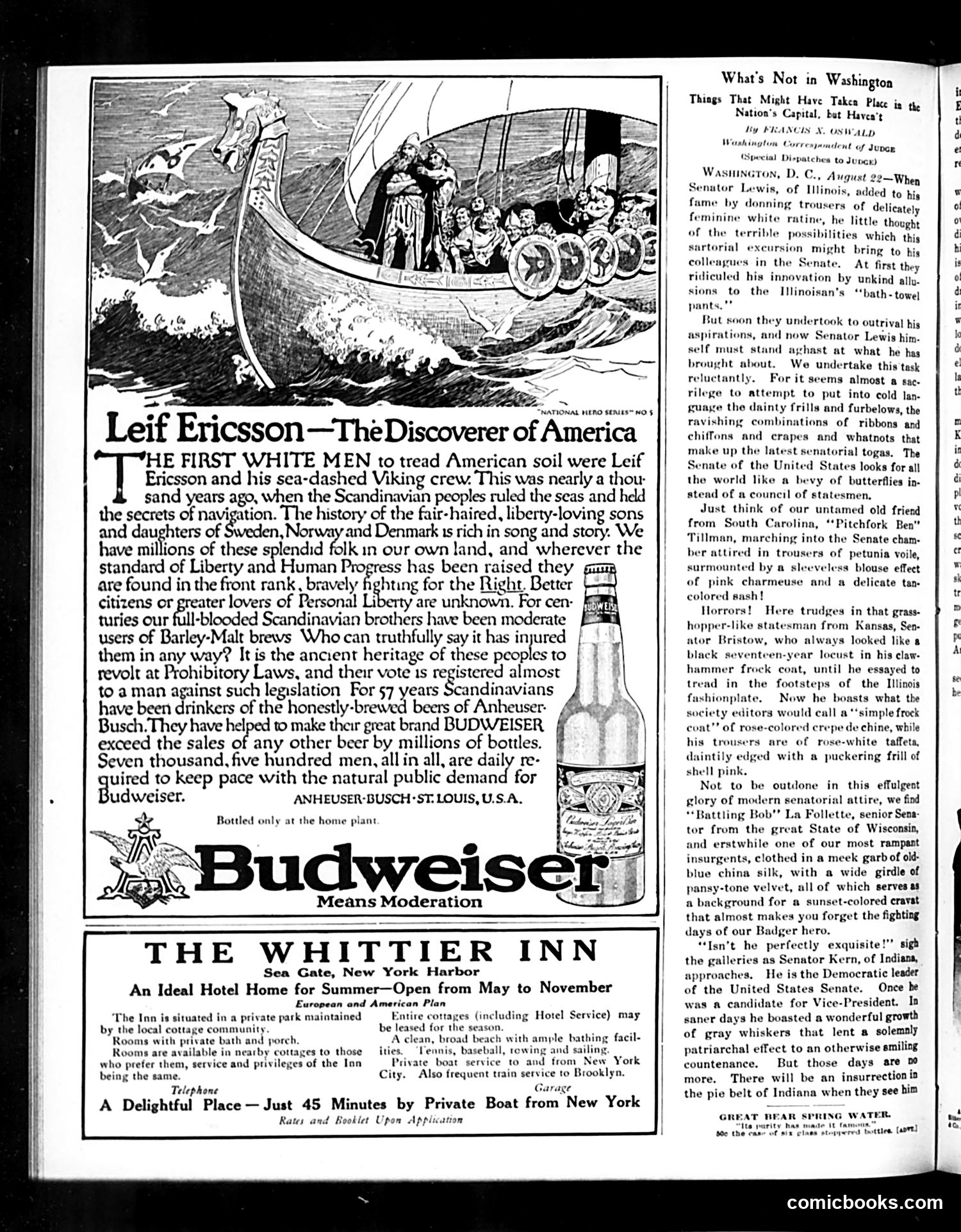
This page contains three distinct elements: **The Budweiser Advertisement** (top two-thirds): An ethnic appeal ad targeting Scandinavian-American voters. It celebrates Leif Erikson as America's "true" discoverer, praises Scandinavian character and liberty-loving nature, then argues they've traditionally drunk beer and opposed Prohibition. It's designed to mobilize this demographic *against* alcohol restrictions—likely referencing ongoing Prohibition debates of the era. **The Whittier Inn Advertisement** (bottom): A straightforward hotel promotion for a New York summer resort. **"What's Not in Washington"** (right column): Political satire by Francis X. Oswald mocking senators' fashion choices. It jests that Senator Lewis of Illinois started a trend by wearing delicate white trousers, inspiring other senators to adopt increasingly feminine clothing (petunia voile, charmeuse)—turning the Senate into "a bevy of butterflies" rather than statesmen. The humor satirizes senators' vanity and ridiculousness.
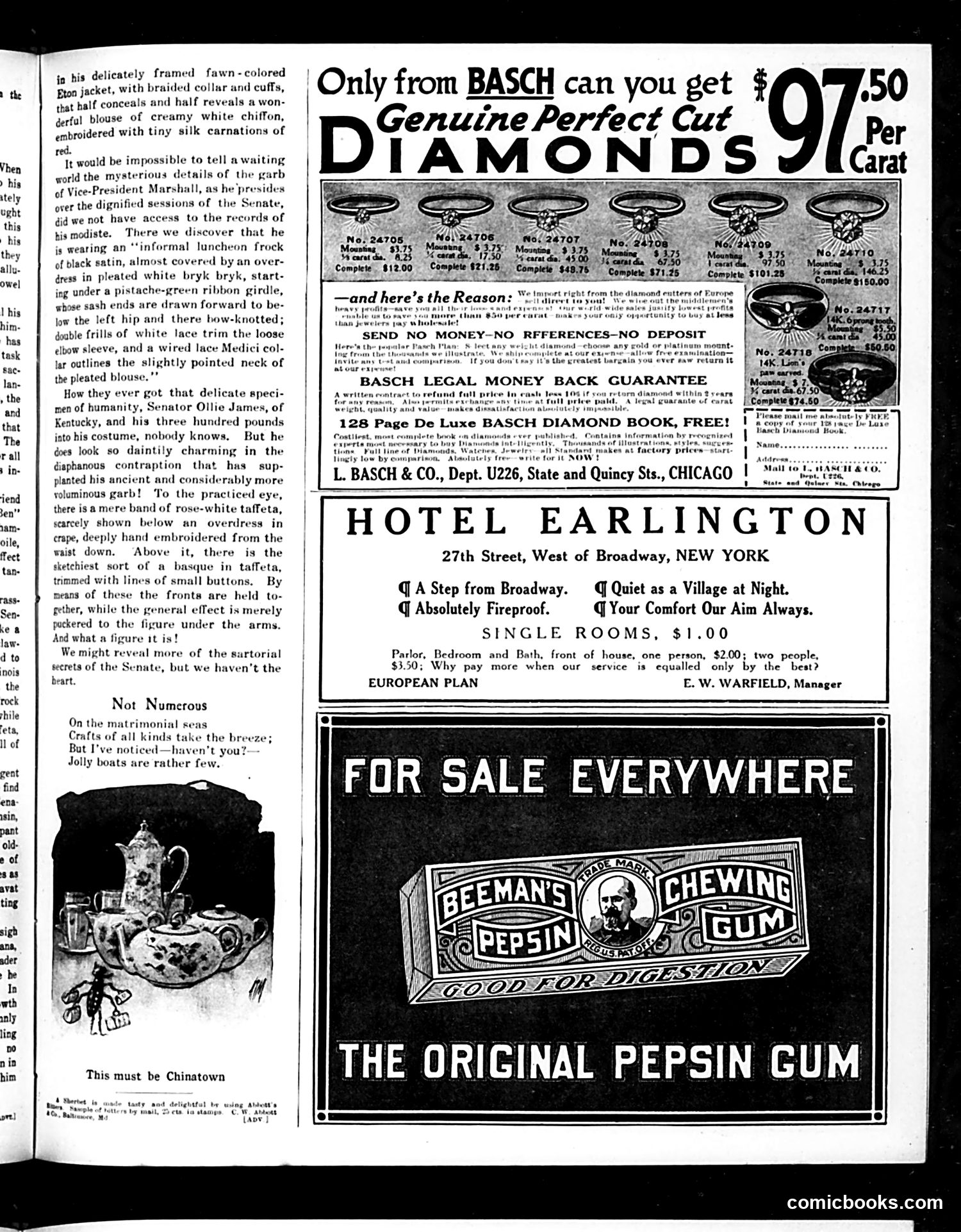
This page primarily contains **advertisements** rather than editorial cartoons. The dominant ad features Basch diamonds at $97.50 per carat, with multiple ring designs shown and a "money-back guarantee" pitch. The text at top left appears to be a **satirical article** mocking U.S. senators' formal attire—specifically Vice-President Marshall and Senator Ollie James of Kentucky. The satire uses exaggerated, flowery fashion description typically applied to women's clothing to ridicule the senators' ceremonial Senate garb, suggesting they're absurdly overdressed or effeminate. This is political humor targeting these specific officials. Below that is a brief illustrated piece titled "Not Numerous" about boats on matrimonial seas—apparently a mild social commentary on marriage, though its specific point is unclear from this excerpt. The remainder consists of hotel and chewing gum advertisements typical of early 20th-century magazine pages.
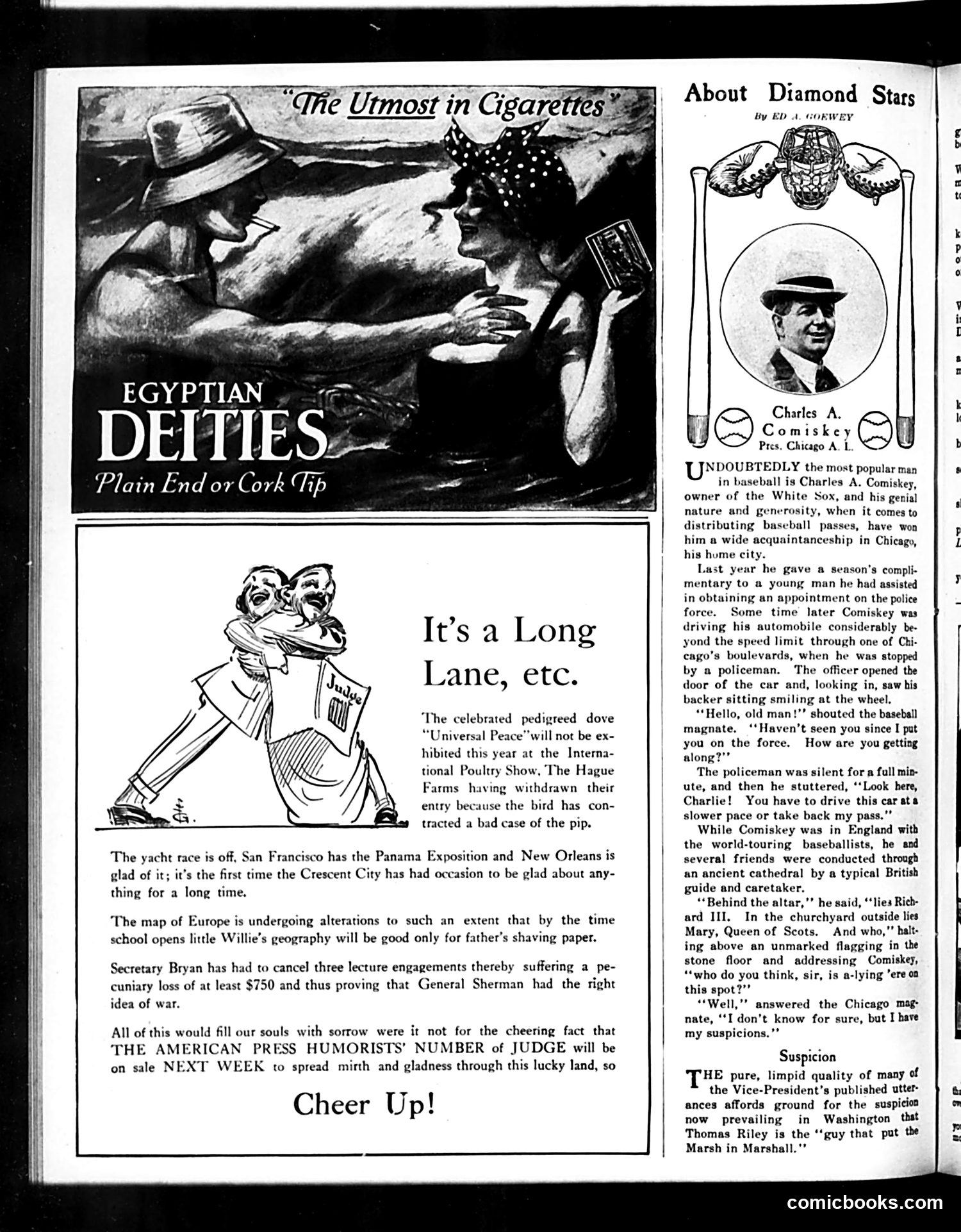
This satirical page from *Judge* contains several brief commentaries on current events: **"It's a Long Lane" section** mocks recent disappointments: a peace-symbolizing dove ("Universal Peace") contracted disease and won't be shown; a yacht race was cancelled; San Francisco's Panama Exposition overshadowed New Orleans; European map changes will make schoolchildren's geography books obsolete; and Secretary Bryan cancelled lectures, losing money—prompting the dark joke that General Sherman was right about war's destructiveness. **"About Diamond Stars"** profiles Charles Comiskey, White Sox owner, through anecdotes. One tells how a policeman Comiskey helped get hired on the force later stops his speeding car and demands he slow down or return the complimentary pass. Another recounts Comiskey touring a British cathedral, where a guide asks who lies under an unmarked stone; Comiskey quips he doesn't know "for sure, but I have my suspicions"—a gentle dig at his bluffing confidence. **"Suspicion"** makes a pun about Vice-President Thomas Riley Marshall, suggesting his vapid public statements explain the phrase "put the Marsh in Marshall."
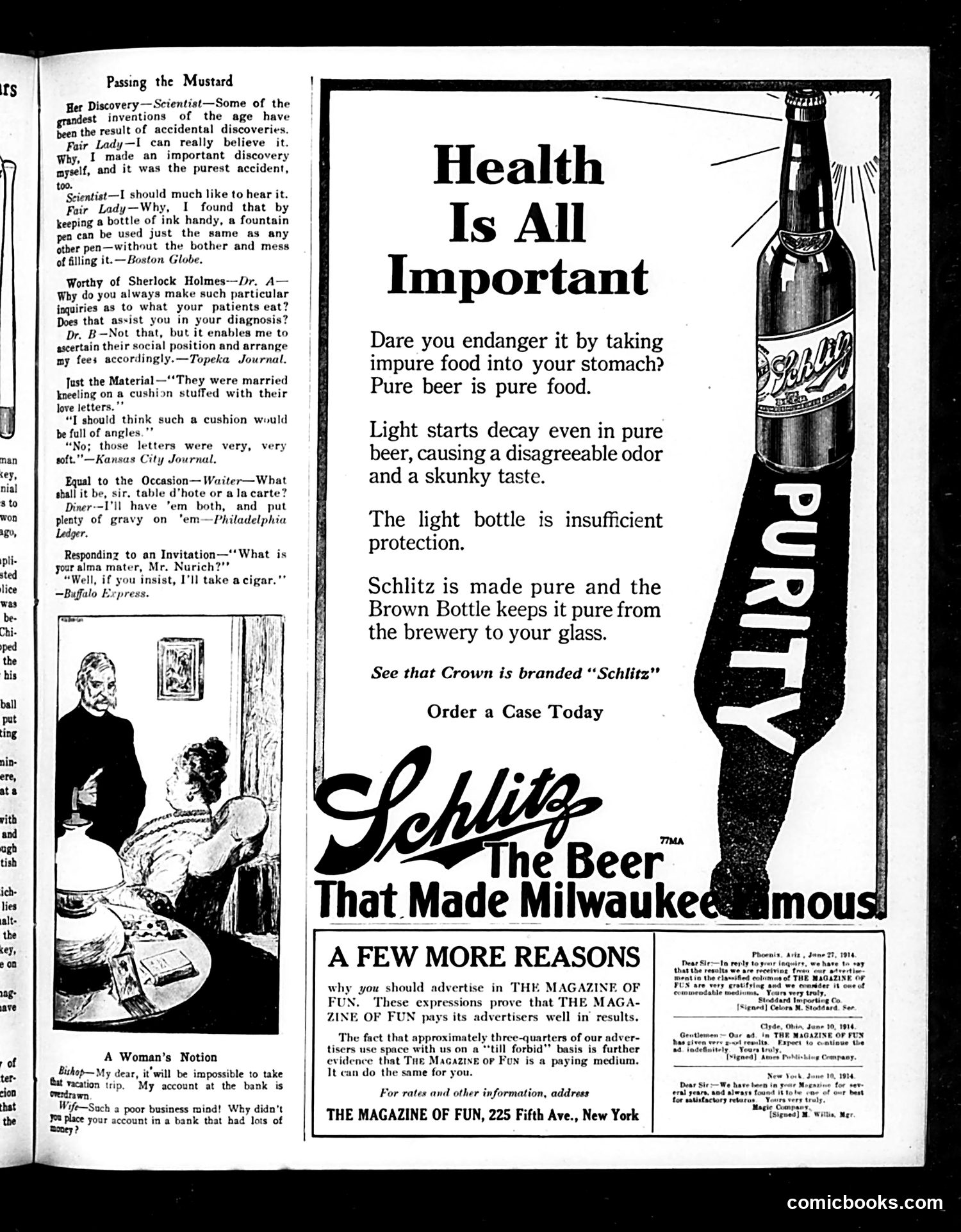
This page mixes humor columns with a **Schlitz beer advertisement** claiming health benefits. ## The Humor Sections The left side contains brief satirical anecdotes mocking professional pretense and literal-mindedness: - A "scientist" is surprised a woman discovered fountain pens work without refilling - A doctor admits he inquires about patients' diets to assess their wealth for fee-setting (mocking doctor opportunism) - A newlywed couple's love letters are "soft" rather than "full of angles" (pun on romantic versus argumentative correspondence) - A diner requests both table d'hôte AND à la carte with gravy (absurd greed) - A woman foolishly advises her husband to use a bank "with lots of money" (illogical thinking) ## The Schlitz Advertisement The large right-side ad uses **pseudo-scientific health claims** common in early-1900s advertising. It argues beer is "pure food" and warns that light damages beer's quality—therefore Schlitz's brown bottle provides superior "purity." This exploits contemporary anxieties about food safety while making unsubstantiated health claims, typical of pre-FDA regulation advertising.
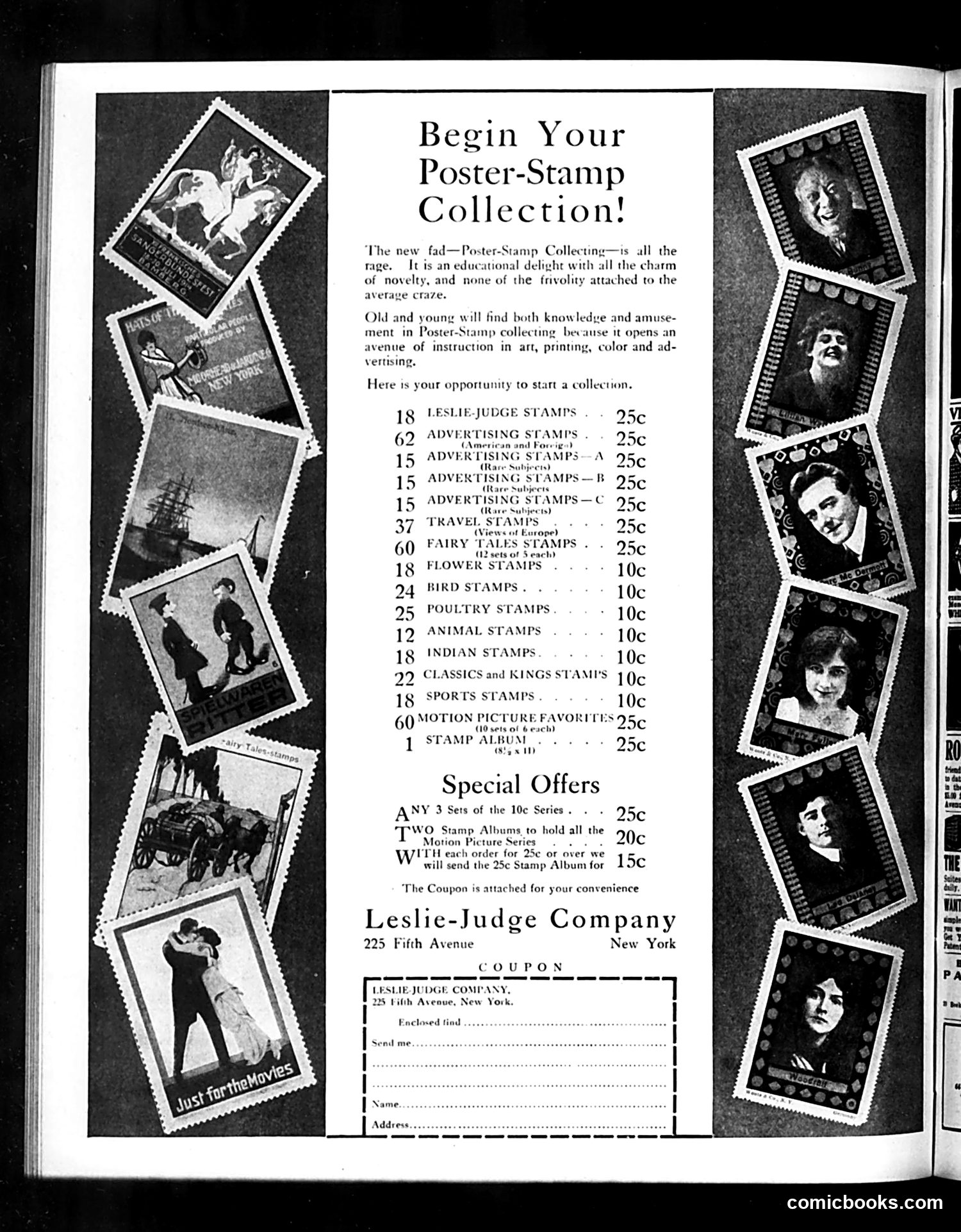
This page is primarily an **advertisement**, not a political cartoon. The Leslie-Judge Company promotes "Poster-Stamp Collecting" as a new fad—small decorative stamps featuring various themes (animals, birds, fairy tales, sports, motion picture favorites, etc.) sold in collections for 10-25 cents. The appeal emphasizes educational value alongside entertainment: collecting offers instruction in "art, printing, color and advertising." The right side displays sample stamps featuring what appear to be **film actresses or celebrities**, reflecting the era's fascination with movies. This represents early 20th-century **novelty merchandising**—using collectible items tied to popular culture (particularly cinema) to drive sales. The framing as "educational" legitimizes the hobby for parents concerned about frivolous spending. No political satire or social critique appears present; this is straightforward commercial promotion.
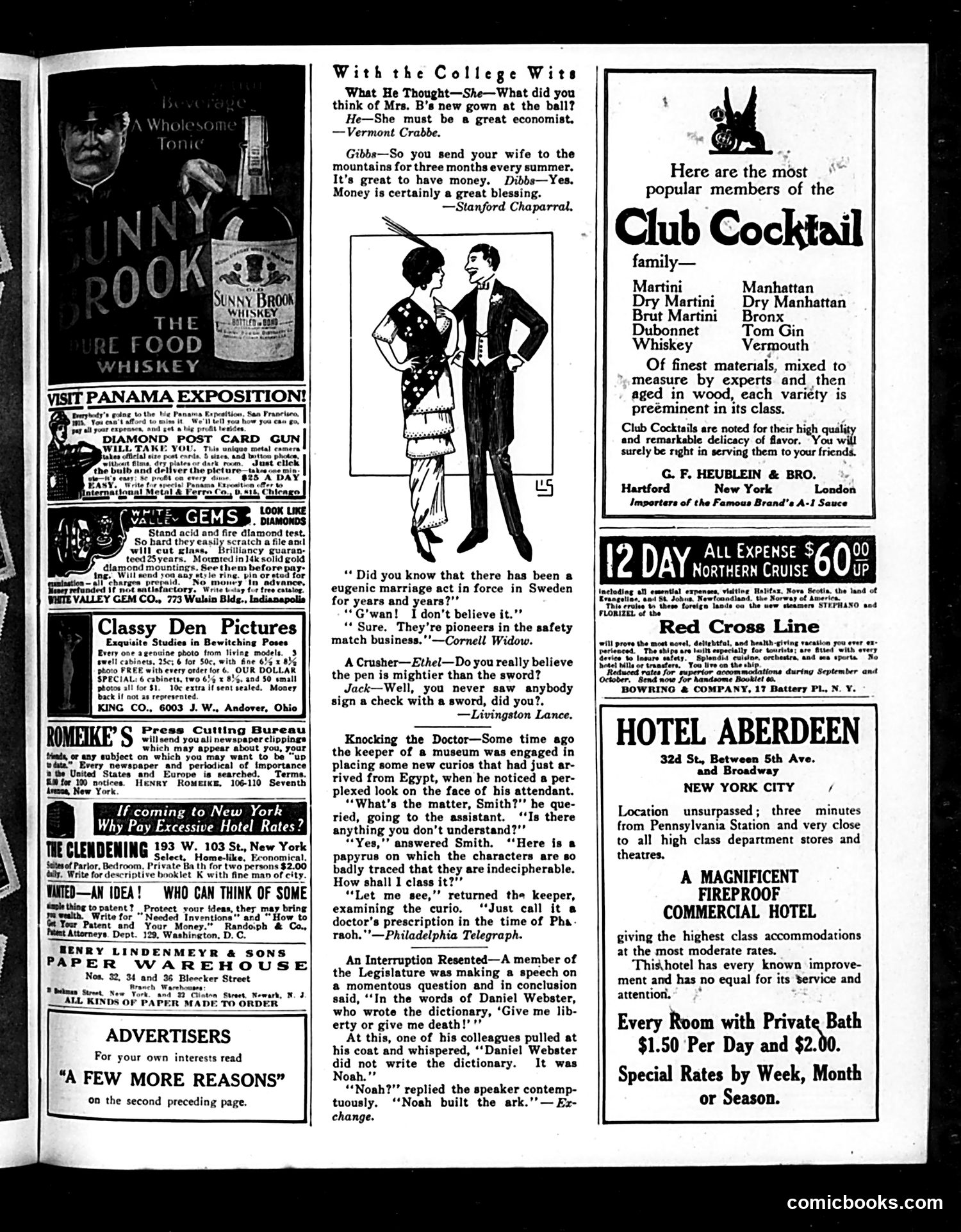
This page is primarily **advertising with light satirical content** rather than political cartooning. The main elements include: **"With the College Wits"** section: A collection of brief, clean jokes sourced from college humor magazines (Vermont Crabbe, Stanford Chaparral, Cornell Widow, etc.). These mock academic life—marriage economics, doctor's illegible prescriptions, and misquoting Daniel Webster. The humor targets educated audiences with wordplay and gentle absurdism typical of early 20th-century collegiate humor. **Advertisements dominate**: Whiskey (Sunny Brook), diamonds (White Valley Gem Co.), hotel services, patent assistance, and notably **Club Cocktail liquor**—featuring various cocktail types positioned as a "family" of drinks. **Historical context**: This appears to be from the Prohibition era (note the cocktail advertisement, which would become illegal). The page reflects pre-1920s American leisure culture targeting middle-to-upper-class readers. No significant political satire or caricature is present—it's primarily a humor magazine's revenue-generating advertising page with mild collegiate comedy filler.
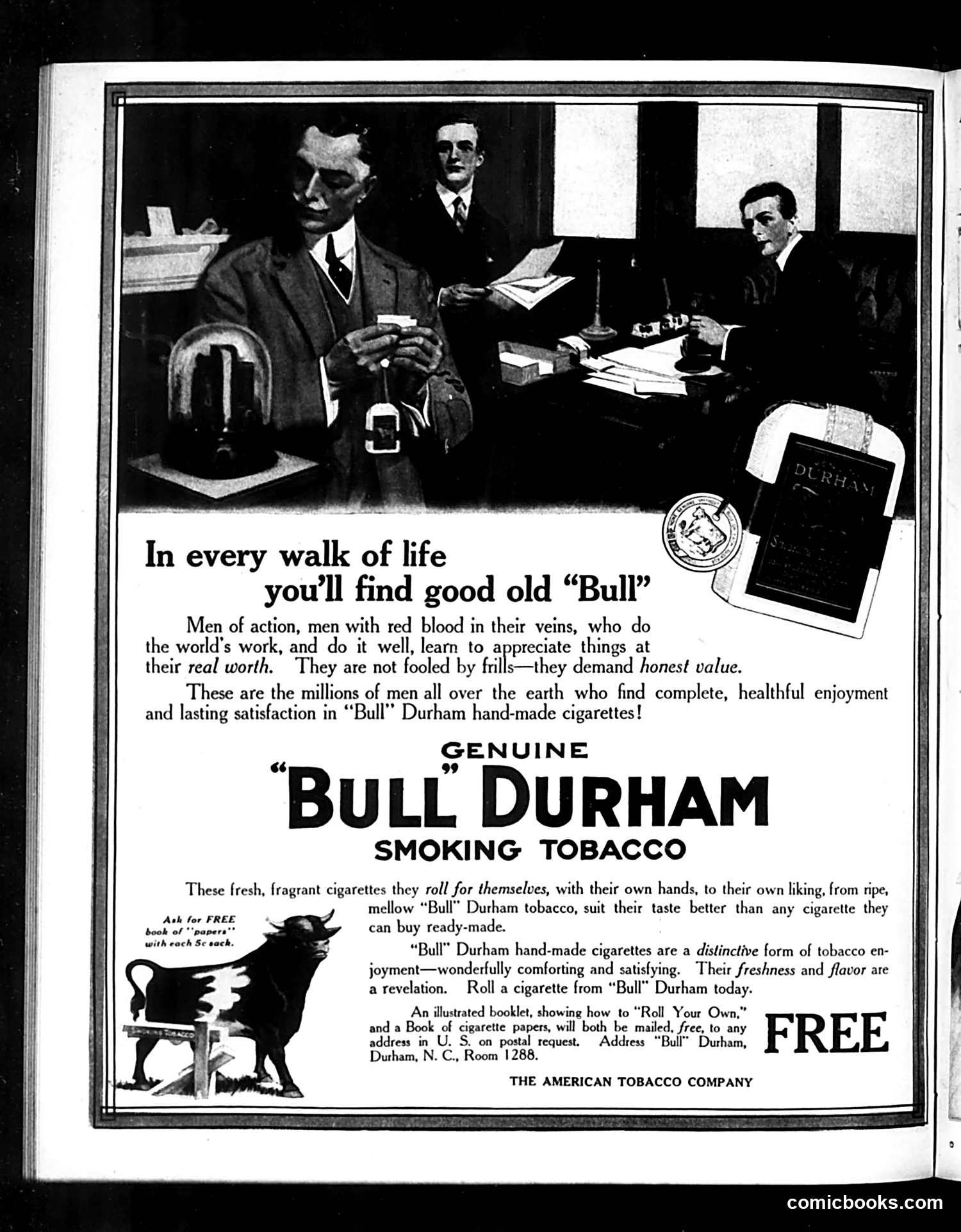
This is a **cigarette advertisement**, not satire or political commentary. It appears from an early 20th-century *Judge* magazine and promotes "Bull" Durham hand-rolled smoking tobacco. The advertisement uses a classist appeal: it depicts three businessmen in an office setting, claiming that "men of action" and serious workers appreciate "honest value" and won't be "fooled by frills." The implicit message is that rolling your own cigarettes from Bull Durham tobacco is more authentic and masculine than buying pre-made ones. The ad emphasizes that customers roll cigarettes "with their own hands, to their own liking," positioning this as superior to factory-made alternatives. It offers free booklets on rolling technique and cigarette papers. The bull logo (lower left) reinforces the brand's strength association. This reflects early-1900s marketing that glamorized smoking as linked to manliness and genuine craftsmanship.