
Judge, 1914-08-22 · page 10 of 24
Judge — August 22, 1914 — page 10: what you’re looking at
What you’re looking at
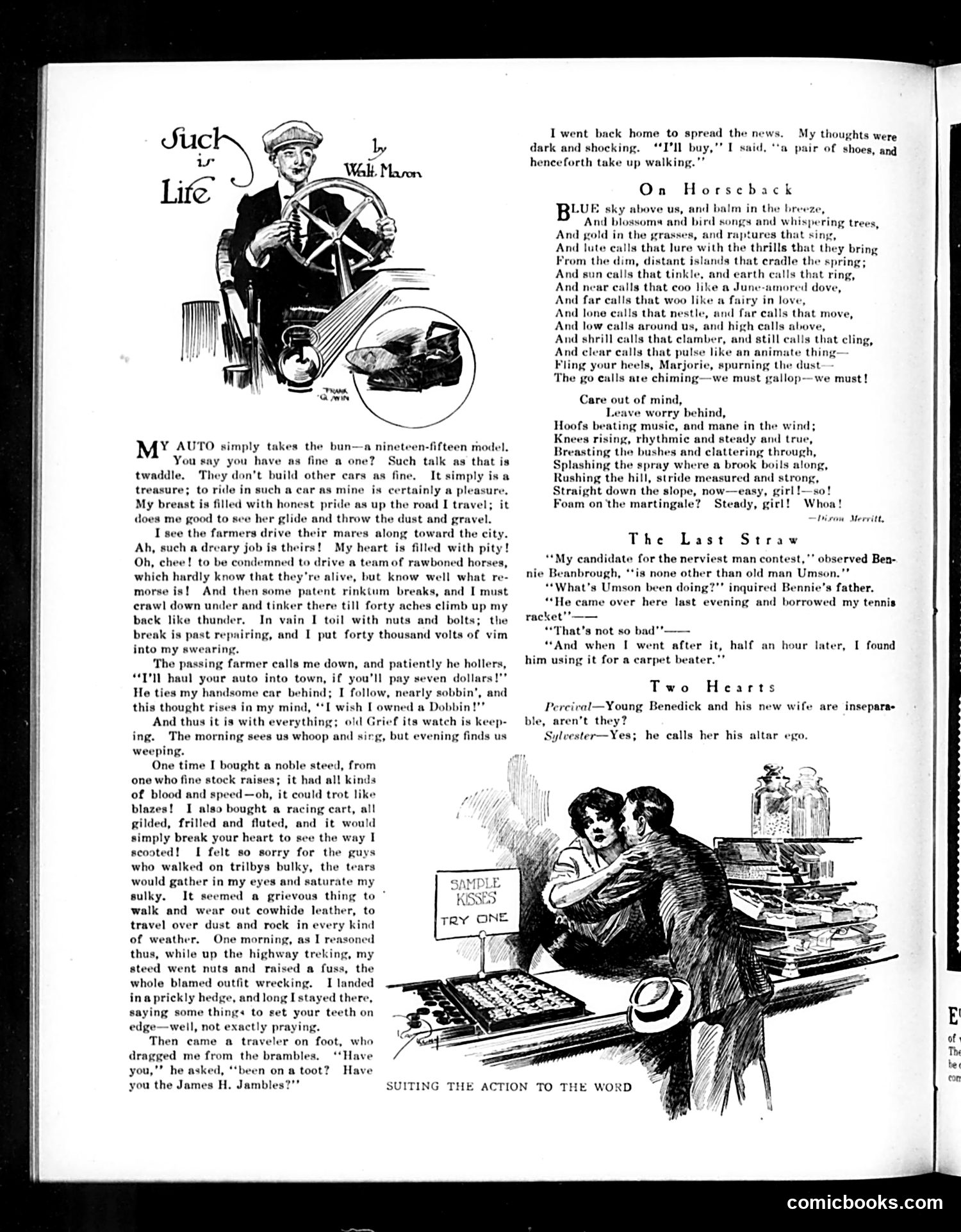
This page satirizes early automotive culture versus traditional transportation. The main story "Such is Life" by Walt Mason ridicules car owners' arrogance. The narrator boasts about his 1915 automobile's superiority over horses, yet repeatedly breaks down, requiring a farmer to tow him—ironically forcing him to wish he owned a simple horse ("Dobbin"). He also recounts buying a racing horse that crashes spectacularly. The satire's point: modern technology owners are smug about progress while constantly humiliated by mechanical failures, making them worse off than those with humble, reliable alternatives. The accompanying poem "On Horseback" romanticizes natural horse travel, contrasting with the automobile's unreliability. "The Last Straw" is a brief joke: a man borrows a tennis racket—presented as the ultimate nerve-testing audacity, mocking how small social transgressions were considered shocking to 1910s sensibilities.
📄 Transcribed text from this page (OCR, searchable)
Machine-transcribed from the original scan — historical spelling and the odd misread are preserved.
MY AUTO simply takes the bun—a nineteen-fifteen model. You say you have as fine a one? Such talk as that is twaddle. They don’t build other cars as fine. It simply is a treasure; to ride in such a car as mine is certainly a pleasure. My breast is filled with honest pride as up the road I travel; it does me good to see her glide and throw the dust and gravel. I see the farmers drive their mares along toward the city. Ah, such a dreary job is theirs! My heart is filled with pity! Oh, chee! to be condemned to drive a team of rawboned hors which hardly know that they're alive, but know well what re- morse is! And then some patent rinktum breaks, and I must crawl down under and tinker there till forty aches climb up my back like thunder. In vain I toil with nuts and bolts; the break is past repairing, and I put forty thousand volts of vim into my swearing. The passing farmer calls me down, and patiently he hollers, “Ll haul your auto into town, if you'll pay seven dollars!"’ He ties my handsome car behind; I follow, nearly sobbin’, and this thought rises in my mind, ‘1 wish [ owned a Dobbin And thus it is with everything; old Grief its watch is keep- ing. The morning sees us whoop and sing, but evening finds us weeping. One time I bought a noble steed, from one who fine stock raises; it had all kinds of blood and speed—oh, it could trot li blazes! I also bought a racing cart, all gilded, frilled and fluted, and it would simply break your heart to the way I scooted! I felt so sorry for the guys who walked on trilbys bulky, the tears would gather in my eyes and saturate my sulky. It seemed a grievous thing to © walk and wear out cowhide leather, to travel over dust and rock in every kind of weather. One morning, as I reasoned thus, while up the highway treking, my steed went nuts and raised a fuss, the whole blamed outfit wrecking. I landed ina prickly hedge, and long I stayed there, saying some things to set your teeth on edge—well, not exactly praying. Then came a traveler on foot, who dragged me from the brambles. ‘Have you,’” he asked, ‘‘been on a toot? Have you the James H. Jambles?"” I went back home to spread the news. dark and shocking. I'll buy," T said, My thoughts were pair of shoes, and henceforth take up walking.” On Horseback LUE sky above us, and balm in the br vering tre: And gold in the grasses, and raptures that sing, And lute calls that lure with the thrills that they bring From the dim, distant islands that cradle the sprin; And sun calls that tinkle, and earth calls that ring, And near calls that coo like a June-amored dove, And far calls that woo like a fairy in love And lone calls that nestle, and far calls t And low calls around us, and high calls al And shrill calls that clamber, and still calls that cling, And clear calls that pulse like an animate thing- Fling y 8, Marje spurning the dust The go calls are chiming—we must gallop—we must! Care out of mind, Leave worry behind, ting music, and mane in the wind; sing, rhythmic and steady and true, Breasting the bushes and clattering through, Splashing the spray where a brook boils alon Rushing the hill, stride measured and strong, Straight down the slope, now—easy, Foam on the martingale? Steady, girl! Whoa! The Last Straw “My candidate for the nerviest man contest,’’ observed Ben- nie Beanbrough, *‘is none other than old man Umson."" **What’s Umson been doing? quired Bennie’s father. “He came over here last evening and borrowed my tennis racket’’—— “That's not so bad'’—— “And when I went after it, half an hour later, I found him using it for a carpet beater."’ Two Hearts Pereival—Young Benedick and his new wife are insepara- aren't they? Sylvester—Yes; he calls her his altar ego. SUITING THE ACTION TO THE WORD comicbooks.com