
Judge, 1914-08-22 · page 4 of 24
Judge — August 22, 1914 — page 4: what you’re looking at
What you’re looking at
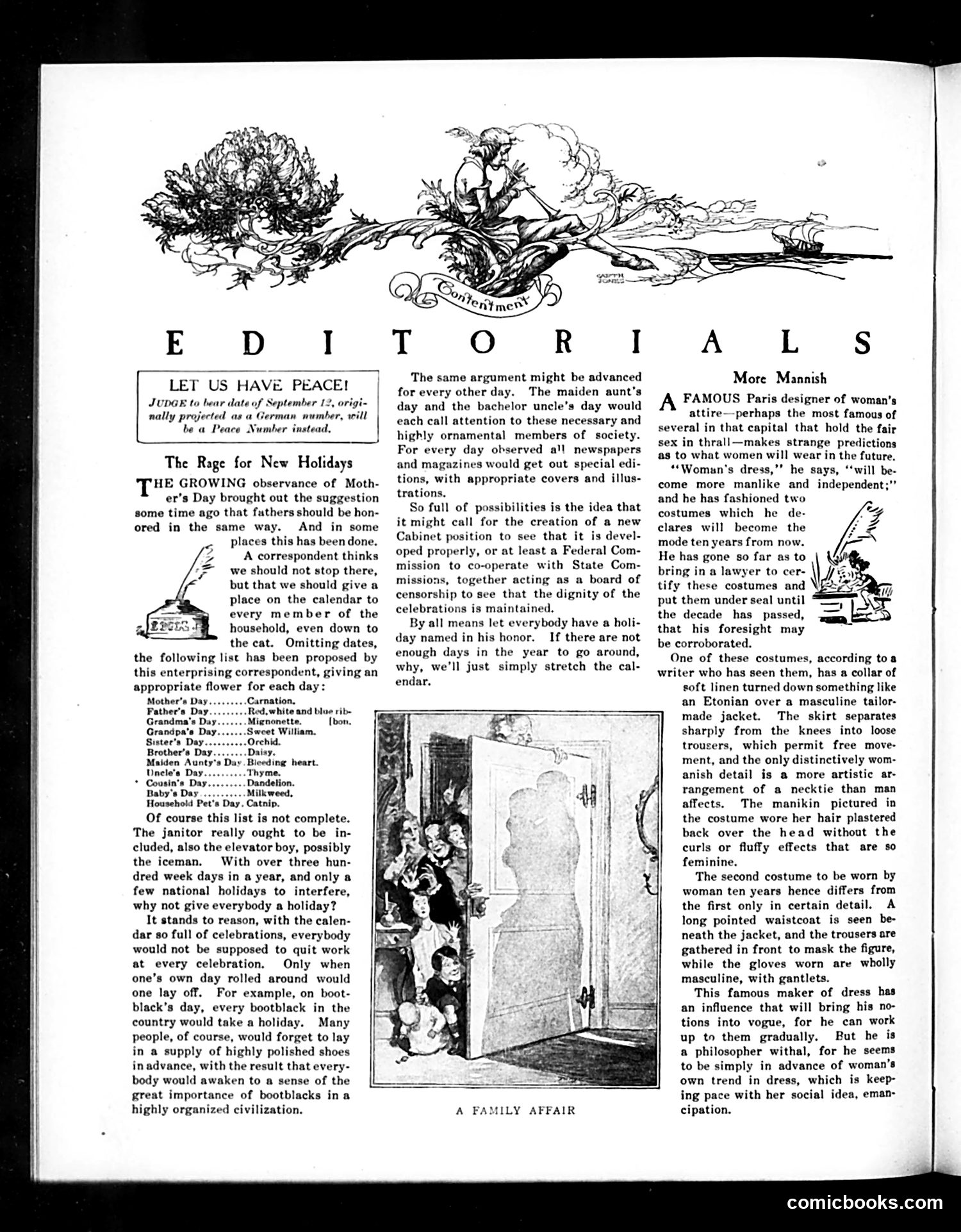
This page contains two distinct editorial pieces from *Judge* magazine: **"Let Us Have Peace!"** critiques the proliferation of new national holidays. The author argues that adding holidays for every family member (Maiden Aunt's Day, Bachelor Uncle's Day, etc.) is impractical and dilutes workplace productivity. The satire suggests that if we honored every possible person with a dedicated day, nobody would work. The editorial advocates for restraint, noting that true holidays require universal observance and shouldn't fragment society into endless special occasions. **"More Mannish"** discusses a famous Paris fashion designer who predicts women's clothing will become "more manlike and independent." The piece describes two proposed costumes—one with masculine tailoring and another featuring gathered trousers—while questioning whether such fashions genuinely reflect women's social progress or merely follow designer trends. Both pieces use gentle satire to comment on contemporary American social customs and European fashion influence.
📄 Transcribed text from this page (OCR, searchable)
Machine-transcribed from the original scan — historical spelling and the odd misread are preserved.
LET US HAVE PEACE! The same argument might be advanced More Mannish me for every other day. The maiden aunt's FAMOUS Paris desi , JUDGE to bear date of September 12, 07 day and the bachelor uncle's day would A FAMOUS Paris designer of woman's nally Projected asa German number, will each call attention to these necessary and attire: perhaps the most famous of be a Peace Number instead, highly ornamental members of society. Ss veral in that capital that hold the fair For every day observed all newspapers S¢X in thrall” makes strange predictions The Rage for New Holidays and magazines would get out special edi- wiWennnedeeu he are eat HE GROWING observance of Moth- tions, with appropriate covers and illus ome more manlike and independent,” er’s Day brought out the suggestion trations. : and he has fashioned two ‘ some time ago that fathers should be hon- __ 50 full of possibilities is the idea that Costumes which he de- ored in the same way. And in some it might call for the creation of anew Circe will, become the places this has beendone, Cabinet position to see that it is devel- ode ten years from now. A correspondent thinks Ped properly, or at least a Federal Com- ig has gone so far as to we should not stop there, ™ission to co-operate with State Com- bring in a lawyer to cer- but that we should give a Missions, together acting as a board of tity these costumes and place on the calendar to censorship to see that the dignity of the 1.¢ them under seal until ZZ: pvery member of the celebrations is maintained. the decade has. passed, 22203 FA household, even down to BY all means let everybody have aholi- that his foresight may the eat. Omitting dates, ay named in his honor. If there are not corroborated, the following list has been proposed by ¢nough days in the year to go around, One of these costumes, according toa this enterprising correspondent, giving an appropriate flower for each day: Mother’s Day - Carnation, why, we'll just simply stretch the cal- endar. Fathe ‘i Red, white and blue rib «-Mignonette. Of course this list is not complete. The janitor really ought to be in- cluded, also the elevator boy, possibly the iceman. With over three hun- dred week days in a year, and only a few national holidays to interfere, why not give everybody a holiday? It stands to reason, with the calen- dar so full of celebrations, everybody would not be supposed to quit work at every celebration. Only when one’s own day rolled around would one lay off. For example, on boot- black’s day, every bootblack in the country would take a holiday. Many people, of course, would forget to lay in a supply of highly polished shoes in advance, with the result that every- body would awaken to a sense of the ( great importance of bootblacks ina highly organized civilization. A FAMILY AFFAIR writer who has seen them, has a collar of soft linen turned down something like an Etonian over a masculine tailor- made jacket. The skirt separates sharply from the knees into loose trousers, which permit free move- ment, and the only distinctively wom- anish detail is a more artistic ar- rangement of a necktie than man affects. The manikin pictured in the costume wore her hair plastered back over the head without the curls or fluffy effects that are so feminine. The second costume to be worn by woman ten years hence differs from the first only in certain detail. A long pointed waistcoat is seen be- neath the jacket, and the trousers are gathered in front to mask the figure, while the gloves worn are wholly masculine, with gantlets. This famous maker of dress has an influence that will bring his no- tions into vogue, for he can work up to them gradually, But he is a philosopher withal, for he seems to be simply in advance of woman’s own trend in dress, which is keep- ing pace with her social idea, eman- cipation. comicbooks.com