
Judge, 1914-08-22 · page 13 of 24
Judge — August 22, 1914 — page 13: what you’re looking at
What you’re looking at
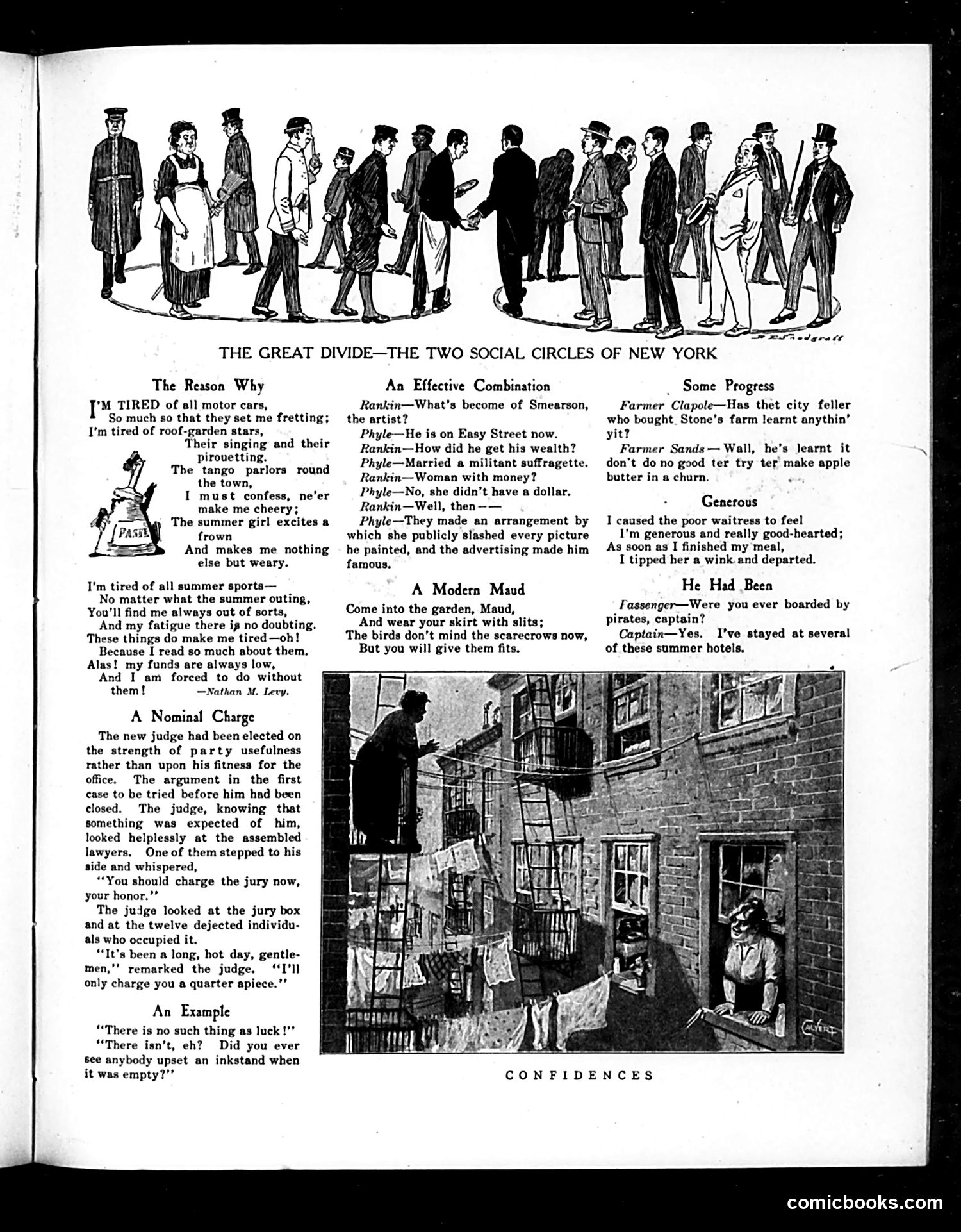
This Judge page satirizes the stark division between New York's wealthy and working classes around the early 1900s. **The Top Cartoon** contrasts two social circles: the wealthy (left) exhausted by fashionable pursuits—motor cars, roof gardens, tango halls—complaining of boredom despite their leisure; and the working poor (right) gathering together. The satire suggests the rich are jaded and empty despite abundance, while the poor find community and meaning. **The Dialogue Sketches** mock specific targets: a "militant suffragette" who married for money (contemporary feminist ridicule); summer hotels exploiting tourists; and a newly-elected judge so unqualified he charges the jury "a quarter apiece" instead of legal instruction (mocking political patronage appointments). **"A Modern Maud"** parodies romantic poetry while advising women to wear revealing skirts—simultaneously mocking both Victorian sentimentality and modest dress. The overall message critiques wealth as spiritually hollow while portraying working-class life as more genuine, though still precarious.
📄 Transcribed text from this page (OCR, searchable)
Machine-transcribed from the original scan — historical spelling and the odd misread are preserved.
THE GREAT DIVIDE—THE TWO SOCIAL CIRCLES OF NEW YORK The Reason Why An Effective Combination _ Some Progress I™ TIRED of all motor cars, Rankin—What's become of Smearson, Farmer Clapole—Has thet city feller So much so that they set me fretting; the artist? who bought. Stone’s farm learnt anythin’ I'm tired of roof-garden stars, Phyle—He is on Easy Street now. yit? tee eloe and their Rankin—How did he get his wealth? Farmer Sands — Wall, he’s learnt it The tango parlors round Phyle—Married a militant suffragette. don't do no good ter try ter make apple the town, Rankin—Woman with money? butter in a churn. e I must confess, ne’er Phyle—No, she didn’t have a dollar. 7 G make me cheery; Rankin—Well, then —— encrous The summer girl excites a Phyle—They made an arrangement by I caused the poor waitress to feel frown which she publicly slashed every picture I'm generous and really good-hearted; And makes me nothing — he painted, and the advertising made him As soon as I finished my meal, else but weary. famous. I tipped her a wink. and departed. I'm tired of all summer sports— A Modern Maud He Had Been No matter what the summer outing, You'll find me always out of sorts, Z Come into the garden, Maud, _ Fassenger_ Were: you ever) boarded by And my fatigue there ig no doubting. And wear your skirt with slits; Pirates, captain? These things do make me tired—oh! The birds don’t mind the scarecrows now, Captain—Yes. I've stayed at several Because I read so much about them. But you will give them fits. of these summer hotels. Alas! my funds are always low, And I am forced to do without them! —Nathan M. Levy. A Nominal Charge The new judge had been elected on the strength of party usefulness rather than upon his fitness for the office. The argument in the first case to be tried before him had been closed. The judge, knowing that something was expected of him, looked helplessly at the assembled lawyers. One of them stepped to his side and whispered, “You should charge the jury now, your honor.’” The judge looked at the jury box and at the twelve dejected individu- als who occupied it. “It's been a long, hot day, gentle- men,’’ remarked the judge. ‘“‘I'll only charge you a quarter apiece.’” An Example “There is no such thing as luck!” “There isn’t, eh? Did you ever see anybody upset an inkstand when it was empty?” ONFIDENCES comicbooks.com